Blog

  • Origin Story

    Origin Story

    Before cinema’s fall from relevancy, most movies were stand-alone, self-contained creations — not episodic instalments in a franchised, multi-segmented marketing blitz. Often, within today’s modern movie franchises, it’s the origin stories that are among the most-loved and lucrative entries — indicative of an audience’s hunger to discover the source of some serialized character’s eccentricities.

    Though eccentric itself, I’m not sure if ULTRAsomething counts as a franchise, nor if its readers are as famished for details as the average Batman fan. But another month is upon us and I have to write about something, so now seems as good a time as any to crank out this site’s origin story.

    ULTRAsomething first appeared in early 2001 as my online music, photography, sound- and product-design portfolio. Seven years later, it was repurposed into the photo-centric, essay-based format you see before you. But these simple facts are not its origin story. For that, we need to travel all the way back to the days of rabbit ear antennas, dial phones, and typewriters.

    Through a series of fortuitous events, as described in Jim’s Victory, a prepubescent, protoplasmic blob now known as Egor, began to compose its own music. As I grew, so too did my thirst for musical knowledge. I became increasingly obsessed with the idea of making ‘weird’ music; got exposed to the avant-garde through some records in my local library; and launched into a lifelong journey of sonic exploration. Music became my primary, all-encompassing love. Unfortunately, my high school guidance counsellor was adamant in her belief that “avant-garde composer” was not a viable career choice, so I decided my only other childhood interest, architecture, would become my vocation.

    By the age of 17, my architecture plans were crumbling. The career counselling books all suggested that a “successful architect” would become a wiring or ductwork specialist at a large architectural firm. I wanted to design transformative spaces for human interaction — not be some cog in a machine. So if a five-year architecture program wouldn’t pave the road to becoming the next Le Corbusier or Mies van der Rohe, why was I trading in my dream to become the next Pierre Schaeffer or Karlheinz Stockhausen? Fearful of “succeeding” my way into a tediously uncreative corporate career, I made the last-minute decision to study electrical engineering, hoping I might graduate into a job designing synthesizers.

    Instead, I graduated into a job testing high voltage power supplies for the U.S. defence industry — a fate infinitely more soul-crushing than that big-firm architecture gig that had so frightened me. Suffocating beneath the workplace misery, I sought solace in my continued passion for electronic music, and I rekindled my interest in architecture — thinking, perhaps, that it wasn’t too late to switch careers.


    Throughout my 20’s, my architectural interests widened more than deepened, and grew to include furniture and industrial design. I began to hang out in architectural bookstores, where trips down other aisles led me to an interest in graphic design, which led me to discover a small sub-section of photography books contained within. Until then, I hadn’t the slightest interest in photography — but through those books, I began to regard photography as a viable and compelling art form. In an act I’m sure delighted the proprietors, I stopped frequenting architectural bookstores, and transferred my browsing habit to art bookstores, which featured more expansive and diverse photography sections.

    I devoured the contents of every photography book I saw — whether in stores or libraries. No subject was beyond my scrutiny; no genre unworthy of exploration. I began going to galleries, subscribed to numerous photography-centric fine arts magazines, joined the now-defunct Friends of Photography, and bought membership in the newly opened Ansel Adams gallery in San Francisco. I absorbed every book within that gallery’s store, and would attend each and every exhibition numerous times to scrutinize the prints.

    During these years, I learned a lot about photography as a visual medium — about what I liked, what I didn’t like, and why. I learned what made an image work, and I learned the “language” of photography. I even learned about the photographers who made the images, and would study the economic and cultural conditions under which they created them.

    And all the while, not once did I ever think about becoming a photographer myself. I saw photography as an art form, which meant it was created by artists — which I most definitely was not. Besides, by this point, I’d abandoned the corporate life and was now a struggling sound designer, composer, music technology writer, and computer music design consultant. The last thing I needed was another thing to struggle with.

    It seems absolutely ludicrous from today’s perspective — but after several years spent vacuuming up every photo I could find, I was running out of new photos to look at. Tim Berners-Lee had just invented the World Wide Web, but it would still be several years before anyone realized its potential, and even more before the bandwidth would support photographic images. Fresh into my 30’s, and faced with a dwindling photo supply chain, I decided that if I wanted to see more photographs, perhaps I needed to start taking them.

    There was no “Big Bang” — no singular moment that triggered my switch from photography connoisseur to actual photographer. It was simply the logical evolution. And while there were many factors that led me to purchase a brand new Canon EOS 100 (Elan) from Adolf Gasser’s in the fall of 1991, three stand out as significant:

    First, was the influence of Bill Brandt’s “London, 1952″ — not because it was a nude (there were hundreds of fine art photographers working in that genre), but because it was the “anti nude” — a tightly-cropped, softly-focussed, high-contrast image that seemed more closely related to architecture and design than to portraiture. It was one of the most beautiful photographs I’d ever seen, yet it broke every rule of classical photography. Aside from this, and some earlier inspirational examples from surrealist’s like Man Ray or the Czech avant-garde, such concepts seemed underrepresented in the photography canon. “Breaking the rules” seemed like an avenue ripe for further exploration. So what if I gave it a try?

    Second, in my ever-widening search for new photos, I’d begun to frequent Kinokuniya Books in San Francisco’s “Japantown” neighbourhood. Never mind that I couldn’t read a word of Japanese — I couldn’t read any of my French or German-language magazines either. I was there for the pictures. Most of Kinokuniya’s photo books were chock-full of the most banal landscape, cherry blossom, and cloud formation snapshots imaginable. But entwined amongst them was a smattering of photos that proved positively confounding in their seemingly total disregard for form, function or fidelity. Black and white; out of focus; poorly exposed, gritty yet murky — I couldn’t tell if they were the result of a printing press gone horribly wrong, or were actually intended to look that way. Though I now obviously know this was classic Japanese Provoke-school photography, I hadn’t a clue back then. All I knew is that I found the photos mesmerizing, and they seemed every bit as radical as the noise, drone, atonal, and avant-garde music I enjoyed. Without adequate access to more Japanese photography, owning my own camera seemed the most viable path to further exploration.

    Third, was a realization that I could combine two hobbies into one. With only two-and-a-half channels accessible on the TV in my downtown San Francisco apartment, and with cable priced well beyond my budget, my viewing habits skewed toward the ancient art of “people watching.” I could (and would) spend hours camped in front of cafes — watching the passing parade, and delighting in the eccentricities, subtleties, personalities and conventions of human beings. Elliot Erwitt seemed to see exactly the same sort of things I saw, only he actually bothered to photograph them. At the time, I’m not sure I even considered people like Erwitt, Robert Frank or Garry Winogrand to be ‘real’ photographers, since I was still responding to photos by what they looked like, rather than what they said. But none the less, it seemed like having a camera with me could, at the very least, allow me to share those fleeting moments of serendipity with others.


    My first forays into photography were a complete disaster. The visual gap between all those classic images and my one-hour photo lab colour prints — it was beyond cavernous. The photos I loved did not look anything like the photos I took.

    I had a lot to learn about how a camera “saw” the world, and just as much about how to print. I invested in some stainless tanks, stocked my fridge with Tri-X, bought an enlarger and some B&W print chemistry, blacked out my bathroom, and started on the journey toward figuring out just how all those fabulous photographers conjured up compelling images from such a utilitarian little box. I’m still learning.

    As photographer origin stories go, I suspect mine is somewhat backward. I didn’t grow up taking photos. Nor did I become a photographer in the ‘typical’ way — in which one starts photographing friends or vacations, and “catches the bug.” And I most certainly didn’t get interested through a love of gear; to be “cool”; to get access to events; or any other such nonsense. I became a photographer because I fell in love with photographs. And it was because of this love, and the large photographic vocabulary I had already amassed, that I ultimately chose to become a photographer myself. I honestly think, had I done it any other way, there would never have been an ULTRAsomething. Which, as far as I know, is pretty much the de facto requirement for any good origin story.


    © 2022 grEGORy simpson

    ABOUT THIS ARTICLE:

    I’m well aware this is one of the most boring posts in ULTRAsomething’s near 14 years. But some day, when I’m dead and legendary, some poor copy writer is going to appreciate its existence when tasked with writing my obituary.

    “Added Pressure” was shot on Tri-X, inside a Contax G1, fronted with a Zeiss 28mm f/2.8 Biogon, and developed in HC-110 (Dilution B).

    “Ingels, et al.” was shot on Tri-X, inside a Leitz Minolta CL, fronted with a Minolta 28mm f/2.8 Rocker, and developed in a 1:50 solution of Rodinal (Blazinal).

    “Post-It®” was shot on Delta 3200, exposed at ISO 1600 inside a Contax G1, fronted with a Zeiss 45mm f/2 Planar, and developed in a 1:25 solution of Rodinal (Blazinal).

    “30 Years’ Fruition” was shot on Rollei Superpan, inside a Widelux F7, and developed in a 1:50 solution of Rodinal (Blazinal).

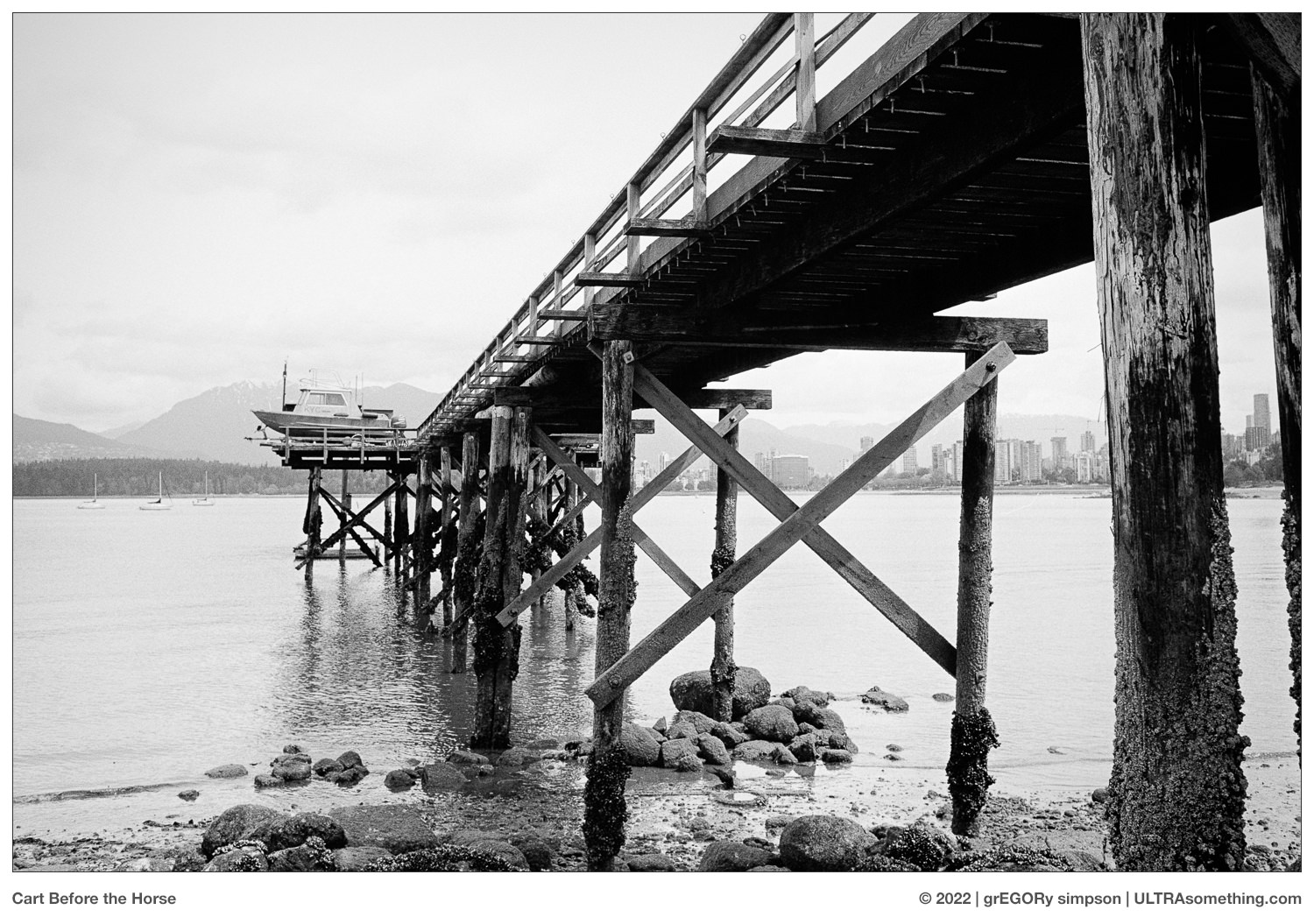
    “Cart Before the Horse” was shot on Fomapan 100, inside a Nikon 28Ti, and developed in HC-110 (Dilution H).

    “Technically Compliant” was shot with a Ricoh GRIII digital camera.

    REMINDER: If you’ve managed to extract a modicum of enjoyment from the plethora of material contained on this site, please consider making a DONATION to its continuing evolution. As you’ve likely realized, ULTRAsomething is not an aggregator site. Serious time and effort go into developing the original content contained within these virtual walls — even the silly stuff.
  • The Shortest Path

    The Shortest Path

    The shortest path between two points is a straight line. Rarely is it the most interesting. And in the physical world, rarely is it as straight as you think — linearity being as much about perception as certitude.

    For example, if I’m in the middle of the Bonneville Salt Flats, and I wish to walk the shortest possible path to a point only 5km away, I’m going to need a shovel. How else am I going to dig a trench — 2 meters deep at the midpoint — to counteract the curvature of the earth? No shovel, no straight line.

    Our world is awash in trajectories we perceive as linear, but really aren’t. Time dilation anyone? It might take a rocket scientist to build a device for travelling to another solar system and back; but it doesn’t take a rocket scientist to know that a quick, 2-year roundtrip voyage from the astronaut’s perspective could result in the passing of, say, 60 years here on earth.

    Fortunately, I’m not here to bore you with the impractical. Instead, I’m here to bore you with something else entirely: our bodies. The very surface upon which we visualize our surroundings — the retina — is spherical, and the images projected upon it are curved. Our brain intuits the true nature of the objects, and auto-flattens any bowed projections accordingly. It’s the same sort of optical post-processing we perform when our brain is fed an upside-down and reversed retinal projection, and flips it around to match the orientation of our own bodies.

    In other words, what we think we see isn’t necessarily what we really see. Which, as a photographer, gives me carte blanche to do anything I want — including ditching the idea that a photograph needs to have straight lines just because our brains are fooling us into believing they should be.

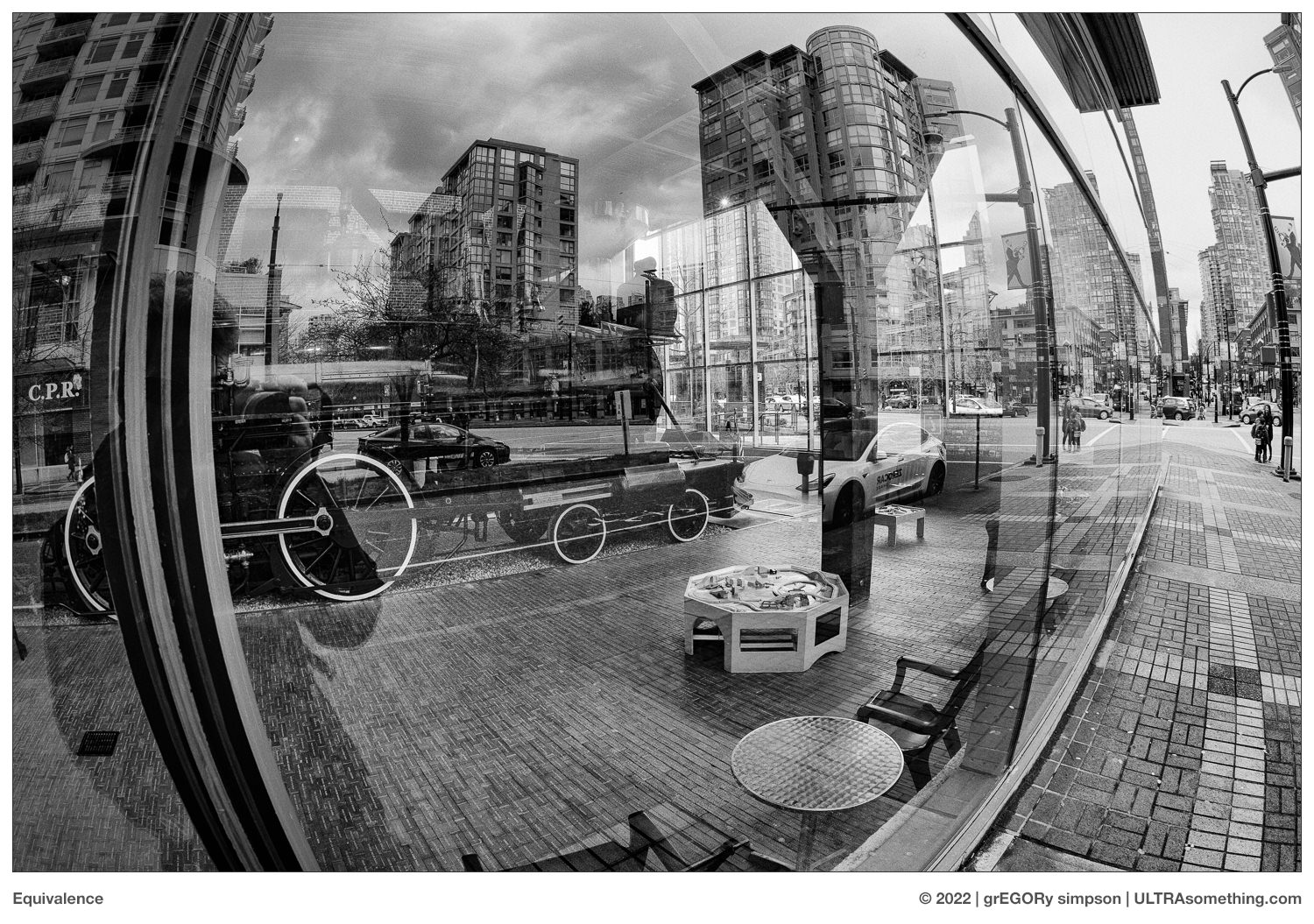
    The whole idea of curvature is what occasionally pulls me into the realm of fisheye lenses, and what keeps me constantly in the realm of the Widelux camera. Both will bow lines we believe to be linear.

    In the case of a fisheye lens, a spherical object is used to project an image onto a flat surface, resulting in a curvilinear perspective in which both horizontal and vertical lines are rendered as curves.

    In the case of the Widelux, a rectilinear lens rotates in a horizontal arc across the scene, and the image is projected onto a curved surface of equal radius. This gives a particularly unique look, in which vertical lines remain straight while horizontal lines become bowed.

    Both techniques delight me to no end, because both mess with our brain’s construct of what an object is supposed to look like. In the common vernacular, we call these “distortions,” but I believe this is a term born of bias. In reality, any projection of a 3-dimensional space onto a 2-dimensional surface results in “distortion.” The question is which elements are being distorted, not whether any distortion occurs.

    Most lenses are of rectilinear design, meaning they’re engineered to keep lines as straight as possible — a feat they achieve at the expense of dimensional integrity. Anyone who’s ever shot a wide angle lens has surely seen the grotesque way in which objects near the borders are stretched wildly out of shape in order to preserve linearity. To me, this is no less a form of “distortion” than the fisheye, which keeps relative dimensions intact at the expense of linearity.

    In fact, I’d even suggest that our brains can more easily acclimate to curvilinear photographs than rectilinear ones — at least at wide angles. That’s because we’re already accustom to interpreting curved retinal projections as straight lines. In contrast, we’re not accustom to interpreting stretched objects, so we’ll never really succeed in ignoring those wide-angle rectilinear distentions.

    It’s a belief backed up by my own experience: The more time I spend looking at photos from a Widelux or fisheye, the less I notice the curvature — my brain easily intuits which lines should be straight, and it soon begins to simply interpret them as such. Since we’re all born with the straightening algorithm installed in our occipital lobes, all we need to do is access it. In contrast, since our brains don’t have any real-time de-stretching code installed, we can’t un-see the elongated objects at the edge of a standard wide angle photo.

    Ultimately, it doesn’t matter which method — curvilinear or rectilinear — is closer to ‘reality,’ since ‘reality’ has little to do with what I’m trying to accomplish with photography. The simple fact I have no interest in colour should tell you that.

    So for me, the party starts once I become aware of all the abstract possibilities of a curvilinear perspective — how I can alter spacial relationships by shifting an object’s location in the frame; how I can place arched surfaces contrary to the direction of the camera’s curvature to actually straighten them; and how I can tilt the lens to enhance or minimize the effects of the curvature — emphasizing and deemphasizing sections of the frame accordingly.

    The notion that lines should be straight is just another arbitrary photography construct — no different than a belief that a good photo is sharp; has level horizons; adheres to the rule-of-thirds; or any of that other hooey. Whether you’ve got a blank frame of film or some empty space on your memory card, the only reality is that you’re free to record anything you want onto it. With that in mind, is the shortest path really the one you want to take?


    © 2022 grEGORy simpson

    ABOUT THE PHOTOS: Equivalence, Deco, Paganism, Dominance and Enveloped were all shot with my new (to me) Olympus M. Zuiko ED 8mm f/1.8 Fisheye Pro lens on an OM Systems OM-1 camera (yes, I’ve doubled down on Micro Four Thirds). Waves and Divergent were shot with a Widelux F7 on Acros II at ISO 100, and developed in Rodinal (Blazinal) 1:50. Spring and Exit were also shot on a Widelux F7 — this time on Fomapan 100, and stand developed for one hour in a mixture of HC-110 and Rodinal.

    REMINDER: If you’ve managed to extract a modicum of enjoyment from the plethora of material contained on this site, please consider making a DONATION to its continuing evolution. As you’ve likely realized, ULTRAsomething is not an aggregator site. Serious time and effort go into developing the original content contained within these virtual walls — even the silly stuff.

  • Walking Man

    Walking Man

    This site has waxed poetic over half-frame film cameras for the better part of decade. My review of the Olympus Pen F surely qualified as an epic poem; while the Pen EE-2 was a work of ekphrastic poetry. The Ricoh Auto-Half veered into sonnet territory; while the Agat 18K could only be classified as an elegy — as much my own as the Agat’s.

    I love the simplicity of these cameras. I love the way the photos they take are more a suggestion of a subject than a detailed rendering, and how that changes my vision accordingly. And I love their frugality — because not only can I fit over 70 shots on a single roll of 35mm film, but the cameras themselves are quite inexpensive.

    Unfortunately, 60 year-old inexpensive cameras designed for budget-conscious consumers don’t last forever, and I must sadly report that my two most-beloved half-frame cameras — the Ricoh Auto-Half and the Olympus Pen EE-2 — have now shuffled off their immortal coils. Quite literally in the case of the Ricoh Auto-Half, as its coiled transport spring has now sprung.

    Both cameras served me well, with the little EE-2 once acting as my ‘walk around’ camera on a trip to Iceland — a destination normally associated with seekers of the ultimate in digital image quality. In fact, it was the EE-2 that delivered my favourite photo from there — a shot I’d never think to take had I been lugging a “real” camera. But it’s the Ricoh Auto-Half to which I’d developed the strongest connection. Immediately after it failed, I had the irrational urge to get it repaired — a choice that would no doubt grossly eclipse the smattering of yen I spent to liberate it from an underground Shinjuku camera shop. Eventually, I realized the more rational option was to frame its loss as a golden excuse to buy an entirely different half-frame camera… and I knew just which one.

    On the final day of my last Tokyo trip — a month before “Coronavirus” first became a household word — I’d traveled on a westbound train to some quiet little neighbourhood outside the megapolis. There, as happens in many Japanese neighborhoods, I stumbled upon the tiniest of camera shops. Inside was a half-frame Konica Recorder, which I made the mistake of handling for a bit too long. I wanted it. I hemmed a little, and hawed a lot. But with my return luggage already bulging with vintage cameras, I feared another purchase might incite Canadian customs to unilaterally declare me a “camera import business,” and slap me with a fine for operating without a license. Besides, I didn’t have enough time to run a roll of test film through it, get it developed, and return the camera should there be any problems. So I passed. But the desire to own a Konica Recorder remained, and the demise of the two half-frame cameras provided the impetus I needed to return to Tokyo (albeit only via eBay) and purchase one. Five days later, it was in my hands.

    Unlike my Auto-Half and EE-2, which were both products of the 1960’s, the Konica Recorder is positively modern — arriving from the year 1985. You can tell because the thing has a sort of checkerboard ‘new wave’ case design, and bears an uncanny resemblance to an old Sony Walkman — a comparison that seemingly extends even to Konica’s decision to call it a “Recorder.” Hopefully such modernity will help it remain functional for the next several years. After all — though gloriously inexpensive — it did cost twice as much as the pair of half-frame cameras it replaced.

    Adding to the comparative cost difference, is the Konica’s additional ongoing operating expense: two AA batteries! These are required to power its exposure meter (a task handled by unpowered selenium cells in the older cameras); its auto-wind (handled via a thumbwheel or spring in the EE-2 and Auto-Half, respectively); and its auto-focus (a feature missing from both the earlier cameras, which are fixed-focus designs). They also power the camera’s built-in flash — another feature missing from the Konica’s predecessors.

    Speaking of autofocus, it seems to operate in “seat-of-the-pants” mode. There’s no actual focus area displayed in the viewfinder. So you’re left to guess what, exactly, the camera is focussing on. Common sense dictates that it’s the middle of the viewfinder — but how big is that area? Considering the camera sports a 24mm f/4 Hexanon lens, it barely matters — most everything is going to be in focus anyway; particularly since its minimum focus distance is still a meter away. To test this, I popped off a couple shots of rather large nearby subjects, centering them in the frame. Keeping in mind that focus is a fuzzy term when it comes to half-frame cameras, I scrutinized the shots and concluded that maybe, possibly, there might just be a tiny bit of bokeh in the background. So I’m lead to believe the autofocus does, indeed, do a little something.

    The lens is surprisingly capable — quite helpful when you’re building photos with only half the number of grains. Exposures were certainly well-placed within the latitude afforded by black & white negative film. Overall, the images were more sharply rendered, and generally better exposed than those from any of my older point-and-shoot half-frame cameras.

    Happily, this camera is free of all that DX-coding nonsense, so you can set your film speed to whatever you want. Unhappily, if you want your film speed to be anything other than ISO 100, 200 or 400, you’re out of luck. No shooting ADOX CMS 20 at box speed. No pushing Tri-X to 800 or 1600. Even at ISO 400, you might want to keep an eye on the sky — the shutter speed tops out at 1/250th of a second.

    Film is transported vertically through the camera, so holding it horizontally results in landscape-oriented shots, like a full-frame camera. I actually prefer the portrait-orientation of the older half-frames, but it’s not a deal killer. As I mentioned earlier, the Konica auto-advances the film after each shot, and to my delight (and just like the Auto-Half), it transports the film only after you lift your finger off the shutter button. So you can take a shot in near silence, then walk away before releasing the shutter button — ensuring the zhzhzhzhtt of the auto-wind is safely out of anyone’s earshot.

    In spite of being a bit larger than either the EE-2 or Auto-Half, it still slides effortless into the slimmest of pockets — aided significantly by the fact there are no extending bits or bobs to snag on your jeans on the way in or out. Instead, the camera’s working elements are all hidden behind a sliding shell that keeps the camera’s closed surface perfectly smooth, while protecting the lens, focus sensors, exposure window, ISO settings, and rewind switch safely from damage or accidental activation.

    And about that rewind switch: when you reach the end of the roll, the film doesn’t automatically rewind. Instead, you need to flip the rewind switch, and those two little AA batteries start pumping out the juice needed to wind your film back into the cartridge. The problem is that there’s no indication of when the camera has completed this task. Instead, the rewind motor will happily spin that spool for as long as the rewind switch is ‘on.’ This makes it a bit difficult to judge when the film has been totally rewound. I thought I’d be able to tell by sound, but I was wrong. On the second test roll, after about 20 seconds, I thought it sounded like the film was back in the cartridge, but nope… it wasn’t. That little discovery cost me a few exposures when I opened the back. So for the third roll, I simply let the thing rewind for about 45 seconds before daring to open the camera. It probably means I’ll be replacing those AA batteries a couple rolls sooner than expected, but this shouldn’t add more than a few dollars to the lifelong operating cost of the camera.

    Besides, any extra battery expense is sure to be offset by the amazing number of shots the Konica Recorder crams onto a single roll of film. I ran three different types of film through this camera — one corresponding to each of its possible ISO settings. I got 80 shots on a roll of Tri-X; 82 on a roll of Fomopan 100; and 78 on a roll of Rollei Superpan 200. Which makes this (AA battery costs included) THE most frugal film camera I’ve ever owned.

    Much like the Walkman that seemingly inspired its form, this is a camera that begs to be carried around. So for two straight weeks, I did exactly that. And much like the concept that inspired its name, I used it to record just about anything I happened upon. 52 of these ‘recordings’ comprise the accompanying vBook. I could write about what I thought of the images this camera takes, or you can watch and decide for yourself.

    As much as I like this camera, sentiment continues to nudge me toward repairing the Auto-Half. Whether I’d find a camera technician willing to bother? Doubtful. But until I do, the Konica Recorder — fashion victim that it is — has proven to be an able and technically superior substitute. Objectively, it produces the finest photos of any point-and-shoot half-frame I’ve used. Subjectively, it’s still too early to know whether I’ll develop the same sort of emotional attachment I formed with its two predecessors — but I have no doubt I’ll enjoy the opportunity to find out, as it will surely accompany me on many more walks in the coming years.


    ©2022 grEGORy simpson

    ABOUT THE vBOOK: A Portent Dawn, Redundancy and Fortuitous — as displayed in this article — are just 3 of the 52 shots included in the vBook. Since it’s an article about the Konica Recorder half-frame 35mm camera, you would be correct in assuming these, and all the photos in the vBook, are from that camera — shot over a two week period, and on the three films stocks mentioned in the text. The soundtrack is basically just a one-take improvisation performed on a Buchla Easel Command, with a tiny bit of additional accompaniment haphazardly improvised in a similar one-take-and-done fashion. The photos were then sequenced against the music in Final Cut Pro X.

    REMINDER: If you’ve managed to extract a modicum of enjoyment from the plethora of material contained on this site, please consider making a DONATION to its continuing evolution. As you’ve likely realized, ULTRAsomething is not an aggregator site. Serious time and effort go into developing the original content contained within these virtual walls — even the silly stuff.

  • Pipe Dream

    Pipe Dream

    In February 2013, on one of my then-frequent trips to Portland Oregon, I made one of my then-frequent visits to Pro Photo Supply to feed my then-frequent habit of shopping for interesting old lenses. There, sitting amongst a collection of gleaming chrome products in the impeccably tidy glass Leica display case, sat some sort of gnarly, heavily used, blackened brass pipe fitting. I naturally concluded that it had been left behind by a tradesman, tasked with repairing and replacing a section of the store’s antiquated plumbing.

    I caught the attention of my buddy behind the counter, nodded my head in the general direction of the anomaly, and asked “why is there an old chunk of pipe in the Leica case?”

    Without even glancing toward it, he knew exactly what I was talking about. “That’s an old, screw-mount Leitz 90 Elmar,” he replied.

    “Is it any good?” I inquired.

    “Probably not,” replied my buddy.

    He opened the cabinet, extracted the alleged lens, and handed it to me. I nearly dropped it through the glass Canon display case over which I stood. My brain had severely underestimated just how heavy an ugly little tube of solid brass and glass could be. I held it up to the light and witnessed its densely oxidized brass and black patina seemingly absorb all the ambient light in its vicinity. I rotated the focus ring, and to my surprise, the lens elements moved in and out. I spun the aperture ring, and the internal blades dutifully opened and closed.

    Both repulsed and mesmerized, I screwed it to an LTM-to-M adapter I had in my bag, then mounted the combo on my Leica M9. Visually, it was the unholiest of unions — a device certainly capable of photographing Satan himself. No lens/body marriage ever looked so homely, ill conceived, or just plain wrong. But like the plot of a bad romantic comedy, repulsion turned to love. And like the plot of a bad porno, love came cheap. $65.

    I’ll admit, the images it foisted upon the M9 sensor looked every bit as ill conceived and homely as the lens itself. They were soft, blooming, heavily vignetted, and weirdly colour-shifted. Plus, the lens seemed incapable of rendering more than 3 stops of dynamic range — no matter how contrasty the actual scene. Calling it a “character” lens would merely trivialize its many aberrations.

    Several times, over the next year, I’d mount it to the M9 and snap off a couple of shots — wondering what subjects, if any, could possibly benefit from being photographed with a 1938 90mm f4 Elmar? Particularly when there’s a perfectly capable 1996 90mm f/2.8 Elmarit-M sitting beside it on the shelf? Obviously, unlike the Elmarit-M, I could mount the pipe on an old Leica III — but I possessed neither a 90mm viewfinder nor the will to bother. So the ugly little pipe fitting eventually got ostracized from the “good gear” cabinet, and into a box with some of Satan’s other photographic castoffs.

    And there it sat… month after month… year after year… until a few weeks ago, when it finally realized its purpose: to protect me from myself.

    Prior to my dual cataract surgeries, I was fearful that my photography style might change once I gained the benefit of sight. For the last several years, trees had no branches; architecture had no ornamentation; humans had no faces. Post-surgery, I can now see that trees do have branches; architecture does have ornamentation; and humans have taken to wearing face masks.

    Sure enough, with my daily environment now awash in a rich display of detail, I felt compelled to photograph it — and the high-res, high-fidelity Leica M10 Monochrom seemed just the tool to use. It took but a single afternoon of snapping the most banal images imaginable for me to learn my pre-surgery fears were coming true. Gone were the metaphors — replaced by hackneyed shots of snowcapped mountains, and boats floating on a gently rippling sea.

    What I needed was a way to save me from myself. And it dawned on me that salvation might just lie in that old 90mm Elmar, sitting in the bottom of Satan’s drawer. Mounted to that same M10 Monochrom and tasked with photographing the vapidness to which I was currently drawn, it worked a treat. While it didn’t stop me from pointing my camera at scenes awash in splendid detail, it did stop my camera from recording all that surfeit precision — the type guaranteed to lead me insidiously down a path to some untoward belief that the “best” photo is the one which most sharply renders an aphid on the stem of some superfluous plant halfway across the frame from the actual subject.

    No matter what I point this lens at, it produces images as soft as a roll of premium toilet paper; with resolution that would strain to chart above 2 lines/mm on an MTF chart; and with the dynamic range of grey cement under a heavily overcast sky.

    Though such characteristics may sound detrimental — and the out-of-camera images do look grotesquely horrendous — there are actually a couple of benefits. First, the inherent lack of resolution eliminates any point to pixel-peeping, and instead lets me concentrate on the more interesting aspects of a photo’s shape and form, and not its details. And second, the paucity of dynamic range makes the files highly malleable. Once I started shoving pixels around in Photoshop, I discovered I quite liked how this old lens saw the world. The very act of setting an image’s black-point and white-point spreads the limited collection of captured mid-greys widely apart — granulating any gradations to produce a rather organic grittiness. This results in an ‘old fashioned’ quality that’s entirely contrary to the technical accuracy favoured by today’s lenses. So while my photo subjects remained every bit as banal as the ones I shot that first afternoon, the actual photos became suggestions of banality, rather than full-on clinical examples.

    Naturally, once I saw how successfully the pipe fitting mucked with the Monochrom’s fidelity, I wanted even less fidelity. And so it soon found its way onto the front of my Olympus OM-D E-M1 Mk3 — courtesy of not one but two lens mount adapters. There, the images took on even more grit.

    I’m not sure how much longer I’ll remain enchanted by the fact that skies have birds, boats have names, and signs have words… but at least I know the patented lo-fi look of my photographs doesn’t need to suffer too much (even if the subject matter does). Maybe it’s finally time I got around to mounting this sucker on an old Leica III, where it truly belongs…


    ©2022 grEGORy simpson

    ABOUT THE PHOTOS:

    Astute readers will notice that I’ve applied the apocryphal formula of “One dozen mediocre photos = one good photo” for visually populating this article. I’m pretty rusty on the whole notion of taking photos of things I can actually see, so there might be a lag until I regain enough skill to take some good photos, and thus reduce the quantity I need to publish.

    As suggested by the article, everything was shot with either the Leica 10 Monochrom or the Olympus OMD E-M1 MK3. For those that actually care, “Fulcrum”, “Stratum”, “Farrago” and “Electroswoosh” are the Olympus shots. Everything else is the Monochrom… well, except the product shot, obviously.

    REMINDER: If you’ve managed to extract a modicum of enjoyment from the plethora of material contained on this site, please consider making a DONATION to its continuing evolution. As you’ve likely realized, ULTRAsomething is not an aggregator site. Serious time and effort go into developing the original content contained within these virtual walls — even the silly stuff.

  • Remix

    Remix

    I consider myself to be a tolerant person. As long as someone’s willful actions don’t impinge upon the ability of others to enjoy their own willful actions, then have a good time! It’s this definition of “tolerance” that justifies my intolerance for recording artists who remix their music — whether it’s to match their current musical tastes, or to align with the “sound” of the day. A willfully remixed recording — particularly when it replaces all traces of the first recording — impinges on my ability to enjoy the music as it originally existed.

    Take Kate Bush’s “Hounds of Love” — a true masterpiece. Or at least it was in 1985, when I first bought it and played it endlessly for the next several years. Every nuance of that album was absorbed and coded into my DNA. Like dozens of other recordings I adore, I could replay its entirety in my mind, without ever putting it on the stereo. It became a part of me.

    But Kate has tweaked it on several occasions, with only the remastered 2018 version appearing on today’s streaming services. Every time I hear this release, I’m dispirited by the subtle alterations in its overall sonic signature; unsettled by its re-balanced instrumentation; and, in the case of “The Big Sky”, dismayed by an entirely different version than what appeared on the original album.

    The thing is, as a musician myself, I get it. When you record a song, you’re aware of the myriad little things you wish were different — more midrange clarity; a tighter bass performance; a cleaner solo; a different drum balance. Any artist worth his or her ears is plagued by the differences between what they intended and what resulted. But here’s the thing: no one else is aware of this. Once you release a recording into the world, it becomes the world’s — it’s no longer yours. A song you wrote about loss may become the listener’s anthem for hope — it’s out of your hands. What’s published is past, so invent the future! If an artist is worried about their legacy, I believe it’s better to put one’s efforts into creating new work, and not into altering the old.

    That’s why, 22 years ago — when I packed up all my belongings and immigrated to Canada — I actually discarded all the reel-to-reel multitrack recordings I’d ever made. The songs were mixed, mastered, and released… and I knew even then that I’d never go back and remix them. Destroying the multitrack masters simply guaranteed it. Besides, I had nowhere to store them, and no longer owned the multitrack reel-to-reel machine required to play them.

    Given my objection to the revisionist tinkering of recording artists, one might logically conclude I’d feel the same about photographers and their prints.

    Nope.

    I have no issue whatsoever with a photographer reworking their previously published photos. While on the surface this might appear paradoxical, the very fact both opinions exist simultaneously means it’s not really a paradox. Rather, it suggests a flaw in the logic used to deem it ‘paradoxical.’ In this case, I suspect the flaw is to believe two entirely different artistic mediums have the same effect on the human psyche. In my case, they most assuredly do not.

    Although I love both music and photography, I absorb them quite differently. Music is more like meditation — it leads me through a complex web of neurocognitive reactions that have a profound effect on my emotional state. Even something as seemingly insignificant as a change in the relative volume between two instruments, results in a slightly modified harmonic series that can alter the synaptic connections formed by a particular recording.

    Photography, however, is more Pavlovian. Its impact on my emotions is more immediate and less immersive. My connection with photography is a cause/effect relationship — I see a photo and it triggers a response. Even when I’ve viewed a photo long enough and often enough to be cognizant of every grain (or pixel), my experience is rarely altered when a photographer modifies the print.

    Music guides me through an emotional experience, and I follow. Photography points me toward an emotional experience, which I then navigate on my own.

    It’s why I can look at two editions of a Daido Moriyama book — each containing significantly different renderings of the same photographs — yet have an identical emotional response to both. In spite of being fully aware of how vastly different one version is from another, it doesn’t affect how I engage with the photos, or their effect on me.

    Bill Brandt was another photographer who frequently reworked his prints. Though unlike Moriyama (who seemingly embraces serendipitous abstraction through duplication and publication constraints), Brandt’s reworkings were more consciously aesthetic. Basically, the older he got, the more contrast he wanted in his prints. You can pretty much date every Bill Brandt print by simply looking at how much (if any) grey it contains. Several of his prints had a major impact on me in my early photography days. Years later, when I was able to see alternate prints of these same photos, I felt no less connected to them, in spite of their radically different look. Sure, I might prefer one print to another, but my emotional response to the photo does not change.

    So, once again, ULTRAsomething has devolved into another introspective boondoggle — and like most introspective boondoggles, this one began with a very simple question: “What would I do if I suffered a retinal detachment that permanently affected my ability to take photographs?” My knee-jerk reply to this hypothetical question was, “I’ll just go back and re-edit the hundreds of old photos I’ve already published — photos that I now wish I’d processed differently.” Obviously, like many knee-jerk replies, this one was highly illogical. If I can’t see well enough to take photographs, I certainly won’t be able to see well enough to edit them.

    But my hypothetical answer, senseless as it was, caused me to explore why I had no qualms about “remixing” old photos, when I’m all qualms-a-go-go about remixing old music. And having done the mental dirty work, I now know — should I secure a lucrative book deal or a major gallery show — that I’ll happily reprocess any of my old images to better fit the display medium. Sure, believing such a thing is possible is every bit as illogical as thinking blindness would the the ideal condition under which to edit photographs. Which is why, while I wait for that call from Steidl or the Tokyo Photographic Art Museum, I’ll continue to look toward the future — snapping new photos and adding to my photographic legacy — whatever the world eventually deems that to be.


    ©2022 grEGORy simpson

    ABOUT THE PHOTOS: In spite of what the article might imply, all the included photos are fresh new dreck, and not reprocessed versions of previously published dreck.

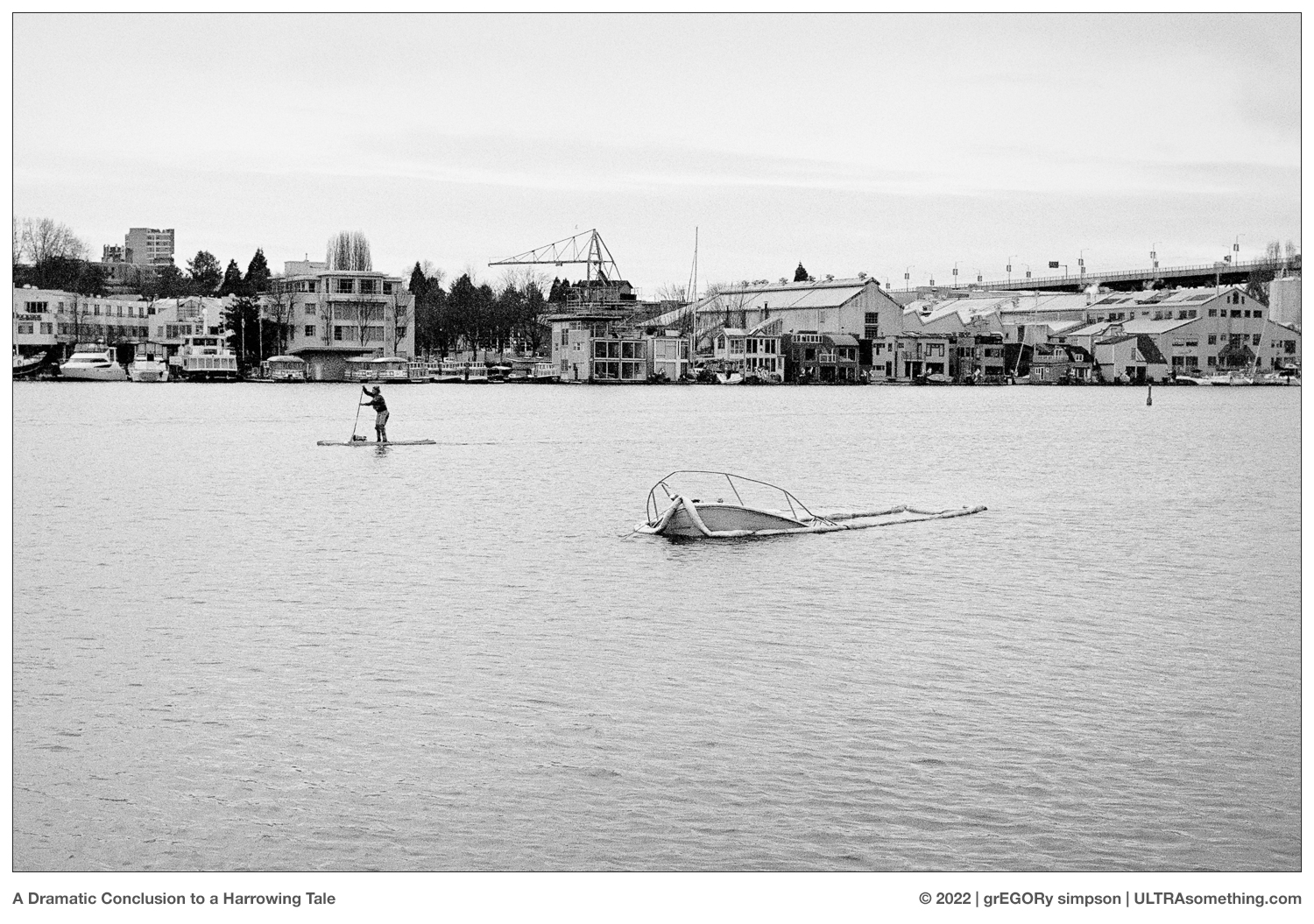
    “A Dramatic Conclusion to a Harrowing Tale” was shot on Fomapan 100, using a Japanese market Leitz Minolta CL with a 40mm f/2 Rokkor lens.

    If one mistakes this article’s subject to be “wonderful albums by female artists in the 1980’s,” then “One for Jane Siberry” would be the lead photo. For me, it invokes a similar mood as her song “Hockey,” from 1989’s ‘Bound by the Beauty.’ It was shot on Tri-X using a Contax G1 and a Zeiss 45mm f/2 Planar lens.

    “Abundantly Camouflaged” was shot on HP5+, using a Minolta TC-1, while “Impertinence” employed the previously seen Leitz Minolta CL — but this time filled with Tri-X and fronted with a 28mm f/2.8 Rokkor lens. “Day and Night” was also shot on Tri-X, this time inside a dubiously focussed Contax G1, now fronted with a Zeiss 28mm f/2.8 Biogon. It is, in essence, a self contained re-mix. But then, isn’t every positive struck from a negative a ‘remix’ of sorts?

    All films stocks were shot at box speed and, as is nearly always the case, developed in a 1:50 solution of Blazinal.

    REMINDER: If you’ve managed to extract a modicum of enjoyment from the plethora of material contained on this site, please consider making a DONATION to its continuing evolution. As you’ve likely realized, ULTRAsomething is not an aggregator site. Serious time and effort go into developing the original content contained within these virtual walls — even the silly stuff.

  • I Eye Eye

    I Eye Eye

    Last spring, after scoring my first hit of Moderna’s COVID vaccine (and the ubiquitous 48 hours of soreness, aches, and malaise that follows), I was right as rain… until four days later, when a blast of chest pain jarred me bolt upright in the middle of the night. Although the pain and accompanying jolts remained my ever-present companion for the next week, I wasn’t overly concerned. I’d experienced this with previous illnesses, and chalked it up to my highly inflammatory immune response doing what it sometimes does. As expected, the inflammation subsided, and the pains ended a week after they began.

    Not long after, reports emerged that a small percentage of mRNA recipients experienced bouts of myocarditis approximately a week after getting vaccinated — the vast majority of whom were men in their late teens and early twenties. Naturally, I took this as a sign that I had the heart of a 20 year-old, and immediately signed up for a TikTok account, hung a Billie Eilish poster on my bedroom wall, and took to openly mocking boomers.

    With that newly minted modicum of antibodies, I booked an appointment with my optometrist — hoping to get some badly needed new contact lenses. I settled into the chair, ready for the doctor’s usual “which is better, A or B” routine, when he abruptly stopped the examination, pushed his swivel chair back toward the desk, turned on the lights, and informed me that my vision issues weren’t because of my prescription, but because of cataracts. Not only that, but they weren’t the usual Stage 3 type that plague a third of the people a half-decade older than me. Nope, mine were Stage 4 — the type more associated with someone who’s 90.

    To prove his point, he continued with the exam, dialled in the best possible correction, then asked me to look at the chart on the wall. “What wall?” I asked. “Exactly,” replied the doctor.

    I was thoroughly confused. Within one month’s time, I learned I had the heart of a 20 year-old and the eyes of a 90 year-old. Is there nothing about me that’s my actual age?

    I’m sure this news comes as absolutely no surprise to anyone who’s viewed my photography all these years — after all, I haven’t exactly been a proponent of photographic fidelity. None the less, I was surprised.

    Because a perpetual tide of COVID waves has decimated the scheduling of “elective” surgeries, I’ve now been stumbling around for 8 months since the diagnosis, waiting for my new plastic eyes. During this time, I’ve stopped driving; avoided going outside at dark, dusk or even on overcast days; and ceased watching anything with subtitles — that’s right, no Nordic Noirs for me. I’ve become a master of the Macintosh’s accessibility settings, and can often be seen wearing two or even three pairs of glasses simultaneously — some upside down — in order to function.

    Surprisingly, this hasn’t had as demonstrable an effect on my photography as one might think. Sure, it affects when I can photograph (mid-day only) and where (I avoid crowded city sidewalks, since I can’t tell people from lamp posts, nor cars from the streets they drive on). But my photos have always had a rather lo-fi aesthetic — even when I could see.

    Then again, maybe the photos have always had a lo-fi aesthetic because I’ve never really been able to see? You don’t just get Stage 4 cataracts without going through the previous three stages — which would obviously have been affecting my vision for many years.

    So I’m actually a bit worried — not that the surgeries won’t work (though complications concern me), but that they will work so well I’ll see just how bad my own photography is. Then what will I do? I’ve grown so accustom to taking and editing photographs without actually being able to see them, that any continuing visual degradation would probably just add to the arc of my photographic oeuvre. But should the surgery succeed, and I suddenly realize that trees have leaves; people have faces; and placards placed on the sidewalk in front of restaurants are for informational purposes, and not for me to trip over — well, that could likely result in a seismic shift in my photography. Do I have enough self-discipline to not become a ‘pixel peeper’ should I gain the ability to actually SEE a pixel?

    I was originally scheduled to have surgery on both eyes in January, but it appears COVID’s latest surge may postpone the joy for at least another few weeks. Once it finally occurs, I’ll still require a couple months of healing before I can be fit for new glasses. So I’m guessing it’ll be spring before I’m all fixed up and functioning like a properly sighted human.

    Fortunately, I can type by touch, and my photography has always been more about intuiting a situation than seeing it. So I expect I’ll continue to post unabated during these next few months of compromised vision — just as I’ve done for the past few. And what happens come spring — once it’s finally over and my vision has stabilized? Who can say? Maybe I’ll buy a 100 megapixel medium format digital camera, and become a colour landscape photographer. Or maybe I’ll be so disheartened by the photos I’ve been publishing that I’ll return to writing music full time (at least until the inevitable battle with deafness pushes me back into photography).

    But first, I need to come to grips with the whole idea of someone slicing up my eyeballs. As a devotee of 70’s and 80’s Italian genre cinema, I’ve seen at least 50 highly stylized close-up depictions of every type of eye trauma imaginable — and not once did the recipient seem even remotely OK with it. I don’t know if it’s some kind of cosmic retribution for my viewing habits, but if it is, I really wish I hadn’t found rom-coms so repugnant. Enduring the karmic punishment of my own personal “meet cute” sounds infinitely more appealing than a knife to the eye.


    ©2022 grEGORy simpson

    ABOUT THE PHOTOS: This month’s photo selections are representative of those only a blind man could love. Although “Cataract” could pass for a photo of an actual cataract surgery, it might just be a snapshot of my washing machine’s spin cycle, or maybe it’s a spinning tire. Whatever it is, it’s an apt metaphor for the article, which was shot with an Olympus OM-D E-M1 MKIII and an M-Zuiko 12mm f/2 lens.“Mixed Metaphors” and “November” were both shot at ISO 400 on HP5+ with a Leitz Minolta CL, fronted with a Minolta 40mm f/2 Rokkor lens, and developed in Blazinal 1:50. “COVID-22” infected a Konica C35, which was stuffed with Tri-X, exposed at ISO 400, and developed in Blazinal 1:50. And while “The Window of Abundant Obstructions” sounds like the title of a giallo I inexplicably haven’t seen, it’s really just the title of another photo of metaphorically fuzzy purpose. It comes courtesy of a Contax G1, fronted with a Zeiss Biogon 28mm f/2.8 lens, through which it rendered a latent image on Tri-X at ISO 400, which I then developed in Blazinal 1:50.

    REMINDER: If you’ve managed to extract a modicum of enjoyment from the plethora of material contained on this site, please consider making a DONATION to its continuing evolution. As you’ve likely realized, ULTRAsomething is not an aggregator site. Serious time and effort go into developing the original content contained within these virtual walls — even the silly stuff.

  • 13

    13

    The joyful exuberance of ULTRAsomething’s childlike naïveté is over. Rebellion rages within — exacerbated by mood swings, sassiness, and a vexatious surliness. They grow up so fast, these cherubic little websites. As the calendar flips to Sagittarius, ULTRAsomething clocks another birthday — its thirteenth. A teenager!

    While turning 13 is statistically quite common for humans, it’s a rather rare event for blogs… or whatever it is this website actually is.

    In fact, many of the classic teen characteristics — such as recalcitrant independence, social awkwardness, and runaway identity crises — have been part-and-parcel of the ULTRAexperience since it was just an infant.

    Which suggests, perhaps, that I’m wrong to frame this site’s 13th birthday in human terms. Maybe websites age more like dogs? In which case I’m happy to report that ULTRAsomething has just turned 91! It would certainly explain why I’m feeling far more introspective on this particular occasion than would be possible for any 13 year-old.

    Then again, 91 implies the website’s demise is close at hand. If that’s the case, shouldn’t ULTRAsomething have more to show for a cradle-to-grave existence than a slovenly 234 articles, 1,500 published photographs, and roughly half-a-million words? That’s an output more worthy of a sloth than a dog.

    Which, now that I think about it, is perhaps a more apt yardstick. In sloth years, ULTRAsomething has just turned 39. That’s an appropriate age equivalency for a site still developing new directional ideas, and that still believes it can one day succeed in spite of all evidence to the contrary.

    So perhaps I’ll celebrate this, ULTRAsomething’s 39th birthday, in the most sloth-like manner possible — sloughing off all those extra words I was planning to write, and taking a nice leisurely nap.


    ©2021 grEGORy simpson

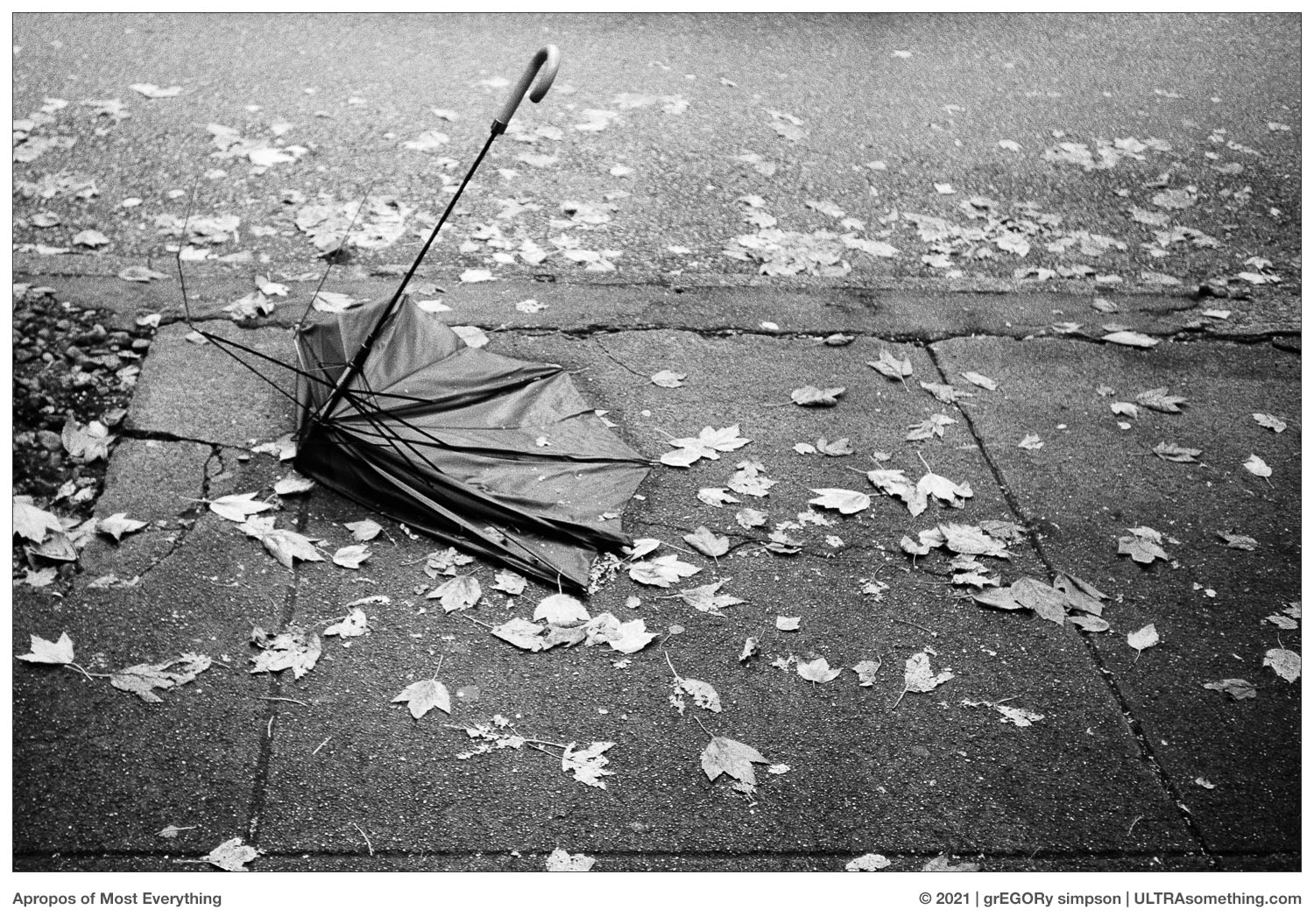
    ABOUT THE PHOTOS: “Felicitous” and “Sun Spot” were both photographed with a Ricoh GRIII — the proper one with the 28mm lens, and not that newfangled 40mm job. Speaking of 40mm lenses, “Introvert” was shot with a 40mm f/2 Rokkor lens, mounted to a Japanese market Leitz Minolta CL stuffed with HP5+, shot at ISO 400, and developed in Rodinal 1:50. “Apropos of Most Everything” was snapped with a Konica C35 at ISO 100 on Acros-100II and developed in Rodinal 1:50. “Vancouver 12, Egor 1” was shot with an iPhone 12 Pro… yes, you read that right. And no, it’s still not a suitable substitute for a ‘real’ camera, but it is better than a Leica at checking email on the go.

    REMINDER: If you’ve managed to extract a modicum of enjoyment from the plethora of material contained on this site, please consider making a DONATION to its continuing evolution. As you’ve likely realized, ULTRAsomething is not an aggregator site. Serious time and effort go into developing the original content contained within these virtual walls — even the silly stuff.

  • Proclivities

    Proclivities

    Back when I was young and dumb(er), I would read interviews in which photographers, like Elliot Erwitt or Lee Friedlander, would mention perusing old contact sheets and “discovering” some heretofore unknown tendency toward a particular subject.

    I always thought this was strange. How can a photographer not know where their proclivities lie? It made no sense to me.

    Last May, while gathering photos for the IPL article, I realized several of the final candidates featured dogs as the primary subject. Deeming this “a tad excessive,” I whittled the selection down to a single pooch, and didn’t give it another thought until June — when multiple dog photos once again found their way into the finalist pool. Again I whittled it down to one, and again I didn’t give it another thought until July — when my final candidates folder contained five new dog photos. However, unlike the previous months, I couldn’t find many suitable alternatives — even that month’s rejects were dog shots! So I was forced to publish two dog photos, rather than one. When it came time to post August’s article, 100% of my preliminary candidates featured a dog somewhere in the frame. I struggled and juggled — failing, once again, to bring the doggie count below two.

    It was only then that it finally hit me — I take a lot of dog photos! In retrospect, it’s obvious. But, like Erwitt or Friedlander, I wasn’t aware just how strong the propensity.

    This got me wondering: Are there any other subjects that attract my camera without piquing my awareness? I glanced over my last several posts, and there it was: the port-a-potty.

    Without even realizing I’d done so, I had published three portable toilet photos within a six month period. Granted, that’s not a lot in the general scheme of subjects — but it’s probably three more portable toilet photos than the average guy publishes in a six month period. Randomly opening a few old blog posts uncovered evidence that this is not a new fixation — I’ve got portable toilet shots going back a decade. Nor is it a fixation likely to end soon, as witnessed by the additional port-a-potty shots I’ve included with this article.

    What other proclivities might be hiding in plain site?

    I turned to my Lightroom catalog, and took a gander at the keyword list I’d so carefully crafted over the years. One keyword, in particular, had an anomalously high count: stairs. I clicked the link and was greeted by the site of a thousand photos in which stairs were a primary element. What’s particularly curious is how few of these I’ve actually published. Stairs, it seems, are one of my most photographed subjects — yet I rarely deem any of them worthy of publication. So why have I taken so many? And why do I continue to do so — particularly when I so obviously suck at it?

    Despite taking all these stair photos, I can recall only one instance when I was consciously aware of doing so — and that’s when I suffered from a debilitatingly pathological obsession with a crumbling and decrepit staircase that descended from Vancouver’s seawall down to the shore. I couldn’t walk past it without a Pavlovian urge to fire off a few shots. I photographed those stairs from every conceivable angle, using every camera and every lens I owned. Hi-fi digital shots; lo-fi grainy film shots; sharply rendered; soft focus; black & white; colour; from a distance; up close — you name it, I shot it. I was tormented by the need to take a compelling photo of those stairs, while never figuring out what was actually so compelling about them. This went on for several years, until the city cordoned off that very segment of the seawall — stairs included — tore it all out, and replaced it with a characterless and visually bland alternative. It was the happiest day of my life. To this date, I’ve only ever published one photo of those stairs, when I used it to make a cheesy, Photoshop composite to illustrate my Alternative History of the Film Camera article.

    Looking back, I’m not sure that particular descent into mania was even related to my generic stair fixation — more likely, it was just a mental defect. This theory is backed up by a totally new, but eerily similar obsession — one that began a few months ago, when I snapped a shot of a dilapidated pedestrian bridge that crosses an even more dilapidated railroad. Viewing the photo at home, I realized it completely failed to encapsulate what I felt when I saw the bridge. So the next time I crossed, I took a few photos… and the next… and the next… and, well, now I find myself looking for excuses to walk across that bridge. This is exactly how the whole seawall steps thing started. I should probably nip the problem in the bud, and make a series of anonymous calls to city hall — demanding they send a crew to dismantle and replace that bridge with something far more characterless and visually bland.

    So I’ve proven, once again, just how clueless that young Egor guy really was. In the end, it took me a scant 30 seconds of research to disprove my old theory that a decent photographer couldn’t possibly be unaware of his proclivities (assuming I qualify as a ‘decent’ photographer). I’ve also discovered that my own particular proclivities don’t necessarily translate into better photos… just more photos. If I can just finagle a way to live to 160, I might finally be able to figure out this whole photography thing.


    ©2021 grEGORy simpson

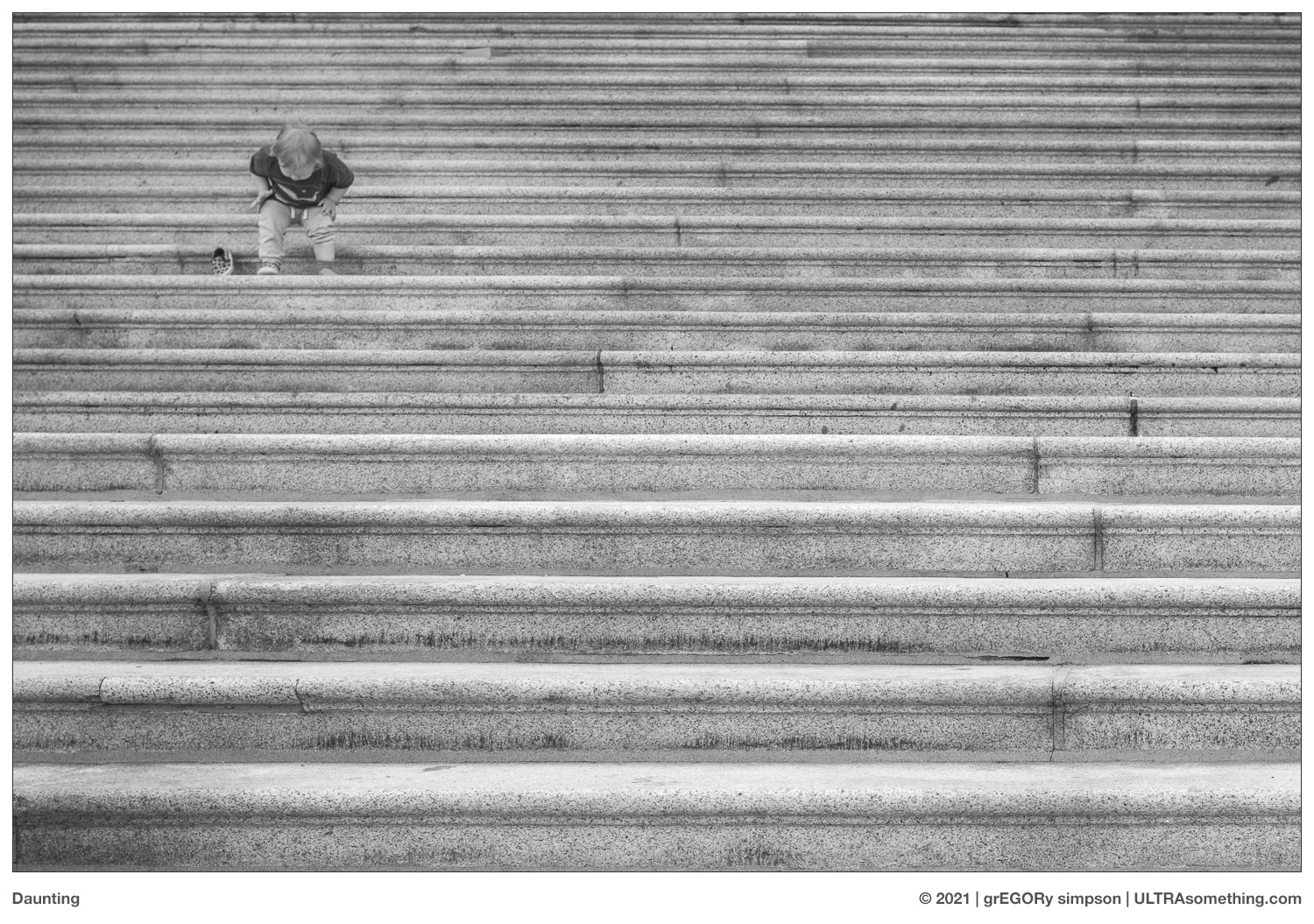
    ABOUT THE PHOTOS: “Kibble-of-the-month.com” [Leica M10 Monochrom | Leica 21mm f/3.4 Super-Elmar-M] is yet another new dog photo, proving the proclivity has not yet subsided. “We’re Gonna Need a Bigger Hole” [Konica C35 | Across 100II | Rodinal] and “Special Delivery” [M10 Monochrom | Voigtlander 75mm f/2.5 Color Heliar] are indicative of my ongoing infatuation with public toilets. “Daunting” and “Scene Awaiting a Crime” [both Leica M10 Monochrom | Minolta 28mm f/2 Rokkor] represent two new additions to my Lightroom collection of photos keyworded with ‘stairs.’ “Straight In” [Leica M10 Monochrom | Leica 21mm f/3.4 Super-Elmar-M], “Straight Through” [Leica M10 Monochrom | Leica 35mm f/2 Summicron v4] and “Straight Up” [Widelux F7 | Across 100II | Rodinal] are just three of an embarrassingly excessive collection of ‘pedestrian bridge’ photos taken in the past few months.

    REMINDER: If you’ve managed to extract a modicum of enjoyment from the plethora of material contained on this site, please consider making a DONATION to its continuing evolution. As you’ve likely realized, ULTRAsomething is not an aggregator site. Serious time and effort go into developing the original content contained within these virtual walls — even the silly stuff.

  • Insipitude

    Insipitude

    Are there any photographs more tedious than ‘test shots’? At best, they’re insipid, uninspired drivel that provide a natural alternative to over-the-counter sedatives. At worst, they’re insipid, uninspired drivel that should be administered only by a licensed anaesthesiologist.

    Some may suggest higher tedium toxicity is achieved by those who take and reject 38 selfies before finally, on shot 39, capturing just the right photo — the one that most artfully conveys a casual, devil-may-care, ‘oh-look-I’m-so-busy-I-haven’t-even-had-time-to-make-myself-look-good’ facade. But I would argue that such selfies avoid the tedium label, because they speak volumes about humanity and its general tendency toward inanity, artifice, manipulation, and self-aggrandizing. Anything that shines a mirror on society has at least some merit. On the other hand, ‘test shots’ convey nothing more insightful or perceptive than ‘oh-look-the-guy-who-took-these-has-absolutely-no-life-whatsoever’.

    As a high-ranking officer in the “Guys Who Have No Life” club, I’m guilty of occasionally dipping my toe into the deep end of the nerd pool. Rarely is it planned. Instead, it just sort of happens — like last month, when I decided to buy some film.

    While Tri-X consumes the lion’s, tiger’s and wombat’s share of my film images, I sometimes require a slower film. For the past decade, I’ve used Kentmere 100. I’d like to say the choice followed an exhaustive battery of tests involving reciprocity failure, negative density, spectrum sensitivity and so on, but that would be a lie. The real reason I chose Kentmere 100, is that it cost less than half as much as other 100 speed films. So I bought a big box of it, stuck it in my freezer, and have been drawing from it ever since.

    It expired a few years ago, but because of my own rather laissez-faire attitude toward fidelity (plus its placement in the freezer), this mattered not one bit. About a year ago, I finally used up the last roll, and since then I’ve been working my way through a hodgepodge of other expired rolls of this and that. I’ve now reached a point where it’s time to replenish my supply of medium speed film.

    The obvious tactic would be to buy more Kentmere 100, but for reasons totally unknown, my local retailer has started pricing it closer to premium films. While it’s still a half-price film in the USA, I live in Canada. I could always mail order it from the states, but I’m worried about the film passing through all those extra security X-rays when it changes hands at the border. So I figured: if I’m going to pay for premium film, I might as well have premium film.

    The hunt was on.

    And by “hunt,” I mean “I was in one of Vancouver’s more film-centric camera stores, when I suddenly remembered I needed some new medium speed film.” After asking the sales clerk for two rolls of a low contrast, ISO 100, Rodinal-loving, B&W negative film with lots of grey tones, he thought for a moment, reached into the fridge, and handed over two boxes of Rollei Superpan 200. I, in turn, handed over my credit card. At this point, it’s totally unclear who’s the guilty party here — him for lying through his teeth about the film’s characteristics; his employer for hiring a guy to work at the film counter who obviously knows nothing about film; or me for making a purchase without performing a single shred of research or even bothering to glance at the box.

    On the next sunny day, I grabbed one of those rolls from the freezer and, for the first time, glanced at the big, bold “Superpan” label on the box. Um. Hmm. If one’s to believe that words mean what they say, this word implies it’s an extended panchromatic film — the type with an enhanced red sensitivity designed for high-altitude surveillance photography, where the film needs to cut through the haze, and produce a sharp, contrasty negative. In other words, it’s exactly the opposite of what I asked for; and the opposite of what “common wisdom” suggests should be developed in Rodinal. Fortunately I don’t give a darn about “common wisdom.”

    Succumbing to the power of subliminal suggestion, my first instinct was that any film called “Superpan” should definitely be loaded into a panoramic camera. I pulled both the Xpan and the Widelux F7 off the shelf, thought for a moment, and concluded the Widelux was the more “super” panoramic of the two.

    As foreshadowed by this article’s introduction, I quickly snapped off a series of vile test shots, dunked the film in Rodinal (Blazinal), and hung it in the shower to dry. I was immediately struck by how significantly different these negatives looked compared to most. From a distance, my Tri-X film always looks like a strip of gently textured mid-grey boxes — very little black; very little white. These Superpan negatives were the exact opposite — all black & white, and very little grey. Each frame looked like a miniature stencil. I feared the worst.

    But fortunately, the camera with which I ‘scanned’ them (an eight year-old Olympus OM-D E-M1) could see what my eyes couldn’t — that there were, indeed, (some) shades of grey; that the highlights held really well; and that there was (a little) detail in the shadows. There was also more grain than I expected — something I personally don’t mind.

    Realizing I rather liked the look, and sticking with the panoramic theme, I tossed the next roll into the Xpan, and once again fired off a bunch of infernal test shots — again at box speed; again developed in Rodinal; and again scanned with the Olympus camera. Which makes this essentially the exact opposite of a ‘test,’ since I didn’t modify a single variable (other than the camera). The results, not surprisingly, were exactly the same.

    I returned to the camera shop for another two rolls of Superpan 200 and, forgoing the panoramic cameras, loaded the first into a Leica M6 TTL. My “plan” (as if any part of this exercise was “planned”), was to dedicate the M6’s roll to testing the film’s forgiveness for over-exposure and under-exposure; and for the impact of various coloured filters.

    At this point, it behoves the story to revisit that first roll in flashback, and mention that the film jammed twice during its trip through the Widelux — once midway through the roll, and again toward the end. In fact, the end-of-roll jam was so bad I couldn’t even rewind the film. I had to put the entire Widelux inside the changing bag, cut the film, and remove it without rewinding it back into the cartridge. I’d never seen a film cartridge jam like this before. Unfortunately, it didn’t take long for me to see it once again.

    Soon after loading the M6 TTL, my attempt to advance to the second frame reached a screeching halt — definitely feeling, once again, like the film had jammed within the cartridge. Since it was the beginning of the roll, and I was miles from home (and my changing bag), I considered opening the camera to free the jammed cartridge. But first, I made one last, brute force attempt to advance the film — and to my surprise, the jam gave way and the lever advanced.

    I happily ran around Granville Island, blowing through what would definitely be the most boring ‘test shots’ of the bunch — taking two; three; or even four shots of the same scene with different exposures and different filters. After shot 37, I was surprised the roll advanced one more frame… and then another… and another. Troubled, I tried rewinding the film, only to discover the rewind knob wouldn’t budge — another jam. Or, perhaps (and more worrisome), it was the same jam I had at the beginning of the roll.

    Back home, the entire M6 — much like the Widelux before it — went into the changing bag, where my suspicions were confirmed: none of the film had been exposed. Instead, because the film was jammed so tightly in the cartridge, the sprocket holes had torn, which meant each tug of the advance lever had advanced the counter, but not the film. In fact, the film cartridge was so jammed, I couldn’t even extract the film with my bare hands after removing it from the camera. In retrospect, I should have opened the cartridge to see what caused the jam but, instead, tossed it in the trash.

    This is both good news and bad news. The good news is, you don’t have to look at any of what would likely be the most boring shots produced by these tests. The bad news is, I was out $11 thanks to Rollei’s dubious quality control issues — a princely sum that would have bought me nearly three rolls of Kentmere 100 back in the day…

    Having experienced two cartridge jams in three rolls, I felt rather hesitant loading the fourth and final roll of Rollei Superpan 200 into the Rollei 35T — a camera selection made for no grander of reason than brand name symmetry. The only “test” I planned for this roll was to expose it at ISO 100 since, ultimately, that was the film speed I needed to replace.

    Prior to exposing it, I decided to research developer alternatives. I suspected the film might do really well in HC-110 (which is the only other developer I keep on hand), but there was very little data available, and I wasn’t keen to start down the “developer test” rabbit hole. The internet is, of course, chock-a-block with all sorts of suggestions as to which is the ‘best’ developer for Superpan 200 (none of which are either Rodinal or HC-110), but in the end I decided I couldn’t really be bothered.

    So I strolled around for about an hour, popped off another string of test shots (this time without any cartridge jam drama), and strolled home to, once again, dunk the film in Rodinal.

    So what did I learn? Well, first and foremost, I learned that I actually like the look of super panchromatic film — or, at least, this super panchromatic film. Had I not purchased it so thoughtlessly, I would never have known this. That said, it’s not a film I’d choose for the bulk of my mid-speed work. When not taking ‘test shots,’ my usual photographic tendency is to photograph widely diverse subjects in widely diverse lighting conditions — conditions in which my exposures are often dubious, and not exactly conducive to this film’s characteristics. However (cartridge issues aside), it’s definitely a film I’d keep on hand for my next foray into high-altitude surveillance photography, along with any other special occasion that might benefit from the film’s extended panchromatic range and contrast.

    I also concluded, without even bothering to test the conclusion, that I’d probably like the film even better if I did some experimenting with various HC-110 dilutions, and that other developers would likely yield even more pleasing results. However, I’m just not that anal when it comes to developing film — if I get a balanced, full-range, scannable negative, I’m happy. Any extra Rodinal-induced grain is just a bonus to my lofi-lovin’ eyes. Which means I also learned that what I always suspected to be true is true: that I’m not the kind of guy who’s going to pick a developer based on my film; but the kind of guy who’s going to pick a film based on my developer.

    But I also learned that I can’t rely on Rollei’s manufacturing or quality control. Life is too short, and my photos (at least those that aren’t ‘test shots’) are too precious for me to chance losing meaningful shots to cartridge jams. If these cartridges were deemed “good enough” to pass Rollei’s quality standards, then I’ll gladly spend my money elsewhere.

    I suspect my next course of action will be to run some actual experiments with Fomapan 100. It’s a film I’ve used on several occasions, and not once do I recall having any sort of emotional response to it — which probably means it was neutral as can be… just the way I like it. Alas, my tolerance for undertaking another round of ‘test shots’ has reached its limit, so the Fomapan experiments will have to wait. Fortunately, winter and its dark and dreary skies are fast approaching. Which, in my world, translates to “Tri-X season” and a return to taking real photographs, rather than all this insipitude.


    ©2021 grEGORy simpson

    ABOUT THE PHOTOS: Hoping to make this article at bit less insipidiciously banal, I opted to publish only three ‘test shots’ per roll. Rest assured, I could have easily published two- or three-times as many, so consider yourselves lucky. The three Widelux F7 shots are: “Two Bridges,” “Under the Boardwalk,” and “Obligatory Symmetry.” The three Xpan shots are: “Carrot,” “Sidewalk,” and “End of the Line.” Finally, the three Rollei 35T shots are “Bus Depot,” “Wild Goose Chase,” and “Epic.” As indicated in the article, all were shot on Rollei Superpan 200 and developed in Rodinal (Blazinal) 1:50, with the panoramic shots exposed at box speed (ISO 200) and the 35T shots exposed at ISO 100.

    REMINDER: If you’ve managed to extract a modicum of enjoyment from the plethora of material contained on this site, please consider making a DONATION to its continuing evolution. As you’ve likely realized, ULTRAsomething is not an aggregator site. Serious time and effort go into developing the original content contained within these virtual walls — even the silly stuff.

  • The 365 Days of Christmas

    The 365 Days of Christmas

    I’ve often wondered: When it’s August, and I see a house bedecked with Christmas decorations, are the residents imbibing in the seasonal spirit far too early? Or far too late? Or are they simply insane?

    I’ll admit, pessimist that I am, I tend to assume the latter, and steer clear of such abodes and the neighbourhoods in which they sit — one can’t be too careful.

    But is that really fair? Could I simply be leaping to conclusions?

    Maybe Christmas has no association with a sizeable collection of plastic reindeer mounted atop a roof in mid-summer. Perhaps the home is occupied by a family of aging Norwegian reindeer herders, who’ve retired to a more hospitable climate, and wish to celebrate their heritage.

    That inflatable snowman in the shrubberies? Who’s to say the residents aren’t just really into winter? Maybe they recently immigrated from the mountains outside Queenstown NZ, and simply find themselves homesick for the melancholic beauty of an August snow.

    Just because someone’s home has every inch of architectural detail lined with a strand of multicoloured lights, doesn’t mean they’re into Christmas. They could just as easily be into ostentatious tackiness. Or engaged in a shrewd attempt to reduce their tax burden by lowering the neighbourhood’s property values.

    And it’s always possible that the circular brown fire hazard nailed to the front door is merely there to hide a blemish. Or that a man-sized candy cane on someone’s porch is only an Amazon delivery destined for the inhabitant’s new confection shop. How am I to know? Who am I to judge?

    I would hope my own generous attempts to consider such alternate motivations are reciprocated by those who bear witness to my eccentricity — film photography. I’ve seen the sideways glances; the nudge-and-nods extended in my direction; the eye rolls. And I get it. Much like Christmas decorations in August, film cameras can seem potently anachronistic in the year 2021.

    Who wouldn’t be wary of a man that’s blatantly disconnected with the ways of modern society? For many, my film cameras imply someone so behind the times, he doesn’t realize the 20th century ended two decades ago. For all one knows, I could have a closet full of bell-bottoms, a Cheryl Tiegs poster on the wall, and a collection of movies on VHS.

    To others, the film cameras might imply I’m a prepper — a survivalist working with the mechanical tools of yore, and training for the day when a giant solar flare wipes out the world’s power grid, and all its electronic devices. For all one knows, I could have a bunker full of canned goods, a mini arsenal, and a collection of movies on VHS.

    (Editorial Aside: Although doomsday preparations are not my motivation for shooting film, I do recognize — should a giant solar flare arrive — that I’ll be the richest man in town. Once people lose the ability to photograph themselves with narcissistic abandon, I’ll be the only person capable of feeding their need to be photographed looking pensive in front of a hip mural; doing yoga on a rocky bluff; or enjoying a glass of wine at sunset.)

    Fortunately, my own Christmas decoration perturbations allow me some empathy toward those who eye me cautiously. And just like the retired Norwegian reindeer herder or the immigrant from the mountains of New Zealand; my film cameras have nothing to do with being either too early or too late. Instead, much like the confectioner’s man-sized candy cane, they simply indicate that I have a passion for my craft and the product that results — an analog photograph. And because of this, I’m neither ahead of my time nor behind it — but smack in the middle of where I like to be.

    That said, if I’m out strolling with a film camera and I stumble upon a mid-summer nativity diorama, I’m still hightailing it out of there. Empathy only goes so far.


    ©2021 grEGORy simpson

    ABOUT THE PHOTOS: My anticipation, when I plunge my hands into the dark bag and spool a roll of film onto the reel, is much like that of a child’s on Christmas morning. What wonders lie within? What joy is yet to manifest? If one really wants to experience Christmas all year long, I’d suggest they give film a try. Accompanying this article are just a few of the presents I’ve opened these past several weeks. “Stairway to Heaven” was shot with a Ricoh Auto-Half on Tri-X @ ISO 200; “Dubious Transport” was shot with a Leica IIIc on Tri-X @ ISO 400, and fronted with a Letiz 35mm f/3.5 Elmar LTM lens. “In Peace Rest,” “Solar Flare: Moment of Impact” and “Tunnel Vision” were all shot with a Minolta TC-1 on Tri-X @ ISO 400. All film from all cameras was, as usual, developed in Rodinal 1:50.

    REMINDER: If you’ve managed to extract a modicum of enjoyment from the plethora of material contained on this site, please consider making a DONATION to its continuing evolution. As you’ve likely realized, ULTRAsomething is not an aggregator site. Serious time and effort go into developing the original content contained within these virtual walls — even the silly stuff.

  • Statistically Speaking

    Statistically Speaking

    In the summer of 1952, Simon & Schuster collaborated with Editions Verve to publish Henri Cartier-Bresson’s The Decisive Moment — a collection of 126 photographs, coupled with a 4500 word essay.

    At the time of its publication, Cartier-Bresson was already a world renowned photographer — having deftly bridged the seemingly insurmountable gap between surrealism and photojournalism, while co-founding Magnum Photos some five years earlier.

    The Decisive Moment is a seminal work of art by the most revered photographer of the 20th century — influencing thousands of photographers across multiple generations. Its very title became one of the most overused phrases in the history of the medium, along with ‘bokeh’ and ‘say cheese.’

    And yet, between 1952 and 2015 — a span of 63 years — Henri Cartier-Bresson’s The Decisive Moment sold a mere 10,000 copies.


    In the summer of 2017, ICBC collaborated with BC Parks to produce a license plate featuring one of my photographs of Porteau Cove Provincial Park.

    At the time of its release, I was (and still am) a nobody — having deftly bridged the seemingly insurmountable gap between electronic music product designer and professional parks photographer, without anyone actually noticing.

    One cannot cross a street in British Columbia without seeing one or more vehicles adorned with “my” Porteau Cove license plate. I’ve spotted it on everything from economy cars to luxury SUVs to Ferraris.

    Last month, I contacted BC Parks to see if they had any sales figures on my plate. They did. Between 2017 and 2021 — a span of 4 years — the Porteau Cove license plate has sold approximately 100,000 copies.


    Upon hearing this, several thoughts crossed my mind. First, of course, was “Pffffft! In your face, Cartier-Bresson!” This was accompanied by a little victory dance, punctuated by the spiking of my AGAT 18K camera, which I’ve retained specifically for such celebratory rituals.

    But the notion that I’d exceeded 63 years of Decisive Moment sales by an entire order of magnitude — and that I’d done it in a mere four years — seemed positively ludicrous. There had to be a ‘catch.’

    Thinking about it, I realized each copy of The Decisive Moment had likely changed hands numerous times over the years, as it passed from collector to collector. Because of this, it’s quite possible that those 10,000 physical copies of the book could have generated 100,000 actual sales, thrusting Cartier-Bresson and I into a tie.

    But applying this logic to The Decisive Moment requires I also apply it to the Porteau Cove license plate. And the fact is, while it costs $50 to buy the physical plate, customers must pay an additional $40 every year — just for the right to keep it on their vehicle. In effect (and much like The Decisive Moment), each documented sale of a physical license plate results in multiple undocumented re-sales of the same plate. For example, a single Porteau Cove plate, sold in 2017, has now generated four additional re-sales — one for each subsequent year. So if we allow Cartier-Bresson to claim sales of 100,000 on a production of 10,000 books, I can surely claim sales of nearly half-a-million on a production of 100,000 plates.

    So… “Pffffft! In your face, Cartier-Bresson!”

    Even still, it doesn’t feel quite right to gloat. Maybe it’s the realization that millions of people have seen Henri Cartier-Bresson’s photos without ever owning a copy of The Decisive Moment. So sales figures aren’t a true measure of his reach. Then again, I don’t own a copy of my own license plate (too expensive), but that doesn’t mean I still don’t see the photo a dozen times a day — tooling around town on the backs of all those economy cars, luxury SUVs, and Ferraris. Which means, much like Cartier-Bresson’s book, one does not need to own the license plate in order to see the photo. And though I’m quite comfortable assuming every one of British Columbia’s 5 million residents has, by now, seen the Porteau Cove plate, I still feel somewhat guilty giving Cartier-Bresson the raspberry.

    Sheepishly, though, I must admit the plate’s success has gone to my head. Lately, I’ve considered carrying around a Sharpie pen, and asking anyone with a Porteau Cove plate if they’d like me to autograph their bumper. I’ll also admit, if someone tries to cut me off on the freeway, I’ll happily yield the space to anyone with ‘my’ plate, whilst closing the gap to all those sporting one of BC’s ‘lesser’ plates.

    But as much as I’d like to wallow in victory, it still feels hollow. Perhaps that’s because I don’t make a dime off that license plate photo. Or maybe it’s because I had zero control over which of my BC Parks photos ended up on a license plate, or how the photo was presented.

    For example (and very much at odds with Cartier-Bresson’s philosophy), BC Parks cropped the heck out of my Porteau Cove photo. Originally a sweeping vista, it’s a shot that would be better suited to the luxuriously wide, 5:1 aspect ratio of a European license plate than to the squat 2:1 ratio of a Canadian plate. Alas, French licensing officials aren’t as inclined toward a photo of Porteau Cove than, say, one of the Côte d’Azur. Which, I suppose, makes this the perfect time to inform French licensing officials that I’m available for hire.

    But the primary reason I won’t claim victory is because of the implication: that a lazy summer landscape can (and usually will) outsell anything contemplative and thoughtful. Frankly, the Porteau Cove photo isn’t one I’d have bothered to take, had I not been employed by BC Parks. Therefore I can’t rightfully consider the photo’s success to be my success, since it’s so at odds with who I am as a photographer. If I were king of the world, license plates would definitely be adorned more artistically.

    For example, New Mexico’s plate would be stamped with Garry Winogrand’s photo of a toddler emerging from a darkened garage into the sunny Albuquerque suburban nothingness. Bumpers in Washington, DC would zip around with Lee Friedlander’s photo of a pigeon-shooing statue of Andrew Jackson, while Nevada gets Elliot Erwitt’s photo of a glassy-eyed woman confronting one of Las Vegas’ notorious one-armed bandits. Heck, if Ireland would slap Josef Koudelka’s photo of four men urinating in an alley onto a license plate, I might just emigrate.

    But here, in my Province of BC, I would definitely not have chosen a Porteau Cove sunset shot as my claim to fame. Not even close. In fact, while I have hundreds of photos I’d be proud to see cruising around on the bumper of a Toyota, I’d probably stamp Fred Herzog’s “Man With Bandage” onto the BC license plate before anything I’d shot.

    Of course, that would mean relinquishing my title as BC’s ‘License Plate King.’ But sometimes you gotta take one for the greater good. And besides, I haven’t really beaten Cartier-Bresson. You may have noticed that I quoted Decisive Moment sales stats for the years 1952-2015 — a period coinciding with the book’s first edition. But in 2015, Steidl published the long-awaited second edition, and while their printing quantities aren’t public record, I have no doubt this edition’s sales have absolutely trounced those of the Porteau Cove license plate.

    Which is just fine with me. Because it means I can stop worrying about gunning for Henri Cartier-Bresson, and start thinking about more important things — like how to get one of my photos onto the Canadian $20 bill.


    ©2021 grEGORy simpson

    ABOUT THE PHOTOS: All four photos were shot with a Leica M10 Monochrom, with “Law of Attraction” and “A Place for Everything” using the 21mm Super-Elmar-M f/3.4; “Suns’ Eye” employing a 28mm Summicron-M f/2.8; and “Three Gyros and a Hotdog” using a mystery lens — not that I’m not trying to be coy: I simply forgot to make a note of my lens usage that day. I’m surprised this doesn’t happen more often than it does.

    REMINDER: If you’ve managed to extract a modicum of enjoyment from the plethora of material contained on this site, please consider making a DONATION to its continuing evolution. As you’ve likely realized, ULTRAsomething is not an aggregator site. Serious time and effort go into developing the original content contained within these virtual walls — even the silly stuff.
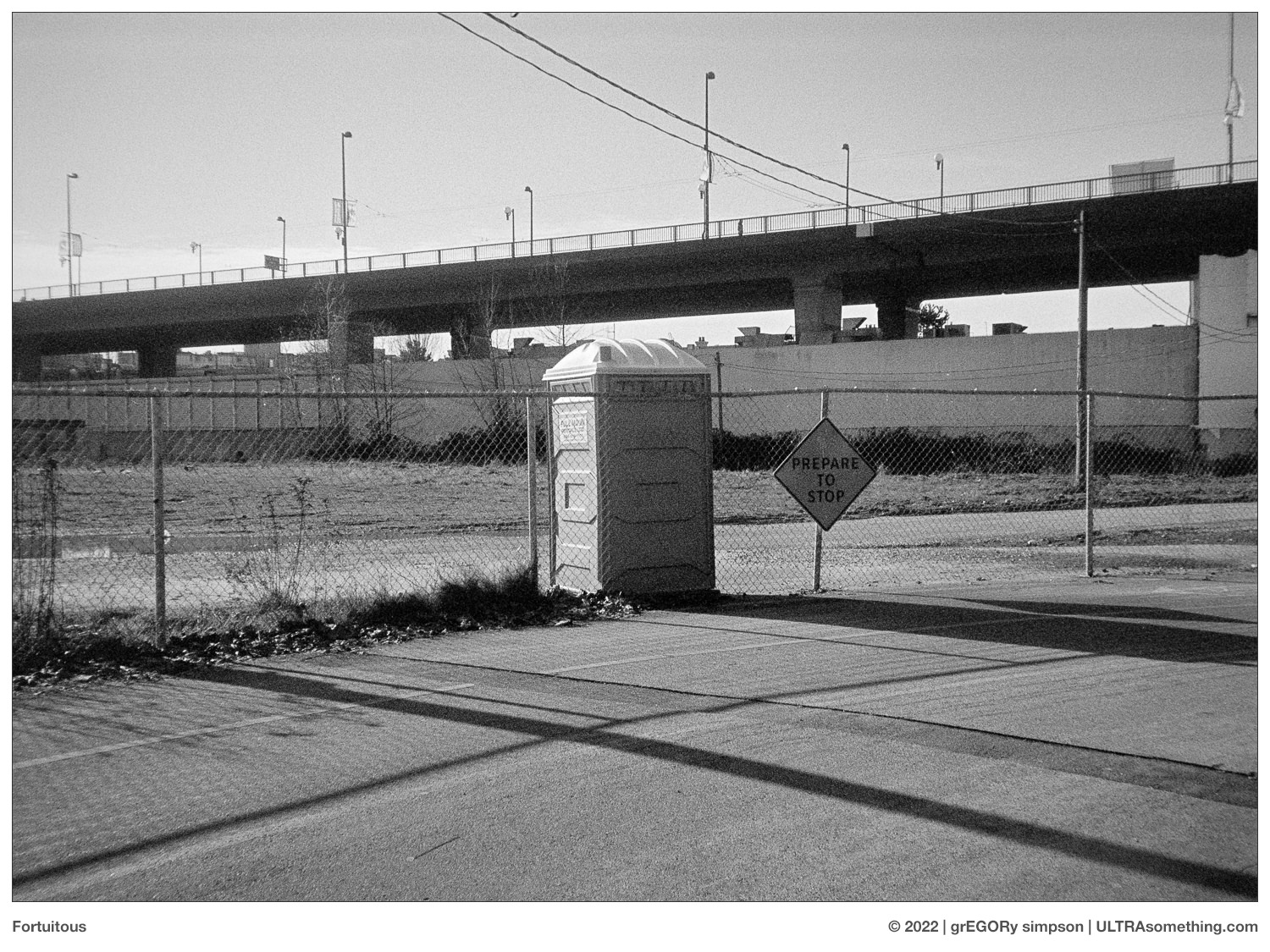
  • Bartlett’s Rejects Rejects

    Bartlett’s Rejects Rejects

    Last month, my bathroom sink erupted — splattering walls with a geyser of thick, brown, sandy grit, and permeating the condo with the unmistakably pungent odour of sewer gas.

    Two hours later, the emergency plumber arrived, and without saying a word, sniffed the air and wheeled his cart right past me and into the offending (and offensive) bathroom. Within minutes he had dismantled my sink, reached his router several feet into the depths of my high-rise building’s communal pipe, and extracted mounds of what is best described as “gunk.”

    He turned to me, a thick wad of it in hand, and with a limited English vocabulary muttered, “Cat. You have cat.”

    “No,” I replied, “I have no cat.”

    “Before you here, they have cat,” he said, thrusting his handful of gunk toward my face to emphasize his point.

    “No. I’ve lived here for over 20 years. No cat.”

    “Upstairs,” he said, nodding toward the ceiling, “They have cat.”

    Satisfied he’d made his point, he returned to his duties, packed his gear, pocketed the $350 I deposited into his gunk stained hand, and wheeled his cart back out my front door.

    Because of COVID restrictions and my own innate introversion, this now stands as the longest face-to-face conversation I’ve had all year. My second longest conversation occurred when the checkout clerk at the grocery store asked if I needed any bags. “Nope,” I replied. “I brought my own.”

    For me, such a physical void simply leads to more unfettered thinking. Each month, I’ll rifle through the thoughts, select a few that are vaguely cohesive, weave them into a new article, and eject it into the virtual void of ULTRAsomething.

    Unfortunately, this month’s contemplations proved too disjointed for a thematically conceived essay, so I decided the best way to package them for satellite transmission was to simply list them. And so, in the spirit of “Bartlett’s Rejects” (2011) and “More Bartlett’s Rejects” (2013), I present “Bartlett’s Rejects Rejects” — the non-awaited completion of the trilogy.

    As with all previous Bartlett’s Rejects, some of these quotes are re-statements of things I’ve written in past articles; some are paraphrases of previous concepts; and some are fresh new cogitations. In recognition that ULTRAsomething has moved beyond its photography blog origins, several of the quotes aren’t even photography-related. However, I would argue — since photography is merely an expression of life itself — that all are entirely relevant to my camera-toting brothers and sisters.

    Because each article in the trilogy contains a mathematically challenged baker’s dozen declarations, the site’s collection of instantly quotable quotes has reached 42 — each ready to swipe, copy, and paste into your next tweet, research grant application, screenplay, love letter, or legislative bill.

    Granted, ULTRAsomething’s pool of quotes isn’t all that deep nor particularly clever. However, it’s their author’s obscurity that will imbue your communication with a scholarly novelty that stretches beyond the perfunctorily common Twain, Shaw, and Wilde quotes that are so lazily referenced by your peers. Plus, astute readers will likely have realized that the number of available quotations — 42 — precisely corresponds to the answer for “the ultimate question of life, the universe, and everything,” as calculated by the super computer in Douglas Adams’ “Hitchhiker’s Guide to the Universe.” Coincidence? Who’s to say?


    “The crappier someone’s taste in music, the louder they play it.” – grEGORy simpson

    “Society honours individuality with exclusion.” – grEGORy simpson

    “The irony of social media is that it rewards anti-social behaviour.” – grEGORy simpson

    “You might as well be yourself, since all the other positions are filled.” – grEGORy simpson

    “The more someone appreciates you for who you are, the more they want you to be someone else.” – grEGORy simpson

    “’Most popular’ is not a synonym for ‘best’.” – grEGORy simpson

    “Unlike most chronic conditions, those suffering from ignorance rarely know they have it.” – grEGORy simpson

    “It takes profound introspection to recognize one’s own shallowness.” – grEGORy simpson

    “The better you get at something, the fewer people who will like it.” – grEGORy simpson

    “Your self-diagnosed likelihood of having a terminal disease is directly proportional to the amount of time spent googling your symptoms.” – grEGORy simpson

    “Knowledge cures belief.” – grEGORy simpson

    “I’m not a photographer. I know this because every time I see an article titled “10 photos every photographer should know how to take,” I quickly ascertain that I have absolutely no desire to take any of them.” – grEGORy simpson

    “The more discerning you are behind the camera, the less time you waste in front of the computer.” – grEGORy simpson

    “We must forgive ourselves for the sins of our past, if we hope to maximize our capacity to sin in the future.” – grEGORy simpson


    ©2021 grEGORy simpson

    ABOUT THIS ARTICLE: One trilogy down. Can the third instalment of the Caffenol trilogy (part 1; part 2) be far behind? Yes. Yes it can. Also, if any of these quotes have already been attributed to some other author, I assure you that it’s the result of ignorance, not plagiarism.

    Regarding the photos: The fact “Mad Libs™ – Tagger’s Edition” illustrates a rather nonsensical list makes it the logical choice to lead this particular article. Alas, none of the other photos have any relevance to the subject matter whatsoever. As such, they are simply ‘filler’ material that I siphoned off the SD card these past couple weeks. Everything was shot with a Leica M10 Monochrom and a 21mm f/3.4 Super-Elmar-M ASPH — everything, that is, except “Chilli Night,” which employed an ancient Leitz 35mm f/3.5 Elmar Screw Mount lens instead of the 21mm.

    REMINDER: If you’ve managed to extract a modicum of enjoyment from the plethora of material contained on this site, please consider making a DONATION to its continuing evolution. As you’ve likely realized, ULTRAsomething is not an aggregator site. Serious time and effort go into developing the original content contained within these virtual walls — even the silly stuff.