This site has waxed poetic over half-frame film cameras for the better part of decade. My review of the Olympus Pen F surely qualified as an epic poem; while the Pen EE-2 was a work of ekphrastic poetry. The Ricoh Auto-Half veered into sonnet territory; while the Agat 18K could only be classified as an elegy — as much my own as the Agat’s.
I love the simplicity of these cameras. I love the way the photos they take are more a suggestion of a subject than a detailed rendering, and how that changes my vision accordingly. And I love their frugality — because not only can I fit over 70 shots on a single roll of 35mm film, but the cameras themselves are quite inexpensive.

Unfortunately, 60 year-old inexpensive cameras designed for budget-conscious consumers don’t last forever, and I must sadly report that my two most-beloved half-frame cameras — the Ricoh Auto-Half and the Olympus Pen EE-2 — have now shuffled off their immortal coils. Quite literally in the case of the Ricoh Auto-Half, as its coiled transport spring has now sprung.
Both cameras served me well, with the little EE-2 once acting as my ‘walk around’ camera on a trip to Iceland — a destination normally associated with seekers of the ultimate in digital image quality. In fact, it was the EE-2 that delivered my favourite photo from there — a shot I’d never think to take had I been lugging a “real” camera. But it’s the Ricoh Auto-Half to which I’d developed the strongest connection. Immediately after it failed, I had the irrational urge to get it repaired — a choice that would no doubt grossly eclipse the smattering of yen I spent to liberate it from an underground Shinjuku camera shop. Eventually, I realized the more rational option was to frame its loss as a golden excuse to buy an entirely different half-frame camera… and I knew just which one.
On the final day of my last Tokyo trip — a month before “Coronavirus” first became a household word — I’d traveled on a westbound train to some quiet little neighbourhood outside the megapolis. There, as happens in many Japanese neighborhoods, I stumbled upon the tiniest of camera shops. Inside was a half-frame Konica Recorder, which I made the mistake of handling for a bit too long. I wanted it. I hemmed a little, and hawed a lot. But with my return luggage already bulging with vintage cameras, I feared another purchase might incite Canadian customs to unilaterally declare me a “camera import business,” and slap me with a fine for operating without a license. Besides, I didn’t have enough time to run a roll of test film through it, get it developed, and return the camera should there be any problems. So I passed. But the desire to own a Konica Recorder remained, and the demise of the two half-frame cameras provided the impetus I needed to return to Tokyo (albeit only via eBay) and purchase one. Five days later, it was in my hands.
Unlike my Auto-Half and EE-2, which were both products of the 1960’s, the Konica Recorder is positively modern — arriving from the year 1985. You can tell because the thing has a sort of checkerboard ‘new wave’ case design, and bears an uncanny resemblance to an old Sony Walkman — a comparison that seemingly extends even to Konica’s decision to call it a “Recorder.” Hopefully such modernity will help it remain functional for the next several years. After all — though gloriously inexpensive — it did cost twice as much as the pair of half-frame cameras it replaced.

Adding to the comparative cost difference, is the Konica’s additional ongoing operating expense: two AA batteries! These are required to power its exposure meter (a task handled by unpowered selenium cells in the older cameras); its auto-wind (handled via a thumbwheel or spring in the EE-2 and Auto-Half, respectively); and its auto-focus (a feature missing from both the earlier cameras, which are fixed-focus designs). They also power the camera’s built-in flash — another feature missing from the Konica’s predecessors.
Speaking of autofocus, it seems to operate in “seat-of-the-pants” mode. There’s no actual focus area displayed in the viewfinder. So you’re left to guess what, exactly, the camera is focussing on. Common sense dictates that it’s the middle of the viewfinder — but how big is that area? Considering the camera sports a 24mm f/4 Hexanon lens, it barely matters — most everything is going to be in focus anyway; particularly since its minimum focus distance is still a meter away. To test this, I popped off a couple shots of rather large nearby subjects, centering them in the frame. Keeping in mind that focus is a fuzzy term when it comes to half-frame cameras, I scrutinized the shots and concluded that maybe, possibly, there might just be a tiny bit of bokeh in the background. So I’m lead to believe the autofocus does, indeed, do a little something.
The lens is surprisingly capable — quite helpful when you’re building photos with only half the number of grains. Exposures were certainly well-placed within the latitude afforded by black & white negative film. Overall, the images were more sharply rendered, and generally better exposed than those from any of my older point-and-shoot half-frame cameras.
Happily, this camera is free of all that DX-coding nonsense, so you can set your film speed to whatever you want. Unhappily, if you want your film speed to be anything other than ISO 100, 200 or 400, you’re out of luck. No shooting ADOX CMS 20 at box speed. No pushing Tri-X to 800 or 1600. Even at ISO 400, you might want to keep an eye on the sky — the shutter speed tops out at 1/250th of a second.

Film is transported vertically through the camera, so holding it horizontally results in landscape-oriented shots, like a full-frame camera. I actually prefer the portrait-orientation of the older half-frames, but it’s not a deal killer. As I mentioned earlier, the Konica auto-advances the film after each shot, and to my delight (and just like the Auto-Half), it transports the film only after you lift your finger off the shutter button. So you can take a shot in near silence, then walk away before releasing the shutter button — ensuring the zhzhzhzhtt of the auto-wind is safely out of anyone’s earshot.
In spite of being a bit larger than either the EE-2 or Auto-Half, it still slides effortless into the slimmest of pockets — aided significantly by the fact there are no extending bits or bobs to snag on your jeans on the way in or out. Instead, the camera’s working elements are all hidden behind a sliding shell that keeps the camera’s closed surface perfectly smooth, while protecting the lens, focus sensors, exposure window, ISO settings, and rewind switch safely from damage or accidental activation.
And about that rewind switch: when you reach the end of the roll, the film doesn’t automatically rewind. Instead, you need to flip the rewind switch, and those two little AA batteries start pumping out the juice needed to wind your film back into the cartridge. The problem is that there’s no indication of when the camera has completed this task. Instead, the rewind motor will happily spin that spool for as long as the rewind switch is ‘on.’ This makes it a bit difficult to judge when the film has been totally rewound. I thought I’d be able to tell by sound, but I was wrong. On the second test roll, after about 20 seconds, I thought it sounded like the film was back in the cartridge, but nope… it wasn’t. That little discovery cost me a few exposures when I opened the back. So for the third roll, I simply let the thing rewind for about 45 seconds before daring to open the camera. It probably means I’ll be replacing those AA batteries a couple rolls sooner than expected, but this shouldn’t add more than a few dollars to the lifelong operating cost of the camera.
Besides, any extra battery expense is sure to be offset by the amazing number of shots the Konica Recorder crams onto a single roll of film. I ran three different types of film through this camera — one corresponding to each of its possible ISO settings. I got 80 shots on a roll of Tri-X; 82 on a roll of Fomopan 100; and 78 on a roll of Rollei Superpan 200. Which makes this (AA battery costs included) THE most frugal film camera I’ve ever owned.
Much like the Walkman that seemingly inspired its form, this is a camera that begs to be carried around. So for two straight weeks, I did exactly that. And much like the concept that inspired its name, I used it to record just about anything I happened upon. 52 of these ‘recordings’ comprise the accompanying vBook. I could write about what I thought of the images this camera takes, or you can watch and decide for yourself.
As much as I like this camera, sentiment continues to nudge me toward repairing the Auto-Half. Whether I’d find a camera technician willing to bother? Doubtful. But until I do, the Konica Recorder — fashion victim that it is — has proven to be an able and technically superior substitute. Objectively, it produces the finest photos of any point-and-shoot half-frame I’ve used. Subjectively, it’s still too early to know whether I’ll develop the same sort of emotional attachment I formed with its two predecessors — but I have no doubt I’ll enjoy the opportunity to find out, as it will surely accompany me on many more walks in the coming years.

©2022 grEGORy simpson
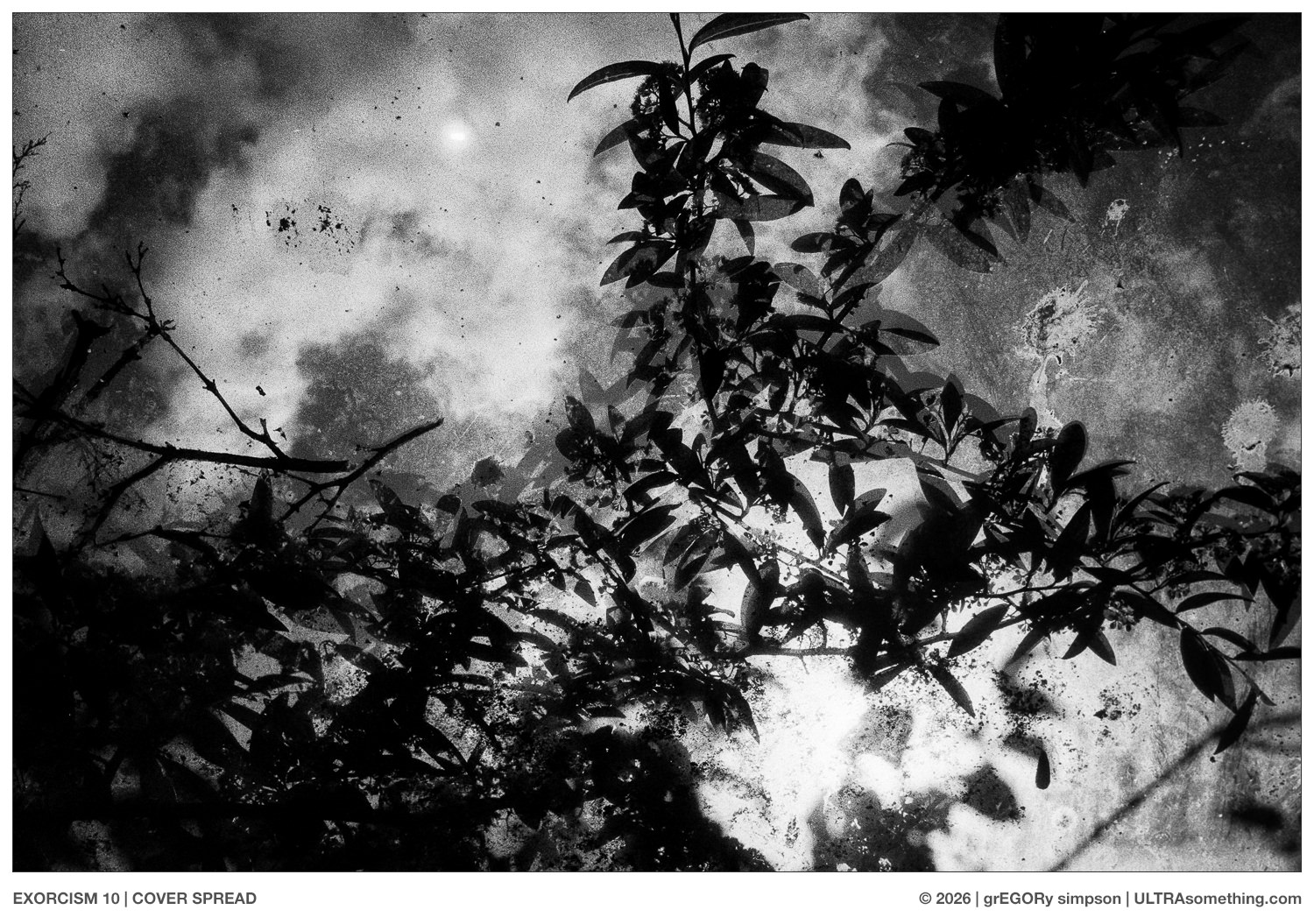
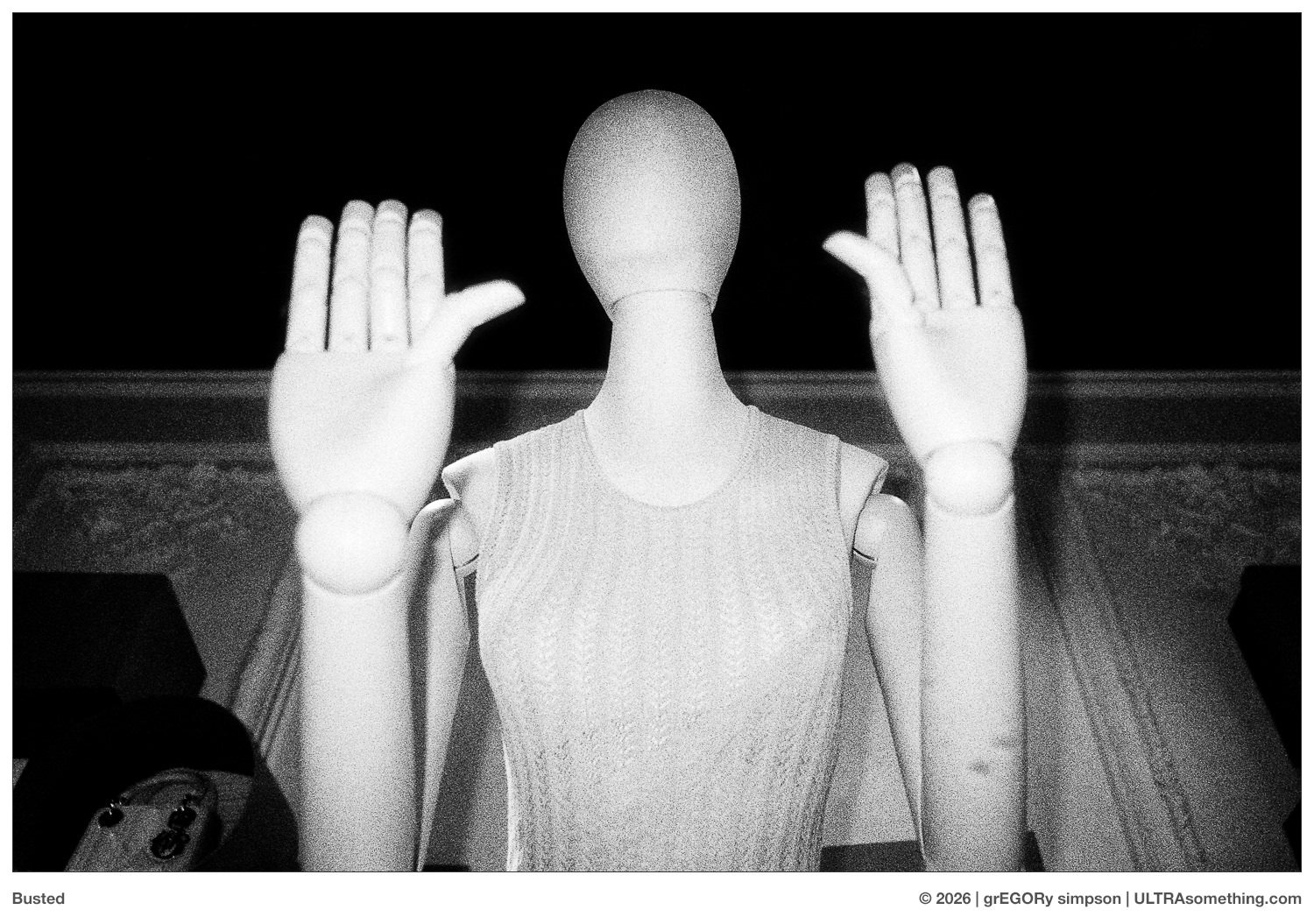
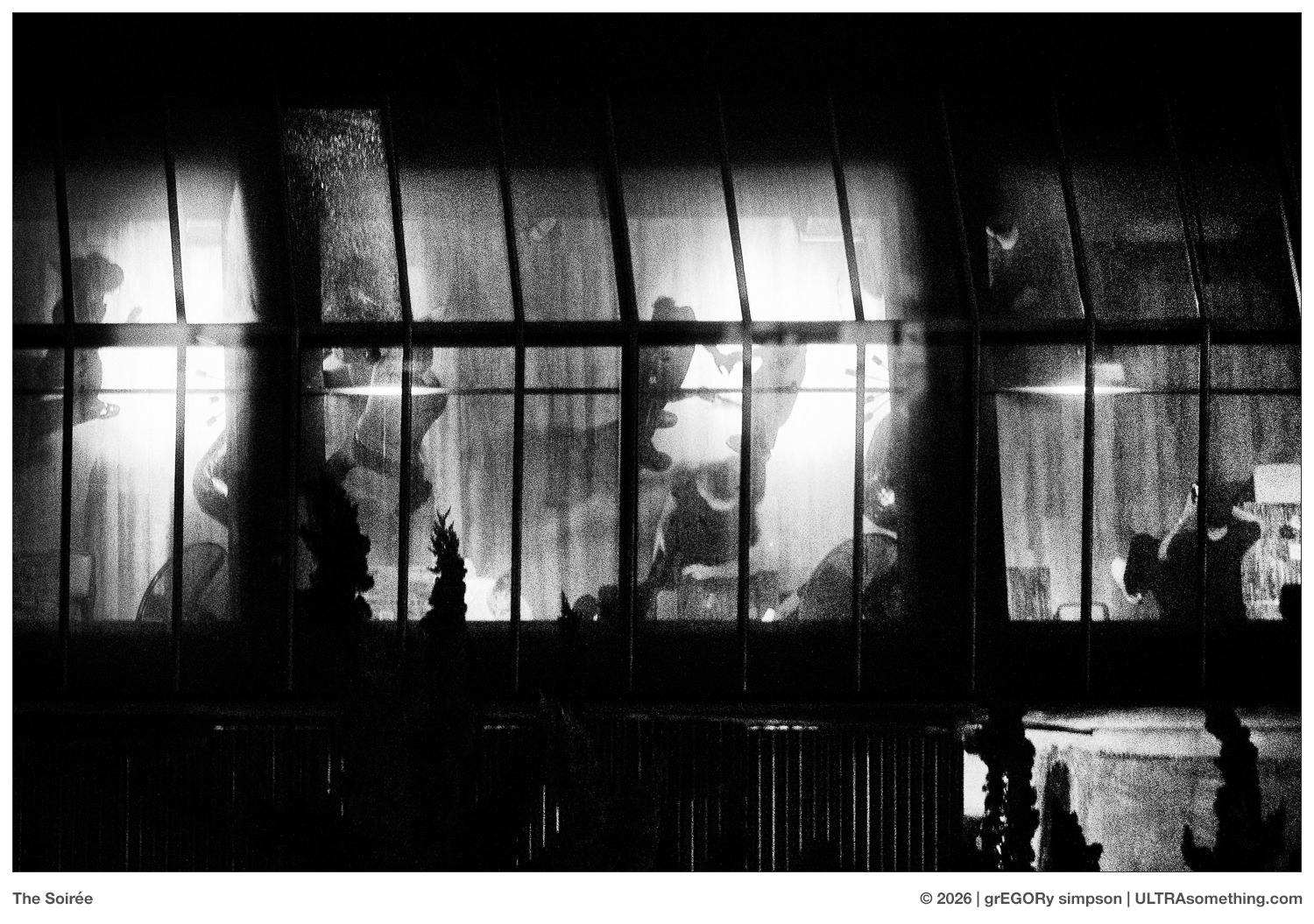
ABOUT THE vBOOK: A Portent Dawn, Redundancy and Fortuitous — as displayed in this article — are just 3 of the 52 shots included in the vBook. Since it’s an article about the Konica Recorder half-frame 35mm camera, you would be correct in assuming these, and all the photos in the vBook, are from that camera — shot over a two week period, and on the three films stocks mentioned in the text. The soundtrack is basically just a one-take improvisation performed on a Buchla Easel Command, with a tiny bit of additional accompaniment haphazardly improvised in a similar one-take-and-done fashion. The photos were then sequenced against the music in Final Cut Pro X.
REMINDER: If you’ve managed to extract a modicum of enjoyment from the plethora of material contained on this site, please consider making a DONATION to its continuing evolution. As you’ve likely realized, ULTRAsomething is not an aggregator site. Serious time and effort go into developing the original content contained within these virtual walls — even the silly stuff.