Last spring, after scoring my first hit of Moderna’s COVID vaccine (and the ubiquitous 48 hours of soreness, aches, and malaise that follows), I was right as rain… until four days later, when a blast of chest pain jarred me bolt upright in the middle of the night. Although the pain and accompanying jolts remained my ever-present companion for the next week, I wasn’t overly concerned. I’d experienced this with previous illnesses, and chalked it up to my highly inflammatory immune response doing what it sometimes does. As expected, the inflammation subsided, and the pains ended a week after they began.

Not long after, reports emerged that a small percentage of mRNA recipients experienced bouts of myocarditis approximately a week after getting vaccinated — the vast majority of whom were men in their late teens and early twenties. Naturally, I took this as a sign that I had the heart of a 20 year-old, and immediately signed up for a TikTok account, hung a Billie Eilish poster on my bedroom wall, and took to openly mocking boomers.
With that newly minted modicum of antibodies, I booked an appointment with my optometrist — hoping to get some badly needed new contact lenses. I settled into the chair, ready for the doctor’s usual “which is better, A or B” routine, when he abruptly stopped the examination, pushed his swivel chair back toward the desk, turned on the lights, and informed me that my vision issues weren’t because of my prescription, but because of cataracts. Not only that, but they weren’t the usual Stage 3 type that plague a third of the people a half-decade older than me. Nope, mine were Stage 4 — the type more associated with someone who’s 90.
To prove his point, he continued with the exam, dialled in the best possible correction, then asked me to look at the chart on the wall. “What wall?” I asked. “Exactly,” replied the doctor.
I was thoroughly confused. Within one month’s time, I learned I had the heart of a 20 year-old and the eyes of a 90 year-old. Is there nothing about me that’s my actual age?

I’m sure this news comes as absolutely no surprise to anyone who’s viewed my photography all these years — after all, I haven’t exactly been a proponent of photographic fidelity. None the less, I was surprised.

Because a perpetual tide of COVID waves has decimated the scheduling of “elective” surgeries, I’ve now been stumbling around for 8 months since the diagnosis, waiting for my new plastic eyes. During this time, I’ve stopped driving; avoided going outside at dark, dusk or even on overcast days; and ceased watching anything with subtitles — that’s right, no Nordic Noirs for me. I’ve become a master of the Macintosh’s accessibility settings, and can often be seen wearing two or even three pairs of glasses simultaneously — some upside down — in order to function.
Surprisingly, this hasn’t had as demonstrable an effect on my photography as one might think. Sure, it affects when I can photograph (mid-day only) and where (I avoid crowded city sidewalks, since I can’t tell people from lamp posts, nor cars from the streets they drive on). But my photos have always had a rather lo-fi aesthetic — even when I could see.
Then again, maybe the photos have always had a lo-fi aesthetic because I’ve never really been able to see? You don’t just get Stage 4 cataracts without going through the previous three stages — which would obviously have been affecting my vision for many years.
So I’m actually a bit worried — not that the surgeries won’t work (though complications concern me), but that they will work so well I’ll see just how bad my own photography is. Then what will I do? I’ve grown so accustom to taking and editing photographs without actually being able to see them, that any continuing visual degradation would probably just add to the arc of my photographic oeuvre. But should the surgery succeed, and I suddenly realize that trees have leaves; people have faces; and placards placed on the sidewalk in front of restaurants are for informational purposes, and not for me to trip over — well, that could likely result in a seismic shift in my photography. Do I have enough self-discipline to not become a ‘pixel peeper’ should I gain the ability to actually SEE a pixel?
I was originally scheduled to have surgery on both eyes in January, but it appears COVID’s latest surge may postpone the joy for at least another few weeks. Once it finally occurs, I’ll still require a couple months of healing before I can be fit for new glasses. So I’m guessing it’ll be spring before I’m all fixed up and functioning like a properly sighted human.
Fortunately, I can type by touch, and my photography has always been more about intuiting a situation than seeing it. So I expect I’ll continue to post unabated during these next few months of compromised vision — just as I’ve done for the past few. And what happens come spring — once it’s finally over and my vision has stabilized? Who can say? Maybe I’ll buy a 100 megapixel medium format digital camera, and become a colour landscape photographer. Or maybe I’ll be so disheartened by the photos I’ve been publishing that I’ll return to writing music full time (at least until the inevitable battle with deafness pushes me back into photography).
But first, I need to come to grips with the whole idea of someone slicing up my eyeballs. As a devotee of 70’s and 80’s Italian genre cinema, I’ve seen at least 50 highly stylized close-up depictions of every type of eye trauma imaginable — and not once did the recipient seem even remotely OK with it. I don’t know if it’s some kind of cosmic retribution for my viewing habits, but if it is, I really wish I hadn’t found rom-coms so repugnant. Enduring the karmic punishment of my own personal “meet cute” sounds infinitely more appealing than a knife to the eye.

©2022 grEGORy simpson
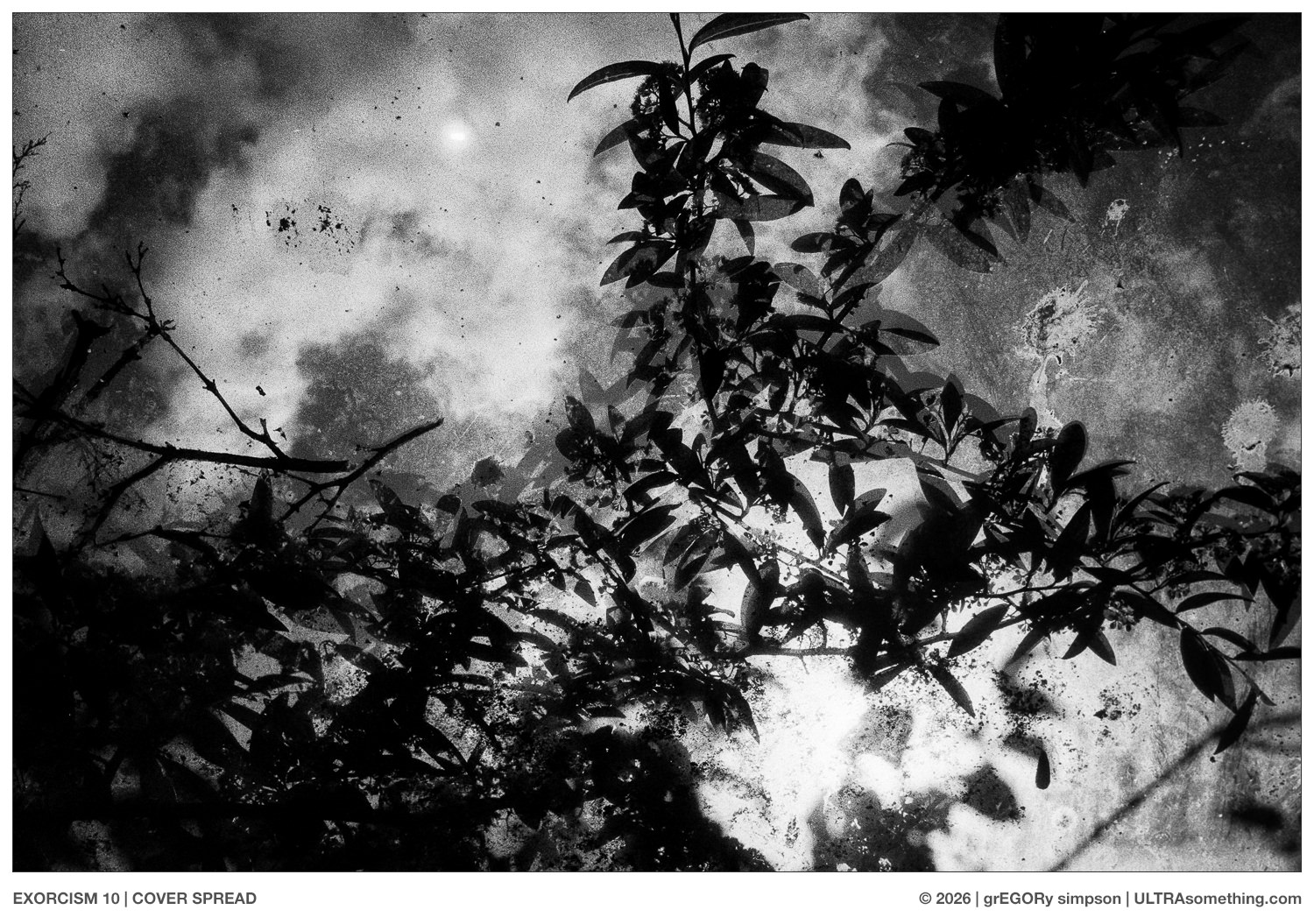
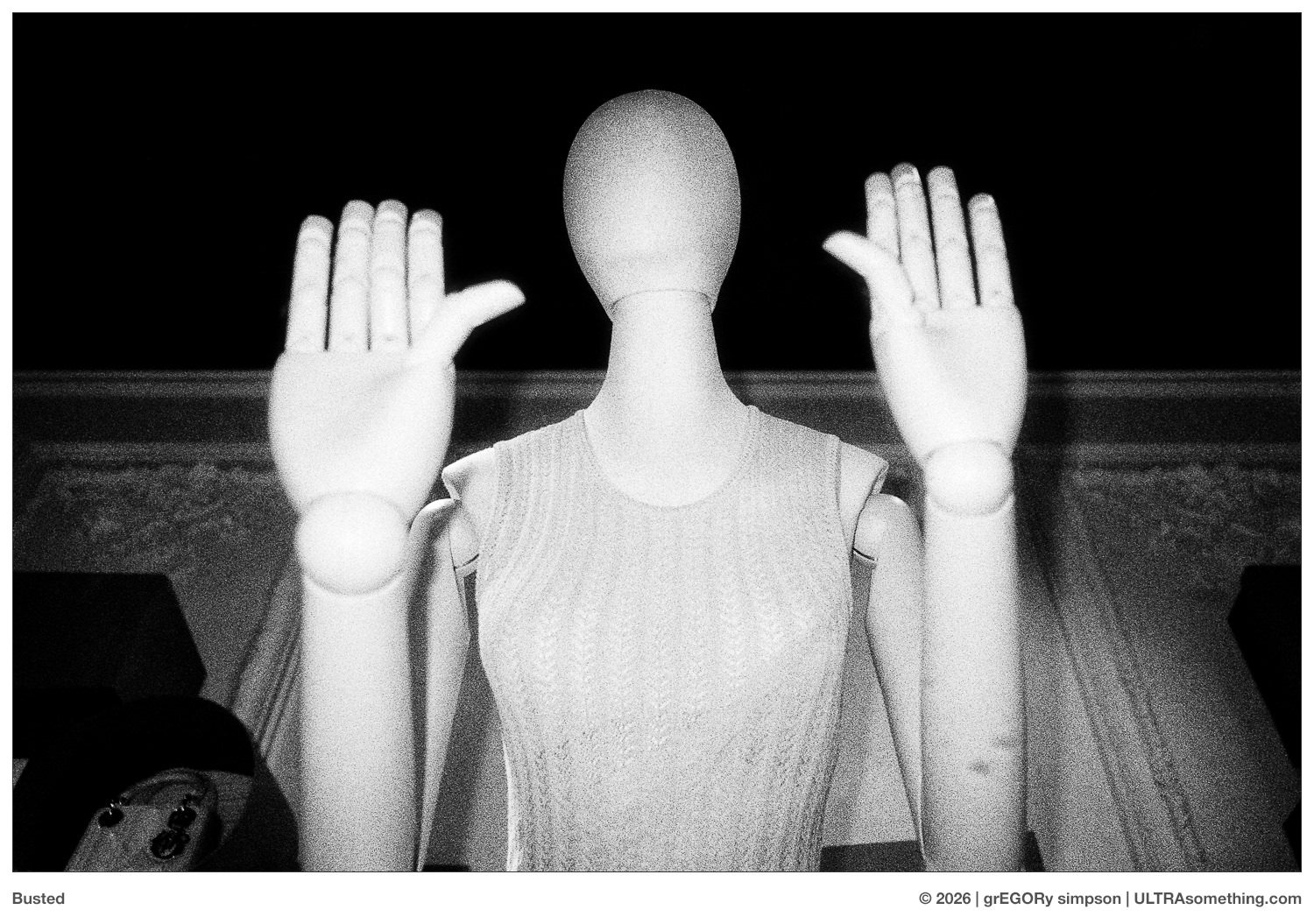
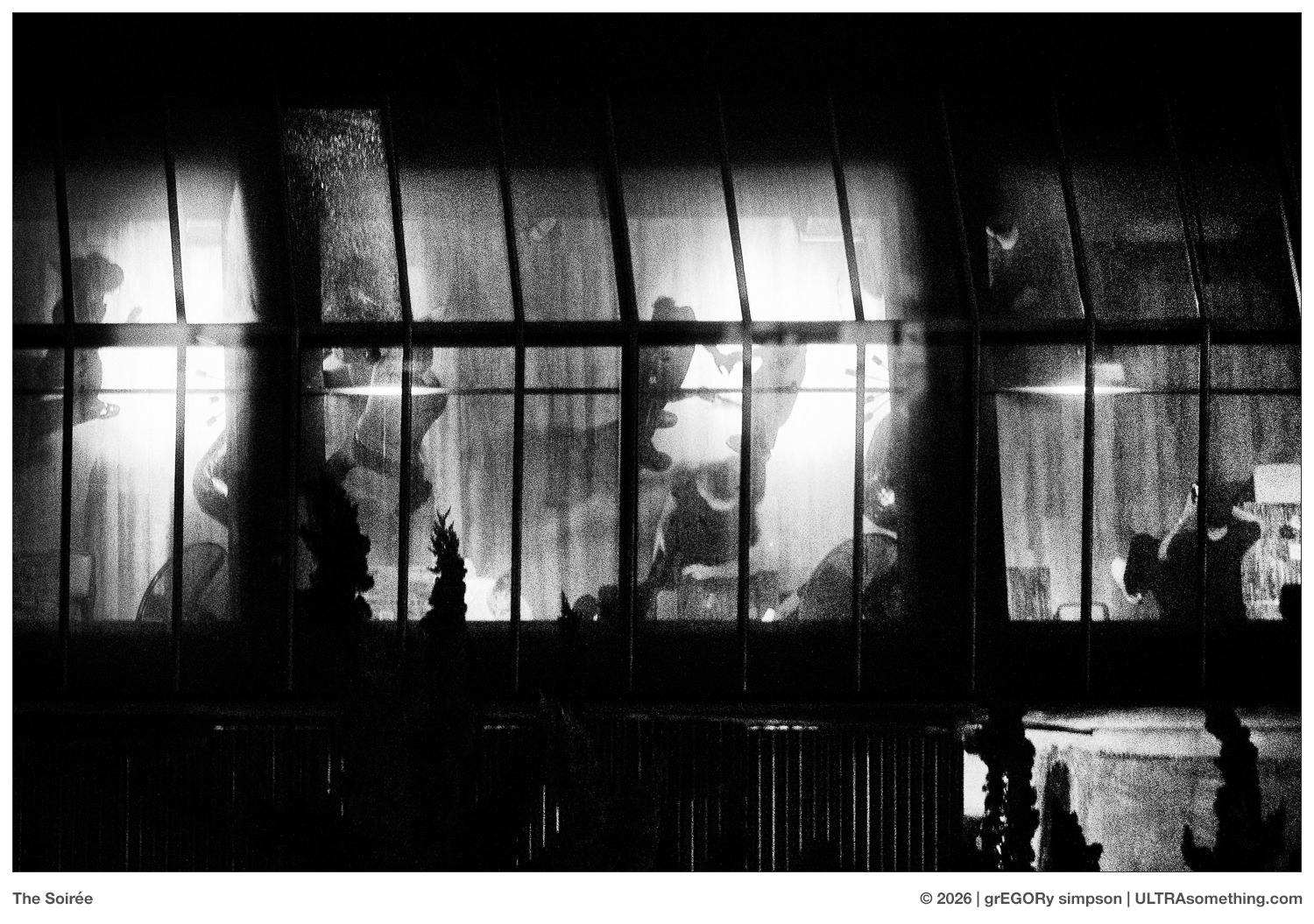
ABOUT THE PHOTOS: This month’s photo selections are representative of those only a blind man could love. Although “Cataract” could pass for a photo of an actual cataract surgery, it might just be a snapshot of my washing machine’s spin cycle, or maybe it’s a spinning tire. Whatever it is, it’s an apt metaphor for the article, which was shot with an Olympus OM-D E-M1 MKIII and an M-Zuiko 12mm f/2 lens.“Mixed Metaphors” and “November” were both shot at ISO 400 on HP5+ with a Leitz Minolta CL, fronted with a Minolta 40mm f/2 Rokkor lens, and developed in Blazinal 1:50. “COVID-22” infected a Konica C35, which was stuffed with Tri-X, exposed at ISO 400, and developed in Blazinal 1:50. And while “The Window of Abundant Obstructions” sounds like the title of a giallo I inexplicably haven’t seen, it’s really just the title of another photo of metaphorically fuzzy purpose. It comes courtesy of a Contax G1, fronted with a Zeiss Biogon 28mm f/2.8 lens, through which it rendered a latent image on Tri-X at ISO 400, which I then developed in Blazinal 1:50.
REMINDER: If you’ve managed to extract a modicum of enjoyment from the plethora of material contained on this site, please consider making a DONATION to its continuing evolution. As you’ve likely realized, ULTRAsomething is not an aggregator site. Serious time and effort go into developing the original content contained within these virtual walls — even the silly stuff.