For the past two months, I did something rather incredible — I stopped taking photos. Granted, I indulge in a similar (albeit somewhat shorter) sabbatical every couple of years, so perhaps this doesn’t appear so inconceivable on the surface. But this recent leave was actually quite different from all those previous. It wasn’t triggered by nihilism, doubt or self-loathing. Instead, I took two months off simply because I felt like playing music more than I felt like taking photos.
Some of you may wonder how one activity precludes the other, but I’m one of those ‘all or nothing’ guys. Either I give myself fully to something or I don’t give at all. I’m not a dabbler. I’m an obsessive, obstinate, indefatigable perfectionist. In my book, half-efforts are indistinguishable from no effort at all.
Not surprisingly, there’s a world of difference between choosing not to take photos and being driven there by existential anguish. For the first time in a decade, I would leave the apartment without strapping a camera to my wrist. Contrast this with my previous sabbaticals, during which I continued to compulsively carry a camera — looking, hoping, longing for some small glint of inspiration that would pull me from my despondent photographic quagmire. But now, there was no quagmire — and thus no neurotic need for the security of a camera.
I fully expected such blithe disregard for photography to eat at my soul, but no such erosion occurred. I was far too distracted by life’s sounds, rhythms and intricately accidental harmonies to concentrate on any of its visual aspects. I thought briefly of Garry Winogrand’s famous comment that “there are no pictures when I reload,” and repurposed it as “there are no pictures when I don’t have a camera.” How could there be? My photos are a direct result of what I see. If I’m not looking, then I’m not seeing. And if I’m not seeing, there can be no photos.
After two months of sating my musical fixations, I was ready to re-engage with photography. I felt good — energized; enthused; inspired. I grabbed a camera and hit the streets.
It was then I realized that ‘seeing’ isn’t so much an innate talent as a practiced skill — and without practice, well…
And so I started all over again at what felt like ‘square one.’ It was frustrating that after only a two month leave, I now found it difficult to find a scene’s more understated elements, or anticipate the shifting dynamics of my environment — and such frustration began to play with my mind and with my confidence. Are my capabilities really this fleeting? Are they gone for good? Does it even matter?
And then René Burri died.
At the risk of being misunderstood, it wasn’t so much Burri’s death that propelled me into a state of melancholia — we all must pass, and his was a full, rewarding and purposeful life — it was the aftermath. Specifically, it was the collective shrug offered by the photographic community.
The fact many mainstream news outlets didn’t report Burri’s passing didn’t really bother me — after all, it’s not like any of them still have photojournalists on staff. So how could they possibly know that one of the greats had died?
Nor was I necessarily troubled by those news organizations that did report Burri’s death, but deemed it significantly less important than Renée Zellweger’s plastic surgery — I’ve lived long enough to accept that humans are an inherently inane species.
No, what bothered me were all the photography outlets that should have known better; that should have cared; that should have respected not just Mr. Burri’s life’s work, but the principles and poetry inherent in the images he shot. To me, René Burri was the consummate “photographer’s photographer” — the sort who didn’t believe that a successful photo was one that looked good hanging over the sofa but, instead, was one that made you think — and not in an obvious way, but in a subtle “works its way into your subconscious over time” way. This is one of the things I admired most about René Burri: the fact I could look at his photos again and again and, years later, find new nuances and meanings that I hadn’t previously noticed.
So is this how the various photo websites also chose to remember René Burri? Hardly. At best they name-dropped him as “the guy who took that famous photo of Che Guevara,” or “the guy who took those famous photos of Picasso.” Mostly they just regurgitated Wikipedia info or the content contained within the Magnum Photos press release that announced his passing. One popular and influential photography site basically ignored his 60+ year photographic career, saying they “don’t quite get him” while focussing instead on Burri’s flamboyant mode of dress — suggesting that “the more a person looks like an ‘artist,’ the less likely he is to do work of genuine merit.”
And to think I actually once thought highly enough of photographers to classify René Burri as “their” photographer. If these are the sort of tributes offered by his peers, what hope is there for photography’s future? Why do I bother? Why am I torturing myself to regain my mastery of subtlety when the master himself, René Burri, is so easily dismissed simply for wearing a turquoise shirt and a fedora?
But on further consideration, I remembered that quality and appreciation have little to do with one another. The fact that Burri is, I believe, under-appreciated by the current generation of photographers does not, in any way, diminish or alter the work he did. It’s there for all of us to see — whether we choose to look is up to us.
I re-watched Anthony Austin’s short film, “Six Photographs: René Burri,” in which Mr. Burri discusses (not surprisingly) six of his photos. And I realized that Burri’s own words are, perhaps, his most fitting eulogy. It seems the great ones always have to do everything themselves…
And with that, my sabbatical ended. If René Burri taught me anything, it’s that we all have a legacy to complete — even if much of the world will only shrug.
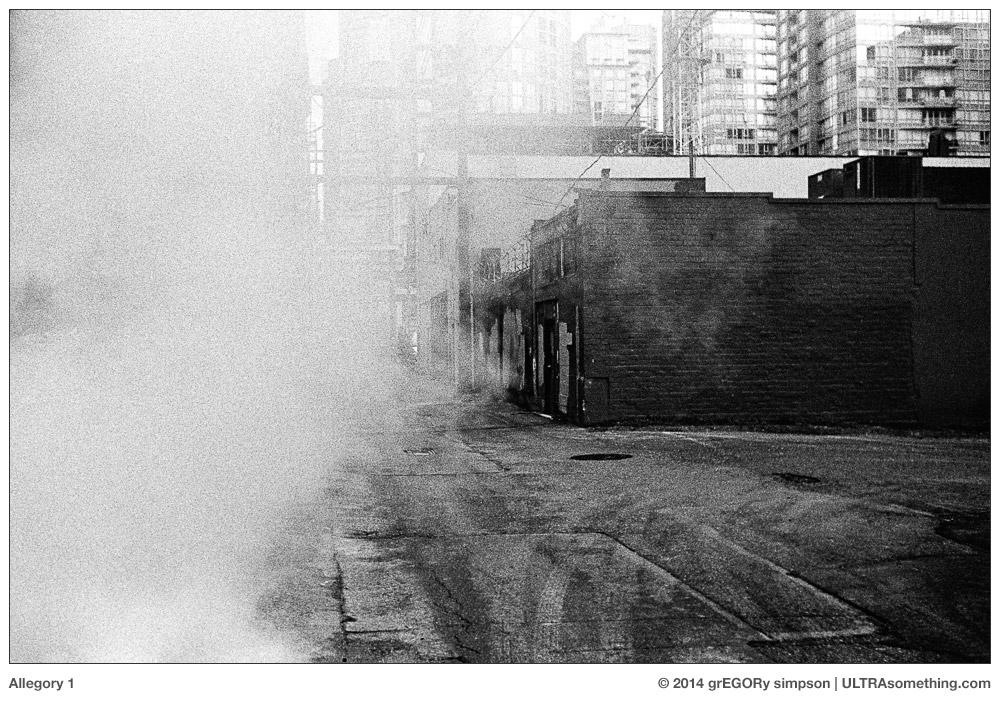
The photos accompanying this article are all allegories for its content. Yeah, I know — they’re not too subtle. But I did say I was ‘rusty.’
“Allegory 1” was shot with a Leica IIIc and a 50mm f/2 Summar lens at ISO 320 on Tri-X, which I developed in Rodinal 1:50. “Allegory 2” was shot with an Olympus OM-D E-M1 and a 60mm f/2.8 Macro lens (it was belching rain, and this is my only “weather sealed” body/lens combination). “Allegory 3” (in case it’s not obvious) is a “selfie.” I shot it with my trusty Ricoh GR. “Allegory 4″” was shot with a Leica M2 and a Voigtlander 50mm f/1.5 Nokton lens at ISO 400 on Tri-X, which I developed in HC-110 Dilution H. Perhaps this is a good time to mention just how silly it is that I include this data with every post — it’s not like these photos exhibit a level of technical perfection that would inspire others to emulate them. Mostly, I’m just lucky if I get my subject somewhat in focus and am able to frame some semblance of a composition.
If you find these photos enjoyable or the articles beneficial, please consider making a DONATION to this site’s continuing evolution. As you’ve likely realized, ULTRAsomething is not an aggregator site — serious time and effort go into developing the original content contained within these virtual walls.
If you’re wondering why this video contains a greater percentage of accurately exposed and sharply focused pictures than are normally found on ULTRAsomething, I have a perfectly good explanation: many of these photos are quite old! Granted, this is an excuse normally reserved for posting shots of lesser fidelity, not greater. But this site has always been rather contrarian in nature. I used old photos simply because I thought it would be fun to comb through a decade-old corner of my Lightroom library to see what I might find. And more often than not, what I found was embarrassing evidence that I once believed “accurately exposed” and “sharply focused” were synonyms for “good photograph.” Silly me. So in order to save myself the humiliation of having too many “proper” photos in the video, I decided to mix in a few recent shots of “dubious” quality, which are obviously more to my current liking.
For those who care about such things, here are the shot specs for each photo frame, in order, from the beginning of the video:
Frame 1: Ugly Bird – Canon EOS 20D + 135mm f/2L USM lens Frame 2: Migratory Flock – Canon EOS 40D + 17-40mm f/4L USM lens Frame 3: Nature Studies – Canon EOS 5D + 135mm f/2L USM lens Frame 4: Inverted Bird – Canon EOS 20D + 135mm f/2L USM lens Frame 5: Thirsty Bird – Leica M6TTL + 21mm f/2.8 Elmarit, Tri-X at ISO 400, Ilfotec DD-X Frame 6: Crows on a Rail – Olympus OM-D E-M1 + Olympus 60mm f/2.8 Macro lens Frame 7: Gull on a Waterfall – Leica M6TTL + 35mm f/2 Summicron-M (v4), FP4+ at ISO 250, Diafine Frame 8: Pigeon on a Rail – Olympus Pen EE-2, Kentmere 100 at ISO 50, Rodinal 1:50 Frame 9: Urban Birds – Ricoh GR Frame 10: Two Geese – Panasonic DMC-G1 (lens unknown) Frame 11: Flying Monkey – Canon EOS 20D + 70-300mm f/4.5-5.6 DO IS USM lens Frame 12: Tweeter – Canon EOS 40D + 17-40mm f/4L USM lens
For the even fewer of you who care about the audio/multimedia side of this presentation, I will mention that (as always), I composed the score specifically for this video. The recording was done in Ableton Live using a handful of software instruments (U-He Bazille, Native Instruments Absynth, FM8 and Monark) along with some software effects (Izotope Stutter Edit, Native Instruments Solid EQ and Solid Bus Comp, plus an assortment of processing plugins from Sound Toys.) The bulk of the sound was generated from multi tracking two different, but interconnected hardware synthesizers: a Dave Smith Instruments Pro 2 and a chaotic mess of knobs, wires, switches, circuit boards and jacks, which make up the modular synthesizer that I affectionally refer to as “the wee wiggler.” Video editing was performed in Final Cut Pro X.
If you find these photos enjoyable or the articles beneficial, please consider making a DONATION to this site’s continuing evolution. As you’ve likely realized, ULTRAsomething is not an aggregator site — serious time and effort go into developing the original content contained within these virtual walls.
For the past several years, I’ve ambled around this dreary cloud of middle-agedness, searching far and wide for the promised silver lining. As best I can tell, being middle-aged is the grown-up version of pre-adolescence. Both are periods of life in which, like a piece of head cheese (and about as unpopular), you find yourself sandwiched between two of life’s more favorable stages.
Pre-adolescents have outgrown the joyously innocent naivety of childhood, but haven’t yet experienced the hormonal upheaval needed to become a moody, snooty teenager who thinks everyone in their 30’s is clueless. Middle-agers have outlived the expiration date on which their opinions hold any social or economic relevance, but haven’t yet attained the seniority required to become a crotchety, cantankerous old bastard who thinks everyone in their 30’s is clueless.
Recently, on one of my exploratory strolls through the murky fog of middle-aged languor, I caught site of a flickering light — dim, but most definitely present. I trudged through the mental malaise for a closer look, and soon recognized the glimmering object as the long-sought silver lining. I traversed its expanse and caressed its glimmering fabric so as to better understand its purpose. What was this thing that would make middle-aged inconsequentiality all worthwhile? For what bright and shiny lining have we traded our youth and vigor?
The answer, it turns out, is “history.” Specifically, our own personal history and experiences — an observational database that’s rich and varied and, as yet, untainted by dementia. This lining has many names: “street smarts;” “enlightenment;” “awareness;” “understanding” — all of which denote the same state. Being middle-aged means, in general, that you know what’s what; your B.S. detectors are finely tuned; and you’ve basically seen and heard it all before.
It’s this last part that I find intriguing — this realization that, socially and culturally, nothing is new. Someone in their 20’s might witness the latest trend or product, and think “Wow, this is the vanguard of an entirely new reality!” But when someone middle-aged encounters this same occurrence, all they do is mentally calculate how long it’s been since it was last popular, and in what incarnation. For us middle-agers, the question isn’t so much “what’s new” as “what’s old?”
Art, fashion, culture and politics all have their own repetitive cycles — and each cycle circles past at varying diameters. The longer we live, the more of these cycles we observe. And the more we observe, the better we can predict (or even profit from) the cyclic nature of human whim.
Look, for example, at the computer industry. In the 1960’s and 1970’s, computers sat in a centralized location and served up data to remote access points. Then, for the next 30 years, personal computers were king — each of us interacting with a data repository that was ours and ours alone. Now we have cloud computing, which is this novel “new” idea in which computers sit in centralized locations and serve up data to remote access points.
Let’s look at another cycle — one that involves my lifelong career as a musician and designer/developer of music technology products. Specifically, let’s look at the synthesizer.
In the late 1960’s and early 1970’s, synthesizers were “modular.” Each musician would custom-assemble their instrument from various electronic modules, mount them side-by-side in a case, and connect their circuits via a maze of patch cables. If you’ve seen the cover of Wendy Carlos’ “Switched on Bach,” watched Brian De Palma’s “Phantom of the Paradise” or seen that giant tower of blinking lights and spaghetti beside Keith Emerson at an ELP concert, you’ve seen a modular synthesizer.
In the early 1970’s, compact analog synthesizers entered the scene. Guided by the Minimoog and Arp Odyssey, this new class of synth dispensed with the practice of allowing musicians to select and connect their own collection of modules. Instead, manufacturers chose the most commonly used synthesis elements and hard-wired them together behind a single, easier-to-understand front panel. Synthesizers were now accessible to all musicians of all skill levels, and the demise of modular synthesis was complete. This smaller, cheaper form of analog synthesis dominated the scene throughout the 1970’s and into the 1980’s, though it continued to evolve steadily — first through the advent of polyphony, then through the addition of programmable patch memories.
In the mid 1980’s, digital synthesizers began to elbow their way into neighbourhood music stores. And by the end of the decade — catalyzed by both the overwhelming success of Yamaha’s ubiquitous DX7 and the advent of affordable samplers, like the Ensoniq Mirage — the music industry announced the “death” of analog synthesis. Musicians, anxious to score the latest digital wonders, considered themselves lucky if their old analog gear netted any trade-in value at all.
In the 1990’s, digital algorithms became more elaborate and sample storage needs grew more extreme. Digital processing requirements quickly outpaced technology’s ability to supply hardware synthesizers with suitable built-in microprocessors, and by the late 1990’s the first real-time, computer-based synthesizers began to emerge. These software-based synthesizers — inexpensive, powerful and plentiful — lead to the near total extinction of the once-mighty hardware synthesizer market. Throughout the first decade of the 21st century only geeks and “luddites” used hardware synths, and electronic music became just another category of computer app.
But in a technologically driven era, one should never discount the power of geeks to reshape an industry. And the geeks who held to their belief that synthesizers should be hardware-based, soon found their own silver lining in the following fact: markets void of excessive profit incentive do not attract large corporations. All the big name synth manufacturers had long-abandoned the idea of innovating in the hardware synthesizer market, and this opened the doors for small, independent developers to release new hardware synthesizers.
Of course, music technology had moved beyond hardware synthesizers for a reason. So if a modern-day, purpose-built chunk of music hardware was going to entice musicians, it would need a particularly unique and compelling feature to do so. And what was that unique and compelling feature? Analog. The fact was, if you were a synthesist and didn’t want to sound like everyone else, you needed the one thing that digital couldn’t do — be analog.
And thus, the cycle began to reverse itself — a few brave souls started to build and release analog hardware. With the market long-deserted, their only competition was from the aging, wheezing synths of analog’s heyday — synths that were becoming increasingly more persnickety and increasingly more expensive to maintain and repair.
Synthesizer design legends like Bob Moog, Tom Oberheim and Dave Smith (Sequential Circuits) also benefited from the vacated hardware synth industry. Each, in the 21st century, was able to re-enter the analog synthesizer market they helped define and create 30 years earlier.
Riding shotgun on this trip back to the future was another phenomena — the rebirth of the modular synthesizer. Modulars picked up right where they left off in the early 1970’s — as a way for musicians to create truly one-of-a-kind instruments by assembling and connecting a diverse collection of individual synthesizer “building blocks.” If you don’t want to sound like everybody else, what better way than to assemble a synthesizer that’s totally unique to you, and you alone?
The modular synth industry has grown rapidly in the past few years, and its popularity has enticed hundreds of new “mom & pop” companies to enter the synthesizer market. Their startup costs remain low because they don’t need to design, build and sell an entire synthesizer. Rather, they just need to produce a piece of a synthesizer — something like an oscillator or a filter or some kind of voltage signal modifier. Today, modular synthesizers are more powerful, diverse and popular than when they were left for dead in the mid-1970’s.
Follow the time line: modular synth > analog synth > digital synth > software synth > analog synth > modular synth. Because I’ve lived long enough to witness its entirety, it becomes rather simple to predict the next wave: digital modular components and digital/analog hybrids. Heck, it’s already begun. In fact, my latest synth, though still resolutely monophonic and analog in spirit, is in fact a digital/analog hybrid…
I know what you’re thinking. You’re thinking, “Hey Egor, this is supposed to be a photography blog. Why are you writing about music technology?”
And the reason I’m writing about music technology (and cultural cycles, in general) is that you need only replace the word “synthesizer” with “camera,” and you now have a magic periscope into the future of photographic trends.
Take a look at all the products unveiled at the recent Photokina show and ask yourself, “which of these is the most interesting?” A younger man might well award this honor to some new system lens or to another incremental iteration of a currently fashionable camera. But a middle-aged man — one who’s been paying attention — will answer, “the Leica M-A.”
To my knowledge, Leica’s new M-A is the first truly professional-grade film camera released in the 21st century. Some have dismissed this announcement as proof that Leica is a relic of earlier times. Instead, I see it as a harbinger of things to come — a small but significant portent of a new breed of photographers, looking to differentiate themselves and their photos from the common processes and techniques employed by millions of their contemporaries. Leica, like Bob Moog, Tom Oberheim or Dave Smith, is the “legend” returning to its roots. Others will follow.
Unlike digital cameras, manufacturing a film camera does not require massive investment or technological know-how. It can (and will) become a cottage industry, driven by clever new ideas and the passion of both maker and shooter. A film camera does not need to sell a million units to be profitable. Like the modular synth market, “mom & pop” camera makers will begin to produce niche-oriented film cameras with unique characteristics that satisfy all manner of different photographic endeavours. I honestly expect, within the next decade, that I’ll be able to purchase a brand new, half-frame film camera to replace my finicky pair of early 1960 Olympus Pens. I also expect I’ll be able to purchase film cameras I haven’t yet imagined.
Leica has given us the first glimpse of a new future, and that future includes the re-birth of the film camera. Sure, the market will be different this time around, but such is the nature of cycles.
And how do I know all this? Because I’m a middle-aged man, and prescience based on historical perspective is my silver lining.
Other than having been all recently taken by me, these photos have little in common with one another — save for the fact that all were shot on a film camera of some type. Not only that, but they were all shot on film cameras from the last century because, well, film is currently quite unfashionable. This means you can view these photos in one of two ways: as evidence that I’m hopelessly behind the times, or as proof that I’m shrewdly ahead.
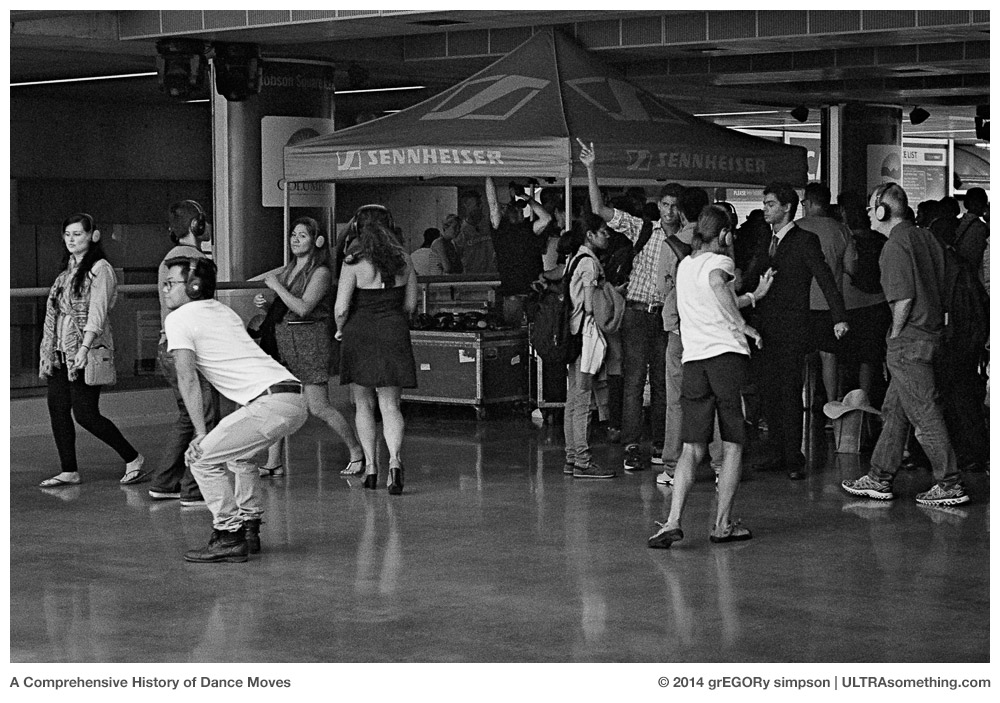
“A Comprehensive History of Dance Moves” and “Autonomy” were both shot on a Leica M2 with a Voigtlander 50mm f/1.5 Nokton lens, using Tri-X film exposed at ISO 400 and stand-developed in Caffenol-C-L.
“1:57 pm” was photographed with a Leica M2 fronted with a Voigtlander 50mm f/1.5 Nokton lens, using Tri-X film exposed at ISO 400, and developed in HC-110 dilution H.
“Pepsi & Poutine” was shot on a Leica IIIc with a Leitz 35mm f/3.4 Elmar lens, using Fomapan 100 film exposed at ISO 100, and stand-developed in Rodinal 1:100.
“A Practical Application for Art” was photographed with a Rollei 35T, using Tri-X film exposed at ISO 1000, and stand-developed in Caffenol C-L.
“Abandonment” came out of an Olympus Pen EE-2, using Kentmere 100 film exposed at ISO 50, and developed in Rodinal 1:50.
“Selfie Patrol” was shot on a Canon AE-1 with a Canon FD 50mm f/1.4 lens, using BW400CL film exposed at ISO 400, and lab-developed.
“Compatibility” was photographed using a Leica M2 and a v4 35mm f/2.0 Summicron lens, using Tri-X film exposed at ISO 400, and developed in HC-110 dilution H.
“Headspace” was shot with a Leica IIIc and a Leitz 50mm f/2 Summar lens, using Tri-X film exposed at ISO 320, and developed in Rodinal 1:50.
If you find these photos enjoyable or the articles beneficial, please consider making a DONATION to this site’s continuing evolution. As you’ve likely realized, ULTRAsomething is not an aggregator site — serious time and effort go into developing the original content contained within these virtual walls.
For me, the greatest advent of the digital photography era is neither the liberating ease with which images can be instantly realized, nor is it the impeccable fidelity of those images. Instead, it’s the way in which digital’s arrival rendered 160 years’ worth of camera gear instantly “obsolete.” In the blink of an eye, every film camera ever manufactured plummeted in value — sold for pennies on the dollar for a ticket on the digital bandwagon.
I’ll readily admit, if you were one of those who purged yourself of film during the digital coup, that you’ll likely disagree with this assertion. So, too, will anyone who simply has no need, interest nor appreciation of film. And this is precisely why this article and its opening proclamation began with the words, “for me.”
Unfortunately, every time I write something good about film, some folks scold me for being “anti digital.” And every time I write something good about digital, I get accused of “selling out” or “abandoning film.” So let’s set the record straight: I’ve been known to purchase a digital camera or two (or ten or twenty) in my lifetime, and I appreciate the easy workflow and stellar fidelity as much as the next photographer. In many instances, it’s exactly what my photography requires. But it’s not the only thing my photography requires. In other words, I don’t consider digital photography as a replacement for film. Rather, I see them as two entirely different and legitimate mediums that yield significantly different results. Oil paints may rule the roost amongst fine artists, but that doesn’t preclude the use of pastels, chalk, ink, water colors, wax, acrylics or any other pigment delivery mechanism an artist wishes to use.
For film lovers with heretofore prohibitive income levels, the post-digital buyer’s market created an intoxicating temptation — and I imbibed. Big time. Naturally, my first tendency was to purchase all sorts of high-end professional models that were now available for entry-level digital prices. And while I do delight in using these fine optical instruments, I’ve discovered something rather peculiar — I tend to enjoy crappy film cameras almost as much (if not more) than “pro” film cameras.
Upon reflection, the reason is quite clear: Because my digital cameras are capable of generating such flawless, technically-precise images, I no longer demand such perfection from my film cameras. In fact, as digital cameras improved, my appreciation for the defects, quirks and inconsistencies of film increased. Freed from the burden of creating “client worthy” photos on-demand, film cameras became a means for self-expression — a way to interpret my impressions of the world, rather than render that world in a realistic (or a trendy, hyper-realistic) light.
So now, not only am I constantly on the prowl for pro-grade film cameras, but you’ll frequently see me cruising for old consumer models, too. Which is exactly how and why I recently came into possession of an early-1960’s Olympus Pen EE-2 half-frame point-and-shoot.
Half the Frame, All the Joy
The Pen EE-2 is my second half-frame camera, and joins its higher-end sibling — the interchangeable lens Olympus Pen FT SLR — in ULTRAsomething’s increasingly crowded cabinet o’ cameras. Since purchasing the Pen FT some 18 months ago, I’ve run more film through that camera than any other that I own — a feat made even more remarkable when you consider I need to shoot twice as many photos in order to finish a roll. But I simply love the way it sees the world vertically, rather than horizontally. I love the fact that the 75+ images it squeezes onto a single roll of film allows me to experiment with the same reckless abandon that digital does, and I love the way the character of the film is amplified by the half-frame format.
While the Pen FT was the so-called professional model — introduced somewhat late in the product cycle — the Pen format was originally conceived as a consumer-level point-and-shoot line. So, given my newfound love for both half-frame photography and rudimentary cameras, it was inevitable that I would eventually own one of the consumer versions. And the Pen EE-2 is about as “consumer” as an early 1960’s camera can possibly get.
Though I profess to loving all cameras (even the ones I hate), I must confess that I can’t always find a unique or useful purpose for each and every model I experiment with. But in the case of the Olympus Pen EE-2, that purpose is clearly defined and quite obvious: it is my are-bure-boke camera.
Are-Bure-Boke
Are-Bure-Boke (pronounced ah-reh bu-reh bo-keh) is a Japanese term, coined to describe a particular style of photography that became increasingly influential in 1970’s Japan. “Are-Bure-Boke” means, literally, “rough, blurred and out-of-focus.” Needless to say, the type of photographs it describes are those that are rough (grainy), blurry and out-of-focus. This makes it one of the most aptly descriptive terms in the art world. Impressionism? Vague. Cubism? Vaguer. Street photography?The vaguest of all. Are-Bure-Boke? Now that’s specific.
Without getting into a long discourse on the history of photography, the career arcs of various photographers, or the stylistic influences of William Klein, Ed Van Der Elsken or Shomei Tomatsu, I’ll simply point you toward a few definitive examples of are-bure-boke photography: Takuma Nahahira’s “For a Language to Come;” Yutaka Takanashi’s “Toshi-E (Toward the City);” and pretty much everything that comes out of Daido Moriyama’s camera.
The Olympus Pen EE-2
The Pen EE-2 is a half-frame 35mm film camera. Theoretically, this means it delivers 72 exposures on a single roll of 36 exposure film. In practice, I’ve been getting about 78 exposures. Each negative is 24mm high by 18mm wide, meaning the camera shoots in “portrait” format. If you want to shoot in “landscape” format (the way most cameras do), you need to turn this camera sideways.
The EE-2 is permanently fronted with a 28mm f/3.5 lens, which gives a field of view roughly equivalent to a 40mm lens on a full-frame camera held sideways. Focus is not adjustable, and is fixed at 1.5 meters. Surrounding the lens is the camera’s “Electric Eye” or “EE” (which is a rather potent clue for those wondering how this camera got its designation). The “Electric Eye” is really nothing more elaborate than an old-fashioned selenium cell light meter, which thankfully means no batteries are needed to operate it.
The camera is gloriously free of bells and whistles. It has a flash sync terminal (which I haven’t used) and it has, umm, well it doesn’t really have anything else at all.
Many might believe a camera with a feature list this truncated couldn’t possibly be anything “special,” but that’s “upside down” logic. In reality, the camera is special because of what it doesn’t have. And what it doesn’t have is a plethora of shutter speeds. In fact, the camera features just two speeds. That’s right. Two. 1/40s and 1/125s. This is not a camera you’d use to photograph the Formula 1 circuit. Heck, even baseball’s a bit too vigorous for those lethargic shutter speeds.
But wait. It gets crazier.
The EE-2 supports both fully automatic and manual exposure. Since the selenium meter is over 50 years old, I knew its accuracy would be either dubious (at best), or flat out wrong (at worst). “No problem,” I thought. “I’ll just use manual exposure all the time, and forget about relying on the built-in meter.” Well, here’s the thing… you know those two shutter speeds I mentioned? Turns out that, in manual exposure mode, you only get one shutter speed, and it’s not the one you’d want — it’s 1/40s.
What’s this mean? It means that if you purchase an Olympus Pen EE-2 you have two choices: 1) shoot in fully automatic mode, meaning the camera chooses between 1/125 and 1/40, but makes you rely on a rather inaccurate and somewhat schizophrenic 50+ year old selenium cell meter, or 2) shoot everything with proper exposure, but with only a 1/40s shutter speed.
Yeah. Right.
Remember when I said the Pen EE-2 was my Are-Bure-Boke camera? Let’s break that down:
ARE: The Pen EE-2 is a half-frame camera. If one wishes to make prints the same size as a full-frame camera, its negatives need to be magnified twice as much. Magnify a negative and you magnify its grain (or “are” in Japanese).
BURE: The Pen EE-2 has exactly two shutter speeds — neither of which is fast enough to freeze action. Consequently, everything that moves will be at least a little bit blurry (or “bure” in Japanese).
BOKE: The Pen EE-2 is a fixed focus camera. This means, in subdued lighting, the camera will have too wide an aperture to deliver much depth-of-field, likely rendering your intended subject somewhat out-of-focus. Conversely, in bright lighting, the diffraction effects of the narrow aperture reek absolute havoc on overall focus. Ultimately, this camera appears to have the world’s narrowest “sweet spot,” virtually guaranteeing that anything you photograph will be at least a little bit out of focus (or “boke” in Japanese).
In the “old” days, I’d have chucked this Pen EE-2 in a drawer — never again to see the light of day (which, coincidentally, would greatly extend the life of its selenium cell). But these are the “digital” days, and what I look for in a film camera is increasingly dissimilar to what I look for in a digital camera.
So rather than feeling annoyed, I feel inspired. An inconsistent selenium cell automatically sets an unknown exposure on a questionably competent mechanical shutter that was, itself, woefully under spec’d over 50 years ago. How can you not embrace such randomness? There is beauty in the unpredictable. There is liberty, challenge, and a desire to point the eye of this are-bure-boke-matic at subjects that might please it; subjects that might match its unique aesthetic character. With it, I can learn to see as it sees, and explore an entirely new visual universe.
Photographing with the Pen EE-2 is like photographing with a mechanical I Ching. John Cage built a musical career around composing this way. Who’s to say I couldn’t do something similar with photography? This small, humble, consumer-grade, half-frame, 50 year-old point-and-shoot with its enigmatic imaging engine is one of the most emancipating cameras I’ve ever used. And to think, if it weren’t for the technical superiority of digital cameras, I’d have never discovered nor appreciated this camera’s many wonders…
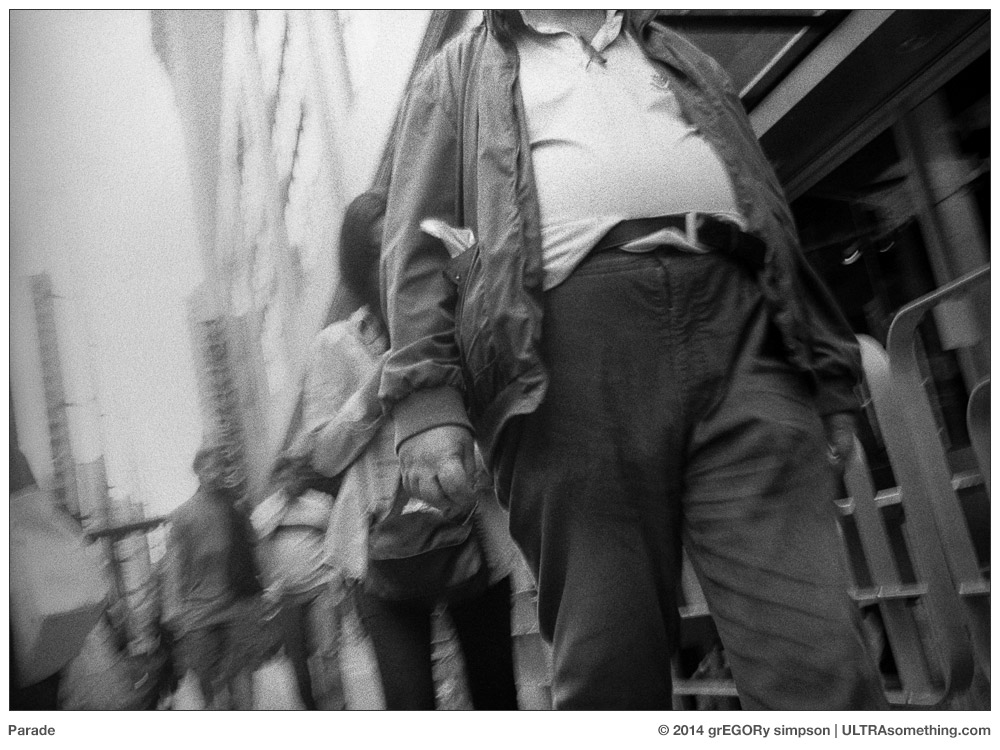
This article’s opening photo, “Parade” is quite likely my favorite shot of the year. I’ll leave it up to you to decide what that says about me, my capabilities and my judgement. Those of you who prefer to think of photography as a technical endeavor, will likely be more interested in knowing that the image was (as expected) shot with an Olympus Pen EE-2 using Kentmere 100 film, which I (ostensibly) exposed at ISO 320 and stand-developed in homemade Caffenol-C-L. Many of the other Pen EE-2 shots accompanying this article were also exposed on Kentmere 100 at ISO 320, and also developed in Caffenol-C-L. These include: “Brain Freeze,” “Architecture,” “Granular,” “True Love 1,” “Bike Lane Preservationist,” “Accoutrements,” and “Rocket Ride” (another shot for which I have a curious fondness). “True Love 2” resulted from a failed experiment with FP4+, which I (over)exposed at ISO 200 and developed in Caffenol-C-L. From the look of the negatives, I should probably have exposed it at ISO 500 (at least). Of course, this is purely conjecture since, in reality, I have no idea what sort of exposure values the 50+ year old selenium meter is reporting. “Assorted Pens” was shot on my digital Olympus OM-D E-M1 using a 60mm macro lens and providing irrefutable evidence to support my claim that “I appreciate (digital’s) easy workflow and stellar fidelity as much as the next photographer. In many instances, it’s exactly what my photography requires.”
If you find these photos enjoyable or the articles beneficial, please consider making a DONATION to this site’s continuing evolution. As you’ve likely realized, ULTRAsomething is not an aggregator site — serious time and effort go into developing the original content contained within these virtual walls.
Bloggers are know-it-alls. I know this because I am a blogger, and thus know it all. Fortunately, most of us limit our didactic soliloquies to a single subject — thus freeing ourselves from the burden of having to explain everything to everyone.
For the ULTRAsomething blog, I’ve chosen to expatiate on photography. Regrettably, I long ago opted to avoid the lucrative sub-genre of “better photography through trendy gear acquisition,” and instead chose to spray my verbiage in the general direction of “better photography through existentialism, nihilism, philosophy and psychology.”
Naturally, being a know-it-all, I was fully conscious of this avenue’s inevitable unpopularity — but I also knew that introspection is far more likely to improve one’s photography than replacing last month’s gear with this month’s.
The upside of such unfashionable pontification is that I basically have the niche all to myself. This means I can invent whatever theories I want, and thanks to the worldwide reach of the internet, they soon become uncontested fact.
Usually I present my hypotheses within tidy little essays that both formulate and justify whatever crap is currently rattling around in my head. But my latest bout of psychological pondering has me stumped. Even though I make it all up as I go, I still want my theories to possess a modicum of plausibility. But, try as I might, I can find no cogent answer to the following question:
“Why, when I see the following stack of objects atop my desk, am I filled with excitement, anticipation and hope…
… while the similarly-themed stack of objects, shown below, stimulates absolutely zero emotional impact?”
Both photos depict a means to the same end. Both are empty vessels, ready to be loaded into a camera and filled with photographs that have yet to be shot. Shouldn’t they have an identical effect on my psyche?
With the film stash shown here, I’ll be able to shoot roughly 2000 photographs (depending on which cameras I use). The trio of SD cards should hold twice that many photographs (again, depending on which cameras I use). But wait — not only do I own more SD cards than what’s shown here (enough for at least 10,000 raw-format photos), but SD cards can be used time-and-time again, yielding a nearly infinite number of “potential images.”
Based on these statistics, shouldn’t the SD cards stir my photographic passions more than the film? If a big stack of film ignites my expectations for all those yet-unrealized photos, why does a stack of SD cards fill me with no more hope than when I look at a pair of my shoes? I don’t gaze upon my shoes and imagine all the places they’ll take me. And frankly, it would be a little odd if I did. So why do I do this with film?
Some might think it’s because I prefer film to digital. But that’s not the case. I prefer both. Each has its merits and its demerits. Each is indispensable in ways the other is not. I would be no more capable of choosing which to eliminate from my life than would a mother choosing between her children.
I’ve considered tactility as a potential factor. That is, film produces a tactile, physical result — an actual image on a strip of acetate or polyester. The SD card stores data — the opposite of tactility. But in reality, all my film gets digitized and fed into the same Lightroom catalog, where its data becomes indistinguishable from data recorded on an SD card. So that can’t be it.
Perhaps it’s more a matter of longevity? After all, film is “permanent,” while data is fleeting. Once you’ve erased an SD card, your photos are at the mercy of your media backup strategy. But negatives have their own Achilles heel — fire and theft. And unlike digital files, negatives can’t be cloned ad infinitum. Destroy a negative and poof — it’s gone forever. Destroy a digital file and I’ve still got three backups scattered around the world. Since all my film gets digitized, it also gets subjected to the same backup strategy as anything shot with a digital camera. So the only difference is that film gives me one additional “backup” copy — the negative. But having one additional backup is hardly a reason for such a visceral emotional difference.
A decade ago, I thought film was more “future proof” than digital. But do I still? I was always quite aware that anything shot on film could one day be re-scanned and re-processed — using technological improvements in both equipment and software to yield a better print. Yet for some curious reason, I thought this wouldn’t be true with digital. I believed that “all the data in a digital file is already being fed into the computer, so it can never look any better than it looks today.” But this is simply not true. I have digital files taken a decade ago that looked so horrible, I assumed they were destined for obscurity. But when re-interpreted with modern raw converters and re-processed with modern software, photos made from old raw files can also look better now than when I took them. So I no longer believe in the “future proof” theory. Film or digital — squeeze ’em both hard enough and you’ll always get a little extra juice.
Next, I considered the possibility that film provides more variety. Although both the film and digital worlds feature a nearly inexhaustible assortment of cameras and lenses, there seems to be very little variety in digital sensors. Look at any one slice of time, and you’ll see that most of the cameras produced within that slice have nearly identical sensors. Marketing departments might try to convince you otherwise, but the digital camera market basically acts as a single, homogenous entity. So if I go down to the local camera shop and purchase six current-generation cameras, I’ll basically be getting the same sensor tech in six different bodies. But if I purchase six different types of film, I’ll get six very different “looks.”
So is that the answer? Is it that film offers more variety? I think not, and here’s the reason: while digital cameras may all be similar to one another at any one time, they continue to change throughout time. Sure, there might be precious little variety if I purchase a bunch of new digital cameras at the same time — but if I purchase different digital cameras at different times and from different eras, I’ll get plenty of variety. Just look at the visible differences produced between, say, a CMOS sensor and a CCD. They’re world’s apart. But they’re both digital. And though they’re the exception, there are a few oddball sensors out there that will also give you a different “look” — Leica’s Monochrom; Sigma’s Foveon; Sony’s upcoming curved sensor; Fuji’s X-Trans (though that one’s more similar to the ubiquitous Bayer pattern sensor than it is different). So the variety is there with digital — you just need to own enough cameras to see it.
Ahh! Maybe that’s it? By shooting film, I can achieve a wide variety of looks within a single camera body. But to achieve a similar diversity with digital requires ownership of multiple bodies. This was likely the same bong from which Ricoh toked back in 2009, when they released their GXR camera. For those who don’t remember, the Ricoh GXR was a camera that featured interchangeable sensors. I thought it was the greatest idea in the world, and I still own and love this camera. Unfortunately for Ricoh, not a lot of other people agreed. Consequently, I can no longer buy new sensors for my GXR, making it the digital equivalent of Kodak’s equally irrelevant APS film format.
So is that it? Is frugality the answer? It’s certainly cheaper to buy multiple types of film than multiple types of digital cameras. And if I owned only one film camera, then I might have just solved this case. But I don’t. I actually own far more film cameras than digital cameras. So the notion that film lets me achieve multiple looks with one camera, while digital requires multiple cameras completely disintegrates between the theory stage and reality.
So what is it? Why do I perform an excited little dance whenever a fresh batch of new film hits ULTRAsomething headquarters? Yet a new SD card thrills me slightly less than a new tube of toothpaste?
I haven’t a clue. But I’m determined to figure it out. It is, after all, why they call it PSYCHO-logy.
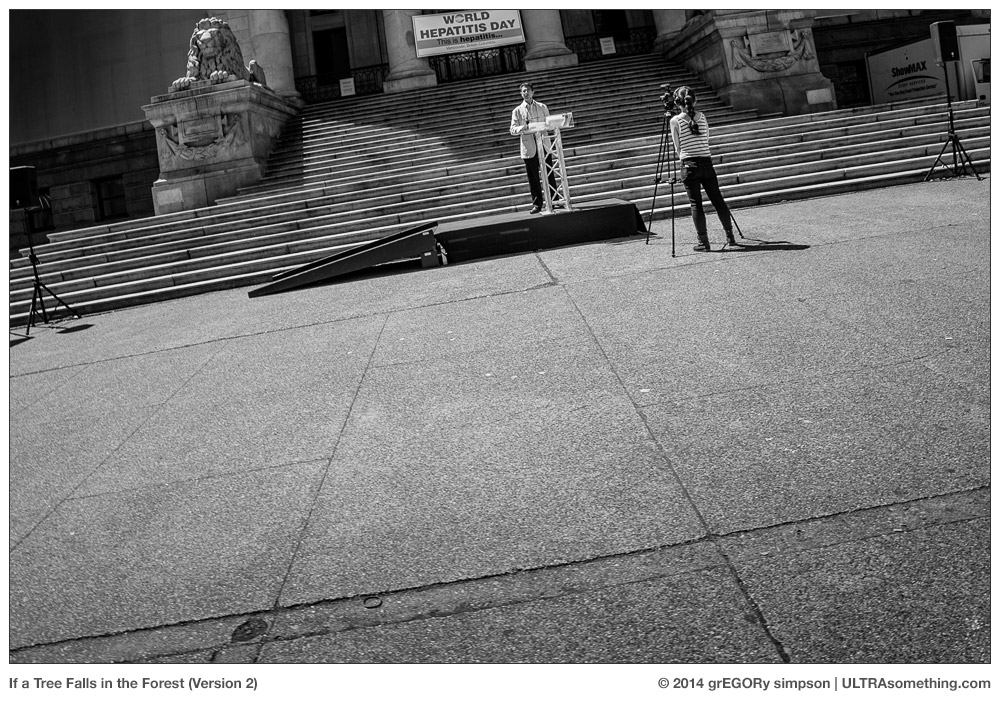
The photos contained within this article shine no additional light on the conundrum. Rather, they disprove yet another possible theory — that my approach to photography might somehow be different depending on whether I shoot film or digital. But it turns out this isn’t the case — I respond to the same subjects and the same stimuli, whether I’m depositing that image onto film or onto an SD Card. Case in point: the two “If a Tree Falls in the Forest” photos. Both illustrate the same situation — an embarrassingly small turnout to what, obviously, was expected to be a much more significant event. The first photo (which, paradoxically, is “version 2” of the “If a Tree Falls in the Forest” theme) was shot on a Ricoh GR digital camera using its 21mm (equivalent) lens adapter attachment. The second photo (which is “version 1” of the “If a Tree Falls in the Forest” theme) was shot with a Hasselblad Xpan using its 45mm lens, and developed in Caffenol-C-M. (See Note 1)
“A Failure to Communicate 3” is a continuation of a theme that began in my previous article, The Blacksmith’s Lot. That article contains two different photos illustrating a communications breakdown — both of which were shot on film. But the photo contained within this article was shot on a digital Ricoh GR, this time with its unmodified 28mm (equivalent) lens. Just as with the “tree falls” series, it illustrates that film and digital seem to have no bearing on the sort of photos I take, eliminating this as another potential answer to the question posed within the article.
Note 1: For those wondering why this photo was taken with an Xpan, yet isn’t panoramic, the answer is simple: The Xpan lets you choose between panoramic (65 x 24) format or standard (36 x 24) format. What’s particularly cool about this is that you can make these changes mid-roll. I learned rather early on that I can always squeeze one extra frame out of a panoramic roll of shots if, at some point in the roll, I switch the camera over and take one standard frame image. It’s the sort of thing you do to maximize your film dollar, and is also the sort of thing that’s completely unnecessary when shooting on SD cards — thus making yet another effective argument that my emotional delight at having plenty of unexposed film in stock is, perhaps, a bit psychotic.
If you find these photos enjoyable or the articles beneficial, please consider making a DONATION to this site’s continuing evolution. As you’ve likely realized, ULTRAsomething is not an aggregator site — serious time and effort go into developing the original content contained within these virtual walls.
“Wow! Was that your father’s camera?” asks the young be-suited man, nodding his head toward the Voigtlander Vito III dangling like an anchor from my neck.
I pretend he isn’t the fourth person to ask me this question today, and politely reply that “no, it was not” and “yes, there is a market for used film cameras.” A predictable course of banter follows, and I answer accordingly: “Sure, you can still buy film;” and “I don’t know where the nearest lab is — I just develop it myself;” and “no, it’s very easy and quite inexpensive.”
It’s not just the Vito III — most any time I venture into a crowd with one of my (way too many) film cameras, someone inevitably asks if it once belonged to my dad. Curiously, the only camera I own that actually did come from my dad is a Canon AE-1 — yet no one’s ever asked if that was my Dad’s camera. I’ve even been asked if my digital Leica M9 was my Dad’s camera. Stranger still, given the plethora of great female photographers throughout history, no one’s ever once asked if a particular camera belonged to my mother, even though carrying my Minolta Freedom Vista would afford me the ability to answer “yes.”
Other than my Rolleicord, the Vito III solicits more “father’s camera” inquiries than any other camera I own. It is, after all, a folding camera — definitely a relic of an earlier age — though it’s an age more associated with my grandfather’s era than my father’s.
Second in popularity to the “father’s camera” inquiry is the ever-curious, “does that thing still work?” I’ve never quite understood this question. I mean, how moronic would I have to be to walk around town with a non-functioning, ponderous chunk of metal and glass slung around my neck? Do these people think it’s a form of masochistic jewelry? Do they assume I’m being hazed for entrance into some fraternity of middle-aged men? I’m less likely to enter into conversation with these folks — offering a simple “yes, it works,” before hurrying along.
I suspect most ULTRAsomething readers will be interested more in how the Vito III operates than to whom it once belonged. But just how does one go about reviewing a camera that’s over 60 years old? Today’s gear expectations are not the same as our ancestor’s. Auto-focus, auto-exposure and scene modes are now the norm. So, too, is WiFi connectivity, built-in HDR and auto-stitched panoramas.
But really, are our needs all that different today than they were in 1950? Don’t the bulk of the features contained within modern cameras exist simply so today’s photographers need to know less in order to take a photo, and work less in order to share and display it? Isn’t the ultimate goal the same — a photograph?
From this perspective, it becomes rather easy to review old cameras — one needs merely evaluate them on how well they perform one simple task: photography. This means such attributes as build, handling and image quality are the yardsticks by which to measure the camera. So how does the Vito III measure up?
A Spot of History
The Vito III was made in the early 1950’s, and is one of the last cameras from the folder era. Truth be told, the folding camera market was basically dead by 1950, and this is why the Vito III is now such a rare camera: low demand meant low supply. Dueling historians argue over whether Voigtlander produced 12,000 or 16,000 of these cameras. But whichever historian you believe, the fact remains there are very few of these cameras out in the wild.
It’s important to remember that the Vito III’s low demand was due entirely to fashion and not to quality. In fact, many believe the Vito III may well be the best 35mm folding camera ever produced. It’s a bold claim that I can’t personally verify, since I’ve shot with very few 35mm folding cameras. But what I can say is that the Vito III is an absolute mechanical wonder, which is as pleasurable to use as its photos are to view.
Obviously the Vito III contains none of the advanced features expected in modern cameras. It was born in the day when cameras required their operators to have a smidgeon of knowledge. First, one needs to have some way of evaluating ambient light conditions — either by using an external light meter or by “seat of the pants” guestimation (my personal favorite). Second, it’s beneficial to have a rudimentary understanding of how aperture and shutter speed affect an image. And finally, it helps to know how to focus the darn thing.
That’s it. If you know these few, simple basics, then you can operate any old film camera without relying on owner’s manuals, menus, and multiple modes of operation. Learn one, learn ’em all. That’s one of the many benefits of old film cameras, and the Vito III is no different — though it is both a spectacularly good and somewhat quirky example, as we’re about to see.
The Good
The good is that the Vito III is a folding camera. You could carry it in your jacket pocket, assuming that pocket is stitched with titanium thread. This is one heavy (and well-made) camera — but it folds up compactly and slips effortlessly into a bag.
Its 50mm Ultron lens opens all the way to f/2 — a rarity for fixed lens cameras (of any era). The lens quality is superb, and I have no qualms shooting it wide open. Sure, it’s a bit “dreamy” at f/2, but this is an attribute I actually appreciate. Stop it down, and this lens could be the flag bearer in the sharpness parade.
Thanks to both the camera’s weight and its Synchro-Compur leaf shutter, handheld shots remain crisper at slower shutter speeds than do shots taken with lighter cameras that feature focal plane shutters. Basically, weight + leaf shutter = the 1950 equivalent of “image stabilization.”
Unlike many fixed lens cameras of its era — most of which required the user to estimate the subject’s distance — the Vito III has a built-in, coupled rangefinder. That rangefinder also happens to be quite accurate and, surprisingly, has a focussing patch that’s still bright and contrasty enough to actually see.
The Quirkily Good
Speaking of focusing, the Vito III uses a totally wacky focus methodology. Rather than turning a focus ring on the lens to focus it, the camera is focussed by turning a knob on the top of the camera. This allows you to firmly grasp the camera with both hands — your right hand doing double duty on the shutter release, and your left hand twiddling the focus knob. It took a few days before this got instilled into my muscle memory, but once it took hold, I really started to enjoy the ergonomics of focussing this way.
Since the focus knob is where most cameras place the film rewind knob, the Vito III engineers crafted a rather clever dual-functioning knob, where flicking a button releases a handle that transforms the focus knob’s functionality into the expected rewind knob. It’s quite ingenious, and one of those things that makes old film cameras so fun to fiddle with.
Not content to limit their ingenuity to knobs, the Vito III also sports a cool little pop-up stand on its baseplate, which allows the camera to sit perfectly level on a tabletop whenever the lens bellows is extended. Again, it’s the sort of nicety that’s so utterly associated with an earlier era, that I just can’t help playing with it.
The Quirkily Quirky
Strangely, the Vito III’s viewfinder has absolutely no frame lines of any kind. Zip. Zero. Nada. This means the exact cropping of every photo you take is going to be somewhat of a surprise. And if your subject is at the lens’ minimum focus distance, there’s a darn good chance the surprise won’t be a good one — parallax errors forcing anything seen in the center of the viewfinder to ultimately appear at the top (or even off the top) of your photograph. I suppose this is something I’ll get used to eventually, but it’s going to take a few more rolls before I have a handle on what will and will not be in my photographs.
Continuing in the frame vein, I should probably mention that frames on a Vito III negative are more tightly packed than on any of my other cameras — meaning the space between photos is absurdly small. The upside of this is I always get one more shot per roll than I would get with any other camera. The downside is that one needs the hands of a surgeon to cut up negatives without cutting into an actual frame.
The next issue isn’t necessarily “quirky” nor is it unique to the Vito III: but the shutter does need to be manually cocked. My Rolleicord, which is a medium format camera, also works this way. But in the 35mm world, it’s much more common to have the shutter automatically cocked by the film advance. On the Vito III, advancing the film and cocking the shutter are two separate and distinct operations — both of which must be completed prior to taking a photograph. Having grown accustom to this two-step dance with my Rolleicord, I found it wasn’t really much of a problem with the Vito III. In the several rolls of film that I’ve now spooled through the camera, I think I forgot to cock the shutter only twice.
One issue I haven’t adequately resolved is the curious fact that the Vito III was built without strap lugs. If you want to dangle the Vito III from your shoulder, you’ll need to use the camera’s original ever-ready case to do so. As I have a psychological aversion to ever-ready cases, this has presented a bit of a problem for me.
I did my best to adapt to the ever-ready case. I used it for the first roll or two that I ran through the camera. And if it was the sort of ever-ready case that allowed you to detach the front half from the back half, I’d probably still be using it. But it’s not — it’s the sort that has the front flap firmly and permanently affixed to the body-case, thus insuring it’s always dangling like a turkey waddle below the camera body.
I next tried carrying the camera in a small, easily accessed bag — but it simply takes too long to extract the camera and open the lens. It’s already a camera that demands slow and deliberate shooting, and since I tend to photograph rather ephemeral subjects, it took a total of 6 shots for me to reject this solution.
So lately, I’ve opted for the roguishly swashbuckling technique of carrying the camera in-hand, with the lens extended and ready for business. Without any type of strap to secure the camera, I adopted a gripping technique in which I curl my fingertips into the opening where the bellows extends. Besides the fact that I need to be careful not to jam a finger into the bellows, there’s an additional complication: an extension lever, which couples the shutter release button with the actual shutter release on the lens, runs right under my fingertips — meaning I need to alter my grip before I can actually take a photo. Considering this might well be the most delightfully engineered camera I’ve ever used, the absence of any strap securing methodology strikes me as totally insane. But in the Vito III’s time, no one used a camera without an ever-ready case, so I guess there was some sort of perverse logic to this decision.
Conclusion
Have you ever been to one of those ‘old-timey’ tourist traps? The kind where actors dress in period costume and perform bygone tasks like butter churning and blacksmithing? I used to feel somewhat sorry for those folks — possessing a skill that nobody actually wanted. But at some point during the middle of this review, it occurred to me that I have become one of them! Film photographers are quickly facing the same fate the befell farriers — practitioners of a craft with a greatly diminished demand. But sadly, unlike the aforementioned butter churners and blacksmiths, film photographers haven’t yet (to my knowledge) become a staple in historical reenactment attractions. But if they ever do, then the Vito III would make a mighty fine prop: durable, dependable and decidedly old-fashioned in appearance.
In its day, the Vito III was considered the pinnacle of 35mm folders. It was a professional’s camera — designed to appeal to that era’s luddites, who preferred the familiar old-skool folding camera format to those fancy new Leica III’s.
In our day, the Vito III is still considered the pinnacle of 35mm folders — though it’s likely not a camera one would choose for daily use. Nor is it necessarily going to be the one film camera you choose to own should you decide to own one. But it is, in its own way, a work of art. And in the hands of a skilled photographer, works of art should emerge effortlessly from this camera.
When I bought the Vito III, I wasn’t sure how much use it would get. But now that I’ve had it for several months, I’m finding myself turning to it more-and-more frequently — often throwing it into a bag just because it slips so easily into a sliver of space. “Modern” guy that I am, I usually prefer shooting with my Leica III’s, but there’s a seductive quality to the Voigtlander Vito III that entices. It’s a camera that’s easy for camera lovers to love.
And by the way, should anyone need an old-timey photographer to set up shop in their old-timey tourist village, I’m pretty sure I’ve got an old-timey Domke photo vest around here somewhere. It’ll make a swell costume.
This article contains two types of photos: those taken with the Voigtlander Vito III and those taken of the Voigtlander Vito III. It’s fairly obvious which camera took the former, while the latter were both shot with an Olympus OM-D E-M1 with a 60mm Macro lens. The Vito III photos shown here were shot on two different film stocks. Specifically, “A Failure to Communicate 1,” “Target Marketing,” “Demi-Monde,” “Type B: Two Types” and “Portland: First Light” were all shot on Fomapan 200, exposed at ISO 160, and developed in Rodinal 1:50. “Obstacle” and “A Failure to Communicate 2” were shot on Fomapan 100, exposed at ISO 100, and developed in Rodinal 1:50.
Regarding the product photos: “Voigtlander Vito III” shows the camera open and ready for action. “Top-Deck Focus” shows the location of the Vito III’s focus mechanism, as discussed in the article. Incidentally, you would be safe to assume that a backdrop consisting of Vladimír Birgus’ book, “Czech Photographic Avant-Garde” does, indeed, constitute a tacit recommendation.
If you find these photos enjoyable or the articles beneficial, please consider making a DONATION to this site’s continuing evolution. As you’ve likely realized, ULTRAsomething is not an aggregator site — serious time and effort go into developing the original content contained within these virtual walls.
Word on the street is that ULTRAsomething is a photography blog. But in the six years I’ve dutifully supplied it with text and photographs, I never once considered myself a blogger. Perhaps that’s because, as a blog, ULTRAsomething does everything wrong. New posts don’t appear daily. And when they do appear, they’re neither simple nor succinct. They weave multiple subjects into crafted narratives and gleefully embrace diversion — seemingly addressing one topic, while subtly being about something else entirely. As blogs go, ULTRAsomething may well be one of the worst examples on the net.
Because nobody wants to create the “worst example” of anything, I spent the past six years trying to convince people that ULTRAsomething was not a blog, and that I was not a blogger. For a time, I described this site as a column and myself as a columnist. Yet everyone still called me a blogger. So I began alluding to ULTRAsomething as a publication and myself as an essayist. “Great blog,” wrote my readers. A couple of years ago, I tried something more “clever,” and referred to the posts as ARTicles — the capitalization scheme designed to mirror the site’s name, as well as provide a playfully ironic bit of word play. But in the wide world of the web, ULTRAsomething remained a blog.
So when I redesigned the site last month, I gave up trying to refer to this collection of columns, essays and ARTicles as anything other than a “blog.” If that’s what people want to call it, that’s what it must be. So to commemorate the occasion, I did something unprecedented on the ULTRAsomething site: I wrote an actual blog entry. Note that I define “blog” in a somewhat rigid, old-fashioned way (if anything web-related can be considered “old-fashioned”). The word “blog” is short for “web log,” which I interpret most literally to mean “an activities log kept on the web, rather than in a hand-written notebook.”
The idea was to keep a detailed record of my findings and observations as I fine-tuned my caffenol film developing methodologies. Caffenol, as discussed in the first post, is a DIY film developer mixed from instant coffee, washing soda and Vitamin C. Given its experimental, grass-roots formulation, very little data exists. So, in order to give a little something back to the community, I decided to document each and every caffenol experiment — discussing exactly what I did, how I did it, and what film I did it to. In other words, a “web log.”
Curiously, after finally succumbing to the pressure to call ULTRAsomething a “blog,” and after writing its first true term-complient posting ever, the Caffenolog 1 entry became my least read article of the year. Funny how that works…
Experiment 2: Neopan Acros 100
Caffenolog 1 ended with my utter amazement that this syrupy swill actually worked. Not only that, it worked quite well. The only issue I had was that I’m not particularly fond of the way Kentmere 100’s grain looks when pushed to ISO 200. So for this experiment, I’ve done everything exactly the same as before, only I’ve used Fuji Neopan Acros 100 film, which I also pushed to ISO 200. Please refer to the Caffenolog 1 post for the ingredients, recipe and techniques that I used here.
I again made up a 500ml batch of Caffenol-C-M, even though I only need 300ml to develop a single roll of film. If anyone routinely whips up caffenol batches of less than 500ml, please leave a comment and let the caffenol community know your results. I would have done it myself, but downscaling the recipe would necessitate measuring ingredients in tenths of a gram, and my scale is granular only to whole grams. Perhaps, given my inherent frugality, this will be the focus of a future experiment.
Aside from the film itself, the only other thing that changed from my previous experiment was the water temperature. My water supply clocked in at 23.5°C — a half-degree cooler than before. So I made a slight adjustment and increased development time from 10:50 to 11:17.
Just as with the Kentmere 100, the Acros 100 emerged from the tank much darker than film developed in anything I’ve used previously. Note that when I talk about the “darkness” of the negative, I’m not referring to a dark (overexposed or overdeveloped) image — I’m talking about the entire negative, sprocket region and all. Most B&W negatives are fairly clear in the regions surrounding the actual image, but with Caffenol, those areas are extraordinarily dark. Currently, I’m assuming this is due to staining from the coffee and not an overall fogging — though a future experiment involving the addition of Potassium Bromide will either confirm or disprove this suspicion. I did note that the Acros 100 negative was slighty less dark than the Kentmere 100 negative — perhaps on the order of a half-stop. I wonder if this has to do with the fact that Kentmere 100 sits on an acetate base, while Acros 100 uses a polyester base? It’s another data point to investigate moving forward.
To insure the least number of variables possible, I shot this set of negatives using the same camera that I used in the first experiment — a Hasselblad XPan. Similarly, all negatives were “scanned” with the same Olympus 60mm macro lens mounted on the same Olympus OM-D E-M1 digital camera.
Although it’s difficult to tell from the downsized, web-compressed photos shown in this post, there were some significant differences between the two sets of negatives. As I had hoped, the Acros 100 had a much tighter and more pleasing grain structure, along with a very rich and malleable set of mid-tones. The shadows were, however, rather unsatisfying — blocking up quickly and exhibiting very little detail.
It was at this point that I realized I made a fundamental error in judgement. I had never before shot with Acros 100 and was thus completely unfamiliar with how it “normally” looks, much less how well it responds to 1-stop pushes. So this second caffenol experiment really doesn’t tell me anything useful. Maybe the shadows normally block up when Acros 100 is pushed? I don’t know. And for this reason, I don’t know whether caffenol is the cause or not. As nice as I think the highlights and mid-tones look here, maybe they actually look better (or worse) in a standard developer? Again, without having any prior experience with Acros 100, there’s no way for me to know whether caffenol is a good developer choice or a poor one.
So my direction for the next caffenol experiment is obvious — use a film with which I’m intimately familiar: Tri-X perhaps. That way I have a base of knowledge upon which to draw some conclusions…
As with my first caffenol experiment, I had a very short amount of time available for exposing the test roll. So just as I did then, I looked for a “theme” to help me quickly push film through the camera. This roll’s theme was lines: all kinds of lines. Some lines were fairly literal, some were implied, and some were wordplay tricks (or “cheating,” if you prefer). But everything I shot was some kind of line. “Telephone Lines,” “Converging Lines,” “Guy-Lines,” “Out of Line,” “Undulating Lines” and “Ikea’s New Stads-Rotä Line” were all shot with a 45mm Hasselblad XPan lens mounted on a first-generation Hasselblad XPan, exposed on Fuji Neopan Acros 100, which I rated at ISO 200 and developed in Cafenol-C-M as described in this (and the previous) caffenol article. “Horizon Line” was shot with the same configuration, only a 90mm lens was used instead. And for anyone wondering about the Ikea shot, the answer is “no I don’t speak Swedish, but I did manage to name this furniture line with the help of Google Translate.” Actually, I had several other names in mind, but I really wanted an umlaut, so it took a bit of experimenting…
If you find these photos enjoyable or the articles beneficial, please consider making a DONATION to this site’s continuing evolution. As you’ve likely realized, ULTRAsomething is not an aggregator site — serious time and effort go into developing the original content contained within these virtual walls.
The idea of a website refresh struck me, quite literally, while walking down the sidewalk one pleasant afternoon. An oblivious smartphone user — their attention focused intently on their handheld device — slammed into me with such force that I nearly dropped my own device — a decidedly less-fashionable, early-1960s Olympus PEN-EE half-frame film camera.
Were it not for my deftly executed evasion effort, the collision would have been head-on, rather than the shoulder-to-shoulder impact that resulted.
“Umph,” I said involuntarily, as the air rushed from my lungs.
“Sorry,” grunted the iperson, never once lifting their eyes from the device. It was the sort of unapologetic apology that could only come from someone who repeats it several times a day.
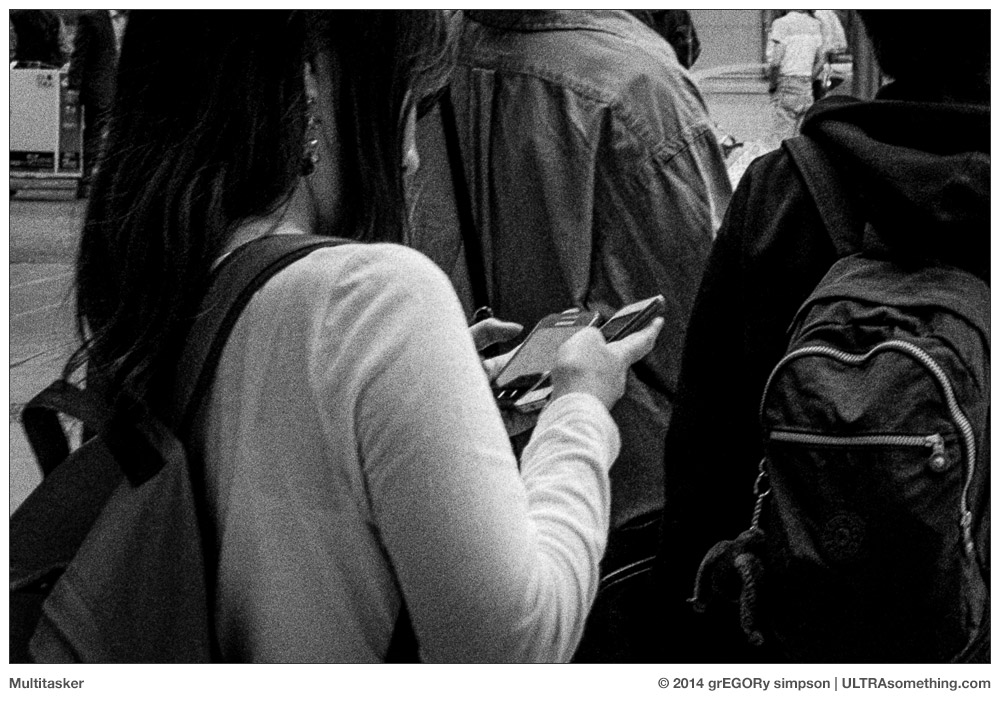
Over the past few years, collisions with distracted smartphone users have risen to second place on my personal list of ‘bruises, contusions and their causes.’ Annoying? Certainly. But many years on earth have taught me the futility of my attempts to change the course of human behavior. So these days, instead of rebelling, I seek to adapt. And I realized that, amongst these millions of isolated and preoccupied souls, not a single one of them was being distracted by the ULTRAsomething site — because the ULTRAsomething site was fundamentally unreadable on a smartphone.
If social mores now dictate that people plow into one another on the street, then shouldn’t I get a piece of that action? Shouldn’t I, in some small way, contribute to the new spirit of heedlessness that’s sweeping the world? Wouldn’t it be great if, instead of muttering “sorry” after ramming into someone, people could say, “sorry, I was totally absorbed and enthralled by the latest ULTRAsomething post.” Now that’s worth a bruise or two.
Since the dawn of the world wide web, I’ve changed my site once every five years. It’s a rate far too infrequent to keep pace with the ever-shifting technological landscape. But it’s always such a laborious ordeal, that I tend to put it off as long as possible.
When I last modified the ULTRAsomething site, the iPhone was still an infant — its sleek, glass touchscreen merely a prophesy of a utopian future filled with internet-enabled, portable handheld devices. Obviously, as one can tell from my assortment of multi-colored contusions, that future is now.
So for the last three weeks, I’ve been re-coding the ULTRAsomething site from scratch. I completely ditched my old fixed-width website, and have adopted a responsive web design that automatically reconfigures itself depending upon the device used to view it. For many of you, these changes will manifest mostly as cosmetic (though I did also implement a multi-tiered navigational menu, which eliminates the use of drop-down lists for the phone & tablet crowd). The biggest changes will be seen by anyone who once tried to read this site on a smartphone. No longer must one pinch, tap and scroll awkwardly to read a few lines of text — instead, the site will reformat itself to be read and navigated quite easily.
I apologize to anyone who has visited the ULTRAsomething site this past week, and endured some weird or ugly formatting. While I did make the bulk of these changes offline before uploading the new site, I’ve continued to “tweak” the live, online version directly. It’s a technique known as “cowboy coding,” and truth be told, I’m not a fer’ real cowboy.
Aside from the fact that the site is now mobile-friendly, there are also a number of underlying changes that will allow me to expand ULTRAsomething in new and exciting ways in the coming months. There are, of course, still some bugs to squash, and I’ll eventually get around to fixing most of them sometime during the next five years.
Also, all you readers who once complained about the old site’s dark background will rejoice in the new, inverted layout. Meanwhile, all you readers who dislike sites with a light background can commence complaining.
So for anyone who can’t possibly wait until they get home to read the latest photo-related yarn on the ULTRAsomething site, now you don’t have to. You can read it on the bus, in the mall, or even while playing human pinball on the street. But please have the good sense to not read it while driving — ULTRAsomething may have adapted to modern imprudence, but we still need to draw a line somewhere.
ABOUT THESE PHOTOS:All four photos were taken at various times in the last couple of months with my Ricoh GR digital camera. They were selected for publication for the most obvious of reasons. Note that the fortuitous lens flare in “Spotlight on Mobility” is actually the result of serendipity, and not subterfuge.
If you find these photos enjoyable or the articles beneficial, please consider making a DONATION to this site’s continuing evolution. As you’ve likely realized, ULTRAsomething is not an aggregator site — serious time and effort go into developing the original content contained within these virtual walls.
It’s been several years since the Caffenol craze took the online world by storm. And by “online world,” I mean “a tiny little corner dedicated to film photographers who develop their own black & white film.” And by “storm,” I mean “a collection of forums, blogs and Flickr pools that cumulatively number more than one.”
Caffenol is a home-brew alternative to commercial film developers. It was first formulated in 1995 by Dr. Scott Williams and the students in his Technical Photographic Chemistry class. Their goal was to devise a developing technique using only commonly available household ingredients. The original recipe used coffee, baking soda and potassium hydroxide, but over the next decade others would tweak and tune the ingredients to increase the developer’s effectiveness. Recently, the popularity of blogging and social media helped to further spread awareness of the technique — involving more people in the experiment, and even giving the substance its hip caffenol moniker.
In March 2010, Rheinhold G. launched a caffenol-focused blog to track his progress with various formulas and techniques, and to solicit opinions and alternate methodologies from his readers. For the next several years, this blog became one of the central repositories for caffenol knowledge.
Unlike commercial film developers, which are created by the calculations of pointy-headed lab geeks, Caffenol is an empirical developer derived from the experiments of pointy-headed film geeks. There are no corporately produced data sheets for Caffenol development — only blogs and forum postings. In November 2012, Bo Sibbern-Larsen gathered much of the information threaded throughout Rheinhold’s blog (and others), and published the free Caffenol Cookbook for all who wished to partake.
The Big Bang
For the past couple of years, I’ve been developing all my film using either Rodinal or Diafine — a combination that’s kept me happy as a pig on a vegetarian’s farm. These two developers are cheap, have long shelf lives and produce radically different results — meaning I can choose which developer I need for which particular look I seek. Caffenol intrigued me, but it just seemed so… nerdy.
But a few weeks ago, I found myself smack dab in the middle of Nerdy Town. I was immersed in writing an epic series of articles discussing the B&W capabilities of the Foveon-based Sigma DP-Merrill cameras. I was weary, and needed a break from all those bits & bytes.
“Take a photo walk,” I told myself before quickly adding, “and take a film camera — I don’t wanna shoot no stinking pixels.”
I checked the Rodinal stock — nearly depleted. “Best not waste it on this,” I thought.
I looked out the window. Sunny. “Not a good day for the extensive speed pushing characteristics of Diafine,” I opined.
So, with my nerdy side in full bloom, I reached the only logical conclusion — it was time to try Caffenol.
I’d been following the exploits of the Caffenol crowd since some time in 2009, and not once had I read an article about anyone blowing up their kitchen; much less catching their eyebrows on fire. And I’m fairly certain, given that its primary ingredient is coffee, that someone somewhere was probably dumb enough to taste it — yet I never once read of anyone succumbing to Caffenol poisoning. From this, I leapt to the obvious conclusion that Caffenol manufacturing was entirely safe — even for me.
So I did a quick read through of The Caffenol Cookbook, made a shopping list of the “readily available” ingredients required, and substituted a walk to the local grocery store for the originally planned photo walk.
Turns out these so-called “readily available” ingredients aren’t exactly readily available. The most basic Caffenol formula (Caffenol-C-M) involves only 3 ingredients: Instant Coffee, Powdered Vitamin C and Washing Soda. The instant coffee was easy — I grabbed some Folgers, which was the cheapest jar on the shelf, and took off for the laundry aisle.
Its shelves were stocked with a bewildering variety of detergent brands — each brand encased in a brightly saturated plastic tub of eye-piercing color. I donned my sunglasses and perused the labels: not a single one contained “washing soda.” Nearby, a stock boy pretended to be busy haphazardly rearranging shampoo bottles. “Where might I find the washing soda?” I asked to his obvious chagrin. He pointed to the Tide, then waived his hand to-and-fro across the rainbow coloured shelves. No help there.
Next, I went to the vitamin aisle, where I discovered there are at least 73 different brands of identical Vitamin-C capsules for sale. You’d think one of those brands could have distinguished itself by actually making a powder. They didn’t. I briefly considered hunting down my shampoo shuffling friend, but assumed his solution would involve pointing toward the hammers in the housewares aisle. I left the store with only the coffee, and proceeded to walk a few blocks to the next-closest store.
That store also failed to stock either Washing Soda (sodium carbonate) or Vitamin C powder (Ascorbic Acid). So I went to another, and another, and another… until I finally got smart enough to think of a better solution than wandering aimlessly from store to store. I remembered the “smoothie bar” inside my local Dietary Supplements store. They sell milkshakes for exorbitant prices, which they justify by mixing in spoonfuls of powdered vitamins — thus enabling them to market ice cream treats as “health food.” Perhaps they would have powdered Vitamin C? Eureka! A quick exchange of cash, and one jar of pure powdered ascorbic acid was mine.
Next I did some more research into Washing Soda, and it seems to be a product championed by people who are drawn to the term “all natural.” So I went to a local grocer that specialized in “natural” products and, sure enough, big heavy bags of powdered washing soda were available for a mere couple of bucks.
I now had everything I needed to prepare my first batch of simple, basic Caffenol-C-M.
The First Roll
I spent so much time researching Caffenol and hunting for ingredients, that the deferment of my Sigma review had turned from dalliance to negligence. But I was too far down the rabbit hole to stop now. I had a burning need to develop something — anything — in Caffenol.
I’d read that most people experience about a 1-stop push from Caffenol-C-M, so I decided to start there. I wasn’t pushing film in any of my currently loaded cameras — so I needed to load another camera specifically for testing. I chose the Hasselblad Xpan for two reasons: First, its extra-wide negatives meant I could fill a roll with only 21 shots; and second, its optics are impeccable — meaning any “issues” I saw would be related to developing, and not due to the camera. I loaded the Xpan with my “go to” (aka, “cheap”) test film — Kentmere 100, pushed the ISO to 200 and took off on a 90 minute walk to expose it.
Here is the Caffenol-C-M recipe I used to develop this first roll of film:
500 ml filtered tap water (24 deg C)
27g Washing Soda (V.I.P. brand)
8g Vitamin C Powder (Organika brand)
20g Instant Coffee (Folgers Classic Roast brand)
I added the ingredients in exactly the order listed: First I added the Washing Soda to the water, stirring to dissolve. Next I stirred in the Vitamin C powder, then the coffee.
At this point, I was convinced something had gone wrong. I’d read that the addition of Vitamin C causes massive amounts of foaming — yet I had no foaming at all. Also, I’d read tales of Caffenol’s horribly unpleasant smell. Mine had a faint odor — but nothing nearly as offensive or pungent as my Ilford Rapid Fixer. And, unlike the fixer, the Caffenol smell doesn’t linger.
I pre-soaked the film for 5 minutes in filtered tap water, poured it out and poured in the Caffenol-C-M. I inverted the tank 10 times to begin, then 3 times each subsequent minute. Because my water was 4 deg warmer than the specified 20 deg C, I reduced the suggested 15 minutes of developing time down to 10 minutes and 50 seconds. When the alarm sounded, I dumped the syrupy coffee solution down the drain.
I next filled the tank with filtered tap water, which served as a simple, acid-free stop both. I agitated for 30s, then let the water sit for another 30s. I repeated the stop bath with a second tank of filtered tap water — mostly because the Caffenol was so thick, I was afraid it would contaminate my fixer.
I then fixed with Ilford Rapid Fixer for 5 minutes — inverting for the first 30s, then performing 3 inversions every minute thereafter. I washed the film using the standard Ilford washing technique, and hung it to dry.
When I first pulled the film from the tank, I panicked — the entire roll was black. But when I held the negative up to the sun, I could see there was indeed some kind of latent image buried within all that blackness. Never, in my long history of developing film, had I ever developed a negative this dark nor this dense. It was darker than a demon’s soul, and denser than a partisan, party-loyal politician. Frankly, I wasn’t sure I’d be able to scan it.
But surprisingly, I was indeed able to scan it — and by “scan it,” I mean “photograph the negatives with an Olympus OMD-EM1 camera and a 60mm Macro lens.” I did have to adjust the base exposure that I normally use when photographing negatives — the caffenol negatives were about 5 stops darker! But buried under all that coffee stain was a full-range negative with a pleasing tonality.
In spite of some initial uncertainty about my choice of ingredients, and in spite of the darkness of the developed negative, my first foray into Caffenol was a success. Some of the shots from this first roll are included with this article. The only thing that gave me pause was the grain — Kentmere 100 doesn’t have the prettiest grain, and when pushed to ISO 200 it turns downright ugly. So what if I were to use Caffenol on a better film — one with a grain more conducive to push processing?
And thus the seeds of experimentation are sown, and ULTRAsomething will play host to my ongoing caffenol experiments; my logs; my caffenologs.
The Xpan is now loaded with a more expensive film stock — Neopan Acros 100 — and is waiting patiently on the shelf for the next time I feel nerdy. Stay tuned for Part 2…
When you’re wandering around aimlessly, trying to blow through a roll of film as quickly as possible, you tend to look for “themes” to pull you along. In this case, I chose stairways. Three of these images make up the “Cruel Stairways” triptych, while several others populate the roll but remain unpublished. All were shot with a Hasselblad Xpan, a 90mm lens, a roll of Kentmere 100 and the mixture of Caffenol-C-M outlined in the article. I was also inexplicably aware of the presence of sleeping men — each napping with his beverage of choice, be it coffee or something with a bit more kick. The “Downtown Park” sleeper was shot with a 45mm lens, while the “Downtown Plaza” fellow was photographed with a 90mm lens. Business establishments also served as handy test subjects — their immutable nature conducive to careful exposure, and thus controlled fodder for analyzing developing techniques. Both “Vancouver Art Gallery” and “Slightly Uninviting” were photographed with a 90mm lens on that same Hasselblad Xpan with that same Kentmere 100 film… And you thought all these photos were just boring and random, didn’t you?
If you find these photos enjoyable or the articles beneficial, please consider making a DONATION to this site’s continuing evolution. As you’ve likely realized, ULTRAsomething is not an aggregator site — serious time and effort go into developing the original content contained within these virtual walls.
Once a product designer, always a product designer. Never mind that I established my design legacy in the arena of professional music software and hardware — my need to improve a product’s usability knows no boundaries.
So naturally (given my passion for BW photography), if a manufacturer misses a golden opportunity to produce a unique and affordable BW camera, an obsessive need to rectify the situation overwhelms me. Such was the case earlier this year, when Sigma announced their upcoming Quattro series of compact cameras. Looking at the Quattro’s specs and design dictates, I knew Sigma was zeroing in on a near-perfect camera for BW photographers — though I felt the addition of two specific features would help separate these photographers from their cash. Specifically, it’s my belief that Sigma needs to make the following software additions to the upcoming Quattro cameras:
1. Implement a user-selectable black & white raw format. This would have two significant benefits: First, it would allow photographers to implement a pure BW workflow — one in which files were never once rendered or viewed in color. Second, because the BW raw file would consist of a single layer of data, it would allow BW photographers to eliminate the extra workflow hassles of using Sigma Photo Pro software. Instead, BW raw files could be opened and edited directly within Lightroom, Aperture or whichever raw converter the photographer preferred.
2. Implement software-based contrast filters. By offering in-camera software-selectable contrast filters that emulate the use of traditional colored glass filters, photographers would be able to adjust a scene’s contrast before a photo is taken, rather than in post. These software-based filters would essentially alter the way the Foveon’s three layers are “mixed together” prior to writing the BW raw file, creating a “film like” BW shooting experience without necessitating the actual use of colored glass filters.
Rather than filing my email under “c” for “clown” (as many manufacturers have been known to do), Sigma actually responded — mentioning their intrigue with the suggestion, and asking if I’d like to borrow a DP3 to familiarize myself with Sigma’s unique Foveon sensor.
“Of course,” I answered. And a week later, the DP3 arrived at my front door for a two week loan.
While this might seem like plenty of time to familiarize oneself with a camera, there were a few factors that conspired against me: First, smack in the middle of my review period, I went on a 5-day trip that afforded me very little opportunity for photography. Next, I succumbed to a head cold that dampened both my energy and my enthusiasm for several days. Then, speaking of dampening, the two weeks also coincided with a significant stretch of typical Vancouver weather.
So my two week romp with the DP3 actually worked out to something more akin to a few days. But it was still long enough for me to form some rather potent impressions about both the camera and its Foveon sensor.
Part 1 and Part 2 of this series focussed extensively on the camera’s Foveon sensor — particularly on its unique capabilities for BW photography. Those two articles built a justification foundation for the two suggestions I submitted to Sigma.
Here, in Part 3, I’ll look specifically at the Sigma DP3 Merrill as a camera, rather than as a box that holds a Foveon sensor. As per my nature, I’ll also offer several other suggestions, which I believe would greatly improve the usability of future Sigma compact cameras.
A Semi-Organized Cacophony of Thoughts
I love cameras. All cameras. I believe there is no such thing as a bad camera — there are only bad matches between cameras and the photographers who operate them.
The Sigma DP3 and I were never meant to be a couple. We are not soul mates; we are not lovers; we’re not really even friends. Mostly, we’re like a pair of co-workers who have absolutely nothing in common — save for a moderate disdain for one another — but who must somehow coexist on a 2-week business trip. In other words, everything I’m about to write is a subjectively tainted observation of a photographer whose needs do not match the camera’s capabilities.
The single biggest reason for this mismatch is that I am a photographer of things that move. Sometimes the subject is moving. Sometimes it’s me that’s moving. Usually both of us are moving. Conversely, the Sigma DP3 is a camera that excels at photographing things that are stationary. If you primarily shoot landscapes, portraits, products or architecture, you’ll likely dismiss many of my observations as “irrelevant.” And you should — because if I possessed a broader photographic repertoire (or still had my job as the photographer for BC’s Provincial Parks), I would seriously consider owning a set of these cameras.
So with all requisite caveats out of the way, I present — in no significant order — a random collection of observations, recommendations, plaudits and complaints:
1. Autofocus is much slower than other current-generation mirrorless cameras. In good light the camera will, on average, focus in about 2 seconds. In dim light, look for something closer to 3 seconds. On paper, these values sound perfectly acceptable — unless you shoot things that move. In this case, both your subject and the context that surrounds it will have joined the annals of history long before the camera locks focus. Sigma has attempted to address this issue through a menu item, which lets you limit the distance through which the camera hunts for focus. This can speed things up a little bit, but it does require you to know that your subject will be within the specified distance limits — a non-issue for those shooting planned or static subjects, but a problem for a photographer who tends to dart in, out and around his subjects.
2. Speaking of mingling amongst subjects, another camera attribute I desire is inconspicuousness. In general, the Sigma does quite well in this category. It’s small(ish), black and unassuming. It allows you to disable all its various electronic beeps and burps. Its shutter is quiet, and its rear LCD can be disabled. That’s the good stuff. Unfortunately, when that rear LCD is off, a ring around the camera’s rather large power button pulses bright green. Having any large, bright and conspicuous light is bad enough — but having it pulse is like a beacon that draws people’s eye to the camera. I searched through Sigma’s menu items several times, hoping for a way to disable the Power button’s glowing light, but could find no such option.
3. Having just mentioned the LCD, this might be a good time to address the elephant in the room — this camera has no viewfinder. While it may be possible to blindly guess framing with a wide angle lens, the DP3’s 75mm (equivalent) demands that the photographer have some way to view and carefully frame his subject. Since I’m genetically unable to photograph with a camera held at arm’s length, I dug out my old Voigtlander 75mm optical finder and affixed it to the DP3. While this significantly improves the camera’s ergonomics, the solution is not without its own set of issues.
Focusing is one such issue, since with an optical viewfinder, there’s no way to see exactly what the camera chooses to focus on. As is my custom with every finder-less cameras, I “solved” this problem by first configuring the camera to use only the center focus point. Then I spent a bit of time “teaching” myself to know exactly where the center of the frame was when peering through the viewfinder. Through simple, rote practice, I’m able to train my eye to compensate for the vertical parallax that inevitably occurs whenever the focus distance changes.
Kudos go to Sigma for placing the hotshoe directly over the lens, so one needs only to compensate for vertical parallax, and not horizontal. And as long as I’m awarding kudos, I’ll award a second for Sigma’s placement of the focus confirmation LED, which sits atop the camera and is easily seen in one’s peripheral vision when peering through an optical viewfinder.
4. Getting back to the LCD, I should probably mention that images previewed on this screen are of relatively low quality. As such, the LCD is probably best used to verify that you got the shot, and not to judge an image’s focus, tonality, noise or color. Fortunately, as a Leica M9 shooter, I’m accustom to a quasi-useless LCD, and I rarely (if ever) chimp my shots.
5. If the lack of fidelity displayed by the LCD doesn’t convince you to stop chimping shots, the agonizingly long wait times will. Because, once you take a photo, you need to wait between 14 and 18 seconds before you can push the Play button and see the image on the LCD. Different levels of visual complexity seem to affect the wait time. If you’re the sort who takes a shot, then sometimes wants to verify that you got the shot, those 15 odd seconds might as well be an eternity — even for someone who shoots static subjects. But if you shoot things that move, the problem isn’t simply a case of boredom — it’s the fact that whatever scene you’re waiting to verify will be long gone should you realize you need a “do over.” Sure, you could simply take a second shot without bothering to verify that you need one, but wasting shots with the DP3 is not something you want to do. “Why not” you ask? Read on…
6. Throughout my time with the DP3, I averaged only about 24-25 shots per battery. In other words, each battery was basically the equivalent of a 24 exposure roll of film. Personally, I like shooting film. In fact, about 90% of last years’ shots were taken on one film camera or another. But here’s the deal: I shoot 36 exposure rolls, not 24. 24 exposures is simply not acceptable — at least not for a photographer who spends his precious few brain cells hunting for shots, rather than counting exposures. Plus, with film, you get a visible exposure counter to keep you abreast of how many shots remain. With the DP3, all you get is a tiny 3-bar battery indicator that’s of little real use. With so few exposures per battery, Murphy’s Law easily asserts itself: the battery always seems to be dead right when you’re presented with your best shot opportunity of the day.
Many reviewers have stated that they get about 70 shots on a charge, so I suspect my well-used demo camera came with a pair of equally well-used batteries. I know my paucity of shots per charge is definitely not due to any configuration issues. I set the LCD to economy mode, which turns off the LCD after a mere 10 seconds. I set the LCD’s brightness two-notches dimmer than its default value, insuring I couldn’t adequately see anything when trying to compose outdoors. I even set the Power Off time to 1 minute, but missed too many shots because the camera had turned itself off — so I reverted to the default setting of 5 minutes.
On one occurrence, I actually got 34 exposures from a single battery. I felt like a five year-old on Christmas morning! Alas, the extra juicy battery was but an anomaly. It’s great that Sigma ships the camera with two batteries, but if I owned this camera, I wouldn’t even think about leaving the house with less than 4 or 5 batteries in my pocket. Which brings up yet another problem…
7. … It takes 2 hours to charge a battery, and the charger handles only one battery at a time. Let’s do the math: If I shoot 5 batteries in a day, then it’ll take 10 hours to charge them all for the next day. That would require setting an alarm to wake me every two hours at night, so I could get up and swap batteries. Optionally, I could buy twice as many batteries as I need — meaning I could sleep through the night — but every waking moment would then be dedicated to swapping batteries out of the charger. A better solution is to purchase several additional chargers. The best solution would see Sigma selling a charger that handles multiple batteries simultaneously. Any way you slice it, batteries are an issue with this camera.
8. If the camera is turned off (which will be the case several times each day, since the battery drain issue necessitates very short auto-power off settings), it will take 2-3 seconds for the camera to power up and be ready to shoot. That’s a bit slower than today’s norm, but isn’t too bad if you’re shooting static subjects. Alas, as I’ve mentioned numerous times, I shoot things that move — if I have to wait three seconds for the camera to turn on, I’ve missed another shot.
9. Speaking of turning on the camera, I’d like the option of having it remember which menu item I used last. As it works now, powering the camera off and on causes it to default to the first menu page. I’d much prefer it remember the last setting so, for example, I wouldn’t have to scroll through a bunch of infrequently used menu items just to reach one that I use all the time, like “Format Card.”
10. Unlike many modern cameras, which have 1/4000s as their fastest shutter speed, the DP3 tops out at only 1/2000s. I’d be fine with this, except that you can only achieve this speed at f/5.6 or higher. From f/4 through f/5, the fastest speed drops to 1/1600s, and below f/4 the top shutter speed is a paltry 1/1250s. In other words, the more likely you are to need a faster shutter speed, the less likely Sigma is to give you one. Unless you want every photo to have expansive depth of field, you’ll need to rely on neutral density filters to shoot below f/4 on a semi-bright day. For this reason, I’d like to see Sigma include a built-in neutral density filter, much like Ricoh has done with their GR camera.
11. The model I tested, the DP3, is one of three nearly identical offerings in Sigma’s compact camera lineup. These three models are distinguished mostly by focal length. The DP3 sports a 75mm (equivalent) focal length; the DP2 has a 45mm (equivalent) focal length; and the DP1 clocks in at 28mm. Since the majority of my photography is on the wide side, I personally classify 50mm lenses as “telephotos.” 75mm might as well be a birding lens in my hands. Needless to say, a lot of my time with the DP3 was spent backing away from the subjects I wanted to photograph. Still, I enthusiastically applaud Sigma for releasing a range of compact cameras with varying focal lengths. It’s something I wish more manufacturers would do. I’m from the school that says “I’d rather carry multiple camera bodies with different focal lengths, than carry one body and have to swap lenses.” It’s the whole “shooting things that move” aspect — swapping lenses takes time — grabbing a body with the right lens attached takes far less. Personally, if I were to own an entire set of DP compact cameras, I’d probably use the 28mm model about 66% of the time, the 45mm variant around 33% of the time, and the 75mm DP3 for those 1% fringe cases. Your shot mix might be totally different.
12. Speaking of lenses, I feel the DP3’s f/2.8 aperture is a stop too slow for a camera that dedicates itself to 75mm photography. Many customers may wish to use this camera for portraiture and, though I don’t necessarily subscribe to the notion that “portraits = shallow depth-of-field,” that extra f-stop could be quite useful for anyone hoping to achieve this look. The issue is exacerbated further by the camera’s APS-C sized sensor, since obtaining a 75mm (equivalent) field-of-view means the camera actually uses a 50mm lens — and thus produces the deeper depth-of-field characteristics of that lens. All that said, the lens is already quite large, and I suspect an upgrade to f/2 would likely result in either a much larger lens or a more expensive camera (or both).
13. Writing about shallow depth-of-field leads handily into the next topic: bokeh. Bokeh rendering is a matter of taste, and thus purely subjective. Personally, I find the DP3’s to be particularly ragged and swirly when areas of high contrast are rendered out-of-focus. For a camera dedicated to 75mm photography, I would want and expect a smoother out-of-focus rendering. But that’s me and my own idiosyncrasies talking. Your photographic aesthetics are (very likely) quite different than mine.
14. Returning to focus issues for a moment, I want to touch on the camera’s manual focusing capabilities. Once again, as a photographer of things that move, I tend to rely heavily on manual focusing — if implemented correctly, it’s simply much faster (and sometimes more accurate) than relying on auto-focus. Alas, manual focus on the DP3 seems to be more of an afterthought than a feature.
One of my biggest issues with the DP3 (and many mirrorless cameras) is that setting a focus distance requires using the rear LCD. To set the focus distance, you need to turn the focus ring on the lens while squinting at the little distance scale on the rear LCD. Ergonomically, I find it quite cumbersome to hold a camera at arm’s length and rotate the lens — I would much prefer a focus dial somewhere on the camera body, which would enable me to set the focus distance with one hand (again, similar to the Ricoh GR). Actually, what I’d really like is a distance scale on the lens itself — that way I could quickly and easily zone focus, and not have to worry with the rear LCD at all. Of course, this has traditionally required a mechanically coupled focus ring, but there are ways around this. I’d suggest Sigma emulate Olympus’ clutch focus solution for its compact camera line. Since the DP3 possesses some quasi-pokey auto-focus times, it could be made much “speedier” if it just had a more thoughtful and useful implementation of manual focus.
15. My remaining issues relate to Sigma Photo Pro. I mentioned many of these in Part 2 — the instability of the software; its poorly developed UI; its intrusive addition of extra work into every digital photographer’s workflow. But there are a few other issues I’d like to address, as well:
First, Sigma’s file format and the software required to interpolate it, are both proprietary. This makes me instantly concerned about whether or not I’ll be able to access my images in the future. It’s never good to have the access to your photo library hang on the fate of a single company.
Second, one really needs to keep two versions of each photo on their hard drive. First, there’s the proprietary x3f file that the camera generates. Then there’s the TIF file that you’ll need to create using Sigma Photo Pro (which is necessary for working on your photos in Lightroom, Photoshop or any other industry-standard photo editor or filing program). You might think, once you convert an image from x3f to TIF, that you could throw away the x3f file. That would be a huge mistake. It’s always possible that Sigma will improve its raw conversion at some future date, or that you might want to re-interpret how you render a particular raw file. So, not only are x3f files much larger than standard raw files, but the need to retain both the TIF and X3f files means you’ll be making a significant investment in hard drives.
Wrap Up
It probably seems as if I’m being unduly harsh on the Sigma DP3, but the fundamental reason for this is actually one of positive intent: I like the look of the camera’s output so much, that I really want it to be a “better” camera (for me) than it actually is.
It’s important to note that, while I might have a significant number of complaints about this particular camera, I have very few complaints about Sigma’s Foveon sensor. Personally, what I need is better access to this sensor’s capabilities than what the DP3 provides.
Of course, I was aware of this long before Sigma lent me a DP3 — I know what my own peculiar needs are as a photographer, and I knew the current Sigma line would not be able to satisfy those needs. But what I didn’t know was just how seductive that Foveon sensor would be.
The bottom line is this: The files from the DP3 are so good that I’m almost willing to forgive Sigma for the sins of its camera, its firmware, and the Sigma Photo Pro software. And this says a lot about the Foveon sensor, because I really didn’t much care for the camera, its firmware or the Sigma Photo Pro software. Because the upcoming Quattro series will likely address several of my DP3 complaints, I’m now even more convinced that Sigma would be crazy to not implement my BW software suggestions. But then, anyone egotistical enough to maintain a photography blog all these years is bound to think such thoughts…
All photos were, of course, shot with a Sigma DP3 with its fixed, 75mm equivalent lens. They were rendered to TIF files in Sigma Photo Pro, using its Monochrome tab, then further processed in Lightroom and/or Photoshop. Because of both the 75mm lens and the camera’s rather deliberate handling dictates, you’ll notice a dearth of my signature “people” shots. Fortunately, the gentleman depicted in “Covert Pursuit (version 1)” was moving quite slowly and cautiously as he crept up on the tulips — allowing for one of the very few “candid” photos I managed to secure with the DP3.
If you find these photos enjoyable or the articles beneficial, please consider making a DONATION to this site’s continuing evolution. As you’ve likely realized, ULTRAsomething is not an aggregator site — serious time and effort go into developing the original content contained within these virtual walls.
In Part 1 of this article, I discussed why, as a black and white photographer, I became intrigued by the upcoming Sigma Quattro cameras. This intrigue lead me to contact Sigma — arrogantly offering to help them insure the Quattro line achieved its full potential as a tool for dedicated BW photographers. Although my interest in Sigma cameras lies primarily in the upcoming Quattro series, Sigma generously lent me their current-generation DP3 for two weeks. Who knew such a loan, so simple in intent, would result in such a dense and weighty tower of words? With Part 1: Sensor School fully occupying the tower’s ground floor, it’s time to add another couple of stories to the Sigmascraper. In this article, I’ll discuss how Sigma’s DP Merrill cameras require altering one’s BW processing techniques, and how these techniques result in some significant differences in the tonality of black & white images. Later, in Part 3, I’ll report on the overall handling and ergonomics of the Sigma DP3 Merrill camera. It will be a report utterly tainted by the subjective viewpoint of someone (me) who prefers cameras that fulfill the curious and specific requirements of “street” photography (or, as I dubbed it in my Roadkill article, “observational” photography).
Shades of Grey
When working with any BW capture medium (film or digital), one of the first things I want to know is this: How does the film/camera translate color into tonality? In other words, what shade of grey will each color create? The following image illustrates four different versions of a photogaphed X-rite Color Checker chart:
On the far left is the chart as shot with the DP3, and processed in Sigma Photo Pro (SPP).
To its right is the same photograph after converting it to BW using the standard Adobe Lightroom (LR) default.
To the right of that is, again, the same photo — only this time converted to BW using Sigma Photo Pro’s default BW setting inside its Monochrome processing panel.
To the far right is a similar color chart, photographed with a film camera loaded with Tri-X and exposed at ISO 400.
What does this tell us? First, it illustrates some significant differences between grey tones when Lightroom and Sigma Photo Pro each employ their own default values. For example, we see that blues are rendered much darker (by default) in SPP than in Lightroom (LR). Conversely, we see that SPP renders red and orange much brighter than LR. Finally, we see that neither renders tones in exactly the same way as my “go to” film — Tri-X, but there’s little doubt that Lightroom’s default conversion comes substantially closer.
Shading the Shades
Of course, default values are just that — defaults. In the case of BW film, photographers affix colored filters to their lenses — changing the scene’s tonal balance by modifying colors before they ever reach the film. For example, a BW landscape photographer might use a red filter on the front of his camera lens. This makes anything that’s red photograph as a much lighter grey, while everything blue photographs as a much darker grey. Obviously, by darkening the greys that correspond to blue, the landscape photographer effectively darkens the sky — making clouds stand out, and giving photos a more dramatic appearance. In the case of BW digital, photographers apply the colored filters after the image is shot — as part of their post-processing workflow. Specifically, the typical (non-Foveon) BW digital workflow is:
Point camera at shiny object, and release the shutter. Your camera photographs the scene using its imaging sensor — usually some variant of a color filter array, as described in Part 1.
Convert all this raw color filter array data into a color image using the demosaicing algorithms built in to your RAW processing software of choice.
Convert the color image into BW by selectively applying a series of colored filters in varying amounts — thus altering the relative grey luminosities in the BW image.
This is how the left-most BW rendering was created in the previous illustration. If desired, one could employ this same color-to-BW conversion technique with any of Sigma’s Foveon-based cameras. But to do so would be to completely ignore a significant imaging advantage of the Foveon sensor: its lack of a color filter array. It’s this very absence of the traditional color filter array that makes the Foveon sensor so appealing for BW photographers.
Monochrome Mode in Sigma Photo Pro
As described in the Sensor School article, the Foveon sensor eliminates the standard color filter array used by most cameras to derive a color image. Instead, Foveon sensors contain three “monochromatic” sensors, which essentially use the thickness of the sensors themselves to “filter” out certain colors. Because Sigma knows the exact spectrum of light capable of reaching each sensor layer, their Sigma Photo Pro software can derive a color image by analyzing the luminosity data contained on each of the three layers. But unlike a color filter array, which must always be demosaiced into a color photo before BW conversion can occur, Sigma Photo Pro software has a special “monochrome” mode. This mode allows BW photographers direct access to the monochromatic data recorded by each of the Foveon’s three stacked sensor layers. Since all three layers see every color in the visible spectrum (but in varying proportions), each layer effectively gives a photographer a different monochromatic version of the same scene — varying only in tonality (and noise, which I’ll discuss later). Within Sigma Photo Pro’s Monochrome editing panel is a little color mixer that lets you combine outputs from these three different layers to create a monochromatic image with the tonality you desire. You can create a BW conversion using only the “blue” layer, only the “green” layer or only the “red” layer. And of course, you can mix these layers in any desired proportion (the default being 33% from each of the three layers). Below is a very pedantic example that illustrates exactly this:
Notice how the monochrome image’s tonal balance changes depending on which sensor layer one chooses to display. There is, however, one significant caveat: noise. Specifically, since the so-called “Blue” layer is the top layer of the sensor stack, it contains almost no noise whatsoever. Conversely, the so-called “Red” layer is derived mostly from the bottom layer of the sensor stack and therefore contains significantly more noise than the “blue” layer.
Personally, I don’t mind the Sigma’s red “layer” noise at all, but then I also really love film grain. The noise is much less ‘offensive’ than the sort of noise created by the demosaicing algorithms necessitated by color filter arrays and, in general, it’s something I just don’t worry about. However, there is a very significant difference in noise level between layers, so depending on what your photographic needs are, this might affect how much of the red “layer” you’re willing to include in your BW images.
Hue-bris
You might be tempted to assume that choosing between Sigma’s blue, green and red layers correlates with using these same colored filters during the more typical color-to-BW conversion performed by Lightroom, Photoshop and others. Do not succumb to this temptation. The tonal renderings resulting from Sigma Photo Pro’s color mixer are, in fact, substantially different than those from a standard image processing program. The following examples should effectively illustrate the difference between red, green and blue filtering in Sigma Photo Pro versus the same red, green and blue filtering applied by a popular BW conversion application (in this case, Nik Software’s Silver Efex Pro 2). The first image (shown below) illustrates four different BW conversions of an X-rite Color Checker chart, as performed by Silver Efex Pro 2 (SFX). Specifically:
On the far left is the color version of the chart.
The left-most BW version was converted using a red filter in SFX.
The middle BW version was converted using a green filter in SFX.
The right-most BW grid was converted using a blue filter in SFX.
The second image illustrates four different BW conversion of the same X-rite Color Checker chart, this time performed by monochrome “layer mixing” in Sigma Photo Pro:
On the far left is the color version of the chart.
The left-most BW version was converted by setting SPP color mixer to 100% red.
The middle BW version was converted by setting SPP’s color mixer to 100% green.
The right-most BW version was converted by setting SPP’s color mixer to 100% blue.
What do these two illustrations show us? They show us that the blue, green and red “filtration” used by SPP is much more subtle than when the filtration is performed on a fully rendered color file. This is to be expected, since the so-called “blue,” “green” and “red” layers in a Foveon sensor are actually panchromatic — capable of recording a full spectrum of colors, but in varying proportion that simply skew toward blue, green or red. Below is a less clinical (though still pedantic) illustration of this effect. There are three columns to look at:
On the left is the color scene as shot with a Sigma DP3.
The middle column contains three different BW renderings from a cropped region — the top taken with Sigma Photo Pro’s “blue” layer, the middle from its “green” layer, and the bottom from its “red.”
The right-most column contains three different BW renderings from the same cropped region — this time performed by Silver Efex Pro 2 on the previously-rendered color image. The top is SFX’s default blue filter, the middle is its default green filter, and the bottom is its default red filter.
Look first at the upper-left corner of each crop — where the graffiti is painted onto a red building. Notice how drastic the differences are between each of the Silver Efex Pro conversions. Note how the conversions aren’t nearly so severe when performed by Sigma Photo Pro. Next, look at the colored banners in the lower right corner, and make note of the same tonality differences. It’s up to you to decide which tonalities you prefer. Personally, I much prefer the less-drastic renderings from Sigma Photo Pro — I can always further-amplify the contrast in Lightroom or Photoshop if I need to.
New Camera, Old-Skool
Since there are basically three monochromatic sensors inside each Foveon-based camera, and since each sensor gives us a different tonal balance, does this mean Sigma’s DP Merrill cameras are 3 times better than Leica’s Monochrom? No. Not by a long shot. First and foremost, there’s the issue of ergonomics. I’ll discuss this aspect in Part 3 of this article, so let’s move along to the next issue: tradition. This is one of those “nebulous” fundamentals that, intellectually, seems completely insignificant — until you actually try adhering to it. One of the wonderful things about shooting BW film (and a benefit that’s shared by the Leica Monochrom), is that the photographer never once sees a color rendering of his photograph. There is a purity to working in BW that simply cannot be replicated by a workflow that injects color into the equation. This is what I mean by “tradition.” It’s a psychological aspect that many (who are not BW photographers) ridicule, but it’s a mindset shared by many true BW photographers. One of the main reasons I’ve been shooting film for the past couple of years is that, after reviewing the Leica Monochrom (and falling in love with the all-BW workflow), I detested returning to a color-conversion workflow. So I didn’t. I started shooting mostly BW film instead. There are ways, using Sigma Photo Pro, to mostly prevent yourself from ever having to see a color representation of a photograph. But there is a complexity to it that seems utterly unnecessary. Here, specifically, are my issues:
You need to run a separate program (Sigma Photo Pro) that converts Sigma RAW files into TIF files, which you then must import into Lightroom, Aperture, or whatever other standard workflow software you use.
Sigma Photo Pro is highly unstable. Rarely was I able to process more than 1 or 2 images on my Mac Pro before needing to reboot the program. Expect to restart SPP dozens of times for each hour you spend working with it.
Sigma Photo Pro is in serious need of a User Interface designer. I know. I spent 20 years designing User Interfaces for Macintosh professional music programs. Using SPP is like taking a trip to the 1990’s — the bad 1990’s, and not the retro-cool 1990’s. I could easily write a 3 part article describing only those things wrong with the user interface and how Sigma should correct them.
Because of the whole post-processing layer filtering thing, there’s way too much fiddling required in order to extract the BW image you want.
Fortunately, I have a solution: Sigma could get rid of all four issues if they simply offered users the ability to record images in a BW RAW format. Through an on-camera menu option, users could select whether they wanted the camera to record a standard color RAW format or a BW RAW format (much like selecting whether to load a camera with color or BW film). By offering a BW RAW format, it’s no longer necessary to run each file through Sigma Photo Pro. The whole complicated 3-layer Foveon calculation is removed from the equation. Instead, the BW file would be a single layer file (exactly like a Leica Monochrom file), which could therefore be read by standard image editing programs, like Lightroom and Aperture. The convoluted and frustrating step of translating every file through Sigma Photo Pro disappears. Not only that, but having a BW RAW format means us BW photographers are never forced to view a color image — meaning we’ve restored purity (and a sense of integrity) to our image making. Alas, while this suggestion removes the pain of SPP from the BW photographer’s lifestyle, it would still remain for color photographers. Here, too, I can help. Sigma could definitely use some organized beta testing to address issue #2 (something I’ve done in the past), and issue #3 is a direct match for my previous (pre-photography) career. In other words, I’m suggesting that Sigma solve these issues by doing something else old-skool — hire me to work on it.
Finally (returning to the topic of Sigma’s Foveon sensor vs. the Leica Monochrom), there’s the issue of color filtering. Leica’s Monochrom, in spite of being a digital camera, allows BW photographers to work with filters exactly as they would with a film camera. Because the Monochrom is a rangefinder, the photographer frames and focusses the scene through a viewfinder window that’s separate from the lens. This lets Monochrom photographers place colored filters on their lenses without colorizing their view of the scene. The sensor sees the altered tonality, not the photographer. Alas, with an SLR (like the Sigma SD1 Merrill) or a mirrorless camera (like the DP1, DP2 and DP3), photographers view their intended scenes by looking directly through the lens. This means, if you use colored filters with a Sigma camera, you’ll be looking through that filter when you shoot — something I find truly discombobulating. But using filters on lenses is the essence of BW photo purity and, as I opined, this purity is one of the things that makes the Leica Monochrom so desirable. Fortunately, I have a solution for this, as well… Sigma should offer “in camera” filters that emulate the look of various colored glass filters used by traditional BW photographers. Specifically, rather than screwing filters onto their lenses, BW photographers would select a “software” filter prior to shooting. This would change the way the Foveon’s three layers are mixed together to create the single BW RAW file. In other words, it restores the purity of BW photography, including the use of filters before an image is taken, further helping turn Sigma cameras into BW dream cameras. For BW photographers, Sigma’s cameras offer truly spectacular resolution, gorgeous (and pliable) tonality, an unbelievably noiseless top layer sensor, and a much noisier (but ultimately inoffensive) bottom sensor layer. The way I see it, there are only two things preventing Sigma cameras from “owning” the BW photography market:
The myriad issues, complications and hassles surrounding Sigma Photo Pro and the resultant workflow impact.
The handling and function of the cameras themselves… but that’s for Part 3 to dissect.
completely necessary that they be boring — it’s just that an adherence to aesthetic dictates will do little to advance whatever fiddly topic the photo is meant to illustrate. The only photo posted with the intention of being “enjoyed” as a photo (rather than as an illustration of some topic) is “Points of View,” which was shot (obviously) on a Sigma DP3 and processed into BW using Sigma Photo Pro’s Monochrome editing tab.
If you find these photos enjoyable or the articles beneficial, please consider making a DONATION to this site’s continuing evolution. As you’ve likely realized, ULTRAsomething is not an aggregator site — serious time and effort go into developing the original content contained within these virtual walls.
I’ve always found the notion of world “awareness” days somewhat curious. First off, if it’s something people genuinely need to be aware of, then one day a year is completely inadequate for fostering a full-scale change in public consciousness. Secondly, there are many more causes than there are days in a year. So inevitably, your special awareness day will have to duke it out with dozens of other awareness days — most of which will be completely irrelevant and unrelated to whatever message you hope to spread. And third, does anyone actually pay attention to these awareness days? I mean, is there a giant calendar somewhere that lists them all?
Back in college, my friends and I maintained just such a wall calendar — except that ours was populated solely by thousands of bizarre holidays that we, ourselves, invented. Granted, thinking up ridiculous celebratory days probably consumed brain cells that would have been better spent learning to solve non-linear differential equations. But hey — that’s what college is for.
Our biggest made-up day of the year was National Biplane Lady Day — the existence of which we owe entirely to one fellow’s girlfriend and her penchant for fashion magazines. While leafing through one of her trendier publications, we happened upon an article showcasing elaborate new hairstyles — one of which looked to have been significantly influenced by the Sopwith Camel. After deciding such a coiffure was worthy of its own “day,” we crammed it onto our busy calendar in the only space available — April 31st.
While it was far from our silliest day, and though we had long since discarded the only known photo of the eponymous model, National Biplane Lady Day took on a growing annual significance — most likely due to its presence on a heretofore undiscovered date within the Gregorian Calendar. It became our Christmas, our New Year’s, our Labor Day and our collective birthdays, all rolled into one. On the eve of National Biplane Lady Day, April 30th, we’d throw a party, count down the seconds until midnight, blow our party horns and check the calendar — only to see it was now May 1st, and not April 31st. Undaunted, we would then regale one another with tales of how we each had spent National Biplane Lady Day.
Like most college buddies, we drifted apart after graduation, though for several more Aprils we continued to reach out and wish one another a happy National Biplane Lady Day. But as the years turned to decades, National Biplane Lady Day was forgotten…
… until a couple days ago, when I read something about Film Photography Day having taken place this past April 12th. What?! Really?! Is an entirely new generation of college kids making up days again? As best as I can fathom, Film Photography Day seems to be something that the Lomography company made up. And if they didn’t invent this day, then as the only company that likely derives the bulk of its income from film and film camera sales, it’s certainly an awareness day that Lomography aggressively markets.
But why do we need a film day at all? What possible purpose can it serve? I suspect Lomography’s bottom line requires they sell film and film-related products every day of the year, and not just on April 12th. So marketing the notion that people should shoot film on one special day each year doesn’t seem like an effective way to fortify Lomography’s balance sheet.
Besides, if someone’s never shot film, I can pretty much guarantee you that one day isn’t going to convince them to give up their lazy, pixel-peeping digital ways. Learning to see, appreciate and perfect the nuances of film is a lifelong labor of love — not a Hallmark Holiday.
And what about the former film photographer — the one who traded his chemicals and darkened dwelling for the ease of the digital workflow? The one who chose the allure of extensive resolution over tonality, and who rejoiced in the freedom to shoot a limitless number of identical images in the relentless pursuit of the one “perfect” image? What possible effect can a Film Photography Day have on this photographer, other than to remind him why he stopped shooting film in the first place?
And if someone is already a dedicated, hard-core film shooter (like me), then it only ticks us off to have some special “awareness” day to remind us of what insignificant, anachronistic, knuckle-dragging dinosaurs we really are.
So do we really need a Film Photography Day? Designating an arbitrary spot on the calendar and suggesting everyone shoot a roll of film will not increase the relevancy of film. Nor will it “save” film, since film is in no need of rescue — rather, film has simply shifted from a mass-market consumer item to a specialized tool for the arts, much like chalk, charcoal or oil paints. Besides, Film Photography Day had to share April 12th with National Nanny Training Day and National Grilled Cheese Day, which (as everyone knows) is the one that gets all the press.
To illustrate my point that film is a lifestyle, and not just a “day,” I’ve adorned this article with a random sampling of casual, walk-about snapshots — the sort most people would take with a smartphone. Only these were all taken on film; and on whichever day of the year I felt like taking them; and yet, curiously, none of them were taken on world Film Photography Day. Coincidentally though, I did write this article on National Biplane Lady Day. But in strict observance to both tradition and the Gregorian calendar, I waited until May 1st to tell you about it.
“Concrete Tornado” was shot with an Olympus PEN FT fronted with an Olympus 25mm f/4 lens, exposed on Tri-X at ISO 320, and developed in a 1:50 solution of Rodinal.
“Riemannian Plane” was shot with an Olympus Pen FT fronted with an Olympus 42mm f/1.2 lens, exposed on Tri-X at ISO 320, and developed in a 1:50 solution of Rodinal.
“Frame of Reference” was shot with a Leica M6TTL fronted with a Voigtlander 15mm f/4.5 Super Wide Heliar lens, exposed on Tri-X at ISO 320, and developed in a 1:50 solution of Rodinal.
“Princess Lane” was shot with a Leica M6TTL fronted with a Leitz 50mm f/2 Summar thread mount lens, exposed on Delta 3200 at ISO 3200, and developed in a 1:25 solution of Rodinal.
“Reflected Past” was shot with an Olympus Pen FT fronted with an Olympus 42mm f/1.2 lens, exposed on Tri-X at ISO 320, and developed in a 1:50 solution of Rodinal.
“Approach” was shot with an Olympus Pen FT fronted with an Olympus 38mm f/1.8 lens, exposed on Kentmere 100 at ISO 50, and developed in a 1:50 solution of Rodinal.
“Conformity” was shot with a Leica IIIc fronted with a Letiz 35mm f/3.5 Elmar thread mount lens, exposed on Tri-X at ISO 320, and developed in a 1:50 solution of Rodinal.
“Mayan Influence” was shot with an Olympus Pen FT fronted with an Olympus 38mm f/1.8 lens, exposed on Kentmere 100 at ISO 50, and developed in a 1:50 solution of Rodinal.
If you find these photos enjoyable or the articles beneficial, please consider making a DONATION to this site’s continuing evolution. As you’ve likely realized, ULTRAsomething is not an aggregator site — serious time and effort go into developing the original content contained within these virtual walls.