Once upon a time I listened to music. And when I say “I listened to music,” I mean I really listened to music. It wasn’t relegated to playing virtual coxswain while I huffed and puffed on the rowing machine at the gym; it wasn’t employed as auditory amphetamine to combat drowsiness on a long drive, nor was it some artificial amigo that kept me company while I surfed the web or dined on a sandwich. Listening to music was a full-frontal commitment — an activity to which I would devote my complete and utmost attention. For the better part of my youth, I would mostly experience music at night. I think it was 1985 before I realized it was actually possible to play Dark Side of the Moon in the harsh light of day. Darkness added an extra (and necessary) element of sensory deprivation. I would sit motionless in a chair purchased for the very purpose of listening to music — my head in the sweet spot between two pulsating transducers and my thoughts tracing the sonic intricacies of the fractal-like patterns that would emerge from the most subtle of harmonic interplays. Like driftwood in the ocean, my mind would undulate with its ebbs and flows before hitching a ride on a reverb tail as it danced off into oblivion. Songs were hallucinogens — a means to enlightenment.
Perhaps it was the wholesale commoditization of music. Maybe it was the requisite demands that age and family place upon free time. Possibly it was the inevitable burnout of a life spent designing and developing music technology. Whatever the reason, it’s irrelevant. What mattered is that I stopped really listening to music. And when the listening stopped, so did my interest in writing and performing it. My creative passions shifted to photography, and music became just another sensory stimulant. I listened because it filled an auditory void. I performed it mostly as a sign of respect to my former self.
Honestly, I thought I was done with music — a belief amplified by the fact I didn’t even seem to miss it.
And then it all started to change.
The first change arrived a few years ago with the return of modular synthesis. Back in the day, a synthesizer was defined as a room-consuming stack of hefty boxes, each filled with numerous electronic modules sporting a myriad assortment of jacks, wires, knobs, switches, dials, lights and oscilloscopes. The purest such synthesizers were void of any familiar musical interface — no piano keyboard, no guitar fretboard, no trumpet valves. To play one, you wired a bunch of the modules together, turned some knobs, and let the whole monstrosity play itself. Not surprisingly, many modular synthesists were prone to wearing lab coats, rather than the more fashionable tie-dye and denim of the times.
As demand for these fledgling, otherworldly sounds grew, manufacturers recognized a market for a simpler sort of machine — one that didn’t require a moving van and a team of mad scientists to descend upon an artist’s recording session. They began to build smaller, rudimentary systems with only a few basic electronic components, which were soldered together behind a common front panel. It completely removed the notion of “modular” from the system, but assured that some semblance of semi-musical sound was likely to emerge when a customer turned a few knobs. They also added a piano keyboard to give traditional musicians and performers a point of entry into this brave new electronic world.
Sadly, as is always the case, “simple, easy and dumbed-down” proved to be the popular option, and by the mid-1970’s modular synthesizers were as dead as a mob informant with an Instagram addiction.
Modular synthesis, and the recordings created with it, were both at the very core of my early musical passions. Once I’d heard the sonic possibilities of herding electricity through a tangle of patch cables and complex circuitry, there could be no substitute. The sound of a modular was raw, pure, powerful, ephemeral and utterly unique. These instruments and their performers were what fuelled my youthful hunger for new sounds, new technologies and the avant-garde. They were the reason I embarked on a long career designing computer and electronic music products. Back in the 1970s, modular synthesis gleamed with all the hope and promise of the best science fiction. But like jet packs and flying cars, that future never materialized… until, over the past several years, an entirely new generation of engineers and musicians rediscovered modular’s untapped promise, ushered in its rebirth, and allowed me to fully re-engage with my most primal passions.
The second change arrived courtesy of photography. I had long realized that photography, like music, required focused immersion to reap its many benefits. The discovery of hidden patterns; the extraction of new realities and obtuse contexts — all were available to those who took the time to really look. But as it did with music, the whims and values of 21st century life demoted photography’s importance from “main coarse” to “garnish.” How could I get people to contemplate (much less look at) a collection of photos? Books were dead. Galleries were the domain of the few and privileged. The internet was the only viable means of democratic distribution, but it was also a place where photography played second fiddle to video, functioned as click bait, or served only as a background for cascading vomit rainbows.
As a means to an end, I created the idea of “vBooks,” which were essentially slideshows set to music. Unlike online galleries (which encourage viewers to pick and choose photos at random from a larger collection), vBooks took their cue from actual photo books — in which the sequencing of photos (as well as the number of photos on a page) worked to create a sort of narrative. By forcing viewers to see photos in a pre-defined order and at a calculated rate, I could use music (in place of graphic design) to provide emotional hints and pace the book. Naturally, to do this, I needed to start writing music again.
And so, for the past couple of years, I’ve been growing my modular synthesis system and creating more music for an increasing quantity of vBooks.
For awhile there was equilibrium — my musical and photographic outputs were locked in synchronization. But the balance has now tilted, and I find myself writing and producing more music than photos.
Which means I’ve reached a crossroads. I once wrote music to accompany photos. Should I now take photos to accompany music? If so, then how do I address the imbalance? If not, then how do I distribute the music? Albums are dead. iTunes sales are dying. Offering up songs to a streaming service is like whispering sweet nothings next to the roar of a jet engine. Besides, do people still listen to music? I mean really listen to music? Because the type of music I like to write is exactly the sort that’s best experienced loud, on premium speakers, in a task-specific chair, and in the absence of all daylight. Would anyone actually listen to a song that was meant for listening?
I had just finished recording Beaufort Force 2, and because I originally composed it as a free-standing piece, my first thought was to release it on the Internet as an MP3. But my only website with a measurable audience is the ULTRAsomething blog — well known for pontificating on photography, not music. Still, I wanted someone somewhere to hear it, so it needed to find a home on ULTRAsomething. This meant I needed to turn it into a vBook. But it would take me weeks to photograph, curate and edit enough images to convey the moody subtleties of the music. It seemed a particularly onerous task — particularly since I knew that darkness was probably the song’s best visual accompaniment.
So, clueless, I grabbed my Leica Monochrom and went for a stroll — hoping to stumble upon some sort of visual inspiration. But instead of finding inspiration, I found something better: a solution! It was staring at me right from the top of the camera — a big silver “M” button on its otherwise totally black top plate.
It occurred to me that in the 14 months I’d been shooting the Monochrom, I’d never once pushed this button. It is, of course, the “Movie” button — a button for recording videos, rather than still images. Video is a medium for which I had no previous inclination — but that was before I had the need to take a whole lotta photos in a very short amount of time. “Hmmm,” I thought. “If I push this M button, I’ll be able to take 24 photos in a single second. With that I’ll be able to fill 3 minutes of blank screen in no time!”
And so I did.
I still think the song works better in a dark room with big speakers and a comfortable chair — but it’s early days. And I’ve got a whole new/old passion to coerce into the 21st Century.
The entire video was shot on a Leica M Monochrom (Type 246) during a single 30 minute walk along the north shore of False Creek in Vancouver. The opening shot used a 50mm f/1.5 Voigtlander Nokton lens. The remaining shots used a Leica 90mm f/2.8 Elmarit.
Eagle-eyed viewers will spot several things (and no, an “eagle” isn’t one of them). First, the shutter is way too fast, giving a strobe effect. If I do this again, I’m packing some neutral density filters in my bag so I can use a nice 1/125 shutter speed, rather than 1/1000s. Second, the sensor is dirty — turns out that removing dust spots from still images is simple, but removing them from video is a pain I don’t wish to endure. So, if I do this again, I’m cleaning my sensor before I leave the house. Third, resting a 90mm lens on your knee does not constitute adequate image stabilization. I knew I kept those old carbon fibre tripods for a reason…
Those with the hybrid hawk/eagle eyes will notice a fourth fact: much of this video is shown in ridiculously slow motion. You might think I did this because I was too lazy to capture enough video to fill 3 minutes of airtime. But you would be only 40% right. The main reasons I chose slow motion are 1) I wanted the lackadaisical pace of the video to match the music, and 2) I actually like the “individual frame” effect, since it sort of works like still photographs — the abbreviated movement giving you time to peruse the frame and absorb the music. Besides, if you don’t like it, you can always close your eyes (thus giving the original, intended listening effect).
One good thing I discovered after hitting the “M” button: I have no more inclination to take high fidelity video than I have for taking high fidelity stills. At least I’m consistent.
The music was, of course, 90% generated by my modular synth, with all tones, rhythms and timbres derived through intricate patching in which modules self-modulate and control voltages feed back into themselves. Conversely, the disturbingly sparse piano track was performed with actual fingers on one of those more traditional keyboard things. As always, Ableton Live served as the recording medium, and Final Cut Pro X as the video editor.
REMINDER: If you find the photos and/or music enjoyable or the articles beneficial, please consider making a DONATION to this site’s continuing evolution. As you’ve likely realized, ULTRAsomething is not an aggregator site — serious time and effort go into developing the original content contained within these virtual walls.
Several times a year, I’ll don my helmut & headlamp, strap on the old leather harness, grab some ropes and carabiners, and rappel into the deep, dark archives of my photographic back catalog. There’s a treasure trove of material down there, just begging to be unearthed.
Lightroom makes these expeditions exceedingly effortless — as long as you’re clever enough to leave a trail of breadcrumbs each time you launch the program. My own breadcrumb trail — comprised of a carefully considered (though simple) keyword strategy and an intricately devised collection of flags, labels and stars — took nearly four years to construct, and I’ve been following it slavishly since 2010.
This article has very little to do with the art of photography and everything to do with the technical aspects of workflow and file management. As such, it’s really more of a “nerdicle” than an “article.” Fans of linguistic brevity might want to give this one a pass — but for anyone looking to improve their Lightroom cataloging, databasing and tagging methods, it might just be worth enduring all these words.
Overview of the ULTRAsomething Strategy
Most photographers tend to think of Lightroom as a raw processor and photo editing application. Which it is — but it’s also a powerful, configurable, photography-specific database program. And like most good database programs, it’s only as effective as the amount of work you put into designing and maintaining that database. As is usually the case, there’s a fine line between creating a database with too much data, and one with too little.
I started using Lightroom 10-years ago, early in its year-long extended beta development period. From 2006 – 2009, I designed, re-designed, and re-re-designed my databasing tactics dozens of times — constantly assessing exactly what worked and what didn’t. Some techniques proved too burdensome to maintain. Others were too confusing, not robust enough, or too inflexible to support different photographic directions. By early 2010, I’d finally perfected my cataloguing method, which I then applied retroactively to the entire database. I’ve adhered to it ever since.
For those photographers still struggling to find a cataloguing system that works for them, I’ll offer a glimpse into mine. Like most systems, it seems complicated when relegated to print. But when put to actual use, it’s so simple and un-intrusive that it’s nearly invisible. As with any database, success requires strict adherence to a set of cataloging rules. Below is a brief outline of the ULTRAsomething system components, each of which I’ll expand upon later in the nerdicle.
Folder Organization
After trying all sorts of seemingly more beneficial folder hierarchies (such as grouping photos into location, subject or event-themed folders), I settled on the simplest and most consistent one imaginable: the calendar. Every photo I take gets filed into a folder that corresponds to the month it was shot. 12 monthly folders are filed in a yearly folder. 10 yearly photos are filed in a decade folder.
Before photos are filed into their permanent storage folders, they’re kept in a special holding folder, which I unimaginatively call “Unfiled.” This is the destination folder for everything that gets imported into Lightroom, and is where all photos sit until properly tagged with all the requisite metadata.
Location Tags
I don’t use any GPS location aids, so I don’t record exact coordinates or specific addresses for my photos. Instead, my location tagging technique involves simply filling in the Sublocation, City, State/Province and Country fields for every single photo.
Keywording
Keywording is the most tedious part of the entire cataloging process, which is why I personally use a rather limited number of them. It’s essential to establish a definitive set of all possible keywords and then stick to it. A shorter keyword list means having less granularity when it’s time to search your library, but there are two substantial benefits: 1) It’s less onerous to tag photos with keywords when there are fewer words to select from (meaning you’re more likely to actually do it), and 2) when searching your library in the future, there is less ambiguity over which keywords you might or might not have used.
90% of my photos draw from the same subset of 50 keywords. Having only 50 commonly-used keywords makes the tagging process quite painless — particularly since I committed these words to memory years ago. Yet there’s still enough granularity that I’m able to quickly find specific photos — particularly when I add additional metadata fields to the search.
Flags
This is basically the only totally arbitrary value judgement to which I subject my photos. Using the P, X and U keys, I rate every photo as “good” (P), “Bad” (X), or “mediocre” (U). Flagging photos is a continuous process — it’s something I do when I view a photo for the first time, and it’s something I do with every subsequent viewing — for eternity. It’s essential that I constantly evaluate photos, because my own opinion of a photo’s merit changes over time. At least, I hope it does. Because without change, there can be no growth…
Star-ratings
I don’t believe it’s possible to consistently grade the relative merits of one “good” photograph in comparison to other “good” photographs. So, although Adobe likely intended the star-rating tag as a way for users to grade their photos, I don’t actually use it for this purpose. Instead, I use the star-ratings to indicate a photo’s work-progress and/or publication status. As such, I only begin applying stars to photos once I’ve started to edit my photos, and only if I think a photo might be on the path to publication.
Color Labels
Like star-ratings, I also use these as status indicators, with different colors indicating different gates through which a photo has passed. Combined with star-ratings and flags, color labels let me create detailed and accurate searches without ever having to resort to making relative “value” judgements about photos.
Smart Collections
With every photo in my library tagged with the metadata mentioned above, I make judicious use of Lightroom’s Smart Collections to arrange photos in all manner of useful groupings. For example, I can create a smart collection that says “show me all the photos I’ve taken in the last year that are on the road to possible publication but that haven’t yet been published.” Or I can say “show me all the abstract photos I took in 2011 that I flagged as “good,” but that haven’t yet been edited in any way.”
The remainder of this nerdicle will discuss each of these tactics in more detail. Anyone who’s struggling with an efficient way to organize their Lightroom catalogs might find value in studying my methods. Even if all my techniques don’t specifically apply to what you need to accomplish, you just might glean some new ideas or methods that you can adapt to your own system.
Folder Organization
Every digital photo is stored in a folder named for the month it was shot.
For example, a photo taken in June 2012 gets stored in a folder named “2012.06” along with every other photo shot that month. That folder (along with folders for the remaining eleven months) are stored in a year folder, named “2012.” Every yearly photo from 2010 through 2019 is stored in a decade folder, named “201x.”
There are generally only three exceptions to this rule:
1) Every year has a thirteenth folder, which is named “Unfiled.” This is the destination folder for everything that gets imported into Lightroom. It’s where every digital photo sits until it’s been keyworded, flagged, geotagged, and put away into its proper monthly folder.
2) The only exception to the “group by month” rule occurs when I shoot an assignment, in which case I create one or more client-specific folders. For example, if a client wants me to shoot an event, these photos will all go into an event-specific folder. When the event is over and the client is satisfied, I’ll export the entire folder (and its photos) as a stand-alone catalog and remove it from my master Lightroom catalog. My Lightroom catalog is for my photos — not a client’s.
3) Film photos are organized somewhat differently. Because I have film loaded into so many cameras at any one time, I rarely have any idea when any particular photo was actually taken. So, instead, I group scans from each film roll into their own folder, which I then group by month developed, rather than by month shot.
My choice to separate photos into monthly folders is based solely on the quantity I shoot. When I first built my Lightroom catalogs, I divided each year into four quarters (Jan-Mar, Apr-Jun, etc.). Ultimately, I realized each folder contained too many photos for me to visually digest, so I switched to a monthly grouping. Were I to suddenly start taking massive quantities of photos (which I hope never happens), I’d probably adopt a weekly folder structure in its place.
Some photographers prefer using folders to group photographs by event or by place. For example, some people might have folders for “Buster’s Birthday Party,” “Iowa Vacation” or “Donny & Marie Tribute Concert.” This has not worked for me, as it tends to overlay an unnecessarily arbitrary filing system over top of a better and more detailed version that already exists courtesy of the metadata. What if you vacation in Iowa more than once? Which Iowa vacation folder are you looking for? What if you go to several Donny & Marie tribute concerts? What if you attend a Donny & Marie tribute concert while vacationing in Iowa? In my experience, these are all questions that are best left to the metadata and not one’s filing structure.
Location Tags
Within a week of importing photos, I tag them with basic location data. Specifically, I fill in the fields for country, state/province, city, and sublocation.
None of my cameras have built-in GPS, nor do I bother using an external geo-tracker running in time-sync with the camera. I simply go by memory — which is precisely why this process needs to be completed ASAP. It’s easy for me to remember exactly where I took every photograph this past week, but nigh impossible to remember where I shot last week. Also, since each day’s photos were often shot at only one or two locations, it’s relatively simple to shift-click all the related photos, and apply the same geotag to all of them at once.
Because I’m not shooting for National Geographic and also because I tend to abhor “vacation” photos, location data is rarely a defining characteristic in my own photos. However, when searching for specific photos, I do have a tendency to remember exactly where I was when I shot it — so having this data available and searchable means it’s much easier for me to find a particular photo in the future.
Keywords
I usually don’t add keywords until I move a photo from my “Unfiled” folder into its permanent monthly storage folder. Moving a photo to its proper place is a deliberate, one-time act — much like keywording. So I like to combine the two actions.
The whole keyword process is a slippery slope, and requires a lot of forethought and fine-tuning to get just right. If your list of possible keywords is too long and detailed, then keywording a photo becomes prohibitively oppressive. If your list of possible keywords is too short, then it can be difficult to find exactly what you’re looking for at some future date.
Unless you’re shooting for stock (does anyone still do that?) or a specific client, then each photographer should create his or her own custom list of possible keywords. And then stick to it. Religiously. My list cannot and should not be your list. Keywords exist to help you find your photos. My keywords won’t help you do that.
My own keyword list is somewhat sparse compared to convention. Basically, if I’m looking for a needle in a haystack, my keywords won’t pinpoint exactly where that needle is. But my keywords will point to a small section of that haystack where, with a tiny bit of manual searching, I will soon uncover that needle.
Obviously, subjects that appeal to me have a more nuanced list of possible keywords than subjects that don’t. For example, let’s look at the subject of birds. If I snap a photo of a bird, then I have exactly one keyword in my standard list to describe it — “bird.” It doesn’t matter if it’s an owl or a finch or a cormorant or a swallow — I’m tagging it with “bird.” It would be pointless for me to increase the granularity of my ornithology keywords because I’m neither an ornithologist nor a bird photographer. If I take a photo of a bird, the fact that it’s a bird is probably all that matters to me. So why spend all that extra time identifying and maintaining a list of bird species? 15 years from now, if I inexplicably need a photo of a kingfisher, then it’ll probably take me an extra minute or two to cull through my bird photos to find it. But for me — a most un-natural photographer — the amount of time I save by using only a single keyword to describe any bird will greatly surpass whatever I might have to spend searching for something in the future.
Wildlife photographers might scoff at such shiftlessness, but consider this: While my keyword list is woefully lacking in ornithological keywords, it does contain numerous keywords to describe different attributes of “abstract” photographs. And what I consider to be an “abstract” photo is what the average wildlife photographer would call a “reject.”
So the point is, we all have different photographic tendencies and requirements. And it’s up to each of us to decide the level of coarseness we need when setting up a keyword list. Basically, if you find yourself spending too much time and effort keywording each photo, then you’ve got too many keywords in your master list. Conversely, if you often have trouble locating photos of a particular type, then your master list probably doesn’t have enough keywords (or perhaps not the right keywords).
ULTRAsomething’s master keyword list contains fewer than 200 keywords (see note 1), of which only about 50 are required to describe 90% of my photos. As I’ve mentioned, this provides enough detail that a keyword search points me to the right section of the haystack without specifying exactly where the needle is. When combined with searches on additional metadata fields, I rarely need to spend more than a minute before I find that needle — and my Lightroom photo library goes back several decades!
(Note 1: I have an additional set of 100 keywords that are related solely to the technical aspects of film photography — words that enable me to identify film types, developers, agitation techniques, and all those sorts of things (lens, camera model, ISO speed) that would normally be embedded in a digital camera’s EXIF file, but that I must add manually to a scanned film photograph.)
Flags, Colors & Stars: A Comparison
Most photographers treat flags, color labels and star-ratings as if they were three different means to the same end: grading the relative “quality” of each photo.
Flags: This is the simplest method of grading photos. With Lightroom, you can assign every photo a white flag (good), a black flag (bad) or no flag at all (neither good nor bad). Some may find this lack of nuance liberating; others may find it limiting.
Star-Ratings: Many photographers like to assign star-ratings (from 0-stars to 5-stars) to their photos. When used in conjunction with flags, star-ratings allow you to subdivide your “good” photos into six levels of “goodness.”
Color Labels: Photographers often use color labels — which provide a similar level of granularity to star ratings — to further gradate, rate and distinguish their photos from one another.
Similar to my keywording strategy, I tend to deviate from “normal” practice when it comes to using flags, colors and stars.
Specifically, I do not believe it’s possible to consistently grade each and every photo, nor is it possible to assess their relative value against one another. What strikes me as a “2-star” photo on Tuesday might seem more like a “3-star” on Saturday.
A similar problem with rating and ranking photos, is that we tend to grade our photos on a curve. For example, I might take a bunch of photos I think are 5-star. Tomorrow, I might take some photos that are even better! But Lightroom doesn’t have a 6-star option, so I’m forced to also rate the new photos as 5-star, even though I think they’re better. Maybe I’ll go back and demote the old 5-star photos to 4-star. Maybe I won’t. But if I do decide to downgrade some old 5-star photos, will I then go through my entire library and see if all the other 5-star photos need downgraded? And am I then going to see if the newly-downgraded 4-star photos are now better than those previously designated as 4-star? And do some of those previous 4’s need to be downgraded to 3’s? It’s a process that never ends. Within a year, you’ll inevitably have 1-star photos that should be 3-stars; 4-star photos that should be 2-stars; and 5’s that are not really better than many of your 2’s.
All that time spent grading photos; all that struggling over how they rank amongst one another… and for what? In the end, all you can say for sure is, “if a photo has any stars at all, then it’s probably a keeper.” At this point, you realize you could have just used flags, saved yourself a ton of time, and achieved the same result.
Now, because I said it’s impossible for me to grade photos with any granularity, you probably assume I use only flags, and don’t bother with color labels or star-ratings. You would assume wrong. In fact, I use all three methodologies to tag every single photo — and the reason I do this is not to increase granularity, but to compensate for the lack of it. Because I find it impossible to categorize a photo beyond the level of good, bad or mediocre (using flags), I use star ratings and color labels as status indicators, rather than value judgements.
What follows is a detailed description of how I use flags, colors and stars.
Flags
Flags are my most basic tagging technique. Every photo offers three choices:
Good — “P” key (white flag)
Bad — “X” key (black flag)
Mediocre — no key (no flag). Note that the “U” key can be used to remove a “Good” or “Bad” flag from a previously tagged photo.
Any photo deemed worthy of “possible future exploration” gets a Good flag. Any photo not worthy of the hard drive space it occupies gets a Bad flag. Every mediocre photo (which is the vast majority of them) gets kept, but has no flag at all.
Because all new photos arrive in the Unfiled folder, and because I see the contents of this folder every single day, my flagging process is dynamic. I am constantly looking through this folder — analyzing it, absorbing it. Consequently, it’s not uncommon for me to reclassify bad photos as mediocre. Sometime mediocre gets promoted to good, and sometimes good gets demoted to mediocre. A photo will fly many different flags while it gestates in the Unfiled folder.
Note that I never actually delete a bad photo until its time to move photos to their permanent monthly storage folders. In general, a photo has to be pretty darn awful to get deleted — mostly because I’ve learned that whatever judgment I possess today might not match what I possess in the future.
Flagging is neither a chore nor a task — it’s simply something that happens thoughtlessly and automatically. Any time I look at a photo, I have an immediate response to it — it’s either good (P), bad (X) or mediocre (U). My fingers are constantly pressing one of these three keys every time I view a photo. It’s an automatic process.
Color Labels
I use color labels for certain very distinct (but ultimately unrelated) purposes. They’re essential for helping me find specific photos and for creating Smart Collections.
Blue: Any time I edit a photo outside Lightroom (such as with Photoshop or a processing plugin), I apply a blue label to the edited photo, then group it with the original, uncolored RAW file in Lightroom. This allows me to quickly scan a collection and see which photos have had “outside” edits. Blue photos might eventually get tagged with a different color as their status changes, but blue is the first (and most basic) color label I apply.
Red: Any time I publish a photo (blog, vBook, etc), I assign a red label to the published version.
Yellow: Any time I publish a photo, I re-label all its preliminary edits with a yellow label. Usually, every published photo has several variations — editing “stages” that the photo endured between capture and publication. For example, my library might contain 4 or 5 versions of a single published film photo. One version might be the initial raw scan, while the second one might be that same scan after removing the dust and repairing the scratches in Photoshop. A third version might contain basic contrast adjustments, plus some dodging and burning. The fourth version might be the one I used for posting on the web, while a fifth version might contain one that’s been modified for printing. Yellow photos are always subservient to Red photos, meaning no photo will get a yellow label until some version of it has been published — at which point I’ll label the published version as red, and all grouped sub-versions as “yellow.”
Purple: I use the purple label to tag my favorite photos of family and friends. These are the ones that get uploaded to Dropbox and saved to thumb drives — they’re important to me. Because these photos are rarely published (but are of equal or greater importance than the usual ULTRAsomething oeuvre), I need something other than flags or stars to indicate which are my favorites. That way my “personal” world doesn’t have to intersect with my “ULTRAsomething” world.
Green: Like the purple photos, green is used to tag photos that have meaning only to me, but have no publication or business potential.
No Color: Every photo starts its life without a color label, and most will rot in a monthly folder for all eternity without ever having one applied.
Rating
I use star-ratings as status indicators. Specifically:
1-Star: This means a photo is undergoing editing and, with further work, may one day be worthy of publishing. This is not the same as the Blue label. Blue labels indicate that a photo has been processed through an external app — but just because a photo has gone through Photoshop, that doesn’t mean I currently consider it worthy of additional work or potential publication. So a photo can be “blue” but have no stars. Nor is this the same as a white-flagged “good” photo. Flags are applied fairly liberally. If a photo interests me in any way, it gets flagged as “good,” but not every flagged photo is worthy of continuing effort. For example, I may shoot a subject from various angles, and ultimately flag three different versions as “good.” Odds are, however, that I’m only going to start editing one of those three picks — and the one I’ve chosen to edit is the one to which I give one star.
2-Stars: Two stars are for photos that I’ve worked on that are now finished and are good enough to publish, but that haven’t yet been published. Perhaps they’ll be published one day. Perhaps they won’t.
3-Stars: Three stars are for published photos. At first glance, this is the same as applying a Red label, since a photo needs to be published in order to get a third star and obtain a red label. However, there are 4-star and 5-star photos to consider…
4-Stars & 5-Stars: These are reserved for future designation. Currently, any photo that gets published gets a red label and 3-stars. But there are varying degrees of publication — Basically, if something gets published by ULTRAsomething (either via the website, a book, or a vBook), I consider it “published,” and thus a 3-star photo. But what if I end up getting my own show at the Museum of Modern Art? Or Steidl wants to make a book? Any such photos would surely supersede the value of those that had appeared only in an ULTRAsomething-based publication, and would thus get a higher star rating (while maintaining the red, “published” color). Unlikely? Probably. But what’s the point of all this photography without a few lofty goals to help drive me? Might as well build room for those goals into my system…
Searching the Catalog
The advantage of using so much metadata is that it’s easy to apply all sorts of nested boolean searches that would be difficult (if not impossible) were I to use only a few different data fields.
By standardizing what goes in each metadata field (and limiting the amount of data available to that field), I’m able to tag photos effortlessly, while maintaining the ability to search my library every which way I need.
And searching is, obviously, the entire point of maintaining a database in the first place. You may have 100,000 photos on your hard drive, spanning 25 years — but without a method to find the ones you want to see, you might as well not have any photos.
Lightroom lets you easily filter and sort your photo library in all manner of ways. Sometimes your need to find a particular photo is a one-time thing — “Show me all those photos I took of dogs at that Yaletown agility show in 2006.” Other times, you might need to filter and sort your library the same way again and again — “Show me all the photos I’ve taken in the last year that are on the road to possible publication, but that I haven’t yet published or finished editing.”
It’s this latter requirement — these sorting techniques that I tend to apply daily — that require extensive use of Adobe’s Smart Collections feature. Smart Collections let me create complex, nested boolean search and filtering algorithms, and then save those algorithms as a preset. Because of this feature, I’m never more than one-click away from seeing every flagged photo from 2011 that hasn’t yet been edited; or seeing every photo that I published in 2010; or… well… you get the idea.
Recap
Because I’ve adhered to this exact same methodology since 2010 (and because I eventually revamped all the earlier photos to conform to these techniques), it’s a system that’s thoroughly ingrained in my photography process. To recap, here’s what happens throughout the life of an ULTRAsomething photograph:
Import photos into the Unfiled folder.
Within a week, geotag them, and flag them as “good,” “bad” or “mediocre.”
Every day, when new photos get added, look through all the other photos temporarily housed in the Unfiled folder, and re-flag them as necessary.
After a photo has been in the unfiled folder for a month or two, add some keywords to it and move it to its proper monthly storage folder.
Whenever a photo gets edited in an external application (like Photoshop or a plugin), apply a blue label to it and group it with the original raw file.
Whenever a photo gets edited (either within Lightroom or with an external editor) and that photo seems destined to possible publication, assign it 1-star.
After completing any and all post-processing, any photo deemed “publication worthy” (but that hasn’t yet been published), gets assigned a 2-star rating.
When a photo gets published, assign it 3-stars, and label it red. Group any preliminary edits or alternate versions with the published photo and label them all yellow.
Check my email to see if Gerhard Steidl, or anyone from MoMa or the Tate Modern has contacted me. If so, get ready to finally use those 4- and 5-star ratings.
Remember that I have personal photos too. Be sure to tag any particularly good photos of family and friends with a purple label, and to tag any other subjectively important photos (personal documents? insurance photos?) with a green label. Don’t forget to export these as JPEGS so they can be backed up to thumb drives and uploaded to Dropbox.
Every time I open my Lightroom catalog, one or more of the previous steps needs to be performed. The process is simple, unvarying, and ceaseless. I consider it the equivalent of brushing my teeth — it’s something one does because it’s necessary, and because of this, I never give it a second thought.
I know this has been a particularly long and wordy nerdicle, and I would normally feel compelled to apologize for boring everyone silly. However, in this particular case, I suspect anyone who fell victim to ennui has long-stopped reading, and would thus not make it to the apology paragraph.
For those of you who did make it to the end, I suspect one of two things: either 1) you actually derived some useful information from it all (which is, of course, my sole reason for writing it), or 2) some sense of loyalty compelled you to read it, even though it didn’t apply to you (which means, as always, I owe you a massive “thank you” for indulging me).
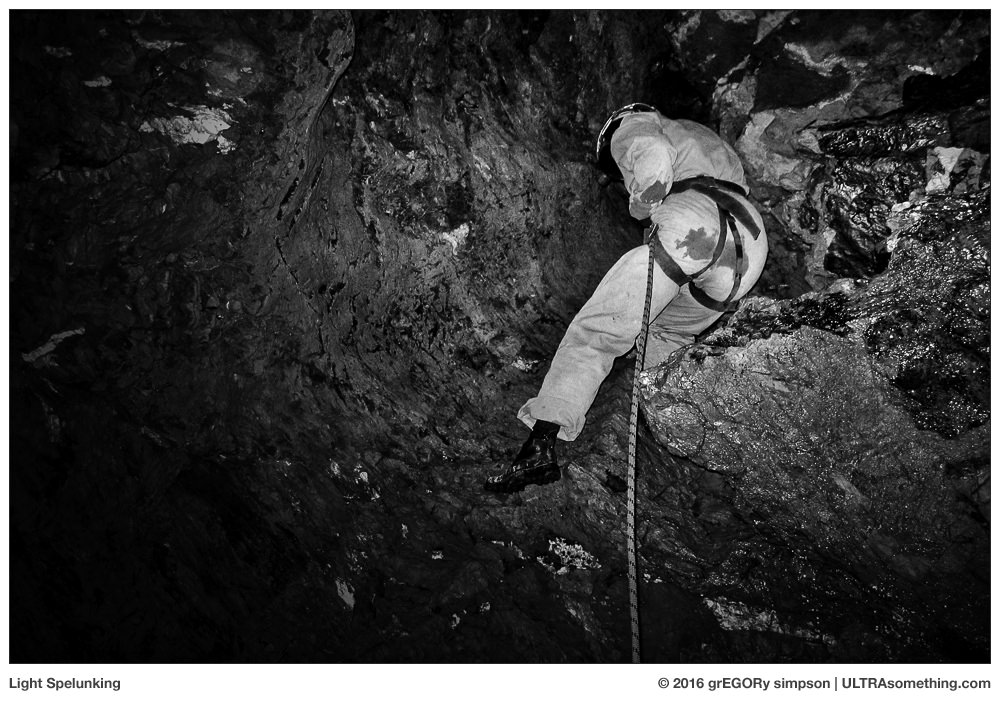
”Light Spelunking” provides irrefutable evidence that any photo — no matter how bad it might be — is “publishable” if you have a strong enough reason to do so. This particular shot was taken over ten years ago with a Canon PowerShot S400 — a camera that was already hopelessly outdated by 2006. So why use it? Well, would you take one of your good cameras on a five hour cave descent that included having to rappel down a 7-story underground waterfall? Exactly. One must forgive the total lack of satisfying composition — photography in a cave involves pointing your camera at where you think your wife might be, then warning her to not look down, lest the flash might blind her.
”Insurance Policy” was photographed with a Leica M8 and a 28mm Summicron lens. It’s published here, not because it’s a great photo, but because it makes a point. As an exercise, I decided to empty my mind and think of a photo that I’d never published, and hadn’t seen in a very long time. Immediately I thought of a photo I’d taken of a fire hydrant wearing a motorcycle helmut. I remember this photo because, when I first saw it, I thought “Gee… that could have been so much better. I need to spend more time exploring alternate angles when I have the opportunity.” I’m rather certain I haven’t looked at this photo since then, so I figured it would be an ideal candidate for testing the effectiveness of my cataloging methods. How long would it take me to actually find this photo in my massive Lightroom library? I didn’t have much to go on. I remembered it was shot in Yaletown and… well… that was about all. I had no recollection which camera I might have used, nor could I remember exactly when it was taken — though I assumed it would have been at least 5 years ago. Because I have an immutable keyword strategy, I thought about how I would keyword this photo today, knowing I would have keyworded it exactly the same way back then. So I fired up Lightroom’s search filter and went to work. First, I went with my hunch that it was taken sometime prior to 2010. So I decided to first search only the contents of my 200x decade folder (which includes every photo taken between Jan 1, 2000 and Dec 31, 2009). I next told Lightroom to display only those photos shot in Yaletown, and I then started typing the keywords I would normally use to describe such a photo. By the time I’d finished typing the first keyword, my list of possibilities was down to only about a dozen images. I spotted the desired fire hydrant photo immediately. So how long did it take to find this needle in the haystack? Less than 10 seconds!
“Keywording Conundrum” was shot with a Leica M Monochrom (Type 246) and an undocumented (and un-remembered) lens. “Pre Google” was also shot with a Leica M Monochrom (Type 246), though the lens is now known: a 28mm Summicron. Both are obviously included for their vaguely relevant illustrative purposes.
“Polarity” was shot with a Ricoh GR, and has no illustrative purpose whatsoever. It was just one of those 2-star photos that I was looking for an excuse to publish…
REMINDER: If you find these photos enjoyable or the articles beneficial, please consider making a DONATION to this site’s continuing evolution. As you’ve likely realized, ULTRAsomething is not an aggregator site — serious time and effort go into developing the original content contained within these virtual walls.
Once every 13 years I get an irrepressible itch to partake in some fisheye photography. The reason for this remains a total mystery, as does any explanation for why the pattern coincides with the mating cycle of a particular brood of cicadas.
In the past, scratching this itch has meant purchasing a fisheye lens, mounting it to my system camera du jour, and bathing in the metaphorical calamine lotion of extensive hemispherical visual experimentation. Within several months, I’d inevitably tire of the fisheye look, and would exile the lens to my drawer of shame. There it would sit until a subsequent Craigslist gear cull would erase all evidence of its previous existence.
So when fresh signs of fisheye rash began to appear a few months ago, I did the inevitable: I started researching fisheye lenses for my micro four-thirds system. I considered everything from a $250 Rokinon to Olympus’ $1000 M.ZUIKO PRO — weighing the pros, cons, costs and resale potential of each.
I was on a march to destiny that could not be stopped — until, that is, I spotted a “50% Off” sign hanging above a table at a local art store. On that table sat a Lomography Fisheye One film camera. “How wonderful!” I thought, “A fisheye lens and another film camera — two things I don’t need, combined into a single product!” I immediately went to work concocting a plan to justify its purchase.
bERt
It’s now been several years since bERt, an industrious working-class neuron from the west side of my frontal lobe, inventoried my collection of film cameras and recognized that the sum exceeded all measures of sanity and sense. Acting swiftly and decisively, bERt devised a corrective strategy built upon a stringent regiment of discipline and austerity.
But a split second before he could submit his proposal to the prefrontal cortex, bERt was beaten to a pulp by a roving gang of bad-ass limbic system neurons, who were hopped up on Rodinal and Hell-bent on scoring an early 1960’s half-frame Olympus Pen from an acquaintance in Portland.
Since that fateful day, no neuron has ever again dared to propose a moratorium on the acquisition of film cameras. Instead, they now work together as a network, and have ushered in a new era of diplomacy and compromise. The process works as follows: if the limbic system wants another film camera and can actually find some clever and creative way to justify its acquisition, then the prefrontal cortex will allow it.
This system keeps the limbic neurons focused on the task of validating their inexhaustible desire for film cameras. It’s a mission so all-encompassing that it limits their time and inclination to seek additional pleasures — pleasures that could easily eclipse the relatively benign side effects of film fetishism, and plunge the mind into an asylum of insatiable excess. In this context, a few too many film cameras appears a rather small sacrifice to make for the sake of overall mental stability.
Which brings us back to the subject of the Lomography Fisheye One. As camera justifications go, this one was particularly easy for the limbic gang to pull off.
For one thing, I now have so many film cameras that the addition of one (or two, or three) has become statistically insignificant, making it rather easy for them to slip past the prefrontal cortex while it’s focused on more pressing matters. Second, this particular film camera was ridiculously cheap. After watching it sit on the “50% Off” table for a month, I waited until the final day of the sale, then offered to take it off the retailer’s hands at a 75% discount. They bit. So for less than the price of the three rolls of film I would eventually spool through it, the little Fisheye was mine.
In Use
If you’re hoping for a review of the Lomography Fisheye One, you’ve come to the wrong place. Anyone who’s ever used a Lomography camera knows to set their expectations subterraneously low. Though with this particular camera, you might want to rent a backhoe.
The Fisheye One is more toy than camera — a cheaply constructed, one-trick donkey that’s inherently incapable of any semblance of fidelity. It sports a black plastic body with a white faux-leather wrap and a matching white lens barrel, which gives it a certain baby panda aesthetic. Those who want something even more ridiculously adorned may opt for a “Hello Kitty” version, which Lomography also sells.
The camera sports a plastic lens element, with focus fixed to a single immutable distance. It has exactly one shutter speed (1/100s) and exactly one aperture setting (f/8). If you need a different exposure, you’ll need to load a different film stock into the camera. Fortunately, it does possess a built-in flash for those myriad situations in which 1/100s at f/8 would result in serious underexposure. But personally, I only used it twice — preferring to simply accept any underexposure as an incubator for maximizing some truly gnarly grain.
The lens is the circular fisheye variety rather than the more popular full-frame type. Most “real” photographers shy away from circular fisheyes since they leave so much imaging surface unused. But frankly, anyone shooting with a Lomography Fisheye One has already made the supreme fidelity sacrifice.
Double exposures are easily achieved — just rewind the film a crank or two and shoot it again. A much harder (if not impossible) task is to precisely align the exposures. Since there’s no way to measure exactly how much film you’re rewinding, subsequent shots will result in misaligned circles — creating an entirely different look that resembles overlapping streams of consciousness more than individual snapshots of time.
In spite of its numerous limitations (or perhaps because of them), the Lomography Fisheye One has enabled my most satisfying foray into fisheye photography to date. And while I have, as always, wearied of the fisheye look for another 13 years, I do have plans to repurpose the camera into a “streams of consciousness” machine as mentioned previously.
So here’s to you bERt the neuron. Were it not for your demise, I would have been forced to choose between the mundanity of functional sanity or a cabinet full of film cameras. Instead, I’ve miraculously managed to have both.
Those wondering about the title need only realize that hurdy-gurdies are a metaphor for film cameras. Long replaced by so-called superior technologies, the hurdy-gurdy is all but forgotten in modern music, whether it be pop, rock, hip hop, electronica, jazz or classical. But the hurdy-gurdy exudes character and attitude. Honestly, it’s one of my favourite instruments of all time. And for that reason, it deserves space in my own music.
As you would expect, all the photos in the vBook were shot with a Lomography Fisheye One camera, though I did use two different 400 speed film stocks in the process (Tri-X and expired HP5+) along with two different developers (Rodinal 1:50 and HC–110 dilution H)
The mood of the soundtrack is a purposeful mishmash. First, I wrote the requisite hurdy-gurdy part (which, due to local noise ordinances, I was forced to perform using a virtual Hurdy Gurdy from a company called Rhythmic Robot). I then punctuated the fisheye’s innate distortions with psychedelic underpinnings from a pre-production Intellijel Rainmaker 16-tap stereo spectral rhythm delay and comb resonator eurorack module — which I just happened to be beta testing for the company. Because of the utter cheesiness of the Lomography Fisheye One (and fisheye photos, in general), I next decided to tacky it up with some up-tempo, funkier bits using several software synths, including Spectrasonic’s Omnisphere 2 and U-He’s Diva (which I opted to record at toxically overdriven levels). Finally, I used Ableton Live to assemble the various elements into a somewhat cyclical pattern for reasons that, I believe, are quite obvious. The final song was mastered in Izotope’s Ozone 7 and the video was assembled and edited in Apple’s Final Cut Pro X.
REMINDER: If you find these photos enjoyable or the articles beneficial, please consider making a DONATION to this site’s continuing evolution. As you’ve likely realized, ULTRAsomething is not an aggregator site — serious time and effort go into developing the original content contained within these virtual walls.
Minolta unveiled the TC?1 compact 35mm camera back in 1996. It garnered a few “oohs” and a handful of “ahhs” amongst the camera cognoscenti, but it elicited little more than a shrug from the nescient, pre?ULTRA Egor. I remember having only two thoughts upon its release: 1) “why would anyone want to set aperture with a sliding switch?” and 2) “who would buy a premium point?and?shoot film camera when digital will render it obsolete within the next couple of years?”
Flash forward twenty years and here I am — definitely older, ostensibly wiser, and the proud owner of a Minolta TC?1. In the interim, I have transformed into a rather strong proponent of “obsolete” film cameras — a curious turn of events for someone who was so rabidly pro-digital in the late 1990’s. If it weren’t for my stubborn refusal to accept the wonders of a sliding aperture switch, there would be no hint of my former self in today’s incarnation.
The TC?1 re-entered my gravitational field quite unexpectedly last November when, in a small camera shop on the east side of Shinjuku, I spotted one sharing a display case with several old Nikons and Leicas. It was homely enough to be endearing, and appeared to be even smaller than my Rollei 35T. But the camera’s most captivating feature was the little bit of text beneath its lens: “Minolta G?Rokkor 28mm 1:3.5.”
I knew Minolta had once manufactured a Leica M?mount version of this lens — now so rare and thus so expensive that it’s oft-rumoured to be the only lens suitable for photographing unicorns. So I whipped out my iPhone, launched my English-to-Japanese translator app, and clumsily communicated to the shopkeeper that I would like to examine the TC?1. He opened the case and handed me the camera. It slid effortlessly into my palm, and had I been blessed with metallic robot hands, its presence would be nearly imperceptible to anyone in my proximity. It was quiet, solid, simple and yet fully featured. Miraculously, I handed it back to the shopkeeper and exited the store without extracting a credit card.
For the next several days, I couldn’t help worrying about that poor little camera: unused, unloved and surrounded by all those big, bad, bully cameras. Every evening, prior to retiring for the night, I’d do a bit of TC?1 research — trying to convince myself I didn’t want to adopt it. But after a week, I caved.
Mechanical Impressions
This will be neither a thorough nor complete review of the Minolta TC?1. Hamish Gill has recently discussed this camera extensively, and I recommend his article to anyone who wishes to learn more. It eloquently mirrors many of my own thoughts and experiences, which means I can be lazy and simply point my readers to his site. Another mix of details and enthusiasm can be found in Bellamy Hunt’s mini-review from 2011.
Instead, I’ll take a more random approach to my impressions and opinions — some of which may corroborate Hamish and Bellamy’s findings, and some of which are unique to my requirements and experiences. So let me begin by reiterating what others have said before me: the TC?1 is a quirky camera. There’s simply no way to make a pro-grade, full-frame 35mm camera this small and not be forced to engineer a few oddities.
In the case of my old Rollei 35T, those oddities are numerous, varied and glaringly obvious. Eccentricities abound, such as placing the film transport lever under the left thumb, while positioning both the film counter and the hotshoe on the bottom of the camera. Obviously, building a 35mm film camera slightly larger than a deck of playing cards required the elimination of convention, which is why the Rollei 35’s irregularities actually increase its functionality and appeal.
So what about the Minolta TC?1 — a full frame 35mm camera that’s surprisingly even more compact than the Rollei? Minolta released the TC?1 a full 30 years after the Rollei 35, so most of the requisite gears and levers have been supplanted with electronic circuitry. For this reason, the peculiarities are not as blatantly obvious until you turn on the camera. Doing so causes a door to slide open, from which a freakishly unconventional rectangular-ish lens barrel and switch arrangement extends — protruding a mere 7mm from the front surface. This appendage’s quirkiness stems from the fact that the TC?1’s aperture is not set by rotating a ring to open and close a set of blades. Instead, the aperture is set by a sliding switch — where each switch position causes a washer with a different size opening to drop down inside the lens. Apparently, back in the day, Minolta touted this perfectly circular aperture as a “feature” that would provide creamy, smooth defocusing in shots with limited depth of field. But here’s the thing: this is a 28mm lens with a maximum aperture of f/3.5. Shallow depth-of-field is not really at the top of this camera’s bag?o?tricks.
Apparently, this unique design has caused some cameras to experience reliability issues over time. Hamish reports that his first TC?1 had a problem with light leaks (apparently due to non-perfect alignment of those little aperture disks). Mine seems to have a different problem — one I haven’t seen reported before. At f/3.5, the camera sometimes fails to take an exposure reading and thus prevents me from taking a shot. This means, on several occasions, I’ve been forced to stop down to f/5.6 when it would definitely not have been my choice. The problem can sometimes be rectified if I pull the little aperture switch as far past f/3.5 as I can (pretending that there’s an f/2.8 setting that I’m trying to switch to). It doesn’t always work, but it does indicate that, perhaps, this might also be due to an aperture disk alignment issue — and that pulling back on the switch gives me just a little more space for the disk to settle correctly. Honestly, I haven’t a clue what the root cause might be — but it can be somewhat frustrating, and is an issue you might want to look for should you be seeking a TC?1 of your own.
Anxious to read about additional oddities? No problem. The TC?1’s got you covered:
In spite of appearances, the TC?1 is not technically a point-and-shoot camera. Instead, it’s a camera that always functions in aperture priority mode. You must select an aperture and then let the camera automatically set a shutter speed. There’s no other exposure method available, and there’s also no way to manually expose. Plus, since there are only four available aperture settings (f/3.5, 5.6, 8 and 16), you certainly won’t have nuanced control over your exposure options.
Curiously, even though the camera forbids manual exposure, it does actually allow manual focusing. Unfortunately, much like the Rollei 35, this is done only via “scale” focusing. To manually focus the TC?1, you rotate the top dial to the AF/M position, then use a little switch to step through every possible focus distance: 0.45m; 0.5m; 0.55m; 0.6m; 0.65m; 0.7m; 0.8m; 0.9m; 1m; etc… Yes, it’s wickedly precise — much much more precise than my ability to guesstimate distances!
The TC?1 compensates for its lack of manual exposure by allowing photographers to set an exposure compensation of up to 4 stops in either direction. This goes a long way toward alleviating my personal dislike for auto-exposure. Sometimes I want to set my exposure well outside convention, so having the ability to override the camera’s internal recommendation by a total of 8 stops is a necessary and welcome luxury.
Camera settings are modified via a sliding switch on the TC?1’s front edge. Hey, if you’re going to replace a conventional aperture dial with a switch, why not go all the way and replace the traditional data dial with one, too? It’s a seemingly odd choice, but it’s not without some merit. Unlike a dial, which you have to continuously rotate in order to select increasing or decreasing values, the switch on the TC?1 can simply be held in one direction and the indicated value will increase or decrease automatically for as long as it’s held. This actually makes it relatively quick and painless to, for example, scroll through that laborious list of possible focus distances.
The battery door and its closure mechanism are woefully under-designed. There is a small sliding switch (surprise, surprise!) that unlocks a battery compartment, which holds the requisite CR123 Lithium battery. All that sliding switch does is to slide a teeny tiny little bolt in and out of a teeny tiny little hole. The whole contraption appears to be fabricated from consumer grade tin foil, which yields two inevitable results: either 1) I can’t quite get the sliding switch to slide open; or 2) I can’t quite stop the sliding switch from sliding open. Fortunately, there’s this handy product on the market called “tape,” which you can use to hold the battery door closed.
The camera is loaded with all sorts of little niceties that belie the rather shoddy battery compartment lock: a diopter adjustment on the viewfinder; spot metering; a slow-sync flash mode; manual DX ISO override; and a self-timer. There is little doubt Minolta was doing everything possible to position this as a “professional’s compact.” This included saddling it with a rather exorbitant ¥148,000 sticker price, which in 1996 would have been roughly US $1400. Even in 2016, that sounds ludicrously high, so just imagine how it sounded twenty years ago! No wonder these cameras are rarely seen outside Japan.
Image Impressions
OK. So the TC?1 is an odd handling camera. Fine. Muscle memory is relatively easy to attain. The real question on most photographer’s minds — particularly given the near mythical status of its built-in lens — is “how is the TC?1’s image quality?”
It’s a simple question with a semi-complicated answer. That’s because one’s idea of image quality is likely to depend on whether you’re living in the here-and-now, or taking a time machine to the past. Fact is, that little 28mm G-Rokkor lens is loaded with character. It pumps out a negative with rather high contrast, good centre sharpness and a potently dramatic amount of vignetting.
This means, if you’re really old school and order prints from a lab (as would likely have been the case for this camera’s intended customer), you’re going to love what you see when you open the envelope. The bold colours, high contrast, sharp subjects and dramatic vignetting give those 1-hour photo lab prints a pleasingly professional pop.
And therein lies the problem: hardly anyone using this camera today is going to make prints at the local drug store. Today’s film shooter — particularly one who would be interested in the Minolta TC?1 — is likely to develop and/or print his or her own photos. In my case, I self-develop and scan all my negatives. Because of this, I actually prefer to start with a negative that’s fairly low in contrast and that doesn’t have as much vignetting — these can be added in processing. So, even though the lens is very capable and characterful, I find myself spending a little extra time in Lightroom/Photoshop working to remove those very same attributes that would have made this such a killer camera in 1996.
That said, the out-of-camera shots might just please you enough that you ultimately drop the mouse, “go with the flow,” and print them with less manipulation than you might ordinarily choose.
Of course, there’s more to “image quality” than technical details — there’s the subject of the image itself. The bulk of my photo technique involves fleeting serendipity — photographing subjects that suddenly coalesce into a single perfect moment before dispersing in the blink of an eye. My need to respond rapidly to ephemeral stimuli is precisely why I prefer using cameras that allow near-instantaneous manual changes to exposure and focus. The TC?1 does not offer these capabilities, and for these reasons is better suited for deliberate photography than to my reactionary sort.
So, even though the TC?1 and Rollei 35 share a similar physical envelope, their widely divergent approaches to miniaturization suggest completely different subjects when used. The Rollei, because it’s both manually exposed and focused, excels at shooting ephemeral subjects (as long as I can work around its 40mm focal length — which is a bit longer than I prefer). The TC?1, because it’s auto exposed and (fundamentally) auto focused, rewards a more pensive shooter.
For two cameras that share such a seemingly similar purpose, the way I use them couldn’t be more different. All I can say is that it’s a good thing my jacket has a pocket on both sides.
I’ve always had issues with publishing so-called “test” images to accompany any sort of gear review. That’s because, as a “creator of images,” I’m conditioned to be very selective about which ones I share. But anyone reading a gear review expects to see a lot of images, no matter how banal they might be. So what I’ve done here is to create a vBook as a sort of “compromise.” By controlling the presentation and sequencing of the photos, I’m able to diminish their perceived banality. If you haven’t a clue what I’m talking about, I suggest you (re)read an old article called Reject Intent.
There are 23 photos in the vBook — all of which were shot with the Minolta TC-1 between mid-November 2015 and mid-February 2016. Some photos were shot on Tri-X, some on FP4+, some on Delta 100, some on expired HP5+ (compliments of a generous reader), and some on UltraMax 400. Everything was exposed at box speed, but developed differently — sometimes I used HC-110, sometimes I used Rodinal and, in the case of the UltraMax 400 roll, a print lab in Shibuya was used (I had a 1-week “warranty” on the camera, and needed to shoot and view one roll in order to see if the camera had any problems).
ABOUT THE MUSIC:
The soundscape was realized predominantly on my ever-evolving modular synthesizer, which is most heavily inhabited by Intellijel modules. Numerous 4MS modules handle much of the clocking requirements and a smattering of additional modules from Make Noise, Mutable Instruments, Expert Sleepers, Noise Engineering, Malekko Heavy Industry and others add to the cacophony cornucopia. Originally, I planned to create the entire soundscape as a single “patch,” which I would perform and tweak in a single take. Alas, I ran out of patch cables before I ran out of ideas. So only about 75% of this performance was done in a single take (from a single modular synth patch). I later overdubbed another track from a re-patched modular, plus a couple more tracks from the Dave Smith Instruments Pro 2 synthesizer. The only software-based instrument was a single instance of G-Force’s Oddity synthesizer (a software “clone” of an old Arp Odyssey). As is usually the case, Ableton Live served as the “multitrack” recorder, and the final mix was mastered using Izotope Ozone 7. The entire sound and photo sequence was then assembled as hastily as possible in Apple’s Final Cut Pro X.
Inevitably, every time I publish a vBook, I get emails asking for an MP3 version of the soundtrack. So, here you go: DOWNLOAD MP3 SOUNDSCAPE
REMINDER: If you find these photos enjoyable or the articles beneficial, please consider making a DONATION to this site’s continuing evolution. As you’ve likely realized, ULTRAsomething is not an aggregator site — serious time and effort go into developing the original content contained within these virtual walls.
I’m supine in a pale blue vinyl chair: fists clenched; toes curled and mouth agape. The whine of the dental hygienist’s hypersonic cleaning tool harmonizes with the gurgling rumble of the vacuum tube suctioning saliva from my throat.
The hygienist leans back slightly, exercising her neck to-and-fro before pausing in mid-stretch to fix her gaze upon my camera, which sits atop my jacket on a counter near my feet.
“Don’t you photographers think life would be more interesting if you actually experienced it, rather than watching it through a viewfinder?” she asked in a tone more accusatory than questioning.
I was speechless. Mostly because her hands were jammed into my mouth, but also because I simply don’t know how to answer a question that’s based entirely on the presumption of two falsities.
Falsity #1 is to assume, just because I have a camera, that I’m a photographer. I’m not. And I know this because every time I see an article titled “10 photos every photographer should know how to take,” I quickly ascertain that I have absolutely no desire to take any of them. Plus, I’d be willing to wager a months’ income that I take fewer photos in a year than any iPhone-toting 20-something dental hygienist.
Falsity #2 is that I walk around looking at the world through a video screen or peering through a viewfinder. All totalled, given the paucity of my output and my own shooting habits, I probably spend less than 5 minutes a month looking through a viewfinder. My camera is an accomplice on my journeys, not a portal through which I experience them. The camera is lifted to my eye only in that brief instant that I wish to frame something intriguing within its rigid rectangular cell — incarcerating it; imprisoning it for future study.
So after removing the fabricated presumptions, her real question should be, “does that camera you always carry around diminish your ability to see and experience your surroundings?”
And the answer, of course, is “No. Just the opposite.” Or, as I eventually muttered to my hygienist, “Mo. Muff vah ahm pah feff.”
Carrying a camera liberates you. It sharpens your eye; heightens your senses and increases your spatial awareness. With a camera, I see beyond the mass of humanity on a packed sidewalk in Shibuya — past the throngs to a single individual, who unmasks himself just long enough to take a drag on a cigarette — a delightfully playful “nine lives” sign in the foreground.
The camera helps me understand that the best way to remember the incongruously out-of-place architecture of Harajuku station is not to take a hackneyed shot of the station, but to photograph the effect it has on others who see it.
Cameras teach me to watch the watchers.
If I didn’t carry a camera, would I have noticed that Tokyo’s ubiquitous clear plastic umbrellas glow like lanterns when backlit?
Would I have observed that those same umbrellas are festooned with tiny stars? Or that peering through one is like looking through a magic window that pierces a cloud-covered sky?
Would I be dazzled by the shapes and shadows cast by something as inconsequential as a stairwell?
Or have become as hyper-aware of juxtaposition as I am now?
As attuned to human emotion?
It’s the camera that allows me to truly see — to truly experience all the subtle nuances that surround me each and every day.
Of course, there are times when I witness events that require absolutely no astuteness whatsoever to appreciate. In such instances, carrying a camera might not help me to see, but it sure helps me to take a photograph.
But even in instances such these, one wonders if there isn’t still an instinctual element at work — one in which intuition and subliminal suggestion are allowed into the subconscious? The subject of the previous photo is, indeed, obvious. And I had numerous opportunities to take it — yet I chose exactly this moment to do so. Why? Perhaps the clue lies at the far right edge of the frame… Yes, cameras even teach you to see and respond to subtleties that your conscious mind simply doesn’t have time to rationalize.
So, would life be more interesting without a camera? I can’t answer for others, but for me, the answer is an emphatic “no.”
All of these photos were taken on a recent trip to Tokyo and represent the tip of a still-uncurrated iceberg of images. Unfortunately, even though I brought only two lenses to use with my Leica M Monochrom (Type 246), I seemed to have been rather lax at recording which lens I used for which shots. For example, “Shopping Spree” was definitely shot with a Leica 21mm f/3.4 Super-Elmar ASPH lens, but the embedded EXIF data says I used my 35mm Summicron. Note that this is not a Leica bug — it’s an Egor bug. Because the majority of my rangefinder lenses are not coded, I disable the camera’s “auto lens detection” mode, and manually enter the lens type each time I mount a different one. At least that’s what I do in theory. Alas, such was not the case in Tokyo. So, even though “Nine Lives,” “The Art of Artistry,” “Stairway, Shinjuku,” “Chicken or Egg?” and “Window Shopping” were also all shot with the Leica M Monochrom (Type 246), I can’t say for certain whether each uses the 21mm Super-Elmar or the 35mm f/2 Summicron (v4) lens — though the racially different perspectives afforded by these two focal lengths does make it fairly easy to make educated guesses.
“Kabukicho” and “Stargazing” were both photographed under heavy drizzle, so the weather-sealed Olympus OM-D E-M1 was used, along with the Olympus 12mm f/2 lens. Note that the 12mm lens is not, itself, weather sealed — but I’ve never had any issue carrying the camera with the lens pointing down — wiping everything dry now and then with a chamois.
“Room With a View” and “Afternoon Snack” both utilized the little Ricoh GR — which frequently rode shotgun whenever I carried the heavier and bulkier Widelux F7 panoramic film camera.
REMINDER: If you find these photos enjoyable or the articles beneficial, please consider making a DONATION to this site’s continuing evolution. As you’ve likely realized, ULTRAsomething is not an aggregator site — serious time and effort go into developing the original content contained within these virtual walls.
One minute, I’m engrossed in the dreariness of paying bills. One second later, the word “japanorama” is the only thought in my head. It entered my consciousness as unexpectedly as a lightning bolt on a sunny day. I heard it as clearly as if someone had shouted it in my ear; I saw it as distinctly as a neon sign in the middle of a cornfield at midnight.
Fully cognizant that both Albert Einstein and Nikola Tesla credited their ideas to a similar sort of otherworldly inspiration, I took the word as a sign. Since I would be travelling to Tokyo in a couple of months, “japanorama” must obviously be a suggestion — a sort of verbal shorthand instructing me to leave my small and sensible film cameras at home, and instead lug one of my big ass panoramic cameras across the Pacific. I’ll admit the idea did seem a bit daft, but who am I to argue with divine intervention?
Originally, I considered satisfying my commandment with the Hasselblad Xpan. After all, the Xpan sports impeccable fidelity, employs rangefinder focusing, and can be switched out of panoramic mode should the scene require. To a pragmatist, the Xpan would be the ideal choice to fulfill the japanorama mandate. Apparently, I ain’t no pragmatist.
Because, sensible choice that the Xpan might be, it just doesn’t put the “o-rama” in “pan-o-rama.” With its 45mm lens mounted, the Xpan has a 71 degree horizontal field of view. My Leica M, with its 21mm lens, shoots a wider horizon than that! Even if I won the lottery and secured enough capital to purchase a 30mm Xpan lens, the combination would record “only” a 94 degree width. But my Widelux F7? Now there’s a camera that can deliver the “o-rama” — 126 degrees worth! Surely this would please whichever god, martian or dissociative identity chose to plant the japanorama idea in my noggin.
But sadly, once I actually arrived on Japanese soil, I discovered that my taciturn source of divine inspiration was substantially less divine than either Einstein’s or Tesla’s. Each morning I would set out on foot, and by the end of the day, 20km would have passed beneath. Slinging a Widelux F7 around my neck, while carrying a Leica M Monochrom in hand, while shouldering a bag of lenses, film, a pocket wifi device, extra batteries, an iPhone, and various bits of flotsam and jetsam — well, it was simply too exhausting.
So the Widelux kept getting left behind. In fact, the only times I used it were when I knew I wouldn’t venture more than a couple kilometres from my room.
Curiously, in spite of its spartan use, I think the Widelux is an ideal camera for Tokyo. Had it been my only camera, I would likely have been completely satisfied. But since I was also packing several other cameras (which were digital, and thus necessary for publishing a daily travelogue), the Widelux was often odd “man” out.
So I’m rather certain I failed miserably at the task dictated by my divine guide. What’s more, I’m fearful that I might have misinterpreted it completely. After returning home from Japan, I chose to google “japanorama” and discovered that it’s the title of a BBC series about Japanese culture. Maybe I was meant to watch this series and not, as I originally believed, carry a Widelux around Tokyo? It’s not like divine intervention has a particularly intuitive user interface. So, in hopes of making amends (and possibly avoiding any cosmic smiting), I’ve decided to go ahead and publish a few of the Widelux shots, which I’ve combined into a small vBook. Hopefully, the next time I’m presented with a supernatural command, it’ll arrive in the form of a complete sentence, and not just a single word.
ABOUT THE PHOTOS: All photos were shot with a Widelux F7 at ISO 400 on Kodak Tri-X, and developed in HC–110 (dilution H). Music was recorded in Ableton Live, using mostly an assortment of hardware synthesizers — a dab of Arturia MiniBrute, a touch of Dave Smith’s Pro 2, and a whole lot of eurorack modules (the bulk of which are Vancouver’s own Intellijel modules). The piano track is the lone software-based instrument, coming courtesy of Native Instruments’ Komplete. As always, the whole concoction was baked in Apple’s Final Cut Pro X oven.
REMINDER: If you find these photos enjoyable or the articles beneficial, please consider making a DONATION to this site’s continuing evolution. As you’ve likely realized, ULTRAsomething is not an aggregator site — serious time and effort go into developing the original content contained within these virtual walls.
I’m not sure exactly when it first began. Nor do I know why the pattern continues. But for several years running, the winter solstice has signalled the arrival of ULTRAsomething’s “camera review season.”
Not that I’m complaining. Well… OK… I’m complaining a little.
Obviously, I rather enjoy having the opportunity to review camera products. But here in Vancouver, there are two absolute certainties for the weeks surrounding the winter solstice. One is that it will rain — biblically and mercilessly. Two is that it will be dark — a slow shutter; wide aperture; ISO 6400 caliber of darkness. Neither certainty offers ideal performance testing possibilities, yet these are precisely the conditions under which most demo cameras arrive at ULTRAsomething HQ.
So I wasn’t the least bit surprised to receive a mid-December email offering a week’s loan of the new Leica SL. I glanced at the weather forecast: extensive quantities of rainfall; tree-toppling wind storms; finger-numbing cold. I took a quick glance out the window. It was 3:00pm and dark as midnight.
Yessiree. Camera season had arrived, and so had the Leica SL.
Synopsis
Because of seasonal time and weather constraints, this is far from a full review of the Leica SL. It’s really just a few “impressions” combined with some field experiments using the SL as an alternative body for M-mount lenses.
So let me jump right to the conclusion: The Leica SL exudes quality. The handling is (surprisingly) exemplary and the image quality is stellar. From the built-in GPS to the dual SD-card slots; from the 4k Log gamma video capabilities to the state of the art 4.4MP electronic viewfinder — this is a professionally-spec’d camera, through and through. It has a seductive appeal that belies its utilitarian appearance in brochures. It’s feature rich, while being user-friendly. In baseball parlance, it’s a home run. In basketball parlance, it’s a slam dunk.
And yet, for all those things it is, there’s one thing it isn’t — a camera that I need.
Though capable of gallery worthy landscapes, Vogue quality portraits and client satisfying videography, the Leica SL seems designed to tick all the boxes that I, as a photographer, don’t. Frankly, as someone who wishes to take photos like the ones shown beside this paragraph (or at the top of the article), I certainly don’t need a Leica SL to do it. Heck, my early–1960’s half-frame Olympus Pen EE–2 is probably overkill. But need and want are two different things and, as such, I found myself wanting to manufacture shooting opportunities at which the SL would likely excel. Such are its temptations…
Details
The Leica SL is the centerpiece of an entirely new full-frame 35mm camera system — a “system” that presently contains but a single lens: the Vario-Elmarit-SL 24–90 f/2.8–4 ASPH. Anyone whose photographic interests would be better served by another type of lens will need to go the adapter route — at least until Leica expands their native lens lineup.
Because I believe zoom lenses to be the devil’s work, and because this new Vario lens is so massive that it comes with its own gravitational field, I declined Leica’s offer to borrow it — choosing, instead, to try out the SL using only adapted M-mount lenses.
The only way I can honestly evaluate a piece of equipment is to use it as if it were mine. Since I would never choose to own the 24–90 Vario lens, and since no adapters existed (yet) for any of my other lenses, that meant using the Leica SL as an M-glass body.
As expected, results were mixed.
Most of the wide lenses I tried exhibited quite a bit of smearing at the edges and in the corners (at least at the wider apertures dictated by camera season weather conditions). This is not a problem that’s unique to the SL — it exists any time you mount a rangefinder lens on a camera with a “standard” sensor. Because of their close proximity to the sensor surface, rangefinder lenses require a sensor designed specifically for their use. Rangefinder-specific sensors contain a series of tiny micro lenses that bend the light at the outer edges so that it strikes the sensor surface at a more perpendicular angle, which eliminates the smearing. To date, only Leica’s own M-series cameras and Ricoh’s A12 M-Mount module for the long-discontinued GXR have sensors designed specifically for rangefinder lenses.
In contrast to the wide angles I favor, longer focal lengths exhibited little (if any) edge smearing on the SL — making them a better match for the SL’s sensor. If you want to see actual bona-fide lab tests that illustrate the differences between various M-mount focal lengths on a Leica SL, I suggest subscribing to Sean Reid’s excellent review site.
Another factor to consider in the “M” vs “SL” debate is the viewing/focusing differences between the two camera bodies. The M uses an optical, “window” viewfinder and a rangefinder focusing patch. The SL uses an electronic “through the lens” viewfinder and contrast-detect focus peaking. The method you prefer likely depends on the subjects you shoot. If, like me, you tend to shoot reactively and candidly with wide angle lenses, you’ll probably find the M system more conducive to your shooting style. If, unlike me, you tend to shoot more methodically — such as portraits, scenics, architecture or products — and if you use longer focal lengths, you’ll probably prefer the SL’s viewing/focusing methodology.
So these differences likely explain why some people have proclaimed the SL to be “the death of the M system,” while others (like me) proclaim that the SL does nothing more than illustrate why the M system is so special. The camp in which you pitch your tent depends upon the type of photographer you are. But that’s true of every camera, isn’t it?
An Eye Toward the Future
Here’s the thing: If I were the sort of photographer that rarely shot wider than 50mm, and if I needed to shoot in color, and if owned an assortment of the latest and fastest long lenses, I would seriously consider the possibility of adding a Leica SL to my toolkit.
But that’s three ‘ifs’ I simply don’t possess. For my purposes, the Leica SL is positioned more as a “Swiss Army Camera” — a camera that might one day function admirably at all those photographic disciplines that are secondary to my true nature.
For example, if Leica were to create a flat-field macro system lens, I could use the SL as a negative “scanner.” If they added a few weather-sealed primes, it could become an autofocus “walk around” inclement weather camera. Toss in a few lens adapters for my Pentax, Olympus and Xpan lenses, and the SL becomes the center of an entirely new camera ecosystem — one that’s separate but complimentary to my Leica M system.
But that, too, is a whole lotta ‘ifs’ — all of which must be satisfied before the SL could replace my Olympus OM-D E-M1 micro four-thirds system in that “Swiss Army Camera” roll. That’s not to say that m43 is, in any way, comparable to the SL. Everything about the SL makes m43 look like a toy. But m43 is a “toy” that’s available right now, and at a price I can afford.
Because I’ve examined only one specific use of the Leica SL — as an alternative body for M-mount lenses — this article cannot be considered a “review” of the product. After all, the Leica SL is a fully realized autofocus camera system on which I have yet to mount an autofocus lens. It’s also a fully-spec’d videography machine — another feature that I failed to exercise in my week with the camera. But even though the camera doesn’t negate my need for a Leica M body, that doesn’t mean I wasn’t captivated by its build quality, handling and performance capabilities.
The SL product line will continue to grow. And as it does, I’ll keep a close eye on the progress. Because as the system matures, many of the hypotheticals that currently surround this camera will become reality. And when that happens, the SL’s allure will be much harder for me to ignore.
ABOUT THE PHOTOS: Obviously, several of these photos look exactly like “my” photos, and not like anything that would ever appear in an SL brochure. That’s because I operate under the assumption that it’s the camera’s job to conform to my requirements, and not the other way around…
Naturally, with the single exception of the final product shot (which utilized my current “Swiss Army Camera” — the Olympus OM-D E-M1), every photo was taken with the Leica SL — albeit with different lenses. Specifically:
“Camera Season 1” and “Camera Season 2” were both photographed with the Leica 135mm f/4 Tele-Elmar — a lens I rarely use on an M-body, but which becomes much less cumbersome on the Leica SL. “Hand to God”, besides being the sort of photo that has earned me a permanent place on the Photographer’s Hall of Fame blacklist, was shot with a Leica 28mm f/2 Summicron. “InstaGeodesic” was shot with a Voigtlander 15mm f/4.5 Super Wide Heliar, while its partner photo, “Scrutiny” was shot with a… hmm… I don’t have a clue actually. I forgot to make note of my lens selections that particular afternoon.
“Between Two Squalls,” which was shot with a Leica 90mm f/2.8 Elmarit-M (1996) and “Missing De Palma”, which used the Leica 28mm f/2 Summicron are both the sort of shots I only ever take when forced to review cameras. “Due North,” shot with the Voigtlander 75mm f/2.5 Color Heliar, also qualifies as one of those “camera review only” shots, although I actually kinda like this one. And, in conclusion, there’s “Artist vs Architect,” which was shot with a Leica 35mm f/2 Summicron (v4).
REMINDER: If you find these photos enjoyable or the articles beneficial, please consider making a DONATION to this site’s continuing evolution. As you’ve likely realized, ULTRAsomething is not an aggregator site — serious time and effort go into developing the original content contained within these virtual walls.
For the last couple of years, my wife has been a passionate student of all things Myers-Briggs. And thus, by the transitive property of marriage, this means that I too have become unwittingly quasi-conversant on the topic.
For the edification of those who lack a fervent family tutor, the “Myers-Briggs Type Indicator” is a rather widely used and somewhat controversial system for sub-dividing humankind into 16 distinct personality types. Based on a theory first floated by Carl Jung, the Myers-Briggs Type Indicator (MBTI) defines four dualities that affect human personality: You’re either extraverted (E) or introverted (I); sensing (S) or intuitive (N); thinking (T) or feeling (F); judging (J) or perceiving (P). 16 possible combinations that yield 16 different types of personalities.
My wife’s interest in MBTI was inspired by the demands of her job — a job in which she must stroke the egos, satisfy the psyches and negotiate the best performances from hundreds of different people — quickly and simultaneously. By learning to identify each person’s personality type, she is able to effectively ascertain their needs and motivations — and thus relate with each individual in a way they each understand and appreciate.
Frankly, I used to think Myers-Briggs was a lot of hooey — mostly because I found it nigh impossible to take any of the MBTI tests myself. All the test variants contained far too many either/or questions to which my answer would be “neither” or “it depends.” So one day, still unable to complete a test, I asked my wife to categorize my personality type for me. “Oh, you’re an INTJ,” she said emphatically.
Since I didn’t know an INTJ from an EIEIO, she read me a couple of profiles that described my personality type, my motivations and the circuity of my thought processes. It was uncanny. All my life I believed I simply possessed a higher percentage of alien DNA than the rest of humanity. Turns out I was just an INTJ.
This got me thinking — perhaps I could expand on the Myers-Briggs concept, and create an addendum specific to photographers. Surely these same techniques could be used to classify all the different types of photographers and their motivations? It would go a long way toward helping each photographer learn what makes them click that shutter release, along with when, where and at what they should concentrate those clicks. Besides, I was bereft of any better ideas upon which to base a new article. So I rolled up my sleeves and gave it a good hard 10 minutes of thought — resulting in the creation of the Ultrasomething Photographer Type Indicator (UPTI).
Just as with MBTI, the UPTI specifies four fundamental psychological dualities, which guide all photographers:
Are your motivations external (E) or internal (I)? Is your photographic direction dictated by praise and appreciation, and a yearning to satisfy and grow your audience? Or could you not be bothered to care what other people might think of your photos — just as long as you’re happy with them?
Are you a literal (L) or metaphorical (M) practitioner of photography? Do you tend to take photographs principally for the purpose of documenting what’s in front of the camera (even if it’s to alter it in some idealistic way)? Or do you take photographs in which the subject of the photos isn’t really about what’s in the frame, so much as what’s implied by it?
Are you a builder (B) or a hunter (H)? Do you generally prefer to construct your photographs — either in the studio or through carefully conceived camera, lighting or subject placement in the field? Or do you prefer to hunt for images — accepting and photographing whatever appears before you and in whatever manner it appears?
Are you more drawn to quality (Q) or to subject (S)? Are you generally more concerned with what your photos look like (image quality, contrast, focus, sharpness, fidelity, etc)? Or do you care more about the subject matter (regardless of its technical merit, or lack thereof)?
Obviously, it’s unlikely that your placement within any of these four UPTI functions will be “absolute.” For example, your photography might not be solely reliant on quality (Q) nor solely reliant on subject (S), but likely some mix of the two. It is, however, probable that one extreme will be more highly weighted than the other, and the sum of those weightings will determine your Ultrasomething Photographer Type Indicator.
I am, without any doubt, an IMHS. Anyone reading this blog for the past few years could easily have guessed as much.
So what are you? What is your UPTI? If you like, feel free to share your UPTI classification in the comments section. And remember, no one classification is better than any other. They’re just different — which is a good thing. Because without differences, we’d all be taking the same photos. And how boring would that be?
ABOUT THE PHOTOS: The photos that accompany this article are, not coincidentally, precisely the sort of thing you’d expect to see come from the camera of an IMHS.
“Another Facebook Moment” definitely has nothing to do with the girls in the photo, and everything to do with lampooning the ubiquity and excessive prominence of social media. Of course, now that I know I’m an INTJ, that whole social media mockery thing of mine makes perfect sense. Photographed with a Leica M Monochrom (Type 246) and a 21mm f/3.4 Super-Elmar-M lens.
“Near Miss” is, again, another photo that really has nothing to do with the subject shown. If it were, I’d probably have shot closer (or used a longer lens). Instead, it’s about context. We don’t know why the man is lying on the sidewalk and this photo isn’t going to tell us. And, rest assured, I certainly didn’t put him on the sidewalk for the sake of this picture. No, it’s really a photo about choices — the wide angle lens indicating a wealth of possibly more appropriate places for the man to lie — perhaps one of the several nearby benches? Or even the Comfort Inn on the corner? Shot with a Leica IIIc and a Voigtlander 25mm f/4 Snapshot-Skopar lens on Tri-X at ISO 400, and developed in a 1:50 solution of Rodinal.
“Open Invitation” — Is this a botched portrait of a man on the street, or is it a gift-wrapped moment of serendipity marrying a momentary body position with a most appropriate sign? Photographed with a Leica M Monochrom (Type 246) and a 28mm f/2 Summicron lens.
“Misfit” is a technical mess. Blurry. Out of focus. Improperly exposed. I couldn’t care less. Because the subject of the photo (which isn’t the man in the mascot outfit, but the pregnant space between him and the other people on the bench) is all that matters. At least it’s all that matters to me. Did I mention I only take photos to please myself? Shot with an Olympus OMD-EM1 with an Olympus 12mm f/2 lens.
REMINDER: If you find these photos enjoyable or the articles beneficial, please consider making a DONATION to this site’s continuing evolution. As you’ve likely realized, ULTRAsomething is not an aggregator site — serious time and effort go into developing the original content contained within these virtual walls.
Those of you still waiting for this month’s tiny cache of ULTRAsomething verbiage will be pleased to know that I haven’t retired — I’ve just been in Tokyo for the past three weeks.
All that eating, sightseeing, eating, photographing and eating left little time for the sort of thoughtfulness that (ostensibly) goes into an ULTRAsomething post. Although, truth be told, I did write an online travelogue (“trog”) throughout the trip. However, since this “trog” was of an even more banal and personal nature than the average ULTRAsomething post, I chose to publish it only for a select few friends and family. Because I had only an iPad with me, I used only iOS apps — PhotoRaw to convert the RAW files to JPG, and Snapseed to process the files for publication via Adobe Slate. The simplicity of the process was quite refreshing, though I’m glad to be back in front of a real computer, where the real curation and editing are just beginning.
So I hope you’ll all forgive the minor delay. ULTRAsomething will be back to its usual lackadaisical publishing schedule next month.
ABOUT THE PHOTOS: “Yaktori Bar, Shinjuku” was shot with a Ricoh GR my first day in Tokyo, and was processed hastily that same evening using Snapseed on an iPad. This fellow and I (the only two patrons in a small Yakitori Bar on the colourfully named, “Piss Alley”) had an awkward little conversation using an iPhone translator app. He wanted to know how old I was (is this a common thing to ask in Japan?) When I told him, he smiled and tapped out a reply on his iPhone, then held up the translated text for me to read. “You big senior!” it said. I’ve chosen to interpret this as a good thing.
REMINDER: If you find these photos enjoyable or the articles beneficial, please consider making a DONATION to this site’s continuing evolution. As you’ve likely realized, ULTRAsomething is not an aggregator site — serious time and effort go into developing the original content contained within these virtual walls.
I step up to the counter and am greeted most enthusiastically by a petit woman of about 30. “What’ll you have?” she asks cheerfully.
“Cup of coffee,” I mutter.
“You need room for cream?” she chirps.
“No. Black.”
“Awesome!”
I feign a little smile to express appreciation for her having recognized my awesome nature.
In truth, I’m so frequently awesome that it becomes a struggle to politely acknowledge all who commend me. Case in point — a mere 30 minutes earlier, my awesomeness was spotted at the corner grocery. The cashier, upon ringing up my total, glanced up from her till and stated, “that’ll be $4.05.”
I reached into my wallet, peeled off a five dollar bill and handed it over.
“Do you have a nickel?” she asked.
I plunged a hand into a pocket, fished around and extracted a beaver-crested 5¢ Canadian coin and dropped it into her outstretched hand.
“Awesome!”
Her affirmation of my formidableness was expressed so boisterously that every customer in my vicinity gazed upon me in admiration.
Such awesomeness is both frequent and boundless. If an acquaintance queries me about my weekend plans, it matters not what I answer. Even if I answer “I have no plans,” their response is inevitably a heartily delivered “awesome!” When I call and make a dinner reservation, it’s a rare host or hostess that isn’t moved to mention such awesomeness. When a tourist needs help finding Robson Street, and I point and say “two blocks that way,” I am not just thanked — I am praised as “awesome.”
Awesome as I apparently am at most everything, there is one endeavour at which I’ve failed to be awesome: photography. Mind you — I have experienced some tangential photographic awesomeness. For example, many of my cameras have been praised for being awesome — and the older a camera is, the more frequently total strangers stop me on the street to tell me so. Occasionally, one of these strangers will ask me why I’m shooting film. I’ll say something like, “I like the way it looks.” This, too, is often praised for its awesomeness.
But here’s the thing: It’s not enough that I have awesome cameras, nor is it sufficient that my choice of photographic media is also awesome. What I really and truly want is to take at least one awesome photograph before I die.
I know it’s possible to take awesome photos, because I’ve seen them. Hundreds of them taken by the likes of Tomatsu, Takanashi, Nakahira, Moriyama, Hosoe, Domon, Araki — and that’s just in Japan!
It’s a cruel twist of fate that my ability to produce exact change on demand is deemed “awesome,” yet I’ve never once had a photograph praised for its awesomeness.
There are a few possible explanations for this. One, of course, is that I suck as a photographer. Another is that there’s a possible disconnect between my definition of “awesome” and its modern, colloquial usage.
In hopes of learning the truth, I did a Google image search on “awesome photography.” No disrespect to any photographer whose work appeared, but I didn’t see a single photo that I would have wanted to take myself. To me, every one of the resulting photos combined technical competence with an over-reliance on software filters to produce the sort of trendy commercial look that’s been so universally popular and emulated for the past decade. That’s fine if that’s your thing. But is it awesome?
Maybe I’m a born cynic, or maybe it’s my generation, but I believe awesome should inspire awe — and to do so, it should be something that blows your mind and shatters your preconceptions. Delivering something that fits within the narrow constraints of preconception is not my idea of awesome.
So what does this tell me? It tells me that both possible explanations for my lack of awesomeness are valid. While the disconnect between my definition of awesome and the rest of the world’s would explain why no one thinks my photographs are awesome, it still doesn’t mask the fact I have yet to take a photo that fits my own definition of “awesome.”
Then again, maybe it’s simply impossible to actually awe oneself. I think someone would need to be either extraordinarily self-aware or extraordinarily narcissistic in order to blow their own mind.
And so I soldier on — searching for the elusive awesome photo while collecting my awesome merit badges for drinking black coffee and pointing to local tourist destinations. But it makes me wonder — if the mediocre and mundane are now classified as “awesome,” is the truly awesome still possible? After all, if someone creates something worthy of inspiring awe, yet no one is actually awed by it, then by definition it isn’t awesome. It’s a depressing thought — and yet I’m oddly comforted by the idea that, perhaps, this is the plane on which my own photography exists. That would be pretty awesome.
ABOUT THE PHOTOS: Photos contained within this article are, in no way, meant as potential “awesome photography” candidates. They are, however, somewhat tangentially related to the topic at hand. The final photograph, “Antigravity Boots” depicts what I consider to be a truly awesome event — any man who can sleep standing up deserves my utmost awe. Particularly since I can’t even sleep sitting up, much less facing up while supine in bed. This photo, by the way, was shot with a Type 246 Leica M Monochrom, fronted with a 21mm f/3.4 Super-Elmar-M lens.
Also rather obviously related to the topic is the opening photo, “Prelude to 18 Potentially Awesome Instagram Photos,” which was shot with a Widelux F7 using Tri-X film, which I exposed at ISO 200 and developed in a 1:50 solution of Blazinal.
Filling in the middle is a shot of an obviously awed child in “Envy,” which I shot with a Type 246 Leica M Monochrom using an unknown lens (though its appearance, and the appearance of other photos shot that day, would suggest some kind of 50mm lens). “Memento” was also shot with the Type 246 Leica M Monochrom, only this time I know which lens I used — Leica’s 28mm f/2 Summicron.
REMINDER: If you find these photos enjoyable or the articles beneficial, please consider making a DONATION to this site’s continuing evolution. As you’ve likely realized, ULTRAsomething is not an aggregator site — serious time and effort go into developing the original content contained within these virtual walls.
I’ve often been mistaken for a lens snob. Readers point to my penchant for Leica rangefinders, then jump to the “snob” conclusion without so much as straining a groin muscle. The reason, of course, is that Leica manufactures some of the best (and most expensive) optics in the world. So if I shoot Leica rangefinders, I must be doing it for the lenses, right? Wrong.
In fact, out of the 15 lenses I currently use with my Leica M’s, only two of them were designed and manufactured by Leica in the 21st century. Many date from the 1950’s, 1940’s and even the 1930’s.
What does this tell us? It tells us that what I really am is a lens addict. But a lens snob? Hardly. Seven of my 15 lenses actually use Leica’s pre-1954 thread-mount standard. And of those same 15 lenses, five of them aren’t even Leicas. What sort of lens snob would own so many non-Leica lenses? And let’s not forget that the one and only time I was ever mentioned by Popular Photography was for writing an article in which I described stabbing a piece of gaffer’s tape with an X-Acto™ knife and using it to take photos.
For me, flaws bring character to a lens. And choosing the right lens is as much about matching a particular character to a particular subject as it is about focal length.
Which is why I was both intrigued and excited when Lomography announced their new LC-A Minitar–1 Art lens for Leica’s M-mount. It’s a repurposing of a 35 year old, much-loved and rather significantly flawed optic — one which originally adorned the quirky, cultish, Russian-made Lomo LC-A camera that started the whole Lomography “trend.”
The Minitar is a 32mm f/2.8 pancake lens that, unlike many current Lomography products, uses actual glass lens elements. The focal length is, I suppose, perfect for those who think 28mm is too wide and 35mm is too long — but I found its “tweener” status more limiting than liberating.
As with most Lomography products, the packaging is beautiful and the accompanying literature is an inspired masterpiece of marketing B.S. Unlike its homonym, this Minitar has more than just the head of a bull. My advice? Should you actually purchase one, don’t bother to read any of the enclosed literature — because once you handle the actual lens, you’ll be convinced they shipped you the wrong one. They didn’t.
The first thing I noticed about the Minitar was its size. This lens is even flatter than my 1946 Leitz 3.5cm Elmar thread mount — which is (and continues to be) my go-to lens whenever I’m looking to go low profile. Sadly, its size may well have been the last unqualified “good” thing I noticed about the Minitar.
While twirling the lens about and marvelling over its thinness, I immediately noticed a rather disconcerting design choice — the aperture blades are fully exposed on the back side of the lens. The only thing separating the blades from an errant finger, key or pencil is… nothing! You know how some people attach a string between their lens barrel and front lens cap so that they don’t lose the cap? Well, this is the first lens I’ve ever seen that might encourage someone to permanently tether the rear lens caps to the barrel — because without that cap, you’re sitting on an accident waiting to happen.
Turning the lens around, I’m presented with a design somewhat reminiscent of my old Leitz thread mount lenses. Specifically, there’s a tiny aperture tab, which rotates around a very small central lens element that, itself, requires the once popular 22.5mm x 0.5mm filter size. Unfortunately, “once” corresponds to “around the time Jimmy Carter was sworn in as President of the United States.” So look forward to spending many a weekend scouring garage sales in hopes of scoring some old filters that might actually fit your new Minitar.
Looking closer at the front of the lens reveals another curious design choice: there is no Depth of Field scale on the lens. Considering it’s a manual focus lens, and one that Lomography touts as being “ideal” for scale focussing, isn’t it a rather obvious oversight to omit DoF markings? Particularly since the oddball 32mm focal length practically guarantees no one will have any first-hand experience with that particular focal length’s Depth of Field characteristics?
Further contradicting Lomography’s assertion that the Minitar is built for scale focusing, is the fact there are only four distance demarcations on the lens: 0.8; 1.5m; 3m; and infinity. There is a slight detent at each of the two middle distances — though the detents on my copy are so subtle and so sloppy that they require the finger sensitivity of a safe cracker to discern whether they’re engaged.
Not that any of this matters — because the distance markings seem to be more “suggestive” than accurate. For example, at the minimum focus distance of .8m, I measured the actual plane of focus at around .73m — a distance more in keeping with the traditional minimum focus distance of a typical M-mount lens. When carefully set in the “deepest” part of its 1.5m detent, I found the optimum plane of sharpness to be closer to 1.3m. At the 3m detent, I was actually unable to determine the true plane of focus — the lens was simply so soft and resolving so poorly that I couldn’t tell whether the subject was any sharper at 2.75m or 2.5m than it was at 3m. To Lomography’s credit, however, they did seem to get the infinity setting about right.
Considering the fact this lens is actually rangefinder coupled, I find it somewhat curious that Lomography bothered to build in any distance detents at all. Distance detents are the most help on lenses that are not rangefinder coupled — since the detents allow you to focus by feel while framing your subject. My 25mm Voigtlander, for example, has distance detents at 1m, 1.5m and 3m — but since that lens is not rangefinder coupled, the detents are actually very helpful (not to mention easily found and accurate).
You might think, “OK, so the lens doesn’t need detents, but so what? It’s not like their presence causes any issues.” That might be true in theory, but it’s not the Minitar’s reality. And this is because, according to my little plastic protractor, the Minitar’s rotational focussing arc is only 40 degrees. That’s right, a mere 40 degrees is all the rotation that separates .8 meters from infinity. As a point of reference, consider my Leica 28mm lens, which has approximately a 115 degree arc to cover this same range. A focus arc of 40 degrees means that the slightest nudge of the focus ring has a significant effect on focus distance — resulting in a lens that’s somewhat difficult to focus accurately. So the inclusion of two wide, sloppy detents within this 40 degree arc means, essentially, that you’re robbed of even more focussing accuracy. So what we have are detents that are neither accurate nor needed, that don’t even function very well as detents, and that rob the lens of the additional focusing accuracy it so sorely lacks.
Moving on…
Let’s talk about aperture markings. While the Minitar’s distance markings might be “approximate” at best, its aperture scale is a work of pure fiction. When I first started using the Minitar, I set exposure the way I always do — manually. But I soon realized every photo I took was drastically overexposed. Thinking, perhaps, that my eye was out of calibration, I pulled out my light meter and checked the scene before me. It measured 1/125s at f/8 and ISO 400. So I obediently set the Leica Monochrom to ISO 400 and its shutter speed to 1/125, while setting the Minitar’s aperture to f/8. The result? A brilliantly white frame of lustrous overexposure. In order to expose this scene properly, I needed to set the Minitar to its narrowest aperture (f/22). Yeah, you read right. The f/8 aperture demarcation on the Minitar was off by 3 whole stops! I tried measuring a darker (f/4) and less contrasty scene, and in this case the Minitar was only off by 2 stops — requiring that I instead align its aperture to f/8 in order to achieve proper exposure. At this point, I didn’t bother with any additional tests — I simply started using the Minitar with the camera in auto exposure mode, since the lens’ preposterously misguided aperture scale prevents any other means of exposure.
Alright. Just because the lens’ distance and aperture calibrations are a total disaster, that doesn’t necessarily mean it’s a bad lens. After all, I can work around its focus issues by using the rangefinder (or Live View), and I can ignore its fantastical aperture markings by simply letting the camera pick the exposure.
So how does this lens perform? The answer to that question depends on who you are and what you expect of it.
Personally, I welcome a few flaws when it comes to photography — whether they result from the gear I use or the techniques I employ. Vignetting? Bring it on! Soft edges? Who cares! Low resolution? Flaring? Now it’s a party! And I’m happy to report that all these properties are readily apparent in the Minitar. Heck, they’re actually the reasons for which one would purchase this lens.
But here’s the thing: We all have our own “line” — some level at which a flaw is no longer a “thing of beauty,” but simply a “defect.” Many of today’s photographer’s draw this line just south of “technical perfection.” Me? My line’s way down ‘round the Antarctic Circle. A lens has to be pretty darn flawed before it annoys me. Consider, for example, my 1937 Leitz 9cm Elmar — a tremendously ugly lens I refer to only as “the pipe fitting.” This lens is so lacking in contrast that I can shoot it in the harshest of midday sun, yet it renders only minute luminosity differences between highlight and shadow regions. It’s about as milky as a lens could be, but I still love it. So yeah, my line at which a lens becomes “unacceptable” is absurdly liberal. And yet, the Minitar crosses it.
It’s nothing I can really quantify. Lomogoraphy does a good job of embracing and marketing the idea of low fidelity, which has the effect of insulating them from criticism. If you think a particular Lomography product is too grungy, well, you’re just not hip enough to “get” it. So I’ll readily admit, here and now, that I’m not hip enough to “get” the LC-A Minitar–1.
While I do really like its drastic luminance vignetting (which, I imagine, is what a micro four-thirds lens would deliver if mounted to a full frame camera), I find its commensurate edge softness much less appealing. Darkened edges are one thing, but edge detail that’s indistinguishable from ectoplasm is something else entirely. This is a lens that basically demands your subject be in the centre of the frame — but even then, that subject is going to be a bit fuzzy.
Now, truth be told, I could probably learn to forgive this lens of its defects. After all, I forgave the pipe fitting of its most dubious characteristics. But here’s the thing — the Minitar is a new lens. It’s not a dusty old relic that’s changed hands 100 times at weekend camera swaps. It’s not a lens you buy with coins you’ve collected from between your sofa cushions — it’s a lens that demands you actually pull out your credit card, order online, and wait many months for Lomogoraphy to build and deliver one to you. And because of this, one can’t judge it as forgivingly as, say, an old 1930’s Leitz lens. An 80 year old lens has earned its flaws. What has a brand new Minitar earned?
When I combine its rather disappointing optics with its rather poorly engineered mechanics and slap on a premium price tag, I’m left with no other choice but to question my sanity for having purchased it.
Try as I might, I simply couldn’t manufacture any love for the Lomography LC-A Minitar–1 Art lens. Curiously, the camera from which it came — the LC-A — has legions of fans, so I’m sure I’ll be fielding an angry email or two as a result. And that’s OK. Because, as I’ve always said, “there is no such thing as bad camera gear — only a bad match between the gear and the user.” And this lens is, alas, a bad match for me. But one really has to wonder: if the Minitar–1 isn’t a match for the low-fidelity, grunge-loving, serendipity freak that is me, then who exactly is it for?
ABOUT THE PHOTOS: Other than the opening product shot, all photos were taken with the incongruous combination of a second generation Leica Monochrom-M (Type 246) and the Lomography 32mm f/2.8 LC-A Minitar-1 Art lens. All images were heavily post-processed because 1) I wanted the photos within this article to have a consistent appearance, and 2) I didn’t exactly have the highest fidelity files with which to begin. Frankly, should I ever shoot with this lens again, I’ll likely process the images with similar aggression — the lens sort of demands it, I think. Also, I’ll grant you that these aren’t the most inspiring images to have ever accompanied an ULTRAsomething article. I must admit to being somewhat anxious to get the lens off the Monochrom, lest I be stuck using the Minitar should an actual “keeper” shot come along.
REMINDER: If you find these photos enjoyable or the articles beneficial, please consider making a DONATION to this site’s continuing evolution. As you’ve likely realized, ULTRAsomething is not an aggregator site — serious time and effort go into developing the original content contained within these virtual walls. Normally, I’m a bit embarrassed to ask for donations, but in this particular case, I’m feeling rather keen to recoup some of the cash spent on this particular lens…
“My primary photographic motivator is a fear of irrelevance.” – grEGORy simpson
Anyone who sinks a seemingly preposterous chunk of precious personal time and energy into a passion — particularly if it’s a passion void of financial reward — will inevitably encounter the same question: “Why do you do that thing you do?”
Were we a truthful species, most of us would likely answer, “because I’m not right in the head.” But few of us have the courage to proffer such an admission. So we invent plausible responses that we hope garner us admiration rather than admonishment.
Some of us tailor altruistic replies like, “to make the world a more beautiful place.” Others seek a medical explanation, professing that their obsession “reduces stress” or “provides inner peace and harmony.” Those with artistic aspirations choose the ever popular “to express myself” answer.
Since one of my many obsessions involves the avoidance of clichéd thought, I felt I needed to make up my own unique answer to those who questioned my fanatical, yet contrarian photographic tendencies. So whenever I was asked why I took photos, my stock answer became “a fear of irrelevance.”
I believed the response to be humble, honest and downright reasonable. So reasonable, that I included it among my second batch of Bartlett’s Rejects photography quotes. So reasonable, that I actually started to think it might even be true!
But recently, upon uttering my stock reply to a new inquisitor, I heard a faint voice emanating from one of my brain’s unexplored corridors. “And what exactly do you do that’s so relevant?” asked the incorporeal voice.
Uh oh.
Relevance is, of course, relative. What’s relevant to one person might not be relevant to someone else. A father’s photos of his children may be relevant to his family, yet inconsequential to all other viewers. A landscape photographer’s shots might prove relevant in justifying a desire to travel, but they’ll likely appear totally extraneous to everyone else. Fine arts photographs might be relevant to those with the necessary clout to define public taste, but are likely immaterial to those not seeking financial gain or social status.
I’m not a father. I suffer from spontaneous narcolepsy syndrome at the mere thought of landscape photography. And I suspect my photographs are quite far removed from the current decorum of the fine arts market. So how, exactly, am I relevant?
Ay, there’s the rub.
For many years, I have defined my own relevance as “helping to keep photography from devolving to the point where a photo is regarded as nothing more than an idealized Xerox copy of whatever’s in front of the camera.” I believe that the best photography is akin to poetry — a stylized, concise, and sometimes obtuse catalyst for stimulating thoughts and emotions that may be unique to each viewer. Suggestion trumps definition. Figurative defeats literal.
One look through Flickr, Instagram, Facebook or the dwindling titles at the local newsstand will tell you I’m not exactly succeeding in my quest. Yet here I am — continuing to take photos and write articles in the face of overwhelming evidence that I am, indeed, irrelevant by my own definition. In retrospect, there was far more hubris than humility in my assumption that I could somehow change the way 7.5 billion people interact with photography. And here I thought those who desired to “express themselves” were the arrogant ones!
So the next time someone asks why I take photos, I’m just going to go ahead and give ‘em the straight dope. “Because I’m not right in the head,” I’ll answer. Sometimes honesty really is the best policy.
ABOUT THE PHOTOS: All three photos were shot with a Leica M Monochrom (Type 246), though each was rendered through a different lens. “Vacancy” employed an old, scale-focus, thread-mount Voigtlander 25mm f/4 Snapshot-Skopar lens, which I’m testing as a possible wide-angle companion for my old Leica III’s. “Truth in Advertising” was shot with a 21mm f/3.4 Super-Elmar lens for maximum relevance. “Hobnobbing” saw my ever-present 28mm f/2 Summicron lens mounted to the Monochrom.
REMINDER: If you find these photos enjoyable or the articles beneficial, please consider making a DONATION to this site’s continuing evolution. As you’ve likely realized, ULTRAsomething is not an aggregator site — serious time and effort go into developing the original content contained within these virtual walls.