Our world is awash in myth. So prevalent and pervasive are most myths that most people don’t even give them a second thought. I must admit that I sometimes wish I was “most people,” because the blind acceptance of misconception tends to irk me far more than is psychologically healthy.
Take, for example, the “what I saw” fallacy. Have you ever opened a photography magazine, and seen a photo that was so overly-processed that you feared it might cause spontaneous macular degeneration? Of course you have — such photos continue to be wildly popular, and are therefore quite ubiquitous. But have you read the photographer interviews that generally accompany such photos? Nine times out of ten, the photographer will inform us that all his Photoshop manipulations were needed to “make the final image look the way I saw the scene when shooting it.”
Every time I read this hoary old fable, I have a little mini-stroke. I mean, if you want your photos to lacerate someone’s retinas, then go for it. I don’t care. That’s your bag, that’s what you like, that’s what you do, and that’s just fine. But don’t justify it by invoking the “it’s how I saw the scene” myth. Who sees the world in candy-coated colors in which highlight and shadow are one and the same? What kind of fiendish scientist replaced your human eyeballs with bionic cyborg orbs?
I’ve seen this “what I saw” fallacy employed to explain everything from extreme tone mapping to unnatural color shifts; from artificial depth-of-field enhancements to excessive clarity adjustments; from a savagely wielded cloning tool to the application of an overly contrived spot-color treatment.
I find such faulty rationale particularly irksome whenever it’s invoked by portrait photographers. What sort of photographer is unable to see a single wrinkle, pore or discolouration on human skin, yet can plainly see the swirls, lines, blooms and pattern in a subject’s iris? Under what bizarre atmospheric conditions is light rendered such that this is “what you saw” when you snapped that impromptu portrait?

You want to know what I see when I shoot? I see squat, that’s what I see. Frankly, I consider myself lucky if I walk across a room without bumping into any furniture. So I’m certainly not going to be seeing the chartreuse-tinted wingtip of a butterfly at 500 meters — my camera might, but I won’t.
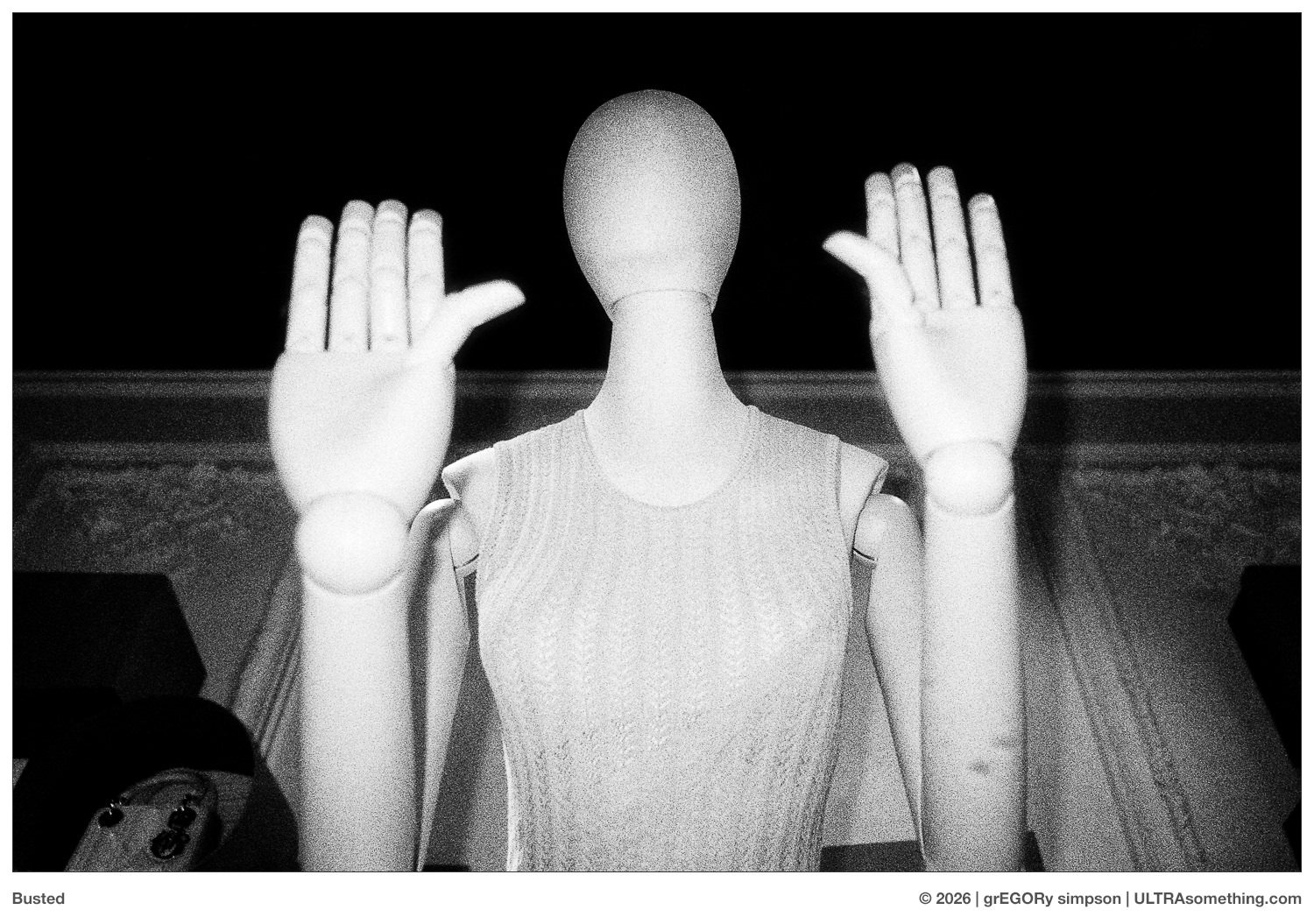
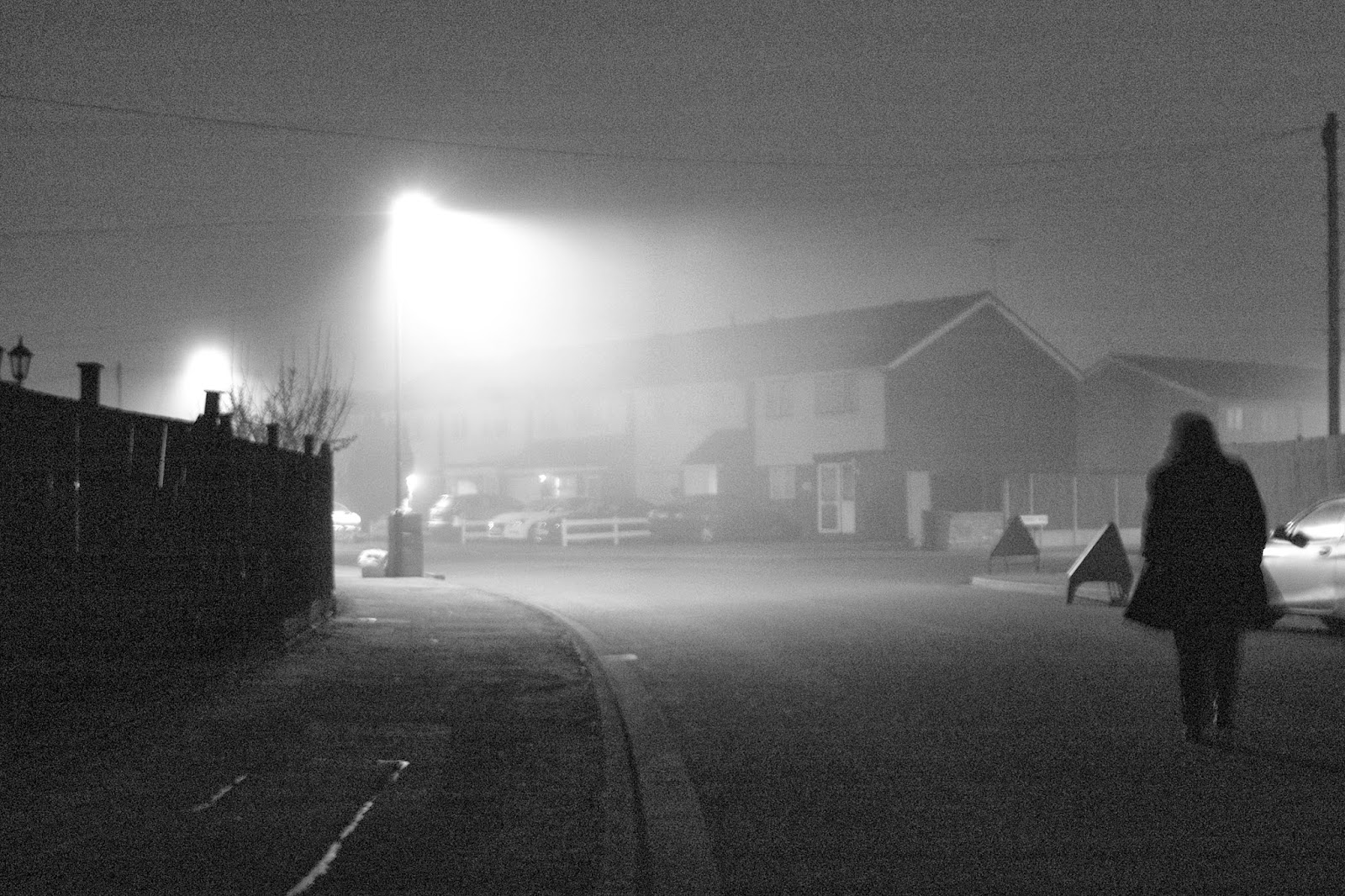
The first photo accompanying this article is indicative of how most of my photos would look if I showed ‘em as I saw ‘em — or, in this particular case, when I don’t quite see ‘em. I was on the street late one night, when I suddenly became aware of a sinister and rapidly approaching presence. I could hear the heavy shuffling of feet, the laboured breathing, and the swishing of stiff fabric as something bore down upon me. I felt the hairs stand up on the back of my neck, and quickly turned to face (and photograph) the impending danger as it lurched past me — brushing my shoulder before it disappeared back into the darkness from which it came. The photo shown here is, indeed, exactly what I saw — which, I surmise, was likely some sort of troll.
And what of the banshee photo? It’s obviously been heavily processed, but not for the purpose of accentuating “what I saw.” Rather, I’ve processed it to accentuate what I didn’t see. In this particular case, the fact I didn’t quite see my subject is a good thing, since banshees usually appear only as harbingers of violent death. Much rarer and even more elusive is the male of the species — the banhee. Banhees traverse the space between light particles, making them particularly difficult to photograph. Since I was capable of only intuiting the banhee’s presence, I simply aimed my camera toward the cold spot to my left — hoping some light particles from the visible spectrum would reflect a portion of the banhee’s image onto my camera’s sensor. In order for either you or I to actually see the banhee, excessive post processing was required — bringing out many details, which initially appeared obfuscated in shadow. And isn’t this the real reason for most processing decisions? To enhance subjects beyond the reality of the scene? Beyond what we “saw?”
Feel free to photograph whatever you want. Process it to look however you want it to look. But if you’re going to make up stories about what you saw, at least make ‘em entertaining. Dragging out the old “this is the way the scene looked to me when I shot it” fallacy is both tiresome and trite — unless, of course, you really do have bionic cyborg orbs.
©2014 grEGORy simpson
ABOUT THESE PHOTOS: “Troll” and “Banhee” were both photographed with a Ricoh GR digital camera — which I’m quickly coming to realize might well be the single best camera available for those wishing to photograph supernatural phenomena.
If you find these photos enjoyable or the articles beneficial, please consider making a DONATION to this site’s continuing evolution. As you’ve likely realized, ULTRAsomething is not an aggregator site — serious time and effort go into developing the original content contained within these virtual walls.