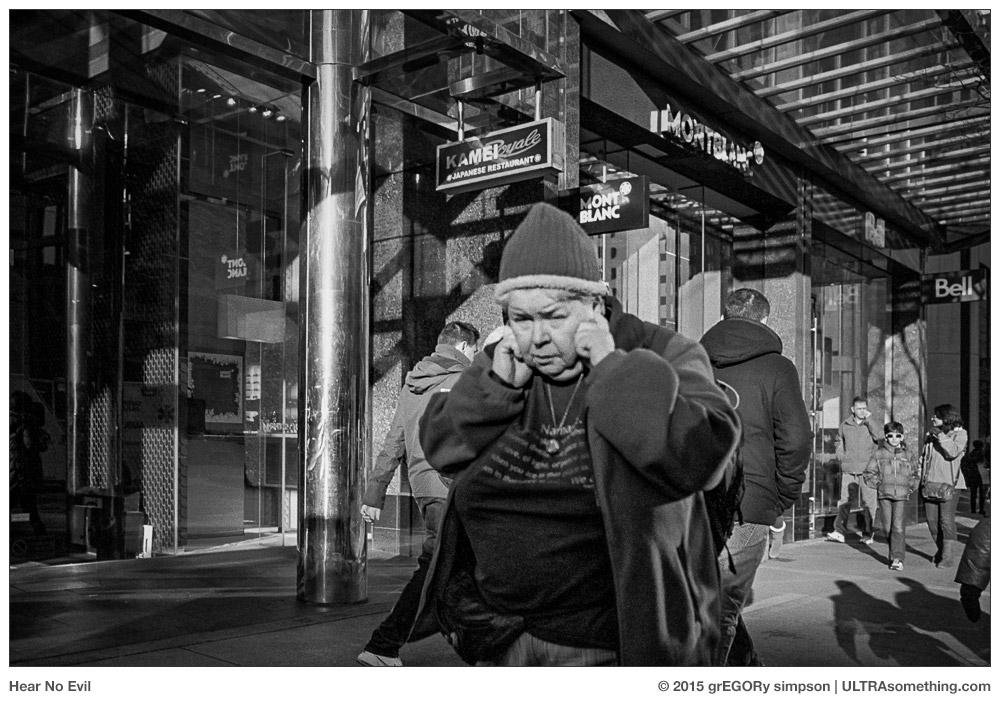
Many mathematicians and physicists support the hypothesis that humans are not real — that our universe is merely a computer simulation, and that all life is but an algorithm running within it. Offering an alternate perspective are the ancient astronaut theorists, who believe today’s Homo Sapiens are the result of meddlesome aliens who long ago tinkered with the indigenous ape population’s DNA.
But who’s to say both viewpoints can’t be correct? After all, a simulated being has no way of knowing that it’s a simulation. So if we take a leap of faith and say that humans were indeed created by aliens, then isn’t it still entirely possible that those aliens were, themselves, merely computer simulations — essentially an invasive subroutine sent to modify a portion of our own galaxy’s code, like a virus that screws with a Word file?
We humans have been fighting over the daddy question for thousands of years. Personally, I don’t really care whether Pop is a geeky hacker, a smooth grey alien, or an old dude wearing a toga and sporting a long white beard. What matters isn’t who or what made us. What matters is what they plan to do with us.
Because let’s face it, the human body is hopelessly outdated. It’s a relic from another time — perilously close to total obsolescence and in dire need of a complete design refresh.
Need proof? Look no further than that pile of keys, coins, cards and mobile devices we’re forced to carry around. Isn’t it about time we borrowed a feature from our marsupial friends and received a built-in pouch of our own?
And haven’t we humans convincingly demonstrated that we’re way overdue for some man wings? We’ve built all kinds of freakish machinery to compensate for our general lack of mobility, so it’s rather obvious we could stand to sprout a few feathers. Besides, equipping us with wings would significantly reduce mankind’s carbon footprint, helping to save the planet for all manner of critters far cuter than us.
I’m just brainstorming here, but wouldn’t a chameleon-like ability to change skin tone relegate racism to the history books? Not to mention the liberating effect it would have on our wardrobe choices.
And why not pop a USB jack into our navels? What’s the use of having an empty port in the middle of our bellies if we can’t use it to power our smart phones or update our own operating systems?
And have you noticed that every time you go to the doctor, someone ends up sticking a needle in your arm? Either they want to inject something into our blood stream, or they want to suck something out of it. So is a simple vein tap really too much to ask for? I mean, all our other bodily fluids have their own taps, so why not blood?
And it’s not just new features that are needed — we humans have been living with some serious bugs for far too long. For example, we all come factory-equipped with two kidneys, two lungs, two eyes, two ears and even two nostrils, but we have only one heart. What’s with that? I don’t know about you, but I consider the fact I have a backup nipple, but no backup heart, to be a serious design flaw.
Naturally, as a photographer, I’ve also given significant thought to re-engineering humans in order to improve our photographic capabilities. At one point, I toyed with the idea that cameras might not even be necessary — that our eyes take in so much, that what we really need is a better way to file and access the visual information we gather throughout life — perhaps even using that oh-so-handy USB navel port to make a few prints.
But upon further thought, I realized such a technique would limit our photographic capabilities, not expand them. For one thing, all of us would be photographing with the same single focal length lens — our own eyes. We’d lose the ability to have telephoto lenses and wide-angle lenses, and thus the enjoyment of seeing what our eyes can not. Sure, we could modify the Human 2.0 spec to include “zoom eyes,” but humans still haven’t mastered the art of walking and texting — so this might be a feature best-left to the Human 3.0 project.
Furthermore, I realized that using our own eyes as lenses would limit us to only photographing what we, ourselves, could look at. And if that were the case, how could we ever take a selfie? We’d have to go back to the draconian days where the only way we could photograph ourselves was to look into a mirror. Yes, we could add “removable eyes” to our Human 2.0 spec, but how long do you think it would be until you dropped one of them down a sewer grate?
So photographically speaking, I now believe that our daddy got it right the first time, and that it’s actually a good thing we’re forced to rely on antiquated machinery in order to take photos. Creativity can never come from an algorithm. If today’s in-camera “scene modes” and software processing filters have taught us anything, they’ve taught us this.
Or course, if we ourselves are truly nothing but simulations and were thus created algorithmically, then to state that creation can not be born from algorithms would imply that we were never actually created at all. Which would mean that…
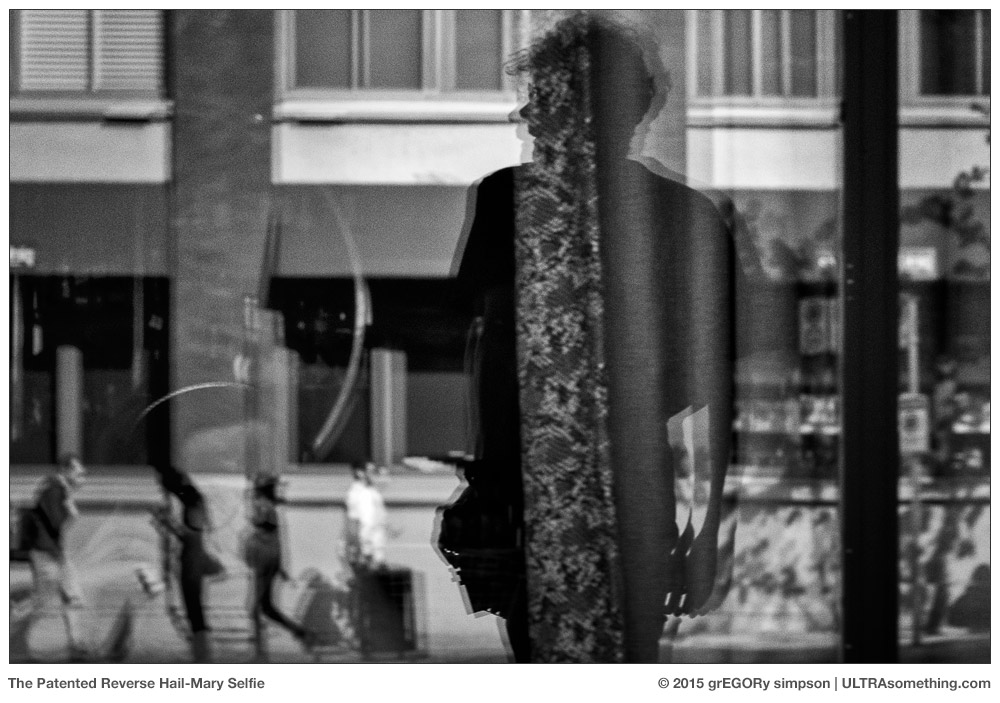
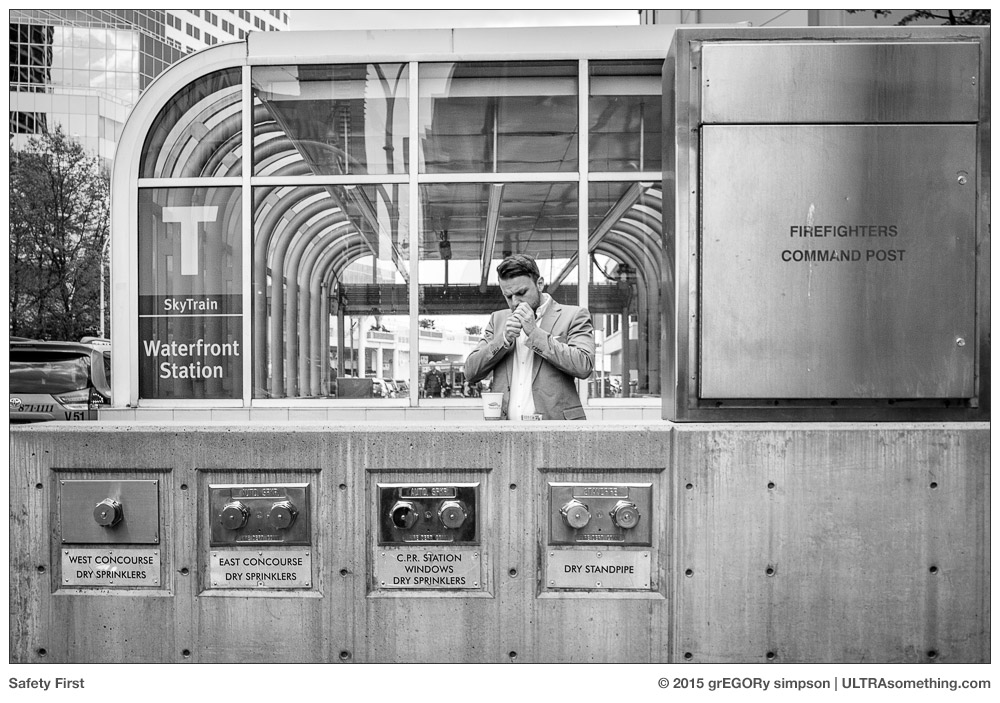
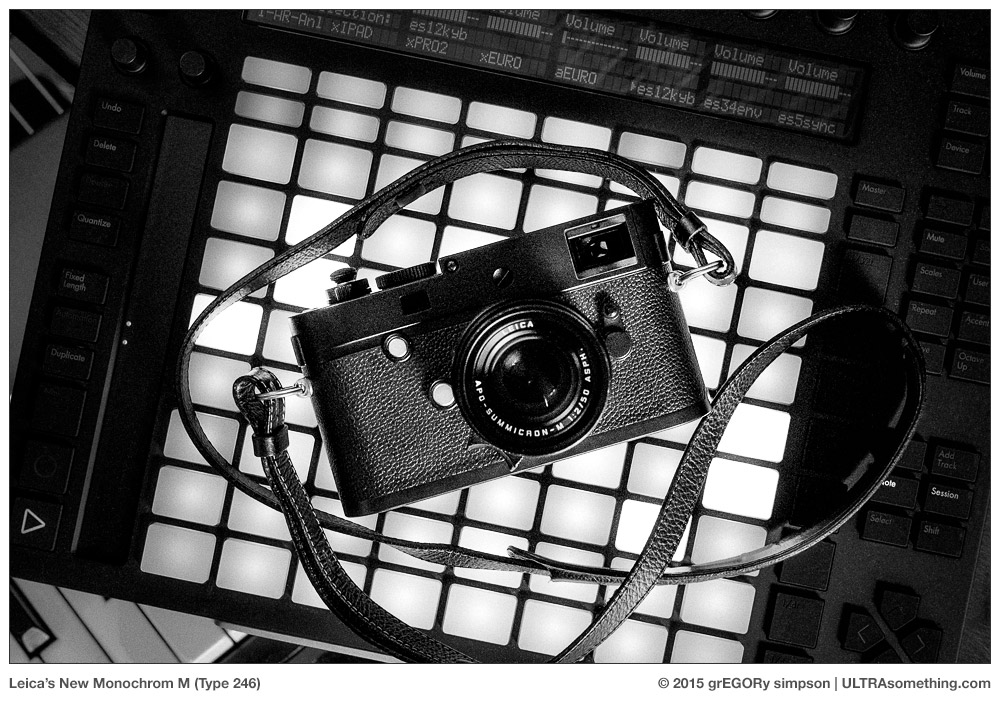
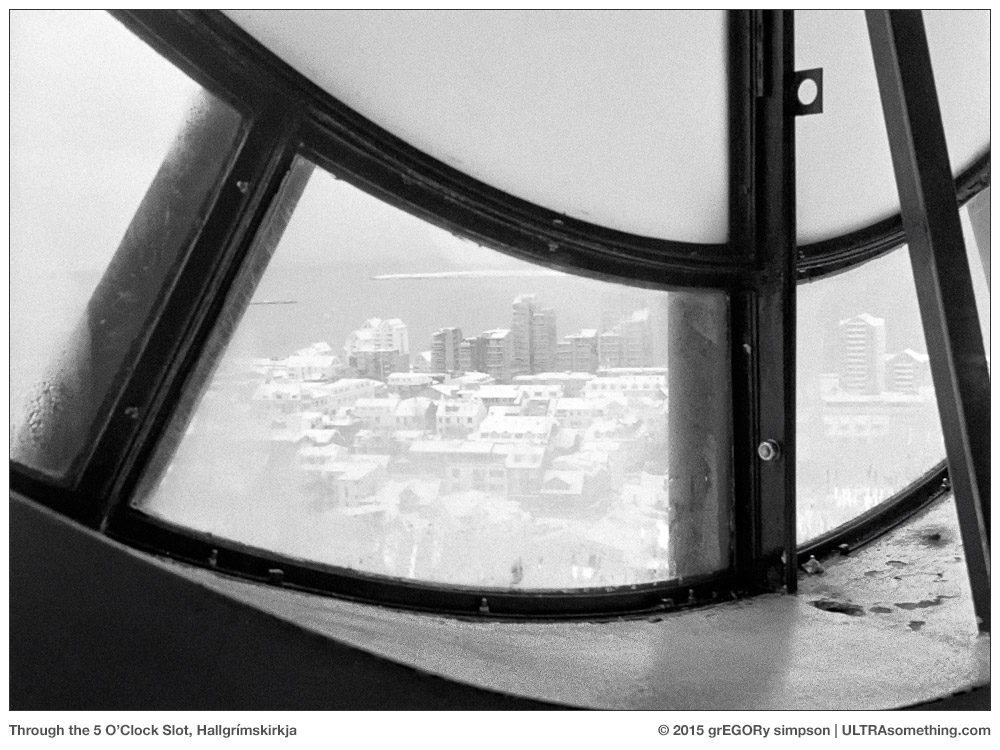
ABOUT THE PHOTOS: All three photos were shot with my newest best friend — the Leica Monochrom M (Type 246). To compensate, all three were also shot with relatively inexpensive lenses. My Voigtlander 50mm f/1.5 found its way onto the camera for “The Patented Reverse Hail-Mary Selfie” while “PCT (Personal Cell Tower) — Prototype” used the cheap yet capable Voigtlander 21mm f/4 Color Skopar. “State of the Art Stick Technology” used a decidedly non-state of the art Leitz 35mm f/3.5 Elmar thread mount lens from the 1940’s.
REMINDER: If you find these photos enjoyable or the articles beneficial, please consider making a DONATION to this site’s continuing evolution. As you’ve likely realized, ULTRAsomething is not an aggregator site — serious time and effort go into developing the original content contained within these virtual walls. Although whether that time and effort belongs to me or to whomever (or whatever) programmed me is, I suppose a matter of question.
Virtual confetti rains down from my browser’s title bar. I shield my eyes from the garish text flashing rhythmically to the pulse of John Philip Sousa, which squawks with all the pomp and grandeur that a poor little MIDI File can muster. “Congratulations on reading your 500th photography article on the subject of copyright infringement!” it exclaims — further proof that Google knows far too much about my personal proclivities.
I’m not sure exactly what attracts me to this particular genre. Perhaps I’m just endlessly fascinated by human audacity.
The articles divide into three distinct classes. In many cases, the author recounts how some rookie photographer decided to bypass the tedious learning curve by simply claiming the author’s images as their own. Other authors tell of compunctionless corporations who poach photographs from Flickr, and use them in worldwide marketing campaigns for hamster deodorant. Every so often, the articles are outrageous narratives about idea-bereft photographers who painstakingly recreate (rather than appropriate) another photographer’s carefully staged image — thus crossing over into the area of intellectual property theft.
What I find particularly curious about these articles is that, in nearly every case, the image thief rarely recognizes that they’ve done anything wrong. To the victim, it’s a crime. To the perpetrator, it’s “fair use.”
Alas, I’ve learned it’s beyond the humble scope of ULTRAsomething to alter social mores. The best I can do is observe, learn, react and report. As such, my report on copyright infringement might surprise you, but here it is: In the seven years that I’ve published ULTRAsomething, no one (to the best of my knowledge) has ever stolen a single one of my photos.
Intriguing, isn’t it?
You’re probably wondering how I’ve done it. Intrusively visible watermarks? Digimarc registration? High-priced lawyers crafting menacing legalese?
Nope.
My technique is far simpler — I take photographs that no one wants to steal.
It’s important to realize that I’m not advocating crappy photography. Just because someone doesn’t want to steal something doesn’t mean it’s without value. For example, I’d wager more people would bootleg a recording of Beyoncé snoring than would steal, say, a copy of Bernard Parmeggiani’s De Natura Sonorum album. But this doesn’t mean the Parmeggiani album isn’t great, nor does it mean that the slumbering Beyoncé album is. It’s just the inevitable result of the bell curve of popular culture. The more popular something is, the more unscrupulous profiteers it attracts.
At some point, every photographer must choose between two audiences. Either they must satisfy the visual requirements of the world at large, or they must satisfy those of a single individual — themselves. The all-too-human desire for recognition, validation and income makes it rather difficult to ignore the call of the world. But it’s this same call that also attracts thieves, opportunists and copyright infringers.
I’m one of the lucky ones — I chose the “personal” path, and my photographs diverge markedly from public inclination. Occasionally, some less-fortunate photographer will also choose the personal route, only to discover they’re actually in-sync with world sentiment. Granted, this enables them to pursue their passion without having to renounce popularity or earnings, but at what price? The price of being targeted by image thieves, that’s what!
It would be a rare rookie photographer who would recognize the “charm” of my photos — so noobs never steal ‘em. Likewise, their obfuscated and metaphoric appeal means they receive little interest from corporations, who require photographs that register with a mass audience. And, since my photos are almost totally of the “found” (rather than “staged”) variety, there’s no intellectual property to steal, because there’s no intellect involved in their creation.
In general, the more personal your photography and the more intimate your motives, the less likely others will claim your photos as their own. Sure, you’re destined for a life of obscurity. And yes, people might snicker at the fact you only own two shirts, which you’ve worn on alternate days since Y2K was an actual global concern. But it all seems worthwhile when you find yourself kicking back to read another photographer’s tale of copyright woe, rather than settling in to write one of your own.
ABOUT THESE PHOTOS: “Artistic License” was shot with a Leica Monochrom M (Type 246) and a Leica 50mm f/2 Summicron APO ASPH lens. “Mixed Metaphors” was also shot with a Leica Monochrom M (Type 246), this time fronted with a Leica 28mm f/2 Summicron. “Jack” was grabbed with my little Ricoh GR, while “Abduction” sees the Monochrom M (Type 246) return to action, but now with the Voigtlander 50mm f/1.5 Nokton lens.
REMINDER: If you find these photos enjoyable or the articles beneficial, please consider making a DONATION to this site’s continuing evolution. As you’ve likely realized, ULTRAsomething is not an aggregator site — serious time and effort go into developing the original content contained within these virtual walls.
“That guy’s a terrible writer,” posts a reader on a photography forum, garnering numerous likes and +1’s. “His photos are just random snapshots with no context,” states another on a different site. “I couldn’t be bothered to read what he wrote, because I’m sure he doesn’t say anything that I haven’t read before,” professes yet another critic — seemingly oblivious to his own deliciously paradoxical condemnation.
These are, of course, all comments written about yours truly.
Online forums are wonderful places for learning all sorts of things about oneself. For example, they taught me I’m not a “real” street photographer because I shoot from afar with a telephoto lens. I’m not sure exactly when my 28mm lens became classified as ‘telephoto,’ nor when ‘afar’ became defined as ‘2 meters’ — though I’ll willingly admit that I’m not a real street photographer… but that’s because there is no such thing.
On numerous occasions, I’ve read that I haven’t a clue how to properly process my photos. But can a total stranger really know how I intended them to look? Frankly, my photos look exactly the way I want them to! A more astute critic would impugn my taste, but it’s always my abilities that come under attack.
My proudest moment came when a highly agitated reader claimed that I’m such a horrible photographer, that my very existence has tarnished the profession and is preventing others from finding photographic employment. How can I not be flattered that someone believes I’m both famous enough and influential enough to ruin an entire industry!
Thanks to my penchant for shooting with Leica rangefinders, one of the most oft-repeated internet condemnations is that I’m not worthy of a Leica. More often than not, the verdict is delivered with the word “sorry” in front, as in “Sorry, but Leica’s are wasted on him.” The word’s inclusion is meant, I’m sure, to soften the verdict and illustrate the benevolence of the adjudicator. But here’s the thing — and this is going to make a lot of people on a lot of forums very happy — I am in complete agreement with this assessment! It’s true, Leica’s are wasted on me. In fact, every camera I’ve ever shot with is wasted on me.
I’ve never owned a camera that wasn’t eminently capable of producing a Pulitzer Prize winning photo. Yet I’ve never won a Pulitzer. All these cameras with all this potential — and here I am squandering them on my own personal enjoyment and dubious aesthetic values. Daido Moriyama photographed his NY ’71 book with a half-frame Olympus camera. It’s a masterpiece. I actually own two Olympus half-frames, yet neither has resulted in a collection anywhere near that calibre. Josef Koudelka’s Chaos shows what one can accomplish with the panoramic format. But two years into my Hasselblad Xpan explorations, I’ve yet to produce a single photo worthy of being a Koudelka outtake. Even today’s trendiest and most popular gear is wasted on me. My Olympus OM-D E-M1? I doubt I’ve used more than 20% of its myriad feature set. Call me “lame,” but I just haven’t gotten around to employing its watercolor art filter yet. Curiously, Leica’s rangefinder cameras are so void of bells & whistles that, in many ways, they’re actually less wasted on me than other cameras — at least I use every feature in my Leica M film bodies. However, I must sheepishly admit to not having yet pushed the “M” button on top of the M246.
So what does this rambling pre-amble have to do with Leica’s new Monochrom camera? Nothing. And everything. Its main purpose is to weed out people who land on this site expecting a blow-by-blow feature assessment. Nothing prevents people from reading something quite as effectively as actual words.
Those who are brave enough to endure the prologue are usually the sort who know (or have now learned) that ULTRAsomething is neither a news site nor a review site. ULTRAsomething is about photography gear the same way that Gilligan’s Island is about survival tactics.
My exploration of this camera is still a work in progress; my opinions are mine and mine alone; and my photos are meant to satisfy myself, and not the demands of an internet audience. In other words, everything I write about Leica’s new Monochrom M (Type 246) camera is but a guidepost — markers that people are free to connect in whatever way most benefits them.
Cents and Sensibility
Another commonly-logged complaint amongst photo forumbulists (yes, I just neologized that word), is that ULTRAsomething’s camera articles are useless. Apparently, this is because the articles never actually tell the reader whether or not to buy the camera, nor if upgrading from some previous model is worth the expense.
It’s a criticism that falls just short of being justified. Yes, it’s true. But it’s true for a rather valid reason — because to do as asked is impossible! How can I make a recommendation? I have no insight into the individual wants, needs and pecuniary status of my readers. I only have insight into my own. So that’s what I write about.
Leica’s cameras, in particular, are rather expensive. So I understand the reader’s desire to find some sort of external validation that either supports their decision to purchase one, or justifies their rationale to not. But these are, ultimately, personal questions that only the reader can answer.
I’m often tempted to take the philosopher’s way out, and suggest that very few people actually need a new camera. As I wrote in a reply to a reader’s comment in the previous article, “My 1958 Leica M2 is far better at being a camera than I’ll ever be at being a photographer.” But “need” implies rational thought and intellect — and for me, photography has little to do with either, and everything to do with emotion. Different cameras may ultimately yield similar results, but the impact they have on a photographer’s instincts, methods, motivation and passion can have a profound and real effect on achieving that result.
So add this to the long list of ULTRAsomething articles that fails to state whether a camera is actually worth the expense. Instead, I’ll suggest you can find the answer you seek by simply asking yourself two questions:
Is this camera going to provide me with a technical, tactile or emotional advantage over a camera I already own?
If so, then am I willing to give up X, Y and Z in order to gain that advantage?
I can’t possibly answer Question #1 on your behalf. But the remainder of this article will answer it on mine.
Similarly, your X, Y and Z will likely be unique and very specific to you. Obviously, no one should be willing to give up X, Y and Z if X = “food,” Y = “shelter” and Z = “safety and security.” But what if X = “learning to cook, rather than going out to eat?” What if Y = “dumping cable TV and sticking with a 4 year-old smart phone running last years’ operating system?” What if Z = “mending your grandfather’s old hand-me-down zoot suit, rather than purchasing something more fashionable?”
Offense and Sensibility
As stated above, the first question I asked myself — and the question you’ll ultimately need to ask yourself — is “will this camera provide me with a technical, tactile or emotional advantage over a camera I already own?” For me, ergonomics are actually the most important factor when choosing a camera. In my case, that means a rangefinder. However, since I already own several, the fact the M246 is also a rangefinder does not provide it with any immediately apparent ergonomic advantage.
So, instead, I decided to look for advantages within the camera’s image quality capabilities. At first blush, this might seem a strange avenue for me to explore — after all, the appearance of my published photos certainly makes it seem as if I don’t actually care about image quality — and to an extent, that’s true. But it’s true only when discussing the look of my final prints. In reality, I like to capture as much fidelity as possible, because the more I capture, the greater the number of ways I can screw it all up in post-processing.
As I discussed in Sensors and Sensibility, I have a few quibbles when it comes to using digital cameras for so-called “street” photography. Believe me, this isn’t a “film vs. digital” debate. I like both and I shoot both. In fact, I don’t believe in pitting one format against the other. To me, they are two completely different mediums, with two completely different outcomes. What matters is not “which is better,” but “which is better for my intended purpose?” And for my use on the streets, I prefer to use film because of its exposure latitude, highlight response, and the “forgiving” nature of its less-clinical renderings. So the best thing a new digital camera could do for me is to negate some of that need for film, while providing me with all the inherent advantages that digital offers (workflow, resolution, flexibility).
What I saw from the tests I performed in Sensors and Sensibility is that the M246 has a tremendous amount of usable dynamic range. For my own particular brand of photography, this translates into the following tangible benefits:
It means I can underexpose a scene (protecting the highlights), yet still have enough clean and meaningful shadow detail to pull up my subject in post processing. The end result won’t necessarily look like film, but it means I’ll be just as likely to “get a usable shot” with a digital camera as I currently do with film.
It means I can use faster shutter speeds, which will freeze the motion blur that comes from having both a photographer and a subject that are frequently in motion. Using faster shutter speeds means shooting at higher ISO — even in bright sunlight — but with the camera’s stellar low light (shadow) capability, it’s a worthy trade-off.
It means I can use narrower apertures, which will diminish focus errors caused by scale focusing. Again, narrower apertures mean shooting at higher ISOs than one might normally choose. But once again, the relatively minor increase in shadow noise is more than offset by the benefit of having more photos appear “in focus.”
While I initially only theorized these advantages (based on my controlled tests), I have since employed these techniques in the field. Though it will take a little while for me to adjust my habits to accommodate this wholesale change to balancing ISO, shutter speed and aperture, the theory has definitely been proven.
The M246 will absolutely provide me with more of a technical, tactile and emotional advantage than any camera I already own — because, until now, I’ve never used a digital camera that I’ve found so thoroughly satisfying for “street” work.
Dissents and Sensibility
There is a flip side to the question of whether a camera provides enough of an advantage to warrant consideration: “Does it create any disadvantages that will negate those hard-earned advantages?”
For some photographers, a black & white sensor might be a disadvantage (particularly if, like me, they’re considering upgrading from a color camera, like the M9). In my case, a monochromatic sensor actually provides a wealth of new advantages — many of which I discussed several years ago in the Fetishist’s Guide to the Monochrom series. 100% of my photography is black & white. This means that the sole advantage of using a color sensor rests in its ability to change relative tonalities after a photo is taken. But for me, this single advantage is more than offset by the Monochrom’s inherent image quality advantages, the workflow improvements for BW photography, and my own psychological need to actually shoot (and not just display) in black & white.
Many potential M246 customers are currently engaged in the whole CCD vs. CMOS sensor debate. M8’s, M9’s and the original Monochrom cameras all used CCD sensors. M240 series cameras (including the new Monochrom M246) use CMOS. There’s no doubt that they provide a different rendering, though I find the differences to be more apparent in color images. Like many, I have a slight preference for the appearance of a color file from a CCD that’s been exposed at base ISO. But I’m not shooting color. And I’m not shooting at base ISO. So any minuscule (and totally subjective) advantage of a CCD is ultimately lost on me, where the new M246’s high ISO capabilities (and thus, its shadow detail and dynamic range) tilt the balance totally in favour of its new CMOS sensor.
Another image quality debate that’s currently raging on the internet concerns the fact M246 files are 12-bit, and not 14-bit. I’ll admit, before I started testing the camera, this “issue” worried me a little. Although Leica explained its necessity, and mentioned they could see no real-world disadvantages to the 12-bit files, I had my doubts. So, during the test phase, I set out with every intention to prove Leica wrong. Instead, I proved that I was wrong. I could find no issues with 12-bit files. I could not “break” the images in post-production, like I thought I could. There was not one single shred of evidence in my testing that would make me think that the 12-bit nature of the M246 files constituted a “downgrade.” Perhaps a 14-bit version of this camera (were it possible) would have even greater fidelity — but the 12-bit version that currently exists definitely bests the performance of the previous 14-bit cameras.
Having thus debunked (or dismissed) the currently trending internet-based worries, I do have one actual issue to report. It concerns the way a geometrically alterered image can bring out noise patterns in the shadows. It’s a problem I first reported back in Part 3 of the Fetishist’s Guide to the Monochrom. At the time, I didn’t fret over it too much — it affected only a small percentage of my photos and, when it did, I could spend some extra time and energy minimizing the effect in post-production. Unfortunately, this issue is still present in the new M246.
In brief, this problem is as follows: Monochrom noise is extremely fine. It’s more like a light dusting of static than any sort of de-mosaicing noise or “film grain.” Because of this, even at high ISO values, the shadows appear relatively noiseless. However, if you boost those shadows by a couple of stops, you’ll start to see what looks like a loosely textured “weave” — much like you’d see if you looked closely at a fine wool suit fabric. If you then alter that image geometrically, you’ll begin to see patterns emerge. Even a simple rotation (such as you might perform to level a horizon) will cause a sort of tilted, grid-like pattern to appear in the amplified shadow regions. If you perform any non-linear geometric distortions (such as lens correction or keystone correction), then the shadow noise will display a subtle moire-like effect with undulating lines and waves appearing within the noise. Remember when you learned about magnetism in grade school? You’d sprinkle some iron dust on a paper and the dusting looked totally random. But when you brought a magnet near it, those iron particles would begin to form patterns. That’s exactly what can happen to the amplified shadow noise in a high ISO Monochrom file.
The best way to minimize any pattern is, of course, to avoid doing what causes it to appear: Don’t shoot at high ISO; then don’t add add several stops of exposure to that file’s shadows; then don’t manipulate the heck out of that image’s geometry.” Right — you might as well tell me to give up photography. So the next best way to minimize the patterns is to actually add some irregularity to the shadow noise. If I have a file that I know will be tortured in post-processing, I’ll add some noise to the shadow regions, then export an upsized version of that file from Lightroom. This works much the same way that dithering works in digital audio. Because digital audio is so clean, any time you re-sample it, you end up with audible artifacts that are imprinted on the sound by the processing algorithms. In order to render these artifacts inaudible, noise is added to the file before it’s resampled.
I have no idea if this is what’s happening with Monochrom files, but on the surface it seems that the noise is so fine that it actually enables us to see exactly what sort of pattern-based processing algorithms are being used by our image processing software — algorithms that are supposed to be invisible to the naked eye become visible because there’s not enough noise to mask them. I’ve tested Monochrom files with both Capture One and Lightroom/Camera Raw, and the results are essentially the same.
If my theory is correct, and if the Monochrom continues to grow in popularity, some enterprising developer might be well served by adding an automatic dithering option to their RAW converter — precisely for the purpose of dealing with low-noise, fine-grained files like those produced by the Monochrom. Hopefully, I’ll find some time this month to perform further tests, and seek out the guidance and knowledge of both Leica and various RAW converter developers. If I find out more, I’ll post a follow-up article.
Vents and Sensibility
Though my testing of the new Monochrom M246 uncovered a cornucopia of tangible imaging advantages, I do have a few issues regarding the camera’s ergonomics. Granted, the M246 is still a rangefinder, and a rangefinder is the #1 requirement for my particular style of shooting. But there are a few worrisome trends developing in today’s digital rangefinders — some of which dampen my enthusiasm somewhat.
I must first begin with a confession: Two years ago, when I first took Leica’s new M (Type 240) for a “test drive,” I had a rather negative response. To say I didn’t like the new body would be an understatement. The 100g of excess weight really annoyed me. The relocated menu button sat directly beneath where my thumb wanted to rest, forcing it over onto the LCD, where its extra thickness cause my wrist to ache. I was completely discombobulated by the fact that, when I brought the camera to my eye, I couldn’t see any frame lines until the camera “woke up,” which felt like an eternity. I suffered separation anxiety over Leica’s decision to remove the frame line select lever, and was even inexplicably annoyed there was no longer a number following the letter “M.” After a single evening spent shooting the M (240), I felt a renewed sense of appreciation for my slimmer (in hand), lighter and “proper” M9.
But this only represents half a confession. Because back in 2006, when Leica released the M8, I had a similarly negative response. Though roughly the same weight as a film M, the M8’s extra thickness made the camera feel much heavier and seem far clunkier. Gripping it made my wrist ache. It seemed to take a similar measure of eternity to write a file to the SD card, and I was totally distressed by the thunderous noise that would spring forth from its shutter.
It was 2009 before I finally purchased an M8, deciding that my dislike of digital SLRs was greater than any ergonomic issues I might have had with the M8. Over time, I grew rather accustom to the M8’s extra thickness and, though it still never felt as good in-hand as a film M, I was able to build up enough wrist strength that it no longer hurt to carry it all day. I never did adapt to the shutter sound, which is one of the reasons why I upgraded to the M9 immediately upon its announcement.
So it’s rather ironic that I immediately dismissed the M240 for failing to match the ergonomics of the M8/M9 when, in fact, I once dismissed that earlier line for its own collection of ergonomic issues. Progress always exacts its price. Fortunately, when the Monochrom M (Type 246) arrived, I was mentally prepared from both my previous M240 experience and from my M8 experience, which taught me that first impressions weren’t always lasting impressions.
I’ve been in possession of a prototype M246 for a month now, and I’ve had the opportunity to take it for several dozen walks. In general, I’m still somewhat annoyed by both the weight and ergonomic concerns. When I bought the M8, it was the lightest, most compact high-fidelity digital camera I owned. I never had to choose between my “good” camera and my “portable” camera — they were one and the same. But a lot has changed since then. Today, the 240-series M’s are the heaviest, least compact digital cameras in my (temporary) possession. Now, when I walk out the door, I must once again choose between fidelity (Leica) or portability (any of my other digital cameras).
Fortunately, for the past month, the choice wasn’t mine to make. I had to take the M246 because I had to test it. And the more I tested it, the more I fell in love with it. In the end, I felt about the M246 the way I ultimately felt about the M8 — that my appreciation for what the camera could do (and how it did it) was greater than my dislike for its heavier, more awkward body.
Thankfully, Leica returned the exiled frameline select lever to the M246. The missing number after the letter “M” (which, admittedly was about as ridiculous an annoyance as has ever been stated) was also rectified, because the M246 has no logo or model demarkations whatsoever. I’m still not totally thrilled with the electronic framelines, but at least they seem to be set for 2m (making framing a bit more WYSYWIG than my M9). Hopefully, now that Leica has put the framelines under battery control, they’ll go the extra step in a future model M and make them expand and contract dynamically with distance. Then, at least, there will be a tangible benefit to waiting for the framelines to “wake up.”
My other problem with the 240-type body was (and continues to be) the placement of the Menu button, which is located directly beneath the spot at which my thumb usually grips a camera. This is an issue I have with nearly every modern digital camera, and not just Leica. Customer demand for larger LCDs has reduced the space available for control buttons. So whenever I carry a camera in hand (which is always), those buttons are in the way — forcing my thumb onto the LCD, where the extra thickness makes the camera feel awkward. I’ve taken to using my old first-generation Match Technical Thumbs Up, which I purchased for my M8 back in the day. Although it partially obscures this camera’s thumb dial, it provides an alternate way of carrying the camera — at least until my wrist gets more buff.
One caveat, however, is that when the Thumbs Up is attached, then Leica’s external electronic viewfinder can’t be used. Which segues nicely into the next topic…
Kaizen and Sensibility
Like most every aspect of modern camera design, I have a love/hate relationship with live view cameras. Technically, I’m fine with the whole idea of live view — particularly when it’s offered as an addition to a more traditional ‘optical’ view, which I greatly prefer to use. Any frustrations I do have with live view cameras tend to expand or contract based on their implementation.
In order for live view to be useful for me, it needs to offer two things: focus peaking and an electronic viewfinder. Fortunately, both are present on the M246, but each has caveats. Specifically, the focus peaking works reasonably well, but I find it slightly more difficult to see than on some other camera models. The other necessity — the electronic viewfinder — is available only through purchase of an external contraption. External viewfinders, by nature, are large, clumsy and inelegant. This one also happens to be of only mediocre optical quality.
In spite of my tempered enthusiasm for this camera’s live view implementation, I’m still thrilled to have it. That’s because the M246 is, at heart, a classical rangefinder with a fully optical viewfinder and focus mechanism. Every modern camera manufacture makes a live view camera, but which of them can sell you an honest-to-goodness rangefinder? Just one — Leica. Yet, as much as I need and rely on rangefinders, there are times when it’s not the optimal way to focus. Fast lenses shot wide open? They benefit from live view. Those 90mm and 135mm Leica lenses that go unloved and unmounted for months on end? They have renewed purpose thanks to live view’s ability to easily focus them. Low ambient light? Another prime reason for using live view. The viewing, framing and focusing options on the 240-series are an absolute delight — combining all the benefits of rangefinder cameras with the shot-saving benefits of a focus-peaking live view when you need it. So the presence of live view on a Leica M series camera — even an implementation as middling as this — is the cherry atop the icing on the gravy on the cake.
Suspense and Sensibility
Let’s revisit my first pre-purchase question, “Will the Leica M Monochrom (Type 246) provide me with a technical, tactile or emotional advantage over a camera I already own?”
The answer is absolutely, unequivocally and enthusiastically “yes.” The camera’s technical advantages are leagues above any other camera I own. The emotional benefits of shooting a digital monochromatic camera proved themselves to me back when I first tested the original M9-based Monochrom, and they continue with this camera. The tactile victory is a bit less one-sided: I find the heavier body and electronic framelines somewhat less desirable than what my M9 offers. But these quibbles are more than offset by the benefits of live view, the quieter shutter, the beefier battery and the overall reliability of the M246.
So with Question #1 definitively answered, I have now moved on to question #2: “Am I willing to give up X, Y and Z in order to gain that advantage?”
I am presently in the process of defining exactly what X, Y and Z might mean to me… In the meantime, I’ve still got Leica’s prototype M246 in my possession, and I’m in no hurry to remind them of that fact.
ABOUT THESE PHOTOS: At the end of most articles, I provide technical details about each of its photos: what camera, which lens, what film and developer. In this case, all the photos are taken with a prototype Leica M Monochrom (Type 246), and thus do not require any film or development data. I could, of course, provide lens information, but frankly I’m sick of writing about gear. I will tell you that all these photos were taken with either a Leica 28mm f/2 Summicron, a Leica 50mm f/2 Summicron APO, my old 1946 thread mount Leica 35mm f/3.5 Elmar or the Voigtlander 21mm f/4 Color Skopar.
Does it matter which lens was used for which photo? I hope not. Because my only intent for the past few weeks was (as I stated at the end of Sensors and Sensibility) “to determine whether or not the M246 is capable of stooping to my level.” Sure, Leica’s new Monochrom is designed for the production of stunning images. But I don’t actually take stunning images and, honestly, I don’t even really like stunning images. So if the camera can only produce such images, it’s of little value to me. Instead, I needed to learn whether or not the M246 could take photos that were unmistakably mine. You know — lo-fidelity, high-cheekiness, dubiously useful snapshots of day-to-day life. Mission Accomplished… and in spades.
REMINDER: If you find these photos enjoyable or the articles beneficial, please consider making a DONATION to this site’s continuing evolution. As you’ve likely realized, ULTRAsomething is not an aggregator site — serious time and effort go into developing the original content contained within these virtual walls.
Each morning, a sound with the ironic name of “silk” punctuates the dawn and snatches me cruelly from a blissful slumber. I fumble for the iPad, shut off its alarm and immediately launch my email app. Nothing jolts me back into a state of consciousness quite like staring into the cold, hard reality of an inbox full of fresh new problems — each vying for my immediate attention.
A couple months ago, one of these wake-up emails bounced across whatever sequence of satellites connects Wetzlar Germany with Vancouver Canada. It was, of course, from Leica. They don’t email me often, but when they do, I know it’s because they want something.
Normally, receiving email from anyone who wants something qualifies as “undesirable.” But when Leica wants something, it usually falls into one of two categories: Either 1) they want me to speak at a Leica Akademie, or 2) they want me to test some new piece of gear. Both scenarios require an extensive amount of work, yet both are actually quite enjoyable.
This day’s email fell squarely into Category #2. “Do you have time to test a prototype of the new Monochrom?” it asked.
Truth is, I didn’t. I’d gotten embroiled in way too many projects and was already burning the candle at both ends.
“Absolutely, I have time,” I lied. “Send it to me.” Hey, I could always buy more candles to burn, but how many opportunities do I get to test a brand new Monochrom prototype?
Leica’s request was that I compare and contrast the image quality between three cameras: the original M9-based Monochrom (MM9); the latest Type 240 color M (M240); and this new M Monochrom, designated as Type 246 (M246).
Anyone who’s aware of my current photographic leanings will probably think I’m a curious choice for such a task. After all, I’m not exactly Mr. High Fidelity when it comes to photography. My photos are often grainy and/or noisy, haphazardly focused, dubiously exposed and unorthodoxly framed. But here’s the thing — the look of my photos is actually a conscious and creative choice, and not (as internet forums might suggest) one born of incompetence. As an engineer, I’m actually quite adroit at testing and analyzing products both clinically and objectively. But as a photographer, I’m free to ignore whatever the logical half of my brain suggests. I’m also free to appropriate left-brain logic and apply it creatively with the right-brain. And it’s this latter function that will dictate the direction of this article — I will first analyze the clinical performance of the M246, then use that analysis to suggest how I might be able to use it creatively.
Shades of Grey (Literal Version)
Any time I work with a new monochromatic imaging surface (film or digital), I like to see how it maps colors to tonality. Such knowledge was particularly important for this series of tests, since I would be pixel-peeping and comparing the outputs from both color and monochromatic cameras. In order to do this, I needed to make sure that any M240 color conversions would closely match the tonality of the M246 and MM9. I did this same thing back in 2012, when I wrote A Fetishist’s Guide to the Monochrom. At that time, I had to create a custom Lightroom profile to make the M9’s BW conversion match the output of the original Monochrom. Would I need to do the same here?
I shot the same X-Rite Color Checker chart under the same lighting conditions (and using the same lens) with the three cameras I’d be comparing: The MM9 and the M246 had very similar tonality. For kicks, I decided to see how the M240 file would look if I simply applied Lightoom’s default BW conversion, as shown below. Note that I was not evenly remotely concerned with focus, resolution or noise in this test, so the “softer” M246 image is indicative of nothing other than my carefree technique.
Surprisingly (and unlike the old M9), Lightroom’s default conversion of an M240 color file matches the tonality of the M246 quite closely. Sure, there are minor differences, but no wholesale zone shifts. Certainly, there’s nothing that should impact my ability to compare images from a BW-converted M240 file with those from either an M246 or an MM9. So, for the remainder of this article, all M240 files have been converted to black & white using Lightroom’s default BW conversion.
The Setup
In order to carefully compare images from three different cameras, I knew that my usual modus operandi of hand-holding and scale-focussing would not suffice. In order to perform these tests, I had to remove as much human variable from the process as possible — particularly considering that the human was me. So every comparison involved the following method:
1) Each camera photographed the same scene, under the same lighting conditions, using the same exposure.
2) Each camera photographed that scene using the same lens, which I rotated between all three cameras. In order to deliver maximum fidelity to each sensor, I used Leica’s stellar APO-SUMMICRON-M 50mm f/2 ASPH lens.
3) To reduce the possibility of external vibration, each camera was mounted to the same Gitzo tripod (a relic from a past career in landscape photography, if you can believe it).
Needless to say, such rigidity means this article’s accompanying photos look nothing like the quirky, grungy, exposure-guesstimated product that usually populates the ULTRAsomething site. Because of this, I’ve decided to divide my Monochrom test article into two parts. This first part will compare camera images from a purely clinical standpoint. By analyzing these differences, I’ll be able to predict how best to employ the new Monochrom M246 in the field. A follow up article will then take a look at my field-analysis of the M246, and whether or not my theoretical findings proved valid.
Shades of Grey (Figurative Version)
For my first round of tests, I chose to compare images at each camera’s base ISO. This means ISO 320 on both the MM9 and M246, and ISO 200 on the M240. Though this theoretically gives the M240 a 2/3 stop imaging advantage, it represents the “best case” scenario for any photographer trying to extract maximum image quality from each camera.
As part of the test process, I always took a second shot with the M240 — this time at ISO 320, which put the camera on equal ISO footing with the two dedicated monochromatic cameras.
I spent two days lugging three cameras and a tripod all over Vancouver, shooting hundreds of “test” frames illustrating various scenes. Upon analyzing all these shots, I came to the conclusion that they essentially all illustrate an identical set of similarities and differences. For this reason, I’ll use just one representative scene, and take various 100% crops from within that scene to demonstrate my discoveries.
Below is the scene as photographed by all three cameras (with the M246 version being the one displayed here).
What follows is a series of comparisons between cameras, using different crops from the above scene.
Comparison 1: Try as I might, after examining hundreds of frames — all shot with each camera at its base ISO, I could see very little resolution difference between them. Sure, the MM9 has only 76% as many pixels as the other two cameras, but it seemed no less adept at resolving detail. Comparisons between the M246 and M240 yielded results that I would consider “inconclusive.” Sometimes, the M246 seemed to resolve slightly more detail, and sometimes the M240 did. In reality, most differences boil down to the influence of “outside variables,” such as atmospheric conditions, wind, or even the subtle contrast differences inherent in the tonal variations between the way each camera mapped color to luminosity.
Comparison 2: This next comparison attempts to remove another pair of variables from the process. Specifically, the M240’s ISO has been increased to 320 in order to match that of the two Monochrom’s. Also, the MM9 file has been upsized by 15% using Photoshop’s Bicubic Smoothing algorithm, so as to match the overall pixel count of the two newer cameras.
Upsizing the MM9 files make them appear a tiny bit “softer” than either the M240 or M246 files. This is to be expected. The 2/3 stop increase in the M240’s ISO has also had a subtle effect on resolution. It’s not always immediately apparent, and is something that will very likely never be seen in a print (much less on a massively downsized web image). As such, it’s only likely to concern pixel-peepers and nerds who write camera reviews (cough).
Comparison 3: This is simply another crop, taken from a section near the center of the frame. Here, the softness of the up-sampled MM9 image is a bit more apparent, while the resolution differences between the M246 (at ISO 320) and the M240 (at ISO 200) continue to appear essentially non-existent.
Comparison 4: Same crop as above. Only now, the M240 frame has been shot at ISO 320, matching the ISO of the other two cameras. In this case (and at 100%), the slightly degraded resolution of the M240 file is apparent.
It’s important to keep in mind that the images I’m showing have had no sharpening and no noise reduction. In other words, they may be somewhat representative of how the sensor performs, but they’re not that representative of how people actually work. The following comparison shows how the resolution differences appear to be minimized significantly when a tiny bit of sharpening is applied using the Pixel Genius PK Sharpener plugin. Note that default, automatic values were used, and that the differences could be narrowed ever more by optimizing the sharpening in each file.
Comparison 5: The next comparison again uses the same image, and again selects a different crop region. The goal for this comparison was not to see which camera had the highest resolution, but to see which camera had the nicest gradation between shades of grey. On first glance, the MM9 appears to give the smoothest gradations at base ISO. However, it’s important to remember that the file’s overall micro-contrast has been softened by the upsizing process, which has the effect of greatly minimizing the visible noise. In reality, files from the MM9 (that have not been upsized) have a nearly identical noise floor as the M240 and M246 cameras.
The M246 at ISO 320 and the M240 at ISO 200 appear nearly identical. Noise levels are incredibly low in both cameras, though I can perceive a tiny bit more noise in the M240. Don’t worry if you can’t — I’ve had the benefit of looking at hundreds of images and doing blind comparison tests. I would guess that, at base ISO (200 on the M240, 320 on the M246), I’ve been able to correctly identify which file came from which camera 75% of the time — and the way I can do this is to look at the noise levels. It can be subtle, but it is perceptible under certain conditions.
Comparison 6: This is the same crop as displayed previously, only the M240 has now been shot at ISO 320 to match the two Monochrom cameras. Here, we can definitely see more noise in the M240 image. Whether or not this matters to you is entirely your decision. Frankly, to me, it doesn’t matter. Nor am I sure I’d be able to see it in an actual print. Some might even prefer the noisier file because it gives the illusion of increased detail. For example, one could easily fool themselves (and others) into believing that the noise seen on the distant mountain is actually a more detailed representation of its “trees”.
Descent Into Darkness
Once I’d seen how a mere 2/3 stop increase in ISO speed began to make M240 and M246 files start to diverge in appearance, the next step was obvious: test the cameras at steadily increasing ISO speeds. So, one evening, I set up a tripod in a safe location and watched night descend upon Vancouver. As the sun set, turning first to dusk and then to night, I photographed the scene each time the required ISO speed increased: First to ISO 800; then 1600; 3200; and finally 6400.
Here is how the scene looked at the beginning of the evening:
And here’s how the scene looked as shown in the final ISO 6400 test:
(Note: Both overview images courtesy of the M246).
As before, a single LEICA APO-SUMMICRON-M 50mm f/2 ASPH lens was shared between all three cameras — Each set of 3 photos also used the identical aperture, shutter and ISO speeds.
The first crop, shown below, is from the upper right section of the frame. Each column corresponds to a particular camera: MM9 on the left; the new M246 in the middle; and the M240 file on the right. Each row correlates with an ISO: 800 on top; then 1600 and 3200 in the middle; and ISO 6400 on the bottom. Note that, for this particular comparison, I kept the MM9 file at its native resolution, and did not up-sample it to match the M246 or M240.
At ISO 800, noise is present though not overly problematic — though it does display a mild impact on the overall resolution, particularly in the shadow regions. This is most apparent in the M240 file, and slightly apparent in the MM9. As the ISO speed rises, so do the differences between cameras.
The second crop, shown below, is from a section located nearly in the center of the frame. Again, the MM9 is on the left, the M246 is in the middle, and the M240 is on the right. Also as before, ISO values range from 800 on the top row to ISO 6400 on the bottom.
Crop 2 depicts an area with more micro detail but less subtle gradation than Crop 1. The results, however, are identical. The new Monochrom M (Type 246) is nothing short of astounding at high ISO.
Again, it’s important to point out that the images displayed in the previous two examples have had no noise reduction or sharpening applied. The M240 files benefit substantially from the application of color noise reduction, and the result of that noise reduction (coupled with some optimized sharpening) is indicated in the file below. With proper processing, the fidelity of the M240 file can be brought mostly in-line with the M9-based Monochrom — though the quality and evenness of the MM9 noise remains (to my eye) superior. Neither file comes close to matching the fidelity of the M246.
Generalities
Basically, what these files (and hundreds more like them) have shown me is this:
With each camera at its base ISO (meaning ISO 320 for the M246 and MM9, and ISO 200 for the M240), there is very little difference in image quality between these three cameras. Resolution, noise and contrast are extremely similar, and all three cameras deliver outstanding image quality. And yet, when I make a blind comparison between two images — one shot with the M240 and the other with the M246 — there is enough of a difference that I can still select a favourite image. And 75% of the time, my favorite file comes from the M246. Obviously, subtle differences in focusing accuracy and other variables will affect my preference, but 75% is not insignificant.
Since files from the original Monochrom are 24% smaller, it might not necessarily be the best choice if you need to make extremely large prints. Though as previously shown, at low ISO’s, the original Monochrom certainly holds its own against the two newer cameras.
That said, there’s a certain indefinable “something” that I like about the MM9 files — particularly when shot near base ISO. I’ve not yet figured out what this is, but it appears the MM9 files have slightly more out-of-camera contrast than the M240 or M246 files, which seems to give them a tiny bit more initial “punch.” Of course, post-processing will easily level any playing field, so I suspect my quasi-preference for the look of MM9 files at low ISO is something that would fail to find its way into a final print.
With the M240 set to the same ISO (320) as the M246, it’s quite easy to tell the images apart. The M240 is noticeably (though not offensively) noisier and, as such, has slightly less detail. In general, this difference is only visible when a file is viewed at 100%, and without any noise reduction or sharpening applied.
Files from the M240, when converted to B&W, get rather noisy and rather blotchy at higher ISO values. Files from the MM9 also get noisier, but the MM9 noise is like a fine dusting of static, rather than clumps of de-mosaicing blotches. Noise from the M246 is extremely fine-grained and totally unintrusive. ISO 6400 from the M246 remains wonderfully clear and imminently usable (at least for my photography).
So which camera is “better?”
You don’t really expect me to answer that, do you? “Better” is a subjective term. What’s better for one photographer might not be better for another. I will, however, tell you what these results mean to me, and how I plan to exploit them in the coming weeks.
A Master Plan
I suspect that the M246’s low-light capabilities are going to fundamentally alter the way I use a digital camera. The reason for this is likely not what you expect — I don’t intend to alter my balance between daytime and nighttime photos, nor do I expect to start taking more photos in dimly lit interiors. In fact, I’ll still use this camera for the purpose of taking photographs outdoors and in broad daylight. So why am I saying its low light capabilities will alter the way I use a digital camera? Bear with me…
When I’m out shooting candid, “found” photos in public places, I have absolutely no control of my environment. My subjects are in motion. I’m in motion. A photo opportunity might appear 1 meter to my left, quickly disperse, and a new opportunity might suddenly present itself 5 meters to my right. I have precious little time to worry about composition, and almost no time to worry about background. Lighting conditions? They are what they are, and they change frequently between deep shadow and bright sunlight.
Because of these constraints and conditions (and because of my own personal preferences), the last few years have seen me gravitate back to film for shooting on the streets. Film (particularly black & white film) is forgiving. I can miss focus and miss exposure, and the picture still succeeds. The same isn’t always the case with a digital sensor — where errors from my hasty, reactionary shooting technique get magnified by digital’s clinical precision.
One of film’s most useful attributes is, for me, the way it gently rolls off the highlights in an overexposed area. Consider the following scenario: I’m shooting on a shady section of the street, and my subject is in that shade with me. Behind my subject, and all around it, there is brightness — sky; reflective buildings; the sunny side of the street. If I were to take this photo using a camera’s built-in light meter, my subject would appear in silhouette — mercilessly darkened, so that the rest of the scene didn’t overexpose. But my subject is the subject, and I want it to be properly exposed, and not necessarily the background. Because of the way BW film rolls off the highlights, I’m free to overexpose a scene (thus properly exposing my backlit subject). Enough highlight detail remains to prevent the image from clipping to pure white. But with digital, this hasn’t necessarily been possible. Digital cameras do not gently roll off the highlights. They clip them — and all the more so on a monochromatic camera. If I use a digital camera and want a backlit subject exposed properly, the resulting photograph will possess a plethora of blown highlights. If I want to protect against blowing the highlights, then digital cameras require I do the opposite of what I do with film: Instead of exposing for my backlit subject and overexposing the background (as I would do with film), digital cameras require that I expose for the background and underexpose my subject, which I then must try to brighten in post-processing.
You see where this is going now, don’t you? Cameras with poor low light performance have noisy shadows and very little shadow detail. If my subject actually resides in those shadows (as is often the case “on the streets,”) then I need to brighten that subject in post-processing. But bringing up the shadows brings up any noise that resided within those shadows. Also, shadow noise tends to seriously obfuscate actual image details. The result? With most digital cameras, I have to choose between one of two evils: huge expanses of blown highlights, or a gritty, blurry, low-res subject. Take a look at my photo oevre for the last few years, and you’ll see which evil I’ve partnered with.
But the M246 is likely going to change all of this. Its stellar low light performance means I’ll be able to play digital contrarian, and “expose to the left.” This will keep my highlights in check. And because of the M246’s low-light capabilities, I know there will be enough clean and meaningful shadow detail that I’ll be able to pull up the brightness of my subjects in post.
But there’s more: Even in the absence of strong backlighting and high contrast, I’ll still be able to take advantage of the M246’s low light performance in ways that might not necessarily be intuitive. Remember when I mentioned how both I and my subjects are usually in motion? Better low light capabilities mean I’ll be able to shoot at higher ISO’s, thus using a shutter speed that will be fast enough to counter any motion blur. And remember when I said subjects can instantly appear at unexpected distances? This is precisely why I often scale focus a camera — quickly guessing my subject’s distance and rotating the lens to match. Alas, my guesses are not always accurate. So to improve the likelihood that my subject will actually fall within the lens’ depth-of-field, it would help if I could use a smaller aperture. Smaller apertures generally mean shooting at higher ISO speeds — not a problem with the M246.
Conclusion
As this is only stage 1 of my Monochrom M246 investigation, it’s still too early to draw any definitive conclusions. But I’ve seen enough to know that I want to take the M246 out onto the streets, implement my master plan, and see if it really does become the “game changing” camera I expect it to be for my brand of candid, observational photography.
So, until I check back in with that report, here’s a fun little photo to ponder: I was working in my studio late one night, and had just quickly patched up a sound designed to drone away in the background while I got some work done. The only external light source in the room came from a pair of IKEA book lights — each with only a single LED. They provided enough light for me to see the synth’s jacks, knobs and wires; but not enough light that I could actually read much of the text imprinted on its panels.
“I wonder what those cameras would do with this scene?” I thought. Ten minutes later I had my answer.
As with the “Cityscape : Crop 3” image shown earlier, this one shows a direct comparison between the three cameras with all noise reduction and sharpening disabled. The M240 column shown at the far right represents the “best” I could make that file look — I fine tuned the color noise reduction and the sharpening to get what I believe was the best result. This shows how much image data can still be extracted from such a noisy M240 file, but it also shows how far removed the quality is from an unaltered, unprocessed M246 file. By the way, I consider it a minor miracle I was able to include the MM9 image at all — it was so dark, I couldn’t see enough contrast in the viewfinder to focus accurately. It took a few tries to get the focus right. The M240 and M246, on the other hand, offer Live View, which made it extremely fast and easy to focus on the synth. Score one for modern technology!
So that’s it for now. The next article in this series, Sentences and Sensibility, is far less pedantic and contains photos that seek to determine whether or not the M246 is capable of stooping to my level…
ABOUT THESE PHOTOS: Usually this section is nearly as verbose as the article, itself. But in this particular case, most everything that needs to be said about the accompanying photos was said in the body of the article. The lone exception is, perhaps, the overview photo of the modular synth. It’s not often that photos make sounds, but this one does. For anyone curious what that tangle of wires and knobs sounds like, the following sound is what spews forth when I push the RUN button on the Intellijel Metropolis sequencer (located in the lower left corner of the synth):
CAVEAT: The Type 246 Monochrom M camera used in this analysis is a protype build, and is running pre-release software. Consequently, it’s possible some differences might ultimately exist between the camera used here, and the one that gets put into production. One important aspect of this, which was discovered and reported by my colleagues during their testing, is an incompatibility between the M246’s DNG files and Apple’s Photos and Aperture apps when running Yosemite 10.10.3. Specifically, these two Apple-branded apps will crash when trying to open an M246 DNG. Leica and Apple are both fully aware of the issue, and Apple has identified the bug in its core RAW software — so a solution is forthcoming.
FURTHER READING: I’m not the only photographer who’s been busy testing an M246 prototype. Jonathan Slack has crafted a thorough and well-rounded article that discusses not only image quality, but also deftly covers the camera’s ergonomic and functional advantages (something I won’t be getting to until the next article). And he does this while simultaneously managing to include actual photos (rather than the silly “test” photos I’ve opted to employ).
And for those who think my approach to discussing equipment is a bit too frivolous and off-the-cuff, might I suggest you visit Sean Reid’s excellent Reid Reviews site? Sean digs deeply into the nitty and burrows in the gritty. And frankly, I’m thrilled that he does so — because knowing that his reviews are so detail-oriented means mine don’t always have to be — I can just point my fact-hungry readers to his site. Sure, it’s a pay site. But for the price of a few licoricemochamellocinnos, you’ll gain access to some of the most complete, detailed and objective camera and lens reviews available. Personally, I’ve been a subscriber since 1974… or maybe it just seems like it.
REMINDER: If you find these photos enjoyable or the articles beneficial, please consider making a DONATION to this site’s continuing evolution. As you’ve likely realized, ULTRAsomething is not an aggregator site — serious time and effort go into developing the original content contained within these virtual walls.
I am what I am. Unless I’m my doppelgänger — in which case I am what I’m not. Mercifully, my doppelgänger and I rarely travel in the same circles. It’s not that we purposely avoid one another, it’s just the natural result of our divergent interests.
Now and then, fate conspires to throw us together. These instances are not altogether unlike a horror movie — each of us wishing (and perhaps secretly plotting) for the other’s immediate demise. Alas, we have but one body to share between our oft-competing interests — to harm the other would only harm one’s self. So we endure.
It’s been several years since my doppelgänger and I last spent significant time together. But a recent trip to Iceland brought us together again — he with his yangs, and me with my yins.
“Hey,” he said, upon learning of our trip, “we’re going to Iceland — a beautiful country filled with beautiful landscapes that will yield a wealth of beautiful photos that many will admire.”
My inclination was somewhat different. “Hey, we’re going to Iceland — a beautiful country filled with beautiful landscapes that I’m free to enjoy while I go about my business of photographing something else entirely.”
Negotiation
The other Egor has a penchant for high-fidelity photographic banality, while I prefer a more impressionist approach. Our differences made it absolutely essential for the two of us to collaborate on a camera strategy. It would be a very long trip if we didn’t.
So a month before the trip, we got together over coffee and agreed on a plan — duelling Leica M’s. He would take the Leica M9. I would take the Leica M6 TTL. Digital precision for him. Film goodness for me. And we could share lenses. 2 cameras. One set of lenses. Easy.
But in the days leading up to the journey, Iceland’s weather forecast grew increasingly more ominous. 100 km/hr winds; freezing temperatures; driving snow and sleet — all were expected during our time in Reykjavik.
Because the cameras were destined to get drenched, I decided to switch from the M6TTL (which contains a battery and electronic circuitry) to the M2 (which is purely mechanical). Doppelgor had no such Leica-centric alternative. The M9 definitely wouldn’t survive a deluge, and we didn’t own one of the newer, somewhat more weather-resistant Leicas.
So my “buddy” threw a wrench into our plans, and decided to travel with our only weather-sealed body — the Olympus OM-D E-M1. Although it’s perfectly possible to use an adapter to mount Leica M lenses on the OM-D, Doppelgor knew these lenses didn’t perform optimally with Micro Four-Thirds cameras — and since his dictate was to take the sort of sharp, technically precise photos that other people expected him to take, he dismissed the idea of sharing lenses with me.
Since Mr. Selfish was now hogging all the bag space with his Micro Four-Thirds lenses, there was no longer any room for my Leica glass. In a petulant burst of rebellion, I decided to take only my little Olympus Pen EE–2 — a fixed-lens, half-frame film camera that would slip into a jacket pocket, and thus not occupy any of the space now being appropriated by that digital oaf.
The doppelgänger and I were, once again, no longer on speaking terms. But as the trip grew nearer, the weather forecast grew even more dire. So dire, in fact, that OM-D boy decided it would be too wet to risk carrying any lenses that weren’t, themselves, weather-sealed. But the only appropriate weather-sealed lens we own is the Olympus 12–40 f2.8 PRO — a zoom lens. If there’s one thing the two of us agree on, it’s that we absolutely despise zoom lenses.
Given our mutual dislike for zooms, it’s curious that either of us actually owns this lens. In reality, we bought it under the same dictate that compels most people to buy insurance — it’s something you own just in case you need it, but you hope you never actually have to use it.
So with a single zoom going in the bag and all the prime lenses staying home, there was suddenly a lot of space for extra gear. In a moment of rare cooperation (motivated, I’m sure, by our mutual disgust at having to travel with a zoom lens) we decided to share the remaining space. In a nod toward Doppelgor’s proclivities, I added the Hasselblad Xpan and its 45mm lens. In a nod toward mine, he added the pocketable little Ricoh GR.
We were ready.
“Which shoulder bag should we take?” I asked.
And then, suddenly, we weren’t ready anymore…
“Shoulder bag?” replied my other self. “We’re going to be hiking around Iceland in some rather inclement weather. A shoulder bag is going to be completely impractical. It’ll have to be a backpack.”
Frankly, I find backpacks to be a deterrent to photography. Shoulder bags give me quick access to anything I might need — it’s all right there, by my side, and in easy reach. Backpacks? No way. Carrying gear in a backpack is the same as not carrying gear at all. What use is the gear if you can’t get to it when you need it?
Still, Doppelgor had a valid point, and I was forced to grudgingly admit that a shoulder bag probably wasn’t going to cut it on this particular trip. Unfortunately, I had quietly disposed of all our backpacks 7 years ago, after finally convincing Doppelgor to ditch his SLRs.
Backpack-less, I called my local Lowepro rep, presented him with my seemingly impossible conflation of bag parameters and dictates, and asked for his recommendation. The next day, he graciously met me at a local coffee shop carrying two options for my consideration.
After a quick game of eenie-meenie-miney-moe, I chose the Photo Hatchback 16L AW. It was lightweight, rain-proof and compact. And yet, as if through some sort of sorcery, the bag could still stow all that gear my doppelgänger and I decided to carry — an Olympus OM-D E-M1 with its big, chunky 12–40 f2.8 Pro zoom; a Hasselblad Xpan with its 45mm f3.5 lens; a Ricoh GR, complete with its 21mm conversion lens; an Olympus Pen EE–2; a big sack of film; an iPhone; an iPad; chargers; snacks; little bits of photo-centric flotsam and jetsam; and the all-important 1-quart Ziplock bag, filled with airline-sanctioned 100ml bottles of assorted liquids.
Although it required hiring a crane to lift the bag and install it onto my back, it was — once properly positioned — quite comfortable.
Outcome
In Part 1 of this article, I discussed my use of film, and my desire to photograph something other than tourism sites. So this article is going to look at Doppelgor’s influence. In particular, I’ll discuss what it was like shooting with a zoom lens (which is something I haven’t used in nearly a decade), plus my experience of having to shoot from a backpack.
Curiously, I never got over my reluctance to use the Olympus 12–40 f2.8 PRO lens. I felt totally uninspired every time it was in my hands — like I was using a scenic-reprographic machine, instead of a camera. Believe me, I’m fully aware this is an entirely psychological disorder, and that there’s no rational reason for this lens to negatively impact my photographic inspiration.
Nor is there any empirical evidence to support my blasé attitude toward this lens. The fact is, it performed perfectly and never once failed to deliver whatever I asked of it. What’s more, it delivered under conditions I wouldn’t dare have forced upon any of my other lenses (or camera bodies, for that matter). It was subjected to gail force winds; driving rain coming off the North Atlantic; pellets of sleet; and bucketloads of snow — and it stood up to all these conditions far better than I did.
The strange truth is that I wouldn’t hesitate to recommend this lens (or the OM-D E-M1) to anybody. It’s a wonderful, practical and adaptable combination that consistently delivers excellent results when none of my other gear will suffice. And maybe that’s the issue: maybe it’s the fact I’ve designated the camera (generally) and the lens (specifically) as “tools to use when all else fails.” I should view these attributes as heroism, not failure. And yet — precisely because neither the camera nor the lens is a prima-donna — I take them both for granted.
So, sheepishly and reluctantly, I must admit that taking the 12–40 f2.8 PRO lens was the right thing to do.
Unlike my apathetic zoom lens experience, the Lowepro Hatchback 16L AW backpack thoroughly surprised me — surpassing my expectations, and even shifting (slightly) my whole negative attitude toward photographic backpacks. While it’s still true that backpacks are best for lugging your gear between locations (rather than shooting out of the bag), I did find a few workarounds.
First, I purchased a Lowepro Dashpoint 30, which is a small auxiliary bag that attaches to one of the shoulder straps on the chest. The Dashpoint was large enough to carry my Ricoh GR and its 21mm conversion lens. It kept the snow and rain at bay, yet the camera was quickly accessible when I needed to grab a shot. Obviously, this isn’t as immediate as having a camera in-hand —but it’s a lot drier, and every bit as quick as grabbing it out of a shoulder bag.
Second, what I first perceived to be the backpack’s biggest weakness turned out to be one of its primary strengths. The Hatchback requires you access camera gear from the surface of the backpack that contacts your back. Traditional backpacks, of course, are accessed from the surface that faces away from you. Lowepro seems to market this as a “security feature,” since it would be nigh impossible for someone to surreptitiously steal gear from your backpack when the point of entry is actually against your back. Initially, I thought this design would make it just that much harder to extract a camera, but it turned out the opposite was true.
Consider a traditional backpack, in which your gear is accessed from the surface of the backpack that faces away from you. Unless you’re traveling with an assistant who can reach into that backpack for you, the only way to get to your gear is to remove the backpack completely, set it down, turn it around, unzip a compartment and extract the gear. But with the Hatchback, I found I could access my gear without removing the backpack! With the waist strap cinched, I would simply shrug the bag off my shoulders — allowing it to fall perpendicular to my body. The compartment that had been facing my back was now facing straight up. Still secured by its waist strap, I would simply rotate the backpack around to my hip, open the camera compartment, and extract the gear. No, it wasn’t as fast or easy as working with a shoulder bag, but it was much faster than extracting gear from a traditional backpack.
While packing for Iceland, I discovered yet another advantage of the Hatchback 16L AW — if I yank all the dividers out of the camera compartment, it becomes just large enough to hold my Domke F–5XB — which is the bag I probably use for 75% of my street work. So, not only did the Hatchback prove itself worthy as a shooting bag (at least as worthy as a backpack can be) but, in the future, it will also serve as a great transport bag — allowing me to transport gear in the backpack, then grab the pre-loaded Domke from inside and commence shooting.
Epilogue
After returning from Iceland, my doppelgänger and I quickly went our separate ways. As usual, he left me with the responsibility of processing his photos and propagating them to all who wish to see them. This was probably a mistake on his part, since I selected some of his least-touristy shots to share.
I have no idea when I’ll see him next, nor do I really care. But it’s nice to know we can get along when we have to. Hopefully, the next time we’re forced to travel together, we’ll be able to employ the whole “two Leicas and a couple of lenses in a Domke F–5XB” strategy. It would be so much less involved.
ABOUT THESE PHOTOS: In direct contrast to the photos accompanying the first article, these are all products of the digital paraphernalia that Doppelgor and I carted to Iceland.
“Reynisfjara Beach” was shot with the Olympus OM?D E?M1 and the Olympus M. Zuiko 12?40 f2.8 PRO lens. This is one of Iceland’s most extensively photographed beaches, made famous by its jagged, off-shore rock formations and the massive, crystallized basalt columns that line its cliffs (and inspired the design of Hallgrimskirkja) — none of which you see here. Sure, I photographed all those things, but you can see that stuff all over the internet. This is the shot that, for me, feels most like being there on that day, and at that time. At least the beach’s other claim to fame — its black sand — managed to make an appearance in the frame.
“Defiance” was taken in Hólavallagarður Cemetery, and comes courtesy of the little Ricoh GR. I seem to be drawn to anything with a crypt, vault, tomb, ossuary, graveyard or columbarium. I’m not sure why I enjoy them so much? Maybe it’s because I won’t have the opportunity once I’m interred in one.
“Vik, Iceland” was taken with the fully weather-proofed Olympus OM?D E?M1 and its 12?40 f2.8 PRO lens immediately after whacking it against my jacket to dislodge a couple centimetres of snow and frozen rain from its dials.
“Vik: 5 Minutes Earlier.” Five minutes before I took the previously discussed shot, the scene looked like this one. For the sake of documentary completeness, I thought it might be nice to show there’s actually a gigantic mountain looming behind that little church. A common cliché, repeated all around the world, is “if you don’t like the weather here, wait 5 minutes.” I can assure you, Iceland is the only place where this hackneyed old phrase actually applies. When I took this shot, the weather had just turned so nice that I was kicking myself for carrying the Olympus OM?D E?M1 and its 12?40 f2.8 PRO lens. “I should have grabbed the Xpan,” I thought. 5 minutes later, big goopy blobs of slushy snow were dripping from the camera. That’s Iceland.
“Inside Hallgrimskirkja” provides proof positive why it’s always a good idea to have a 21mm lens in your pocket. Even if, as in this case, it was only a 21mm conversion lens for my little Ricoh GR.
“Squall, Southern Iceland” illustrates a beach that I suspect might be a popular destination in the summer. This, obviously, was not summer. Score another victory for the weather-sealed Olympus OM?D E?M1 and the 12?40 f2.8 PRO lens.
“The Isolation Myth” is a shot of Mýrdalsjökull Glacier (and a few of its visitors) taken (of course) with the OM?D/12?40 f2.8 PRO combo.
“A Crack in the Sky” is about as rigid an interpretation of the first Yin Every Yang article as is possible. Directly behind me is Skógafoss waterfall — its frozen mist tickling the back of my neck. Between me and the waterfall are roughly 100 tourists setting up tripods — all jockeying for the clearest, tourist-free view of the waterfall; all probably sitting at home right this minute using Photoshop to clone one another out of the photo. Me? I watched the chaos, took a few photos to document it, then turned 180 degrees and shot the illusion of desolation everyone else was trying so hard to create in front of the waterfall. As you would expect, it’s the Olympus OM?D E?M1 and the Olympus M. Zuiko 12?40 f2.8 PRO lens crunching the numbers and recording them to SD card.
“Obligatory” is the sort of typical Icelandic shot one expects to see when subjected to someone’s Icelandic vacation photos. I’m rather embarrassed to include it, but I felt a bit sorry for taking advantage of Doppelgor — he doesn’t read this blog, and I’m rather certain he wouldn’t be very happy with the photos I selected to show. So, just for him (and because we have to share a body), I uploaded this shot of Seljalandsfoss Waterfall. It was taken near dusk, and in a driving snow storm. Doppelgor fashioned a makeshift tripod out of a quickly mounting pile of snow, plopped the Olympus OM?D E?M1 into the middle of it, set the shutter speed to 1/15s, and took this little bit of stereotypical insipidness.
“Occasus Borealis” (shown below) is definitely ugly enough to require a bit of explanation. Doppelgor wanted to go and photograph the Northern Lights — as if the hundreds of thousands of online photos weren’t plenty enough. Knowing it would be pitch black, and that we’d probably be shooting exposures well in excess of 15 seconds, he actually wanted us to bring a tripod. I talked him out of it. “Lean the camera up against a post or the side of a bus or something,” I said. He wasn’t pleased, but given the tight size and weight constraints of our carry-on luggage, he decided he’d rather have pants than a tripod. We stood outside in the middle of the night, in the middle of nowhere (apologies to the residents of Thingvellir), and waited hours for the spectacle that never came. Two months later, I’m just now regaining feeling in my toes. Doppelgor got rather bummed out that night, and went back to the bus to warm up. So I borrowed his OM?D, jammed the side of it up against a signpost, and took this photo of the missing lights. I decided, since everyone posts photos of their Northern Lights successes, I should document what failure looks like.
Speaking of failure, that’s exactly what I consider this particular photo collection to be. There is really nothing of myself in these photos. In spite of the fact they (ostensibly) try to avoid the most overtly clichéd attributes of travel photography, they don’t actually express anything. I’d like to blame the zoom lens, but soul does not come from lenses, cameras or anything else you can buy at your local camera shop. It comes from within. And yet, in spite of its inherent soullessness, equipment selection can have a huge impact on one’s photography. If I had left the OM-D and its zoom lens at home, and taken the M2 instead, I have no doubt I would have returned with a far greater selection of soulful photos. Why? Simply because I feel more inspired with a mechanical rangefinder in my hands. Of course, this sort of admission is exactly the type of statement that makes people call me names on photography forums — which is why I decided to bury it down in the “About These Photos” section. I mean, seriously… does anyone actually read anything that follows the “official” end of an article?
FULL DISCLOSURE: The Lowepro backpack discussed in this article was given to me, free of charge, since my local Lowepro rep also happens to be a friend. You’re welcome to believe this might well be the reason why I gave it a favourable review — but I assure you my opinions can not be purchased for a mere US$79 (retail). Actually, they can’t be purchased for any price.
REMINDER: If you find these photos enjoyable or the articles beneficial, please consider making a DONATION to this site’s continuing evolution. As you’ve likely realized, ULTRAsomething is not an aggregator site — serious time and effort go into developing the original content contained within these virtual walls.
It’s not that I don’t like vacations. It’s that I don’t like the sort of vacations normal people like.
Normal people like to fly somewhere far away. So far away that the destination qualifies as exotic. So far away that one full day is forfeited to the act of traveling there, and a second is lost to jet lag recovery. Normal people, once acclimated to their destination, have a mere four days to experience whatever it is they hope to experience before losing two additional days to the return journey.
Normal people believe it would be an act of sacrilege to pay so much and travel so far without seeing everything they bookmarked in the guide book. So normal people fill their days with numerous pre-fab excursions — thus achieving freedom from the pressures of interpreting road signs, or figuring out which combination of indecipherable coinage constitutes “exact change” for toll road passages.
Normal people, having willingly traded all autonomy for the privilege of letting others do their thinking, are rarely given more than 20 minutes at any one tourist destination. That’s just enough time to file off the bus, walk up a hill, snap a few photos identical to those snapped by 50,000 other tourists that day, then file back onto the bus for the drive to the next destination.
None of this is anything I particularly enjoy. I prefer to absorb a place rather than simply gaze at it — an experience unlikely to be achieved in a mere 20 minutes, nor within a 100 meter radius of the parking lot.
When vacationing, all I want is to wander aimlessly, get purposely lost, and really experience my locale — the way it actually is, and not the version presented by the local tourism board. My fondest vacation memories tend to be those trips on which I’ve failed to visit a single tourist mecca.
This past winter, I vacationed in Iceland — a place where normal people don’t usually go in the winter. But destination and season not withstanding, my Iceland trip still contained a heaping helping of normalcy: tour buses, museums, architectural sites and regional activities all found their way into my four day sojourn in Reykjavik.
Normal people consider such vacations to be ideal photo opportunities. For some, it’s a chance to point their cameras at something other than themselves. For others, it’s a chance to place something more compelling in the background of their latest selfies.
But for me, such tourism is like a forced exile from photography. Pre-chewed, pre-sanctioned and pre-vetted photo sites are the antithesis of my own photographic tendencies. Each time I point my camera at one of these spots, a piece of my soul gets taken away. But being a photographer means that friends, family, coworkers and acquaintances expect me to take these photos. Even worse, they expect me to enjoy taking them. Obviously none of these folks are ULTRAsomething readers — or they would know I’d much rather photograph just about anything else.
To prevent myself from stumbling into a quagmire of photographic depression while dutifully photographing every hackneyed scene, I decided to counter each expected photographic maneuver with the unexpected; to muddle that which was clear; to yin every yang.
The most obvious yang to be yin’d was the witless snapping of vapid tourism shots. So every time I took a photo in the expected direction, I would turn and search for photo opportunities that might lie in the opposite direction.
The second most obvious yang to yin concerned photographic fidelity. Travel shots are expected to be vivid and colorful. So I brought along a sack of B&W Tri-X film and my Hasselblad Xpan to counter those expectations. But then, travel shots are also supposed to be sharp and dramatic, so I also brought the Olympus Pen EE–2 — a half-frame, fixed-lens, early–1960’s point-and-shoot film camera (a.k.a. “The Are-Bure-Boke-Matic”). It’s pocketable, impervious to the extremes of an Icelandic winter, and it’s pretty much incapable of rendering anything sharply or dramatically.
My plan worked perfectly. Unlike most vacations, in which I arrive home without a single soul-satisfying shot to commemorate it, I managed to escape Reykjavik with several shots that I actually liked. Not surprisingly, the majority of these were taken with either the Xpan or the Are-Bure-Boke-Matic, and with an idiosyncratic eye that’s firmly at odds with what normal people would consider “proper” travel photography.
Unfortunately, my collection of Reykjavik photos likely means I’ll fail to find any “takers” should I decide to lead a photographic workshop in Iceland. Which, strange as it sounds, is actually a workshop I’d quite like to host. Iceland is a truly beautiful country. It’s a place where a devout, anti-landscape photographer could find himself converting. But such religion is not to be found in the heavily photographed tourist sites. Instead, it’s within all the little things: a fence post; a gravel road; a sudden white out. All are things I witnessed from inside a small tourism van. And all are things I would have preferred to photograph instead of the eventual destination. It makes me want to go back and hire my own driver, who I will force to pull off the road at what, to most, would appear to be the most pedestrian of places.
An Iceland workshop for ULTRAsomething readers. Did Iceland’s gale force winds blow away too many of my brain cells, or is this something people would be interested in?
Part 2 of this article will switch direction, and discuss a topic more appealing to most readers: photo gear. Specifically, I’ll discuss my decision to pack some of the world’s most normal photographic equipment on my Iceland trip — discounting the Xpan and the Pen EE–2, of course.
Not surprisingly, given this article’s directive, all the accompanying photos were taken on film — definitely not what normal people would do in 2015.
The first two photos in the article are a perfect example of “yinning the yang.” “Through the 5 O’Clock Slot, Hallgrímskirkja” is a shot of Reykjavik from the top of the stunning, expressionist Hallgrímskirkja church — the tallest building in Reykjavik. A popular tourist destination, one ascends an elevator to the top of its clock tower, leans out a little opening and snaps a shot of the city. Rather than taking great care not to include any of my surroundings in this shot, I chose to frame Reykjavik within the actual context of the clock tower itself. Grainy, blurry goodness compliments of having shot it with my Olympus Pen EE-2 half-frame camera, using Tri-X at ISO 400, which I developed in HC-110 (dilution H). “Downtown Reykjavik” is exactly the sort of shot a normal person would take from the clock tower — assuming said normal person was shooting a Hasselblad Xpan, fronted with a 45mm f/4 lens and loaded with Tri-X, which they exposed at ISO 400 and developed in their kitchen using a solution of Kodak HC-110 (dilution H).
“Traffic Jam, Iceland” was taken on the drive to our first “official” stop on a tour of Iceland’s southern shore. To me, this shot feels more indicative of the journey than anything I shot at one of the tourist destinations. As with all my Hasselblad Xpan shots, it used the 45mm f/4 lens (the only Xpan lens I brought to Iceland), and was exposed on Tri-X (the only film I brought to Iceland) at ISO 400 (the only film speed I shot in Iceland). Like all the Iceland photos, it was developed in HC-110 (dilution H).
“Leifur Eiriksson, Reykjavik” is, by far, my favourite shot from Iceland. Perhaps that’s because it’s the sort of shot you don’t have to travel to Iceland to take — meaning it’s purely a product of my own predilection. It was taken in front of the Hallgrímskirkja. While everyone was struggling with how to photograph such a tall building, I was gobsmacked to be the only one bothering to photograph this particular scene! It’s not panoramic, so you know it was shot with the half-frame Pen EE-2. Tri-X. ISO 400. HC-110 (H).
“Church, Hvolsvöllur Iceland” What can I say? You spend enough time in Iceland, you get a bit overly sentimental. Sorry about that. Xpan. 45mm f/4 lens. Tri-X at ISO 400. HC-110 (H).
“Implied Blue” was shot at the Blue Lagoon — the one place I swore that no one could pay me to visit. Turns out no one did pay me. I paid them. If I would have seen more shots like this one, I might have been more inclined to actually want to go. Pen EE-2. Tri-X. ISO 400. HC-110 (H).
“Roadside, Southern Iceland” is exactly the sort of scene that reveals itself continuously while you’re busy driving to someplace else. Frankly, I could spend hours just walking along the roadside, looking at the invisible sites, like this one. Xpan. 45mm f/4 lens. Tri-X at ISO 400. HC-110 (H).
“Driveway, Reykjavik” is, quite obviously, the yin to the previous photo’s yang. Rather than driving 100km for this photo, I simply walked outside the hotel and photographed its driveway. Pen EE-2. Tri-X. ISO 400. HC-110 (H).
By the way, if you experienced a profound sense of déjà vu while reading this article, there’s a very good reason: It’s not the first time I’ve discussed this very topic. Vacate Shun, written way back in 2010, touches on exactly these same travel-related photography issues — proving that I haven’t evolved one iota (and also that I don’t take vacations very frequently).
If you find these photos enjoyable or the articles beneficial, please consider making a DONATION to this site’s continuing evolution. As you’ve likely realized, ULTRAsomething is not an aggregator site — serious time and effort go into developing the original content contained within these virtual walls.
For many, photography is the act of creating a 2-dimensional facsimile of a physical subject. Whatever one’s goal — whether it’s to establish a record of the subject; to improve upon the subject; or to render the subject in abstract — it’s usually the subject itself that motivates the photograph.
For me, photography is the act of creating a 2-dimensional facsimile of a musical strain. My mind generates a perpetual flow of unwritten and unrecorded melody, timbre and rhythm — musical thoughts from a magical radio deep inside. Though existing solely within, these thoughts create a river of churning moods, and the photos I take (and the way I choose to take them) are more a reflection of this imagined musical atmosphere than of the actual subject matter.
Curiously, when I sit down to compose music, the opposite occurs — I create an imagined photo or scene, then compose music to express the mood generated by my internal vision. It’s why, from an early age, my aspirations were never for rock stardom, but for film composition. I was, after all, already composing against a visual backdrop — albeit one that only I had seen.
This unorthodox approach likely derives from my belief that songs and photographs are best when they’re born from emotion. Perhaps, when I photograph to an imagined soundtrack or compose to an imagined scenario, I’m making a subconscious effort to abstract that emotion — to isolate myself from any direct contact with real emotions and their potentially detrimental effect.
Or maybe, as always, I’m just thinking about it all too much…
But thinking about such things is what I do. And writing about any subsequent revelations is my primary motivation for maintaining the ULTRAsomething site. What can I say — exploring the existential and fighting through the nihilism is my idea of a good time.
One advantage to my intermingling of sight and sound is the way they suggest solutions to one another. Should a crises of faith occur in my photography, it’s likely I’ve battled, overcome, and can thus learn from a similar situation in my music. If I take a wrong turn musically, then I’ll turn the other direction when faced with its photographic parallel. One endeavour informs the other — back and forth; give and take.
Which explains exactly why watching an interview with electronic music composer and sound designer, Alessandro Cortini, led to a recent photographic revelation.
Though I’m well aware of my tendency to approach photography as a figurative outlet, this fact alone doesn’t explain why I often have so little interest in a photo’s fidelity. There’s nothing necessarily counter-emotional about fidelity. And yet slowly, month-by-month, year-by-year, I grow increasingly disinterested in photography’s ability to describe a subject with any real level of accuracy.
The Cortini epiphany came while watching him interviewed by Sonicstate’s Nick Batt during the 2015 NAMM show. In that video interview, Nick asks Alessandro Cortini about the minimalist qualities of his latest album, Sonno.
Nick: “One thing I found by listening to (your Sonno) record is that it forces you to listen in a very different way, because you listen to much more of the subtlety.”
Alessandro: “It’s fairly repetitive, which some people will consider good and some other’s bad. But I feel like, when you hone into a specific sequence of notes, then other things come into play — the way that you hear them. And then you pay more attention to the frequency range or to the EQ’ing, or to the amount of reverb and delay. Because melody’s been sort of taken care of, you’re not waiting for it to change. And also, I’m not normal. So that’s probably why I like that.”
Upon hearing this, I slapped my palm to my forehead in a spontaneously cliched act of realization. Cortini, though talking about music and melody, had encapsulated everything I’d been thinking about photography and subject, but hadn’t yet articulated.
By removing the requirement that a photo’s subject must somehow inform, it allows other visual elements to step forward to fill the void. Without a doctrine that it must clinically define the subject, a photo becomes more about geometry, tone and texture. If a photograph lacks an obvious path to its purpose, then it challenges viewers to step off the tour bus and become active explorers — finding and forging a less obvious path through the photo.
The problem, of course, is that many viewers won’t accept this level of responsibility. So photographers need to consider if alienating a large portion of their potential audience is a sensible risk. In my case, the answer — clear and resonating — is “Yes!” I don’t believe I have anything unique or personal to add to the collective oeuvre of several million traditional photographers. Sure, the demand for traditional photography is far greater — but so too is the supply. I’d rather stay true to my own urges, experiment with my appropriation of the Cortini Principle and find my own (albeit small) audience of explorers. Who knows? Maybe I’ll even write a song about it.
ABOUT THESE PHOTOS: “Conqueror Worm” was shot with the Fuji X100T, which I had borrowed from Fuji for the purpose of writing a review. In truth, this was my favorite photo taken with this camera, but I decided to leave it out of the Fuji review article. Rightly or wrongly, the photo just seemed totally at odds with the dictates of a typical review article — even review articles as atypical as mine. “Incarcerated” was shot with what must surely be my “Cortini Cam” — the half-frame Olympus Pen FT. On it was an Olympus 42mm f/1.2 lens and in it was BRF400+ film, which I exposed at ISO 400 and developed in HC-110 (Dilution B). “Counterpoint” was the first photo I took with my Leica M9 and 28mm f/2 Summicron lens after returning the X100T to Fuji. It felt good to have a rangefinder back in my hand, so I can once again subject my readers to odd little tableaux like this one.
By the way, should anyone actually click the sonicstate.com link to the Cortini interview, the quoted passage occurs at about the 9:00 mark. Those of you who (like me) actually enjoy geeky synth talk are free to watch the whole thing.
If you find these photos enjoyable or the articles beneficial, please consider making a DONATION to this site’s continuing evolution. As you’ve likely realized, ULTRAsomething is not an aggregator site — serious time and effort go into developing the original content contained within these virtual walls.
Late 16th-century full plate body armour? Adorned.
Aqualung for when the B.S. fumes turn toxic? Functioning.
Alright then — time for another post in which I detail my impressions of a popular, modern camera.
Truth be told, I rather dislike writing about cameras that are currently on the market. Inevitably, if a camera doesn’t fulfill my needs, I’m labelled ‘an idiot’ by those who are loyal to the brand. If a camera does fulfill my needs, I’m labelled ‘an idiot’ by those who are loyal to competing brands. The implication, therefore, is that I’m an idiot no matter what I think — hence the need for the previously mentioned blogging accoutrements. René Descartes once famously said, “I think, therefore I am.” Had the internet been around in Descartes’ time, I’m quite certain the exact quote would have been, “I think, therefore I am an idiot.”
So why do I bother posting camera discussions on the internet? Two reasons — both selfish: First, any article that geeks out over camera gear receives roughly 1000% more readers than one of my prototypically philosophical (and far better, IMHO) ULTRAsomething articles. Second, I like to try out new cameras. And the “price” I pay for borrowing a camera from a manufacturer is that I must agree to write about it on the internet.
Whenever I discuss modern cameras, I begin the article with a disclaimer — one that clearly states that my views are totally, incontrovertibly and unabashedly subjective. For me, photography is a passion, not a science. Consequently, there’s rarely an ounce of objectivity in anything I write when I write about cameras. When I review a camera, I review it for myself. Is this a camera that satisfies my needs? Does it satisfy them better than what I already own? Is there something the manufacturer could do to improve my satisfaction? Never do I proclaim to discuss whether or not a camera satisfies your needs. That’s because I haven’t a clue what your needs are. Only you can know that.
Thus, the only intrinsic value in an ULTRAsomething camera “review” is its entertainment value — unless, of course, it’s your desire to take photos exactly like mine. And frankly, if that’s the case, you’ve got much bigger problems than merely selecting which camera to purchase.
So with this disclaimer firmly in your mind, I’m about to do something unique in the annals of ULTRAsomething — I’m going to begin with the conclusion. Hopefully, by placing the disclaimer and conclusion in such close proximity, I’ll reduce the amount of wear and tear to which I subject my body armour, aqualung and flame resistant underwear.
Conclusion
The Fuji X100T is a lightweight, compact, fully-featured slice of modern circuity. It’s well made, versatile and capable of delivering photographs that are as beautiful as any rational photographer might hope for in a camera of this class. And yet, as much as I was seduced by the X100T’s image quality; as much as I was dazzled by its hybrid viewfinder and impressed by Fuji’s willingness to innovate, the camera failed to captivate me as I had expected. My reason, though I’m aware it might be perceived as overly captious, is simply that the X100T doesn’t fully obviate the need for the one feature it most seeks to emulate — the rangefinder.
For most photographers, this fact will be superfluous. But for me, the advantages inherent in true rangefinder focusing are essential. The bulk of my photography is based on speed — can I grab a shot between the time it reveals itself and the time it disappears? Milliseconds matter to me. Fidelity… not so much.
Of course, there’s more to photography than grabbing candid, fleeting splinters of serendipity. Which is precisely why there are different types of cameras. Like many photographers, I have several “specialist” cameras for those photographic avenues that most interest me, and I have a few “generalist” cameras for all those areas in which I’m more of a dabbler.
“Generalist” cameras perform a multitude of functions well, but are easily bettered at any one specific task by a purpose-built camera. For example, I rarely shoot sports, wildlife or macros, so I have one generalist camera whose job is to scratch all those various itches. Anyone whose primary photographic interest actually is sports, wildlife or macros would never choose to use the camera I use. Their needs are more demanding, specialized and precise than mine.
And this is the perspective from which I must judge the X100T. It is a camera designed for those with a general interest in the same type of photography for which my interests are quite particular. Please don’t misinterpret this statement as pompous. Rather, consider it analogous to someone who lives on a small island and dismisses a perfectly good BMW for failing to meet their needs. It’s not that the BMW is “beneath” them — it’s just that their particular situation would be better served by something like, say, a rowboat. A rangefinder is my rowboat.
Though I’ve never sworn to remain faithful to rangefinders “until death do us part,” I will be loyal until such time that modern technology equals or exceeds the unique capabilities that rangefinders offer. Alas, it’s not there yet.
I have little doubt, should any company ultimately find a way to reinvent the rangefinder using 21st century technology, it will be Fuji. They’ve been narrowing the gap through three generations of X100 development. And perhaps, should Fuji choose to implement some of my suggestions, the X100F might finally be the camera to do it. The question is, will that “F” stand for fourth generation, fifth generation, or fifteenth?
If your photographic aspirations don’t require the tactile benefits of true rangefinder focusing, you should definitely take a good long look at the X100T — particularly if you value cameras that slip effortlessly into jacket pockets. However, if a mechanically coupled focus ring with distance demarcations is essential to your technique, then the X100T is obviously not going to give you this — nor is it going to give you the technological equivalent.
Breaking Out
So, having dispensed with the conclusion, I can now commence with discussing how, exactly, I reached it and the path that lead me there.
Over the past few years, Fuji has been carving out a niche for itself as “the camera for photographers who, in the past, would have used rangefinder cameras.” As a man who does, indeed, use rangefinder cameras (past and present), this caught my attention. Each time Fuji released a new model (X-Pro, X100, X-T), I would trudge down to my local dealer, check out the camera, reject it rather quickly, then trudge back home to my rangefinders.
Obviously, my dismissal of each Fuji offering didn’t jive with the opinions of many photographers. Fuji’s loyal and growing fan base is proof positive that my opinions definitely diverge from the norm. How can that be? The answer lies entirely in the reasons why I choose to use rangefinders.
Throughout history, most photographers have wanted one thing above all else: a camera that takes the highest fidelity images their wallet can endure. In the past, if you wanted such a camera and you wanted it to be small and unobtrusive, you would likely choose a rangefinder. For many, the rangefinder was merely a means to a (smaller) end. Today, most photographers who wish to combine high fidelity with reduced size seek the company of so-called “mirrorless” cameras. Today’s mirrorless camera is, in essence, the modern solution to the size problem previously solved by rangefinders.
But size is not the rangefinder’s lone differentiating factor. Consider, for example, the viewfinder. With rangefinders, photographers view the subject through a window beside the lens. With SLRs and mirrorless cameras, photographers view the subject directly through the lens. Each approach offers unique advantages. By looking through the lens, a photographer sees exactly how the photo will be framed and is therefore able to include and exclude elements precisely. By looking through a window, a photographer sees what’s happening outside the photographic borders and is therefore able to time shots more accurately. Different too, is the viewfinder’s focus rendering. A through-the-lens view allows photographers to preview exactly where the plane of focus sits, and the depth-of-field characteristics of the resulting photo. A window view lets photographers see the world with all the brightness and infinite depth-of-field their own eyes can muster, which helps them to find subjects either behind or in front of the current plane of focus.
Neither viewing method is necessarily “better” than the other, since both possess advantages and disadvantages depending on what you’re photographing. As such, the X100T’s dual-mode viewfinder is a revelation — enabling photographers to switch between a rangefinder-style “window view” and an SLR-style “through the lens” view. In other words, you get the best of two worlds in one camera. This feature, alone, makes the X100T (and several other Fuji cameras) highly desirable. It’s certainly the reason I’ve been paying close attention to Fuji products for the past several years. And for many photographers, this is reason enough to choose Fuji over dozens of other mirrorless camera brands.
But there’s an additional benefit to rangefinder cameras. And that’s the manual rangefinder focusing mechanism itself. While I certainly appreciate the size advantages of a rangefinder, and definitely appreciate the window finder advantages of a rangefinder, it’s the focusing advantages of the rangefinder that are most crucial to the way I work. Simply put, a manually focused rangefinder camera allows me to grab shots that always elude me when shooting with auto-focus.
I’m fully aware that the X100T supports manual focusing, and that Fuji has done an excellent job implementing features to make manual focusing more accessible and more reliable. But here’s the thing: Fuji’s manual mode seems best suited to photographers who focus manually because of the extra control it gives them. I choose to focus manually because of the extra speed it gives me. But the way it’s implemented on the X100T, manual focusing actually slows me down.
But I’m getting ahead of myself (an inevitable problem of beginning with the conclusion)…
Breaking Weather
When Fuji released the X100T, it was the first camera of theirs that didn’t immediately raise any red flags during a cursory camera shop visit. In fact, the X100T solved what I perceived to be the two biggest problems with its predecessor. Specifically, it displayed parallax corrections in real-time when manually focusing, and it finally supported exposure compensation when shooting in “manual mode,” while still letting the camera determine ISO.
Suspecting an X100T might soon find a home in my cabinet o’ cameras, I contacted Fuji and had then ship one to ULTRAsomething’s Vancouver headquarters for further review.
Although Vancouver is one of the world’s most beautiful cities, it’s positioned smack dab in the middle of the largest temperate rainforest on earth. It’s now mid-winter. Most folks here call this “the rainy season.” I call it “camera review season.”
For reasons I can attribute only to Murphy and his silly law, the “rainy season” always seems to coincide precisely with the arrival of review cameras. So when the Purolator man brought me the Fuji X100T, I wasn’t too surprised to see him adorned head-to-toe in his finest monsoon wear. I emailed Fuji to verify that it would be OK to use the camera in the rain. “It’s not weather sealed,” said my contact at Fuji, “so it’s best to avoid moisture as much as possible.”
I glanced at the weather forecast…
… Thanks, Mr. Murphy
Breaking Good
My time with the X100T corresponded with some of the wettest weather of the past year. So I had plenty of opportunity to hang out indoors, and familiarize myself with the camera’s many features, menu items and ergonomics. Because there exists a plethora of reviewers who actually make proper use of these many features, I’m not going to bother discussing the majority of them. Instead, I’m going to mention those things, big or small, that impacted me.
Aside from the window viewfinder mentioned earlier in this article, my favorite X100T feature is one many would consider rather insignificant: the inclusion of a threaded shutter release button. Once standard equipment back in the day, modern cameras have all but eliminated threaded shutter buttons. Apparently, today’s manufacturers assume the thread’s only purpose is to attach a remote, mechanical shutter release — a function that’s now replicated electronically (if not wirelessly) on all cameras. But there’s a much more important (and oft forgotten) purpose to that thread: it allows for installation of a “soft release” button. Soft release buttons increase the height and improve the ergonomics of the shutter release button, increasing its sensitivity. More sensitivity means less force is required to trigger the shutter. This allows photographers to employ longer shutter speeds without inducing camera shake, while simultaneously releasing the shutter that much quicker. True, the advantages are mere milliseconds, but as I mentioned earlier, milliseconds matter. Every Leica M camera I own (film or digital) is affixed with a soft release, so it’s a delight that I can use this same technique on a modern camera, like the X100T.
And as long as I’m discussing small features with big payoffs, I’ll mention one way in which Fuji has made the best of an otherwise negative situation — software control of focus distance (aka, “focus by wire”). There is no standard to govern which direction one must turn a manually focussed lens in order to focus it. Leica M-series lenses, for example, rotate counter-clockwise to reach infinity. Old Pentax lenses rotate clockwise to infinity. Since these are geared, mechanical devices, there’s no way to reverse the direction in which they rotate. Consequently, if a photographer is accustom to lenses that rotate in one direction, it can be quite disconcerting to switch to a camera system in which lenses focus in the opposite direction. While I generally dislike cameras that “focus by wire,” there is one potential advantage to having focus fall under software control — the rotational direction can, theoretically, be altered. Surprisingly, I’ve worked with very few cameras that actually enable users to switch this direction. But Fuji, as further proof they’re a company that pays attention to a photographer’s needs, does indeed offer an option to reverse the direction in which the camera focusses. Little things like this make a huge difference in a camera’s ergonomics. In my case, the camera arrived with lenses set to rotate backward from the Leica M standard, which is the one I’m most accustom to. I simply had to scroll to the sixth page of menu options, and change the Focus Ring setting from clockwise to counter-clockwise. Boom! My ‘backward’ focusing camera became a camera that focussed the way I wanted it to.
Before moving on to the inevitable negative issues, I’ll mention one other X100T attribute, which I find quite useful: its whisper-quiet shutter. If, like me, you often photograph in very close proximity to subjects who are unaware of their status as “subjects,” a near-silent shutter is quite a useful characteristic. Because the X100T uses a leaf shutter (and also has the capability of employing an electronic shutter), it is significantly quieter than the rubberized cloth focal plane shutters used in my film-based Leica’s — cameras which, in olden days, were well known and well respected for their discretion.
Breaking Bad
Since I began this article with the conclusion, it should come as no surprise that the X100T wasn’t all sunshine, lollipops and rainbows. No camera is.
First and foremost is what I’ll call “the thumb problem.” Specifically, I have them — thumbs, that is. I know. It’s crazy. It’s the 21st century. Who needs thumbs? Well, apparently Fuji is hoping to hasten the thumbless future, because they’ve most definitely designed the X100T for thumbless humans.
Why else would Fuji place fidgety little buttons everywhere us legacy humans would likely want to rest our thumbs when gripping the camera? If you’re like me, and walk around with the camera in hand — one finger on the shutter release and ready to pounce on the next ephemeral photo opportunity — then there’s only one logical place for your thumb: smack in the middle of the LCD. Normally I wouldn’t mind — particularly since I never use the LCD when shooting — except that the four selector buttons (which surround the menu button) fall directly under that lumpy area where the thumb’s first phalanx joins the metacarpal bone. So it’s botched shots a-go-go as the base of my thumb is constantly triggering these buttons, modifying the camera’s functionality in all manner of unexpected and undesired ways. In the end, I simply disabled all four selector buttons — insuring the camera wouldn’t accidentally enter some unwanted mode. I’m sure there are some folks with a hand that conforms to the idealized model contained within Fuji World Headquarters, but mine isn’t one of them. And I suspect many people’s aren’t. Unfortunately, rectifying this problem would require a rather significant redesign of the body and the circuit boards beneath.
Perhaps Match Technical’s Thumbs Up™ device would solve the problem? I own several Match Technical products for use on other cameras, and have the utmost confidence in their quality. If I actually did own an X100T, I would definitely take the chance and purchase a Thumbs Up. I have no way of knowing whether it would rectify Fuji’s vision of a thumbless future, but it’s got to be an improvement over the camera’s current design limitations. At the very least, it would probably let me re-enable the four selector buttons I was forced to turn off.
Breaking Minutiae
My next two irritants with the X100T are both laughably minor, and are probably indicative of my own shortcomings rather than the camera’s. But I want to get them out of the way before concluding with the more significant issue.
Minor irritant #1 is the camera’s (equivalent) focal length: 35mm. Remember how I said I review cameras from my perspective and my perspective only? Well, for me, 35mm is a “tweener” focal length. My go-to lens is a 28mm and it’s the focal length I default to using about 60% of the time. My secondary focal length is 50mm, which probably accounts for about 30% of my photos. Out of the remaining 10%, 21mm usage commands about half. The remaining 5% is shared amongst all my other focal lengths (15, 35, 75, 90, 135). 35mm is just not a focal length I use much these days. Granted, with time and practice, one can train themselves to see and use any focal length. And the truth is, 35mm used to be my favorite focal length. But somewhere in my photographic journey, it shuffled off into obscurity. So, even though I’m a huge fan of fixed focal length cameras, I would be far more likely to choose an X100T if it came in 28, 50 or even 21mm flavors. Again, that’s just me. For you, 35mm might be perfect.
Minor irritant #2 relates to the third-stop aperture ring. Third-stops may be well and good for some — particularly those coming to the X100T from the SLR world, but I expose manually. I’ve calibrated my brain and my eye to see in half-stops. If I cross from the shady side of the street to the sunny side, I instinctively (and mindlessly) rotate either the shutter dial and/or the aperture dial to compensate for the exposure difference. All these manipulations — all these years of internalizing exposure — have presumed half-stop settings. Honestly (and some would say ridiculously) this is the reason I don’t own any Zeiss M-mount lenses — they have an aperture ring that adjusts in thirds-of-a-stop. Once again, for me, milliseconds matter. If I have to suddenly think about whether the camera I’m blindly adjusting is calibrated in half-stops or third-stops, I’m going to miss the shot.
Breaking Deals
Of far greater concern to me is the way Fuji has implemented manual focus. I’ve touched on this already, and stated my belief that the X100T’s manual focusing mode is best suited to photographers wishing to increase focus accuracy, and not to those (like me) who need it for speed.
Exhibit A is the camera’s focus ring — a ring so narrow that it’s nearly impossible to rotate it without accidentally turning the aperture ring simultaneously. Slight rotational adjustments for the purpose of fine-tuning focus are no problem. But anyone wanting to grab hold of the focus ring and crank it old-skool will, like me, find themselves inadvertently changing aperture as well. The ergonomics here absolutely prevent me from using the X100T as a grab-and-go manual focus camera.
Exhibit B is the lack of any distance demarcations on the lens itself. Most mechanically-focussed lenses (which this is not) have distance scales printed on the lens barrel. This allows you to pre-focus before the camera even reaches your eye — a technique known as “scale focusing.” The ability to scale focus — and do it instantly — is, for me, the make or break feature when it comes to assessing whether or not a camera is suitable for my own (street) use. Obviously, most modern cameras now have auto-focusing capabilities, meaning most modern lenses perform their manual focusing edicts “by wire,” rather than via mechanical coupling. So, naturally, distance scales have been on the endangered species list for quite some time.
But as I just mentioned, the advantage to having distance markings on the lens barrel is that you can quickly focus a lens before you even point it at your subject. Often, when walking around, I have a rather good idea where the most likely photo opportunities will arise, and thus know how far away they are. If I’m working in a tight, crowded area, I might preset my lens’ focus distance to 1.5 meters or 2.0 meters. If I’m watching events unfold a bit further away, I might preset my lens to somewhere in the 3.0 – 5.0 meter range. That way the camera is “pre-focussed” and ready to shoot. Without these demarcations on the lens, there is no easy way to quickly “dial in” the desired focus distance. You’re stuck looking through the viewfinder or firing up the rear panel LCD if you want to change manual focus distance. And frankly, even with the LCD activated, the distance scale is nigh invisible for the presbyopic segment of the population.
While trying to work around these X100T limitations, I ultimately settled on a technique in which I used the AEL/AFL button to auto-focus while in manual focus mode. For example, if I wanted to set the lens to 3m, I’d simply stop, look for something that I knew was 3m away, bring the camera to my eye, press the AEL/AFL button to focus on it, and I was good to go — the lens was set to 3m and the camera was still in manual focus mode. If I wanted to change to a different focus distance, I’d have to repeat the process. Obviously, this isn’t nearly as desirable, fast or inconspicuous as being able to set the focus directly by simply turning the lens barrel.
Fortunately, there are work-arounds that Fuji could employ to help solve this issue, and I’m going to name two that I’d like to see them implement. One could be done in firmware and, I suspect, retrofitted into the existing X100T. The other would definitely require hardware modifications and, perhaps, a patent search.
I’ll begin with the firmware suggestion, since it’s something I believe Fuji could (and should) execute now: To improve the camera’s immediacy for “street” or “candid” photographers, Fuji should create a set of pre-set focus distances, which can be freely assigned to any function button(s) the photographer chooses. Assuming a Thumbs Up™ solves the thumb problem for me, I’d personally welcome the ability to assign different preset focus distances to the four selector buttons. Maybe I’d assign one button to 1.5m, another to 2.5m, a third to 5.0m and the fourth to infinity. This would enable me to use the camera in manual focus mode, while affording me the ability to instantly change the focus distance without having to look through the viewfinder or check the rear LCD. Another advantage is that you could drop in and out of Autofocus mode at will. For example, if you saw a shot opportunity and had the time to autofocus, you could do so (by either switching to AF mode or using the AEL/AFL button to acquire focus). Then, by simply pressing one of your preset focus distance buttons, you’d be able to drop back into your desired preset focus distance and continue the “hunt.”
This change would go a long way toward making the X100T perform more like the camera it wants to be, and it would alleviate many of the issues I have with the camera.
My second suggestion is, admittedly, an idea ‘borrowed’ from some Olympus lenses — lenses that are also focus-by-wire, but which have implemented an elegant solution for people who prefer mechanically coupled manual focus. Some Olympus lenses feature a clutch ring. When you pull back on the clutch, a distance scale is exposed. With the clutch thus engaged, the rotation of the focus ring is limited — physically stopping when it reaches the minimum focus distance, then stopping again when it reaches infinity. Because the software knows the amount of physical rotation available, it can then map focus distances to rotation angles, meaning printed distance scales are now available on a focus-by-wire lens. Such a system would go a tremendous way toward bridging the gap between manual focusing rings and those that focus by wire.
Concluding Conclusion
It may seem silly that I’ve decided not to purchase an X100T because it fails to act like a rangefinder camera. Particularly since it’s obviously not a rangefinder camera, nor does it claim to be one. But the X100T takes so many of its design cues from rangefinders of yore, that one is almost forced to evaluate it in comparison to them. And thusly compared, the camera doesn’t offer the necessary behavioural attributes of a true rangefinder.
This doesn’t mean it’s a bad camera — quite the contrary! If someone pretends to be something they’re not, that doesn’t mean they’re not great at being what they are. If a lawyer dresses up as a surgeon for Halloween, you probably wouldn’t want him operating on you, but you still might want him to represent you in court. And that, in a nutshell, is my issue with the X100T: The camera is an Oscar-caliber thespian — but I find myself more in need of the character it portrays.
ABOUT THESE PHOTOS: Throughout this article, I mention how I often photograph “candid, fleeting splinters of serendipity.” Yet the article contains no such photos. The reason, of course, is that this is a review of the X100T — a camera that stands somewhat in the way of my ability to take these sorts of photos. And since accepted practice dictates that one must populate camera review articles with photos taken by the reviewed camera, it’s rather obvious why I haven’t included the sort of photos I wanted to take with the X100T.
Though the majority of my review days were lost to Fuji’s request that I not use the X100T in the rain, I did lose several additional days trying to coerce it into taking the sort of shots I wanted it to take (and that its body styling suggested it could take). Ultimately, these days weren’t “wasted,” since I learned a lot about the camera, as well as how it might need to be modified before I’d consider buying one.
Toward the end of my review period, I realized I hadn’t yet taken any photos to include with the article. So, instead of trying to make the X100T conform to me, I knew I would instead need to conform to the X100T. As a consequence, most of this article’s photos are a bit, shall we say, “static.” Obviously, my own proclivities regarding subject, processing and a pathological aversion to color did come into play — so anyone hoping to glean some useful information about the X100T’s image quality had best look elsewhere. In my estimation, all modern camera’s produce acceptable images (the X100T included), and it therefore becomes my job to ruin those images as best I see fit. Curiously, after giving up and letting the X100T do its own thing (even though it’s not my thing), I was nearly tempted to purchase the camera in spite of myself!
If you find these photos enjoyable or the articles beneficial, please consider making a DONATION to this site’s continuing evolution. As you’ve likely realized, ULTRAsomething is not an aggregator site — serious time and effort go into developing the original content contained within these virtual walls.
Once a year, I drop a fresh set of AA batteries into my trusty old ACME Annoyance Meter, slip it into my back pocket, and carry it with me wherever I go. Over the next several weeks, I’ll take hundreds of annoyance readings, which I then use to recalibrate my internal indignation levels.
The majority of measured annoyances are fairly mild — barely deflecting the meter into the yellow (caution) zone. As always, several irritations flirt with the red (danger) zone, while one or two will inevitably peg the needle. This years’ winning annoyance, for the third year running, was “bicyclists who ride on city sidewalks, forcing pedestrians to leap out of their way when, in fact, there’s a perfectly good (and mostly unused) bike lane 1 meter to their left.”
Curiously, all of this year’s rankings are nearly identical to last year’s. Apparently we humans have been rather unimaginative lately, since creativity and innovation are required to either invent new annoyances or fix old ones. So, for example, my love of sound continues to render me impervious to the cacophony of “urban noise pollution,” while “social media” still rankles my DNA more than “bedbugs, cockroaches and vermin infestations.” The reason, of course, is that bedbugs, cockroaches and vermin can ultimately be eradicated, but there is absolutely nothing one can do to get rid of social media. Earth’s going to have to take a giant asteroid hit before that crap goes away.
The up side is that, since this year’s annoyances are the same as last year’s, no additional lifestyle adaptations need be adopted on my part. So I purchased a fresh set of bandages to aid in healing the inevitable bicyclist-induced injuries, and I’ll continue to grudgingly manage my Facebook, Google Plus and Twitter accounts.
Occasionally, rather than adapt to a particular annoyance, I’ll dig in my heels instead. Instagram is a prime example. Mind you, I’m not opposed to the idea of Instagram — not in the least. It can be a very powerful and effective communication tool for quickly distributing visual information to a wide swath of viewers, and for this I welcome its presence. What I don’t welcome is the notion that everyone needs to be on Instagram, or that one can’t possibly be a serious photographer if one doesn’t feed a daily stream of images into the gaping pie hole of social-media’s latest celebrity monster.
My photos aren’t news. The subjects contained within them are not time-sensitive. There is nothing “instant” about my photos or the viewing audience’s need to see them. Frankly, I consider the notion of “instant” to be anathema to what my pictures really need — time to gestate.
And for this reason, I’ve invented Whenevergram™.
Whenevergram is an entirely new photography-based social media platform. It forces photographers to view their own images for a minimum of six months before they can be uploaded to the internet. Whenevergram is designed to significantly increase the diversity, impact and lyricism of web-based photo libraries.
The concept is simple. A system extension, installed on all your desktop and mobile devices, displays a random photo from your unpublished photo queue whenever you try to perform some task. For example, each time you open a web page in your browser, one of your photos appears first. Much like a pop-up ad, you must click the photo’s DISMISS button in order for the web page to load. Similarly, every time you send an email, you’re first presented with another random photo from your unpublished queue. Make a call, see a photo. Send a text, see a photo. Check your bank balance, see a photo. Visit a friend’s Instagram feed, see one of your own photos first. Every hour, you’re bombarded with dozens of your own images. Every day, hundreds.
After a photo has spent 6 months in the curation queue, it gains two additional buttons to the right of the DISMISS button: PUBLISH and ARCHIVE. Whenevergram’s assumption is that, after being forcibly subjected to viewing a photo for the past six months, you’ll have a much better handle on whether it’s good enough to share. If it is, you publish. If it’s not, you archive. If you’re still on the fence, clicking DISMISS will keep the photo in your curation queue, until you’ve made your decision.
At no time will Whenevergram display a DELETE button. Deleting photos goes against Whenevergram’s belief that photos should never be discarded — that each photo represents not just a particular moment in your life, but also a small psychological profile of your mindset for having chosen to photograph that particular subject, and in that particular way. Covert intelligence organizations within various governments will find this information particularly useful, thus guaranteeing their relentless assistance in insuring the eventual success of Whenevergram.
Although Whenevergram’s primary intent is to force people to become more thoughtful curators of their own photos, it has the secondary effect of forcing people to become more thoughtful photographers as well. Most photographers are guilty of haphazardly shooting dozens of images when a single, carefully considered image would more closely yield the intended result. Because of the exorbitant costs associated with storing all these images, photographers will begin to voluntarily limit the number of photos they take in the field. Also, since photographers are required to view every photo they take for a minimum of 6 months, the sheer torture of having to endure one’s own banality will insure they become more engaged and aware.
Of course, like any good social media platform, Whenevergram needs a gimmick. Twitter, for example, places a 140 character limit on each tweet — as if we all lived in olden times, when every character you added to a telegram meant more money out-of-pocket. Also taking its design conceits from the past is Instagram, which demands every photo be cropped into a square, as if shot on a Kodak Instamatic in the 1960’s using 126 film, or on a Polaroid SX70 in the 1970’s or on some 600-series Polaroid in the 1980’s. Instagram’s pro users can pretend to have shot photos on Medium Format 120 film with an old Rolleiflex or Hasselblad (and are often inclined to use more tasteful “retro” filters, as a result).
I think enough time has passed that the 1990’s can now be considered “retro,” so I’ve designed Whenevergram to use that decade’s trendiest print format — the panorama. So, unless you really are shooting with a panoramic camera, be prepared to see your photos aggressively cropped in an entirely new, exciting and motivating manner.
As a bonus gimmick, I’ve decided that Whenevergram will have no “LIKE” button of any kind. No “thumbs up.” No “plus 1.” Not even a “groovy capture.” Some might consider this a form of anti-social media, but nothing stifles a novice’s ability to self-curate quicker than a bunch of internet photography bumpkins “liking” all their pretty, platitudinous photos.
I’m quite certain, given both the gullibility of social media trendsetters and the nefarious requirements of the US National Security Agency, that Whenevergram will make me the next social media billionaire. I’ve even retained an agent, should David Fincher wish to direct a movie about it. But in the meantime, here’s my own little “movie” to introduce Whenevergram to the world:
ABOUT THESE PHOTOS: This post contains 12 photos, though only three of them appear in the body of the article. All 12 do, however, appear in the video presentation that concludes the article. So, if you’re wondering why there seem to be more photo descriptions than photos, that’s why. I’ll address each photo’s technical details in the order in which they appear inside the video:
Frame 1, “Ladies” was shot with a Canon AE–1 and an FD 50mm f/1.4 lens at ISO 400 using expired BW400CL, which I had processed at the local drugstore. Obviously, it endured some significant cropping at the hands of the Whenevergram algorithm.
Frame 2, “Fashion Forward” was also cropped by Whenevergram, though this time it worked its magic on a negative from a Leica M6 TTL, which was fronted with a Voigtlander 50mm f/1.5 Nokton lens, shot on Tri-X at ISO 320 and developed in Rodinal 1:50
Frame 3, “Telepathy” came to life within a Hasselblad XPan using a 90mm f/4 lens and Kentmere 100 film, which I exposed at ISO 200 and developed in Caffenol-C-M. Yes, there’s a reason it’s called “telepathy,” and no, you probably won’t figure out why unless you’ve had to stare at it for 6 months while beta testing Whenevergram.
Frame 4, “Specs” is another product of the Leica M6 TTL, but this time with a 50mm Summicron-M (v5) lens. Tri-X was again involved, only now exposed at ISO 400, but still developed in Rodinal 1:50.
Frame 5, “Granville Square” (that one was way too easy to name) was birthed by the trusty Hasselblad XPan, fronted with its 45mm f/4 lens and loaded with Tri-X 400, which I exposed at ISO 400 and developed in HC-110 (Dilution H).
Frame 6, “Patchwork Pastiche” sprang forth from an entirely different panoramic camera — the Widelux F7, which was loaded with FP4+, exposed at ISO 125 and stand-developed 1:100 in Rodinal.
Frame 7, “Lift” is the first digital photo in the slideshow — a product of the Ricoh GR, which continues to be my constant companion everywhere I wander.
Frame 8, “Vortex” (which also appears in the body of the article) is my favourite of the bunch, proving I practice what I preach. It, too, was shot on the Ricoh GR. And, somewhat curiously, it was shot on the same hillside, on the same night, and using the same technique as the (potentially) $7M photograph shown in A Measly Million.
Frame 9, “Deluxe Model” was photographed on a Hasselblad XPan, with a 45mm f/4 lens on the front and Tri-X (exposed at ISO 400) in the back. I developed it in HC-110 (Dilution H), and yes, this is exactly what I intended when I shot this photo.
Frame 10, “Bubble Gum Selfie” is a photo that never should have been. If you wonder how anyone can achieve such horrible fidelity in the presence of so much light, the answer is “run a test in which you use a known speed-enhancing developer (say, Caffenol-C-L) to develop a roll of Tri-X, which you exposed at box speed.” Actually, you don’t have to run such a test. I did. It ain’t pretty. Not that it matters, but the camera was a Leica M2 and the lens was a Voigtlander 50mm f/1.5 Nokton.
Frame 11, “+1” also appears in the body of the article, and sprung forth from a Hasselblad XPan using a 45mm f/4 lens, Neopan Across 100 (exposed at ISO 200) and a tank full of Caffenol-C-M.
Frame 12, “Burning Man” bookends the article — being the shot at the top of the text and the final shot in the video. It too was photographed with a Hasselblad XPan, fronted with a 45mm f/4 lens and shot on Tri-X, which I exposed at box speed and developed in HC–110 (Dilution H).
ABOUT THE VIDEO: Way too much effort went into producing this cheeky little video. But once I start something, I’m compelled to finish it. So, for those who are interested in a “behind the scenes” peek at the production details for the latest ULTRAsomething vBook, here you go:
As per my usual technique, I composed the music via improvisation — recording it one track at a time into Ableton Live. The first thing I did was lay down the percolating, pulsing, thumping, squawking rhythm track. This was produced entirely by the “Wee Wiggler” modular synthesizer, with me wiggling knobs on the fly to alter the feel of the groove. Modules from Intellijel and Make Noise did most of the heavy lifting. There were no actual drums. No drum machines. No drum samples. Just a bunch of wires routing a bunch of ordinary control voltages to some oscillators, filters, gates and vactrols to achieve a carefully conceived chaos. For anyone wishing to recreate this rhythm at home, I’ve included a snapshot of the patch I built to do it (the sounds created by modular synthesizers are ephemeral — once you tear out the wires to create a new sound, you’ll never achieve the old one again). As a special shout-out to this article’s inspiration, Instagram, I’ve cropped the photo into a square and given it a nice, retro film-edge effect.
On three sparse (but essential) tracks, I employed Dave Smith’s incredible Pro 2 synthesizer, then rounded out the composition with a number of computer-based instruments including one instance of Omnisphere, one instance of Camel Audio’s Alchemy and two instances of Native Instruments’ Kontakt sampler. Ableton Live’s built-in compressors and EQ provided the only audio sweetening, save for the final mix, which was mastered through Izotope’s Ozone 6.
As always, the jumble of photographs, music and textual overlays were then gathered, assembled and edited within Apple’s Final Cut Pro X.
If you find these photos enjoyable or the articles beneficial, please consider making a DONATION to this site’s continuing evolution. As you’ve likely realized, ULTRAsomething is not an aggregator site — serious time and effort go into developing the original content contained within these virtual walls.
A couple years ago, I was out shooting on the streets with a late–1940’s model Leica III. As often happens, a stranger approached me, pointed at my camera and struck up a conversation. Ninety-nine times out of a hundred, the dialogue follows a predictable path: I’m asked if film is still being made; why I’m shooting it; and where one goes to get it developed. But this was not one of those ninety-nine times.
Instead of initiating the expected discussion about the availability and merits of film, the gentleman’s first question was “can you still find batteries for that thing?”
I replied that the camera didn’t require batteries, to which he responded, “then how can it possibly work?”
I told him it was all mechanical.
In a condescending manner, thinly disguised as stoic mentoring, the man informed me that I must not know very much about cameras, because some sort of power source would obviously be needed to operate the shutter.
“A spring and some timing gears,” I responded.
The man tightened his lips into a scornful smirk, shook his head in pity at my manifest ignorance, and walked away.
What made this encounter all the more curious is that my would-be tutor wasn’t all that young — mid–30’s, I’d guess. Generationally speaking, he was certainly old enough to have had either first- or second-hand experience with film cameras. But then, he didn’t ask me about film — he asked about batteries. I tend to think that only digital cameras are products of the consumer electronics industry, but in reality cameras became electronic devices long before the pixel pushed aside the silver halide crystal. Batteries have been juicing camera bodies since auto-focusing replaced the split image; since built-in metering and exposure-priority modes supplanted the Sunny–16 rule; and since automatic film advance superseded a precisely crafted assortment of ratcheted levers.
So, attitude aside, I can’t really fault the poor fellow for failing to know the finer points of camera history. He’s the one living in the here and now, while I’m the one carrying a mid–20th century mechanical film camera in the 21st century.
The Givethness and Takethness of Technology
Photography is and always has been a technologically driven medium. In order to stand out from the pack, photographers must create something different than what their peers create. Technology — with its promise of freshly contemporary images and a more effortless way to achieve them — provides the path of least resistance. The irony, of course, is that the majority of photographers attempt to differentiate themselves by pursuing the same technological advances, thus ending up right back where they started — creating work that’s indistinguishable from the pack. And so technology cranks the wheel again… and again… and again.
Similarly plagued, but with an entirely different illness, are those photographers with creative aspirations that come from within, rather than as a byproduct of modern technology. I’m one of those guys — in fact, each major advance in camera technology seems to widen the gap between how a camera operates and how I actually need it to operate. To a photographer on the technological treadmill, this might sound like nirvana: no more straddling the bleeding edge; no more learning and re-learning and re-re-learning the latest techniques; no more fistfuls of money thrown at the next big trend, only to see it fade into the inevitable cliché.
But such nirvana is merely an illusion, because gear is always going to be part and parcel of the image making process. So, while it’s true that photographers such as myself aren’t slaves to modern gear cycles, we are slaves to particular types of gear — specifically, we’re slaves to the types of gear best-suited to the work we’re trying to produce. And more often than not, because the photos we hope to create aren’t trendy, the gear we need is no longer being manufactured.
Which all helps explain why my 21st century condo has a cabinet stocked mostly with mid–20th century mechanical film cameras. It’s because no other class of camera has ever satisfied my photographic tendencies, aesthetics and desires nearly as perfectly as the 35mm mechanical rangefinder.
The Leica Lineage
My favorite camera is my 1958 Leica M2. Ergonomically, it’s nearly perfect and is a model of utter simplicity. There are no modes. No menus. Nothing to set, configure or interpret. It’s simply a light-tight box that fits comfortably in hand, holds the film flat, and allows me to mount some of the best (and smallest) optics ever created. Of all the cameras I’ve ever used, it provides the lowest barrier between seeing a photographic opportunity and photographing that opportunity — a rather important consideration given my preferred subject matter: the fleeting and the ephemeral. It’s also built like the proverbial tank — something that’s becoming increasingly more important now that the camera is entering its 57th year on this earth.
The camera for which I’ve long-lusted, but have yet to own, is the Leica M4. It was released in 1967, and replaced both the M3 and M2. Leica retired the M4 in 1972, but brought it back briefly in 1975 to help restore some financial stability after the M5 debacle. So what is it that makes me yearn for an M4 when I already own a perfectly good M2? Simple: it’s younger. When your photographic leanings are as anachronistic as mine, you start to worry a bit about the age of your gear. Although the M4 does offer a handful of improvements over the M2, most have no direct effect on its ability to “get the shot.” The sole exception would be the self-resetting film counter, which the M2 lacked. Technically, if I were smart enough to remember to manually set the M2’s film counter to “1” each time I loaded a roll of film, then I wouldn’t need a self-resetting film counter. But since I’m not that smart, I often find myself in the middle of a shooting opportunity without any clue of how many shots remain.
So if my M4 desires are primarily age-driven, why not lust all the more vigorously for an M5, M6, M7 or MP? Why not the M4–2 or the M4-P? After all, these are all 35mm rangefinder film cameras, and they’re all newer than the original M4 (save for some M5’s, of course).
The answer is subtle, but equally simple: I haven’t salivated over these other cameras because I consider them to be cousins, rather than direct descendants of the M3>M2>M4 bloodline. These cameras are all products of the industry’s inevitable technological evolution — each subsequent model adding electronic features I neither need nor want, while simultaneously cheapening internal components and compromising build quality. Don’t get me wrong — they’re still mighty fine cameras. In fact, I actually own an M6TTL, and while it succumbs to the inclusion of a built-in light meter, its exposure setting remains 100% manual and its shutter 100% mechanical. I had Leica replace its most egregiously cheapened component (the rangefinder itself) with the improved, flare-resistant version from the later-model MP. So with the battery compartment left empty and a bit of major surgery, I’m able to coerce some “old school” usefulness out of a camera that’s quite a bit younger. But it’s still a product of the 20th century, and it’s still not as pure of purpose as the original M3>M2>M4 line.
I assumed this would forever be my fate: seek out old Leica mechanical film cameras, buy them, and ship them off to qualified camera technicians until the last living craftsman sheds his mortal coil, leaving behind no earthly soul to clean, lubricate, calibrate, repair or modify them. It’s not like I have other options — my tools of choice are the tools of an earlier generation. The world keeps spinning, technology keeps evolving, and time ticks forward — day by day, week by week, year by year. Nothing can change this…
… or can it? Einstein theorized that time is not an absolute quantity but is instead a malleable variable within the larger concept of spacetime. But this is only a mathematical theory, not a law. No one’s physically proven it…
… or have they?
In late 2014, Leica released a new camera — a film camera. A fully mechanical, fully manual, meterless, batteryless slab of solid metal and brass, the Leica M-A. It is, without a doubt, the true and rightful heir to the M throne — the direct descendent of a royal bloodline that began with the Leica II in 1932, and ended in 1975 with the discontinuation of the Leica M4. What followed was an ascension of contenders and pretenders — each excellent in its own way but, as I stated previously, each only tangentially related to the original bloodline. But the M-A is a direct descendent — the camera that should have inherited the M4’s throne back in 1975, but didn’t…
So how is it possible that, in 2014, Leica has managed to release the true and logical replacement for the M4 when it’s already released a dozen different M model cameras in the interim?
Simple: Leica has folded time.
Their stunning achievement left me with an odd combination of feelings: gratitude; disbelief; depression. Gratitude because I now know there’s a brand new camera on the market that’s actually an ideal fit for my photographic proclivities. Disbelief because, let’s face it — did anyone actually think a major camera company would release a professionally spec’d, fully mechanical, fully manual film camera in 2014? Depression because, like everything Leica makes, the M-A is priced significantly out of my comfort zone.
The Leica M-A: Four Steps Forward, One Step Back, a Huge Leap Sideways, and the Road to Perfection
Considering my assertion that the M-A is the successor to the M4, it makes the most sense to “review” the camera within that context. What has Leica improved? What have they messed up? What hasn’t changed? What needs to change?
Let’s start with a list of tangible improvements over the M4:
• The addition of 28mm and 75mm framelines
While the previous-model M4 offered only 35, 50, 90 and 135mm framelines, the M-A foreshadows the “future” model M6 through these two additions — proof that Leica has been folding time for quite awhile now.
Although my use of the 75mm focal length is spotty at best, 28mm is my “go to” focal length — so it’s quite useful to have these framelines included with the camera and not have to guess framing (or use an external viewfinder).
• The return of the 1-piece film advance lever
I know this will sound ridiculous, but I always thought the film advance lever on the M3 and M2 was a mechanical marvel — not because of its complexity, mind you, but because of its simplicity — a single, perfectly balanced, perfectly shaped, perfectly ergonomic lever that practically begged you to flick it and ready yourself for another shot.
Leica introduced a redesigned 2-piece hinged lever with the M4 — a design they carried forward though the M5, M6 and M7 lines, before finally reverting to the 1-piece lever with the MP. I never really cared for the 2-piece lever. It was slightly less ergonomic and slightly slower to operate — seemingly insignificant should one be photographing static subjects, but rather important should one need to fire off a quick succession of shots with split-second accuracy. Needless to say, I’m quite happy that the M4’s successor has reimplemented the 1-piece film advance lever.
• It comes in black
This is another one of those subtleties (like the film advance lever) that might not seem all that important to many, but is very important to me. Although I think chrome cameras are far more beautiful and definitely look nicer sitting on a shelf, black cameras draw far less attention in public — and since I’m the sort of photographer that works in public and tries to draw the least amount of attention to himself as possible, flat-black cameras are an essential part of my process.
Yes, Leica did make a smattering of black M3, M2 and M4 cameras back in the day, but the vast majority were chrome. The rarity of the black variant makes them particularly attractive to collectors, and thus exorbitantly expensive. This means, prior to the introduction of the M-A, I was stuck either using a chrome body or paying to have it painted (which is exactly what I did with my Leica IIIc). By offering customers the choice of ordering their M-A in “display quality” chrome or “street quality” black, Leica has improved the bloodline that much further.
• Removal of the residual flash bulb synchronization contact
This improvement is quite minor indeed — even for me! But with flashbulbs no longer really needed or available, it makes little sense to include a bulb-sync terminal on the M-A. One less hole in the camera; one less snap-on cover to lose; one less thing to poke you in the eye.
I would suggest that the Leica M-A’s one and only backward step is the return of the rewind knob. Prior to the M4, and dating all the way back to the Leica II/III days, Leica cameras employed knurled knobs to rewind the film. With the M4, Leica replaced that torturously slow finger-grater with an angled, folding rewind crank. This made changing film much quicker and significantly less painful. Besides, I quite liked the way it jauntily angled into the top plate — giving the tried-and-true M-shape a bit of understated flair. I have no idea why Leica decided to return to the flat, knurled knob design of the older model cameras. Perhaps its less expensive? More durable? I’m not sure. Fortunately, I use my Leica IIIc, IIIf and M2 frequently enough that I already have a protective layer of calluses on my thumb and forefinger.
Of course, as close as this bloodline comes to being the “perfect” tool for my needs, it’s only natural that I’d like to see at least a couple of improvements to the M-A’s successor (should Leica see fit to fold time once again). Specifically:
• A shutter lock
My shooting technique requires use of a soft-release button, which threads into the camera’s shutter release socket. Using a soft-release further decreases the amount of time between deciding to take a photo and actually taking it. Sure, it’s a time measured in milliseconds — but for my work, milliseconds matter. Also, because I don’t release the shutter with my fingertip, but with the Distal Interphalangeal Joint (thank you, Google), I’m able to hold the camera steady at much slower shutter speeds.
Not surprisingly, the soft-release’s main problem is the same as its main benefit: tripping the shutter is ridiculously easy, which means accidentally tripping the shutter is also ridiculously easy. Camera bags are the natural enemy of the soft-release button. Statistics show that 73% of the time you place a cocked camera in a bag, you will accidentally take a photo of the inside of that bag.
The most obvious solution would be to simply not advance the film (and thus not cock the shutter) immediately after taking a photo. But that’s a learned behaviour that’s long-ingrained into my photographic process. To unlearn such behaviour would take the rest of my life. And even if I were to unlearn it, I’d have a subsequent problem: every time I’d try to take a shot, I’d forget that I hadn’t previously transported the film or cocked the shutter. So this is simply not a workable solution for me.
The second-most obvious solution is to simply not put the camera in a bag. And while this is, indeed, a solution that I sometimes employ, I should mention that I live in Vancouver BC, which is located smack in the middle of the largest temperate rainforest on earth. Bags are sometimes rather necessary to transport cameras from point A to point B.
The third-most obvious solution is to simply unthread the soft-release button every time I put the camera in a bag. This, too, is a solution I sometimes employ, but it’s fraught with its own set of problems: namely, the combination of tiny soft-release buttons and big clumsy fingers (particularly when in the presence of sewer grates) causes the premature demise of said buttons.
So this is why I want every Leica camera to have a shutter lock. Lock the shutter, and I have no photos of the inside of my camera bag; I have no wet camera; and I’m no longer donating soft-release buttons to the Vancouver Public Works department.
• On-camera diopter adjustment
OK, I know. I’ve gone on and on about how old camera technology is better-suited to my particular style than new technology, but there comes a point when you gotta say “enough is enough.” Since the dawn of time, the only way to adjust the diopter setting for a Leica rangefinder has been to purchase an overpriced, screw-on diopter attachment of fixed value. I’m sure this is a nice little revenue stream for Leica, but come on — throw us blind guys a bone here.
Heading up the “doesn’t really matter” category of M-A features is Leica’s decision to retain the Rapid Load mechanism, which first appeared on the M4, and which replaced the old 2-spool method employed by the M2 and its parents. Though I would never have expected Leica to return to the oft-disliked 2-spool loading method, I must admit that I prefer it to the Rapid Load, which I find to be a bit more finicky. I suspect I’m in the minority here, and since the Rapid Load doesn’t affect the camera’s picture taking prowess, I’m perfectly fine with Leica’s decision to satisfy the majority of its customers rather than a few of its more peculiar ones.
Also in the “doesn’t really matter” category (at least for me) is the fact that the M-A’s shutter speed dial returns to the smaller, clockwise-increases-speed orientation of the original lineage. Leica increased the diameter of this dial substantially when the M5 was released — an ergonomic decision that makes it much quicker to change shutter speeds than with the smaller dial used by the M3, M2 and M4. Leica again changed the dial size when they released the M6 — making it smaller than the one on the M5, but still larger and more ergonomic than those on the earlier M’s. Beginning with the M6TTL, Leica inexplicably reversed the direction of the dial, such that a counter-clockwise rotation would set faster speeds. They continued with this larger, reverse-rotating dial with the M7, and on into the digital M8, M9 and current M (240) models. At this point, I own two cameras that use the large, counter-clockwise dial (M6TTL and M9) and three cameras that use the small, clockwise dial (M2, IIIc and IIIf), so it really didn’t matter which methodology the M-A employed. All that mattered was that if the dial were indeed small, then it would rotate the same direction as the old cameras. And if the knob were large, then it would rotate in the direction of the newer cameras. I’ve trained my muscle memory to recognize dial size as the indicator of which way to turn it. I have no idea what original-model M6 owners do, since those cameras have large dials that turn in the direction of small-dial cameras. I suspect Leica went back to the original small, clockwise-to-quicken dial because this would make the new M-A compatible with all the old shoe-mounted exposure meters that some folks like to mount on top.
Everything else about the M-A is exactly what I would have hoped: The one-piece, full-metal body with solid brass top deck and baseplate insures this camera will truly last for the rest of my life. The rangefinder is clear, bright and precise as only a newborn Leica’s can be. And that classic, rubberized-cloth focal plain shutter, which remains mechanically controlled and exquisitely quiet, continues to protect my delicate proboscis from the potential ire of many a subject.
Conclusions
In the world of on-line camera reviews, I’m aware this one stands out as somewhat unique — but so is the Leica M-A.
I barely discussed camera features because, frankly, the camera’s total lack of features is its primary feature.
I discussed nothing about the camera’s image quality because that’s more a product of the lens used, the film chosen, and the developing technique applied. In fact, prior to writing this article, I considered including only photos taken of the M-A, and not by the M-A. The conceit of this plan was to illustrate that the camera’s only function is to transport the film, hold it flat, open the shutter precisely when commanded and keep it open for an accurate duration of time. What purpose would be fulfilled by showing photos? Particularly the type of photos that I favor? It’s not like I’m going to start taking some pedantic photos of clock towers or some hackneyed reflection shots, just because I’m writing a camera review.
But, ultimately, I decided to go ahead and include some photos — mostly because readers will expect them, but also to help break up the significantly long blocks of text contained within this article.
And speaking of significantly long blocks of text, I’m fully aware that this is a very long article for what’s ultimately a rather short review — but that’s because the true beauty of the M-A is not revealed within its specifications, but within its lineage and its gestalt — important factors in understanding what it is that makes such a simple camera so wonderful.
At this point, I suspect several of you are wondering whether or not I won the lottery. After all, how else could a mere photographer — particularly one whose stylistic choices are as unpopular as mine — afford to buy a new Leica M-A?
And the answer, sadly, is “I didn’t.” I asked Leica for a review sample and, surprisingly, they complied. Regrettably, I possessed the camera for only two weeks, and those two weeks happened to coincide with the Holidays, a photo-precluding excursion to Portland, copious quantities of Vancouver rain, and a rather significant and extended migraine. But in spite of all the deterrents, I still managed to run 5 rolls of Tri-X through the camera — more than enough to draw the conclusions outlined in the article, though obviously not enough to have assembled a compelling collection of photos. Still, it’s all I needed to realize that this camera must somehow, someday be mine.
Though few photographers will care or understand, Leica has done something truly extraordinary — they’ve revitalized a camera bloodline that was essentially left for dead 40 years ago. And by doing so, they’re helping to extend the life of a particular style of photography — a style that’s heavily dependent on 35mm rangefinder film cameras — for several generations to come.
There’s a faint but tactile unease emanating from within the big cabinet o’ cameras that sits inside my tiny little condo. Cameras may well be inanimate objects, but they know. They know I’m eyeing them, prioritizing them, and placing dollar values on their pretty little vulcanite hides. There’s enough of ‘em in there to finance a new Leica M-A… I know it. And so do they…
ABOUT THESE PHOTOS:With the exception of the two photographs depicting the M-A itself, all the photos in this article were (of course) shot with the Leica M-A. Needless to say, that fact is rather meaningless. What’s perhaps of more interest is the lens, film and developer used to create each photo. To keep things simple, I shot everything on Tri-X exposed at ISO 400, and developed it in HC-110 (Dilution H). The sole exception was Mobile Office, which I shot on some decade-old expired Tri-X at ISO 320 — an experiment I did not continue since some minor fogging was evident on the negatives. That leaves us with only the lenses to discuss:
Mobile Office was shot with a Voigtlander 50mm f/1.5 Nokton-M
Hear No Evil utilized a Leica 28mm f/2.0 Summicron-M
Crosswalk found its way here via a Voigtlander 21mm f/4 Color-Skopar
Death Takes A Dip employs a Leica 28mm f/2.0 Summicron-M
False Creek, Vancouver BC used a Leica 50mm f/2.0 Summicron-M (v5)
Aptly Named required my trusty Leica 28mm f/2.0 Summicron-M
Rocket Man was shot with a Leica 50mm f/2.0 Summicron-M (v5)
The Clock Atop Vancouver Block was photographed with my woefully underutilized Leica 90mm f/2.8 Elmarit-M
Underworld comes compliments of the Leica 35mm f/2.0 Summicron-M (v4)
Relativity is a product of the Leica 28mm f/2.0 Summicron-M
Incidentally, because I’m likely to be asked about it, I should probably identify all the participants in the Bloodline photo shoot. In front and in-focus is the Leica M-A, sporting the tried and true 28mm f/2 Summicron lens. Slightly behind it and on the far left is the Leica M2, wearing the ultra-rare 1999 special-edition thread-mount 50mm pre-ASPH f/1.4 Summilux, which was made exclusively for the Japanese market (and, yes, I am willing to sell it). Further back and sitting atop the Winnogrand book is the Leica IIIf, sporting a classic 50mm f/3.5 collapsible Elmar lens. And in the very back, barely in focus, is the stunning Leica IIIc, resplendent in its gun metal grey paint, 35mm f/3.5 Elmar lens and matching Voigtlander 35mm viewfinder.
If you find these photos enjoyable or the articles beneficial, please consider making a DONATION to this site’s continuing evolution. As you’ve likely realized, ULTRAsomething is not an aggregator site — serious time and effort go into developing the original content contained within these virtual walls.
Last month, Peter Lik sold a photograph for US$6.5 million, which (at the time I’m writing this) makes it the highest price ever paid for a photo.
Naturally, upon hearing the news, I did what any self-respecting photographer would do: I began sifting through my old images like a miner panning for gold.
Lik’s photo netted nearly $2.2 million more than the $4.38 million paid for the previous record holder — Andreas Gursky’s Rhein II — in November 2011. Not coincidentally, the date of Gursky’s sale coincides with the last time I went spelunking through my back catalog — an expedition I’d undertaken just 6 months previously when Cindy Sherman’s Untitled #96 sold for US$3.89 million.
Every time a photo sells for a record price, it prompts a lot of moaning and groaning on photography forums. These forums — more typically used for heated arguments about which camera brand is best — become temporary, makeshift therapy groups. For several days, the forum’s collection of scholarly University of Wikipedia graduates lay down their vitriolically-barbed arms, join (virtual) hands, and regale one another with stories of how they, themselves, have deleted thousands of photos that were far far better…
Personally, I make no value judgement on the photos that sell. It matters not one bit whether I like the photo or not. It matters not whether I think my photos are better, more honest, more interesting, prettier, grittier, wittier, or anything else. It’s art. Plebeian logic does not apply.
So, while my fellow photographers wallow about in an orgy of self-pity and group condemnation of the record-setting photo, I roll up my sleeves and start analyzing precisely why this image just set a record. Solve the puzzle, solve any and all financial burdens. Why complain, when you can learn?
I decided to look at the last three record-setters, to see what characteristics they might all share.
Cindy Sherman’s Untitled #96 is a closely-cropped photo of a fully clothed woman’s face and torso. It’s a self portrait, and is predominantly and almost uniformly orange in color.
Andreas Gursky’s Rhein II is a rather obviously Photoshopped, idealized landscape showing land, water and sky. Unlike Sherman’s photo, there are no people present. Nor does it present itself as a sea of orange, tending toward the opposite colors of green and blue.
Peter Lik’s Phantom is, on first glance, a photo you’ve seen several thousand times. That’s because its a photograph of the ever-popular (and thus widely over-photographed) Antelope Canyon in Arizona — a must-see destination for any photographer hoping to shoot a photograph worthy of hanging over the living room sofa. Unlike the Sherman or Gursky photos, Lik’s is black and white. And though it may seem as totally void of people as Gursky’s, it does contain a sort of ghostly, human-like figure that appears to have formed out of the dust — a suggestion of a human without actually being a human. A “phantom.”
So what’s the common denominator here? That’s a tough one — but if the answer was easy, we’d all be multi-millionaires.
I decided to zoom out a little bit, and instead of looking at each photo individually, I started to look at them as some part of a larger pattern. Figure out the pattern, and you figure out what the next record setting photo will look like.
Suppose someone presents you with the following numerical sequence: 0, 1, 1, 2, 3, 5, 8, 13. What comes next? Once you figure out the pattern (in this case, a basic Fibonacci sequence), then you can easily predict that the next number is 21.
So what patterns do I see in this sequence of high-dollar photos?
Well, the Sherman is colourful, wider than it is tall, and it’s most obviously a “straight” photo of a human. The Gursky is also colourful and wider than it is tall, but it is completely void of human presence and is more “abstract” than straight. The Lik, like the Gursky, is landscape oriented and is a nature shot — though it does contain a ghostly suggestion of humanity. But, unlike the previous two photos, it’s in black and white, though it returns to the non-abstract, “straight” photography aesthetic of the Sherman.
Careful analysis of this sequence implies that the Simpson (which I hope to make the next record setter) needs to have the following attributes: It must have a ghostly suggestion of humanity, it must be black and white, it must be portrait-oriented and it must be more “abstract” than “straight.”
In other words, it needs to keep two characteristics from the previous photo (black and white, ghostly human presence), completely alter a third (orientation), and return to one of the characteristics that was present two photos earlier, but not previously (abstract).
Scouring my Lightroom catalog has produced this:
So there you have it: the next record setting photo.
Most of you will probably head straight to your favourite photography forum to begin trashing it mercilessly — but that would be a huge mistake.
Why? Because I’ve decided to give my loyal ULTRAsomething readers a piece of the action. If you believe, like I do, that this image is going to be the photo that unseats Lik’s Phantom from its position as “most expensive photo ever,” you’re about to get wildly rich. Instead of hogging the expected take of US$7 million all to myself, I’m going to allow some lucky middle-man to profit right along with me. That’s right — I’m going to offer to sell this photograph wholesale to one lucky reader, who is then free to turn around and sell it for full price at auction.
And what am I asking for this exciting and lucrative opportunity?
Bidding starts at a measly US$1 million. If only one of you is clever enough to bid for the right to own this photo, you will have the potential to turn a $1 million investment into a $7 million reward.
It might just be the deal of the century. And to think I actually resisted the art world for all these years!
Normally, this is the point where I happily pull back the curtain and let readers peep at the technical details surrounding any photos contained within the article — things like camera body, lens, film stock, ISO speed and development technique. However, for a fine art photograph such as this, sharing such pedestrian knowledge would be considered quite gauche and would likely impact your ability to attain maximum dollar at auction.
So, instead, I’ll state simply that I used a device designed specifically for photographic purposes, and that the photo was shot in the summer of 2014. No other details need be known.
If you find these photos enjoyable or the articles beneficial, please consider making a DONATION to this site’s continuing evolution. As you’ve likely realized, ULTRAsomething is not an aggregator site — serious time and effort go into developing the original content contained within these virtual walls.
If ULTRAsomething was a television show, this month would mark the beginning of its seventh season.
Like a television show, ULTRAsomething has a core following of loyal fans, along with a more ephemeral group that arrives and departs with each new story arc. And like many modern television shows, ULTRAsomething seems to attract “binge viewers” — people who stumble upon the site, like what they see, get hooked, then peruse its extensive backlog of articles in a few marathon reading sessions.
Of course, if ULTRAsomething really was a television show, it would have been cancelled within 24 hours of its first post. Also, it would likely have had some sort of minor cultural impact by now. At the very least, it might have swayed public sentiment toward my belief that the best photography has little to do with “art” and everything to do with “poetry.” Plus, had ULTRAsomething really been a TV show, it would most definitely have earned me a buck or two by now — maybe even a Netflix deal. But no…
I know it seems unfathomable, but ULTRAsomething began with the intention of generating income. Originally, it was conceived as an obligatory “marketing tool” for my declining commercial photography business; then it morphed into a glorified “resume” for my skills as a writer; and finally it was retooled into something that could exist as a stand-alone, ad-supported entity. Alas, it failed to bring any new clients; nor did it attract any publications wishing to pay for my services (though several gladly offered me the “prestigious” opportunity to write free articles for them); and in regards to attracting site sponsorship, it appears advertisers value quantity of viewers over quality of content. Who knew?
Which all goes to suggest that, if ULTRAsomething really and truly was a television show, it would likely air on the local Public Broadcasting station. But even in this scenario, the site’s been totally negligent in both its obligation to sell tote bags, and to pause every couple of paragraphs so that I might mercilessly badger my paucity of viewers into donating (Note: my accountant has requested that I take this opportunity to remind you that this site does contain a rather prominent DONATE link at the bottom of every post).
But one thing ULTRAsomething has done properly — at least in its comparison to a television series — is to place its most problematic “characters” into life-threatening comas until they can be dealt with properly.
So perhaps this is a good time to check in on a couple of ULTRAsomething’s current crop of coma patients, and see whether or not they’re going to live or die…
The Caffenolog
ULTRAsomething introduced this character six months ago in an article entitled “Caffenolog 1: Enter the Dragon,” then quickly followed up with a second story, “Caffenolog 2: A Shot in the Dark.” Caffenolog — which dealt with my ongoing experiments with various Caffenol recipes and processing techniques — was expected to become a regular cast member, but early audience ratings proved abysmal. Site readership declined precipitously upon publication of each instalment, and the third entry — though written — was ultimately shelved and never published. Instead, Caffenolog was placed in a coma, and it’s my sad duty to inform you that the Caffenolog has passed away.
Surprisingly, even though it seemed Caffenolog had very few friends, a significant number of readers came to visit the comatose patient. In fact, readership of both Caffenol articles has remained steady ever since their initial publications. Most articles deliver the majority of their readers within the first several weeks, then gradually decline into obscurity over the next couple of months. But there has been no such decline in Caffenolog readers. So while it first appeared that both posts would vie for the title of “least read article in 2014,” they are now firmly in the middle of this years’ popularity pack. So even though Caffenolog is “dead,” don’t be surprised if it makes a return appearance — maybe as another character’s “self-conscience;” or maybe as a ghost that haunts the arrival of some new digital contraption; or perhaps we’ll learn that Caffenolog had an evil twin…
The Magazine
In “Littlefields,” published in October 2013, I mentioned that I had designed a small photography magazine, and that it was my intention to publish it as a “spin-off” of ULTRAsomething.
The magazine has been in a coma ever since. Brutally handsome, temperamental, and somewhat of a prima-donna, the ULTRAsomething spin-off magazine was originally meant to be published quarterly. Each issue would contain six previously unpublished images, which would address a single theme. Each issue of each magazine would be custom printed by me, and would be hand-assembled into a concertina format, with each panel a mere 3.5” square. This would allow it to be viewed as either a small palm-sized book, or as a 21” wide hexaptych suitable for framing or resting on the mantelpiece. The concertina, when not displayed, would slip into a signed, custom-printed and hand-made “folio” for placement in a (tiny) bookcase.
Alas, as you might expect, ULTRAsomething simply couldn’t afford to offer such a prime role to an actor of this stature. To do so would require significant time and money. In fact, the magazine would demand so much time and so many resources that it would basically preclude my ability to continue publishing the ULTRAsomething website.
Considering that the “viewership” for such a magazine would be significantly lower than what the ULTRAsomething website currently enjoys, the magazine has slipped back into its coma.
However, I’m still not ready to “pull the plug,” since there’s a possibility this magazine will one day exist — either as the “successor” to the ULTRAsomething blog or as an enticement for a vaguely conceived “patronage” program for ULTRAsomething readers.
Sneak Preview
So what’s in store for Season 7? Well, like most long-running programs, ULTRAsomething’s gotten a bit lazy and formulaic over the years. So I’m rather certain you can expect more of the same: a healthy dose of punditry articles to please our core audience; a smattering of articles about photographs (rather than about photography) that seem to please only me; and articles about gear, which is how we bring fresh new readers to the blog each and every year.
Of course, if ULTRAsomething truly was a television show, I’d be forced to lie and say this is going to be our biggest and best season yet. But as a website, there’s no real harm in informing you that this probably isn’t true…
Remember when I mentioned my belief that photography shouldn’t be considered an “art?” Well, hopefully, the photos accompanying this article bear witness to this belief.
“The Inevitable Cultural Consequence of ‘Game of Thrones’” and “A Prelude to Extinction” were both photographed with a Ricoh GR digital camera. “Easy Street” was shot with an Olympus Pen EE-2 on Kentmere 100 rated at ISO 320, and developed in Caffenol-C-L. Yes, that’s right… caffenol! It may be dead as far as the blog is concerned, but it’s alive and well in my darkroom (A.K.A. “kitchen”), where I continue to enjoy its push processing benefits now that I’ve switched to the “C-L” recipe, which adds a bit of Potassium Bromide to the formula (eliminating the fogging entirely).
If you find these photos enjoyable or the articles beneficial, please consider making a DONATION to this site’s continuing evolution. As you’ve likely realized, ULTRAsomething is not an aggregator site — serious time and effort go into developing the original content contained within these virtual walls.