Once a year, I drop a fresh set of AA batteries into my trusty old ACME Annoyance Meter, slip it into my back pocket, and carry it with me wherever I go. Over the next several weeks, I’ll take hundreds of annoyance readings, which I then use to recalibrate my internal indignation levels.
The majority of measured annoyances are fairly mild — barely deflecting the meter into the yellow (caution) zone. As always, several irritations flirt with the red (danger) zone, while one or two will inevitably peg the needle. This years’ winning annoyance, for the third year running, was “bicyclists who ride on city sidewalks, forcing pedestrians to leap out of their way when, in fact, there’s a perfectly good (and mostly unused) bike lane 1 meter to their left.”
Curiously, all of this year’s rankings are nearly identical to last year’s. Apparently we humans have been rather unimaginative lately, since creativity and innovation are required to either invent new annoyances or fix old ones. So, for example, my love of sound continues to render me impervious to the cacophony of “urban noise pollution,” while “social media” still rankles my DNA more than “bedbugs, cockroaches and vermin infestations.” The reason, of course, is that bedbugs, cockroaches and vermin can ultimately be eradicated, but there is absolutely nothing one can do to get rid of social media. Earth’s going to have to take a giant asteroid hit before that crap goes away.
The up side is that, since this year’s annoyances are the same as last year’s, no additional lifestyle adaptations need be adopted on my part. So I purchased a fresh set of bandages to aid in healing the inevitable bicyclist-induced injuries, and I’ll continue to grudgingly manage my Facebook, Google Plus and Twitter accounts.
Occasionally, rather than adapt to a particular annoyance, I’ll dig in my heels instead. Instagram is a prime example. Mind you, I’m not opposed to the idea of Instagram — not in the least. It can be a very powerful and effective communication tool for quickly distributing visual information to a wide swath of viewers, and for this I welcome its presence. What I don’t welcome is the notion that everyone needs to be on Instagram, or that one can’t possibly be a serious photographer if one doesn’t feed a daily stream of images into the gaping pie hole of social-media’s latest celebrity monster.
My photos aren’t news. The subjects contained within them are not time-sensitive. There is nothing “instant” about my photos or the viewing audience’s need to see them. Frankly, I consider the notion of “instant” to be anathema to what my pictures really need — time to gestate.
And for this reason, I’ve invented Whenevergram™.

Whenevergram is an entirely new photography-based social media platform. It forces photographers to view their own images for a minimum of six months before they can be uploaded to the internet. Whenevergram is designed to significantly increase the diversity, impact and lyricism of web-based photo libraries.
The concept is simple. A system extension, installed on all your desktop and mobile devices, displays a random photo from your unpublished photo queue whenever you try to perform some task. For example, each time you open a web page in your browser, one of your photos appears first. Much like a pop-up ad, you must click the photo’s DISMISS button in order for the web page to load. Similarly, every time you send an email, you’re first presented with another random photo from your unpublished queue. Make a call, see a photo. Send a text, see a photo. Check your bank balance, see a photo. Visit a friend’s Instagram feed, see one of your own photos first. Every hour, you’re bombarded with dozens of your own images. Every day, hundreds.
After a photo has spent 6 months in the curation queue, it gains two additional buttons to the right of the DISMISS button: PUBLISH and ARCHIVE. Whenevergram’s assumption is that, after being forcibly subjected to viewing a photo for the past six months, you’ll have a much better handle on whether it’s good enough to share. If it is, you publish. If it’s not, you archive. If you’re still on the fence, clicking DISMISS will keep the photo in your curation queue, until you’ve made your decision.
At no time will Whenevergram display a DELETE button. Deleting photos goes against Whenevergram’s belief that photos should never be discarded — that each photo represents not just a particular moment in your life, but also a small psychological profile of your mindset for having chosen to photograph that particular subject, and in that particular way. Covert intelligence organizations within various governments will find this information particularly useful, thus guaranteeing their relentless assistance in insuring the eventual success of Whenevergram.
Although Whenevergram’s primary intent is to force people to become more thoughtful curators of their own photos, it has the secondary effect of forcing people to become more thoughtful photographers as well. Most photographers are guilty of haphazardly shooting dozens of images when a single, carefully considered image would more closely yield the intended result. Because of the exorbitant costs associated with storing all these images, photographers will begin to voluntarily limit the number of photos they take in the field. Also, since photographers are required to view every photo they take for a minimum of 6 months, the sheer torture of having to endure one’s own banality will insure they become more engaged and aware.

Of course, like any good social media platform, Whenevergram needs a gimmick. Twitter, for example, places a 140 character limit on each tweet — as if we all lived in olden times, when every character you added to a telegram meant more money out-of-pocket. Also taking its design conceits from the past is Instagram, which demands every photo be cropped into a square, as if shot on a Kodak Instamatic in the 1960’s using 126 film, or on a Polaroid SX70 in the 1970’s or on some 600-series Polaroid in the 1980’s. Instagram’s pro users can pretend to have shot photos on Medium Format 120 film with an old Rolleiflex or Hasselblad (and are often inclined to use more tasteful “retro” filters, as a result).
I think enough time has passed that the 1990’s can now be considered “retro,” so I’ve designed Whenevergram to use that decade’s trendiest print format — the panorama. So, unless you really are shooting with a panoramic camera, be prepared to see your photos aggressively cropped in an entirely new, exciting and motivating manner.
As a bonus gimmick, I’ve decided that Whenevergram will have no “LIKE” button of any kind. No “thumbs up.” No “plus 1.” Not even a “groovy capture.” Some might consider this a form of anti-social media, but nothing stifles a novice’s ability to self-curate quicker than a bunch of internet photography bumpkins “liking” all their pretty, platitudinous photos.
I’m quite certain, given both the gullibility of social media trendsetters and the nefarious requirements of the US National Security Agency, that Whenevergram will make me the next social media billionaire. I’ve even retained an agent, should David Fincher wish to direct a movie about it. But in the meantime, here’s my own little “movie” to introduce Whenevergram to the world:
©2015 grEGORy simpson
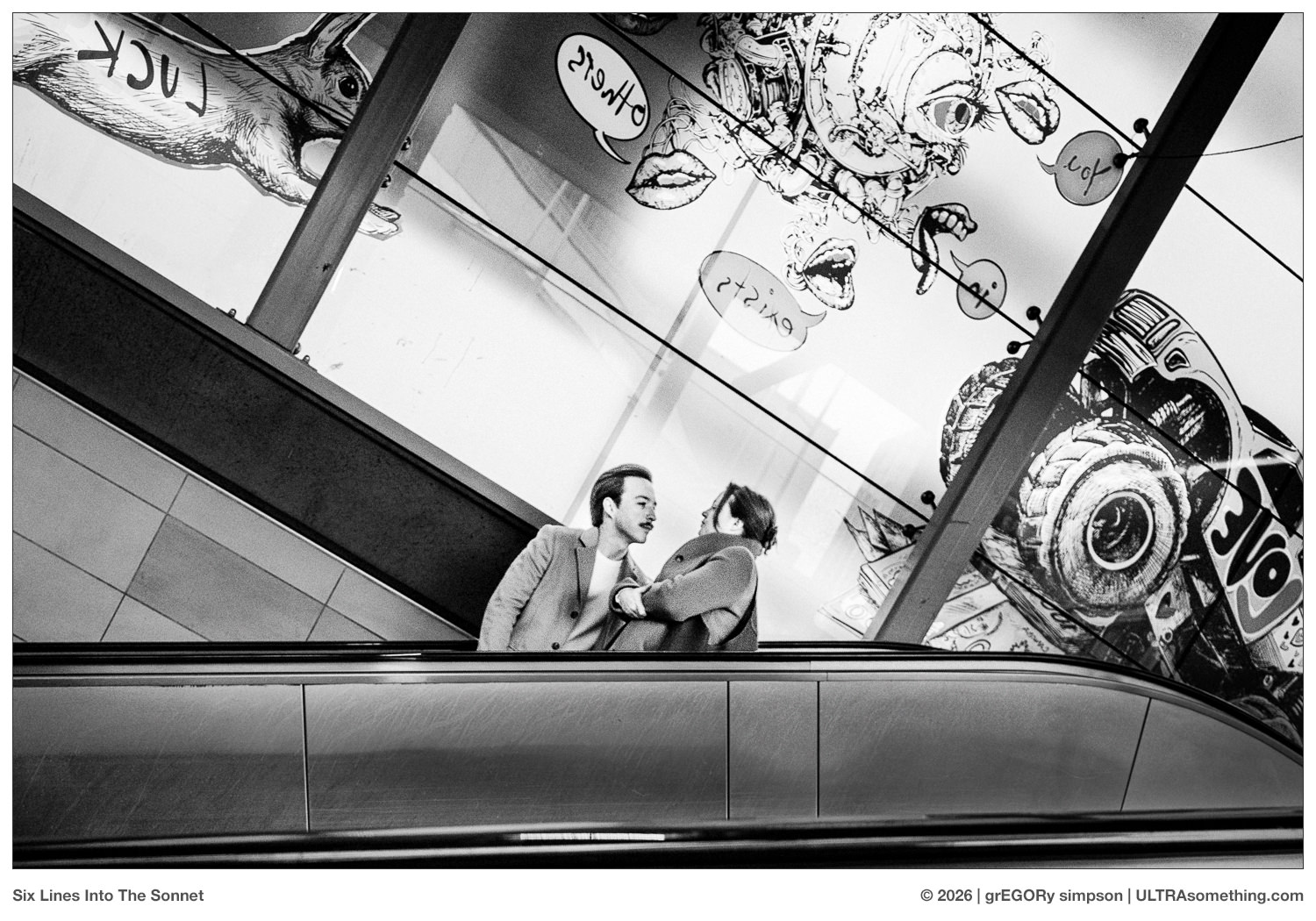
ABOUT THESE PHOTOS: This post contains 12 photos, though only three of them appear in the body of the article. All 12 do, however, appear in the video presentation that concludes the article. So, if you’re wondering why there seem to be more photo descriptions than photos, that’s why. I’ll address each photo’s technical details in the order in which they appear inside the video:
- Frame 1, “Ladies” was shot with a Canon AE–1 and an FD 50mm f/1.4 lens at ISO 400 using expired BW400CL, which I had processed at the local drugstore. Obviously, it endured some significant cropping at the hands of the Whenevergram algorithm.
- Frame 2, “Fashion Forward” was also cropped by Whenevergram, though this time it worked its magic on a negative from a Leica M6 TTL, which was fronted with a Voigtlander 50mm f/1.5 Nokton lens, shot on Tri-X at ISO 320 and developed in Rodinal 1:50
- Frame 3, “Telepathy” came to life within a Hasselblad XPan using a 90mm f/4 lens and Kentmere 100 film, which I exposed at ISO 200 and developed in Caffenol-C-M. Yes, there’s a reason it’s called “telepathy,” and no, you probably won’t figure out why unless you’ve had to stare at it for 6 months while beta testing Whenevergram.
- Frame 4, “Specs” is another product of the Leica M6 TTL, but this time with a 50mm Summicron-M (v5) lens. Tri-X was again involved, only now exposed at ISO 400, but still developed in Rodinal 1:50.
- Frame 5, “Granville Square” (that one was way too easy to name) was birthed by the trusty Hasselblad XPan, fronted with its 45mm f/4 lens and loaded with Tri-X 400, which I exposed at ISO 400 and developed in HC-110 (Dilution H).
- Frame 6, “Patchwork Pastiche” sprang forth from an entirely different panoramic camera — the Widelux F7, which was loaded with FP4+, exposed at ISO 125 and stand-developed 1:100 in Rodinal.
- Frame 7, “Lift” is the first digital photo in the slideshow — a product of the Ricoh GR, which continues to be my constant companion everywhere I wander.
- Frame 8, “Vortex” (which also appears in the body of the article) is my favourite of the bunch, proving I practice what I preach. It, too, was shot on the Ricoh GR. And, somewhat curiously, it was shot on the same hillside, on the same night, and using the same technique as the (potentially) $7M photograph shown in A Measly Million.
- Frame 9, “Deluxe Model” was photographed on a Hasselblad XPan, with a 45mm f/4 lens on the front and Tri-X (exposed at ISO 400) in the back. I developed it in HC-110 (Dilution H), and yes, this is exactly what I intended when I shot this photo.
- Frame 10, “Bubble Gum Selfie” is a photo that never should have been. If you wonder how anyone can achieve such horrible fidelity in the presence of so much light, the answer is “run a test in which you use a known speed-enhancing developer (say, Caffenol-C-L) to develop a roll of Tri-X, which you exposed at box speed.” Actually, you don’t have to run such a test. I did. It ain’t pretty. Not that it matters, but the camera was a Leica M2 and the lens was a Voigtlander 50mm f/1.5 Nokton.
- Frame 11, “+1” also appears in the body of the article, and sprung forth from a Hasselblad XPan using a 45mm f/4 lens, Neopan Across 100 (exposed at ISO 200) and a tank full of Caffenol-C-M.
- Frame 12, “Burning Man” bookends the article — being the shot at the top of the text and the final shot in the video. It too was photographed with a Hasselblad XPan, fronted with a 45mm f/4 lens and shot on Tri-X, which I exposed at box speed and developed in HC–110 (Dilution H).
ABOUT THE VIDEO: Way too much effort went into producing this cheeky little video. But once I start something, I’m compelled to finish it. So, for those who are interested in a “behind the scenes” peek at the production details for the latest ULTRAsomething vBook, here you go:
As per my usual technique, I composed the music via improvisation — recording it one track at a time into Ableton Live. The first thing I did was lay down the percolating, pulsing, thumping, squawking rhythm track. This was produced entirely by the “Wee Wiggler” modular synthesizer, with me wiggling knobs on the fly to alter the feel of the groove. Modules from Intellijel and Make Noise did most of the heavy lifting. There were no actual drums. No drum machines. No drum samples. Just a bunch of wires routing a bunch of ordinary control voltages to some oscillators, filters, gates and vactrols to achieve a carefully conceived chaos. For anyone wishing to recreate this rhythm at home, I’ve included a snapshot of the patch I built to do it (the sounds created by modular synthesizers are ephemeral — once you tear out the wires to create a new sound, you’ll never achieve the old one again). As a special shout-out to this article’s inspiration, Instagram, I’ve cropped the photo into a square and given it a nice, retro film-edge effect.

On three sparse (but essential) tracks, I employed Dave Smith’s incredible Pro 2 synthesizer, then rounded out the composition with a number of computer-based instruments including one instance of Omnisphere, one instance of Camel Audio’s Alchemy and two instances of Native Instruments’ Kontakt sampler. Ableton Live’s built-in compressors and EQ provided the only audio sweetening, save for the final mix, which was mastered through Izotope’s Ozone 6.
As always, the jumble of photographs, music and textual overlays were then gathered, assembled and edited within Apple’s Final Cut Pro X.
If you find these photos enjoyable or the articles beneficial, please consider making a DONATION to this site’s continuing evolution. As you’ve likely realized, ULTRAsomething is not an aggregator site — serious time and effort go into developing the original content contained within these virtual walls.