Blog

  • Lascaux

    Lascaux

    I’m a man whose communication style leans heavily on metaphor, irreverent observation, and a trippingly jaunty sardonic panache. It’s a technique best suited for face-to-face interactions, where my body language and facial expressions help unlock my carefully coded words. Without benefit of these visual cues, phone chats can sometimes be a bit dicey, but at least I have the element of ‘inflection’ on my side. That, and the fact phone conversations are exactly that — conversations. Meaning any disconnects can be swiftly identified and rectified.

    The potential for misunderstanding increased substantially in the early 1990’s with the arrival of an entirely new form of communication: email. Unlike traditional conversations, email interactions did not occur in realtime. One would type a statement, then wait about 15 minutes for their USRobotics 9600 baud modem to grind out a connection and transmit the message to its intended recipient — a recipient who, more likely than not, wouldn’t be online until sometime later in the week. In 1992, it could take a month just to make dinner plans.

    It was beneath the dimly lit dawn of this nascent new technology that I first realized my communication M.O. was indubitably problematic. The written word did not communicate body language. It knew nothing of inflection and was, by design, a medium made for monologues. Sardonicism and metaphor are perfectly detectable in long-form writings, but email was designed for pithiness. And pithiness demands the sort of ordinary unambiguity that bores me silly.

    So in 1993, I typed my first emoticon: the “winky face.”

    It looked ridiculous to me — as if a violent sneeze had triggered an involuntary finger twitch in the middle of my typing. But its meaning was almost instantly understood by the recipient. It was visual intonation; textual body language. Without this funky bit of punctuation, my wryness was constantly mistaken for wrongness. And so the winky face became one of the most powerful weapons in my punctuation arsenal — exceeded only by my obsessive love for the em dash.

    Curiously, I’m not really big on actual winking. I estimate I’ve winked a total of 20 times in my life. Tops. So what I really wished for was an emoticon that more closely approximated the physical expression I made when letting loose with some obscure utterance: a sort of cockeyed smirk. But, try as I might, typing :-/ only served to further confuse anyone reading my emails. So the winky face remained.

    Over time, I grew to detest the winky face. I began to hate myself every time I typed it. It looked unprofessional; undignified; juvenile. But every time I decided to eradicate it from my emails, the old misunderstandings returned. I tried to eliminate all need for the winky face by crafting lengthier emails that built enough infrastructure and foundation to convey the mail’s intended mood and spirit. But humans were too busy and their attention span too limited for this to succeed. I even tried dabbling in the art of forthright, metaphor-free communications — but that was just anathema to my soul, which culminated in more self-loathing than if I had simply employed the winky face.

    Email proved to be just the tip of a cultural iceberg, and the 21st century has given us all manner of new communication refinements. Emails grew even pithier, begetting Twitter. Emoticons grew cuter and far more numerous, begetting emojis.

    Oh, great — thought farts and pictograms. It’s almost as if we’ve turned our back on everything that’s happened to written communication in the 4,000 years since the birth of the abjad. We’re cavemen again. We’re just guys named Ogg tagging a wall with some quasi-representational facsimile of a buffalo so Mrs. Ogg can see what we ate for lunch.

    But maybe that’s not it at all. Maybe we’re not regressing. Maybe we’re just correcting a misstep in the evolution of human communications. Maybe pictographs were the right direction all along. After all, plenty of written languages have their foundation in symbols, rather than syllabaries or segmental scripts.

    But even symbol-based languages have, over time, seen their pictograms simplified, stylized and bastardized until they’re no longer recognizable to anyone who hasn’t received academic training in their interpretation. We’ve reached a point at which there are now nearly 4,000 different written languages in the world. How many can the average human learn in a lifetime? How does this promote communication?

    But emojis? They’re universal. A barfing guy in Russia is a barfing guy in China, who’s still a barfing guy in America. Barfing is universal. But the written word for barfing is not.

    Every time I type a winky face at the end of a sentence, I feel as if the written word has failed me — that it wasn’t designed for folks who, like me, prefer to communicate in riddles. Perhaps this is why I got involved with photography — it speaks to my need to communicate in metaphor, but it does so pictorially. Photography is language — but it has nothing to do with the written word. For all intents and purposes, a photograph is nothing more than an elaborate and complex emoji. And that’s the way I use it. To communicate in the cryptically enigmatic manner that I have long favored.

    So I’ve come to the conclusion that emojis are a good thing… if it weren’t for that fact that we’re already killing them.

    Once again, we humans can’t help but mess up something good. We’ve set emojis on the same trajectory that doomed all those other pictographic languages — we’ve allowed different entities to stylize them and obfuscate their meaning. For example, look at this link to the various “smirking face” emojis.

    What do you see? You see an emoji interpreted so freely that its intended meaning is no longer clear. So while the Apple, LG and HTC representations look exactly like a smirk, Google and Microsoft have stylized theirs to the point of resembling an emoji for “remembers a pleasant thought.” And Samsung’s interpretation clearly indicates “contentment” to my eyes. Smirkiness? I don’t see it.

    So here we are — another promising technological advancement in universal communication turned into just another tool with the power to confuse. We’re now 25 years into the smiley>emoticon>emoji arc and I still can’t drop a simple smirk into an email, because someone reading it on a Samsung device will surely misread its intention.

    Frankly, it’s enough to make me want to just quit writing altogether.


    ©2017 grEGORy simpson

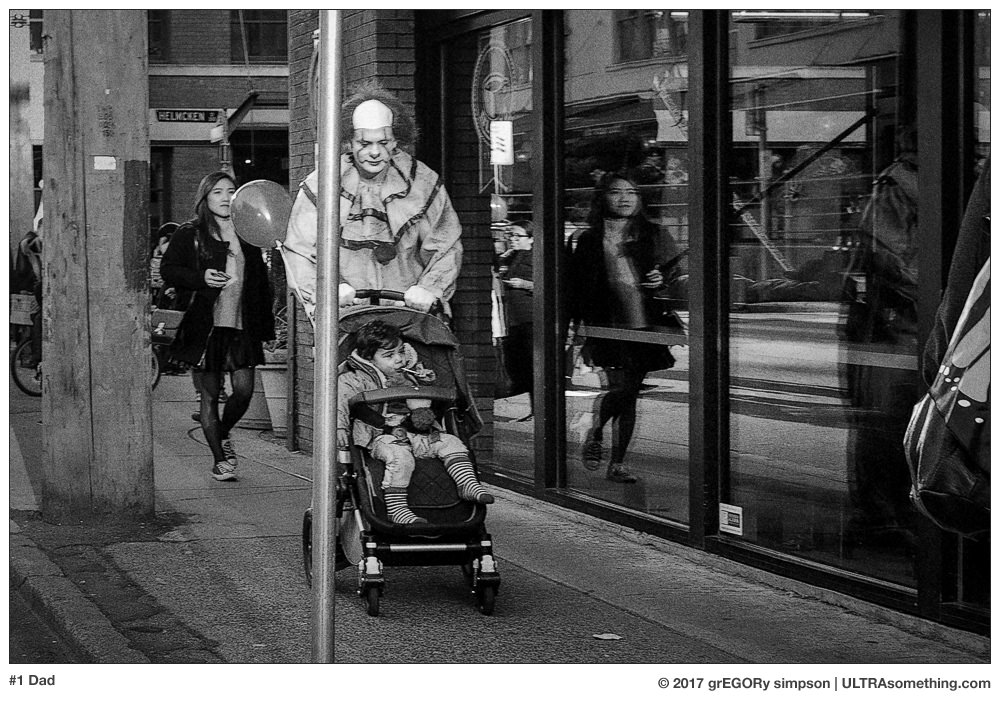
    ABOUT THE PHOTOS:

    Hopefully, I don’t need to draw you a picture to explain why I chose this particular set of photos to accompany this particular article…

    REMINDER: If you find these photos enjoyable or the articles beneficial, please consider making a DONATION to this site’s continuing evolution. As you’ve likely realized, ULTRAsomething is not an aggregator site — serious time and effort go into developing the original content contained within these virtual walls.

  • Mad Science

    Mad Science

    They have drive, passion, genius and a genuine desire to improve the world. Focused to the point of obsession, these socially awkward idealists will stop at nothing in their quest to advance society and turn dreams into reality. What’s not to like?

    Apparently, the answer is “everything.” Because society — the very society they seek to improve — is forever casting these misunderstood visionaries in the role of villain. We call them “Mad scientists,” disdain them for a desire to “play God,” and spend hundreds of millions of dollars making horror movies about their dastardly deeds.

    Funny thing is, I see them not as horrific villains, but as tragic victims — which probably explains why the “mad scientist” has always been my favorite character in film, television or literature. In almost every instance, the scientist made but a single error in judgement — an error that could so easily have been corrected by a loving spouse or a trusted friend. But no. Universally despised and thus shunned by mankind, they must toil in seclusion — save for the lucky few with an amiable hunchback on the payroll.

    I’ll admit it: I feel a kinship with the mad scientist. Anyone else who possesses an INTJ Meyers-Briggs personality type will likely feel it too. Is it really so wrong to want to put the soul of a dog into the body of a chimp to create a more capable companion? And what’s so crazy about building a contraption that extracts all the nutrients from a kale, blueberry and wild salmon puree and infuses them directly into a chocolate chip cookie?

    Although I don’t personally possess the skills necessary to see either of these ingenious ideas to completion, I do have a couple skills that can be fused: music and photography.

    I have long allowed one passion to influence the other — often learning from a creative misstep made in one discipline so as to avoid making it in the other. In spite of this, I’ve never gone so far as to actually graft a part of one endeavour directly onto the other. But hey, I’m about as secluded as a man can be — alone in my home studio office; blinds drawn and beyond earshot of all naysayers and ninnies. So who’s stopping me?

    I flipped a coin to determine which of my specialties would be the donor and which the recipient. Heads, I’d transplant the brain of a photographer into the body of a musician; Tails, I’d do the reverse. Heads it was.

    I have since made two songs that are the direct result of this transplant. The first, Beneath a Velvet Manhole, employs my photographic love of foraging for photographic subjects. The second, 23 Miles East of Wistful, draws on my photographic obsession with murky, grainy, low-fidelity images.


    Beneath a Velvet Manhole

    For the past twenty years, I’ve been more interested in finding photographs on the streets than in manufacturing them in some photographic studio. So why is every song I write a studio creation? Could my music benefit from my photography brain? Wouldn’t it be beneficial to get out of the studio and practice a bit of “street recording?”

    So that’s the impetus behind this song. I ventured smack into the middle of my usual photographic hunting grounds — downtown Vancouver. Only instead of a camera, I carried a handheld audio recorder. Returning to the studio, I proceeded to annihilate the street recording with a modular synth and a Make Noise Morphagene. I can best describe the Morphagene as a modular device that digitally replicates the various tools needed to create musique concrète — a 20th century type of experimental music in which tape is sliced up, re-spliced, played back and re-recorded on a pair of variable-speed reel-to-reel tape machines.

    Pure musique concrète is the only type of music that’s as unloved and unappreciated as the typical mad scientist (who, more likely than not, is the only sort who actually enjoys listening to musique concrète). In order to coerce someone else into actually giving it a listen, I decided to accompany the recording with a laid back, improvised, one-take accompaniment — a “studio” recording to be sure, but one with a decidedly organic feel.

    The result is a 3:57 little ditty called “Beneath a Velvet Manhole.”


    23 Miles East of Wistful

    Apparently I’m never going to outgrow my love for low-fidelity photos. If I close my eyes and think of all the photos that have most influenced me, intrigued me or captivated me, I realize that each is either poorly focused, motion blurred, badly exposed, or so grainy as to be nigh unrecognizable. It’s not just that I tolerate low fidelity photos — it’s that I admire them.

    So why do I strive for sonic perfection in music when I tend to disdain that very quality in photographs?

    The fact of the matter is, I really do like broken sounds. I find myself comforted by pervasive hiss, extreme equalization, wavering pitch, drunken rhythms, amplifier saturation, mechanical noises and bad connections. And yet, in spite of this, I tend to avoid using these sounds for fear of offending the ears of another. But since I don’t seem to care whose eyes I offend, it’s rather silly to concern myself with another’s ears.

    And with that realization came “23 Miles East of Wistful.” It was conceived within a single sound design session during which I so thoroughly mangled the sonic characteristics of what would normally be a “pleasant” sounding piano that it became almost painful to play. At that point, I simply turned on the recorder to capture a single improvised performance of me plunking away on this thing. In spite of the disfigured piano sound, the results were still a bit too “clean” for my taste, so I further improvised some accompaniment — using acoustic instruments that I butchered to sound synthetic; and using synthesizers that I lacerated to sound like acoustic instruments. Throughout the process, I made sure to retain all the original timing slop and to do everything I could to extract as much noise and hiss from each track as possible.


    So is my mad science ready to stand with such greats as Mary Shelley’s Victor Frankenstein? Fritz Lang’s Rotwang? David Cronenberg’s Seth Brundle? Chuck Jones’ Wile E. Coyote?

    Probably not. But then a high rise condo isn’t exactly the best place for tinkering with the laws of nature. Anyone have a drafty old castle for sale?


    ©2017 grEGORy simpson

    ABOUT THE PHOTOS & MUSIC:

    If nothing else, the accompanying photos indicate that madness can invade any discipline: taxidermy; civil engineering; and… um… OK. I’ll admit the third photo is probably more indicative of my own madness than of anything else. As for the music? I’ve made madder. Just take a listen through the recent ULTRAsomething recordings should you seek confirmation. I’ll be rectifying that shortly..

    Note that each song is hosted by Bandcamp, which means it can be played up to three times before you’re politely asked to pony up a buck. Honestly, if you like a song well enough to play it a fourth time, I think it’s only fair to ask for $1 — particularly when that $1 buys you the ability to download the song in both a mobile-friendly MP3 format, and a lossless, full-fidelity version suitable for playback on the type of audio systems designed to annoy your neighbours. And yes, for those who actually want multiple songs but can’t be bothered with the whole buck-a-song arrangement, I am indeed working on a subscription model that will grant you access to ULTRAsomething’s entire current oeuvre… but that might take me awhile…

    REMINDER: If you find these photos enjoyable or the articles beneficial, please consider making a DONATION to this site’s continuing evolution. As you’ve likely realized, ULTRAsomething is not an aggregator site — serious time and effort go into developing the original content contained within these virtual walls.

  • ULTRAzombie

    ULTRAzombie

    Humans are quirky critters — each of us an individual ingot of doubt, wrapped in superstition, packed in misconception, and encased in myth. Although this could be the opening sentence to any number of articles on any number of human foibles, this particular one is about mankind’s inveterate fear of failure.

    Humans fear failure because we fear being embarrassed, ridiculed or ostracized. And so, to avoid such perceived indignities, we compromise our potential by limiting our reach to those goals most easily grasped.

    Curiously, because I’m either sub- or super-human (depending on who you ask), I’ve somehow skirted the whole “fear of failure” thing. In fact, I embrace failure. Failure, I’ve always surmised, is merely a necessary step on the path to success.

    “An achievement that’s void of failure is no achievement at all.” Since you’re welcome to quote me on that, I’ve included the necessary punctuation for your convenience. If one has never failed in their pursuit of an intent, then perhaps that intent isn’t all it (or you) could have been.

    Striving for that which is just beyond our reach forces us — by the very metaphor I’ve employed — to grow.

    There is, however, a downside to fearlessly facing failure: if you do it often enough and for long enough, then you begin to accept it. When everything you reach for results in failure and your goals are never achieved, then you haven’t grown at all — you’ve stagnated. Those who at least strive for easily attainable goals have some forward momentum. But those of us who shoot for greatness and fail relentlessly have none.

    Lately, I’ve started to realize that ULTRAsomething might just reflect this very condition. It is, by all traditional measures, a colossal failure. On a personal level, it failed in its mission to secure me employment as a writer, photographer, or composer. In the altruistic realm, it failed to have any global impact on modern photography’s steady descent into the mire of verisimilitude — where the literal and idealistic routinely and regrettably trump the metaphorical and poetic.

    For all intents and purposes, this site is dead. And yet, like a reanimated corpse, it lurches forward — another article; another set of photos — beamed into space to bounce around the satellites like so much space noise.

    So why, in spite of overwhelming evidence to the contrary, do I have this nagging belief that ULTRAsomething is actually succeeding at something? Perhaps it’s because I don’t feel the sort of complacency that stems from an acceptance of failure. Nor do I believe I’ve stagnated — though I am metamorphosing into something still too pupal to identify. So maybe ULTRAsomething has failed only at being what I intended, while its real triumph lies in being something other than that. Of course, if that’s the case, then my real failure is in recognizing what, exactly, that something is.

    So I blunder on — like some sort of zombie — singularly focused on my quest for brains, brains and more brains. Because without more brains, the true purpose of ULTRAsomething might forever elude me.


    ©2017 grEGORy simpson

    ABOUT THE PHOTOS:

    The best thing about writing a “theme” post is it lets you purge yourself of photographic guilt. Consider, for example, the annual zombie walk. For the past couple of years, I’ve felt inexplicably compelled to grab a few snaps — even though I know the vapidity of such photos goes against everything I strive for in photography. But if I write an article that is, in some way, a metaphorical discussion of zombies, then the hackneyed suddenly becomes relevant and my guilt is assuaged.

    REMINDER: If you find these photos enjoyable or the articles beneficial, please consider making a DONATION to this site’s continuing evolution. As you’ve likely realized, ULTRAsomething is not an aggregator site — serious time and effort go into developing the original content contained within these virtual walls.

  • Mundanity (Pt. 2)

    Mundanity (Pt. 2)

    As discussed in Part 1, I am a connoisseur of the mundane. Mundanity is where one finds a subject’s essence — its personality, soul and individuality. The artifice of spectacle has little capacity to surprise and delight. But the humility at its periphery comprises all that is life. Within the mundane lies the fragments of every story yet to be told.

    Not surprisingly, the discoveries excavated by an observer of the mundane are often interesting only to other mundanologists. I liken my skill to an anthropologist sifting through acres of sand in search of a single bone fragment. To most, the results seem unworthy of the effort. But to the anthropologist and their peers, it’s another piece in the puzzle of life; another key to another door of greater understanding. Sadly, unlike anthropologists, there are no university grants bestowed upon mundanologists. Our toils in the fragmentary riches of life are void of financial reward or social acceptance. In fact, so unappreciated is our work, that I had to neologize the word, “mundanologist.”

    Part of the blame falls on errant colloquialism — society’s seemingly universal misunderstanding of the definition of mundane. Heck, even the editors of thesaurus.com got it wrong. If you visit that site and enter the word “mundane,” the first synonym they hit you with is “banal.” Which is downright crazy. Because, to a mundanologist, banality is the antonym of mundanity.

    The more highly-evolved Merriam-Webster dictionary defines mundane as “of, relating to, or characteristic of the world.” That pretty much supports what I said back in the opening paragraph — that mundanity is where one finds a subject’s essence; its personality, soul and individuality. In other words, its “characteristics.” Look up “banal” in Merrian-Webster and you’ll see it defined as “lacking originality, freshness, or novelty.” Yup. That’s pretty much the exact opposite of the meaning of mundane, since it implies a homogeny that’s totally at odds with the idea of character. For me, “banal” results from pomp and spectacle — events manufactured precisely for the purpose of encouraging homogeny. It’s only when homogeny is removed that a subject’s true character is seen.

    But little by little, over the past several years, I’m finding it increasingly difficult to uncover those moments of sublime mundanity. All the little “tells” and all the quiet moments that define the heart of humanity are being absorbed into the glowing glass screen of the smart phone.

    Mundanity still exists. But it has become privatized — a secret conversation between human and smart phone. Because of this, my techniques for observing and recording the mundane have become obsolete. Physical manifestation of the mundane has diminished significantly as humanity now engages with it through these ubiquitous and indistinguishable portals.

    Mundanity, which was once on display for anyone curious enough to observe, is now hidden within the banality of conformity. All one witnesses is a sea of humans — totally removed from their environment; heads down, noses to the phone; oblivious, withdrawn, and utterly self-absorbed.

    So what is a certified mundanologist to do? How does one go about photographing that which is now hidden? I wish I knew. Perhaps mundanity can be synthesized — created through artificial circumstances in some sort of “lab environment.” Maybe this involves moving my photographic efforts back into the studio? Maybe it means manipulating my environment to force mundanity away from the smart phone? Maybe it means I move on to photographing mundanity in a species without opposable thumbs — I don’t know. All I do know is that my photographic forte is accelerating toward extinction. What lies beyond is still a mystery.


    ©2017 grEGORy simpson

    ABOUT THE PHOTOS:

    For the majority of this site’s nine-year existence, I’ve enumerated the camera, lens, film and developing technique used for nearly every photo that accompanies each article. Frankly, it’s the single most pointless use of keystrokes on ULTRAsomething.com — an insignificant vestige of this site’s beginnings as a photography blog. Photos are about what they communicate, not what created them. So I’ve made an executive decision, and have eliminated the inclusion of technical info going forward.

    That’s not to say that I won’t ever have anything to say about the photos themselves — au contraire. Sometimes there are stories behind the photos — stories that may amuse, entertain or even enlighten. So the “About the Photos” postscript will likely continue as needed.

    “Moribundity” is a literal representation of what I see, day in and day out, on the streets of Vancouver. It stands as Exhibit A for the prosecution, which argues that there is no longer a need to always carry a camera in-hand every moment that I’m out in public.

    “Prelude to a Lost Weekend” and “Communications Breakdown” stand as Exhibits A and B for the defense, which counter-argues that I should always have a camera in hand, no matter where I walk or how short the trip.

    “Augury” is exactly that — a sign that I need to find another path. While “Prelude to a Lost Weekend” and “Communications Breakdown” indicate that there’s still mundanity to be mined on the streets of Vancouver, the occurrences are spaced too infrequently to keep up with my need to keep my shutter finger lean and muscular. I must grow. I must find another path.

    REMINDER: If you find these photos enjoyable or the articles beneficial, please consider making a DONATION to this site’s continuing evolution. As you’ve likely realized, ULTRAsomething is not an aggregator site — serious time and effort go into developing the original content contained within these virtual walls.

  • Unmasked!

    Unmasked!

    One of the best things about being a writer is that no one knows what you look like. Which means one’s appearance doesn’t distort one’s message. If a writer’s words resonate with the reader, then the reader will simply invent some friendly, benevolent mental image of the writer — one that is likely far more generous than their actual visage.

    Those who peruse this site thoroughly have probably seen the small self-portrait sitting on my About page — a portrait that’s been there since the day this site began. I don’t believe its presence has substantially damaged my credibility. After all, web stats confirm that the bulk of my readers have never visited this page. But for those who did make the journey, I made certain to shoot a portrait that was as bland and innocuous as possible. The more I could resemble Mr. Potato Head, the easier it would be for readers to plug their own imagined features into my face. Also, as time passes, the advantages of having a photo that doesn’t age (while I do) are not to be discounted.

    Because I enjoy both the relative anonymity, and the inverse Dorian Gray affect, I’ve been struggling with whether I should direct my readers to a video interview I gave last fall to the International Leica Society (and which was just recently published by the LHSA).

    Truth is, I don’t recognize the guy in the video. It’s purported to be me. But the dude being interviewed has a beard — and my mirror reflects a clean shave. Plus, I’m reasonably certain I’m a suave, youthful, handsome, debonair, articulate and captivating raconteur. Yet the video portrays a fidgety, bumbling geezer with a distracting multi-regional accent of obscure origin.

    Ultimately, I decided to go ahead and point my readers to this interview — he has a message that echoes my own, and I’m still pretty sure the guy isn’t actually me. And if he’s not me, then my anonymity is preserved. However, if he really is me (as some who know me have confirmed), then maybe it’s time to face the fact that I’m no longer the guy on my About page.

    Whichever is the case, the warning remains the same: “Viewer discretion is advised.”


    ©2017 grEGORy simpson

    ABOUT THE PHOTOS:

    All the photos shown in the video interview have appeared previously on this website, so there’s no reason to regurgitate the technical info surrounding them. The video was shot, edited and published by the International Leica Society — an organization for whom I had the pleasure of addressing their annual meeting last fall (if you think 7 minutes of me is over-the-top, imagine watching me speak in front of an audience for an hour!). Anyway, Leica fans and aficionados should definitely check out their website. You kids with your new-fangled social media might prefer their Facebook page. This article’s sole new shot, “Lucha Libre”, was snapped with a Ricoh GR and is included as a literal representation of the title’s figurative meaning.

    REMINDER: If you find these photos enjoyable or the articles beneficial, please consider making a DONATION to this site’s continuing evolution. As you’ve likely realized, ULTRAsomething is not an aggregator site — serious time and effort go into developing the original content contained within these virtual walls.

  • Mundanity (Pt. 1)

    Mundanity (Pt. 1)

    Prologue

    Many years ago, when I was still silly enough to believe I could earn a living with photography, I went to renew an insurance policy. When the agent saw “photographer” listed on my form, she got very excited.

    “Oh wow! You’re a professional photographer!” she exclaimed. “This is my lucky day.”

    “How so?” I asked.

    “Well, I’m a pretty good photographer myself, but I’m not a pro yet. But since you are, that means you know all the secret spots for taking the prettiest sunset photos.”

    She paused, looking at me hopefully. “Come on. You can tell me, can’t you?” she asked with a coquettish tilt of the head.

    “Umm… any place where you can see the western sky?” I answered hesitantly.

    “Oooh! That’s a great tip!” she chirped. “Maybe some place high, so you can see more of the sky, right?”

    “Depends on what you want,” I said. “Do you just want a photo of the sky, or do you want it to have some context? Maybe some buildings in the foreground? Or people? Or some kind of object or natural element that you want silhouetted by the orange glow?”

    “No. I want something that looks professional. I don’t want anything blocking the view,” she stated emphatically. “So you’re saying I should go up on top of Mt. Seymour if I want to get the best sunset photos?”

    I had said no such thing.

    “I’m so glad we met. I knew a professional like you would have the answer.”

    This may have been the precise moment when I realized I never again wanted to be called a “photographer.”

    Pronouncement

    “I am not a photographer.”

    It’s a statement I’ve made several times, and one that some readers probably find curious — what with the whole photo-centric nature of ULTRAsomething these past 9 years.

    A while back, in an article called “POV,” I shone a tiny light on this proclamation: “I know I’m not a photographer,” I wrote, “because every time I see an article titled ’10 Photos Every Photographer Should Know How To Take,’ I quickly ascertain that I have absolutely no desire to take any of them.”

    It was one of my patented (pending) tongue-in-cheek over-simplifications of a more complex entanglement of issues. But it sufficed as a place-holder until I got around to penning a more thoughtful analysis.

    So here it is: I am not a photographer, because I see photography as nothing more than a means to an end. It is not, in and of itself, a destination. Photography (or at least what I would consider captivating photography) is merely a way to express and share what it is that really interests you; concerns you; fascinates you. Show me a person who lists their primary interest as “photography,” and I’ll show you someone with a portfolio full of generic photos — the sort of person who reads articles titled, ’10 Photos Every Photographer Should Know How To Take.’

    The best photographs exist because someone has a genuine interest in the photo’s subject — a person in a portrait; the rituals of culture; a moment of conflict; the subtle interplay of angles on a building — and not because they were looking for an excuse to activate their camera.

    So if photography is a means to an end, and “the end” is to facilitate, document or motivate our true interests, then what exactly is my interest?

    The mundane.

    The mundane is what occurs when someone removes their mask. The mundane is nature on recess.

    It’s easy to photograph the spectacular. But spectacular is a facade. I’m interested in how a subject looks or behaves for the 99% of the time it isn’t on display. I’m interested in the flower that’s already bloomed; the peacock that isn’t strutting; the theatre on its dark night; the student who graduates in the middle of their class; the river a quarter mile downstream from the waterfall; the commuter stuck between work and home. And yes, the western sky under the full, flat noonday sun.

    It’s within the mundane where one finds true beauty. The photos I take are merely to remind me of this. But then, I am not a photographer.

    [CONTINUED IN PART 2…]


    ©2017 grEGORy simpson

    ABOUT THE PHOTOS:

    “Shinjuku” was shot with a Leica M Monochrom (Type 246) and a 21mm f/3.4 Super-Elmar lens. It’s a photo that completely encapsulates the feeling I get from the back alleys of Shinjuku — my favourite place to hang out in Tokyo (even if I do it with a tiny bit of trepidation). No such trepidation exists in Yoyogi Park, which is where I shot “Extreme Portraiture”, using the same camera and lens. “Aftermath” was shot back in Vancouver at ISO 400 on Tri-X with a Leica M6TTL fronted with a 35mm Summicron (v4) and processed in HC-110 Dilution H.

    REMINDER: If you find these photos enjoyable or the articles beneficial, please consider making a DONATION to this site’s continuing evolution. As you’ve likely realized, ULTRAsomething is not an aggregator site — serious time and effort go into developing the original content contained within these virtual walls.

  • Luxembourg

    Luxembourg

    I don’t take many vacations — two per decade has traditionally been my norm. So in 2015, when I inexplicably indulged in two such adventures (Iceland in March; Tokyo in November), I assumed that would suffice for another ten years. But a strange thing happened — after spending all of 2016 nestled snuggly in my Vancouver condo, I’ve suddenly developed another hankering to journey abroad.

    Truth be told, Japan is always calling me — wooing me ever since my first visit in 1995. So, not surprisingly, my initial thought upon the hanker’s return was to simply organize another trip to Japan. But somewhere deep inside there’s a tiny voice that whispers, “try something new.”

    If I were the sort of person who kept a “bucket list,” I’d have a ready-made catalog of places I’d like to explore. But since I’m well-practiced in the art of mortality denial, I never bothered to create such a list. As such, my travel inclinations are rather vague. Northern countries seem to exert the greatest pull — Sweden; Finland; Norway; maybe hop across the water to Estonia and Latvia. And there’s something about Eastern Europe that beckons me — I think it’s the architecture and the history, but I can’t say for certain.

    So I decided to look at it from another angle. Why not choose a destination where I, ruler of the ULTRA empire, am the most revered? Maybe bask in a little idolatry; check out my statue in the town square; accept some big ol’ key to the city from the town’s mayor and see what it unlocks?

    I cracked open Google Analytics to learn which countries sent me the most readers over the past couple of years. Not surprisingly, the top four countries were (in order): USA; UK; Germany; Canada. Hmm. With the exception of Canada (where I live, and thus likely exert a tiny bit of disproportionate influence), these are countries with rather large populations. I’m not sure this is telling me anything useful.

    A more accurate representation of a country’s love and adulation would be found in a per-capita analysis. So I set up a spreadsheet listing the top-15 countries in terms of gross number of visitors to the ULTRAsomething site. I then looked up and entered the population of each country, and let Excel crunch the “per capita” numbers.

    The results were somewhat surprising. None of the top four countries from the “gross number of readers” list made it into the “per-capita” top-4 list.

    So which countries hold ULTRAsomething in the highest regard? From first to fourth, the list reads: Luxembourg; Switzerland; Singapore; Norway.

    My first thought was, “well, Luxembourg gave us Edward Steichen, so maybe it’s only natural they like me.” But what’s not natural is the gap by which Luxembourg won. It wasn’t just first on the per-capita list of ULTRAsomething readers — it was first by a whopping 1,000%! So popular is this site amongst Luxembourgers, that I actually checked to make sure I wasn’t Prime Minister. Turns out I’m not. Xavier Bettel must be one heck of a photographer, composer and blogger because he currently has that distinction. I have yet to parse through the registry to see if, instead, I’m associated in some way with the Grand Duchy.

    Switzerland, Singapore and Norway are all in a virtual tie with one another — far behind Luxembourg, but also substantially ahead of fifth place finisher, Australia.

    I find it curious that only one of the top-4 countries (Singapore) lists English as one of its official languages. Apparently I’m more popular when no one can actually read what I have to say.

    So I’m torn. Should I follow the data and make Luxembourg my next vacation destination? Or is there some weird statistical anomaly at play here? Maybe one of the runner-up countries wants to put together a bid? I’m looking at you Switzerland, Singapore and Norway. Make me an offer…

    Sadly, the one country I dearly love to visit — Japan — does not appear anywhere on the list of top-15 ULTRAsomething worshiping countries. Cleary, my love of Japan is not reciprocated.

    Ultimately, I’m not sure whether I’ve solved my vacation dilemma or merely complicated it. But at least I now know a little something about Luxembourg — handy should the web stats prove authentic, and the capital city key forthcoming.


    ©2017 grEGORy simpson

    ABOUT THE PHOTOS:

    “Travel Essentials” was shot with a Ricoh GR.

    “Full Travel Coverage” was shot with a Leica M Monochrom (Type 246) and a lens I forgot to document — though I’m guessing it might have been an old v4 35mm Summicron.

    “Unencumbered Travels” was shot with a Leica M Monochrom (Type 246) with a Super-Elmar-M f3.4 21mm ASPH lens.

    REMINDER: If you find these photos enjoyable or the articles beneficial, please consider making a DONATION to this site’s continuing evolution. As you’ve likely realized, ULTRAsomething is not an aggregator site — serious time and effort go into developing the original content contained within these virtual walls.

  • Obscurity

    Obscurity

    Fame changes everything. Or so I hypothesize. After all, I don’t have any actual firsthand experience upon which to base this assumption. But obscurity? Now there’s a topic with which I have practical knowledge.

    In spite of its woeful reputation, I believe obscurity is a valuable and rewarding state of existence. Consider all those artists whose first album was their best. Or first book. Or first movie. The reason, of course, is that debut works are all created in obscurity — a feat that can rarely be replicated once fame arrives.

    Back when I designed electronic music products, I most enjoyed the development phase. That time between the inception of an idea and the actual release of the product was filled with unbridled creativity and boundless enthusiasm. During this cycle, the product was truly mine. But at the moment of its release, it no longer belonged to me — it belonged to the world. The product became a slave to the whims and demands of the paying public, and I became its servant.

    Naturally, the dismay I felt each time I “lost” a product was counter to the emotions of accountants, investors, and most everyone else in the company — all of whom were delighted to finally see my lengthy toils in seclusion turn to cash. And that’s the problem. Because as wonderful as obscurity can be, it’s not a currency the bank can convert. Which is an issue if you’re the type of human who benefits from the consumption of food. Compromise inevitably becomes necessary. And compromise is the enemy of pure creation.

    In the early 1970’s, San Francisco’s legendarily anonymous avant-garde “rock” group, The Residents, formulated the “Theory of Obscurity.” It postulates that pure, unadulterated art can be created only in the absence of the expectations and influences of the outside world. In other words, obscurity is the only path to true art.

    But even The Residents, while not achieving Adele-like levels of fame, have managed to carve out a 45+ year career in the fickle, fad-happy, micro-niche world of the avant-garde — a task, I would argue, that’s far more difficult than achieving superstar status in the pop world. Ultimately, because of their success, they could no longer uphold the standards of their own theory.

    Fortunately, I’ve managed to maintain abundant levels of genuine obscurity throughout my life — and in doing so, I’ve discovered a flaw in my personal interpretation of the Theory of Obscurity. Originally, I assumed it meant that if one remained unknown, then one remained obscure. Obviously, the outside world expects nothing from an artist it knows nothing about. Therefore, I surmised, it cannot force its influence upon the artist. Obscurity = Invisibility. Or so I thought.

    But over time I realized that invisibility does nothing to prevent an artist from placing expectations upon oneself. It does not prevent them from exploring the world and absorbing its influence. In reality, Obscurity > Invisibility.

    All those photography monographs that I buy and analyze; all that music I dissect; all those articles I read — all have a cumulative and colouring effect on my own photos, music, and essays. All are indicative that the outside world has, indeed, encroached into my inner world and is exerting its influence — in spite of my invisibility.

    So, every now and then, I’ll simply flip a switch and shut down a block or two of external sensory receptors. I’ve recently unsubscribed from every blog on the internet; abstained from buying any monographs; and ceased searching for photography that interests me. I’ve even stopped actively listening to music of any kind (though one can’t avoid absorbing it osmotically). I don’t want current fashion or even classical techniques to influence what I photograph, think, or compose. I want to give whatever is within a chance to escape without the weight of my own expectation.

    Most believe that such willful ignorance is a tool of the closed-minded — a way to sequester oneself from the need to admit culpability or own-up to being wrong. Curiously, I view it as just the opposite — a way to open the mind and free oneself from the tyranny of predictability and convention.

    Granted, the wholesale rejection of knowledge is not something you want to adopt for your entire life. And it’s certainly not something that coincides with my natural hunger for greater understanding. My take on willful ignorance is that it’s merely the second half of a symbiotic whole — a 2-step procedure, like breathing. The consumption of knowledge is analogous to breathing in; the rejection of knowledge is like breathing out. One must naturally follow the other.

    So obscurity is not the catalyst that keeps the outside world at bay. Discipline is. Obscurity is not a cause; it’s an effect. And it’s a precious thing. Because any work I create in a state of obscurity will forever define me in my fame — should such an unfortunate fate one day befall me.

    [bandcamp width=100% height=120 track=3427633204 size=large bgcol=ffffff linkcol=336699 tracklist=false artwork=small]


    ©2017 grEGORy simpson

    ABOUT THE PHOTOS & MUSIC:

    “The Fork” was photographed with a Ricoh GR. “Morning” was shot with a Leica M6TTL and a 35mm Summicron lens (v4) on Tri-X at ISO 400, and developed in HC-110 (H). Whether anyone thinks it’s a lousy photo or not is immaterial — that’s because it’s not a photo at all; it’s a metaphor.

    “Even Mater Suspiriorum Was Once An Ingénue” is this article’s musical accompaniment. Is the title perhaps a bit too long? Probably. Do you have to be familiar with the films of Dario Argento in order for it (and some of the sound design) to make sense? Probably. Will this prevent you from enjoying the music? Probably not — but there are plenty of other things about this song that might. This song is, in many ways, truly indicative of what happens when outside influence is allowed to seep into our subconscious — even if that influence is, itself, something the average person would consider to be obscure.

    REMINDER: If you find these photos enjoyable or the articles beneficial, please consider making a DONATION to this site’s continuing evolution. As you’ve likely realized, ULTRAsomething is not an aggregator site — serious time and effort go into developing the original content contained within these virtual walls.

  • Death of the Cool

    Death of the Cool

    Over the past several years, I’ve written numerous articles exploring the parallel nature of music and photography — and how the creative techniques I apply to one are often relevant to the other.

    Distilled to the utmost purity, photography is simply a way to trigger an emotional response through visual stimulation, while music works through aural excitation. But curiously, in spite of this similarity, the expectations an audience places upon photographers and musicians couldn’t be more different.

    To the general public, a good photograph is a good photograph — regardless of the photographer’s physical characteristics, personality, dress, manner or age. To that same public however, a good song is not just a good song — it’s an amalgamation of the musician’s appearance, personal style and aura.

    No matter how good a musician is, the bulk of their audience likely comprises a single generation — with the musician’s relevance and popularity dictated by how closely they personify that generation’s definition of “cool.” A cult of personality surrounds musicians, and a listener’s emotional response to the actual music is inevitably filtered and distorted by their perception of the musician who performs it.

    I believe this phenomenon occurs because sight is our dominant sense. Whatever we see influences whatever we hear, taste, feel or smell. Anything created to engage one of the non-sight senses is inevitably impacted substantially by what one sees while experiencing it. But if you create something (like photography) that directly targets someone’s visual sense, then any superfluous visual information matters little in comparison.

    When we listen to music, we’re often engaged in some other activity — reading, writing, dining, socializing, etc. With music, there is ample sensory headroom remaining for additional stimuli, which means our enjoyment of it can be impacted substantially by our environment. For example, when people we admire engage with a particular type of music, we often choose to listen to the same music — meaning we allow far more than an auditory sense to dictate our listening choices. This “sensory headroom” is also one of the reasons people enjoy live music — it adds a visual element in which the appearance of the musician and the staging of the concert all filter and alter one’s involvement with the music. In contrast, when was the last time you bought a ticket to watch an artist paint a picture?

    One of the ways musicians have maintained a visual connection with their audiences is through their choice of instrument. There are thousands of different musical instruments, the workings of which are often a mystery to the majority of people. Instruments have a certain mystique — even amongst other musicians. A trumpet virtuoso will likely become a ham-handed buffoon when handed a viola — yet both instruments can be used to play the identical tune. This plethora of instruments enables each musician to maintain a level of visual exclusivity that separates him or her from other musicians, and from the general public. If we watch someone extract fabulous sounds from an instrument that we, personally, have no idea how to play, it creates a certain allure — an element of “cool.”

    Contrast this to photography. Sure, there are thousands of different camera models, but essentially they’re all minor variations of the same thing — a box with a lens and a button. Once you’ve taken a photo yourself, there’s nothing particularly exciting about watching someone else take a photo. Richard Avedon pushed a button, just like Henri Cartier-Bresson did, and just like Daido Moriyama does. Stylistically, their photos couldn’t be more different. But they all used essentially the same tool to create them. The fact one person’s tool was a medium format camera, another’s was a Leica rangefinder, and the third shoots with compact cameras makes no real difference. It’s tantamount to trying to draw a distinction between a pianist that plays a Steinway and one who plays a Yamaha — the subtle differences may impact the musician, but to the audience these instruments are one-and-the-same.

    I never thought to dissect this distinction between the enjoyment of photography and the enjoyment of music until about a month ago, when I made my quasi-annual pilgrimage to the musical instrument and recording trade show, called NAMM. Previously, I had a much more knuckle-dragging, neanderthal-ish take on why good photography could stand alone, while music appreciation was inextricably tied to celebrity, trends and generational hipness. Photography fans, I postulated, were simply more “evolved.”

    The fact that Robert Frank’s seminal 1959 album of photos (The Americans) remains one of the best selling photography monographs today is testament that good photography transcends generational cool. In contrast, how many youngsters seek out Charles Mingus’ equally-seminal 1959 album of music (Mingus Ah Um)? If you’re a young fan of modern photographers (regardless of genre) and you have a modest collection of monographs, you’ve probably got a copy of The Americans on your shelf. But if you’re a fan of Taylor Swift, Drake or Beyonce, you probably don’t have a copy of Miles Davis’ Kind of Blue on your iPhone.

    So what happened at this years’ NAMM show? What transformed my barbaric “music fans are shallower” presumption into such cognitive enlightenment? Simple. I witnessed a performance that, based on my old theory, would have required me to admit that I, too, am shallow. And there’s no way I could let that happen…

    NAMM attracts around 2000 exhibitors who display their musical instrument wares to over 100,000 attendees. Consequently, I see all manner of musicians playing all manner of instruments — cellos, trumpets, drums, organs, guitars, pianos, synthesizers, oboes, kotos, accordions, dulcimers, pipas, sitars, etc. Every one of these people seems eminently “cool” to me because, frankly, it’s cool to watch someone interact so expressively with objects of such exotic purpose.

    But everything changed when I attended a lecture about using smart phones and tablets as musical instruments. It featured a performance by a world-renowned virtuoso keyboardist, jamming away on his iPad. Watching him play, I was certain I could never manage to articulate that iPad app with the dexterity, precision and feeling that he did. By definition, this should have made his performance seem “cool.” Yet it was one of the dullest and most uninspiring musical recitals I’d ever seen. Why? Because it was played on an iPad.

    Watching someone play an iPad is visually no different than watching someone play Angry Birds. Or type a tweet. Or move funds between bank accounts. The end result may sound fantastic, but it’s a tedious thing to witness. I had no more interest in watching a virtuoso play an iPad instrument than I would have watching Josef Koudelka take a photo… and I dearly love Koudelka’s photos!

    Technically, this should have thrilled me. A milestone had been reached! Finally, here was a case of music being produced solely for music’s sake! The point of a Koudelka photo isn’t to watch Koudelka take the photo — it’s to savour the end result. So shouldn’t the point of a musical performance be the music itself, and not the visual act of seeing it performed? Apparently not. Because I simply could not engage with it. And the reason I couldn’t was because of the way in which the music was being performed.

    Tablets and smart phones are ridiculously common place. They are not purpose-built devices; they’re platforms. I’ve used one. You’ve used one. Roughly 7 billion of us own one or the other, or both. Those of us who don’t have likely witnessed scores of people who do. These are not objects of mystery, and the odds are good that you’ve (literally) bumped into someone using one on the street within the past 24 hours.

    What do all these people do on all these devices? Who cares?! The point is, we all know that whatever we do on our devices, we do it because it’s easier and more convenient than doing it some other way. And so, when we see someone swipe out a musical performance on an iPad, it gives the illusion that this person is taking the easy way out — that they’re shortcutting the musical creation process. Would any of us want to go see Yo Yo Ma play if he was dragging his finger around on a cello app, as opposed to playing a real cello? Probably not. Even if he could obtain the same sonic result with the app, there’s something fundamentally uncool about it — as if Yo Yo Ma was no longer “special,” because he’s using the same device you just used to watch cat videos on YouTube.

    And therein lies the problem. If you stick daggers into your iPad like Keith Emerson did with the keys on his organ, it’s not going to scream out in distorted anguish and bring 10,000 fans to their feet. It’s just going to quit working. You can’t play it with your teeth like Jimi Hendrix played guitar. You can’t even close your eyes and make dreamy “jam faces” while you play, because there’s no tactile feel to an iPad’s glass screen, meaning you need to constantly watch yourself play it.

    So it was here, in this small conference room on the second floor of the Anaheim Convention Center, that I came to realize exactly how and why the appreciation of music can not exist wholly within the music itself.

    And I further realized, having returned to writing music after my photography-centric hiatus, that it won’t be enough to simply stick my music up on the internet, and let it stand on its own merit. Music needs to be propped up in ways that photography doesn’t. If I want people to engage with my music to the same extent that they engage with my photography, I’m going to have to do more than just post it on the internet. I’m going to have to make the experience of listening to it seem cool. And somehow, I’m also going to have to make myself seem cool.

    Alas, though I have now defined the task before me, I haven’t a clue how to approach its resolution. So if anyone knows how to make a middle-age man who plays a giant electromechanical instrument that looks remarkably like a 1940s telephone switchboard look “cool,” I’m all ears.


    ©2017 grEGORy simpson

    ABOUT THE PHOTOS:

    “Death of the Cool” was photographed with a Leica IIIc and a Voigtlander 25mm f/4 Snapshot-Skopar lens on Tri-X at ISO 400, which I developed in Rodinal 1:50.

    “Symbolism” and “The New Cool?” were both shot on a Leica M Monochrom (Type 246); the first employing a Voigtlander 50mm f/1.5 Nokton lens, and the second a Leica f/2 Summicron (version 4).

    The title is obviously (to me anyway) a reference to Miles Davis’ 1957 album, “Birth of the Cool.” That which was born must eventually die…

    REMINDER: If you find these photos enjoyable or the articles beneficial, please consider making a DONATION to this site’s continuing evolution. As you’ve likely realized, ULTRAsomething is not an aggregator site — serious time and effort go into developing the original content contained within these virtual walls.

  • The Exhibitionist

    The Exhibitionist

    There are countless ways that photographers can exhibit their photos. Online sharing sites are, of course, the most popular technique, but other possibilities abound. This article discusses two such possibilities — both of which share an unexpected connection to ULTRAsomething.

    The Metal Print

    Metal prints have been wildly popular for the past several years, and many photographers have at least dabbled in the creation of a metal print or two.

    I dunno. Maybe it’s the curmudgeon in me; or perhaps it’s simply that I have a modicum of taste — but I’ve just never felt the need to trundle down to the corner drug store and have ’em slap one of my photos onto a sheet of razor-sharp aluminum. And as long as I’m at it — ceramic coffee mugs, canvas tote bags, cork coasters, neoprene mouse pads, plastic luggage tags and silicon smart-phone cases are also all “on notice.” I happen to believe that the best receptacle for a photographic print is a nice, white sheet of quality paper. Metal? Sheesh, that’s for license plates.

    Which brings me to my first public mea culpa of the year — after nearly a decade of resistance, I’ve acquiesced to a client’s request for a metallic version of a photograph.

    The client? The Province of British Columbia.

    The destination of said metal print? A license plate.

    OK. So it’s not a mea culpa as much as an admission that British Columbia managed to call my bluff.

    Apparently the province is issuing a new set of vanity plates for anyone who wishes to adorn their vehicle with something other than the standard string of dark blue, random alphanumerics on a white background. Instead, BC residents can now order a license plate with their choice of three photos: Porteau Cove Provincial Park, The Purcell Mountains, or a Kermode bear.

    Here’s the LINK.

    The Porteau Cove photo is mine. Well, technically, the copyright belongs to BC Parks — meaning it’s theirs to do with as they please, which apparently includes stamping it on a license plate.

    I took it in the summer of 2008, in the waning days of my commercial photography “career.” Surprisingly, I have a rather vivid memory of the surrounding circumstances. It was late in the evening, and I could tell the sun would eventually set behind a nearby hillside. I knew, if I was lucky, that the sun’s rays would reflect off the sea mist and flare across the lens, rendering a “painterly” effect.

    In spite of this, I nearly packed it in early. If I left before sunset, I’d be home by 10:30pm — a “short” 16 hour day. If I waited to take the sunset and twilight shots, I wouldn’t make it home until after midnight.

    “Who really needs to see another hackneyed sunset photo?” I asked myself.

    Nine times out of ten, I would probably have answered “no one,” packed up my gear, hiked back to the car and left for home. But today was different — I had a wicked, horrible migraine. I was actually in too much pain to drive; much less traipse a mile back to the car. If I waited and left after sunset, the soothing blanket of darkness would give me a tiny chance to better endure the drive. So, coiled in a fetal position around my tripod, remote shutter release in my hand, I decided I might as well go ahead and take that blasted photo.

    And that blasted photo is now a license plate. I can’t really claim that I’m proud of this fact, but I’m certainly amused.

    The Magazine

    A few years back, I wrote a review of a new photography magazine called “Littlefields.” Technically, it was a review of the Littlefields concept more than of the magazine itself. I admired editor Jim Clinefelter’s courage to sell physical content in a digital content world. I admired the quality and diversity of the work contained within, and I admired the format itself — a small stack of 4 x 6 prints, culled (usually) from a larger selection of prints, which decreased the likelihood that any two issues would be exactly alike.

    I admitted to a modicum of envy. Releasing my own work in printed, serialized form had long been a fantasy of mine, but I lacked the courage to buck the online distribution trend. Besides it was already hard enough getting people to engage with my content. To suddenly ask people to pay for photos (even if they were printed) just seemed like an insurmountable hurdle. So, after initially being encouraged by the Littlefields model and re-visiting my designs for a small, quarterly “accordion” style magazine, I went back to the simplicity of chucking my stuff up on the ULTRAsomething site.

    I am thus pleased to announce that, in spite of my cowardice, some of my photos will soon be appearing in an actual photo magazine. And that magazine is… Littlefields!

    Yup. Issue 19 is dedicated entirely to the photography of yours truly. So if you’ve ever dreamed of owning a few printed ULTRAsomething photos (even if they are only 4 x 6), now’s your chance to get TEN of ’em in one package.

    Since Littlefields requested that the images conform to some sort of theme, I chose “portraits.” If I were any good at lying, I’d claim to have curated the photos such that, in their entirety, they formed a ‘portrait’ of mankind. The truth, however, is far more fundamental — I simply chose to include only photos that were taller than they were wide — “portrait-oriented” photos.

    I provided Littlefields with a master pool of 20 photos. In classic Littlefields fashion, each issue of the magazine will ship with a random selection of 10 images, meaning if you buy one issue for yourself, one for your spouse, one for your parents and another for your in-laws, each of you will get a magazine with a slightly different selection of photos.

    Anyone interested in owning what will surely become a valuable asset (I am, after all, on a license plate), should pop on over to the Littlefields site and buy an issue or two. Heck, while you’re there, why not check out some of the available back issues?

    Personally, I’m hoping this issue sets a new sales record for Littlefields. That way, the magazine will be forced to publish a second collection of my photos. Should that happen, I’ve cleverly decided that the next theme will be “landscapes” — and I don’t mean the sort that wind up adorning a BC license plate.


    ©2017 grEGORy simpson

    ABOUT THE PHOTOS:

    “Happy Hour” was shot with a Leica M (Type 246) Monochrom with a 21mm f/3.4 Super-Elmar lens, whilst “A Complex Relationship” came courtesy of the Ricoh GR.

    I snatched the BC Parks License Plate ad off some official government website. Hopefully, no one in the BC government will find cause to complain — after all, my contract did include the right to publish my own BC Parks photos for “self promotional” purposes. Though, admittedly, I’m not sure exactly what I’m promoting. Perhaps it’s my ‘skill’ as a license plate photographer? In which case, I hereby announce that I’m willing to entertain any and all offers to travel to exciting or beautiful destinations worldwide for the purpose of taking your license plate photo! There… that should satisfy my legal obligation to “self promote…”

    REMINDER: If you find these photos enjoyable or the articles beneficial, please consider making a DONATION to this site’s continuing evolution. As you’ve likely realized, ULTRAsomething is not an aggregator site — serious time and effort go into developing the original content contained within these virtual walls.

  • Fashion

    Fashion

    I was never particularly engaged with fashion. Oh sure, there was that period in the early 1980’s when my hair was so feathered, frosted and fab that it would slip out while I slept to go party with Duran Duran. And I often wore bias-cut clothing so asymmetrical that I appeared to be askew even when standing upright. But such youthful dalliances soon receded, and by my mid-20’s I began to view fashion as nothing more than a superficial divertissement of the supremely shallow.

    In fact, many of my choices were so far outside the dictates of current fashion that society didn’t even consider them to be unfashionable choices — just “eccentric.” For example, by the mid-80’s, I’d shunned pop music entirely and was listening almost exclusively to a potent cocktail of 19th century bel canto opera, 20th century classical avant-garde, and all manner of music from the early Middle Ages — from plainchant to monophony to those heady heterophony grooves!

    Being fashionless isn’t without its downside, of course. Paucity of choice and lack of availability plague anyone whose interests don’t align with mall mentality. But I soon came to realize that having eccentric tastes was far preferable to having those tastes become validated by fashion.

    This fact first came to my attention in the early 1990’s when banded, collarless shirts become trendy. I had taken to donning collarless shirts in the mid-80’s after deciding I liked wearing sport coats but disliked wearing ties. Pairing a sport coat with an open collar looked ridiculous — pairing it with a buttoned collar, sans-tie, looked even more so. Turtlenecks were a non-starter. So, having seen some period films showing men in the 1930’s wearing collarless shirts, I set out an a mission to find them. It wasn’t easy. Mostly I was limited to scouring costume and period-wear mail order catalogs (pre-internet days). Inevitably, if I found one, it was offered only in white — but collarless was “my” thing, so I’d order it. Not once did anyone suggest I looked “out of style,” because few had ever seen this style.

    That all changed in the early 1990’s when the collarless look hit the fashion magazines. Suddenly, collarless shirts were available everywhere, and in any hue and pattern I desired. It was wonderful, and for a couple of years I felt like I was in heaven — until the fashion tide turned and heaven revealed itself to be a facade for Hell.

    Wearing something no one has ever seen is one thing. Wearing something everyone is wearing is something else. But wearing something that’s “last year’s” or even “last decade’s” style is tantamount to having the word “LOSER” tattooed on your forehead in Comic-Sans. I was forced to abandon “my” look because, once the trend subsided, it had become synonymous with “clueless, backward dweeb.”

    And this is how I discovered that fashion has a way of destroying everything it touches.

    Now, take the phrase “banded, collarless shirt” and replace it with “black & white, candid ‘street’ photography,” and you’ll see what I’m currently struggling with. How do I make a difference in a genre that was once merely an obscure photographic sub-classification, but which has become increasingly trendy, over-done, under-thought and watered-down?

    Sometime in the last year or two, I stumbled upon a list of “50 Vancouver street photographers you should follow.” Now, not to be arrogant or anything, but I think I’ve been doing it long enough, well enough, thoughtfully enough, and with enough of a following that my name should have appeared somewhere on that list. It didn’t. But that’s not actually what I found troubling. Rather, it was that a town as small as Vancouver even had 50 street photographers to follow — 51 if you count the guy who didn’t make the cut. But that’s fashion for you. And so, much like the collarless shirt debacle, I’m feeling the necessity to abandon the very style of photography I once thought to be “mine” because fashion has claimed it for itself.

    Similar issues hold sway in my music career. Forty years ago, I built my sound on synthesizers, and I steadfastly stood by their use — well after they ceased to be “cool.” By the time I was writing and recording as “Grace Darling,” the grunge movement was in full swing, and guitars (once shoved from the limelight by synths) were back on top. Grace Darling’s use of synthesizers was, in fact, the primary reason the alternative music press gave for ignoring the band. “Synths are out of style,” the editor of one major music publication told my band’s label owner, Woodie Dumas. “Truth is, all our editors really like that Grace Darling album, and we listen to it all the time. But we know our readers won’t like it because of the synthesizers.”

    Electronic music is once again popular — perhaps more so than ever. Which is thrilling, because it means I have a cornucopia of choice when purchasing new musical equipment. But today’s trend is tomorrow’s punchline, and synth-based music will inevitably face a swift and vicious backlash. Knowing this, and having witnessed it so often in the past, I’ve opted to get in front of the situation. If the music I create today is enjoyed precisely because of its reliance on synthesizers, then it’ll be despised tomorrow for exactly the same reason. So I’m working overtime to write the sort of music that I hope fans of modern electronic music will dislike. That way, though I limit my potential audience today, I insure those who do enjoy the music actually enjoy it for what it is, and not simply because it’s fashionable. That way, “my” thing can stay “my” thing, and it doesn’t become a victim of fashion whim. I haven’t yet figured out whether this is a clever strategy or a stupid one.

    So this is why ULTRAsomething seems to be a little less focused lately — why the photos seem more “experimental” than “street,” and why the music strives to avoid commercialism, when it would be so easy to just churn out catchy, danceable pop tunes. It’s just me trying to put as much distance as I can between passion and fashion. ‘Cause lets face it — the only thing sadder than chasing fashion is having it chase you.


    ©2017 grEGORy simpson

    ABOUT THE MEDIA:

    “Ab Fab” and “Harajuku” were both photographed with a Leica M (Type 246) Monochrom fronted with an old v4 35mm Summicron-M lens. “Facts and Fictions” was shot with a Ricoh GR digital camera. All were chosen to accompany this article for painfully obvious reasons. “Four Year Window” is my most recent musical composition, and has absolutely nothing to do with fashion — save for it being unfashionable enough that it’ll never be played in any dance club anywhere and at any time now or in the future. It’s also my favorite composition of 2016, suggesting my dogged determination to avoid popularity is beginning to find its musical voice…

    REMINDER: If you find these photos enjoyable or the articles beneficial, please consider making a DONATION to this site’s continuing evolution. As you’ve likely realized, ULTRAsomething is not an aggregator site — serious time and effort go into developing the original content contained within these virtual walls.
  • Ephemaural Tracks

    Ephemaural Tracks

    A couple of months ago, I substantially altered ULTRAsomething’s site structure. By eliminating all subdomains, integrating all content under a single URL, and awarding top-o-the-heap, landing-page status to the essays, I liberated myself to write about topics other than photography.

    Since then I have published two articles, both of which were about… well… photography.

    So what happened to ULTRAsomething’s ambitious plan to increase its scope while simultaneously decreasing its readership?

    Its been incubating.

    Saying that I wish to write about “topics other than photography” is essentially a maundering way of saying “music.” I wanted to give myself an outlet for new music, and an opportunity to write about it. Music was my first love, my greatest motivator and, after an eight-year hiatus, is a renewed and predominant passion.

    So these past few months, while I struggled to squeeze out two new photography articles, I was rather effortlessly churning out new tunes. Five of them to be exact. Six if you count the fact that my last article contained a vBook with a new musical score.

    This incubation period was necessitated by my need to rectify the world I once knew with the world today. Decades ago, when I first became involved with music, the expected presentation method was the album — a collection of songs with a generally cohesive style and sound. “Serve the album” was the mantra burned into my subconscious. Serving the album meant settling on a sonic direction; spending a year writing and recording new music that conformed to that direction; selecting the best songs and arranging them in the best order; shipping the master recording off to the record company; basking in the thrill of seeing your music on the shelf at Tower Records or hearing yourself on the radio; then repeating the process all over again.

    In truth, this distribution model was extinct long before my musical sabbatical began. My band’s record label (C’est La Mort) went out of business in the mid 1990’s, and I spent the next decade musically directionless — subjugating my own musical inclinations for whatever trend might help land me the odd scoring gig, or support whatever music industry product I was designing at the time.

    It was this very lack of direction that eventually lead me to abandon music, and to concentrate on commercial photography. But it wasn’t too long before that, too, succumbed to the dreary existence that comes from wasting a passion on someone else’s vision.

    And this is when I first recognized the synergy that exists between my musical and photographic pursuits; and how efforts in one endeavour could apply to the other. I’d spent too many years destroying my musical passion searching for commercial reward. So when a similar trend began to seep into my photography, I was able to recognize it and alter my approach — abandoning commercialism, and refocussing my efforts on becoming the photographer I wanted to be, and not the photographer I thought the world wanted me to be. I started the ULTRAsomething photography blog and became a teensy-weensy legend ’round photography’s more obscure outer fringes. Did it make me money? No. But it provided something more valuable — happiness, purpose, meaning and pride.

    So a few years ago, when I felt those old musical passions rumble somewhere deep within, I was careful not to artificially expedite their return. I opted for an organic approach — if I felt like writing music, I did. If a few weeks passed and I didn’t feel like writing music, I didn’t stress over it. The strategy worked — music re-entered my life, and has now become the predominate passion that it once was.

    Which meant it was time to apply some of what I’d learned from photography back into music. First and foremost, this meant recognizing that a similar happiness, purpose, meaning and pride are indeed within my musical grasp. All I needed to do was model my musical distribution after the one I established for photography. In other words — free web distribution and some accompanying paragraphs to give it a semblance of purpose.

    And so, when you click the MUSIC link on this site’s Menu Bar, you’ll find yourself on a page that links to my current musical output. It’s an output void of commercial expectation. It crosses genres and fuses methodologies in ways that likely please only me. It is, in many ways, the antithesis of the album-oriented aspirations of my youth. If I feel like pursuing a musical idea, I pursue it — free from the worry of whether it fits within a particular classification, or whether it furthers or invalidates my “image.” Whatever ephemeral impulse guides me to create a particular track is accepted without judgement. Thus, the music I create is ephemaural music.

    Because I’m following flights of fancy, I’m not currently grouping this music in any way — there is no this genre or that genre. There are no playlists, save for the big giant one that plops each new song at the top of a growing list, along with an accessibility rating from 1 to 10. Any song can be played without leaving the site. If one wishes to learn more about a particular song, they need only click the song’s name, and they’re whisked away to a page on my Bandcamp site where I’ve written information about that song. In further support of my cross-pollination of passions, I’ve also chosen to tag each song with a uniquely identifying photo or graphic.

    For example, the song named Ghost of ’83 has an accessibility rating of 10, meaning it’s about as unchallenging and simple a piece of music as I could possibly write. Clicking the song title takes you to its Bandcamp page, which contains the following description:

    Ghost of ’83:

    “Have you even searched your dwelling for a lost object, only to unearth something completely different — something you didn’t know you still had? Maybe it’s an old 10 Ruble Soviet coin you got in grade school. Or maybe it’s an unmarked cassette mix tape. Whatever it is, you have no idea why you kept it, nor do you even recall making a conscious decision to do so. It’s just there — a miraculous survivor of numerous spring cleanings and a surprising reminder of a past you thought you’d forgotten.

    The mind sometimes works in a similar way. You reach into the old hippocampus to extract a recent idea you wish to explore, and instead you pull out some dusty old remnant of a synapse that hasn’t been switched on in decades.

    This is precisely how this particular song came about. Four days ago, I was messing around with a software emulation of a Buchla 266 Source of Uncertainty module, and a particular cluster of uncertain notes managed to exhume a small section of my long-dormant early-1980’s musical brain. Back then, influenced by slasher movie soundtracks, New York avant-garde minimalism and German New Wave, I was bravely writing and recording a rather unsophisticated style of instrumental technopop, which I somehow thought would prove popular enough to get me into the film scoring business. Ahh, youth.

    Anyway, two hours after first realizing my new ideas sounded a lot like something I might have written in 1983, I had a complete recording — a four minute composition generated entirely by a heretofore forgotten remnant of my past self. Upon finishing it, I contemplated ‘modernizing’ it — replacing the anemic drum track with something less pedantic; rewriting the bassline so as to remove its naïveté; Maybe giving it a modern sheen and an infusion of more esoteric sounds. But I stopped myself. This song came entirely from a piece of me I didn’t know still remained. Why taint that? Why deny that ancient little synapse its very own unadulterated moment?

    And thus was born ‘Ghost of ’83.’

    Hmm… I wonder where I stored that old prog rock neural network of mine?”

    Similarly, the song named Krelic has an accessibility rating of 2, meaning that engaging with its “charms” will prove rather onerous to a sizeable chunk of the world’s population. Clicking the song title takes you to its Bandcampp page, where you’ll read the following:

    Krelic:

    “In the 1956 film ‘Forbidden Planet,’ Dr. Morbius introduced us to a mysterious, ethereal and wholly electronic form of music, which was produced over a half-million years ago by the ancient Krell civilization. Though not knowingly descending from the Krells of Altair IV, I am a disciple of their music, and have prepared this humble homage.

    A word of warning: while wildly popular amongst the kids on Altair IV, Krell music is not overly accessible to earthlings. If ‘Revolution 9′ is your favourite song on The Beatles’ White Album, or if you consider ‘Several Species of Small Furry Animals’ to be the pinnacle of the Pink Floyd catalogue, then you might enjoy ‘Krelic.’ (Though, truth be told, both of those songs have more in common with Pierre Schaeffer and Karlheinz Stockhausen than they do with ancient Krell music — but we’re diving into semantics here).

    Because I lack the immense mental facility required to compose and perform such music directly, I have resorted to inhuman tactics and turned over full control to the modular synthesizer. By patching it such that it derives all its pitch, timbre and rhythm cues solely from modules feeding back into themselves to form complex networks of control systems, I insure that zero human intervention is required. Songs are ever-altering themselves — directing themselves as the electronic circuitry sees fit, and not as a human would. For this particular recording, I configured one of these self-evolving patches one evening before bed, then allowed it to continually play and metamorphose throughout the night. In the morning, I simply grabbed a cup of coffee, walked into the studio and hit the RECORD button to capture a 10 minute ‘snapshot’ of the song’s evolution some 12 hours after first patching it.

    Who knows? In a half-million years, maybe it’ll have a few devotees of its own?”

    Moving forward, these songs and their expositions might become posts in their own right (write?) — particularly if I think there’s something instructional, inspiring or even (gasp!) entertaining about a tune’s particular tale.

    So there you have it. ULTRAsomething is now officially a two-topic site. As I stated previously, I’m sure this decision will cost me readers, and that’s a price I’ve accepted. Although it’s tempting to use my newfound freedom as a soapbox for all manner of issues, the site will maintain its focus on the angst and agony of creativity. For now and the foreseeable future this means “music” and “photography.” To create and write about other so-called “art forms” would require more commitment and dedication than I’m likely capable of generating in these waning years.


    ©2016 grEGORy simpson

    ABOUT THIS POST:

    Because its referenced content is a hodgepodge of collected snippets previously posted ’round the ULTRAsomething universe, there’s not much to glean from a detailed description of it all, particularly when every source would have a different description. Most music is created on a rather bulky modular eurorack synthesizer, though a few other external hardware synths often end up in the mix (as does the occasional software-based synth). Recording always happens in either Ableton Live or Apple Logic Pro X. Mastering is usually done with Izotope Ozone 7, though occasionally something from Waves works its way into the mastering process.

    REMINDER: If you find these articles to be entertaining, inspirational or even helpful agents in your war on insomnia, please consider making a DONATION to this site’s continuing evolution. As you’ve likely realized, ULTRAsomething is not an aggregator site — serious time and effort go into developing the original content contained within these virtual walls.