Blog

  • The Gym

    The Gym

    I’ve been going to the gym for nearly five years now. Most times, I’m the only one there — which is nice because no one will see me hyperventilate. I toil away, lost in a hazy sort of half-meditative state built specifically to shelter my conscious mind from the horrors of physical exertion. There is only silence, punctuated by the clanking of machinery, grunting, and (when things get a bit intense) a mumbled outburst of glossolalia from my inner-demons, who apparently dislike agony as much as I.

    When there are others present, they’re usually the type who prefer the idea of working out more than the actual act. In spite of that whole introverted, introspective, misanthropic vibe of mine, I actually enjoy sharing the gym with these folks. Seeing them makes me feel like I’m some kind of super athlete. I’m not, of course, but when I workout, I workout to excess. Grumpy demons not withstanding, I’m there to do a job — and I get down to it. So when I see these people walk in, lounge around, lift a weight or two; check their cell phones; send some texts; take a few selfies; walk on a treadmill for two minutes and then preen endlessly in the floor-to-ceiling mirrors, I ask myself: “Who do they think they’re kidding?” Going to the gym is not the same thing as working out. You don’t lose weight, tone muscle, build strength, or improve your cardiovascular system by some contact osmosis with gymnasium air. People who frequently brag about having just spent an hour at the gym are probably telling the truth — but what they haven’t told you is they spent that hour catching up on their Instagram feed. So when I share the gym with these folks, I get to feel smug. Which is fun. I don’t get to feel smug very often.

    But once in a blue moon, a yoga girl shows up. I never know where they came from or why they chose to exercise in my building on that particular day. I only know that they pop in, make me feel totally inadequate, and then disappear — never to be seen again. I’m not talking about the sort of yoga girl who signs up for the occasional class so she has an excuse to buy some new Lululemon pants and indulge in a post-yoga blueberry peach cinnamon soy milk chocolate chip honey banana smoothie. I’m talking about real yoga girls — with their nitinol bones and chimp-humbling feats of strength. Real yoga girls are real athletes. So whenever one enters the gym, all my smugness evaporates and my workout routine becomes anything but.

    Yesterday was one of those once-in-a-blue-moon days. The girl wasn’t exactly what I’d call ‘my type,’ but she did have a body that was seemingly carved from a block of solid velvet — reason enough to send my hormones scurrying about like a bunch of headless chickens.

    Now in spite of my actions suggesting otherwise, I’m not an idiot. I know there’s exactly zero hope that any yoga girl will ever acknowledge my existence, and I have plenty of first-hand experience to support my hopelessness. But headless hormones are senseless hormones, so I did what I always do: I shifted my workout into overdrive in an effort to impress her with my own brand of stoic athleticism. Never mind that my workout routine is already designed to drive me to near extinction. More weight! More reps! More speed! More everything! It was perhaps the most gut-wrenching workout of my life, and I had every right to feel proud — had I not felt so ashamed of my fatuous motivations.

    Eventually, the inevitable came knocking — as the inevitable always does — and I reached that point where the body cries uncle, and starts shutting itself down. The ears are the first to surrender — relinquishing their demand for blood and resulting in the sudden cessation of all sound. The eyes go soon after and the room grows dimmer than midnight under a new moon. My head spins and gravity begins to exert itself, as if trying to screw my body into the floor.

    With unconsciousness looming, I weighed the optics of passing out in the middle of the gym vs. quitting and going back upstairs. Exhibiting my first bit of common sense in nearly an hour, I chose to slink out of the gym and into the hallway to catch the next elevator.

    Surprisingly, she exited the gym 20 seconds after I did — coinciding with the elevator’s arrival. I held the door. She stepped in, pushed the button for her floor and flashed me a smile. The sheer novelty of her acknowledgement collided head on with my patented brand of social ineptness, and I realized I hadn’t a clue what to say. Which is why I then asked, “are you one of those people who actually likes to work out?”

    “Oh yes!” she exclaimed. “I love it. I’ll work out 4 or 5 hours a day when I get a chance. There’s nothing I enjoy more than being in the gym. What about you?”

    Either the girl was nearsighted or my physical prowess actually fooled a real yoga girl into believing I was a machine of a man. I could have lied. Maybe I should have lied. But lying just isn’t in my DNA. Besides, my heart was currently diverting blood away from the body’s more motivational organs and toward what it deemed to be my most pressing bodily function — remaining upright and conscious.

    “I hate it.” I answered. “I’ve hated it for years. I hated it today. I’ll hate it tomorrow. I’ll hate it until I die.”

    She looked stunned, but I wasn’t done. “Honestly,” I continued, “I think that whole endorphins thing is a myth; a fictitious drug conceived by the fitness industry and marketed to people who want to believe they can get high without sticking a needle in their arm and transacting business in a seedy urban back alley.”

    Apparently real yoga girls don’t value honesty as highly as I do, because her smile disappeared and a stony silence filled the elevator, for what seemed like hours, until we arrived at her floor. “This is me,” she said, hurriedly slipping her solid velvet body through the tiny crack of a doorway not yet a quarter of the way open.

    “Just as well,” I thought to myself. “She’s probably going to grab a spoonful of quinoa before heading out for a 10 mile jog around the seawall.” Knowing that my own post-workout plans involved a short shower and a long nap, I took comfort in the fact that she wasn’t exactly what I’d call ‘my type.’


    ©2018 grEGORy simpson

    ABOUT THE ARTICLE:

    Regular readers know this is where I usually provide some additional information about whatever media accompanies an article, but this time I opted to use this space to discuss the article itself. Those of you wondering why you’ve just endured such a fluffy bit of literary cotton candy probably missed the previous article, The Corner. It foretells a future in which articles such as this can comfortably exist — a future in which a dissertation titled, “A Clinical Analysis of Edge Distortion in Wide Angle Lenses” could follow an article called, “Those Darn Adorable Doggies,” and precede an article titled “Feet: Why So Many Toes?” Welcome to the future.

    REMINDER: If you find these photos enjoyable or the articles beneficial, please consider making a DONATION to this site’s continuing evolution. As you’ve likely realized, ULTRAsomething is not an aggregator site — serious time and effort go into developing the original content contained within these virtual walls.

  • The Corner

    The Corner

    I have two announcements to make. One is that today marks the end of the ULTRAsomething site; and two is that today marks the beginning of the ULTRAsomething site.

    Each announcement warrants a bit of exposition.

    The End

    I’ll let you in on a little secret. I had every intention of shutting down this site on 14 Dec 2018, which will be the 10th anniversary of the first ULTRAsomething post.

    When I started the “blog” (an anachronistic term at this point), I pledged to myself that I would write at least one post every calendar month. No matter if I was sick; or busy; or grumpy; or simply had nothing to say — I was going to be no less disciplined than the folks at the utility company, who never once failed to present me with my monthly electric bill.

    Unfortunately, I neglected to set an expiry date for this little exercise. Looking back, I think I expected the site to last no more than a year or two. Surely, by that time, I would have sold the movie rights; Ryan Gosling would have won an Oscar for his portrayal of me; and I’d be pimping my latest collection of bound essays on the late-night talkshow circuit.

    By year three, it was apparent this scenario might have been a wee bit optimistic. So I trudged on and continued to honor my pledge. It wasn’t always easy, and I had to get a bit creative on occasion — once going so far as to post an article on the final day of the month, which stated simply that I was posting an article just so I could say I posted an article. Think what you want about ULTRAsomething, but I’ve never been afraid to go ‘meta.’

    I believe it was at this exact point, seven years in, when I finally faced facts: ULTRAsomething was an albatross, and I needed an exit strategy. So I decided to give myself three more years, and then pull the plug on the site’s 10th birthday. Ten years sounded like a masochistically impressive number — one that would hopefully convince someone to bother writing me an obituary one day.

    The dream of ULTRAsomething’s cessation sustained and nourished me for a full three years. “31 more articles to go.” “30 more articles to go.” “29 more articles to go…”

    Earlier this year, when the countdown reached “9,” I started to think more seriously about the finale. Should I simply surprise everyone with a “Sayounara Suckers!” post on December 14th? Or should I have a protracted farewell in which I express heartfelt thanks to my 17 faithful readers, and ride into the sunset on the back of a few ‘greatest hits’ and ‘fondest memories’ posts?

    The more I planned for ULTRAsomething’s demise, the more I realized I couldn’t picture my life without it. Without ULTRAsomething, how would I artificially justify my existence? What would happen if I finally took a good photo, but no longer had a place to post it? What if I had a thought, which I knew would appeal to at least 6 of those 17 readers? How would I share it with them? What would be my new, post-ULTRAsomething identity? Would I even have an identity?

    Fear and uncertainty were beginning to taint my feelings of jubilant anticipation. So I asked myself a difficult question: Is pulling the plug really the best solution?

    I am at the corner of yesterday and tomorrow. I know where I came from; I know where I am; but where will I go? I have three choices. One, I can terminate the site as originally intended, allowing ULTRAsomething to die with dignity and a modicum of grace. Two, I can let it live as it has — watching it dodder and drool to a feeble and insignificant conclusion. Or three, I can have it murdered!

    The Beginning

    The lurid sensationalism of the murder option is simply too attractive to ignore. So here’s what’s happening: Rather than heroically pulling the plug on December 14th; and rather than gutlessly watching ULTRAsomething stagger and stumble towards oblivion; I am going to strip it naked, cover it in wildebeest blood, strap a parachute to its back, and drop it smack into the middle of the Olare Motorogi Conservancy in Maasai Mara.

    In less metaphorical terms, this means I’m shedding myself of the old notion that articles must somehow tangentially relate to photography, music, or the creative process. Rather, the site is simply going to be the creative process. I’m going to write what I want, when I want, as often as I want. If I don’t wish to write an article one month, I won’t. If I wish to write three articles one month, I will. If I wish to write a detailed compendium on the history of the slide rule, you’ll get to read it. A collection of gluten-free cricket recipes? Why not? I might even get around to finishing my dissertation on the comparative charms of various 1970’s Italian cinema genre actresses (spoiler alert: Edwige Fenech comes out on top).

    Freed from its self-imposed tyranny, ULTRAsomething will no longer pretend to be a niche site. Instead, it will pretend to be a frothy, general-interest, lifestyle and entertainment site. Which means it will compete head-to-head with other such sites — most of which seem to thrive on salacious celebrity gossip, fashion tips, and a miles-long stream of food photos and selfies. If you’re wondering how something as contrarian as ULTRAsomething can possibly survive when pitted against such banality in a battle for internet traffic, then you understand the metaphor — it can’t! And therein is the genius of my murder plan.

    Practically speaking, I’m still me. So every topic, no matter how serious or consequential, will be approached with the usual flippantly sardonic irreverence. Which means the majority of my 17 readers might not actually notice much of a change — save for an even more pronounced absence of words like “f/stop” and “focal length.” But just to make certain this titanic shift in direction doesn’t go completely unnoticed, I’ve designed a new site logo to replace the one I’ve used since 2002.

    I’m sure some of you have questions. So as the new ULTRAsomething’s first order of business, I’ve prepared a detailed, relevant and hopefully helpful FAQ.

    FAQ

    Q: Do any of these changes affect me at all?
    A: Yes. Your life will become demonstrably better in every possible way, but you will inevitably fail to connect your newfound happiness to ULTRAsomething — misattributing it to your new promotion; your new lover; or your recent lottery winnings.

    Q: I’m filthy rich and already own a Koenigsegg CCXR Trevita, Bugatti Veyron, and an Aston Martin Valkyrie. Rather than sullying my collection with something as pedestrian as a McLaren P1, I’d prefer to invest in ULTRAsomething, which I’m sure will give me far more enjoyment. How should I do this?
    A: You can donate small sums of cash through the site’s DONATE link — easily the ‘best kept’ secret in the 10 year history of this site. Sums of six-figures or more may be wired directly from your bank to mine. Contact me.

    Q: If I donate to ULTRAsomething, does that mean I have the right to request topics for articles?
    A: Yes. But your requests will have absolutely no bearing on what I choose to write or publish.

    Q: I couldn’t be bothered to actually read this article. Are you saying that ULTRAsomething will no longer be a photography blog?
    A: ULTRAsomething was never a photography blog. It was always an exercise in existentialism, which I linked clumsily to photography as a way to trick people into reading it. ULTRAsomething will continue to be an exercise in existentialism, minus the blatant photographic pandering. However, there will still be plenty of photos integrated into the site, and perhaps even the occasional article about those photos. I consider the language of photography to be every bit as important to this site as the language of words. It’s just that those words don’t need to be about photography.

    Q: I’m so glad you’ve decided not to pull the plug on ULTRAsomething come December 14th. Do you have any idea how much longer you’ll continue to publish it?
    A: No. But if all goes according to plan, pronounced reader apathy should effectively kill it on or about that same date.


    ©2018 grEGORy simpson

    ABOUT THE PHOTOS:

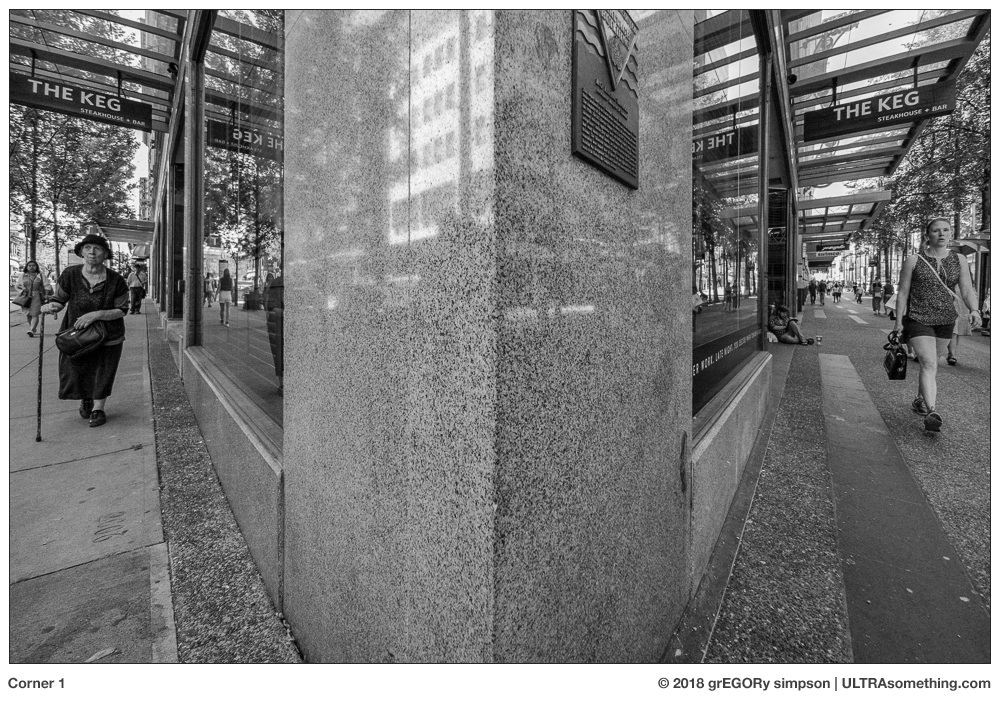
    There is absolutely no mystery to the photos accompanying this article — but there is a side note. Should you ever wish your life was blessed with more public consternation, scornful scrutiny, and contentious conversations with security personnel, I’ve found the solution: Stand on a corner 6″ from the edge of a building and take photographs of it with a 10mm lens. Your blessings will come.

    REMINDER: If you find these photos enjoyable or the articles beneficial, please consider making a DONATION to this site’s continuing evolution. As you’ve likely realized, ULTRAsomething is not an aggregator site — serious time and effort go into developing the original content contained within these virtual walls.

  • Bones

    Bones

    Anyone yearn for the good old days when ULTRAsomething was a photography site? I know some of you do, because up in the menu bar is a link to this site’s Contact Form, which several folks have wielded precisely to express such sentiment. Most recently, a friend and longtime reader sent an email in which he mentioned “those dim and distant days when you threw your photography crowd a bone or two.”

    It got me thinking: Isn’t every article a bone? Isn’t every topic a festering feast of carrion, from which each and every photographer can pluck his or her own bone of choice and suckle at the marrow? Anyone who’s read ULTRAsomething for long enough to feel nostalgic for its past knows I don’t believe photography is about cameras, lenses or the mechanics of taking pictures. Photography is about life. It’s about how we experience our surroundings and how we filter them though our own unique cognitive maze. For me, photography is existentialism; not f-stops and DxO sensor ratings. To write about existentialism is to write about life, love, music, sociology, art, science, politics, religion, and even photography. All a reader needs to do is connect the dots.

    If I connect a few dots of my own, I’m lead to believe it’s not so much a bone the photography crowd seeks as it is a chocolate covered tiramisu with a crème brûlée filling, soaked in cognac and garnished with a generous scoop of designer ice cream. I get it. You all want another gear review.

    The problem with writing gear reviews is they require I actually possess something new. I don’t. And there are two reasons for this: One is that I can’t really afford to buy any new camera gear; and two is that I’m quite happy with the gear I have.

    Technically, there are a couple work-arounds to the affordability problem. The first is to buy really cheap stuff, which is exactly what I did for my last gear article — a review of the Lomography Fisheye One toy camera. That little box of Tupperware set me back a whopping $20. Canadian. Which makes it the least expensive product ever reviewed on ULTRAsomething. Of the 70 articles dedicated to discussing photography gear on this site, it ranks 69th in popularity. Its follow-up article, Folding Time, is but a few spots shy of claiming the dubious distinction of being the least read article in this site’s 10-year history. For comparison, the most expensive product I’ve ever reviewed is the Leica Monochrom (Type 246) — which also happens to be the most read article in this site’s history. So “cheap gear” is obviously not quite the decadent dessert bar at which my readers hope to engorge.

    Which brings me to the second possible workaround to the affordability problem: equipment loans. Most photography writers have only to ask manufacturers for review samples, and as fast as the UPS guy can pull up his brown shorts, there’s some fresh new loaner gear in the house. The problem with this solution is I seem to have written myself onto several company blacklists. Apparently, you must heap boundless praise upon a camera and use the phrase “game changer” a minimum of three times in the opening paragraph, or it’s no more cameras for you. The one exception has always been Leica — who are perfectly comfortable letting me write balanced and thoughtful reviews. Unfortunately, they seem to have a “don’t call us, we’ll call you” policy where I’m concerned. And since they haven’t called in awhile, that’s not really an option either.

    My second impediment to new gear ownership — satisfaction with my current gear — is actually a very good problem to have. Being happy with my current gear means I can spend more time constructively blaming myself for lousy photos, and less time blaming the cameras and lenses. That’s not to say I don’t find myself yearning for a Voigtlander 10mm f/5.6 M-mount lens or, most inexplicably, an Olympus M.Zuiko ED 300mm f/4. But neither of these are really anything more than daydreams…

    So if I’m going to daydream, why not dream big? Why not dream up a product that doesn’t exist? Why not dream of a product that, if it did exist, would inspire me to go earn some easy cash at that dicey medical research center on the outskirts of town?

    Dreaming up such a camera requires no creative enhancement of any kind; no Psyilocybin mushrooms; no need to brew a cup of DMT or drop the needle on some Jefferson Airplane. Nope. My fantasy camera is based on a camera that once existed in the film era — the Ricoh GR21.

    In 1996, Ricoh created the 28mm GR1 compact film camera. It was soon followed by the 28mm GR1s in 1997 and, five years later, the 28mm GR1v and 21mm GR21. In 2013, Ricoh introduced the first digital version of the old 28mm Ricoh GR1 film camera worthy of being called its ‘successor.’ I bought that camera the instant it hit the stores, and it’s been my constant companion ever since. It may not be my “best” camera, but it’s the camera I carry when I’m not on any particular photo mission — which is most of the time.

    We are now five years on from the release of the Ricoh GR, which (like the film series before it) has had but one minor refresh in the form of the GRII. If history tells us anything, it tells us that we’re due for a major update to the GR line. When I purchased the Ricoh GR, 28mm was my ‘standard’ focal length, as it had been for several years. In the decade prior to that I’d been a 35mm shooter, and in the decade before that, 50mm was my “thing.” Anyone quasi-adept at trend-line analysis could have predicted what happened next: I’ve gradually become a 21mm shooter.

    So naturally, the camera of my dreams is a Ricoh GR21D — a digital (and hopefully more reliable) version of the old GR21 film camera.

    Based on my status as the world’s most peculiar photography blogger, I fully expect Ricoh to green light this camera immediately. But before they do, I have a few more requests:

    1) Cameras need viewfinders. If I wanted to hold a camera at arm’s length and squint at an LCD, I’d use my iPhone. So please replace the series’ useless built-in flash with a pop-up optical viewfinder.

    2) We all know this is going to be a fairly expensive camera due to its relatively limited audience (me?). So go ahead and give that audience what it wants: a full-frame sensor with modern low light capabilities. If you do this, I won’t spend the next year grumbling about how good the camera could have been.

    3) Repeat after me: “monochrome.” This might be controversial, but since you’re making this camera for me, consider increasing the fidelity by leaving out the Bayer filter and those silly software demosaicing algorithms. Feel free to add a color version to the lineup if you think it’ll increase sales — I’ll be buying the monochrome.

    It’s not that far-fetched of a dream. There is historical precedent, and there’s nothing technology-wise that hasn’t already been done. The market for compacts has definitely taken a smart phone beating, but smart phones still don’t offer full frame sensors, optical viewfinders, impeccable wide angle optics, good ergonomics, or the fast handling speeds needed by certain types of photographers.

    This is a camera I want so badly that I’m now carting around a Frankenstein approximation of it — a Ricoh GR with a clunky, bulbous monstrosity of a 21mm adapter snapped to its front, and a wart of a 21mm viewfinder slotted into its top. Pocketable, it is not. Front heavy, it is. Plus it disconcertingly rattles when I carry it. And even with these bolt-on carbuncles, it’s still not a full-frame, low-light sensor. It’s also still burdened with color, which I automatically strip out when I import the raw files into Lightroom. But even though I never actually see the color images, I do still see the image degradation caused by using a camera with a Bayer filter.

    So how about it Ricoh? Isn’t it about time for a digital version of the GR21? You make it; I’ll find a way to buy it. Heck, I might even review it! But just to be clear, I still won’t use the “game changer” phrase.

    And this, my bone-loving friends, is how you write an article about photography gear without having to actually acquire any photography gear. One doesn’t blog for 10 years without learning a trick or two…


    ©2018 grEGORy simpson

    ABOUT THE PHOTOS:

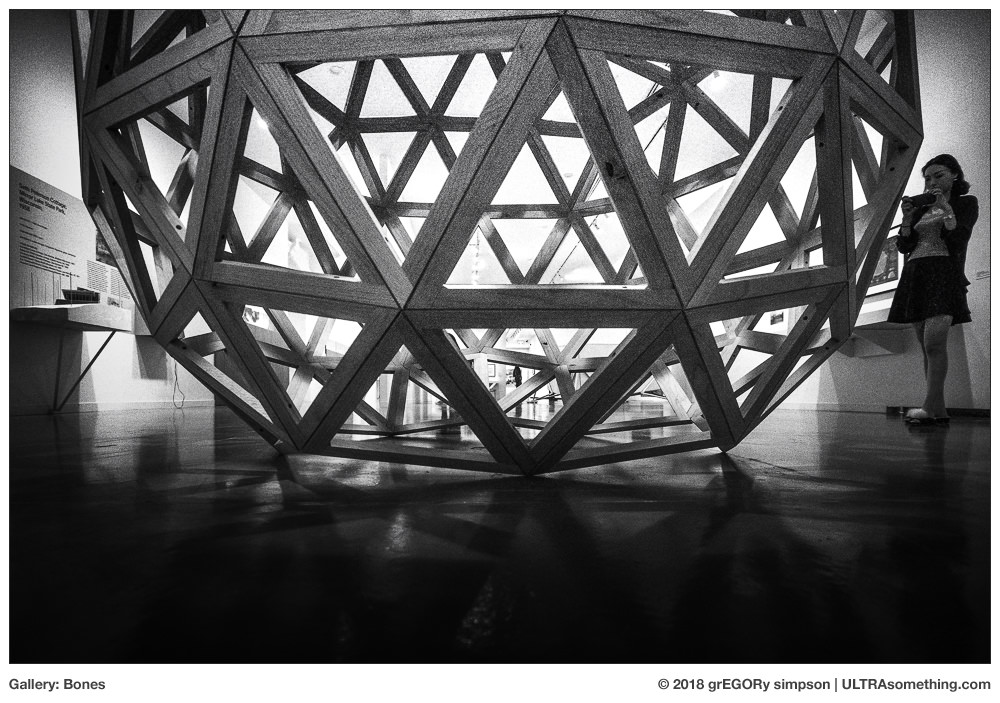
    What we have here is the result of the whole ‘carrying around a camera when I’m not expecting to take any photos’ situation. These are all simply photo “notes” that I take to remind myself of this thing or that thing. Maybe something amused me. Maybe I just like the geometry; or the light; or… whatever. In this case, the photos document two different non-photo-oriented strolls through the Vancouver Art Gallery, along with a stop in a downtown store whose domed glass roof looked more (to me) like art hanging in a gallery than the art hanging in the gallery. The first trip yielded “Gallery: Bones” and “Gallery: Not Gallery,” which were taken with the faux GR21 monstrosity. The second trip yielded “Gallery: Porn,” “Gallery: Bombhead” and “Gallery: Antigravity Exhibit.” These were shot, instead, with the Leica Monochrom (Type 246) and a 21mm Super-Elmar-M f/3.4 lens — a combination I had just realized wasn’t any larger (just heavier) than the Frankenstein GR… which coincides with the precise point I started to dream of a pocketable digital GR21.

    REMINDER: If you find these photos enjoyable or the articles beneficial, please consider making a DONATION to this site’s continuing evolution. As you’ve likely realized, ULTRAsomething is not an aggregator site — serious time and effort go into developing the original content contained within these virtual walls.

  • The Girlfriend Theorem

    The Girlfriend Theorem

    I’m so happy to live in the era of “prestige TV.” I doubt such shows as The Love Boat, Fantasy Island or The Six Million Dollar Man would have been nearly so effective at mitigating my mopiness. Really, how did people manage to survive divorce in the years before Netflix?

    Unfortunately, after working feverishly this past year to add ‘international crime series authority’ to my already overly-specialized resume, the “prestige show” queue is running dry. Which means I might soon need to face up to the whole dating problem.

    Truth is, it’s not like I haven’t been looking for a date. I have. It’s the finding part that I’m particularly bad at.

    Initially, I didn’t think landing a date would be overly difficult. I eat well, exercise, don’t drink, and have a BMI lower than 98% of North American men in my age group. I have all my hair – even if a quarter of those hairs are grey. I respect my partner’s autonomy, value her needs, and I do a reasonable job arranging the smoke and mirrors to give the illusion of intelligence.

    Yet here I am, over a year into the hunt, and my “find a date” success rate is humming along at a cool 0%. You’d think, with 7.6 billion people in the world, that my odds would be pretty good. So why am I now re-watching shows I’ve already seen? Sure, I enjoyed all 18 episodes of Jordskott, but do I really need to be watching it a second time?

    So I decided to sit down, crunch some numbers, and figure out why 7.6 billion people isn’t a large enough pool from which to draw.

    The first calculation was the easiest. There are two sexes. And in spite of the fact it outs me as “old fashioned,” I must admit I’m one of those men who likes my romantic entanglements to involve women. Exclusively women. So just like that, 51% of the world’s population disappears from my prospects pool simply because I’ve got a thing for twin X chromosomes. That leaves me with a pool of 3.72 billion.

    Obviously, I’m not going to date kids, teenagers, 20-somethings, septuagenarians, octogenarians, nonagenarians or centenarians. First, that would be creepy. Second, that would be really creepy. Ultimately, only about 30% of those 3.72 billion women are likely to fall into a category I’d consider “age appropriate.”

    Even worse, age-particular as I may be, I suspect many women would not define “age appropriate” quite as liberally as I — so in reality, that number likely diminishes to 15% of the female population. Which means my cornucopia of promise is down to only 558 million options.

    Roughly half the women in the world are single, but in my “age appropriate group,” that number probably sits at 25%. Tops. So my future girlfriend must come from a pool of 140 million.

    5% of the world speaks English as their first language. I’m guessing the number doubles if I include those for whom it’s a second language. Other than my aforementioned attributes, my wit is probably my best lure. And since that wit is wholly dependent on the English language, that means only about 10% of the fish will be biting in this particular sea — so I’m down to 14 million possible partners.

    But that’s a worldwide number. Geographical separation means I’ll never have any opportunity to meet the vast majority of these women. And while this website does have a rather extensive international reach, site stats inform me that reach is almost exclusively male. So any future date will likely come from the 0.05% of that English speaking population that actually resides somewhere within the Greater Vancouver Area. 0.05% of 14 million leaves me with a pool of 7,000 women.

    Now let’s be realistic. Coquitlam, Surrey, Delta, Richmond, Langley, North Vancouver and scores of other cities are all part of “the Greater Vancouver Region.” They’re also cities I haven’t been to in years. Heck, I doubt I’ve even been to 80% of the neighborhoods within Vancouver’s own city limits in the last decade. So just because there’s a pool of 7,000 potential partners in the Greater Vancouver Region doesn’t mean I’ll meet all 7,000 of them.

    Let’s say I go out of my way to crash every party, attend every event, join every Meetup group, and never go to the same grocery store twice. Would I even come in contact with 5% of the total pool? Probably not. But I’m trying to be optimistic, so I’m going to say 5% is possible if I’m willing to quit my job, give up making music and dedicate myself to becoming the world’s most social introvert. That leaves me with a pool of 350 women.

    But 350 is a raw total. I haven’t even started to account for the laws of chemistry and attraction. Quite frankly, I’m not likely to fall for just any English speaking, age appropriate female that I meet. Similar values, compatible interests, mutual respect, and that all important “spark” are necessary variables. So how should I weight these? I decided the answer lies with the poets, who for eons have told us that there’s just “one in a million” people to whom we will be attracted. The problem, of course, is that my pool size isn’t a million; it’s 350. Which means I’m 999,650 women short of the number I need to meet if I’m hoping for guaranteed success. This shortage leaves me with only a 1 in 2857 chance at romance.

    Of course attraction works both ways. Just because there’s a 1 in 2857 shot that my one-in-a-million girl lies within my meetable pool of potential mates, that doesn’t imply she’ll necessarily consider me to be her one-in-a-million. A staggering number of single men are wading through this very same pool, competing for the same women. And frankly, given that my current income is squarely commensurate with my lifelong dedication to music, I’m not sure that either my stellar BMI ranking nor my smoke & mirrors intelligence will spark many flames. And let’s be honest — mathematically calculating the probability of romantic involvement is a surefire recipe for diminishing that probability. So when I apply some basic statistics formulas and combine the odds that my one-in-a-million is in a pool of only 350 with the odds that she’ll see me as her one-in-a-million, I reach the final number:

    I have a 1 in 2.86 billion chance to find a girlfriend.

    That’s a rather staggering number. Particularly when you consider that the odds of winning Canada’s 6/49 lottery are only 1 in 14 million, while the odds of winning the more lucrative Lotto Max draw are only 1 in 28 million — a likelihood that’s actually 1000 times more probable than me not having to watch Jordskott several dozen more times before I die.

    So yesterday, rather than turning left into a cafe and plunking down $3 for an espresso and the hope of a serendipitous meeting, I turned right. Strolling into a small convenience store, I approached the counter, handed over that $3 to the cashier, and left gripping my very own lottery ticket. Sometimes, in life, you just gotta go with the better odds.


    ©2018 grEGORy simpson

    ABOUT THE PHOTOS:

    I seriously considered publishing this article without any accompanying photos. This site has long jettisoned the notion that it needs to constrain itself to the topic of photography — co-jettisoning the bulk of its readership right along with it. So what’s the point of publishing photos with every article?

    Would Poe have been more poetic if he’d slipped a few murky daguerreotypes into The Conqueror Worm? Would Wilde have been wilder if The Picture of Dorian Gray contained actual pictures of Dorian Gray? And while William S. Burroughs was, indeed, a bit of a shutterbug, I didn’t see him feeling the need to sprinkle those snapshots throughout the texts of Naked Lunch, The Soft Machine, Nova Express or Junkie.

    Of course I’m not exactly Poe, Wilde or Burroughs — so maybe I shouldn’t be so anxious to replicate their rejection of illustrative photos. Besides, I find the allure of posting topic-specific visual puns far too intoxicating — and you can’t just go cold turkey on a jones like that.

    REMINDER: If you find these photos enjoyable or the articles beneficial, please consider making a DONATION to this site’s continuing evolution. As you’ve likely realized, ULTRAsomething is not an aggregator site — serious time and effort go into developing the original content contained within these virtual walls.

  • The Ephemeralist

    The Ephemeralist

    “Label not, lest thee be labelled.” – The Book of Egor 19:73

    My favourite thing about us humans is our inexhaustible wealth of idiosyncrasies. So pervasive are these idiosyncrasies that I sometimes wonder: if idiosyncrasy is an intrinsically human trait, can we still call our idiosyncrasies idiosyncratic? However we label this characteristic, one thing remains certain: it’s an inspiring source of abstract fodder for the ULTRAsomething factory — endowments from a most benevolent benefactor.

    Speaking of labels, today’s essay deals with exactly that. Or rather, it deals with the paradox of labels, and how we Homo sapiens have a compulsive need to categorize and label everything: every thought; every idea; every belief; every creation, condition or culture. And yet, in spite of this, we very same humans are steadfastly resistant to accepting any label applied to ourselves.

    Labels make it easy to avoid precision. If I tell you, “I’ve been listening to a lot of minimalism this past year,” it’s nothing more than a literary wave of the hand. You still don’t know who I’ve been listening to. It could be La Monte Young, Arvo Pärt, Philip Glass, Jóhann Jóhannsson, Steve Reich, Brian Eno, Pauline Oliveros, Max Richter, Jo Kondo, or any of several hundred other composers — all of whom create music with little more in common than its ‘minimalist’ label. On a whim, I googled what one of the founding fathers of classical minimalism, Terry Riley, had to say about this label. The first thing to pop up was a 2014 interview conducted by Philip Oltermann, in which Riley stated, “Minimalism was never a word we used for what we did. It was a tag from the art world someone stuck to us later. My heart sinks when I get emails from music students saying they are writing a ‘minimalist piece.’ Once you become an ism, what you’re doing is dead.”

    Ask any artist how they feel about the heedless pigeonholing of their creative toils. Ask a writer how they like having their thoughts and ideas lazily summarized by a two-word generalization. Ask that ULTRAsomething guy what he thinks about being labelled a “street photographer.”

    Because there are 7.6 billion people who will happily affix a label to you, and only one person who wishes it removed, I maintain that it’s impossible for humans to be label-free. The only thing nature abhors more than a vacuum is an unlabelled human. So if we can’t shed our labels, why not create them ourselves? Society doesn’t really care what labels we wear, just that we’re cloaked in them. This is precisely why I’m always self-labelling — papering over whatever designation society stapled to my forehead with a fresh, more appropriate label of my own choosing.

    Self-labelling is more difficult than you might expect. Sure, inventing new labels is easy (because that’s what we humans do), but it remains our natural inclination to staunchly reject whatever label we think up. Our inner self comes face-to-face with the labelling paradox.

    I’ve struggled for years to label my photography, because if I don’t someone will inevitably drive by and stamp the word “street” on it. I’ve donned the guise of an “observational photographer,” a “figurative photographer,” and even just a “photographer.” Eventually, I felt inclined to abandon them all.

    I’ve faced similar problems musically. “Synth pop” was a label the music press attached to me early in my career — a label that sunk me like an anchor, given that “grunge rock” was the popular label of the day. Throughout my career, I’ve made numerous attempts to label my music, but none proved compelling enough to counteract whatever label the industry wanted to apply. Prior to my sabbatical, one record company rejected my submission, labelling it “instrumental crap.” At least it was a label more thoughtfully applied than “synth pop.”

    Perhaps the flaw in all my previous self-labelling attempts is that they’ve been too medium-specific. Calling my photography “observational” or “figurative” might indeed be more accurate than “street,” but it’s a photo-focused label. It doesn’t really apply to my music, or to me as a person. Wouldn’t the most appropriate label be the one that gets to the very heart of what I do and who I am, regardless of medium?

    So with that in mind, I plowed through a list of new label possibilities — dismissing each for some reason or another, until I eventually established an uneasy truce with one. I am, I decided, an ephemeralist.

    It pokes at the core of how I create, and what motivates me to do so. I am forever improvising. I have no interest in re-creating that which has already been created. When my record label asked me to go on tour to support an album in the early 1990’s, I rejected with the youthfully arrogant statement, “no one expects an artist to go on stage every night to re-create his latest painting. Why should I have to re-create an album?”

    When I make music, I record each track in a single take. If I didn’t play exactly what I intended, I don’t consider it a flawed performance. I don’t perform another take — instead, I merely accept the recording for what it is, and let its existence influence what happens when I record the next track. When I program a sound into a synthesizer, I never bother to save the program — I created that sound for a specific performance at a specific moment in time, and when that moment is gone, so too is the sound. It’s part of what I love about modular synthesizers. They are, by their very nature, ephemeral. The patch I create today will never again exist. Even if I plug dozens of cables into the same jacks and set several hundred knobs and sliders to the same positions, the sound will not be the same — the cumulative effect of their subtle positional differences would ultimately result in an entirely different sound. For years, music technology companies viewed this as a bad thing because it prevented RE-creation. But I have no desire to RE-create. Music, to me, is about expressing a feeling that I have right here, right now — not replicating a feeling I had previously.

    Photographically, my need is the same. It’s why I go hunting for photos on city streets. It’s why I look for fleeting moments, and why no one ever says “cheese” in my photos. It’s why I’ve spent the past decade writing essays rather than novels — essays enable me to address any and every transient thought without having to force them into some larger narrative. My interests indeed lie in the ephemeral.

    I do, however, agree with Terry Riley — any ism has the capacity to limit. So it’s important to remember that your ism is only a label and not a definition. And since you applied it to yourself, you’re free to interpret it as you wish — not as society dictates. You are not bound by your ism.

    For example, I’ve definitely applied the concept of ephemeralism a bit too aggressively lately. Ephemeralism, in fact, is the very reason I went over four months without recording any new music. Most nights, I’d belly up to the synthesizers at about 8:00pm and play straight through ’til 3:00am. Seven straight hours of real-time music creation — and not a drop of it recorded. I was fearful that if I recorded a performance, I might subconsciously let it influence, define or limit what I might otherwise play the next night — as if committing to an improvisation would define a genre to which future improvisations must conform. Eventually, I realized that my natural disposition to ephemeralism is exactly why this would not happen. Besides, there’s nothing about ephemeralism that implies the music shouldn’t be heard, just that it shouldn’t be reprised. To not record what I played was like pointing the camera at a subject, but not releasing the shutter. The moments are ephemeral, but if you don’t capture them, then you have no reason to exist. So I’m back to punching the record button every now and then.

    Some of you might think this whole obsession with self-labelling is silly. And it is. But as silly as it may be, labels change the way society views us. Our very names label us — implying personality traits, social status, and cultural designations that might not actually apply. This is why, back in my 20’s, I relabelled myself as “Egor.” My name is Gregory. Every time I met someone, I’d say, “Hi, my name is Gregory.” To which they would reply, “Nice to meet you, Greg.” I provided a label (Gregory), and they immediately relabelled me as “Greg.” Eventually, I decided that if people insisted on shortening my name to four letters, I should be the one to decide which four letters they used. I chose the middle four letters, and became “Egor.” I would say, “Hi, my name is Egor,” and people would say “Nice to meet you, Egor.” I regained control of my label. Even better, this new label functioned far better than the one applied by the general public. People remember “Egor.” They don’t remember “Greg.” People seek out the opinions of “Egor.” They don’t give a crap what “Greg” thinks.

    So this explains my obsession with labels, and why I believe anyone saddled with an ill-fitting tag should simply create their own. No one wants to hear what you’re not. They want to hear what you are. So be something of your own creation. Invent your own label. An idiosyncrasy? For sure. But then, we’re only human.


    ©2018 grEGORy simpson

    ABOUT THE PHOTOS & MUSIC:

    “Imprint”, the song included with this essay, is the first I’ve published in four months and the last vestige of my “improvising for an audience of none” phase.

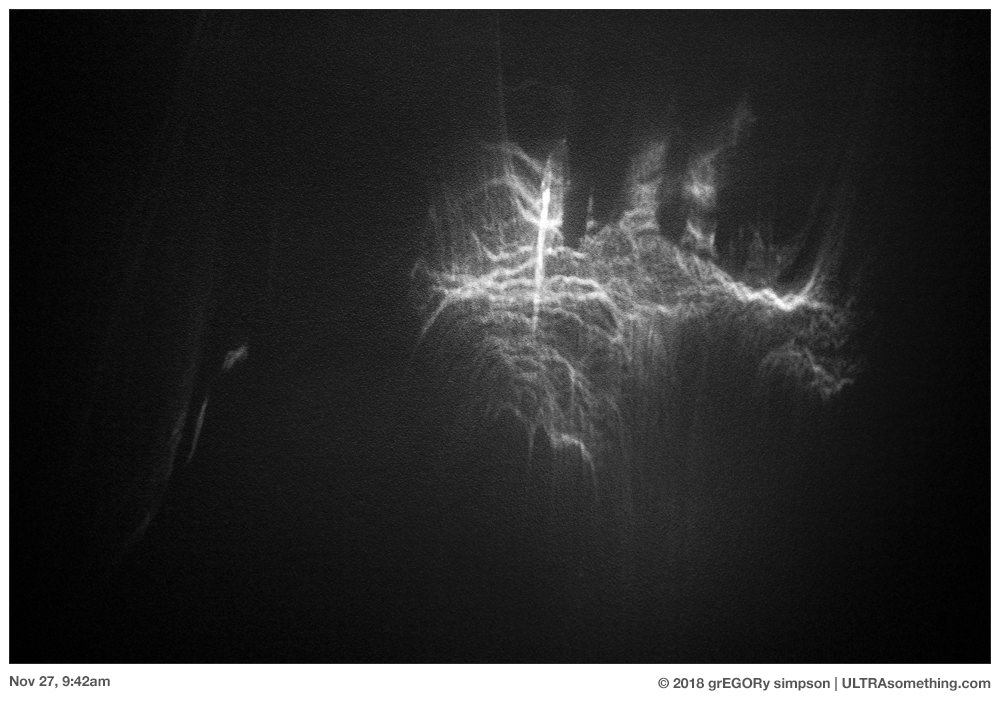
    “Nov 27, 9:42am” is a photo of a reflective splotch seen on my bedroom door on November 27 at 9:42am. By 9:43am it was gone. I haven’t seen anything similar since.

    “Dec 4, 1:48m.” A musician takes his sousaphone for a stroll down Granville Street. Maybe this happens more frequently than I know, but I haven’t witnessed any sousaphonists before or since. So it’s ephemeral to me.

    REMINDER: If you find these photos enjoyable or the articles beneficial, please consider making a DONATION to this site’s continuing evolution. As you’ve likely realized, ULTRAsomething is not an aggregator site — serious time and effort go into developing the original content contained within these virtual walls.
  • Googletainment

    Googletainment

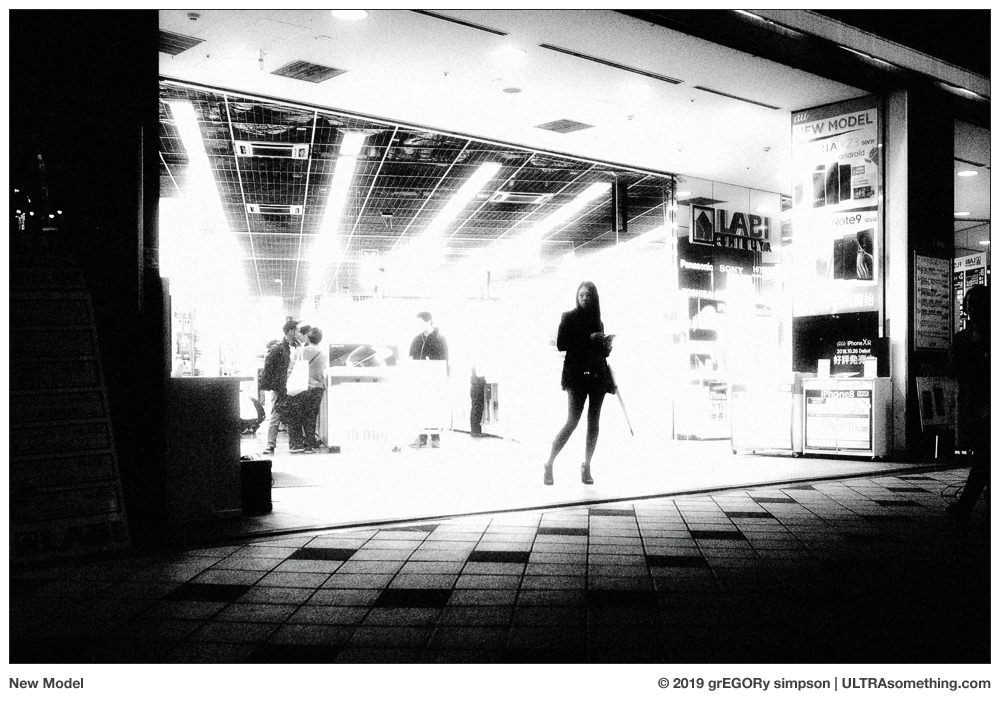
    Several years ago, when this site was popular enough to garner the occasional mention in photo-related publications, I decided to set up a Google alert for my own name. Silly? Probably. Self-absorbed? Most decidedly. But it was an effortless way to keep an eye on my online image — just in case something I photographed or wrote went inexplicably viral.

    While a few posts did unleash some minor epidemics, my natural contrarianism insured none of them graduated into a full-scale pandemic. Eventually, as my popularity waned, the Google alerts became less about me and more about other unfortunate dudes who just happened to share my name.

    At this point, had I any sense, I would have cancelled the Google alert. But no. I didn’t. I couldn’t. There’s just something so disturbingly irresistible about getting alerted to news stories that look like they’re about you, but aren’t.

    Your name is all over that thing. Someone’s quoting you; arresting you; interviewing you; eulogizing you. Only it’s not you. It’s downright creepy. It’s as if there are parallel universes in which you’re living parallel lives, but thanks to the butterfly effect, your paths have diverged so substantially that only your name links you across worlds.

    Recently, for example, one of my namesakes was praised in his city’s local paper for inviting a young boy to sit beside him while he played organ in church — even allowing the child to press a prescribed key at certain times during the performance! It was a news story without even the slightest hint of newsworthiness — the sort of reporting that’s so fluffy it makes dryer lint jealous. And yet I was riveted! Bizarro me, it turns out, is a musician too! And he’s interested in sharing what he knows with others! Attaboy, organ me! Apparently, not every butterfly impacts every event equally.

    A couple months ago, I read about another of my doppelnamens who got ticked off, and took a sledgehammer to 12 police cars in a parking lot. Not that I’m condoning this sort of thing, but I must admit to having felt a modicum of pride at getting to “stick it to the man” without actually compromising my own spotless criminal record or moral code. I did, however, find myself somewhat mystified by the fact that my namesake caused only $4900 worth of damage. $4900?! With a parking lot full of cars and a sledgehammer in hand? “The real me,” I thought, “would have easily hammered his way north of $10,000!”

    More often than not though, news of my doppelnamens is purely pedestrian and utterly banal. I’ve retired. Or I’ve been appointed chair of some horrifically boring committee. Or I’ve died. I do find the obituaries particularly unsettling — especially when the doppelnamen is the same age as I am.

    I’ll be the first to admit that such behavior might just be a teensy-weensy bit voyeuristic. But I figure it’s nowhere near as bad as those people who stalk old friends and lovers on Facebook. At least I’m only creeping on myself… well, sort of…

    I wonder though — have my namesakes also enabled Google alerts? And if so, how many of them saw some photograph I’d taken, listened to some song I’d written, or read some twisted essay about folding time or celebrating National Biplane Lady Day, and then panic-called friends and family members to assure them it wasn’t he who was responsible!

    Life in the 21st Century. A little to love; a little to loathe… but oh so entertaining.


    ©2018 grEGORy simpson

    ABOUT THE PHOTOS:

    The match between an article and its photos usually occurs through one of two means: either the photos themselves suggest the topic of the article; or the article suggests a particular type of photo. When this second situation occurs, I simply go spelunking through my Lightroom catalog, and then repurpose previously-rejected photos into a new context. But this particular article, in spite of resting squarely within the latter camp, did not involve a descent into Lightroom. Fact is, after staring into a computer monitor since the early 1980’s, I sometimes feel a need to focus my eyes at a distance other than one meter  — so I wasn’t overly keen to wade through thousands of photos searching for those in which my own image appeared distorted through abstraction. Instead I went old-skool, picked up a camera and walked out of the house for some fresh content. 60 glorious computer-free minutes later, I returned with three new illustrative shots for the article. Such swashbuckling tactics do violate my self-imposed dictate to let photos gestate for at least 1 year before publishing — but why give yourself rules if you’re not going to break them now and then?

    REMINDER: If you find these photos enjoyable or the articles beneficial, please consider making a DONATION to this site’s continuing evolution. As you’ve likely realized, ULTRAsomething is not an aggregator site — serious time and effort go into developing the original content contained within these virtual walls.
  • The Dark Web

    The Dark Web

    Maybe you’re searching for a coven of witches to put a hex on that obnoxious coworker who habitually steals your lunch from the office fridge. Or perhaps you need the services of a professional cleaner to, um, tidy up that little disagreement that turned a bit uglier than anticipated. Or maybe it’s something simply as innocent as wanting to chill out in San Sebastián for a couple of weeks without damaging your own credit rating.

    Where do you turn?

    The dark web.

    At least that’s what I’ve learned from streaming perhaps a few too many Scandinavian Noirs and other assorted European crime series.

    So just how the heck do I get on the dark web? If all these television shows are to be believed (and why wouldn’t they be?), it seems everyone on earth knows the secret handshake except me.

    I’m reasonably certain that step 1 is to get myself a decent VPN to obscure both my identity and my location. Most Canadians did just that back when it was possible to trick Netflix into streaming U.S. content north of the border. Alas, I was so awash in the aforementioned Scandinavian Noir crime thrillers that I had no interest in American content. So I’m already behind the curve.

    I reckon too that I’ll need a browser that’s perhaps a bit more ‘specialized’ than Safari. Google Chrome maybe? And I’ll obviously want some Bitcoins or other cryptocurrency to pay for my nefarious purchases. Actually, come to think of it, Kodak has recently entered the cryptocurrency game. So maybe I’ll just buy a few kodacoins next time I visit the local camera store for another brick of Tri-X.

    Beyond that? I’m not sure what to do.

    Mind you, I’m not actually looking to put a hex on anybody — though I will reluctantly admit that my dating prospects are so abysmal that I‘ve recently moved “witches” from the ‘unacceptable companions’ list to the ‘acceptable’ list.

    No, the reason I want to get on the dark web is that I’m fairly sure it’s where most of the ULTRAsomething readers are. It must be, ’cause there certainly aren’t many visiting this site on the “light web” any more. And since I’m nothing if not a servant to my readers, how can I obey without knowing which content they find most engaging? What photos do they like? What music? What articles? Are people praising me on the dark forums or bashing me? Sure, I’ve received my fair share of vitriol on the light web, and I couldn’t care less. But dark web vitriol? I mean, you know, they’ve got assassins!

    So obviously, accessing the dark web is imperative. But until I gain the necessary knowledge to do so, I’m erring on the side of caution — guessing what sort of content its dark denizens prefer; and publishing only content of that sort. It’s a decision that might just save my life. And if it happens to increase my odds of bewitchment? Well, that’s what I’d call a ‘win-win.’


    ©2018 grEGORy simpson

    ABOUT THE PHOTOS:

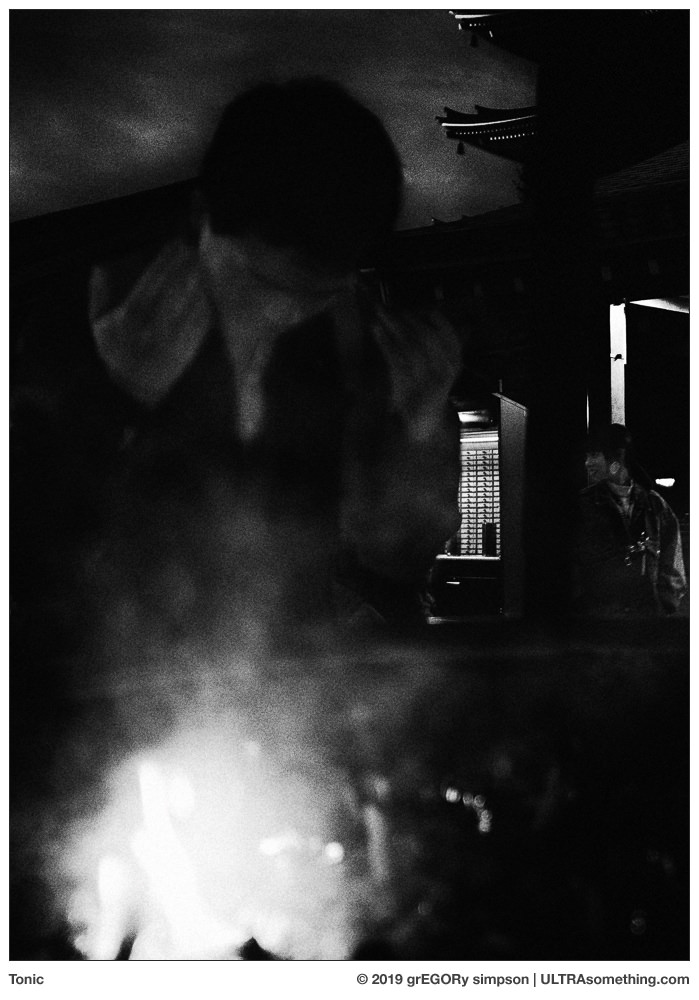
    Funny thing — the older I get, the less interest I have in shades of grey. Maybe it’s the subliminal result of calling myself a “black & white” photographer for so many years. If I’d been cultured enough to call myself a “monochromatic” photographer, maybe I’d still be partial to the subtle nuances between greys. But it just never felt right to describe my work as “monochromatic” — particularly since I had no desire to produce photos in any one hue other than “none.” The same thing happened to Bill Brandt late in his career — the older he got, the more his photos skewed toward blacks, whites, and no greys. Consequently, there is a rather pronounced difference between photos he printed earlier in his life and those same photos that he printed later. I’m not too worried about it. I’ll leave it to the art historians to categorize my different photographic stages… assuming that I ever produce any photos that pique the interest of an art historian, that is.

    REMINDER: If you find these photos enjoyable or the articles beneficial, please consider making a DONATION to this site’s continuing evolution. As you’ve likely realized, ULTRAsomething is not an aggregator site — serious time and effort go into developing the original content contained within these virtual walls.
  • Equilibrium

    Equilibrium

    The world abhors disorder and embraces equilibrium. Yins need yangs. Dogs need cats. It’s the whole “for every action there’s an equal and opposite reaction” thing. Or as I like to think of it, “there are people who suck and people who blow.”

    Curiously, most folks consider these to be one and the same. In the common vernacular, saying “ULTRAsomething sucks” is perceived as having the same meaning as saying, “ULTRAsomething blows.” But here’s the thing — I only agree with one of those statements.

    It’s curious that sucking and blowing have become synonyms, since one obviously involves inhalation and one exhalation. Physically, we all do both — equilibrium. But metaphorically, we tend to favour one over the other.

    Personally, I much prefer people who blow to people who suck. People who suck consume more of the world’s energy, creativity, knowledge and compassion than they replenish. We all know people whose very existence drains us of our own vitality, and who reduce our stockpile of enthusiasm to levels barely adequate to sustain an evening of Netflix binging. Soul vampires.

    We also all know people from whom new ideas flow easily; whose presence energizes the room or whose generosity is above reproach. Soul nourishers.

    The reality, of course, is that we all suck a little and we all blow a little. But there are very few people who do this in equilibrium. Rather, equilibrium is achieved on a global macrocosmic level — where society, as a whole, manages to both suck and blow in proportion.

    I definitely strive to be someone who blows. Granted, I don’t blow anywhere near as demonstratively as a Mother Teresa or a Ghandi. But then, to compensate for my moderate blow levels, I do try to subsist on the most minuscule quantities of suck.

    And that’s why I’m perfectly fine with the notion that ULTRAsomething blows — after all, it has no real purpose other than to hopefully inspire others to blow. Its mission is to give a (very) little something to this world — to improve it in some microscopic way; to advance society by a nano-nudge.

    So a tip of my hat and a hearty and heartfelt “thanks for noticing” to all those readers who, for all these years, have proclaimed that ULTRAsomething blows. And to all those who have suggested ULTRAsomething sucks? All I can say is “your ignorance is showing.”


    ©2018 grEGORy simpson

    ABOUT THE PHOTOS:

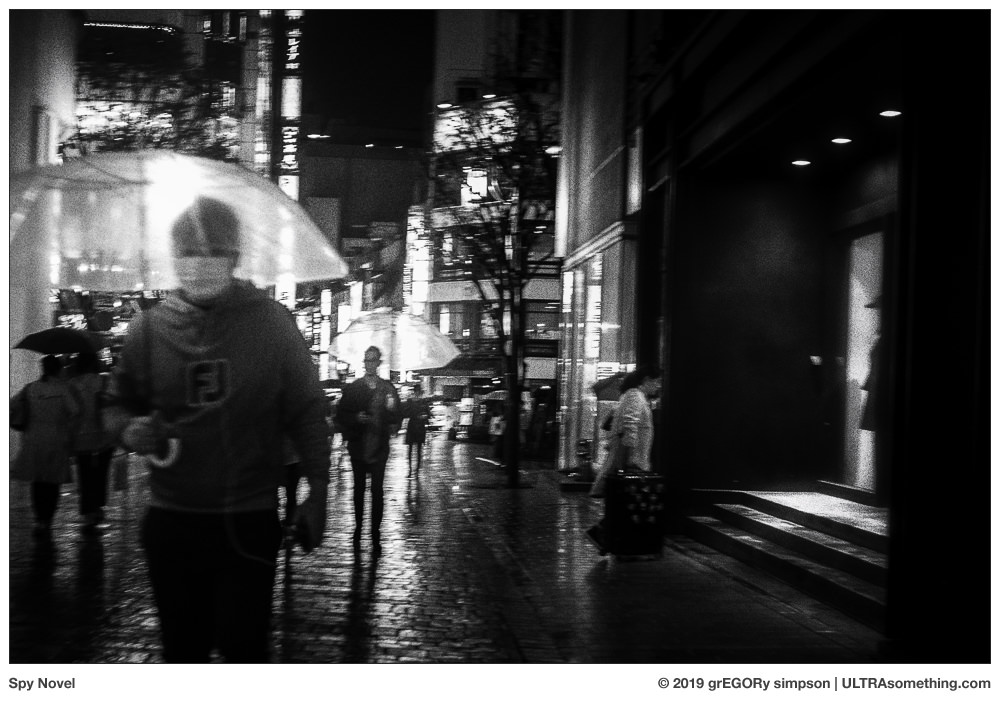
    In an effort to illustrate just how much ULTRAsomething blows, I decided to populate this article with recent photos from my 1969 Olympus Pen FT camera. By using a 50 year old camera, I’m not sucking up more of the word’s precious natural resources for the purpose of building a new one. Why would I do that when the Pen FT takes perfectly adequate photos? Same goes for digital media — why consume all that cloud storage bandwidth and all those backup drives, when all I need to preserve my images is a single strip of acetate? And just in case some of you believe the chemicals within acetate (and a few mils of Rodinal) smell slightly of suckage, note that the Pen FT is a half frame camera, meaning I get 72 exposures on a single strip — halving my per-shot chemical use and thereby minimizing my toxic footprint. In fact, the only thing that doesn’t blow about the enclosed photos is the photos themselves. Upon making my selects, I realized they neither blow nor suck. Rather, to my eye they appear to bite — a discovery that sort of messes up my entire metaphor. Oh well, it’s not like anyone reads this “About The Photos” section anyway.

    REMINDER: If you find these photos enjoyable or the articles beneficial, please consider making a DONATION to this site’s continuing evolution. As you’ve likely realized, ULTRAsomething is not an aggregator site — serious time and effort go into developing the original content contained within these virtual walls.

  • Mantra

    Mantra

    Monkey Mind. In Buddhist philosophy, it describes a mental state in which our brains race around in a furious frenzy of restless thought. Zen masters place it rather prominently on the ‘naughty list,’ and encourage us to abolish our tree-swingin’ monkey minds through meditation — adopting instead the disposition of a deer in the forest.

    I don’t know. I’ve observed both in nature, and I feel rather confident in my assessment that it’s the monkeys who are having a heck of a lot more fun.

    Besides, if I were to develop the mind of a deer, how would I manage to write the ULTRAsomething site? This sucker’s very existence relies on me thinking about crap most people never even thought about thinking about. I don’t just have a Monkey Mind — I have a Barrel Full O’ Monkeys Mind.

    New Age adherents have suggested my unwillingness to reject monkey mind is a sign of my inferiority, and that I am therefor beneath them on some cosmic human evolutionary scale. Which probably explains why I don’t have any new age friends. Personally, I believe all creatures in the forest are important, and all have evolved to fill a specific need. I don’t subscribe to the idea that a squirrel should try to become a better woodpecker, nor the wolf a better bear. I do believe, however, that the monkey should try to become a better monkey, and I’ve spent many years making sure my monkey mind moves in a forward direction, and not a circular one.

    Fact is, I’m rather proud of my monkey mind and its profound inability to blindly and willingly accept convention or ‘common wisdom.’ Being the antithesis of a deer is sorta my raison d’être.

    The only time ol’ Mr. Monkey lets me down is when it’s time to fall asleep. Apparently, the average monkey doesn’t require as much shut eye as the average human — a situation that makes for a logy human and a dulled monkey mind. In such instances, the mind of a deer would indeed be preferable — though I’d more likely opt for the mind of a sloth.

    I’ve spent the bulk of my life actively searching for a slam-dunk passageway to sleep. You name it, I’ve tried it. And I’ve likely tried it numerous times, since I’ve had tens of thousands of nights to experiment. For me, the best solution has always been to envelop myself in music — the louder the better.

    But it can’t be just any music — it has to have a certain indefinable ‘something.’ It needs to be music that I can crawl inside of and let swaddle me. It needs to have numerous competing and conflicting threads (melodic, rhythmic, harmonic, timbral) that ebb and flow, and that I can follow in my subconscious. It needs to be both unfathomably dense and ingeniously simple.

    The closest I’ve ever come to finding the perfect monkey sedative is Dawn Upshaw’s recording of Henryk Górecki’s Symphony No. 3. I discovered its somniferous qualities soon after purchasing it way back in 1992. It served me reasonably well for several years — until I got married to a woman whose quest for a deer’s mind thwarted my inner-monkey’s need for music at bedtime.

    Flash forward a couple of decades and I’m single again — with a renewed quest for the right tunes to help drag me into slumber. The Górecki symphony remains one of my go-to standards, but it suffers the same fate as most tunes — it takes a long time to work. Most of my musical sedatives, if they do succeed, require one full album play to make me drowsy, and a second to seal the deal. Which means, best case, I’m looking at about a 90 minute process.

    If only there was a way to hasten the task.

    A couple of months ago, I was improvising on my modular synth when I suddenly started to feel quite drowsy. To help me remember what I’d been playing, I punched the RECORD button to capture a segment of my experiments. After about 8 minutes, I got so sleepy I had to stop.

    The next day, I tried listening to the recording. I fell asleep.

    I tried again the following week. I fell asleep.

    On a third attempt, I pumped myself full of caffeine and told my monkey mind that it must stay alert throughout the entire song. It was a struggle, but the caffeinated monkey prevailed. I decided to take advantage of my vibratory state — quickly mixing and mastering the improvisation, then posting it to my Bandcamp site.

    Since then, I’ve used this track to fall asleep nearly every night. But what’s truly remarkable is that I often fall asleep within a single listen — 8 minutes (or less) and I’m out cold. During the day, should the pressures of life grow too great, a single listen is also all that’s required to sooth my jagged nerves and set me back on course.

    Because of this, I gave it the only name I could: “Mantra.” It’s either the most miraculous song I ever wrote or the most boring. Or maybe it’s both.

    I have, at last, evolved.


    ©2018 grEGORy simpson

    ABOUT THE PHOTOS & MUSIC:

    First things first: This article contains no actual photos. Unless you believe it’s somehow significant that the word “photo” accounts for the first two syllables in the word “Photoshop.” Otherwise, you best consider it an illustration, since no camera of any sort was utilized in its creation. I figured I could prowl the streets in search of an image with just the right mood, or I could just build one in 3 minutes.

    Second things second: Describing the song is basically the purpose of the article. Sure I could detail which modules I used specifically and what modulation techniques I employed. But that would prove tedious to all but 11 people in the known universe… plus it would require that I actually remembered. Which I don’t.

    REMINDER: If you enjoy this site’s photos, music or articles or if you find them beneficial in any way, please consider making a DONATION to this site’s continuing evolution. As you’ve likely realized, ULTRAsomething is not an aggregator site — serious time and effort go into developing the original content contained within these virtual walls.

  • Hunt. Fish. Farm.

    Hunt. Fish. Farm.

    Hunt. Fish. Farm. Prior to the industrial age, these were basically the only choices available to a hungry human hoping to fulfill their daily caloric needs.

    But times change, and for the majority of today’s first-world burghers, it’s take-out, vending machine and frozen food aisle that top the list of options to sate a rumbling belly. Industrialized sustenance might offer the advantage of convenience, but I would posit that a blackberry plucked fresh from the vine is infinitely more satisfying than a blackberry-flavoured popsicle dropped from the lunchroom vending machine.

    In case you’re wondering — no, I haven’t just rebranded ULTRAsomething as a foodie blog. I’m still writing about photography — I’m just indulging in metaphors again.

    Take-out, vending machine and frozen food aisle are stand-ins for Photoshop, Affinity Photo and PaintShop Pro — three popular options for the modern photographer looking for “likes” in these dog-eat-dog days of social media. And while these options might indeed yield images as quickly and conveniently as a popsicle from a vending machine, they are equally void of nutritional value. So as long as I’m on my positing pedestal, I’ll also declare that a naturally compelling photo is infinitely more satisfying than one which tries to manufacture its charisma through extensive software manipulation.

    So what about hunt, fish and farm? For what photographic techniques are these terms a substitute? I would suggest that the photographic equivalent for these words are: hunt, fish and farm. Which makes this perhaps the lamest metaphor I’ve ever crafted.

    But even if you’ve succumbed to the seductive allure of altering your photos through illustration and collage, you still need to gather the raw ingredients — some assemblage of pixels with which to begin. And where do you get those pixels? You hunt, fish or farm for them.

    Hunting for photos is what I do. It involves hitting the streets with nothing more than a small camera and a pocket full of hope. Hunters have no idea what their cameras will shoot that day — if anything. A successful hunt could feed your ego for months, while a string of unsuccessful hunts leaves you enervated and desperate. Hunters never stop moving. Fast shutters and good shoes are key. Hunters are always searching; always scanning the immediate surroundings for something — anything that might look tasty in a frame. I think of Daido Moriyama stalking the streets of Shinjuku. Or Josef Koudelka, who seemingly travels 100,000 kilometers per published photograph.

    Go to any “street photography” class, and you’ll inevitably find it taught by a fisherman. Fishermen prefer to locate areas ripe with potential photo opportunities, and then cast a net. Fishing might mean attending events, parties or celebrations because you know you’ll be going home with something in your camera. Or fishing might mean locating the most intriguing geometric spot in the neighbourhood, and then waiting patiently for something to happen within it. Most of the great photojournalists or documentary-style photographers are fishermen, and why not? Fishing produces a steadier stream of photos than the ‘feast or famine’ nature of hunting, and it’s a lot less stressful. I think of Henri Cartier-Bresson as the consummate fisherman. Or Lee Friedlander for those of us with more esoteric tastes. Fishermen possess patience. I do not. 7 seconds is roughly the maximum amount of time I can stand still and wait for a photo opportunity to materialize before pounding more pavement.

    Farming is what most photographers do if they want an actual income. Growing your own photos in a studio or under a controlled environment is a lot less risky than wandering around aimlessly with a camera, or spending hours hunkered down over some little spot you’re fishing that day. Farmers grow their own photos from the seeds of an idea, rather than relying on chance encounters in nature. Motion blur, focus errors and lighting challenges disappear. There’s no such thing as a missed shot. My photographic journey actually began with farming, and I may yet choose to till a little corner of the condo should the hunting prove too lean. Farming might lack the thrill of the hunt, but you’ll never be lacking for portfolio fodder. Most photographers with names known to the general public qualify as farmers: Richard Avedon; Annie Leibovitz; Helmut Newton. But for me, Frantisek Drtikol is the one who first got me interested in farming, and his shapes, tones and shadows still fertilize my imagination to this day.

    Some of you may wonder why this metaphorical list neglects other nutriment-satisfying activities, like ranching, foraging or trapping. The reason, of course, is that ranching is just farming for carnivores; foraging is simply hunting for vegetarians; and trapping is fishing for non-pescatarians. In the end, if we want to satisfy our hunger for images, we all must first become hunters, fishermen or farmers — even if our ultimate goal is only another popsicle for our Instagram feed.

    So what feeds your photography? Are you a farmer who pursues photography with the same creative vision and aesthetic refinement that motivates painters, sculptors and other studio-based artists? Or are you a healthy and well-balanced fisherman who effortlessly merges life and friendship with an appreciative eye and a passion for photography? Or maybe you’re like me — a hunter seduced by the unknown, obsessed with the chase, riddled with uncertainty, yet nourished by photographic possibilities deemed unpalatable to many?


    ©2017 grEGORy simpson

    ABOUT THE PHOTOS:

    The three photos accompanying this article could only come from the camera of a hunter. I can assure you I would never have thought to stage a scene in which a man in a clown suit pushes his contented child in a stroller. And I could fish all year, but no matter how hard I tried, I’m certain that I would never land a photo of a man about to eat a shoe. And I still can’t fathom how Forrest Gump beat out Pulp Fiction for the Best Picture Oscar in 1994, so you can be certain this is not the sort of image I would choose to either fish for or farm — but hunters can’t be choosers.

    REMINDER: If you find these photos enjoyable or the articles beneficial, please consider making a DONATION to this site’s continuing evolution. As you’ve likely realized, ULTRAsomething is not an aggregator site — serious time and effort go into developing the original content contained within these virtual walls.

  • By Proxy

    By Proxy

    Back in the 20th century, when I would write songs with words (and was popular enough to have an audience that listened), people would frequently ask me what those songs were about. Scratch that — people would frequently tell me what they were about. This was inevitably followed by a lengthy monologue on why the interpreter didn’t approve of the song’s message. Naturally, these interpretations were often incorrect — thus revealing more about the listener than me, the writer.

    I received numerous tongue lashings over a song called “Inside Me,” which a surprising number of people interpreted as a crass and blatant ode to sexism. Never mind that it’s a song about love, grief and loss — sung by a woman peering into the open casket of her husband, leaning in to kiss him and knowing this would be their final moment together. The sexism case was built around a lyric that asks, “wouldn’t you like to be in here inside of me?” Had anyone bothered to pay attention, they’d know this was not a question the woman asks, but a question she imagines her husband asking. She’s struggling with the thought of a life without him, and is drifting toward the temptation to join him in death.

    INSIDE ME by Grace Darling

    Although most people failed to spot the corpse in “Inside Me,” nearly everyone discovered its presence in another song from the first Grace Darling album — “I Bury My Love.” Except that song isn’t about a corpse at all. It’s about a woman condemned to the drudgery of a long and loveless relationship who meets someone new, but is forced to suppress her feelings for the sake of those who do not love her. The love she buried was an emotion, not an actual corpse.

    After releasing that first Grace Darling album, I began to question the idea that songs needed to be about something. Which probably had a lot to do with why, instead of buckling down to work on the next Grace Darling album, I embarked on a new recording project called Bartholomew Fair. The formula was the same — me and a female vocalist — but the approach was entirely different. I decided that the lyrics to every song would be nothing more than impassioned random syllables. I wanted people to feel this music, not try to interpret it.

    NEVER NEVER NO / THE WELL by Bartholomew Fair

    It was around this same time that my photography obsession blossomed, which meant that many of my earliest photo experiments were shaped by a similar philosophy — that images, like music, should be “felt.” Alas, my commitment to this ethos waxed and waned over the next several years as I struggled with the chasm between creating what I wanted to create and creating what people expected. I returned to the Grace Darling project for a follow-up album (chock-full of songs about something), and I would occasionally take on photography clients, who obviously demanded my photos be of something.

    Eventually, I realized I was simply too much of an iconoclast to ever earn a comfortable living creating content for others. So if I was going to be uncomfortable, I might as well create for me. And that meant adopting wholeheartedly the idea that songs needn’t be about some thing and photos needn’t be of some thing — rather, they should both just be the thing.

    This is more easily conceived than executed, because there’s a curious malady that infects both photography and music. It’s a condition in which the audience expects a song to be familiar, or a photo to be pleasing. So without really intending to, we end up producing beautiful photos of horrific things, or jaunty tunes about paralyzing despair. We communicate boundless topics and emotions, but we wrap them all in the same meager assortment of ribbons and bows, which diminishes their intent.

    Obviously, songs and photos can never actually be the things they communicate, but they can serve as proxies. And a proxy for something should have the same effect as whatever it substitutes for. Though noble in intent, it’s an idea fraught with danger. Could someone develop such mastery of proxy that their art inflicts psychological damage on the audience? It’s a scary thought. Fortunately, I’m not masterful enough to achieve this effect (though I am considering turning the idea into a schlocky sci-fi horror screenplay). But just to be safe, I’ve taken to creating some rather curiously banal proxies of late.

    Neuron & The Nyquil, which I wrote earlier this year, isn’t a song about the druggy, spaced out feeling one gets when trying to function under the dual impact of a head cold and a shot of Nyquil — it’s meant to be that feeling. And because of that, it’s kind of unsettling and a bit disorienting to listen to.

    My most recent track, Between Tick & Tock, is similarly conceived. It’s an aural re-creation of that agitated, otherworldly feeling you get when you’re forced into an interminable wait — such as a doctor’s waiting room or a delayed flight. It’s that sensation in which urgency collides with quiescence, time seemingly stands still, and fleeting snippets of anticipation bubble up from the nothingness only to be quickly swallowed by the vastness of limbo. “Between Tick & Tock” is not a song about limbo — it’s meant to feel like limbo. And because I’m quite certain no one actually enjoys the feeling of limbo, I don’t really expect anyone to enjoy this song.

    The obvious question is “why?” Why write this? Why create proxies at all? If no one wants to feel like they’re in limbo, why write a song that’s meant to feel like limbo? Besides, I’m purportedly composing and photographing for myself — so why bother to create proxies for things that I, myself, have no desire to feel?

    Maybe it’s time to apply my proxy making prowess to sensations more pleasant and to feelings less trivial. Can I create a proxy for joy? For compassion? For belonging? Or is it best to experience such moods directly, and not by proxy? I suppose the only way to know is to try. So if anybody needs me, I’ll be behind a wall of synthesizers seeing if I can’t proxy me up a girlfriend…


    ©2017 grEGORy simpson

    ABOUT THE MUSIC & PHOTOS:

    I wrote and recorded “Inside Me” in early 1990, as part of my Grace Darling recording project (which consisted of Val Martino on vocals and me on everything else). It utilized some rather archaic equipment — a Tascam TSR-8 1/2″ 8-track reel-to-reel, a piano patch from an original E-mu Proteus, and a poorly-wielded Lexicon LXP-1 reverb unit. It was meant to be a ‘respite’ from the more heavily (synth) orchestrated Grace Darling tunes.

    “Never Never No” and “The Well” are the opening ‘songs’ on the ill-fated Bartholomew Fair CD, which featured Sonya Waters on vocal. I’m rather certain its predominant instrumentation comes from a combination of Kurzweil K2000 and E-mu Proteus 2 Orchestral synth. I was still recording vocals directly to an 8-track reel-to-reel, but I’d taken to digitizing the best bits of each track and mixing them in a precursor to Pro Tools, called “Sound Tools.”

    “Between Tick & Tock” is, as indicated, a new song meant to sonically portray limbo. It’s a hodge-podge of synthesis techniques built around hardware modular synthesizers and software-based tools.

    “Diversion,” “Imminence” and “Resignation” are only vague proxies — combining both the subject and the feel into a sort of hybrid image. I probably should have included real proxy images with this article, but I wanted it to be at least somewhat accessible…

    REMINDER: If you find these photos enjoyable or the articles beneficial, please consider making a DONATION to this site’s continuing evolution. As you’ve likely realized, ULTRAsomething is not an aggregator site — serious time and effort go into developing the original content contained within these virtual walls.

  • Holes in Wholes

    Holes in Wholes

    I’ve taken some rather mediocre photos this past week, and I’m absolutely thrilled. The reason for this seemingly incongruous declaration is that, nestled within it, is an implication that I’m indeed taking pictures — something that hadn’t really happened in the six months prior.

    OK, that’s not quite true. I did photograph several labels inside Ikea so I could later retrieve those items from the warehouse. And yeah, I took numerous shots of my flooded condo — on two separate occasions actually — courtesy of a neighbour whose love of long showers is matched only by his disdain for shower curtains. But other than that? Zip.

    That’s not to say I didn’t want to take photos. Although I’d slightly relaxed my pathological need to grab a camera every time I stepped outside the condo, I still carried one more often than not. The motivation remained, but the vision had vanished.

    When the International Leica Society kidnapped me last year — detaining me until I had acquiesced to their demand for “five photography tips” — I stated on camera that “my only real tip for people is that they just try to find themselves somewhere out there, and then take a picture of that.”

    It wasn’t exactly profound. After all, ULTRAsomething exists primarily as an exercise to see how many ways, and for how many years, I can continue to express this identical sentiment. So you’d think I’d be capable of following my own advice. Apparently not. Because what I discovered, after much soul searching, is that I’d spent the past six months looking for photographs of who I was, and not of who I’d become.

    The fact is, everyone changes. Nothing is static. That hairstyle that flattered you in 1987 probably doesn’t do so today. Sometimes the changes are gradual, and sometimes they’re sudden. For me, this has been one of those sudden years — a year of loss; a year of change; a year in which external forces have altered the very landscape of my Egorness.

    There are holes where there was once life; holes where there was once hope; holes in dreams; holes in reality; holes within holes. I am, shall we say, a bit more melancholy. Often, where I would once see a photo, I would now see only another hole.

    And so it occurred to me. If holes are what I see and holes are who I am, then shouldn’t I be photographing holes? Why keep shopping for allegorical curios when you no longer own a metaphorical shelf to display them?

    So I abandoned my search for baubles, and began to focus on holes — specifically holes that prevent wholes. And naturally, because I was once again photographing myself, I began to see holes everywhere. I’ll be the first to admit that these are not the most compelling photos to have emerged from my camera — but they are the first to have emerged in many months. At one week into my career as a hole photographer, I’m still too new to even be a noob.

    We are rarely who we were, and we are not now who we will likely be. We are only who we are, right this second. Who we are is what we see, and what we see is what we can most easily and effectively photograph. So go photograph it.


    ©2017 grEGORy simpson

    ABOUT THE PHOTOS:

    Recognizing that I wasn’t exactly prolific these past 6 months, I took to carrying only film cameras. Why disappoint myself constantly by the utter paucity of images on an SD card, when I can wait… and wait… and wait until I collect enough images on a strip of acetate to warrant the bother of viewing? Last month, after realizing I’d had Tri-X fermenting in a couple of cameras for over a year, I decided to buckle down and finish those rolls. One month and zero photos later, I made the resolution once again — only this time I backed it up with my newfound identity as a hole photographer. Needless to say, these are all “end of the roll” shots.

    REMINDER: If you find these photos enjoyable or the articles beneficial, please consider making a DONATION to this site’s continuing evolution. As you’ve likely realized, ULTRAsomething is not an aggregator site — serious time and effort go into developing the original content contained within these virtual walls.