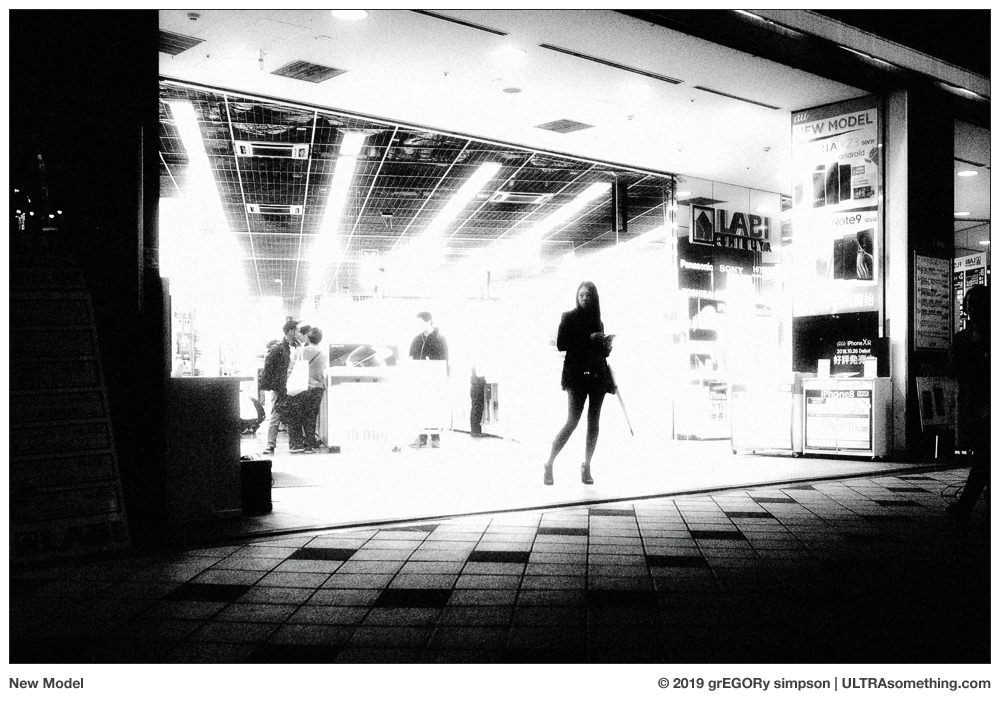
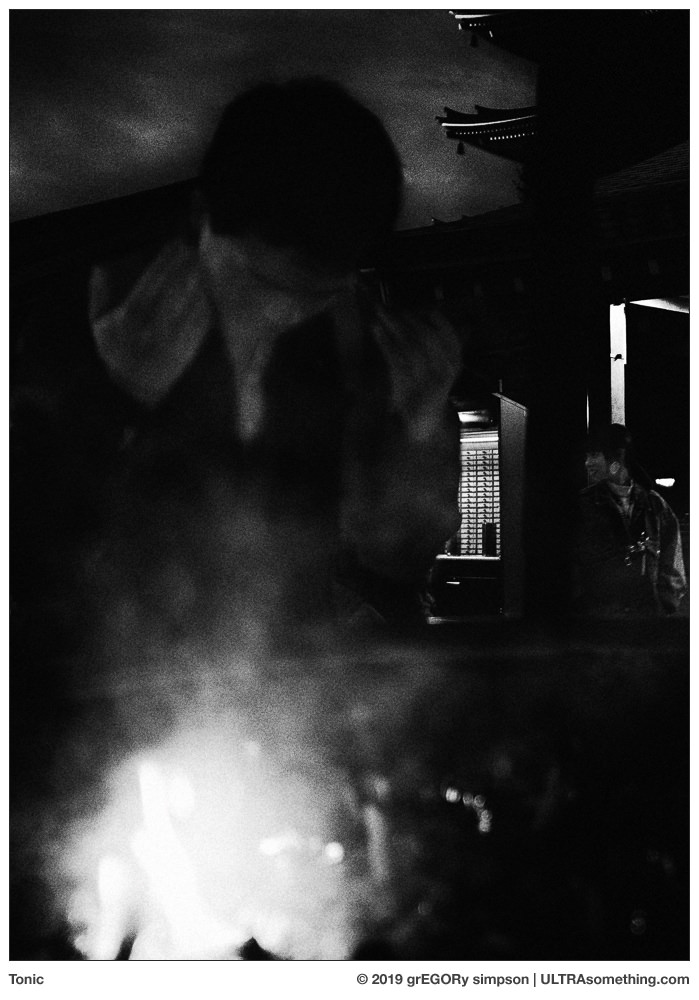
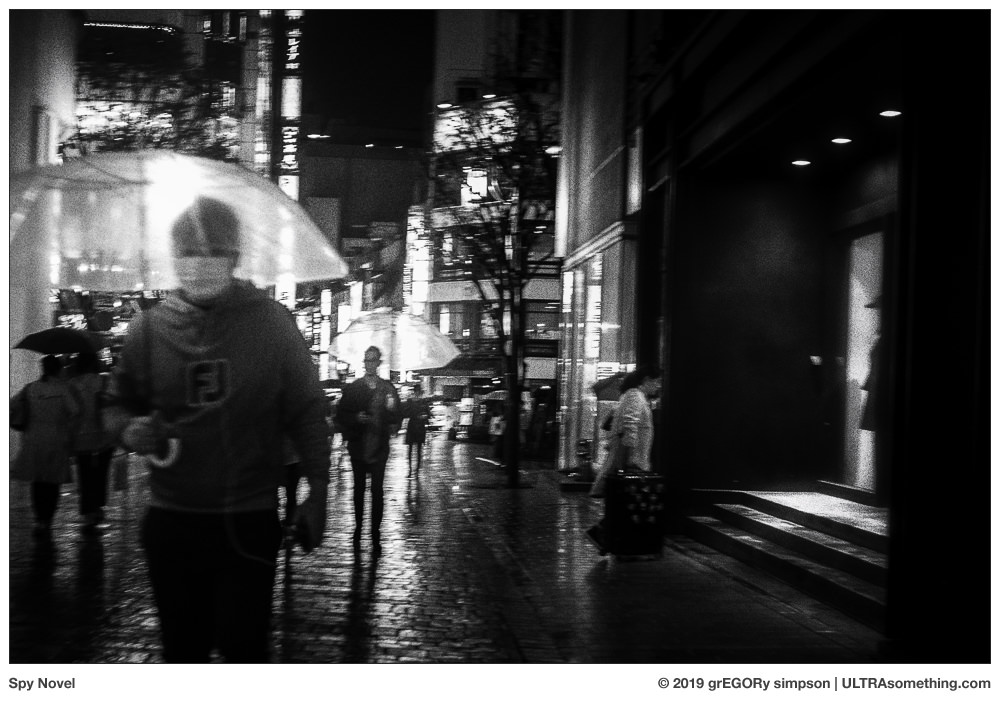
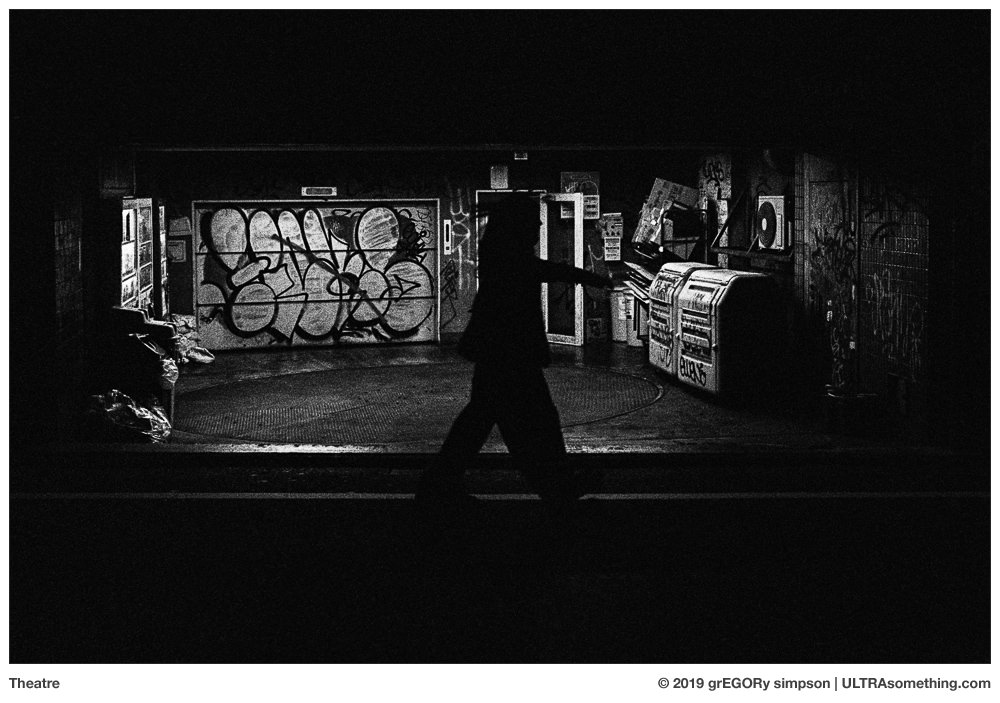
Every couple of years, in what I presume must be an act of preventative penance, I crack open the archives of my photographic past and dive into its pool of rejects.
Perhaps “pool of rejects” is a bit of an understatement, considering my collection of failures is as vast as the Pacific Ocean and as deep as the Mariana Trench. The breadth and depth of rejects is particularly disheartening when considering how few photos I actually take. People on a week-long vacation return home with more photos than exist within my entire 30+ year archive. If this is the yield of a ‘discerning’ photographer, I’d hate to see what would happen if I were ‘cavalier.’
Apparently my penance reserves are running low, because this was one of those “every couple of years” months. After eight straight weeks of life-induced camera neglect, I had no new photos and another looming publication deadline. Since I’m loathe to write an ULTRAsomething essay without media content, and since my life-induced synthesizer neglect has been even more egregious than my camera neglect, I had no choice but to suit up and descend into the watery grave of rejects.
To survive any plunge into the archives and surface with at least a shred of remaining ego requires a very narrow and focussed approach. Diving across too wide an archival expanse produces the psychological equivalent of ‘the bends.’ So for this article, I chose to focus only on photos taken during this same two month period, but exactly one decade ago. Besides possibly salvaging a publishable image or two, I also hoped to answer one of those burning navel-gazing questions of mine: “Am I a better photographer now than I was 10 years ago?”
The answer, it seems, is “no.” Turns out I’ve seen absolutely no measurable growth as a photographer, which is only heartening when contrasted with the realization that I’ve also seen no measurable decline. I like to think this means I’ve established a ‘mature’ style, and not that I’ve stagnated. But then, I am a master of rationalization.
Curiously, my photography isn’t the only thing that hasn’t progressed much in a decade. I could see absolutely no fashion variances between now and 2009. Same hair; same clothes; same bags; same glasses; same everything. In fact, the only visual clue that I was looking at 10 year-old photos was the marked absence of smart phones. Although the iPhone was two years old in the summer of 2009, it (and its ilk) had yet to become the ubiquitous homogenizing device it is today. Which probably explains why my tendency to photograph people has declined in the past decade. Humans absorbed with their phones don’t really motivate my photographic urges.
The one area in which I absolutely expected to see self-improvement was in my curatorial skills. As I’ve said on many occasions, “A monkey could take the same photos I take. My skill is in selecting which ones should be published.” Alas, combing through mid-2009’s archives revealed that I’d pretty much mined everything that was mineable. Which explains why this article is accompanied by such mediocrity.
Ultimately, I managed to survive the archival descent with my ego mostly intact — unnerved only by the realization I could vividly remember taking every single photo. I recalled the circumstances surrounding each image as if I took it a few weeks ago; not a decade ago. I could remember which way I was walking; what camera I was using; how the image presented itself to me; what I chose to eliminate from the scene — everything! Which means I’m now so old that the passage of a decade has become statistically insignificant. But since I’ve already met this year’s quota for mortality-based freak outs, I’m choosing to willfully ignore this one.
Hopefully, I’ll find my way out of camera-neglect next month. Ideally, what I’d really like is to find my way out of synthesizer-neglect. It’s been an awfully long time since I tortured the world with some new music…
For those who like to reminisce about digital cameras from days long passed, I will inform you that “Time Served, “Portrait of an Individualist” and “Scout” were all shot with a Leica M8 and a 28mm f/2 Summicron lens. Meanwhile, “Shoes of Damacles,” “Logjam” and “Flight” were all photographed with the very first micro four-thirds camera — the Panasonic Lumix G1. Since no lens data is embedded in the photos, I’m reasonably certain that all were taken with the Leica 28mm f/2 using a Novaflex M-to-m43 adapter.
REMINDER: If you find these photos enjoyable or the articles beneficial, please consider making a DONATION to this site’s continuing evolution. As you’ve likely realized, ULTRAsomething is not an aggregator site — serious time and effort go into developing the original content contained within these virtual walls.
Allow me to introduce myself. My name is Saga, and I’m a Behavioural Scientist. For the past fifteen years, I’ve been Principal Investigator for a joint Swedish/Canadian study on the genesis of internet influence and its impact on modern society.
Specifically, my colleagues from Stockholm and Vancouver have analyzed and catalogued which personality traits and persuasion tactics result in the greatest social influence, and the extent to which a single individual can guide the thoughts, beliefs, mores and behaviour of an entire community. A significant portion of this study involved designing and developing numerous websites, each “hosted” by a carefully crafted yet totally artificial personality.
It feels strange to be introducing myself to you when, in fact, I’ve been the one writing this site for the past decade. I feel as if I know all of you so well, even if you don’t know me. ULTRAsomething, as you’ve probably now surmised, was one of several hundred sites painstakingly designed to isolate and thus experiment with numerous artificial personas and communication techniques.
In particular, it was one of two blogs designed around the topic of photography. Our goal was to see what type of individual could exert the most significant influence on the world’s photographic vocabulary. Site A (ULTRAsomething) was built around a manufactured personality who believed photography was about the image. Site B (name withheld) introduced a personality whose character believed photography was about the camera. In order to prevent each site’s photographs from exerting any actual influence on public opinion, we decided that both should feature the worst photos possible — that way we could measure the influential impact of the method, and not of the photos themselves.
For ULTRAsomething we chose to create blurry, low fidelity, black and white photos of random nothingness. Since no one on the staff could take photos bad enough to satisfy the dictate, we rescued an adorable Chihuahua/Irish Wolfhound mix from the local pound, strapped a camera to its chest and rigged it to fire off a shot every time the animal stopped to scratch. For Site B, we opted to concentrate on cat photos and HDR. Initially, the cat photos were taken by the daughter of an associate. But when she reached the age of six, she began to develop a sense of visual taste, so duties were transferred to my own two year-old niece. The HDR photos were all taken by my ex-husband, and were the result of a well-orchestrated “false-like” campaign, in which I and other researchers continuously liked, praised, and thus encouraged him to over-sharpen, over-saturate, and over-compress his images to the point of utter ridiculousness.
As anyone with an internet connection has surely seen, Site B’s “photography is about the camera” approach was extremely effective at establishing influence, and is now the primary reason why cat photos and HDR remain the two most commonly praised genres of “fine art” photos on the net. ULTRAsomething’s “photography is about the image” message failed to exert any influence whatsoever, and its grainy little blobs of murkiness are universally despised by the feline favouring patricians of the new camera-centric photographic empire.
With the study now complete, Roscoe (our Chihuahua/Irish Wolfhound mix) has semi-retired from photography, and enjoys life as my faithful and fun-loving companion. He keeps me company since I divorced my husband, who had sadly transformed into an insufferably arrogant bore after believing the robot-generated adulation heaped upon his most retina-tearing photos.
In spite of its lack of influence and miniscule readership, I’ll admit to developing a soft-spot for the ULTRAsomething piece of our experiment. Each month, I found myself looking forward to curating Roscoe’s random snaps, and to moderating the witty comments sent in by readers. While every other site in our study attracted an abundance of negativity, bullying and ignorance, ULTRAsomething’s readers always remained respectful, clever, funny and intelligent.
So I’ve decided to continue publishing ULTRAsomething, even though the study is over and the subterfuge revealed. While divulging the truth may convince some of you to unsubscribe, the behavioural scientist in me knows most of you will continue to believe the ULTRAsomething myth — that it’s written by a middle-aged Canadian guy who’s doomed to a life of serial existential crises, and who wanders around taking photos of metaphors so as to avoid facing any of these crises directly.
If my studies have taught me nothing else, it’s that the internet affords each of us complete control of our own public image. Society believes who we say we are, rather than who we really are. And the fact I’m a Swedish woman with a flea-scratching, camera-toting dog will probably not deter you from believing the lie I’ve propagated this past decade. Which is good for me, and for the future of my new hobby.
So you’ll probably see me next month, pretending once again to be that Egor character. I may, however, need to visit the pound and adopt a new camera dog. After eleven years, I still haven’t figured out how to take pictures as bad as old Roscoe’s.
Old dog; new camera. These pictures were, as always, curated from a collection of photos shot by Roscoe on various walks these past few weeks. The only difference is that I fastened a new Ricoh GRIII on Roscoe’s camera harness. It’s lighter and smaller than most of the cameras Roscoe hauls around — a fact he appreciates in his waning years.
REMINDER: If you find these photos enjoyable or the articles beneficial, please consider making a DONATION to this site’s continuing evolution. As you’ve likely realized, ULTRAsomething is not an aggregator site — serious time and effort go into developing the original content contained within these virtual walls.
After committing decades to scrimping, saving, frugalizing and general indentured servitude, I have looked deep within and determined it’s time to retire and enjoy my remaining life. The only snag comes courtesy of those darn online life-expectancy calculators — all of which suggest my remaining life will extend a dozen years past the demise of my savings.
Which makes me wonder why, six years ago, I bothered to adopt a healthy, active, nutritionally balanced lifestyle. Retirement would be firmly in my grasp if only I’d embraced donut brunches, whisky lunches, and a casual crystal meth habit. Fortunately, in spite of my ill-considered healthy proclivities, I doubt I’ll actually survive those extra 12 years on $0. So I guess that’s the upside — albeit one with its own significant downside.
Still, retirement is an intriguing prospect — but not because I want to spend my days roasting in the sun on some tropical beach; or playing golf; or taking pottery classes; or chasing kids off my lawn. I don’t even want a lawn! Rather, it’s because I need time to work on things that really matter. I’ve got albums to record; electronic music performances to give; maybe I’ll even get around to finishing that opera I started in 1991. There are photo books yet to shoot, curate and publish; exhibitions to plan. Perhaps a tome of antiwisdom, or even a screenplay awaits. Maybe I’ll even direct it. The world is awash with job opportunities just waiting to pay me with a pocketful of smiles and a fistful of legacy. If only goods and service providers didn’t prefer their invoices be paid with nifty plastic Canadian bank notes.
Between the time spent being someone’s employee; the time spent reclaiming my soul after doing so; the bill paying; the inordinate amount of effort needed to rectify other people’s screw ups; the cooking; the cleaning; the sleeping; and all the general health requirements dictated by the life expectancy calculator, I still manage to set aside 14 minutes of “me” time per day. 14 minutes of “me” time per day works out to 7 hours of “me” time per month — which, not coincidentally, is about how long it takes to squeeze out another mediocre ULTRAsomething article (though I often have to forgo a couple nights of sleep in order to finish).
In fact, the only reason ULTRAsomething is still hanging around is it helps scratch my creative itch. Unfortunately, my creative itch is a bad case of poison ivy, peppered in chigger bites, and wrapped in poison oak — while ULTRAsomething is but a teaspoon of expired calamine lotion.
The ticking of time has become a thundering pulse — a relentless reminder that meaningful creations will require more effort than a smattering of minutes can provide. A megafied ULTRAsomething — complete with content that matters and long-term, large-scale projects — that’s my retirement goal.
I’ve long dreamed of finding an employer for whom my skills and passion have value, thus negating the need to ever retire. Or a patron of the arts who actually connects with my idea of what constitutes art. Alas, if I haven’t found them yet, they probably don’t exist. Which means the scrimping, saving, frugalizing and general indentured servitude must continue ad infinitum. I’m not sure exactly how long “infinitum” lasts, but it sounds like an awfully long time. Too long, actually. Anyone know where I can find a really good french cruller and a reliable supply of quality crystal meth?
If this article seems a bit short, there’s a good reason: I burned a significant quantity of my 14 minutes/day (and several additional nights’ sleep) exploring the technological needs of a potential larger-scale electronic music project. Which probably had a whole lot to do with inspiring this essay.
The accompanying photos may or may not have meaning. I’ll let you decide. They were, however, all taken with digital cameras (one on a Ricoh GR; and two on a Ricoh GRIII) ’cause who has the time to develop and scan film?
REMINDER: If you find these photos enjoyable or the articles beneficial, please consider making a DONATION to this site’s continuing evolution. As you’ve likely realized, ULTRAsomething is not an aggregator site — serious time and effort go into developing the original content contained within these virtual walls.
I have recently completed a 24-hour period in which I had the distinct displeasure of shooting with the biggest hunk-o-junk in the history of hunk-o-junkdom.
The hunk in question is the Soviet-era Russian Agat 18K — a half-frame toy camera that, if given to an actual child, would undoubtedly necessitate in a lifetime of psychotherapy.
Like most fiascos, my time with the Agat 18K began with good intentions. Creatively intoxicated by my glorious experience with the Ricoh Auto-Half, the seeds of a new idea began to germinate in the old encephalon. “Why not,” I thought, “build myself a legacy as a ‘half-frame photographer?’” As niches go, it’s reasonably untapped, and I thoroughly enjoy both the half-frame shooting process and its results. Besides, it would be a step up from my current legacy as an ‘irrelevant photographer.’
My first order of business, prior to purchasing any new film camera, is to assuage my guilt over already owning far too many. Deftly deploying the acrobatically inclined synaptic leaps of a world-class rationalizer, I invented a theory that half-frame cameras should only count as half-a-camera in my inventory total. Dodgy justification in place, I guiltlessly began researching which half-frame camera would next aid my newly-anointed legacy.
This time around, I wanted a camera that offered a bit more control than the point-and-shoot models I’d been favouring, yet remained ludicrously inexpensive. This short but simple set of requirements led me straight to the Agat 18K.
Gleaming with the sumptuous glow of my monitor’s LED backlight, the Agat appeared to check all the right boxes. It sported both manual focus and manual exposure. It was cute, which seems to be a design aesthetic shared by all the best half-frame cameras. The internet was chock-a-block with rave Agat 18K reviews, and it even possessed that one special feature I look for in every new film camera — something I call the “discombobulation factor.” The Agat’s d-factor comes courtesy of its vertical orientation, which (if held as designed) results in landscape-oriented photos rather than the portrait aspect of most half-frame cameras. But the most important factor was its price: $25. Canadian. Plus another $6 to ship it from Belarus.
I could see no possible scenario in which the Agat 18K wouldn’t yield at least $31 worth of fun — even if it completely and totally sucked.
I was wrong.
The camera found its way from Belarus to Vancouver far quicker than expected. I’ve placed expedited Fed Ex deliveries within Canada that took longer to arrive. Combining hindsight with cynicism, I suspect the seller was highly motivated to unload it as quickly as possible — lest I change my mind. I extracted the tiny camera from the center of a 10 meter spool of bubble wrap, and examined it carefully. Cosmetically, it looked about as fine as a 31 year old plastic toy camera can look.
Glancing at Vancouver’s weather forecast and seeing a queue of unseasonably warm and sunny days ahead, I grabbed a roll of expired Kentmere 100 from the back of the freezer, and began to load the camera.
Here’s where the story darkens.
My first attempts to advance the film proved futile — the advance knob would turn, but the film would not wind. Consulting the owner’s manual, I was faced with the realization that I couldn’t read Russian. So I turned to the internet instead, where I learned that the Agat’s advance knob has a little button in the middle. When it points to a red dot, the button pops up and the camera is in rewind mode. When it points to the white dot, the film can advance. My button was clearly pointing at the red dot, but it was not raised. I tried to spin the button around to the white dot — it wouldn’t budge. I tried to gently coerce the button into popping up. It remained firmly seated.
This was the first of several hundred times that I would attempt to fix an issue by slamming the camera against a hard surface — and unlike many of the subsequent slams, this one worked. The button popped up.
Alas, that had no effect on the camera’s function, since the film still wouldn’t advance unless the button pointed toward the white dot. Noticing that the button was knurled, I pulled out a screwdriver, nestled the blade up against one of the knurled ridges and, with brute force, slowly worked the button around to the white dot.
Thus positioned, I turned the advance knob, only to watch it spin freely around the inner button causing it to point, once again, to the red dot. I repeated the brute force and screwdriver method several more times until, eventually, I could advance the film by pressing my thumb hard against the inner button while slowly and carefully rotating the knob — a technique that required about 15 seconds of fiddling between photos. Since this is a half-frame camera, that meant at least 72 fiddles per roll, which was not a viable long term solution. So I decided, upon completing this test roll, that I would super-glue the rewind button to the advance knob, allowing me to effortlessly advance the film — even though it meant I’d forever need to open the camera in a changing bag.
Exposure is set via pictograph, thus ensuring that the camera’s intended market — children in the 1980’s — would never learn the basic practice of manual exposure setting. Which worked out perfectly, given the eventual domination of smart phone cameras.
The pictographs control both the aperture and shutter speed. When the aperture gets wider, the shutter gets slower. A little table in that Russian language manual spells out the relationship precisely. What’s humorous is the documented specificity of these values: At f/2.8, the shutter speed is listed as 1/130; at f/4 it’s 1/169; at f/8 it’s 1/262. Personally, I find it rather difficult to accept that a plastic toy camera that’s unable to make a pop-up button pop-up is capable of microsecond shutter accuracy. But the Agat’s optimism did provide me with at least $1 or $2 worth of entertainment, so I was well on my way toward recouping my $31.
The Agat’s manual focussing feature is a bit more traditionally “manual” than its exposure setting, though not without issues. Focus is set by rotating a small ring around the front of the lens. The ring turns effortlessly — too effortlessly. So loose is this ring, that a gentle breeze is all the force required to rotate it out of position and, thus, out of focus — the sort of gentle breeze that can be generated by as benign an action as simply walking with the camera.
Furthermore, the camera’s discombobulation factor — its vertical design orientation — proved more discombobulating that I’d imagined. Operating it as designed requires jutting your elbows all akimbo, whilst attempting to pinch the top and bottom of the long-edge of the camera with one hand while your other hand is asked to plunge a button — located on the front face of the camera — directly toward your face. After a bit of experimenting, I discovered that holding the camera upside down felt slightly more ergonomic, though it was then impossible to read the exposure values or check the latest status of the focus ring.
Still, with all these quirks, I was encouraged, engaged, and excited to begin shooting. And for two or three shots (save for the hassle of advancing the film), I was almost happy.
On the fourth shot, I pressed the shutter button and nothing happened — a seemingly innocuous event that marks the precise moment at which I began my descent into madness.
My experience with the Agat 18K’s shutter release and transport mechanism has revealed an inadequacy in the English language. Specifically, there is no word in the dictionary that means “really, insanely, super frustratingly, annoyingly flawed.” So I’m taking the opportunity to coin the term risfaf. Feel free to add it to your daily lexicon.
That first shutter failure was, in and of itself, not overly alarming. These things sometimes happen with old film cameras, and are somewhat expected on those with dubious lineage. So I simply tried pressing the shutter again… and again… and again. Sensing a pattern, I altered my pressing technique. I came at the button from the top, the bottom, the left, and then the right. Click! On the eighth press, with the button pressed at a 45 degree angle, I finally took a photo. I jammed my thumb against the knurled button on the bottom of the camera, gingerly advanced to the next frame, awkwardly placed the camera to my eye and pressed the shutter button. Once again, the camera failed to take a shot.
Convinced I’d learned the secret method with the previous frame, I immediately tried releasing the shutter using the same 45 degree press from the right. Nothing. I tried again. Nothing. After 10 or more presses from various angles, the shutter released.
With each frame came greater agitation. Twenty, and sometimes thirty presses were required to release the shutter. Sometimes it would release with a flick of the finger to the side of the button. Sometimes it would release if I rotated the button while plunging it. Only two things were certain: first, it would never release on the first several tries; and second, it would never release the same way twice.
By around the tenth shot, I was painfully aware of the sideways glances I was getting on Vancouver’s seawall. Apparently, it’s considered a form of aberrant behaviour to stand in one spot for 4 or 5 minutes, while repeatedly pushing a button on a black and yellow plastic toy camera.
My behaviour grew demonstrably more aberrant once I’d finally exhausted every possible way to push the button, and began whacking the camera against the palm of my hand. This worked for a little while, until such time that it needed firmer contact with my fist and then, eventually, the side of a building or a steel railing.
Equally annoying was that, when I did manage to finally release the shutter, the film advance knob would often freeze, requiring spectacularly barbaric whacks against the cement sidewalk before it would again allow the film to advance.
After spending nearly two hours to take a mere 20 photos of absolutely nothing worthwhile, I was overcome by a powerful desire to throw the camera in the trash. But I am neither a rash nor emotional person so, instead, I brought the camera back to the condo, sat it on the kitchen counter, and decided I’d deal with the issue the following day. Besides, after seeing how badly this camera handles, it would be a real shame if I didn’t also get to see whether its image quality was equally atrocious. I had to find a way to finish that roll.
The next day, possessed with renewed (though thoroughly unjustified) optimism, I stared at the little Agat all throughout breakfast. I knew it would haunt me until I picked it up again, so I thrust a jeweller’s loupe in my eye socket, and began to carefully inspect the camera for a solution. And sure enough, I found one!
It turns out that cheap little yellow plastic shutter release button is threaded! A whole new way to try to release the shutter! I dug through a drawer, pulled out an old school remote mechanical shutter release, and screwed it into the button. I plunged the trigger on the shutter release, and the cheesy little Agat made a decisively positive click. I shoved the camera and the remote shutter release into my pocket and took off for Canada Place.
I spent several wonderful seconds aligning pictographs, framing shots, and shielding the persnickety focus ring from the gentle, spring-like breeze — holding the camera in one hand while releasing the shutter with the cable release clutched in the other.
Buoyed by the belief that the Agat 18k had not beaten me, I proceeded to run off a string of two straight shots until, on the 3rd, the film jammed. Fortunately, one whack on the rail and all was well for another two shots — until the shutter again failed to fire. After dozens of tries with the mechanical release, I unscrewed it, and returned to the previous day’s technique of pushing the button from every possible angle, until I again resorted to smacking it against a rail for several minutes until it finally released.
Once more I pressed my thumb against the rewind button and began to slowly rotate the advance knob — until it seized up half-way to the next frame.
At this point, no amount of pushing, plunging, whacking or smashing would free the camera. It was well-and-truly frozen. I shoved the camera into my pocket and headed home.
Back in the condo, using an assortment of hammers, screwdrivers and pliers, I managed to free the transport and advance the film one more time — at which point it froze again.
With over a half-roll of film remaining, I’d had enough. I plunged the camera into the dark bag, extracted the film into my stainless tank, and dunked it in some Rodinal. It was time to see the fruits of my labours.
As bad as the camera functions, I was actually rather surprised by the image quality. It wasn’t half-bad.
Of course, “half-bad” didn’t include the numerous frames that exhibited visible light leaks, nor those in which the light leaks threatened to take over the image, nor even those times when the light leak was so egregious that it obscured the entire frame. Nor does it include all those times when the focus ring spun itself out of focus, nor those other frames when I accidentally took a selfie because the shutter released while I was smacking the camera against a firm surface…
OK. So I rarely managed to get an issue-free shot with the Agat 18K. But when it happened, it was surprisingly good — providing you don’t mind excessive barrel distortion, really soft corners, or… oh, never mind.
Granted, there’s a certain serendipitous charm to the images. But since a similar effect could easily be achieved by closing my eyes and twirling around in a circle until dizzy, I’m not sure it’s worth the frustration.
Needless to say, this is not a camera you’ll turn to when your photos require split second timing. Nor is it a camera you’ll turn to should it be absolutely essential that you take a photo some time that day. And it’s most certainly not a camera you’ll choose to use if, like me, you believe every moment of life is precious. Which is why it’s highly unlikely I will ever spool another roll of film into this thing.
What’s truly surprising is that this model — the Agat 18K — is an improved version of the older, earlier Agat 18. Since the “K” obviously stands for “Krap,” I can’t even imagine what the K-less model would have been like.
Granted, this is a 31 year old Soviet-era plastic toy camera… so one’s expectations must be sufficiently subterranean. And I’ll readily admit, given the plethora of rave reviews this camera gets on the internet, my particular model may have some accelerated degradation issues. I would be fine if the Agat’s shutter were to release oh, say, every second or third time I pressed it. And if it only locked up once or twice a roll, I’d be able to live with that. It would definitely be nice if the frame advance actually advanced the film and, when it did, wouldn’t shred the sprocket holes. I could even live with the light leaks and the free spinning focus dial. But this camera is a long way from being that camera. Quite simply, this camera is risfaf.
All photos (except for the camera itself) came from the 1/2 roll of Kentmere 100 film, which was willed through the camera, more so than wound.
All photos are untitled because they are simply unworthy of being dignified. They are, essentially, all test shots. And, as such, many aren’t even really “my” test shots, but a collaboration between myself and a malfunctioning camera. None of the photos are as intended. They are, instead, what transpired.
REMINDER: If you find these photos enjoyable or the articles beneficial, please consider making a DONATION to this site’s continuing evolution. As you’ve likely realized, ULTRAsomething is not an aggregator site — serious time and effort go into developing the original content contained within these virtual walls.
What is a camera’s purpose? Is it to record what we see? Or is it to record what we don’t see? Is it meant to reflect reality or to abstract it?
Most people who point a camera toward a subject expect a realistic representational photo. And while we often believe the results to be representational, rarely are they a representation of what we, as humans, experienced. Our biology simply cannot resolve as much detail as today’s digital sensors. Nor can our gummy little orbs see as wide, as far, or as deep as lens choices permit. Firmware enables us to further fine-tune that rendering to peer into shadows, extract detail from highlights and, in general, enhance an image in whatever way pleases us. Today’s cameras do not record reality — they record hyperreality.
That’s not to imply yesterday’s film cameras were any more reality-focussed than today’s digital cameras — they just skewed more toward the surreal side of the reality spectrum.
I’ve never had much interest in hyperreality — it’s a concept somewhat at odds with my predilection for dream logic, metaphor, and my notion that photographs should be poetry: an implied art form, rather than an explicit one.
Every time I release the shutter, my goal is to create an abstraction of reality. And since every camera, lens, and software choice abstracts reality in a different way, I have come to think of cameras more like paint brushes than image recorders.
Every brush has its signature. Every pen; every pencil; every bit of chalk, charcoal or crayon has a similar purpose, but produces a radically different result. The way you hold it; the ergonomics of using it; its limitations and quirks — all affect your approach to image creation, and thus, the image itself.
In the past decade, half-frame cameras have become one of my preferred drawing implements. More akin to the coarseness of a lump of charcoal than the nuanced control of a sable hair brush, half-frame cameras record an impression rather than a description. They are ‘sketch cameras.’
During my 2015 visit to Tokyo, I stumbled upon a cabinet full of Ricoh Auto-Halfs in an underground consignment shop. In many ways, the Auto-Half is the quirkier, cuter cousin to my Olympus Pen EE. It features a lens that’s slightly wider (25mm vs 28mm) and slightly faster (f/2.8 vs. f/3.5), yet the camera somehow manages to be about 20% smaller. But what really captivated my imagination was a big knob on the bottom, marked “W.”
Pretty much every mechanical film camera has a rewind knob, but the Ricoh Auto-Half has two knobs — one a rewind knob (“R”) and one a wind knob (“W”). Yes, this is a wind-up camera.
In case you’re wondering why anyone would want to wind-up a camera, think “poor man’s motor drive.” Wind-up the Ricoh, take a shot, and a spring automatically advances the film to the next frame. Crank that knob enough times, and your film will auto-advance for the next twenty or more shots.
There, beneath the streets of Shinjuku, I fell in love with the Ricoh Auto-Half in that wholly unnatural, embarrassingly lustful way in which grown men sometimes develop an irrational infatuation with gadgets. I absolutely had to have one.
Ricoh, as best I can tell, made several trillion of these back in the 1960’s. And while everyone in Japan must have a half-dozen buried in a drawer, they never seemed to catch on in North America. So I knew, if I was ever going to score a good one, I’d have to do it in Japan.
Alas, after spending over an hour digging through that pile of Auto-Halfs, neither myself nor the shopkeeper could locate a single working version. Several days later, I did find a rather expensive, collectible, gold-plated model in a much classier shop. But I just couldn’t see myself walking around Vancouver with that thing blinging up and down the sidewalks, so I left Tokyo without buying a Ricoh Auto-Half.
On my return to Tokyo in 2018, one of my very first visits was to that same underground camera shop. As I’d hoped, its cabinets were bulging with a ‘fresh’ new pile of Auto-Halfs. I rolled up my sleeves, fired up Google Translate, and used it to coerce the shopkeeper into rolling up his. The dig was on.
Fifteen minutes later, we had found not one, but two mechanically functioning cameras. One was dashingly adorned with a checkered flag pattern and some little race car graphics; the other was plain ol’ silver. Possessing, as I do, a rather minimalist design sensibility, the choice was an easy one. I handed over a few yen, popped in some film, wound up the camera and hit the street with my little silver Ricoh.
One thing I couldn’t test in the shop was the selenium cell meter. Because they gradually deteriorate with age (and particularly with exposure to light), I immediately rejected any camera without an attached lens and photocell cover. While the cover’s presence doesn’t guarantee that the previous owner had actually used it, its absence guarantees they didn’t. So my first order of business was to buy one of those ubiquitous rolls of inexpensive Fuji color negative film that seem to be all over Tokyo, shoot some tests, then get prints made at one of the equally ubiquitous photo labs. To my delight, the meter worked flawlessly.
Had it not worked, I could have theoretically resorted to the camera’s manual exposure mode. But without access to a portable electron microscope, I’d never be able to resolve the tiny aperture legend on the top dial. Even after I got the camera home, and with a jewellers’ loupe stuck to my eye, I still couldn’t read the tiny text. Suffice to say, unless your vision really is as hyperreal as a digital camera, the manual exposure setting on this camera is utterly useless. So too is the fixed and rather languid 1/30s shutter speed when it’s engaged. Auto exposure uses a snappier 1/125s shutter speed.
Also barely visible, is the frame counter on the bottom of the camera. Happily, it’s bigger than the aperture text, so anyone choosing to shoot this camera in public can always introduce themselves to the nearest teenager, and politely ask them to read the counter.
Framelines in the viewfinder are suggestive at best, and barrel distortion is quite pronounced. The shutter (located on the front of the camera) is silent, but the auto-wind is not. Fortunately, the camera takes a photo when you press down on the shutter release, but doesn’t advance until you release it. I quickly learned to grab a shot, keep the shutter release held down, then walk away to advance the film.
With its fixed focus lens, The Ricoh has a minimum focus distance of 1.5m (5 feet). Anything closer will be rendered in glorious washes of fuzz. Suffice to say, this is not a camera you’ll gravitate toward for portrait work — unless you’re the sort of contrarian who likes sharp backgrounds and bokeh people. Not that backgrounds (or anything else) in this camera are particularly sharp.
What might sound like a whole lot of belly aching is actually me professing my love for the Ricoh Auto-Half. This is the most fun I’ve had shooting a camera since the Widelux first graced my shelves. The half frame format satisfies my low-fidelity leanings and dovetails seamlessly with my frugality. Routinely yielding 77 frames per roll, the Auto-Half frees me to experiment; to take an extra shot or two of a single subject; to risk a shot in spite of improbable odds; and to dabble in a bit of grainy impressionism.
Sketching with film completely alters the way I see, and it redefines what I think makes a photograph. The results are sometimes mysterious, occasionally moody, often fleeting, frequently grungy, and always every bit as hazy as memory itself.
This post features the return of the vBook — that exorbitant consumer of precious time, which I continue to believe is the optimum way to share online photo collections… even if I’m the only one who thinks this. But since the Ricoh Auto-Half is a “sketch camera,” and since sketches sit most comfortably in a sketch book, the vBook seemed the only viable way to effectively convey this camera’s true purpose.
Because the Ricoh has been my constant companion for the past three months, it’s seen many rolls of film pass through it, including Tri-X pulled to ISO 200, Delta 100 pulled to ISO 50, and Delta 100 shot at box speed (all developed in Rodinal 1:50), plus some Fuji Superia 200, shot at box speed and developed in a commercial lab. All make an appearance in the “Diptych Roulette” vBook and in the two additional photos accompanying this post.
The music is the result of a frantic afternoon compose-a-thon, featuring improvised sound design and 1-take performances on numerous synthesizers, including the Novation Peak, DSI/Oberheim OB-6, an obsessively extensive eurorack modular setup, and a sprinkling of software-based instruments.
REMINDER: If you find these photos enjoyable or the articles beneficial, please consider making a DONATIONto this site’s continuing evolution. As you’ve likely realized, ULTRAsomething is not an aggregator site — serious time and effort go into developing the original content contained within these virtual walls.
I’d rather be good than popular. Ideally, I’d like to be both, but this is the real world I’m living in.
It doesn’t matter whether it’s my photography, my music, or my writing efforts — being “good” is the only motivation I require. The upside is that I, and I alone, get to define what “good” means. The down side is that I’m a mercilessly harsh critic — but that’s exactly how one gets to be gooder.
I’m not sure whether my passion to improve is what drives my existential obsessions, or whether it’s driven by them. But every now and then, I find myself mired in an exploration of the flip side of existence — non-existence. Don’t be alarmed; I’ve been thinking about my demise rather frequently for at least 40 years. I find a dash of nihilism really helps me cope with the rest of my day.
It also helps me see things in a different light. In this case, mixing thoughts of non-existence with thoughts of self improvement has revealed a flaw in my decision to trade away popularity for self-gooderization — specifically, its impact on my future Celebration of Life memorial service.
By eschewing popularity, I’ve guaranteed myself an embarrassingly sparse ceremony. Even worse, if I put in the effort needed to get truly good, I might fail to establish the quorum of friends necessary to have such a celebration at all.
So with this in mind, I started to wonder what my Celebration of Life might actually look like? Aside from its glaring lack of attendance, that is.
One obstacle to a successful service became immediately apparent — a significant paucity of photos of me beyond the age of 16. Teenage dorkiness doesn’t motivate one’s parents to snap off many shots. And I’m pretty certain, as an adult, no one ever looked at me and thought, “Gee, I’d sure like to have a photograph to remind me of this guy.”
Anyone who walks past my service’s open doorway, peers into the empty banquet room, and catches site of my “life in pictures” presentation will surely wonder, “What tragedy robbed such a young man of a life just beginning?” Undoubtedly confused by my seemingly anachronistic 1970’s fashion choices, I can imagine them shaking their heads in pity and saying, “Poor child must not have been right in the head. He’s in a better place now.”
Horrified by the realization that I would continue to be as misunderstood in death as I was in life, I decided I would need to either start taking selfies or hire a personal photographer. But the thought of resorting to selfies was at odds with my whole goodification process, while the very idea of having someone follow me around taking pictures seemed just a tiny bit narcissistic — even for me. Besides, such drastic action would only be for the benefit of passers by — it would have no effect on convincing anyone to actually attend my memorial.
Perhaps the bulk of the people who appreciate me enough to celebrate my death are the folks who don’t actually know me — like the people who read this blog. So I’m considering making my future Celebration of Life an online celebration. The benefits are numerous. It wouldn’t upset anyone’s busy schedule or interfere with their weekend plans. No man would need to don a suit, nor woman an elegant but simple dress. People could attend my Celebration of Life any time they wished, adorned only in their underwear and chowing down on a bowl of Fruit Loops — exactly as they greet the arrival of each new ULTRAsomething article. Plus, there will be photos-a-go-go. Sure, they won’t be photos of me, but they’ll be photos by me, which is what we’re ultimately celebrating here.
But how will the internet know I’m dead? And how will you know it’s time to celebrate that fact? Technology probably holds the key: Perhaps some sort of app that hooks into the heart rate monitor in my smart watch can detect when heart failure occurs, thus auto-generating a pre-written obituary and triggering de-encryption of my Celebration of Life web page, which I was clever enough to create and upload while still alive. Of course, this means I’ll need to start wearing a watch, but such is the sacrifice I must make for choosing good over popular.
My fear is that I might do something to trigger a “false positive.” What if it’s a hot day, and I decide not to wear my smart watch? I’m fairly certain it won’t detect my pulse from the charging tray on my night stand. The last thing I want is to have everyone start celebrating my death, only to have the party interrupted by an embarrassing tweet that says, “Oops. Smart watch snafu. Still alive. Sorry.” If that were to happen, no one’s ever going to celebrate my real death.
I don’t know. Obviously I’ve still got quite a few issues to work through, so I guess I should plan to stick around a bit longer. Besides, I’m nowhere near good enough to die yet.
For those who enjoy metaphors, this selection of photos is blatantly obvious. Probably just as obvious as identifying which photo(s) were shot with a Ricoh GR; an Olympus OM-D E-M1 w/17mm f1.2 lens; or a Minolta TC-1 on Tri-X would be for a camera nerd.
REMINDER: If you find these photos enjoyable or the articles beneficial, please consider making a DONATION to this site’s continuing evolution. As you’ve likely realized, ULTRAsomething is not an aggregator site — serious time and effort go into developing the original content contained within these virtual walls.
Photography is the art of subtraction. Unlike painters, who begin with a blank canvas and build images stroke-by-stroke, photographers select their images from a sphere of visual information — a sphere centred around the photographer, and which follows their every movement through space and time. But since 4-dimensional objects don’t adhere to the impositions of a standard IKEA picture frame, substantive eliminations are needed to extract optically manageable wafers from within.
The first thing most photographers flush is the time dimension — extracting individual slices from its ever-advancing trajectory. Using a shutter speed of only 1/60s, a photographer has 3,600 potentially different time slices available every minute — 5.2 million options per day.
Having selected the most significant centisecond, photographers must next decide both how large a bite to take out of that big, bulbous visual sphere, and where exactly to take that bite. For example, a 50mm lens on a full-frame 35mm camera takes a bite that’s 39.6 degrees wide by 27 degrees tall. When you point that lens in one direction, you immediately exclude 99.2% of the area surrounding you. Since your 50mm lens is at the centre of a 360 degree sphere, this means you actually have a choice of 121 different views every 1/60s — none of which will contain a single duplicate element. That increases your number of unique daily photo possibilities to 630 million.
Within each of these 630 million options, photographers must then decide how best to flatten their wedge’s depth dimension, and render it onto a 2-dimensional plane. Focus is the most common means of achieving this, so for the sake of simplicity, let’s say that each bite-sized wedge offers only four different focus options: close-up; near; mid; and infinite. That quadruples the total number of photographic possibilities to over 2.5 billion per day. Which is precisely why I tend to roll my eyes every time someone tells me there’s nothing to photograph.
Now if you’re the least bit normal, 2.5 billion daily potential photographs might seem like a reasonable enough number. But if you’re like me, then you know there are billions more options available if you just keep on eliminating things.
For example, I long ago chose to eliminate color from my work — further distilling the number of elements contained within my own four-dimensional space.
So, too, have I jettisoned the need for fidelity or the notion that a photograph needs to render anything more substantial than a vague suggestion. Half-frame film cameras; grossly over- or under-exposed shots; long-shutter speeds; aggressive development and extreme cropping — these are all ways to eliminate any bourgeois ideas of what constitutes ‘quality.’ Eliminating detail through blown highlights or blocked shadows further refines an image through subtraction.
Any why must the subject of a photo define an object? Can’t we eliminate that old trope and simply photograph a mood?
Similarly, once you eliminate the idea that photography must provide an answer, you allow it to become the question.
Even after all this — after all the elimination, removals and deductions required to even take a photo — there comes further distillation through the process of photo selection and curation.
Photography requires absolutely no skill beyond the ability to choose. Photography is abstraction through subtraction. The more you subtract, the more your photo is likely to say something. Paradoxically — and this is the hardest thing for most photographers to accept — the more your photos have something to say, the fewer people will hear. Should this matter, you can always resort to using one of those nifty little Ricoh Theta spherical video cameras. Me? I’m still working out how best to eliminate both light and shadow.
Those of a certain age may recognize this post is named after what I consider to be one of Bow Wow Wow’s lesser songs. Having given exactly zero thought to this song in over 35 years, it would be easy to dismiss this as a coincidence. But if you’re one of those people who believes there’s no such thing as coincidence, then perhaps my id was subconsciously aware this may well be one of my lesser articles, and leapt across the decades to make the connection.
All photos in this article are from November’s two week Tokyo walkathon/shootathon, and were shot with either my trusty Ricoh GR; an Olympus OM-D EM1 with a 17mm f/1.2 Pro lens; a Leitz Minolta CL with a 40mm f/2 Rokkor lens; or a half-frame, point-and-shoot Ricoh Auto Half. I’ll leave it to you to guess which photos came from which camera. Ideally, if I do my job correctly, it shouldn’t matter one bit.
REMINDER: If you find these photos enjoyable or the articles beneficial, please consider making a DONATION to this site’s continuing evolution. As you’ve likely realized, ULTRAsomething is not an aggregator site — serious time and effort go into developing the original content contained within these virtual walls.
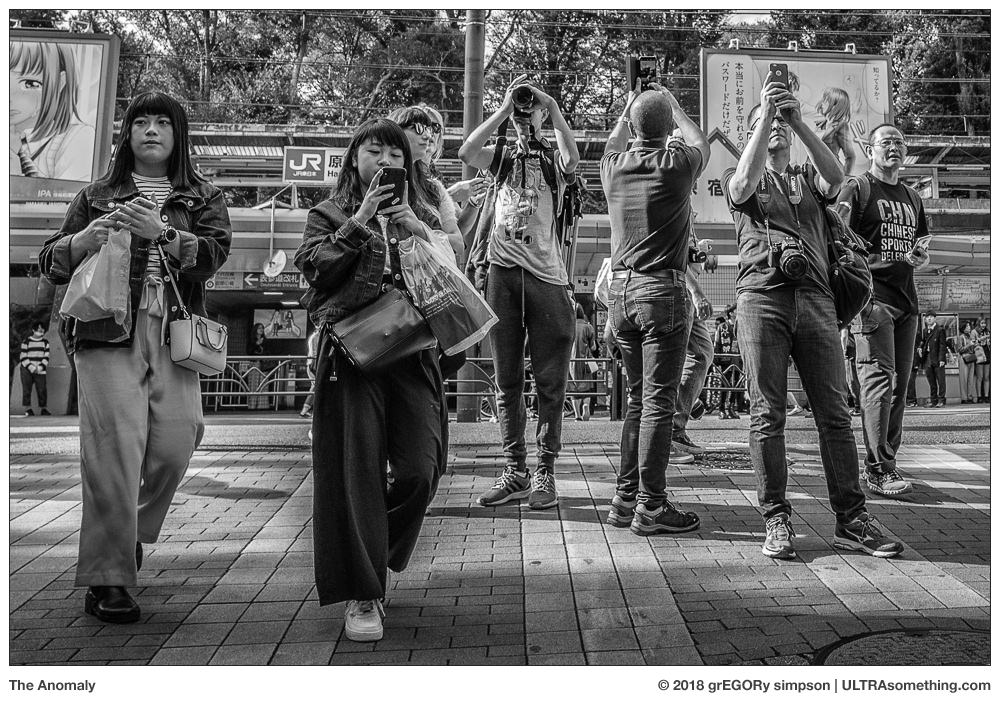
Statistics show that 99% of all new blogs die within their first year. On 14 Dec 2008, ULTRAsomething became one of those new blogs. And today, 14 Dec 2018, it turned ten years old — making it a genuine blogging anomaly.
Perhaps even more anomalous is the fact ULTRAsomething’s ongoing existence came not from beating those odds, but from defying them.
Consider those same statistics, which suggest that a failure to attract a significant number of readers is the main reason that bloggers stop blogging. But ULTRAsomething’s still around — and not only has it never risen above a statistically insignificant audience size, but the site’s current per-article engagement rate is just 10% of what it was several years ago. So I have not only failed to increase my readership, but I’ve actually seen it diminish by an order of magnitude.
Which is perhaps an indication that ULTRAsomething is not an anomaly because of its success, but because of some untreated mental illness.
Most researchers conclude that the single biggest impediment to having a successful blog is simply that the author never defined its purpose. But in the last ten years, I have defined several. ULTRAsomething began with the purpose of giving additional online validity to my flagging commercial photography endeavours. Instead of increasing my client base, I learned that I no longer wanted to be a commercial photographer.
With a decent aggregate of articles under my belt, I shifted the site’s purpose away from obtaining gainful employment through photography to obtaining gainful employment through writing. Surely, I thought, someone somewhere would discover ULTRAsomething and offer me a paid writing gig. Nope.
So the site’s purpose morphed again. Instead of using it to attract an employer, it would become the employer. I placed less emphasis on attracting thoughtful readers and more emphasis on attracting all readers. A large reader base would surely entice various photography companies to sponsor ULTRAsomething, thus making it a source of badly needed income. Instead, I learned that attracting enough readers meant I would need to produce content condoning all the things I abhor about photography. I wasn’t willing to do that, and no companies — no matter how niche — were niche enough to sponsor the likes of ULTRAsomething.
So I pushed the repurpose button once more — making the site take on a supporting role in a more noble and grander goal. I wanted, more than anything, to establish and open the Vancouver Centre for Photography — a gallery, library, bookstore, and educational facility in which the public could discover the sort of love for photography that I have. Where good photography is not seen as a sharply rendered copy of an object in time and space, but as a means of expression; as a language; and as an art form. Instead of achieving this, I learned how frustrating it is to have a dream that no other living soul shared, nor even saw a need for.
Which ultimately led me to the site’s current goal, which is simply to have no goal. And yet, propelled by such willful and supposedly devastating lack of purpose, ULTRAsomething has managed to turn ten years old.
What happens next? I haven’t a clue. And I like it that way. I still want to open the Vancouver Centre for Photography… only it’s a dream now being funded through the purchase of lottery tickets rather than subtle, blog-based persuasion. And those so-called experts? The ones who claim that a blog must have a purpose if it’s to survive? I counter that argument with this month’s text and photos.
So thanks for reading! Thanks for the witty comments! Thanks for the donations! And thanks for all the times you let me know this site brings you a modicum of enjoyment.
Now if you’ll excuse me, I’ve got a rash of Tokyo photos to sift through…
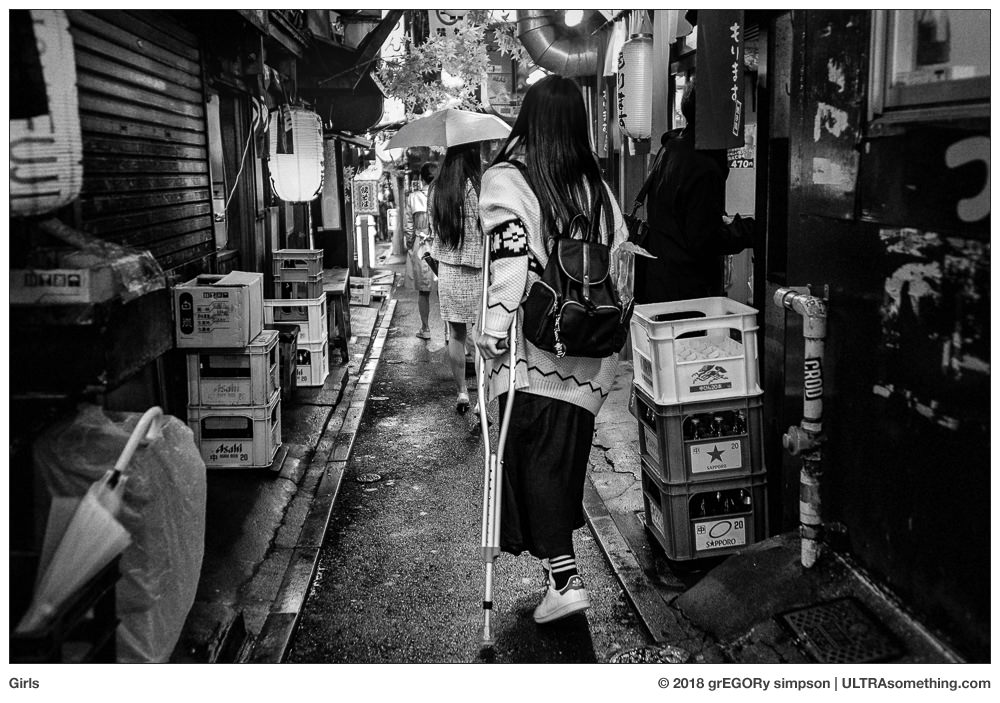
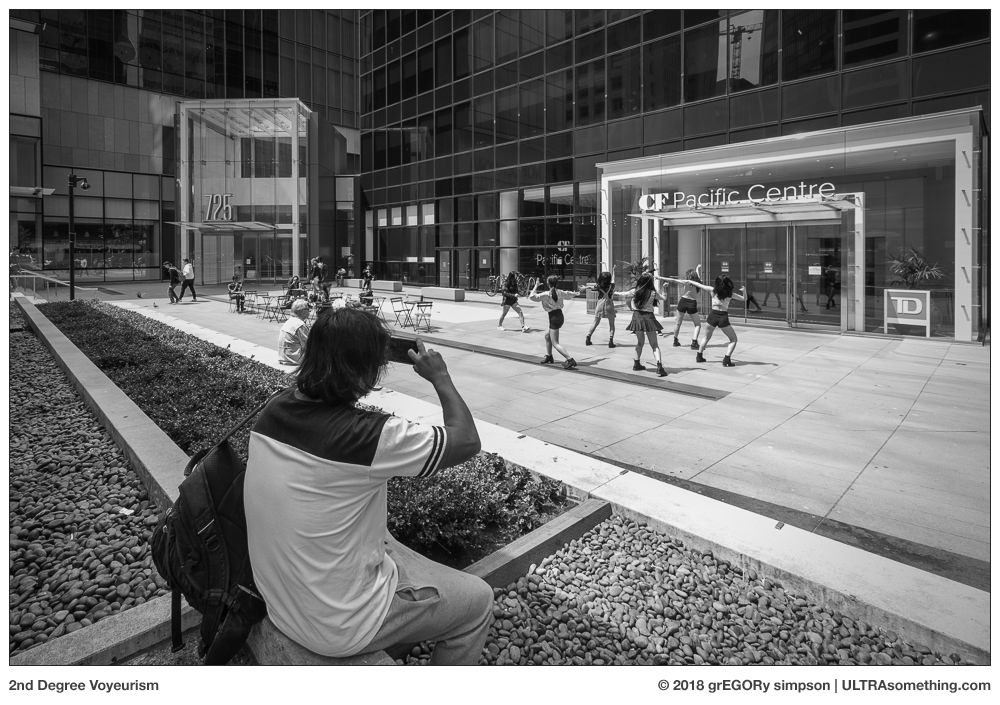
The previous two photos are metaphorically literate (is that possible?) examples of anomalies. But I figured, as long as I’m writing a post called “The Anomaly,” maybe I should include some genuine photographic anomalies — color photos!
It’s probably been seven or eight years since I posted a color photo on this site. People frequently question why this is — often assuming I’m trying to make some sort of statement, or attempting to artificially imbue my photos with a sort of gravitas. Nothing could be further from the truth. The reason I shoot almost exclusively black & white is that I’m absolutely horrible at color photography. Because my photos are rarely about the object in the frame and more often meant to convey a mood or suggest a metaphor, color often detracts from what I want a photo to say. The eye is drawn to luminosity, contrast and saturated colors. In the field, my brain works just quickly enough to find a way to encapsulate a scene’s luminosity and its contrast. By eliminating color, I eliminate the need to worry about how colors will attract or repel a viewer’s eye — and whether those colors will enhance or detract from the message. So my freezer contains only B&W negative film, my primary digital camera is a Leica Monochrom, and when I do shoot with a color digital camera, I have Lightroom automatically convert those images to B&W on import so that I never even see the images in color.
There is only one exception to this rule — one anomaly. Occasionally… VERY occasionally… I’ll take a photo that’s actually about the color. Because Tokyo is such a wonderfully colorful city, I found myself purposely shooting ‘in color’ on several occasions. So what the heck, why not post a few of these in the footnote? It’s not like this site has a purpose or anything…
REMINDER: If you find these photos enjoyable or the articles beneficial, please consider making a DONATION to this site’s continuing evolution. As you’ve likely realized, ULTRAsomething is not an aggregator site — serious time and effort go into developing the original content contained within these virtual walls.
I used to read magazines. Yes, it’s true — I’m that old. And several years ago, whilst perusing one of those publications, I happened upon an article documenting its author’s trip to exotic, far away Vancouver — my home. Buried within the usual assortment of tourist shots and factoids about totem poles and steam clocks, sat a photo of an alley just one block from where I live. Accompanying that photo was some rather self-congratulatory pronouncement about how the author, because he was such an adventurous sort, had ‘discovered’ this unknown alley. Discovered it? I walk past it every single day on my way to the market. So do about 100,000 other people.
I immediately crossed “travelogue” off my list of books to one day write. The idea suddenly seemed absurd: a photographer travels to some distant land and writes about the customs and culture as if no one on earth had ever before experienced them — oblivious to the fact there are millions of people living, working, loving and playing right in the very place they’re portraying as ‘exotic.’ Never mind that we have this little thing called “the internet,” with which we can instantly gaze upon several hundred million photos of every “out of the way” tourist spot on the planet or fire up Google Street View and wander any alley we wish. Cultural differences? This is rapidly becoming one world — connected through Facebook, Instagram, Twitter and instant messaging. It’s not like the western hemisphere hasn’t a clue what those crazy people in the eastern hemisphere are wearing. More often than not, we’re now all wearing the same thing. Travelogues struck me as the textbook definition of ethnocentrism.
Of course, none of this means I don’t enjoy going places. Nor does it mean I’m not excited to see or experience things that I, personally, don’t get to see or experience on a daily basis. But that doesn’t mean millions of others don’t. Or haven’t. And since ULTRAsomething’s audience is a global audience, it would be rather silly of me to wax poetic about my travels.
So then what’s up with that live travel blog at the top of this article? The one that looks a whole lot like poetic waxing? Doesn’t its existence negate the very thing I seek to avoid?
I would postulate not. And the reason for this is because it’s in no way ethnocentric — it’s egorcentric — and you’re welcome to read it and see. In fact, I welcome you to check in and read it every day or two — because unlike this site’s more typically lethargic publication schedule, I’ll be updating it semi-regularly while I’m in Tokyo — you know, like a real blogger.
Über-ULTRA readers may wish to set a reminder on their smart phones to check daily for fresh content. I’ll be sure to put the latest update date (Tokyo time) at the top of this page (just remember to refresh your browser to check for new content). Those of you who can’t bear the suspenseful gulf between updates may prefer to wait and binge read it after I return to Vancouver.
REMINDER: If you find these photos enjoyable or the articles beneficial, please consider making a DONATION to this site’s continuing evolution. As you’ve likely realized, ULTRAsomething is not an aggregator site — serious time and effort go into developing the original content contained within these virtual walls… not to mention the expense of undertaking another introspective journey to Tokyo.
Growth. Our culture seems obsessed with it. Financial growth; personal growth; spiritual growth. Whether it’s more social media followers or a shaggier Chia Pet — everyone seeks more.
And since we’re humans, it’s not enough that we crave growth — we actually feel compelled to complain when it happens. In fact, we complain about it so often that we gave it a name: growing pains. But when was the last time you heard someone mention “shrinking pains?” We humans are just as capable of shrinking as growing, but you rarely hear anyone boasting about it.
In the last decade, the closest I’ve come to experiencing anything that resembled a “growing pain” was when my supply of toilet paper and paper towels ran out simultaneously, and I replenished both in a single Costco visit. The influx of rolled paper products was too much for my tiny condo to absorb. I slipped many of the larger rolls into pillow cases and placed them beneath real pillows on the bed, like a set of faux bolsters. Smaller rolls were wedged into the ceiling, like bundled stacks of drug money — nestled between the pipes, studs, and wiring conduits via an access hole for the water shutoff valve.
After that experience, I vowed to never again undertake such unfettered growth. Which, admittedly, was a rather easy vow to keep, since shrinking is a topic with which I’m far more familiar. Whether it’s shrinking income, shrinking influence, shrinking readership, or even shrinking height. Seriously, how is it I’m 2 cm shorter than I was twenty years ago?
When my ex moved out last year, she took a truckload of cookbooks, clothing, kitchen gadgets, plants, knick-knacks, keepsakes and furniture with her. In stark comparison to the paper products bonanza of yore, I found myself with the opposite problem: far less stuff than places to put it.
In order to give the illusion that I didn’t live in an empty condo, I became the great disperser. I mastered the art of taking a pair of empty cardboard boxes and arranging them jauntily on a shelving unit — making it look as if such minimalism was an actual choice. Two lone candle sticks sit at opposite ends of a shelf, the space between them a shrine to the beauty of negative space. A single camera was placed on another shelf — the expanse around it inviting guests to scrutinize the device as if it were an object of art, rather than an object to make art.
Once I tackled the visible void, I concerned myself with the cavernous emptiness of that which was hidden — the numerous empty drawers, kitchen cabinets and closets that, when opened, revealed nothing beyond another yawning chasm of zilch.
So I took my modicum of stuff from its two or three carefully organized locations and spread it around the condo — some charging cables and batteries in this drawer, a backup hard drive and some thumb drives in that cupboard, and so on. A single extra roll of dental floss took possession of an entire medicine cabinet; a bathmat for the unused second shower commandeered an expansive drawer in the vanity beneath the sink; a bass guitar hangs from an otherwise barren bedroom closet clothes rod. I repeatedly combed through my belongings, until I succeeded in placing something into every nook and cranny of the condo — a new, spacious spot for everything!
The result? In spite of the fact there is demonstrably less stuff in my condo now than two years ago, I can no longer find anything. It used to be, when I needed something, I knew exactly which drawer to empty out and search through. Now, searching for something is like a scavenger hunt — sifting through clues from my memory while I ransack the condo, opening every door and drawer in a frantic search for my pliers.
Ultimately, other than the fact people are less likely to share them on a world-renowned blogging site, shrinking pains are no different than growing pains — they’re merely a side effect of change. Personally, I don’t fear growth, and I don’t fear shrinking — both are the inevitable result of living, loving, experimenting, and evolving. The one thing I do fear is remaining static. Because nothing tortures me quite like the horror of stagnation pains.
These photos are so blatantly and literally connected to the article that I may well have jeopardized any chance to win this year’s “Obtuse Photographer of the Year” award.
REMINDER: If you find these photos enjoyable or the articles beneficial, please consider making a DONATION to this site’s continuing evolution. As you’ve likely realized, ULTRAsomething is not an aggregator site — serious time and effort go into developing the original content contained within these virtual walls.
In my day, we didn’t have some fancy smart phone to tell us what day it was — we had calendars. Made out of paper! With dates printed on the pages. The greater the number of calendars one had scribbled upon and discarded, the more one was thought to be ‘mature.’
But a calendar implies maturity like a “best before” date implies that a package of Strawberry Pop Tarts was ever good to begin with. That’s because calendars lie. Just like statistics. Or anyone who has ever responded to their dental hygienist by stating, “Yes, I floss after every meal.”
In spite of having personally discarded so many calendars that the local land fill was renamed in my honor, I never felt all that mature. Even though it takes me 17 minutes to scroll down through one of those new-fangled pop-up date fields when entering my birth year in an online form — I’m still not ready to give up giggling as a pastime. Besides, I’m a grown man who plays with synthesizers for a living. It’s fun, yes. But high school kids can bag french fries for more money than I make. And if you don’t think income and maturity have anything to do with one another, you’re probably not tuned-in to dating euphemisms, in which “mature” is a code word for “rich.”
So I simply came to accept “man child” as further proof of my Girlfriend Theorem calculations, and got on with the business of giggling at the wheezing, bubbling, alien burping sounds that I program into my synthesizers.
But one day, with no warning and without premonition, it happened — that one singular instant when a steel girder whacks you on the side of the head, knocking you clear across the divide and into maturity.
For me, that girder arrived in the form of a pineapple.
I’d returned from a trip to the grocery store and had just unloaded two bags full of blueberries, oranges, avocados, tomatoes, bok choy, broccolini, and other assorted fruits and vegetables — one of which was the pineapple now yielding to the ferocity of my knife.
And it dawned on me. There wasn’t a single processed food item in those bags. When did this happen? When did going to the grocery store not mean coming home with a couple sacks filled with frozen pizza, Hot Pockets, Stouffer’s lasagna, a baguette, pasta, runny cheese, Cheetos, chocolate chip cookies and a pint of ice cream?
What the hell happened to me?
I got… what’s the word for it?… Old!
Now this isn’t exactly new news. The mirrors in my home have been telling me this for years, and mirrors (unlike calendars) don’t lie. But the mirrors only tell you that you’re old on the outside. Those two sacks of groceries? They told me I was old on the inside.
I wasn’t quite sure what to think of the fact I’d now crossed the threshold to maturity. So I did what any mature man would do. I slumped into the sofa, grabbed the remote control, and surfed around until I found an old episode of “Murder, She Wrote” on the television.
Some time during the fifth commercial break for pharmaceuticals (“Ask your doctor about JOYarex™”), I started to feel a bit depressed about this whole maturity bag. All those ads — showing all those happy seniors walking arm-in-arm on a deserted beach at sunset — offered a far more enticing vision of maturity than sitting alone on the couch watching television. “Hey Siri,” I said to an iPhone so outdated that only a geezer could own it, “remind me to ask my doctor about JOYarex.”
By the seventh commercial break for pharmaceuticals (“side effects of YOUTHenasia™ may include misinterpretation of your intentions”), I decided to hunt for the bright side of this maturity issue. And while I didn’t manage to find an entire bright side, I was able to locate a few tiny patches of filtered light. So I’ve decided to embrace whatever speckles of sunlight exist, and incorporate them into my new mature lifestyle. I figured it would be preferable to succumbing to the allure of a YOUTHenasia prescription and its worrisome side effects.
So here are a few maturity-related lifestyle changes I’ve decided to adopt in an effort to act my age:
First, I will now refer to anyone under the age of 40 as a “whippersnapper.” Never mind that I don’t have any idea what this means — it just sounds mature. So I figure tossing the term around like a football at a backyard bar-b-que is bound to secure me the respect and admiration someone of my maturity deserves.
Second, any future “girlfriend” will now be referred to as “my lover.” Why tiptoe around semantics when the smile on my face will make it clearly evident what’s really going on. Introducing a woman as “my lover” paints me as both mature and suave.
Third, from here on out, I will spitefully reject any new technology, trend or methodology. “What’s that a drone? If I need to photograph from a high angle, I’ll carry a ladder, the way nature intended!”
And finally, because youth always appreciates hearing about the hardships endured by their elders, every article I write will now begin with the words, “In my day…”
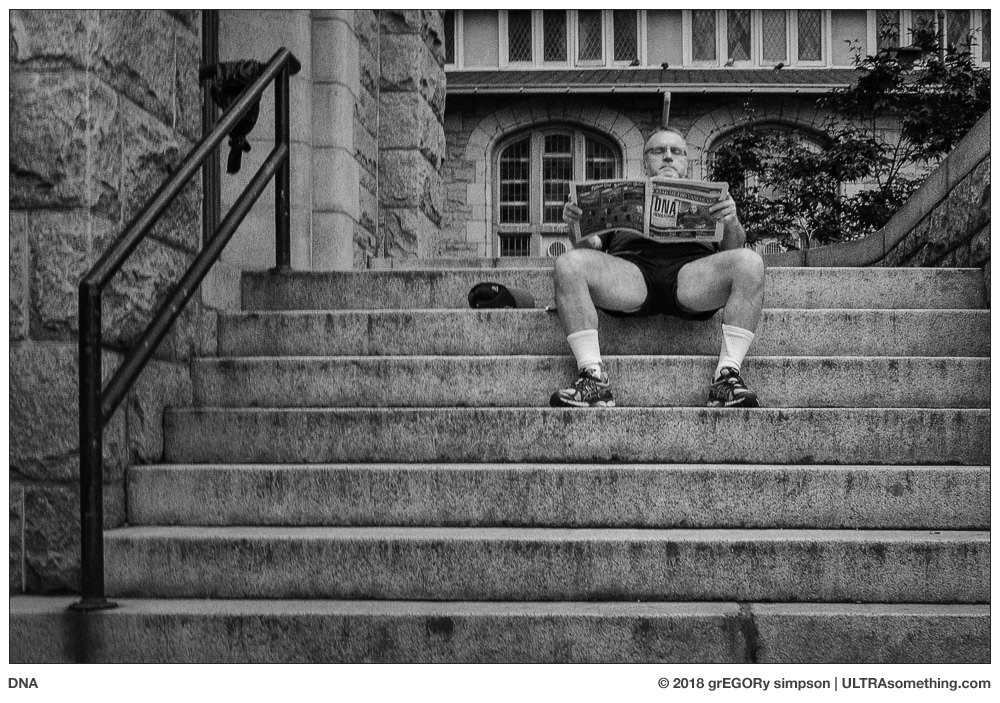
“DNA” is the sort of photo that the immature version of me would have taken. I have yet to reconcile the fact I took this photo after my incident with the pineapple.
“Commuter 1” and “Commuter 2” clearly depict people who haven’t yet had their pineapple incidents. Then again, if I thought I could ride a skateboard down the middle of the street without a significantly elevated likelihood of death, I would probably do so.
Which makes me think… Maybe it takes more than a couple of bags full of produce to cross the maturity threshold? Perhaps it’s not even a threshold at all? Maybe it’s just the first sign of a process? That would be good — ’cause I’m really not ready to give up giggling yet.
REMINDER: If you find these photos enjoyable or the articles beneficial, please consider making a DONATION to this site’s continuing evolution. As you’ve likely realized, ULTRAsomething is not an aggregator site — serious time and effort go into developing the original content contained within these virtual walls.
I’ve been going to the gym for nearly five years now. Most times, I’m the only one there — which is nice because no one will see me hyperventilate. I toil away, lost in a hazy sort of half-meditative state built specifically to shelter my conscious mind from the horrors of physical exertion. There is only silence, punctuated by the clanking of machinery, grunting, and (when things get a bit intense) a mumbled outburst of glossolalia from my inner-demons, who apparently dislike agony as much as I.
When there are others present, they’re usually the type who prefer the idea of working out more than the actual act. In spite of that whole introverted, introspective, misanthropic vibe of mine, I actually enjoy sharing the gym with these folks. Seeing them makes me feel like I’m some kind of super athlete. I’m not, of course, but when I workout, I workout to excess. Grumpy demons not withstanding, I’m there to do a job — and I get down to it. So when I see these people walk in, lounge around, lift a weight or two; check their cell phones; send some texts; take a few selfies; walk on a treadmill for two minutes and then preen endlessly in the floor-to-ceiling mirrors, I ask myself: “Who do they think they’re kidding?” Going to the gym is not the same thing as working out. You don’t lose weight, tone muscle, build strength, or improve your cardiovascular system by some contact osmosis with gymnasium air. People who frequently brag about having just spent an hour at the gym are probably telling the truth — but what they haven’t told you is they spent that hour catching up on their Instagram feed. So when I share the gym with these folks, I get to feel smug. Which is fun. I don’t get to feel smug very often.
But once in a blue moon, a yoga girl shows up. I never know where they came from or why they chose to exercise in my building on that particular day. I only know that they pop in, make me feel totally inadequate, and then disappear — never to be seen again. I’m not talking about the sort of yoga girl who signs up for the occasional class so she has an excuse to buy some new Lululemon pants and indulge in a post-yoga blueberry peach cinnamon soy milk chocolate chip honey banana smoothie. I’m talking about real yoga girls — with their nitinol bones and chimp-humbling feats of strength. Real yoga girls are real athletes. So whenever one enters the gym, all my smugness evaporates and my workout routine becomes anything but.
Yesterday was one of those once-in-a-blue-moon days. The girl wasn’t exactly what I’d call ‘my type,’ but she did have a body that was seemingly carved from a block of solid velvet — reason enough to send my hormones scurrying about like a bunch of headless chickens.
Now in spite of my actions suggesting otherwise, I’m not an idiot. I know there’s exactly zero hope that any yoga girl will ever acknowledge my existence, and I have plenty of first-hand experience to support my hopelessness. But headless hormones are senseless hormones, so I did what I always do: I shifted my workout into overdrive in an effort to impress her with my own brand of stoic athleticism. Never mind that my workout routine is already designed to drive me to near extinction. More weight! More reps! More speed! More everything! It was perhaps the most gut-wrenching workout of my life, and I had every right to feel proud — had I not felt so ashamed of my fatuous motivations.
Eventually, the inevitable came knocking — as the inevitable always does — and I reached that point where the body cries uncle, and starts shutting itself down. The ears are the first to surrender — relinquishing their demand for blood and resulting in the sudden cessation of all sound. The eyes go soon after and the room grows dimmer than midnight under a new moon. My head spins and gravity begins to exert itself, as if trying to screw my body into the floor.
With unconsciousness looming, I weighed the optics of passing out in the middle of the gym vs. quitting and going back upstairs. Exhibiting my first bit of common sense in nearly an hour, I chose to slink out of the gym and into the hallway to catch the next elevator.
Surprisingly, she exited the gym 20 seconds after I did — coinciding with the elevator’s arrival. I held the door. She stepped in, pushed the button for her floor and flashed me a smile. The sheer novelty of her acknowledgement collided head on with my patented brand of social ineptness, and I realized I hadn’t a clue what to say. Which is why I then asked, “are you one of those people who actually likes to work out?”
“Oh yes!” she exclaimed. “I love it. I’ll work out 4 or 5 hours a day when I get a chance. There’s nothing I enjoy more than being in the gym. What about you?”
Either the girl was nearsighted or my physical prowess actually fooled a real yoga girl into believing I was a machine of a man. I could have lied. Maybe I should have lied. But lying just isn’t in my DNA. Besides, my heart was currently diverting blood away from the body’s more motivational organs and toward what it deemed to be my most pressing bodily function — remaining upright and conscious.
“I hate it.” I answered. “I’ve hated it for years. I hated it today. I’ll hate it tomorrow. I’ll hate it until I die.”
She looked stunned, but I wasn’t done. “Honestly,” I continued, “I think that whole endorphins thing is a myth; a fictitious drug conceived by the fitness industry and marketed to people who want to believe they can get high without sticking a needle in their arm and transacting business in a seedy urban back alley.”
Apparently real yoga girls don’t value honesty as highly as I do, because her smile disappeared and a stony silence filled the elevator, for what seemed like hours, until we arrived at her floor. “This is me,” she said, hurriedly slipping her solid velvet body through the tiny crack of a doorway not yet a quarter of the way open.
“Just as well,” I thought to myself. “She’s probably going to grab a spoonful of quinoa before heading out for a 10 mile jog around the seawall.” Knowing that my own post-workout plans involved a short shower and a long nap, I took comfort in the fact that she wasn’t exactly what I’d call ‘my type.’
Regular readers know this is where I usually provide some additional information about whatever media accompanies an article, but this time I opted to use this space to discuss the article itself. Those of you wondering why you’ve just endured such a fluffy bit of literary cotton candy probably missed the previous article, The Corner. It foretells a future in which articles such as this can comfortably exist — a future in which a dissertation titled, “A Clinical Analysis of Edge Distortion in Wide Angle Lenses” could follow an article called, “Those Darn Adorable Doggies,” and precede an article titled “Feet: Why So Many Toes?” Welcome to the future.
REMINDER: If you find these photos enjoyable or the articles beneficial, please consider making a DONATION to this site’s continuing evolution. As you’ve likely realized, ULTRAsomething is not an aggregator site — serious time and effort go into developing the original content contained within these virtual walls.
Manage Cookie Consent
ULTRAsomething uses plugins (which use cookies) to organize and optimize the site. It's kinda how blogs work.
Functional
Always active
The technical storage or access is strictly necessary for the legitimate purpose of enabling the use of a specific service explicitly requested by the subscriber or user, or for the sole purpose of carrying out the transmission of a communication over an electronic communications network.
Preferences
The technical storage or access is necessary for the legitimate purpose of storing preferences that are not requested by the subscriber or user.
Statistics
The technical storage or access that is used exclusively for statistical purposes.The technical storage or access that is used exclusively for anonymous statistical purposes. Without a subpoena, voluntary compliance on the part of your Internet Service Provider, or additional records from a third party, information stored or retrieved for this purpose alone cannot usually be used to identify you.
Marketing
The technical storage or access is required to create user profiles to send advertising, or to track the user on a website or across several websites for similar marketing purposes.