Blog

  • All Hail the Humonkey

    All Hail the Humonkey

    I’m somewhat of an aficionado when it comes to apocalyptic lore — at least as filtered through the lens of the motion picture industry, which is probably no more fantastical an account than the sacred source material from which it derives.

    Though frequently uncredited in films, the original tale was penned around the year 95 AD by a guy named John, who I’m guessing kept a dream journal next to his bed for recording his “visions.” Since John was a fairly common name, scholars don’t agree which John this actually was. But they do agree, given it’s a pretty good yarn, that he must have been one of the famous Johns — so the story was deemed to be gospel, and tacked on to the end of the New Testament. In my own experience, dreams may inspire some interesting plot elements, but they’re definitely not true. If they were, I’d have spent the bulk of my childhood in psychoanalysis — given how regularly I arrived at school stark naked.

    In John’s vision, a group of people are hanging around playing harps and imbibing in incense (the precursor to fiddling with iPhones and vaping). Meanwhile, some dude is breaking sealed scrolls and reading them (the precursor to hacking various government and corporate websites). The first seal he cracks contains a cryptic message about a rider on a white horse, who wears a crown and carries a weapon, and is a conquerer. This, the first sign of the apocalypse, has been interpreted by various faiths and researchers as a direct reference either to A) any of a dozen different historical figures; B) Christ; or C) the antichrist. In other words, one’s interpretation depends entirely on whether one identifies with the conquerer or with the conquered. If you ask me, this makes for a rather flimsy first sign.

    The next seals don’t make things any clearer. We get a second rider galloping around on a red horse, convincing people to kill one another (which seems rather redundant given the first rider’s conquering nature); and we get a third rider on a black horse, who carries some scales and a price list that artificially inflates grain prices. Most scholars interpret this to mean “famine,” which is why they’re scholars and I’m not — because I just see it as a sign of greed. And honestly, as horrific as famine is, mankind’s propensity for greed is far more likely to trigger its demise. But what do I know? I majored in Electrical Engineering. Breaking the fourth seal unleashes another horseman, who rides a pale green pony and goes by the name of Death. Judging by all the conquering and killing that was unleashed by the first three cowboys, I fail to see what’s left for this guy to accomplish.

    Indicative of dream logic, the next three seals careen off into an entirely different direction — forgoing the whole horse thing entirely, until we crack open the seventh seal, which (like the season finale of every series on Netflix) serves only to reveal that there are yet another seven signs to interpret. Only now, instead of horsemen, the signs are unleashed by seven angels — each of whom plays a tasty trumpet solo to herald each new catastrophe.

    Why all the poetry? Wouldn’t it be more helpful to have a list of actual apocalyptic signs, rather than a bunch of archaic allegories to interpret? I know I’m the last person who should ever argue against metaphor — but the plain truth is that most people are too literally minded for symbolism to be an effective form of communication. If you have a message that really needs to reach as many people as possible, it needs to be pedantically clear. You know, a message as important as, say, the end of the world.

    So it’s ironic that it falls on me, Mr. Metaphor, to alert the world to an actual, tangible, apocalyptic sign that’s manifesting right here; right now. Yes, I’m talking about the Humonkey!

    With COVID vaccines and treatments continuing to dominate science news, you may have missed the announcement: Mankind is now injecting human cells into monkey embryos, and birthing human-monkey hybrids. Who needs some wishy-washy parable to signify the end of the world, when we’re staring at this reality?

    Strangely enough, it’s not so much the invention of the humonkey that has me concerned — it’s the fact this isn’t our first attempt at building a chimera. Preceding the humonkey experiment were pig-human chimeras (pigmen) and sheep-human chimeras (sheeple). So it’s not just that mankind thought it would be a good idea to merge itself with monkeys; it’s that mankind first thought it would be a good idea to merge itself with pigs and sheep — as if those creatures were somehow preferable receptacles for human DNA. Really? What scientist thought “Who among us wouldn’t want to be half man, half sheep?” Sometimes you just have to wonder how much actual “sapiens” there is in the average “homo sapiens.”

    Curiously, this isn’t even the fist time mankind’s travelled down the sheep hole. It’s been 25 years since some folks in Scotland first cloned a sheep, and yet I don’t see any more of them out strolling the streets today than I ever did. Didn’t anyone bother to first check the global supply chain, to see whether there was an actual demand for more sheep? Just like someone probably should have conducted a poll, to see how many humans want to be fused with a pig. Anyone with a lick of sense would prefer a monkey bod — one built for swinging around treetops; flinging feces; and with four times as much physical strength. Not only that, but macaque monkeys easily adopt human behaviours — such as taking selfies that go viral, and engaging in copyright lawsuits over ownership. So the fact it took scientists this long to choose what should have been an obvious chimera partnership doesn’t necessarily presage a utopian outcome.

    The whole humonkey thing wouldn’t be quite as terrifying were it not for one of Elon Musk’s recent experiments, in which a device implanted in a monkey’s brain enables it to telepathically control robots from thousands of miles away. Yeah, what could go wrong there? Sure, I know this is being developed to ultimately help humans create things by simply visualizing them, and that the desire behind all this technology is to better the human experience. But wasn’t that also the idea behind social media? And we’ve all seen where that’s lead us. And ask yourselves this: is it a coincidence that the monkey used in these experiments was also a macaque? As if it weren’t already bad enough that mankind’s creating a litigious race of humonkeys, we’re now creating a litigious race that can sue one another telepathically.

    Sadly, I’m sure we humans will all ignore this apocalyptic sign and blithely carry on with our lives. After all, it’s not like we ever really bothered to address any of the previously identified existential threats. Remember how we were all going to die if we didn’t stop using antibacterial soaps and hand sanitizer? Now, thanks to COVID, the manufacturing of hand sanitizer has become the second largest industry on the planet (I didn’t bother to look it up, but I’m sure it’s true). Show me those humans who don’t own at least 14 jugs of hand sanitizer, and I’ll show you the rag tag army of survivors who will be left to battle, and ultimately succumb to the rise of the humonkey.

    Mark my words: As soon as the first humonkey telepathically generates a video that goes viral on Tik Tok, it’s all over. Put that in the Book of Revelation.


    ©2021 grEGORy simpson

    ABOUT THE PHOTOS: As you can easily see from these photos, I’m already channeling my inner monkey in preparation for the upcoming apocalypse, though I’m obviously no macaque. All were shot with my trusty M10 Monochrom, with “Not Easy Enough” fronted with a Minolta 40mm f/2 Rokkor; “A Personal Apocalypse” with a Voigtlander 50mm f/1.5 Nokton; and “Cross Eyed” and “One for the Ladies” both snapped with a Minolta 28mm f/2.8 Rokkor. Also, much like I must frequently apologize to physicists for my cavalier interpretations of their life’s work, so too must I apologize to theologians. Suffice to say, if you’d like to see your area of expertise recklessly paraphrased on the internet, ULTRAsomething is the site on which it will probably happen.

    REMINDER: If you’ve managed to extract a modicum of enjoyment from the plethora of material contained on this site, please consider making a DONATION to its continuing evolution. As you’ve likely realized, ULTRAsomething is not an aggregator site. Serious time and effort go into developing the original content contained within these virtual walls — even the silly stuff.

  • The IPL

    The IPL

    I’ll admit I’m not much of a sports fan. I can’t tell you exactly when it was I last watched a football, baseball or basketball game — but it definitely wouldn’t be this century.

    Hockey is the one exception — my singular concession to the manly art of yelling at the television and grumbling about biased referees, bonehead plays, and archaic rules. Unfortunately, watching hockey requires subscribing to various premium sports channels — channels I would never watch were it not for hockey. When a game ends and I turn off the TV, the cable box remains tuned to the sports channel. So the next time it turns on, I’m greeted by the site of some sport other than hockey. And more often than not, that “sport” is poker.

    Can someone with less atrophied grey matter explain, exactly, why poker is considered a sport? I truly don’t understand.

    Perhaps, as a one sport guy, I should recuse myself from pontificating about this. But try as I might, I just can’t find the “sport” in sitting around a table, playing a game of cards. I’ll admit to having had similar doubts about curling, darts and billiards — but at least those activities generally require standing. That’s not to denigrate various sitting sports: Rowing is no easy task; and many Paralympic sports look to be truly gruelling. If nothing else, auto-racing is a test of human endurance. Even bobsledding requires that you run as fast as you can before settling into a nice sleigh ride. But poker? Poker?!

    What sets the bar for an activity’s designation as a sport? Poker’s inclusion would suggest that “plopping your butt in a folding chair and engaging one another in some form of competitive bidding” clears that bar. So why can’t I grab a 6-pack, kick back, and tune into a local art auction on one of those sports channels? That’s something I might actually be inclined to watch.

    This got me thinking. There’s money is sports. Big money. So if bog snorkelling (Wales), pumpkin kayaking (Nova Scotia), and wife carrying (Finland) can all be sports, why not photography? Plus, unlike those sports, photography’s appeal is international. Which makes it more conducive to lucrative sponsorship deals and, dare I say, inclusion in the Olympics. What’s more, photography could fit comfortably in both the summer and winter games, doubling the sport’s exposure on the international stage.

    So naturally, in my unending desire to quit my day job and grow ULTRAsomething into a global media empire, I’ve decided to establish photography as a competitive sport. But unlike those sports you’ll watch only during Olympic years (like luge or pole vaulting), or those you’ll never watch (like bowling), I’ll make sure photography is a sport that’s seen every hour of the day, every day of the week, and on at least one premium sports channel — just like poker. To this end, I’m proud to announce that I’m establishing the Intergalactic Photography League (IPL).

    Like poker, the sport of photography is a game of chance, and its champions are those who are best able to apply wit and ingenuity in order to escape a particular statistical outcome. Unlike poker, photography’s winners are determined subjectively rather than objectively. It’s not a sport that can simply award the trophy to whoever threw the javelin the furthest, or ski’d through the slalom course the fastest — there’s an element of artistic interpretation involved. This makes it more akin to snowboarding, figure skating, gymnastics, or high diving.

    Judged sports are obviously more susceptible to tainted results. Sentiment, human error, emotion, favouritism, corruption, and other such foibles will inevitably afflict the judging. Fortunately, there is not one single tangible metric that makes one photo better than another, so the inevitable controversy and online bickering generated by each IPL match will only bring more attention to the sport — along with the occasional lucrative mainstream media coverage that accompanies a juicy judging scandal.

    In fact, I would go one step further. Instead of televising only the announcement of the judging results, the IPL will televise the judging process. All the judges will be mic’d up and tossed into a pit, where viewers will see them argue about the relative merits of one photo over another. I’ve judged numerous photo contests in my day, and I can assure you that several have nearly come to blows. Just watch our ratings soar when the cameras capture one IPL judge throwing a chair at another IPL judge.

    Additionally, I would suggest all judges be drawn from a pool of cancelled celebrities. Not only will they be publicity starved, and thus willing to work for free, but their notoriety and the outrage they’ll attract will draw even more viewers to the sport.

    Because professional photography isn’t a team sport (like football or volleyball), there’s no need for silly uniforms. But as a solo sport (like tennis or golf), there should be some sort of dress code to identify the participants as professionals worthy of idolatry, while still allowing for artistic individuality. I suggest we all adopt jet-black shaggy haircuts and head-to-toe black clothing, à la Daido Moriyama. Having a cohesive yet individualistic look expands sponsorship opportunities above and beyond the obvious gear-related endorsements. Imagine the earnings potential if Columbia Sportswear had a line of ULTRAsomething logo’d black, seam-sealed waterproof jackets — practical enough to transport a rangefinder and a couple Summicron lenses, while stylish enough to meet with your agent at the trendiest new restaurant. Good luck trying to get past the maître d’ dressed like your favourite hockey player!

    Unlike exclusionary sports like track (gotta be fast); basketball (gotta be tall); or baseball (gotta suffer from jock itch); the IPL is inclusionary. This means that participating in the event whilst smoking and drinking (like darts) is both accepted and encouraged — thus increasing the sport’s appeal to the commoner, and creating a society in which every young boy or girl can dream of one day being a professional photographer.

    And finally, because all other sports are filmed in high definition, IPL matches will be filmed on hand-cranked 8mm cameras using expired Kodak film stock. This ensures that all IPL events leap from the screen— catching a couch potato’s eye as they surf a thousand channels for quality sports entertainment.

    There are still a few details to work out. For example, it could be quite difficult to pit a landscape photographer against a street photographer. One practitioner would more likely win with a black & white, lo-fi, metaphorical or funny subject found out in the wild; whereas the other would prevail with a searingly sharp, saturated, heavily processed concoction requiring the ultimate in sensor technology, quality hiking boots, and trendy Photoshop skills. Part of me wants to tell the landscape guys to start their own damn league (after all, why invent a sport unless I, myself, can win it). But then I think how much more violently entertaining the judging discussions will be, so I’m leaning toward a league in which all genres compete on equal terms.

    I can’t believe I’ve spent all these years grumping about poker being a “sport,” without ever seeing the forest through the trees. Money. Fame. Prestige. All are within reach. And the icing on the cake — we’ll have the hippest trading cards in the whole wide world of sports.


    ©2021 grEGORy simpson

    DISCLAIMER: This article means no disrespect to the many fine men and women who participate in any of the sports mentioned in this article. But if it makes you feel any better, you’re welcome to cast shade on the Intergalactic Photography League once it’s up, running, and stocked with a first class legal team.

    REMINDER: If you’ve managed to extract a modicum of enjoyment from the plethora of material contained on this site, please consider making a DONATION to its continuing evolution. As you’ve likely realized, ULTRAsomething is not an aggregator site. Serious time and effort go into developing the original content contained within these virtual walls — even the silly stuff.

  • 5 Surprisingly Beautiful Uses For Your Mystical Underpants

    5 Surprisingly Beautiful Uses For Your Mystical Underpants

    Welcome, hordes of new ULTRAsomething readers! I hope you find this site both educational and inspirational, and that you enjoy your journey through its 13-year archive of photos, articles and music.

    To you handful of returning readers, thank you for your continued support. Please treat the new visitors graciously, and be sure to share your wit with them, as you have with me.

    In case you’re wondering what’s going on — why I’m welcoming new readers, and why this site has recently shifted to a faster and more robust server — the answer is simple: I have honed the art of writing seductive headlines, and am preparing for the voluminous traffic that will surely result.

    Prior to this month, I was blithely unaware I even had a headline problem — believing, quite ignorantly, that my titles were the crème de la crème, and that my ability to artfully misspell a word, turn a phrase, or infuse a double- or triple-entendre was what made them so.

    But that all changed when I wrote last month’s Superfluouuus article. Right before publishing, I noticed a new widget crammed into the corner of my site’s Admin screen, which said “28/100.” That’s it. No words. No context. Just a fractional number.

    Curious, I clicked the widget and discovered it was provided by a newly installed Google Analytics plugin. Its sole purpose is to rate the ‘quality’ of the article’s title — and thus determine the likelihood that Uncle Joe and Aunt Josephine will actually read it. In other words, it’s my article’s clickbait score.

    I thought the need for such a feature silly, scoffed at the ridiculously low rating assigned to Superfluouuus, and published the article anyway. “What does Google know?” I thought.

    Apparently, the answer is “a lot more than I do,” because Superfluouuus had the lowest first-month readership of any article in the history of ULTRAsomething. My knee-jerk reaction was to attribute this to the article sucking. But that’s obviously not the reason, since people would need to actually read the article in order to know that it sucked. This could mean only one thing: it’s the title that sucked — apparently unclickably so.

    So with renewed determination, I decided to rethink my entire titling strategy. I would learn the art of clickbaiting.

    Previously, I would compose a title after the article was written — choosing something I felt reflected the subject matter and its mood. Perhaps I needed to reverse this procedure, and echo a technique used in the 1960’s by legendary B-movie director, Doris Wishman, who wouldn’t start writing a screenplay until she’d first thought of a title lurid enough to warrant the trouble.

    In a way, Doris was an early practitioner of the art of ‘clickbaiting’. Only, in Doris’ case, she wasn’t looking to capture clicks; she was looking to capture cars cruising past the drive-in marquee on the outskirts of town.

    I typed a few of Doris’ titles into my new Google Analytics toy — curious to see how Google rated them. “Keyholes are for Peeping” scored a 42, and “Bad Girls Go To Hell” earned a 48. Curiously, “Too Much Too Often!” only managed a 28 — the same rating as the disastrously inadequate “Superfluouuus.” Clearly, even Doris could have benefited from an online algorithm.

    Remembering lessons I’ve learned from the many years spent publishing this site — that creativity is anathema to the masses — I decided to abandon the idea of writing titles that I like, and instead write titles that Google’s algorithms will like.

    According to Google, an average title scores between 40 and 60. Anything less and you’re wasting server space, and haven’t any right to a carbon footprint on Google Earth.

    My four previous titles — Onerousity, AI, Dinosaur and Nocturnes — each scored a paltry 23, making Superfluouuus’ 28 rating seem somewhat good in comparison. In fact, out of all nine titles on ULTRAsomething’s landing page, only In a Gotta-Do Vida made it into the “barely acceptable” range of 40-60, scoring an impressive (for me) 54! Checking my web stats, I confirmed that, indeed, In a Gotta-Do Vida had the highest readership of those nine articles.

    Google suggests web publishers craft titles that score 70 or higher, in order to attract clicks. Because my readership stats are dismal, and so many of my titles rate in the 20’s, I decided to go ‘all in’ and learn to compose Google-worthy headlines.

    After extensive trial and error, I figured out which words Google’s algorithms liked (and which it didn’t), and eventually gained the skill to consistently churn out titles with a 93 rating (such as the one adorning this very article).

    Unfortunately, I never found the right combination of words to score a perfect 100. But that’s probably because I lost interest in using the tool for its intended purpose, and grew far more interested in using it to glean insight into modern society.

    For example, compare these two titles: “5 Surprisingly Beautiful Uses For Your Mystical Underpants” and “5 Surprisingly Inspirational Uses For Your Mystical Underpants”. The first scores a 93, while the second scores only a 68. The only difference is that I replaced the word, ‘beautiful’ with the word, “inspirational’ — but that single change resulted in a 25 point penalty, and the title’s banishment to the bowels of mediocrity. Beauty, it seems, is far more important than self-actualization.

    Upon learning of society’s lust for beauty, I then tried to amplify the score through specificity. Personally, I’d rather something be ‘ravishing’ or ‘beguiling’ than plain old ‘beautiful.’ Yet the use of either adjective also resulted in a 25-point reduction in my score. Apparently, generalities are hot and poetry is not.

    Employing just the right adjective is definitely a key component toward satisfying the algorithm. For example, using the phrase “hauntingly beautiful” instead of “surprisingly beautiful” results in a 3-point reduction, while other replacements for the word ‘surprising’ yield even lower results — informing us that ‘surprise’ is a particularly important human motivator.

    Nouns, it seems, are totally meaningless. Which suggests that what you write about doesn’t matter one bit, just as long as you hype it properly. To me, the most clickable part of this article’s title is the phrase “mystical underpants.” But to Google, it’s irrelevant. “5 Surprisingly Beautiful Uses For An Old Bedsheet” has an identical rating. As does a list of beautiful uses for “your green mascara,” “vintage chainsaws” and “a deceased muskrat” (which is the one I’d be most likely to click).

    It’s no wonder Doris Wishman never transcended her status as a ‘cult’ director. Without access to Google Analytics, she had no way of knowing that “Keyholes are for Peeping” would have increased its box office receipts significantly had she simply retitled it, “5 Surprisingly Beautiful Ways to Use a Keyhole.”

    Anyway, much like how Doris and other old exploitation directors employed “square up” reels to keep the duped audience from feeling cheated, here is my half-hearted attempt to fulfill the promise of this article’s title:

    1. Fashionable COVID mask
    2. Party toga for your sock monkey
    3. Gerbil hammock
    4. Bitchin’ bowling ball bag (Men’s Size XXL only)
    5. Trailer park bathing suit

    And if you’re wondering where, exactly, you go about finding mystical underpants, stay tuned for next month’s article: “3 easy ways to mystify your undergarments”.


    ©2021 grEGORy simpson

    ABOUT THE PHOTOS : Upon completing this article, I felt a moral obligation to better square the deal with anyone who clicked through with an expectation of at least some mysticism. So the accompanying metaphorical photos are designed to stimulate discussion and debate amongst the more spiritually inclined readers. Conception begets birth — where the future is unwritten. Are the blanks filled in through Free Will? Or through determinism? And if determinism, then by the divine intervention of Gott I’m Himmel? Or via the duality of a Ghost in the Machine? Then forward, into the light Toward Bardo, to burst forth again into another conception.

    Of course, it’s entirely possible I made all this up and that the photos are nothing more than random shots from a Leica M10 Monochrom, with “Conception” using a Voigtlander 50mm f/1.5 Nokton; “Free Will” and “Gott im Himmel” employing a 21mm f/3.4 Super-Elmar-M; and “Ghost in the Machine” and “Toward Bardo” both utilizing an old Canadian-made 35mm f/2 Summicron (v4). The fact that Toward Bardo was shot in Tokyo could either be an additional indication of the Buddhist implications of the photo; or perhaps a sly nod toward my own personal concept of heaven. Or maybe it’s just anther random coincidence. God only knows… or, more accurately and less colloquially, I only know… which may actually be very Buddhist of me… or not. Feel free to debate amongst yourselves, but please do so on another forum: As we all know, this is strictly a serious, pure and unadulterated photography website.

    REMINDER: If you’ve managed to extract a modicum of enjoyment from the plethora of material contained on this site, please consider making a DONATION to its continuing evolution. As you’ve likely realized, ULTRAsomething is not an aggregator site. Serious time and effort go into developing the original content contained within these virtual walls — even the silly stuff.

  • Superfluouuus

    Superfluouuus

    Vancouver’s entertainment district has endured a steady decline this past year. With the pandemic shuttering the nightclubs, forcing thousands of college students to seek debauchery within the constricted confines of illegal house parties, the street is barely recognizable. Gone are the spent beer bottles, abandoned stilettos, and puddles of teenage vomit. In their place are spent hypodermic needles, abandoned encampments, and puddles of junkie vomit.

    The other night, walking past the Vogue Theatre, I glanced up at the resplendent art deco sign rising six stories above the theatre’s marquee, and noted that one of its letters — a large neon ‘U’ — had burned out. Through the lens of the district’s new milieu, my first thought was to catalog this as nothing more than an apt metaphor for the current state of Granville Street.

    But upon further thought, I realized I might be letting my own cynicism taint my rationale. Perhaps the extinguished ‘U’ isn’t a sign of decline, but a sign of ingenuity?

    As establishments like the Vogue continue to navigate the pandemic, they walk a financial tightrope — weighing the cost of current losses with the promise of a considerable post-pandemic revenue stream. The greater the public’s pent-up demand, the greater the number of cash spewing patrons, lusting for social interaction, who will eventually storm their lobbies.

    So it’s in their best interest to keep the neon lit — taunting the teens like a carrot on a stick — feeding society’s yearning for what it currently cannot have. But lighting all that neon is a costly gamble, and with neither income nor a known end to the ongoing pandemic, each establishment needs to make crucial decisions. Do they light the neon only on certain nights, and thus risk fading from memory and receding into irrelevancy? Or do they sink deeper into debt to keep their beacons of hope aglow?

    Perhaps the Vogue has found a solution. There are five letters in the word ‘Vogue’, but only one of those letters is superfluous — the ‘U’. If one removes the ‘U’, the pronunciation of the word remains unchanged. The ‘E’ at the end informs us that the ‘O’ is a long vowel, similar to the way we know that ‘not’ and ‘note’ are pronounced differently. So, in practice, it makes no difference whether their sign reads “Vogue” or “Voge” since they sound the same — ensuring memories of happy times at the Vogue remain linked to the promise of even happier times at the Voge. And it was all done with a 20% reduction in cost! Clever folks, those Voge people.

    So naturally, self-reflective introvert that I am, I started thinking about my own life, and whether it was plagued by any unnecessary ‘U’s.

    My low hanging ‘U’ is probably that second bathroom of mine. Does a domicile of one really require two bathrooms? I suppose there’s some merit to the idea of a ‘guest’ bathroom, but self-reflective introverts don’t have guests. And even if we did, COVID laws forbid it. If this was 1991, I would have converted it into a darkroom by now. I once considered installing a room-sized hot tub, but in the absence of guests, all that extra bathwater seemed no less superfluous than a second toilet. Ultimately, there’s not really anything to be done about my redundant bathroom, other than rent it out. But that sounds like more bother than it’s worth.

    Mentally touring my apartment — already a shining example of minimalism — I could think of only two other seemingly superfluous possessions: my synthesizers and my film cameras. One could argue that I have too many of each. But I would counter that not a single one of them is unnecessary — each has a different strength; a different character; and a different way of helping me voice whatever it is I wish to say. So what might appear superfluous to a non-existent guest is perfectly fluous to me.

    Perhaps my own extraneous ‘U’ isn’t something physical at all. Maybe it’s abstract? Listening to my own music, I sense a tendency toward dense production and harmonic complexity. And looking at my own photos, I see a propensity to include a lot of elements in the frame. Neither inclination yields a product that’s easily consumed in a single swallow, which suggests that my artistic inclinations could stand some pruning. Except all that extra complexity isn’t superfluous at all — it’s fundamental to the music and photography I wish to create. So, since most people consider multiple engagements with the work to be superfluous (and since my own work is designed to require multiple engagements), perhaps what’s truly superfluous about my creative output is its very existence. And if my music and photography are what’s superfluous, then what does that make me? Am I the ‘U’?

    At that point, with my introspective dive only a fathom or two away from exploring a nihilistic shipwreck — that humanity is, itself, one big evolutionary ‘U’ — I resurfaced; took a shot of the sign and carried on with my evening stroll.

    The next night, as I walked along that same stretch of Granville Street, I glanced up at the marquee I’d found so inspirational the previous night. The Voge Theatre had once again undergone a name change, and was now simply called the Vog Theatre — its ‘E’ having followed the ‘U’ into disrepair, thus invalidating the very crux of this entire thought exercise. And it was then that I realized it’s not my creative output that’s superfluous — it’s my propensity to assign meaning where none exists. As Freud once said, “sometimes a chunk of burned out neon is just a chunk of burned out neon.”


    ©2021 grEGORy simpson

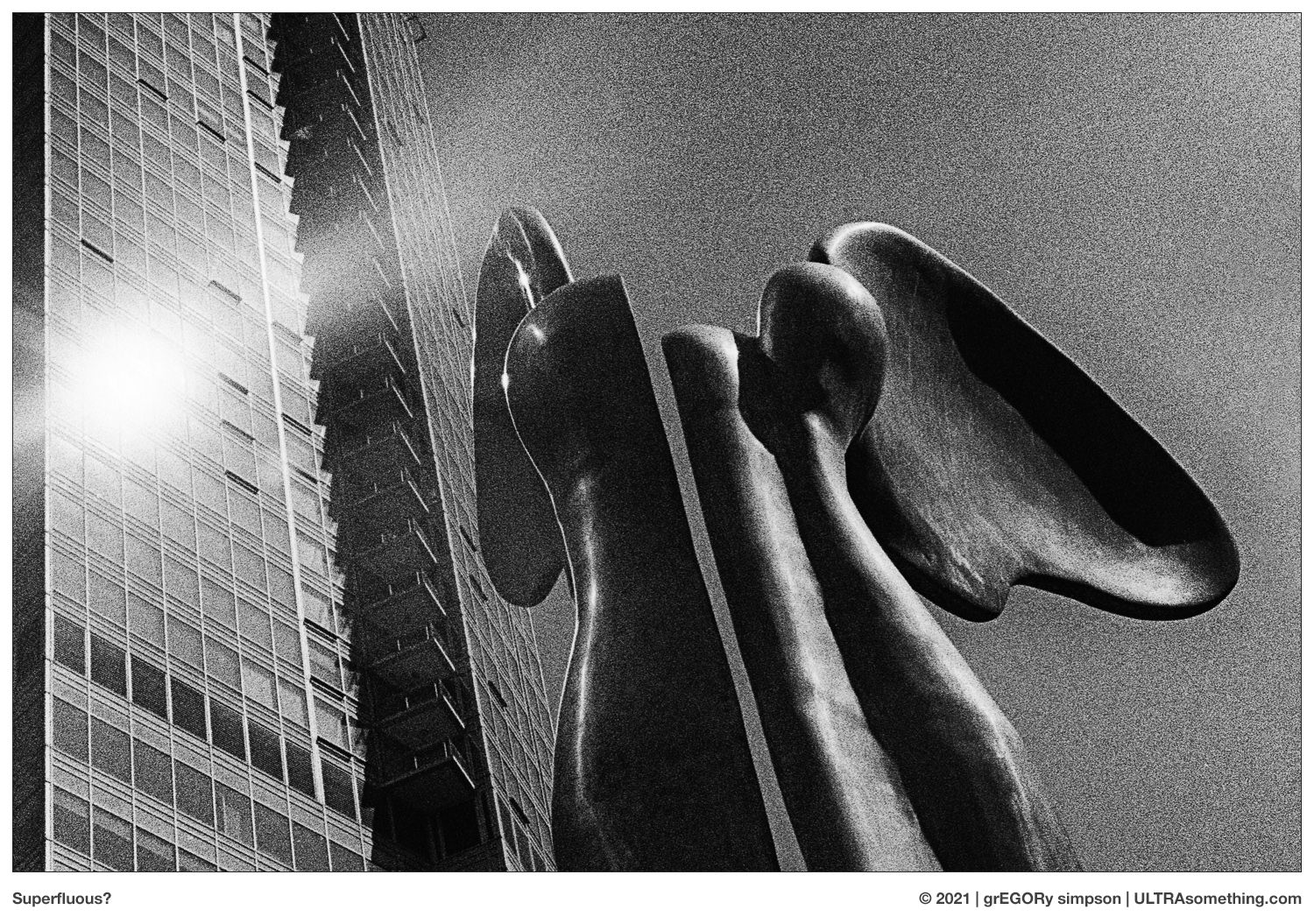
    ABOUT THE PHOTOS: Superfluous? was shot on Tri-X and developed in Rodinal 1:50, using a Leitz Minolta CL and a Minolta 40mm f/2 Rokkor lens. Superfluos is this month’s lone digital shot, coming courtesy of the Rocoh GRIII. Megafluous spooled out of a Widelux F7 on a strip of Tri-X, developed in Rodinal 1:50. Superfluous!, also shot on Tri-X and developed in Rodinal, popped out of a Hasselblad Xpan fronted with its drastically underused 90mm f/4 lens. Obviously, this is all superfluous information.

    REMINDER: If you’ve managed to extract a modicum of enjoyment from the plethora of material contained on this site, please consider making a DONATION to its continuing evolution. As you’ve likely realized, ULTRAsomething is not an aggregator site. Serious time and effort go into developing the original content contained within these virtual walls — even the silly stuff.

  • Onerousity

    Onerousity

    I know this is going to sound pathetic, but this monthly publishing schedule of mine is quite the arduous task. Thinking of an entertaining and imaginative topic (much less an unimaginative one) is difficult enough, but then having to illustrate those words with fresh photographic content? What am I? Superman?

    Over the years, some readers have helpfully suggested that the photos aren’t necessary, and I should just write essays. Meanwhile, other readers have suggested the opposite — that I should just publish more photos and forget about the writing. But it’s my belief that both are essential. That way, one medium can prop up the other in the all-too-likely event that either is particularly substandard that month.

    Living smack in the middle of North America’s largest (and only) temperate rain forest certainly doesn’t help with the photography aspect — especially in the winter, when weeks can pass without a break in the rain. Personally, I don’t mind donning the seam-sealed clothing, grabbing a seam-sealed camera, popping on a seam-sealed lens, and heading outdoors. Unfortunately, my fellow citizens don’t feel the same way — and when the rains come, the streets empty. So if you’re someone who’s fond of photographing humanity, the pickings get mighty slim.

    There’s also a certain melancholy sameness to photos taken in the rain. One can only have so many poignant ‘lonely traveler beneath an umbrella’ shots, and I’ve probably achieved my lifetime quota. Now and then I’ll get lucky, like the time an unseasonable rain drenched a large street festival, resulting in a decade’s worth of such photos. But that was nine years ago, proving “now and then” is more often about the “then” than the “now.”

    Consequently, prior to this year, I settled into a pattern of photographing ‘things’ in the winter and ‘people’ in the summer. But the current pandemic has locked my photography into ‘things’ mode for the past 13 months, and I’ve struggled a bit creatively. One thing I’ve discovered about ‘things’ is that there’s not a limitless supply, and I’m rather certain there’s not a single ‘thing’ in downtown Vancouver that I haven’t photographed a dozen different times, on a dozen different days, from a dozen different angles, and with a dozen different cameras. So the only way this winter differs from last summer, is that I’m now photographing what all those ‘things’ look like when wet.

    That said — though I’m rarely happy with the results — I quite enjoy the act of photography. The arduousness of monthly publication stems not from a lack of enjoyment, but from a lack of quality content that springs forth from that act.

    Far more burdensome is the essay itself. This probably has a lot to do with the fact I quite dislike the act of writing. What I do like, however, is having written something. Unfortunately, the latter isn’t possible without the former, meaning I spend two days a month living in the glow of self-satisfaction and twenty eight days a month irritated that I have to do it all over again. I’m sure this is some mild form of insanity. So to prevent the encroachment of more advanced forms, I just keep nurturing this one. ULTRAsomething’s in its thirteenth year now, and my walls still aren’t rubber, so I persevere.

    Now and then, I do consider shifting my emphasis more toward music, and less toward wandering around aimlessly with a camera and self-flagellating myself into another essay — but my web stats are dismal enough without subjecting the site to such a seismic creative shift.

    Fortunately, complaining is one of my fortes — so whining about writing essays has birthed this actual essay. Likewise, whining about taking boring photos has justified their publication for illustrative purposes. So, just like that, another article arrives. In a typical 30-day month, I would now warm myself within the two-day glow of self-satisfaction. But this isn’t a typical month — it’s February. And with only 28 days until the calendar turns, I’m forced to forgo this month’s glow and face the void of another looming publication deadline. I can already feel the tingle of onerousity.


    ©2021 grEGORy simpson

    ABOUT THIS ARTICLE: As this month’s article is about the article, the “About This Article” part of this article is rendered superfluous. Check back next month when, more likely than not, “About This Article” will have returned to its usual function of providing artificial justification for whatever springs forth from the void.

    REMINDER: If you’ve managed to extract a modicum of enjoyment from the plethora of material contained on this site, please consider making a DONATION to its continuing evolution. As you’ve likely realized, ULTRAsomething is not an aggregator site. Serious time and effort go into developing the original content contained within these virtual walls — even the silly stuff.

  • AI

    AI

    What is intelligence?

    If the erudite and respected literary scholar fails to grasp even the most rudimentary functions of smart phone use, can we call them “intelligent?” What about the mathematician whose groundbreaking theories revolutionize mankind’s understanding of the universe, but who’s incapable of passing a fourth grade geography test?

    Intelligence is a word wielded in bias — assigned in accordance with the adjudicator’s own prejudice.

    Dictionaries often define intelligence as an accumulation of knowledge — a definition that my own bias rejects absolutely. Suggesting that intelligence equals knowledge creates a class structure that excludes anyone without education. That makes absolutely no sense — one should not be able to buy their way into an “intelligent” diagnosis. An educated dolt is still a dolt; and an uneducated genius is still a genius. Besides, everyone has knowledge of something others do not, so the standard definition degrades to utter nonsense.

    My personal belief is that intelligence and knowledge have little to do with one another — a belief that’s no doubt prejudiced by my own proclivity to calculate and derive, rather than draw from a database of knowledge. Since I don’t believe the possession of knowledge implies intelligence, I certainly don’t believe possessing more knowledge implies even more intelligence. Rather, I believe intelligence relates to how one applies whatever knowledge they do have. Remembering a million bits of trivia is not intelligence. Going on Jeopardy so you can leverage all that trivia to win a stack of money — that’s intelligence.

    And don’t even get me started on the whole anthropomorphic aspect of the definition, in which humans have deemed themselves the most intelligent species on earth. We pants-donning primates are so arrogant, we even rate animal intelligence by how closely their cognition resembles our own. But I bet you Cousin Tammy, unlike an octopus, doesn’t have two-thirds of her brain’s neurons dispersed throughout her limbs. Sever an octopus’ arm and that arm will continue to function in support of the creature — finding food and feeding it. Cousin Tammy? Her severed arm isn’t gong to do a damn thing but lie motionless in a pool of gore. Sure, the octopus hasn’t a clue how to colonize Mars, but neither does Cousin Tammy.

    Troubled as I am by the word “intelligence,” you can imagine how I feel about appending the word “artificial” to the front of it. It’s like using one totally arbitrary word to modify a second totally arbitrary word.

    Yet here we are — living in a world where Artificial Intelligence (AI) is all the rage. As best I can ascertain, all these newfangled AI products are really just LE products — but it’s a whole lot harder to market “Laziness Enhancement” software than it is to woo customers with the notion of “Artificial Intelligence.”

    Now don’t get me wrong — I’m all for software that lets me be as lazy as possible. The less time I have to spend preparing my taxes, buying socks, or transferring files to someone, the better. The greater the number of rote functions a machine can learn, the happier I am. The problem is that companies are developing AI to make our creative and aesthetic decisions for us. The whole reason I want my software doing the rote stuff, is so that I have more time to do what really matters — the creative and aesthetic stuff.

    Think about it. If you want to create something that you actually care about, are you going to turn over the decision making process to an algorithm? Particularly an algorithm that’s designed to produce a result in the most pedestrian, middle-of-the road, unimaginative way possible? A way that looks or sounds the most like everyone else’s AI-derived results?

    The only time you would want your software making aesthetic decisions is when your end goal isn’t the creation itself, but to do as little as possible to create it. In which case, why create it at all? Why contribute more noise to a noisy world?

    AI is designed to produce an outcome that will generate the widest appeal amongst the lowest common denominator — and it’s very good at doing that. It can mix and master your music so that it sounds like the mixing and mastering of the most popular songs; and it can process your photos and videos so they match the appearance of the most widely liked photos and videos on social media.

    AI is an ouroboros — a snake that eats itself. The more frequently people rely on AI to make creative decisions, the more the algorithms will feed into themselves — further narrowing the scope of acceptability and further precluding true creativity and self expression.

    Some have opined that AI technology is a dangerous path — one that will take us toward a dawn in which machines become more “intelligent” than man, and thus our overlords. I fear the exact opposite — that AI will take us toward a dawn in which machines become so narrow-mindedly unintelligent and prejudiced that mankind’s reliance on them will render us incapable of expansive thought. Sadly, both theories achieve the same end — mankind is toast. So, you might want to stock up on your favourite jam.

    Call me unfashionable, but I believe one’s creative output should be an expression of oneself, not the algorithm they purchased. Otherwise, the ‘likes’ that someone gathers on social media are every bit as artificial as their intelligence — however you choose to define it.


    ©2021 grEGORy simpson

    ABOUT THE ARTICLE: In case you can’t tell, I’ve been messing around with the newly released Luminar AI photo editing software. For now at least, my belief is that mankind is safe, since the product seems to be more a collection of ‘presets’ than it is actual AI. But there’s still an insidiousness to some of those presets — particularly all the ones designed to sham your Instagram feed with altered faces, idealized bodies, and stock-imaged skies. But if you stay away from that kind of crap, Luminar AI does have some decent (albeit typical) editing tools hiding just below the surface.

    In any event, no Luminar software (nor any AI) were employed in the creation of the hodgepodge of film and digital AI metaphors included with this article. I have no doubt my webstats will suffer accordingly…

    REMINDER: If you’ve managed to extract a modicum of enjoyment from the plethora of material contained on this site, please consider making a DONATION to its continuing evolution. As you’ve likely realized, ULTRAsomething is not an aggregator site. Serious time and effort go into developing the original content contained within these virtual walls — even the silly stuff.

  • Dinosaur

    Dinosaur

    Several years ago, while forced into chit-chat duty at some evening event, I wandered into conversation with a young graduate student. It’s my tendency, during such obligations, to keep only one brain cell engaged and idling in neutral — so I don’t recall exactly how or why the topic turned to high school. But I do recall her grousing about the difficulty of writing so many research papers.

    “They didn’t teach you everything you needed to know, so you had to spend extra time googling the topic!” she exclaimed exasperatedly.

    This struck me as a curiously nonsensical complaint that warranted further exploration, so I stepped on the gas and shifted my single solitary brain cell into first gear.

    “I dunno,” I answered, “isn’t doing research one of the main components of learning? Plus, having it all online is far better than driving to the library and searching through stacks of encyclopedias, like when I was in high school.”

    She cocked her head, furrowed her brow, and gazed off into the distance — as if trying to make sense of what I had just said.

    “Oh,” she replied, relaxing her expression with a sudden glint of recognition, “I’ve heard of those. They were called CD-ROMS, right?”

    “No, this was before CD-ROMS,” I said.

    Her countenance transformed once again — the blankness of her gaze informing my need to elaborate.

    “CD-ROMS,” I added, “only existed for a few short years in the 1990’s. They weren’t around when I was in high school.”

    “I don’t understand.”

    “They were actual books,” I said. “Every year, encyclopedia companies would publish a three foot high stack of books, which contained information about thousands of subjects, all arranged alphabetically.”

    Her jaw dropped and her eyes bugged out like an old Looney Tunes cartoon. “Noooooo waaaay,” she exclaimed. “You had to use books?!”

    I flashed back to my own similar moment of disbelief — around age 7 — when my grandparents casually mentioned listening to plays on the radio. “Noooooo waaaay,” I exclaimed. “You didn’t have television?” Recalling how this revelation filled me with questions about humanity’s existence within such a void, I offered the woman a few elucidating tidbits.

    “Yup,” I answered. “And since encyclopedias were really expensive, libraries rarely replaced them — which meant you were often looking up information that might be 10 years old.”

    Watching her recoil in horror, I quickly doubled down. “So before there was a web to surf, I’d sometimes surf the encyclopedias for fun. I’d just grab a book off the shelf — Maybe the “G” book today, or maybe the “T” book, and randomly read all about whatever subjects began with that book’s letter.”

    “Wow,” she said, shaking her head. “That’s terrible. I can’t even imagine what that must have been like.”

    At that point, another gentlemen sauntered into the conversation, telling the woman, “That’s right, my parents told me about those days.” And as they began to discuss how lame people were in the past, I shifted my single brain cell back into neutral — slinking off to the corner in an effort to avoid any additional chit-chat.

    I have since identified this evening as the very moment when I first stepped into the tar pit. Other instances have followed, such as the time an incredulous techno musician, upon finding out I designed, developed, tested and documented electronic music synthesizers for a living, exclaimed, “How can you know anything about synthesizers? You’re old!”

    But there is probably nothing that makes me feel more like a dinosaur than watching the changing nature of music and photography. Unlike many of my Mesozoic brethren, I do not believe either medium is ‘dead.’ On the contrary, they’ve never been more alive. The difference is in what people choose to communicate, and the channels with which they communicate it.

    Any kid with an iPhone and a few free sound loops can assemble a collage of beats and publish a new dance tune — and they do. Tap another app on that same iPhone, and an entire team of Silicon Valley A.I. engineers spring into action — applying every algorithm necessary to compute an image that will match all the most popular attributes of similar images. Photography, like music, has become democratized and disposable. Neither are particularly vital anymore, but both are ubiquitous. They are a part of the fabric and currency of everyday life. That’s not death; that’s full adoption.

    The problem is that democratization leaves little room for creativity. When everyone’s music employs the same rhythms and sounds, and when everyone photographs the same subjects while hoping for the same results, the opportunities for anyone wishing to express themselves outside accepted parameters become more limited. Of the dozens of musical genres I enjoy, exactly zero have a dedicated channel on Apple Music. The photography I like is never seen on Instagram, but rather in those same dusty, antiquated, paper tomes that once held every high school student’s collected knowledge.

    And so, little by little, month by month, I sink deeper into the tar pit — still consumed by a desire to pen an opera for those who only want to dance, and driven by the need to mount an exhibition of murky, black & white, metaphorical photos to an audience only accepting of the sharp, colourful, and literate.

    One part of me is comforted by a dream that some future generation might one day unearth my bones and — appreciating them for their love of hard bop trumpet licks and crunchy silver halide crystals — choose to display them in a museum. Another part of me recognizes that museums will likely no longer exist — having themselves become dinosaurs.

    But tar is like quicksand — the more you struggle, the deeper you sink. And so I’ve learned to simply accept the inevitable — that there is no future in becoming a dinosaur, and yet we are all destined to become one. In my case, I’ll just get there a few years earlier than the grad student.


    ©2020 grEGORy simpson

    ABOUT THE PHOTOS: Speaking of dinosaurs (and murky black & white), this month’s compliment of photos springs forth from my latest roll of Tri-X — exposed at ISO 200, and spooled through a Ricoh Auto-Half, which is a half-frame film camera from the 1960’s that I enjoy using perhaps a little too much.

    REMINDER: If you’ve managed to extract a modicum of enjoyment from the plethora of material contained on this site, please consider making a DONATION to its continuing evolution. As you’ve likely realized, ULTRAsomething is not an aggregator site. Serious time and effort go into developing the original content contained within these virtual walls — even the silly stuff.

  • Nocturnes

    Nocturnes

    The goal does not change. Whether writing a song, taking a photo, or envisioning films I would make had I ever the time — I commence with a desire to create enigma. Enigma is the province of the nighttime; of a faltering thrum; of the space between words. The questions within shadow; the beauty within impurity; the fertility of the incongruous. Enigma is thought made infinite — inconvenient but rewarding; undervalued but revelatory.

    Rarely, upon completion, do the results reflect this goal. Perhaps in an effort to be understood; or perhaps in an effort to understand myself, I stumble with alarming regularity toward perspicuity. Perspicuity is the dominion of the daytime; of the dance floor; of instructional prose. The delineated edge; the crack of a beat; the bulleted list. Perspicuity is closure — convenient but facile; popular but perfunctory.

    Like so much of my work, these nocturnes lie in the vast chasm between these ends.


    ©2020 grEGORy simpson

    ABOUT THIS ARTICLE: If I honour that old trope about a picture being worth a thousand words, then surely a song is worth five? At least when one considers how much time goes into its writing, performance and production. So with six thousand virtual words hiding within this month’s allegorical content, there’s little need for an abundance of traditional nouns and verbs. A Leica M10 Monochrom fronted with a v4 35mm Summicron f/2 lens was employed for both the photo and the song art. A Leica M10 Monochrom fronted with a v4 35mm Summicron f/2 lens was not, however, used in the production of the song.

    REMINDER: If you’ve managed to extract a modicum of enjoyment from the plethora of material contained on this site, please consider making a DONATION to its continuing evolution. As you’ve likely realized, ULTRAsomething is not an aggregator site. Serious time and effort go into developing the original content contained within these virtual walls — even the silly stuff.

  • Let’s Get Physical

    Let’s Get Physical

    I thought I was finished writing about the whole ‘gotta-do vs wanna-do’ struggle that plagues humanity. But with last month’s thumb resting even more heavily on the gotta-do scale, I realized I’d only highlighted the problem — and not solved it. Without the necessary assemblage of free minutes required to partake in any long, leisurely, multi-episodic crime dramas, I instead turned to YouTube for some satisfyingly short snippets of restful pablum. Unlike most folks, however, I tend to skip over the adorable animal videos, and head straight toward the math and physics channels. It seems I’m as big a sucker for a good quantum mechanics video as I am for another Scandi Noir.

    Inevitably, and as predicted by quantum physics, this month’s gotta-do excesses became entangled with my YouTube viewing preferences. And it was through this entanglement that I solved the whole gotta-do skew — recognizing that the imbalance exists solely because I’ve bothered to monitor it. In other words, I’ve been looking at my reality through the lens of classical, Newtonian mechanics.

    But in quantum mechanics, Schrödinger’s equation shows us that an object exists in many different states simultaneously, until such time as you choose to look at it. All this woe-is-me, I-have-no-time, my-photography-is-meaningless existential angst that is ULTRAsomething would disappear if I simply stopped trying to measure my progress. For example, it’s only when I look at my web stats that the site’s precipitous 95% decline in readership becomes reality. Instead, I should consider web stats through the lens of quantum physics, where the site is simultaneously both an abject failure and a phenomenal success — and everything in between. All I need to restore my ego, and reclaim a smidgeon of dignity, is to avoid ever checking on how I’m doing — thus un-entangling the site from the constraints of a single universe.

    Quantum physics reminds us that the best way to eliminate the problem of mounting gotta-do tasks is to simply stop measuring whether or not they were completed. Since Schrödinger has shown us that they’re just as likely to be complete as not, I might as well assume they’re done and get on with the more soul-satisfying wanna-dos.

    Buoyed by the promise of Schrödinger’s equation, I next sought to apply it to my bank account. If I stop checking the balance, then the account remains in the multiverse — where I am both millionaire and nillionaire. Unfortunately, our science-denying society demands we pick a universe, and that we pay our debts to that universe. Which means that while I’m here in this world, wondering if I’ll ever get to retire in time to do the things I wanna-do, there’s some other version of me that’s already kicking back, writing music, and mounting photography exhibitions around a COVID-less world. Lucky bastard.

    But just because the electric company demands I pony up payment every month — triggering a measurement that forces the collapse of my bank account into a single value — that doesn’t mean mathematics and physics can’t offer an even better solution.

    Consider the Banach-Tarski Paradox, which proves (mathematically) that it’s possible to divide a single object into five parts, and then reconstruct those five parts into two objects — each an exact duplicate of the original. Finding a way to apply the math to, say, a shiny gold bar would go a long way toward hastening my early retirement goals.

    The problem with Banach-Tarski is that the soundness of the mathematics are constrained by the physical properties of matter. So while it’s theoretically possible to turn one gold bar into two; two into four; and so on, the tactile nature of those bars, given current technological constraints, prevents it from happening.

    Which is when I stopped thinking about money in terms of gold bars, coins or stacks of currency, and started thinking of it in terms of what it really is — a virtual concept. If you have $5000 deposited in your bank, that doesn’t mean they’ve stuffed fifty crisp $100 bills into an envelope and scribbled your name on it. Nope. Your $5000 isn’t really there. It’s a number on a spreadsheet. It’s virtual. It’s math… just like the doubling process made possible by Banach-Tarski.

    So without the physical constraints of an object, I surmise that it’s possible to virtually separate your bank account into five different bank accounts, and then recombine them in such a way as to have doubled the account’s original value.

    I probably need to watch another few YouTube videos in order to get my math chops up to speed — after all, I can’t just willy-nilly divide my bank account into five new ones — I need to calculate exactly how much to allocate to each one. But I have no doubt this will work perfectly.

    I find it hard to believe there are people who prefer to spend their precious wanna-do time watching kitties getting stoned on catnip, when they could instead be learning useful skills — like mathematically doubling their money! But just remember: if you decide to try this technique yourself, always honour the principles of Quantum Physics, and never be so stupid as to check your account balance to see if it actually worked.


    ©2020 grEGORy simpson

    ABOUT THIS ARTICLE: This article, along with Folding Time, might just constitute the first two chapters in my new book, Physics by Mori. A mori, should you be wondering, is what a moron believes to be the plural of the word. Which is admittedly inaccurate — what with me, the author, being only one moron, and not a plurality of mori — and thus a rather moronic title to choose. Though it’s probably no more moronic than my wanton misappropriation of physics, which I am all too wont to do.

    And speaking, as I was, of quantum entanglements — the concept is readily apparent in many of the photos I’ve taken this month. I seem to be merging DNA from various distinct art movements into new and unholy abominations — a bit like when Seth Brundle fused with the common house fly. Hence we get a neo-impressionist rendering of a subject more associated with Julius Shulman; a pictorialist manifestation of J.M.W Turner’s mannered paintings staged directly into brighly lit skys; a collision of Sophie Taeuber-Arp’s abstract-geometry with German Expressionism; and a mashup of Egorian-style anti-fidelity photography and a bit of René Magritte inspired surrealism. And yes, I designated my own photography as a ‘genre’ — after 12 years of toil and turmoil on the ULTRAsomething site, I think I’ve earned it.

    REMINDER: If you’ve managed to extract a modicum of enjoyment from the plethora of material contained on this site, please consider making a DONATION to its continuing evolution. As you’ve likely realized, ULTRAsomething is not an aggregator site. Serious time and effort go into developing the original content contained within these virtual walls — even the silly stuff.

  • In a Gotta-do Vida

    In a Gotta-do Vida

    I have a serious problem with self-discipline. I am a strident practitioner of the “you gotta-do what you gotta-do before you can do what you wanna-do” philosophy of life. Which means I’ve managed to get a heck of a lot done in my many decades — none of which has really mattered one single bit in the grand scheme of life.

    By continuing to capitulate to the endless stream of life’s gotta-dos, there’s rarely enough time for more than the simplest of wanna-dos. In a single week, I can write several owners manuals; update and revise others; systematically test new hardware & firmware updates; discuss the design and development of future products; research and learn competitor’s products; manage personal finances; troubleshoot computer issues; fix a few broken items around the condo; chase down several OPS’s (“Other People’s Screwups”); make a few market runs; cook; clean; the usual. The wanna-do side is often balanced by nothing more than the mundane act of watching a movie on Netflix. Which, besides failing to provide actual ‘balance,’ isn’t even something particularly high on the wanna-do list — it’s just the only thing that fits within the time and energy constraints that remain after addressing all those gotta-dos.

    And if plowing through the weekly wanna-do list isn’t enough, I’m forever and proactively plowing through next week’s too. Between the inevitable obstructions, my decades-long battle with migraines, and having the immune system of an enfeebled centenarian, I can’t just do what I gotta-do today — I also gotta-do what I gotta-do for tomorrow. That way, when the monkey throws its wrench into the works, the gotta-dos still get done.

    So week-by-week, month-by-month, year-by-year, the gotta-dos are achieved and the wanna-dos are not. Which is precisely why I began this article by asserting that I have a serious problem with self-discipline — one that, admittedly, is counter to that which plagues folks with teetering inbox towers; dishes in the sink; and a thriving community of frisky dust bunnies under the bed. I’d like to be more like these people. Really, I would. Except I can never fully enjoy participating in the wanna-dos while the stress of all the gotta-dos is staring me straight in the face.

    To date, the only way I’ve found time to slip a few wanna-dos into my life is to convince myself that they’re gotta-dos. This is probably why ULTRAsomething is still hanging around after nearly 12 years — even though it’s the proverbial tree falling in the forest. By making the care and feeding of this site a gotta-do, and by making photography a central component of the site’s language, I manage to turn a wanna-do (photography) into a gotta-do. This elevates photography to the same level as, say, reclaiming a little drawer space by scanning my 1990’s tax returns. ULTRAsomething is an artificial construct whose sole purpose, I believe, is to allow me to accomplish a few things I wanna-do by masquerading as gotta-dos.

    Curiously, the one thing I always wanna-do the most is create music. But my particular methodology makes this a totally immersive task — one that requires I dedicate large blocks of time across multiple days in order to achieve the results I desire. Which is precisely why the thing I wanna-do the most is the thing I actually do the least. I’ve simply never found a way to convert something as time and labour intensive as music production into an actual gotta-do. Photography, by contrast, takes very little effort, and is usually accomplished with a simple press of a button while I’m out running my day’s gotta-do errands.

    As I slide into the final quarter of my life, all these unaddressed wanna-dos torture me. But the old gotta-dos just keep rolling in — the need for income primary among them. So until I figure out how to monetize my soul-nourishing wanna-dos, I’ll continue to live the gotta-do vida.


    ©2020 grEGORy simpson

    ABOUT THE PHOTOS: Several years ago, in order to prevent the annual gotta-do grind from having a more serious impact on my sanity than it does, I decided that another wanna-do needed to find its way into the gotta-do category: Tokyo. After three trips in five years, I’ve come to realize how important Tokyo is to repairing my spirit, restoring my will, and feeding my soul. In a normal year, I would probably have spent time this past month sorting out this winter’s travel and accommodation plans. But this is not a normal year. So in a grossly inadequate effort to keep Tokyo close to my heart, I opted to populate this month’s article with a few of last years’ Tokyo photos. All were taken with a Leica M10 Monochrom. I could hunt through my database to see which lenses I used for each shot, but that really doesn’t seem like something I gotta-do.

    REMINDER: If you’ve managed to extract a modicum of enjoyment from the plethora of material contained on this site, please consider making a DONATION to its continuing evolution. As you’ve likely realized, ULTRAsomething is not an aggregator site. Serious time and effort go into developing the original content contained within these virtual walls — even the silly stuff.

  • The Middle of Between

    The Middle of Between

    Contentment is not an emotion I’m prone to experience.

    I’m always on the road from where I’ve been to where I plan to go, but am rarely where I am.

    The one exception has been my camera strategy — which has remained remarkably consistent for over a decade. It would probably surprise the average photo pundit to know this, but I am fundamentally happy with my photographic style, and with the equipment I use to achieve it.

    The only downside to all this complacency has been its affect on this site’s web stats. Since I feel little need to discuss modern digital cameras, I tend to write about other stuff, like Googling my own name, or driving with a dog on one’s lap. It’s an inclination squarely at odds with the old “better camera gear = better photographer” myth that populates the internet.

    My digital strategy consists of three prongs: 1) a Leica M (for the majority of my considered photos); 2) a pocketable Ricoh GR (for the majority of my unconsidered photos); and 3) an Olympus OMD-EM1 (for “swiss army knife” purposes).

    Each prong, though fundamentally stable, has evolved somewhat through the years. The M8 begat the M9, which begat the realization that I was converting 100% of the M photos to B&W, which therefore begat the M246 Monochrom, which begat the M10M Monochrom. Naturally, I don’t consider the M10M to be perfect — I’d like a bit of in-body image stabilization; a smidgeon more weather sealing; a sleeker and modern-spec’d electronic viewfinder accessory; and a few less megapixels. But I am invested in the line for as long as Leica wishes to support it. It’s the single most essential piece of photographic hardware I own.

    The pocketable Ricoh entered my orbit as the not-quite pocketable GXR back around 2010, which begat the fully pocketable GR in 2013, before the inevitable begetting of the GRIII in 2019. It too, is not as perfect a system as I would like — mostly because I’d still prefer Ricoh make a digital version of the GR21. But for as long as clothing manufacturers make pockets and Ricoh makes GR-series cameras to slip into them, I’ll be there.

    I began to dabble in Micro Four Thirds back in 2009, when I purchased the very first model — the Panasonic G1. This begat a lot of dabbling with each new generation of Panasonic body, until 2013 — when I switched to the Olympus OMD-EM1, and the dabbling begat devotion. The EM1 lineup miraculously manages to include every possible blade, spork, corkscrew, gadget and toothpick I could ever want in a single, weather sealed, lightweight and affordable Swiss Army Camera. After its arrival, all my other ‘general use’ cameras found their way onto Craigslist, and I knew I’d be sticking with the Olympus system for as long as Olympus stuck with me.

    Uh oh.


    Olympus’ sudden departure from the camera & lens business means that, for the first time in a decade, my camera complacency boat is getting rocked.

    Fortunately, there are numerous alternatives in the world of Swiss Army Cameras, with each system designed to appeal to as many photographic needs as possible. My own needs are rather pedestrian, and distill to a list of ten basic requirements:

    1. Robust weather sealing
    2. Acceptable quality when used with M-mount lenses
    3. Superb, native format auto-focus lenses
    4. Small and lightweight
    5. Excellent in-body image stabilization (IBIS)
    6. Pleasing image quality
    7. Fiscally sensible
    8. Well-established and supported lens mount
    9. Highly customizable buttons & dials
    10. Decent video (’cause, maybe, one day…)

    The Olympus checks every one of these boxes, earning only a single demerit for the 2x crop factor it applies to M-mount lenses (though it means I have a sudden wealth of beautiful telephotos). Fortunately, the wide end is still served by some stellar native lenses, and the OMD rarely leaves the condo without an Olympus 17mm f/1.2 Pro lens acting as the body cap. Inside the condo, the camera is frequently fronted with the 60mm macro lens — a combination that has served as my primary film ‘scanner’ for the past 7 years. My miserly manner appreciates the plethora of used system lenses; my delicate colour sensibilities — though rarely exercised — respond positively to Olympus’ colour science; and while higher ISOs tend to be a bit noisy, I actually like the character of that noise — so it’s never been an issue for me. Video capabilities on the OMD far exceed mine; I never experience any fatigue from carrying it for hours at a time; its 5-axis IBIS lets me hand-hold ridiculously slow shutter speeds; and Olympus’ weather sealing is heads and pompadours above the competition.

    The only SNAFU is that Olympus is about to join Minolta, Contax, and other wonderful camera companies in the dustbin of history. So while Olympus may once have been “well-established and supported,” their abrupt departure implies it will not see the light of future innovation.

    My first and most prevalent thought is to simply keep using the system for as long as it satisfies my needs. I shoot film, and I don’t worry one bit about the fact that most of those camera systems don’t exist anymore. So, really — as long as I can still find batteries — there’s no reason to move on from a perfectly adequate system. I’m even considering doubling down, and have started to keep an eye out for any panic selling of Olympus Pro prime lenses.

    But I would be remiss if I didn’t use Olympus’ exit as an opportunity to see what the alternatives might be. Given my quasi-association with Leica, and the curious fact that I actually own an SL2 battery (though not the actual camera), the new Leica SL2 seemed like an ideal starting point. So after a quick email exchange with the local Leica rep, I found myself in temporary possession of an SL2, a 16-35 L-mount lens, and a Leica M-mount adapter.


    The Leica SUPER-VARIO-ELMAR-SL 16–35 f/3.5–4.5 ASPH is an absolute bazooka of a lens, weighing as much as a small mountain lion, and handling just as unwieldily. I suspect the primary reason for its size is that Leica needed to ensure there would be enough room to write the product name. Truth be told, I know next to nothing about native L-mount lenses, so I naturally assumed any zoom this slow, and with a variable aperture, must be a cheap “kit” lens. Because of this assumption, I decided my best choice was to carry this ‘cheap’ lens around town while I familiarized myself with the SL2’s many features and menus. It was only after getting home that I checked the lens’ price — $8,400 Canadian Loonies. I awoke from my dead faint some two days later, and promptly swapped the bazookalion for the M-mount adapter.

    From that point forward, it was all M-glass all the time, and I experimented with a wide swath of new and old Leica and Voigtlander lenses — most of which performed admirably on the SL2. Keeping in mind that an M-body’s specially designed sensor is required to achieve maximum M-glass performance, some corner degradation was to be expected — and the SL2 did, indeed, degrade. However, the slight quality trade-off one gets from mounting M-glass on the SL2 might be worth the many other advantages offered by a Swiss Army Camera — particularly since my real M-cameras are either of the film or digital Monochrom variety. I had originally planned to do some detailed, pixel-peeping body/lens comparisons, but once I observed the lenses in actual use, I deemed such comparison unnecessary. Would I use M-lenses on an SL2? Gladly. Do they perform as well as on an M body? No.

    Speaking of bodies, the SL2 is quite large and heavy (at least from the viewpoint of a guy who shoots M, GR and OMD bodies). But in spite of the bulk, the SL2 was surprisingly easy to carry for hours on end (with M-lenses, of course). The camera’s ergonomics are much improved over the original SL, though the first version’s Bauhaus-inspired minimalism looks much nicer sitting on a shelf — which is exactly where my Swiss Army camera usually resides.

    Image quality can be outstanding — readily revealing both the price of your chosen lens, and the amount of technical effort that went into the care and feeding of those 47 million pixels. This presents a tremendous upside for anyone engaged in a formal, technical photographic discipline. However, if you own a stable of ‘vintage’ lenses and engage in informal, non-technical photography, you will readily see the downside of so many megapixels. I’m not shooting automobiles in the studio, homes for Architectural Digest, nor landscapes to hang over the sofa. I’m shooting metaphors. And it doesn’t take 47 megapixels to shoot a metaphor.

    So for my casual needs, a Swiss Army Camera with 47 mpix is probably two times too many. Unless I had a lot of light, used a very fast shutter speed, or locked that sucker to a tripod, I didn’t see any demonstrable benefit to shooting files that clog up my hard drive and slow down my editing process. Obviously, what’s a ‘negative’ to me might well be a ‘positive’ to someone else — but I’m not planning to become Mr. Tripod any time soon. It would be nice to see Leica offer it with a choice of sensor — not everyone needs or wants 47 megapixels. 24 is probably the sweet spot, but I’d be really happy to see some of that modern sensor tech applied to, say, a 16 mpix sensor. Now that would likely yield some truly stellar, low noise, high dynamic range files. I can only imagine the clarity of the metaphors!

    All said and done, I’m a bit conflicted on the SL2. It would give me many of the things I want in a Swiss Army Camera — particularly in regards to M-mount compatibility, but the price vs need factor makes the “fiscally sensible” requirement totally out of whack for me. Particularly since I wouldn’t be able to afford a single L-mount lens, thus negating nearly every benefit of owning a “jack of all trades” camera. Sure, I still need to sell my M246 Monochrom, which would help defray the cost — but I honestly think that’s a windfall better spent on food, utilities, and synthesizers.


    So for now, I’m going to remain in an awkward state of limbo, and see what transpires with Olympus (specifically), and with the Micro Four Thirds format (in general). I must admit however, that in spite of its video focus, Sony’s new a7s III might just go well with a nice wedge of Emmentaler. Unfortunately, I have no Sony contacts, and thus no way of borrowing one to test. Which is probably fine — I don’t even own a spare battery for it.


    ©2020 grEGORy simpson

    ABOUT THE PHOTOS: The photos accompanying this article should be all the proof one needs that the current trend in high-res, super-fidelity monster cameras doesn’t really speak to me. “The Middle of Between” (shot with a Leica M10M and an old v4 35mm f/2 Summicron lens) was taken when I decided to take a ‘night off’ from shooting the SL2. It represents exactly the sort of photo I tend to gravitate toward. “Fluxion” (shot with the Olympus and a first-generation ‘Leicasonic’ 25mm f/1.4 ASPH DG Summilux) was taken on an evening soon after returning the SL2, and it represents the ‘status quo’ of my current ‘swiss army’ strategy. “Toyota” illustrates why it’s always nice to have a weather-sealed camera, and it was shot beneath a steady rain, using the Leica SL2 and a Voigtlander 50mm f/1.5 Nokton M-mount lens. It also illustrates why most camera manufacturers aren’t overly interested in having me review their cameras. Sure, I took hundreds of ‘pretty’ shots while I was testing the SL2, but they’re pedantic, boring, pointless, and not at all representative of how I wish to ultimately use a camera. After realizing I’d never be able to afford a native L-mount lens, I shot “Obscura” with the SL2 and no lens at all. Those wishing to duplicate my frugality, but not my infatuation with flare, should avoid pointing their tiny metal pinholes directly at the sun.

    REMINDER: If you’ve managed to extract a modicum of enjoyment from the plethora of material contained on this site, please consider making a DONATION to its continuing evolution. As you’ve likely realized, ULTRAsomething is not an aggregator site. Serious time and effort go into developing the original content contained within these virtual walls — even the silly stuff.

  • Stages

    Stages

    Later this month, the leading digit on the old mortality odometer will advance one click. And while I place zero significance on any birthday that affects only the least significant digit, changing decades always summons a moment of reflection — usually with negative consequence.

    Thirty years ago, in order to insulate myself from the emotional impact of a new decades digit, I decided to dispense with the idea of Base-10 mathematics — creating a model that divided life into a series of 20-year stages. This same year, Tim Berners-Lee was still beavering away on an idea he called the “world wide web,” so I hadn’t the technical means to distribute my new paradigm to a global audience. But in the spirit of “better late than never,” I shall present that model now.


    At ages 0-19, one is a “kid” — ensconced in a microcosm, and devoid of any practical knowledge or skills. Without any real-world concerns to occupy their minds, the kid years are a breeding ground for the neuroses, fears, habits, misconceptions, and aberrant personality traits that will cripple us for the rest of our lives. This is the stage in which serious psychological trauma occurs when we realize that other people have an entirely different idea about what constitutes “acceptable behaviour.”

    At ages 20-39, one is an “adult” — individually insignificant but, collectively, ruler of the world and dictator of both culture and commerce. Energy, enthusiasm and idealism are at their peak — matched only by ignorance, stupidity, and a seemingly endless supply of demonstrably poor judgement. This is the stage in which no serious psychological trauma occurs, because we are all just cogs in a vast collective, even though we’re too benighted to know it.

    At ages 40-59, one is “middle aged” — rulers of themselves, and masters of self preservation. Extensive knowledge and experience enable one to establish niches of expertise, and to build comfortable and fortified castles, with moats of freshly imported alligators. This is the stage in which serious psychological trauma occurs when we discover that our philosophical enemies have managed to build bigger and better castles.

    At ages 60-79, one is a “senior” — ensconced in a microcosm, and devoid of any practical knowledge or skills. Though one does indeed possess boundless wisdom, 20 years’ worth of middle aged complacency has rendered it totally irrelevant. This is the stage in which serious psychological trauma occurs when we realize that we’ve wasted our prime years of life, and there’s no getting a second chance.

    At ages 80-99, one is a “geezer” — historically rare, but through the miracles of modern medical advances, is now a “thing.” Much like kids, geezers accept their standing as second class citizens and also enjoy bragging about their age. Unlike seniors, geezers have managed to re-purpose their vast reserves of knowledge into more practical concerns, like devising tediously complex medication schedules. This is the stage in which serious psychological trauma occurs when we realize we haven’t a clue how to operate any of our household appliances.

    At ages 100-119, one is a “living monument” — possessing first-hand accounts of events long-relegated to the dusty tomes of the past. Living monuments often pique the interest of local television news editors, who frequently punctuate their town’s upcoming celebration of an historical event by interviewing the one person, still alive, who was there to witness it. Unfortunately, these brief moments of celebrity are soon forgotten — both by the viewer and by the monuments themselves. This is the stage in which serious psychological trauma occurs when, in those rare moments of lucidity, we realize who we are, where we are, and how damn old we are.

    At ages 120 and up, one is a “vampire” — possessed with a thirst for blood and a chronic sun allergy. Vampires gravitate toward dank, dark, secluded recesses where they feed on vagrants and other societal misfits who were unable to build or retain castles of their own. This is the stage in which serious psychological trauma occurs whenever some yokel with a torch cracks open the coffin and shoves a crucifix in our face.


    In hindsight, I think these classifications might be a tad bit naive — after all, I conceived them during the age of “ignorance, stupidity, and a seemingly endless supply of demonstrably poor judgement.” But, like most psychological games one plays with oneself, they did help ease the pain every other decade. Turning 30 was a breeze for me; as was turning 50. Turning 40, however, was an existential train wreck, and it took several years before I could fully reconcile that I had graduated into ‘middle aged.’ I know now that the blame for all that turmoil rests solely on the shoulders of this ridiculous classification system of mine.

    Fearful that I’m about to succumb to another psychological meltdown like the one I endured at 40, I recently revisited my life stages theory, and discovered that I’ve basically failed to adhere to any of my own definitions. My kid years were often spent reading history books, biographies and philosophy texts, while my teenage musical forays extended well beyond the pop music of my time, and deep into the classical and avant-garde canons. My adult years, though filled with the requisite idealism, did not reflect the idealism of my own generation — and I rebelled against it with the ferocity that others rebel against other generations. And in middle age, I failed to command a niche, build it a castle, or purchase a single alligator for its mythical moat. And yet, in spite of this, I never became vampire food — even with my proclivity for hanging around dark alleys at night, taking photographs.

    So as far as I’m concerned, my whole “stages of life” thing is total crap. Debunked. And if that’s the case, there’s no reason whatsoever to put any merit on a decade shift that’s about to propel me into some nebulous fourth stage… At least that’s what I’ll be telling myself later this month.

    Coping mechanisms are a wonderful thing.


    ©2020 grEGORy simpson

    ABOUT THE PHOTOS: I don’t really know why I’ve adorned all these photos with latin titles. Given my age, I’m going to chalk it up to a case of nascent senility. Should I ever start publishing photos that should be read literally, rather than metaphorically, you’ll know my brain has entered an advanced stage of senescence. Mercifully, by that point, I will no longer know how to operate any of my digital devices — so any tangible evidence of my cognitive demise will remain unpublished.

    REMINDER: If you’ve managed to extract a modicum of enjoyment from the plethora of material contained on this site, please consider making a DONATION to its continuing evolution. As you’ve likely realized, ULTRAsomething is not an aggregator site. Serious time and effort go into developing the original content contained within these virtual walls — even the silly stuff.