Blog

  • Hamlet

    Hamlet

    To B’s or not to B’s. That is the question.

    Every weekend I stand over my kitchen sink — music blaring, timer ticking — steadfastly inverting my stainless tanks as I develop, stop, fix and wash the previous week’s photographs. Inevitably, my mind drifts to how sweet life would be if only I owned a Jobo machine to do the agitation for me.

    So every couple of months, I point my browser to the B&H website and ponder the purchase of a Jobo CPE-3 processor — with its big ol’ tilt mechanism, its big ol’ footprint, and its big ‘ol price tag. And every couple of months, I talk myself out of it. Not only does it cost about three times what I think it’s worth, but unless I want to make a Jobo film processor the centerpiece of my living room decor, it’s simply too massive for my tiny condo. Plus, the bulkiest bit of the processor’s overall bulk is the bulky tub — an utterly pointless component given that I shoot only B&W film, and thus don’t need to submerge all my developing chemicals into a temperature controlled multi-gallon bath of hot water.

    If only someone made a device that featured the Jobo’s motorized rotator, but without its colossal plastic tub or its punitive price… and that’s when I remembered the existence of Google.

    Truth be told, I half-expected my search to uncover more alternatives than it did… but seeing as how 99.999+% of the world’s photos are taken with a smart phone, I guess the dearth of options makes sense. Plus, if you are a B&W film photographer, the process of occasionally inverting a film tank isn’t exactly an insurmountable burden. If it were, I wouldn’t have done it for the past 33 years. But the older I get, the more time becomes my most precious commodity. And the 11 minutes I spend hand-inverting a roll of HP5+ in Rodinal, followed by the 5 minutes I spend hand-inverting that same roll in fixer, is 16 minutes that I could be doing something else — like cleaning up the mess; or preparing my negative sleeves; or readying new Lightroom folders for the upcoming scans. In the 1990’s, 16 minutes didn’t matter to me. Today, it does.

    The first and most desirable alternative, is the glorious Filmomat processor.(note 1) Like the Jobo, it commands the room — but unlike the Jobo, it looks great while doing so. It also costs nearly twice as much as the Jobo, yet (because it fully automates the developing process) doesn’t seem at all overpriced — though it’s well beyond “affordable” to a guy who drives a 13 year-old Ford Fiesta.

    The second alternative came from Jobo themselves, via a contraption they call a “manual processor roller base.” Essentially, it’s just four wheels turned upside down. You lay your tank across the wheels and proceed to hand rotate the tank for the duration of the developing/fixing time. This seemed more like an anti-solution than a solution. Using the hand-inversion method, I only have to attend to the tank for 10 seconds every minute. The manual processor roller base would require constant hands-on attention.

    The third alternative was basically a category of similar products, which riffed on the idea of Jobo’s manual processor roller base, but used a motor (rather than your own hand) to keep the film tank in constant rotation. There were a few processors with this design — one of which seemed to have died in kickstarter; one of which appears frequently on eBay but seems rather poorly conceived; and something called a B’s processor.

    Reading through the B’s literature and watching the videos, I became intrigued. It was small; reasonably priced; firmware updatable; and looked to address some of the fluid dynamics issues that also contributed to my Jobo hesitancy. So, not wishing to lose any more of life’s precious moments to the tedium of hand-inversion, I ordered one.

    What I didn’t know to order, however, was the little accessory strap that allows you to mount shorter tanks on the device. My 2-reel stainless tanks aren’t big enough to span the gap between the wheels, so the B’s maiden voyage required that I dust off my 2-reel Paterson tank. Maybe you like Paterson tanks. I don’t. Frankly, I believe they should be classified by The Hague as a torture device and outlawed. But it was the only tank I had that would fit the machine, so I bitched and moaned my way through my first-ever rotational processing cycle. While the negatives came out absolutely perfect, my Paterson contempt remained an impediment.

    To eliminate all need for the Paterson tank, I ordered the small tank adapter from B’s. Also, intuiting that a Jobo tank might be better suited to rotational development than my stainless tanks, I ordered a 2-reel Jobo 1520 tank from B&H whilst removing the CPE-3 from my wish list.

    I endured one more Paterson tank experience — again with perfect negatives — before the Jobo tank and B’s accessory strap arrived.

    I’ve now used the B’s Processor to develop 18 rolls of B&W film — all types, all developers, all sorts of ambient temperatures — and every one of them is perfectly developed. The Jobo tanks themselves work great — the reels load much faster than the Paterson reels, and chemistry enters/exits the tank instantly (unlike a stainless tank). Also, as an added bonus, not a single drop of liquid has yet to escape the tank — minimizing clean up.

    My process is straight forward and stolen step-by-step from the method suggested by the B’s manual. Specifically:

    1. Fill the tank with water, and prewash the film for 4 minutes, with the processor running in Mode 3 (fast) the entire time.
    2. Dump the prewash, fill the tank with fresh water a second time, then run the processor for an additional 1 minute in Mode 3 (fast).
    3. Dump the prewash, fill the tank with developer, then run the processor in Mode 1 (slow/pulse) for the full development time one would normally use for hand-inversion.
    4. Dump the developer, fill the tank with a fresh water stop bath, and run the processor for 1 minute in Mode 3 (fast).
    5. Dump the stop, fill the tank with fixer, and run the processor for 5 minutes in Mode 1 (slow/pulse).
    6. Dump the fixer, and wash using a modified Ilford technique — employing a couple of hand-inversion cycles, and a couple of spin-cycles on Mode 3.

    Given the price, impeccable results, and teensy amount of storage space it requires, there really isn’t any significant downside to the B’s Processor. The worst things I can say about it are…

    • It’s really designed to work best with tanks larger than 2-reel (Paterson excepted). Adding the strap to support a stainless or Jobo 2-reel tank seems a bit clunky, and the asymmetrical weight of a full tank sitting on the left half of the processor makes the unit a bit unstable… but it works… just not elegantly.
    • The rotation is controlled via magnets that must be attached to your developing tank. These can be attached via rubber bands or stuck on with some included stickers. Even if you decide to sticker the magnets to your tank, you’ll still need to slip on a rubber band to create a “track” for the wheels. Like the add-on strap to support 2-reel tanks, it all seems a bit clunky. But, again, it works… just not elegantly.
    • The B’s design does not allow the tank to be submerged in a water bath, which means (should you wish to use it for colour processing) your developer temperature will cool during rotation — requiring you to use the “average temperature over time” method. Fortunately, I don’t shoot colour film. But if absolute repeatability is essential, you’ll probably want a processor that allows the tank to be submerged… though you’ll spend a lot more in the process (no pun intended).

    The B’s processor has quickly earned a spot in my film developing workflow. The fact its operation sometimes feels a bit clunky has not had any actual impact on its usability. When combined with the magnetic stirrer that I now use for chemicals, the whole film developing process makes me feel more like Walter White cooking up some blue meth than some old nerd developing film — albeit without the significant financial rewards, of course.

    So, to B’s or not to to B’s? I weigh strongly in favour of the former. Every time I use it, I gain 16 minutes of precious free-time to engage in life’s other mundane tasks. And I get beautiful negatives with 100% repeatability. Hamlet never had it so good.


    ©2023, grEGORy simpson

    note 1 : At the time of my Google search, Filmomat had only a fully automated processing unit. Since that time, they’ve released the Filmomat Light — a smaller, cheaper, manual unit, which is conceptually similar to the motor-driven processors (like the B’s), but which allows for a water bath (for color). Since it’s not as large as a Jobo CPE-3, it could potentially fit on a shelf in my closet. It’s an intriguing option, partly because it supports installation of two motors, which enables one to simultaneously develop two tanks — ideal for someone like me, who is always shooting different films at different ISO’s and developing in different chemicals. Then again, I could accomplish the same thing (while occupying less space) if I simply purchased a second B’s Processor. Also, I know full well that if I did have a processing tub, I’d inevitably start shooting colour film just to make use of it — and I suck at colour photography.

    ABOUT THESE PHOTOS: There’s really no grand underlying theme to the photos — save, I suppose, for the fact that all were shot in the last month, and all were processed using the B’s Processor… other than the digital shot of the machine in action, of course.

    Rest Stop, Highway 99 was photographed with an Olympus XA, on Fomapan 100 at ISO 100, and developed in HC-110 Dilution H. Storm Front, Kitsilano was shot with a Contax G1 and a Planar 45mm f/2, on Ilford HP5+ at ISO 400, and developed in Rodinal (Blazinal) 1:50. B’s Processor Processing used the OM Systems OM-1 with the Olympus 17mm f/1.2 Pro lens. Lucid Dream came to fruition in a Minolta TC-1, on Ilford FP4+ at ISO 125, which was developed in Rodinal (Blazinal) 1:50. If You Drink, Don’t Spell was shot with a Contax G1 and a Biogon 28mm f2.8, on Fomapan 100 at ISO 100, and developed in HC-110 Dilution H.

    REMINDER: If you’ve managed to extract a modicum of enjoyment from the plethora of material contained on this site, please consider making a DONATION to its continuing evolution. As you’ve likely realized, ULTRAsomething is neither an aggregator site nor is it AI-generated. Serious time and effort go into developing the original content contained within these virtual walls — even the silly stuff.

    Those who enjoy a tactile engagement with photographs are encouraged to visit the ULTRAsomething STORE, where actual objects, including ULTRAsomething Magazine, are available for purchase.

  • Intent

    Intent

    If what I read on the internet is true (and who knows if it is — it could have been written by ChatGPT), there’s considerable consternation within the photo community over the rapidly advancing presence of generative AI, and how it will ultimately lead to the death of photography. As a guy whose life is both consumed and enriched by photography, I figured I might as well weigh in on the topic. So here it is: Generative AI will have no effect on my photography whatsoever. I will continue to take photos exactly as I always have (albeit with the glacially slow stylistic shifts that occur over the course of one’s life) and I will remain just as unknown and insignificant 10 years from now as I am today. I don’t care one bit if AI robots scrape my website and use my photos to train their algorithms because, frankly, I think generative images could benefit from a touch of ULTRAsomething DNA.

    Besides, I don’t know if anyone has noticed, but photography is already dead — at least as a culturally significant form of artistic expression. Obviously, it’s alive and well as an illustrative art form (where Photoshop reigns supreme in altering images into fantastical artifice), and as a marketing tool to help sell products, ideologies and agendas. It’s also thriving, more than ever, as a tool for cataloging cherished moments and events — even if those moments are instantly manipulated by in-camera AI algorithms to smooth skin, slim bodies, replace skies, and alter colours. Hell, memories are already sugar coated distortions of reality, so of course people want their photos to match the artifice.

    For anyone already engaged in the jiggery-pokery side of image creation, AI will absolutely lessen the need to begin with an actual photo. But I would argue, for such applications, that the final image has always been an illustration (not a photograph), and that the creator’s differentiating skills and creativity lie in their illustrative mastery. So AI isn’t ‘killing’ photography — it’s simply lessening its necessity as an original component in a digitally fabricated painting. AI frees modern illustrators (who may erroneously be identifying as ‘photographers’) from the shackles of reality. Even though AI trains on what already exists, and can thus only re-create what’s come before, the paradoxical result is that the granularity with which these trillions of images are remixed enables anyone to create an infinite number of results. AI gives free rein to one’s imagination, so the more creative the mind, the more fantastical the image. That’s exactly the way art should work. It’s the world gone full circle. In the mid-19th century, painters feared photography would render the paint brush obsolete, but it didn’t. Photography was a different medium — employed by different practitioners to different ends. So here we are again, but with our shoes on our other feet.

    Like everyone, I dabbled a bit with generative AI. I asked it to create a black and white ‘photograph’ of a man walking down the street with a tuna slung over his back. The results were hilarious, and with a bit of fine tuning in Photoshop, I could easily have slipped one into my portfolio and few would have been the wiser. But it was no more a photograph than a painting is a photograph, and for this reason was totally unrelated to what I like about photography or the reasons I do it.


    The problem with generative AI is not the technology, but the intent. In 2018, a team from MIT published the results of their research on the propagation of information, and discovered that a lie would spread up to twenty times faster than a truth. So if your intent is the dissemination of disinformation, you’re going to be twenty times more successful than the guy with benign intent.

    Technologies are often developed to achieve utopian goals, but one man’s utopia is another man’s hell. And therein lies the issue — technology is morally, politically, and culturally agnostic. A car can transport someone to the home of a sick friend in need of assistance, or it can be used as a weapon of mass murder to mow down those you seek to destroy. The car is still a car — it’s one’s intent that matters.

    Mankind has always sought to control and manipulate others — whether through the religious doctrines of the past, or the rampant consumerism of the present. And the tools for manipulation have always been amply employed.

    Generative AI is simply the newest, shiniest tool in the toolbox. But where it departs from photography, videography, writing, painting and other art forms is through the democratization of the technology — putting it into the hands of everyone, and not just the gifted wordsmiths, visual effects specialists, or those with exquisite Photoshop skills. Everyone can now access a tool that allows them to freely create any artificial image or video they can dream up. This will undoubtedly result in some of the most fantastically compelling art ever created. But it will also result in some of the most fantastically dangerous disinformation ever conceived. And the only thing separating these two outcomes is intent.

    AI, itself, is not dangerous. Its harm will come from both its ubiquity and its symbiotic relationship with social media — a democratizing distribution medium with much greater cultural reach than the books, galleries, newspapers, cinema, television or websites that came before it. Social media removed the barrier to information dissemination. AI removes the barrier to the creation of that information. It’s an unstoppable and potentially combustible combo.

    Which is exactly why any suggestion that society pause AI development is absurd. Does anyone really believe this is possible? When was the last time you saw society agree on anything? When was the last time you saw technology regress? The idea you can pause technology is just another utopian daydream from those unwilling or unable to recognize that different people have different intents. Once a technology exists, you cannot legislate it out of existence. It’s here. It’s available to everyone, and we’re all going to bear the consequence. AI, itself, isn’t the fundamental problem — it’s humanity. And if we haven’t fixed that in the last couple hundred thousand years, do we really think an extra six months will do the trick?


    So perhaps I need to reassess my earlier statement that generative AI will have no effect on my photography. I suspect it will have an indirect and accidental effect, because it will impact all of our lives, and thus society as a whole.

    It will affect my photography in exactly the same way the smart phone affected it — not because I started using the phone to take photos (the way the rest of the world did), but because it changed the very nature of how people interact with one another. The streets were once awash in curious, wondrous, compelling, humorous and thoughtful human relationships just begging me to photograph them. Now they’re awash in people consumed entirely by solitary interaction with their smart phones. The fact there is now more humour and metaphor in shrubberies, wildlife and inanimate objects than in humans has, indeed, had a profound effect on my photography. No doubt, AI will have a similarly transcendent impact on the world around us, and will thus reverberate though my photos of that world.

    But beyond this, I’ll continue to walk around the same as I always do. I’ll look for things that interest me, amuse me, or that I just think would look good as a photograph. And I’ll do this because that is and always will be my photography’s intent. Anachronistic? Yeah, probably. But then I’ve been known to stand in my kitchen and develop film to the blaring opulence of a Vincenzo Bellini opera; the pulsing coolness of some Art Blakey hard bop; or the relentless drive of some old 1970’s German motorik beat. The electric scooter didn’t kill my walking; digital didn’t kill my film; and Techno didn’t kill my love of a tasty medieval hurdy-gurdy groove. So AI ain’t gonna kill my photography… but it might very well kill us.


    ©2023, grEGORy simpson

    ABOUT THIS ARTICLE: Ten years ago, I wrote and article called Reject Intent, which is one of my personal favourite (and thus, least popular) articles. In spite of what seems to be a related title, it has absolutely nothing to do with this one… and yet, in some ways that article actually explains some of the fundamental concepts implied within this one.

    Three years ago I wrote an article called Ai, which its title suggests might be fundamentally more akin to this one — except that it deals mostly with using AI tools to improve one’s photographs, rather than using AI to actually generate them. Back then I hadn’t even conceived of using AI to create, and not just enhance, an image. Still, the concepts within remain fairly sound, so it might be worth a read. Though I now wonder if the technology isn’t changing so fast that even this article will be out of date by the time I publish it.

    ABOUT THE PHOTOS: Quite clearly, several of these photos were selected for the express purpose of screwing up AI training algorithms. In the case of A man sits on a rocky outcropping, if even one person’s attempt to generate a beautifully rendered AI scene of a man watching a sunset includes a section of a construction crane, I’ll be happy. Sure it doesn’t have the “clever” titles normally associated with my photos, but I thought a dose of literalism would really help screw with the AI training. DALL-Egor is obviously a play on the DALL-E generative AI engine, and given how few photos of me there are on the internet, this should help quite a bit to ensure any generative portraits of me are rendered useless. Gilligan’s A.I. and CityGPT are more a warning of what awaits us than an act of AI training terrorism, while A Spanner in the Works is just a blatant attempt for me to crash the AI training algorithms. Lamborghini, like A man sits… and DALL-Egor, is merely another drop of poison in the training well. It’s also the only digital photo in this post — its gnarliness defying the pristine intent of the technology.

    REMINDER: If you’ve managed to extract a modicum of enjoyment from the plethora of material contained on this site, please consider making a DONATION to its continuing evolution. As you’ve likely realized, ULTRAsomething is not an aggregator site. Serious time and effort go into developing the original content contained within these virtual walls — even the silly stuff.

    Those who enjoy a tactile engagement with photographs are encouraged to visit the ULTRAsomething STORE, where actual objects, including ULTRAsomething Magazine, are available for purchase.

  • Favourites

    Favourites

    If I ever felt compelled to publish a daily blog, it would likely be nothing more than endless bellyaching about whatever annoys me. The fact I constantly suffer thousands of such vexations means I’d always have a fresh and reliable well of inspiration from which to draw.

    Since my current ambition (or lack thereof) results in a slovenly monthly publication schedule, I rarely resort to excessive grousing. But this month, sensing I might have exhausted my readers with a surplus of magazine related articles, I decided I could use a new topic. So I plunged my net into the well of negative inspiration to scoop out some random annoyance du jour. A single dip was all I required to extract a lumpy and pungent peeve lying heavy at the bottom of the net. I recognized it instantly as society’s current and increasingly irritating obsession with declaring someone a G.O.A.T. — Greatest Of All Time. Never mind that the very acronym annoys me, but 9 times out of 10, the so-called GOAT is either still active or recently retired — indicative that we humans believe “all time” = “the time during which we, ourselves, have lived.”

    But as I bellied up to the laptop to begin airing my grievances over the current GOAT craze, I realized it was really nothing more than an extension of another, broader, more established quirk of human behaviour — the notion of favourites, and society’s belief that anyone can and should have a favourite this, that, or another thing.

    The whole favourite this and favourite that concept has always had a whiff of Shrödinger’s Cat to me — probably because, much like measuring particle states in quantum physics, it’s an answer that’s applicable only to the moment at which one’s forced to declare it.

    Personally, I don’t really have a favourite anything. Yet when pressed to declare one, I almost always have a ready answer. The problem is that my answer — perhaps accurate in the moment — will be entirely erroneous 10 minutes from now.

    As a test, I decided to try something easy, like declaring my favourite photograph. The first image to pop into my head was a blurry, grainy 1966 photo of a stripper on stage in Shingawa-ku that appeared in Daido Moriyama’s Japan: A Photo Theatre book (offsite link). And for the next minute or so, I was quite comfortable with my choice — until my mind wandered to Shomei Tomatsu’s 1969 photo of a student protest in Shinjuku (offsite link), which never fails to capture my eye for a rather prolonged period each and every time I gaze upon it. But after thinking more about Tomatsu’s work, I shifted instead to that bizarre photo of a jet (or missile or whatever it is) emerging from a giant splotch of grain in his 1960 photo from Iwakuni (offsite link). How long I’ve wished to one day take a photo so compelling, yet so vague! That photo has been a carrot on a stick — taunting me for decades. Having concluded, through this exercise, that ambiguity must be the most compelling characteristic of my favourite photograph, I instead found myself considering Takuma Nakahira’s For a Language to Come and many of the truly inscrutable photos contained within — each of which make me feel totally inadequate behind a camera. But are any of these my favourite photo, or is it simply my favourite photo book? And is it really even my favourite photo book? Surely that would be Daido Moriyama’s Farewell Photography, except when it’s Masahisa Fukase’s Ravens or maybe Robert Frank’s The Americans, which contains the Elevator Girl shot (offsite link), which I’ve declared many times previously to be my favourite photograph — an honour I’ve also bestowed upon a couple of different Garry Winogrand snaps, plus several from Josef Koudelka. But then I remembered W. Eugene Smith’s Tomoko Uemura in her Bath (offsite link) which I’ve long considered to be the perfect photo — a seamless amalgamation of exquisite photographic technique and exploitative political activism. I’ve often stated that if I took a photo even one-tenth as good, I’d die a satisfied man. But does that make it my favourite? I’m sure I’ve claimed it as such. But I’ve also claimed the same from photos by Frantisek Drtikol, Bill Brandt, Lee Friedlander and Yutaka Takanashi. But if any of those answers are accurate, then why do I have all these Ed Van Der Elsken, Diane Arbus, Elliott Erwitt and Anders Petersen books? Trying to declare a ‘favourite photograph’ is a journey without end.

    Care to know my favourite album? Be prepared for a romp through the annals of classical, jazz, rock, antiquity, pop, funk, the avant-garde, prog, noisescapes and drones. What about my favourite movie? Architect? Food?

    The problem with declaring a favourite anything is that, by definition, it becomes a defining choice that excludes all others. How do you know something more preferable won’t exist tomorrow that doesn’t exist today? How do you know it doesn’t already exist, but you just haven’t experienced it yet? How do you know your own experiences and growth won’t alter your perspective? Or even just a shift in your mood?

    I’d like to suggest we all start using the term ‘inclinations’ rather than ‘favourites’, but after 15 years of writing this blog, I’ve learned I have no sway whatsoever over popular culture. So I’ll continue to be annoyed when asked the “what’s your favourite” question, but will still pony up an answer because, at that precise moment, I will have a favourite. But ask me tomorrow, and I’ll surely give you an entirely different response.

    Fortunately, while I’m never sure of my favourite anything, there is one thing I am sure of: the fact ULTRAsomething might very well be the G.O.A.T. of fatuous photography blogs.

    ©2023, grEGORy simpson

    ABOUT THESE PHOTOS: I’d apologize to all my younger readers for captioning a couple of photos with such ancient cultural references, but I don’t think I have any younger readers. So most of you will probably be aware of Gil Scott-Heron’s song “The Revolution Will Not Be Televised” or Jane Curtin and Dan Ackroyd’s old Conehead characters from SNL. The Revolution Will Not Be Sanitized was shot on an iPhone 12 after the mirror locked up in my Olympus OM-2n, forcing the phone into emergency service. France was shot with a Ricoh GR III.

    More related to weather terminology than anachronistic pop culture is Purple AQI, which was shot with an OM Digital OM-1, fronted with an OM Digital 40-150 f/4 lens.

    Spring has sprung; at least according to that antiquated notion that the equinox brings about a change in the weather. So to remind my future summer-basking self what’s right around the corner in Vancouver, I present Winter 1, which came courtesy of an Olympus Pen FT with a Zuiko 38 mm f/2.8 pancake lens, shot on Tri-X at ISO 400, and stand developed. And yes, there was originally a “Winter 2,” but I decided it was too gloomy to sit amongst the lighter photos included with this month’s essay.

    To v. Fro employed an Olympus OM-2n, Zuiko 28 mm f/3.5 lens, Kentmere 400, and a nice bath of HC-110 Dilution E.

    This post also contains several links to offsite photos. Since I won’t publish images for which I don’t own the copyright, I must resort to offsite links when discussing other photographers. I suspect, this being the internet, that many of these links will eventually go dead — forcing any interested readers to go searching for the books and photos discussed in the article. However, I’m confident that disinterested readers will be in the vast majority, and will thus never notice the inevitable link erosion.

    REMINDER: If you’ve managed to extract a modicum of enjoyment from the plethora of material contained on this site, please consider making a DONATION to its continuing evolution. As you’ve likely realized, ULTRAsomething is not an aggregator site. Serious time and effort go into developing the original content contained within these virtual walls — even the silly stuff.

    Those who enjoy a tactile engagement with photographs are encouraged to visit the ULTRAsomething STORE, where actual objects are available for purchase.

  • EXORCISM 02

    EXORCISM 02

    How you felt about “ULTRAsomething | Exorcism 1” determines the appropriate adage for Exorcism 2. Either it’s “If it ain’t broke don’t fix it,” or it’s “If at first you don’t succeed try, try again.”

    Much like the steps I take on my frequent photo walks, Exorcism 2 follows the same path as Exorcism 1. It binds together photos from recent excursions — all shot on film; and all shot without the intent or purpose necessary to receive any photography grants more lucrative than “my own savings.”

    The vast majority of photos are from the fall of 2022, though a smattering of earlier shots — stuck in the processing queue when Exorcism 1 was assembled — found their way here. As before, they are an accident of where I happened to be, and not the result of any planning, whether elaborate or otherwise. As usual “where I happened to be” was Vancouver Canada — though a short trip to Whidbey Island in Washington State did afford me an opportunity to point my camera at subjects I, personally, haven’t photographed hundreds of times before. But even those oft-photographed Vancouver bits look new every time I shoot them. A change in the light; the camera; the lens; the angle; my mood; the film; the processing; the context. Every time, something new is revealed.


    The above transcript is the apologia for ULTRAsomething Magazine’s second exorcism.

    In the first apologia, I wrote “every issue will result more from purge than plan; more from exorcism than curation,” which is exactly why I refer to each release as an exorcism and not an issue. I also wrote that the magazine would be an exercise in “improvisational publishing.” Little did I know this meant I’d need chops like Lee Morgan at a smoking’ hot Blue Note recording session.

    Long story short, after hundreds of hours spent nerding out over the myriad intricacies of commercial CMYK printing, I decided to change print methodology for Exorcism 02.

    Long story long, I printed Exorcism 01 using a standard black CMYK technique, meaning it uses only the key (black) ink, and no cyan, magenta or yellow inks. This yields a colour neutral publication but produces blacks that are more of a muddy grey. I chose to print Exorcism 02 using rich black, which lays down all four inks to produce deeper blacks and more dynamic range — albeit with a slight mid-grey shift toward cyan (which yields more delineation through the grey scale).

    To produce a truly neutral, rich black CMYK publication, one must find a local print shop willing to iteratively tweak the PDF’s embedded GCR CMYK profile to the printer-specific profile. Fortunately, I was able to find such a commercial printer. Unfortunately, they quoted a production price four times higher than my current online printing company. So I decided a tiny bit of cyan in the mid-greys ain’t so bad.

    Changing printing methodologies means Exorcism 02 and Exorcism 01 look a little different from one another. Part of me thinks the deeper blacks and increased dynamic range justifies the change. But another part of me isn’t sure it’s worth losing the grey neutrality. I have a few months before I need to decide which technique I’ll employ for Exorcism 03 (and beyond). The only real consequence of this decision is that one of the first two Exorcisms — specifically, whichever does not become the standard — will become an extremely valuable collector’s items. Or rather, it would if ULTRAsomething had collectors… or value…

    Hopefully — standard black vs rich black decision aside — the publication of Exorcism 03 will require less head spinning; minimal levitation; diminished projectile vomiting; and no need for Father Karras to hurl himself down another flight of stairs… but who really knows? This is improvisational publishing, after all.


    © 2023 grEGORy simpson

    FIRST AND FOREMOST: Thank you to everyone who purchased a copy of ULTRASOMETHING | EXORCISM 01. I hope the magazine rewarded your generosity with at least a smattering of enjoyment.

    ABOUT THE PHOTOS: The photos, shown here, appear in ULTRASOMETHING | EXORCISM 02, but represent only a small subset of the images contained in the magazine — all of which were shot on film, with each of the following cameras contributing at least one photo to the publication: Black’s Sassy; Contax IIa; Contax G1; Fuji GS645S Wide 60; Konica Autoreflex TC; Konica Hexar AF; Leica M6 TTL; Minolta TC-1; Minolta XTsi; Nikon 28Ti; Olympus OM-2n; Olympus Pen FT; Olympus XA; Pentax MZ-S. For those keeping track, that’s two more cameras than were used to produce EXORCISM 01 — a sum I deemed to be “arguably excessive and marginally eccentric.” I suppose, with Exorcism 02, I can safely remove the word “marginally.”

    Note that my intention is to publish three magazines/year, which works out to roughly one every four months (though I don’t plan to be religious about the timing). Those of you with a penchant for math may have noticed it’s been only three months since Exorcism 01. Fear not — I’m not moving to a quarterly schedule. It simply took so long to line up all the publishing ducks for Exorcism 01, that Exorcism 02 was already well into production by the time the premiere issue was finally released.

    ULTRASOMETHING | EXORCISM 02 is now available on the ULTRAsomething STORE.

  • Dirty Words

    Dirty Words

    I don’t know if I’m a writer because I like words, or if I like words because I’m a writer. But regardless of which is the chicken (or is it the egg?), I often obsess over using just the right one.

    Sometimes — as revealed in last month’s article — a word has too many definitions to be useful. Other times, a word might have only one definition, but too many connotations.

    Take the word, “photographer.” In theory, it should be a perfectly suitable term for that thing I do with cameras. And yet, I loathe it — not because it’s the wrong word, but because of the misconceptions it forms in the minds of others.

    Whenever I’m defined as “a photographer,” I’m automatically cast as a person with traits, motives, likes, and cognitive thought patterns that are fundamentally and utterly unlike who I actually am. By definition, a photographer is simply “a person who takes photographs,” which accurately defines me. But in the common perlocutionary vernacular, a photographer is often “someone who is drawn to capture and enhance scenes of conspicuously orthodox beauty,” which is definitely not me.

    So whenever someone asks if I’m a photographer, I always answer “no” — for the simple fact that a “yes” inevitably leads to one of three possible follow-up questions:

    1) “Have I seen your photos anywhere?” Setting aside the ridiculous notion I have any idea what they might have seen, the ubiquitous presence of that B.C. license plate means I could probably respond in the affirmative — but it’s far too anomalous to count, and would only reinforce their mistaken assumptions.

    2) “How much does it cost to photograph a wedding these days?” As if every photographer wants nothing more than to spend their days and nights Photoshopping some hideous family of misfits into a bunch of faux princes and princesses.

    3) “You must absolutely be LOVING the a) autumn colours; b) cherry blossoms; c) spectacular sunset; d) beautiful blue skies.” Nope; Uh-uh; Nyet; Negative. Well, maybe I am, but they have absolutely no affect on what I photograph, because they have absolutely nothing to do with anything I wish to convey through photography.

    So technically, I don’t have a problem with the word “photographer.” I have a problem with society’s insistence that it means something totally foreign to what I do.

    On the very rare occasion when someone asks what I photograph (rather than simply assuming my life revolves around rainbows, waterfalls and headshots), I usually say “metaphors.” You’d be surprised how quickly that ends a conversation. So, no, I ain’t no photographer.

    Language was invented to aid communication. But when society chooses to adorn it with unscripted implications, the words lose their intended meaning and communication breaks down.

    Consider what is, perhaps, the most noxiously loaded word of all: “artist.” Like “photographer,” the word could theoretically be applied to what I do. One might argue it’s even more suitable than “photographer,” since it’s more inclusive of other aspects of my life, such as writing essays or composing music. Plus, it suggests a certain element of creativity might be involved — a trait seemingly lacking from the imaginations of those who interpret “photographer” as “archivist of insipidly beautiful things.”

    However, the word “artist” has become so hijacked by illocutionary pretension that I’ve never once been able to apply it to myself. The very idea of calling myself “an artist” makes me throw up in my mouth. I challenge anyone to read any artist’s statement and not be inclined to pop a breath mint afterwords.

    I’m now publishing what would objectively be called a fine art photography magazine, and I have every intention to eventually descend further into the abyss with books and prints. So it’s a little awkward that I won’t call myself either an artist or a photographer. The problem, I suppose, is that society eschews the objective and adopts the subjective. Even though I believe what I’m doing is photography; that the product is indeed art; and that it’s perfectly fine — the amalgamation of those words implies something entirely different in the subjective minds of others.

    For decades now, I’ve succeeded only in defining what I’m not, but never what I am. Take a peek through ULTRAsomething’s archives, and you’ll see me donning different hats through the years — hoping one might finally suit me. To date, none have. So for the next little while (and thanks to the publication of ULTRAsomething magazine), whenever someone inquires about that camera in my hand, I’ll reply, “I’m a media mogul.” No doubt this response will inspire its own rash of misconceptions, but like a kid trying out a new dirty word, it’ll be fun to see the response.


    © 2023 grEGORy simpson

    ABOUT THESE PHOTOS: Rather than attempting to absorb the existential significance of each individual photo, perhaps it would be more illuminating to understand the ‘artist’ behind them…

    ARTIST STATEMENT: “The photos I choose to take likely differ from those you would choose to take. Whether or not you consider this a good thing is entirely up to you.”

    REMINDER: If you’ve managed to extract a modicum of enjoyment from the plethora of material contained on this site, please consider making a DONATION to its continuing evolution. As you’ve likely realized, ULTRAsomething is not an aggregator site. Serious time and effort go into developing the original content contained within these virtual walls — even the silly stuff.

    Those who enjoy a tactile engagement with photographs are encouraged to visit the ULTRAsomething STORE, where actual objects are available for purchase.

  • Sinner or Saint

    Sinner or Saint

    I like to believe I’m sane. Though I’ll admit, with no one around to offer a contrary opinion, my self-diagnosis does lack calibration. Perhaps no one’s around for a reason?

    Then again, those who calibrate their sanity based on the opinion of others might be the least sane of all. I think social media has pretty much confirmed the accuracy of this theory.

    Popularity has never been my end game — which is why I’ve seen more clowns pile into a Volkswagen Beetle than ULTRAsomething has readers. My ego doesn’t rely on acceptance, but on the answer to one single question: “Am I proud of what I’ve accomplished?”

    At least that’s how I used to define it — until I actually bothered to look up the word “pride.” It turns out ‘pride’ is a very loaded word. People can be proud for all sorts of reasons — including really stupid ones. Which, I suppose, explains why ‘pride’ makes the Top-7 list of deadliest sins.

    So what is pride? According to Miriam-Webster, pride is 1) Reasonable self-esteem: confidence and satisfaction in oneself; 2) Pleasure that comes from some relationship, association, achievement, or possession that is seen as a source of honour or respect; 3) Exaggerated self-esteem, or conceit.

    Let’s unpack that, shall we? In the first definition, pride results from within oneself. In the second definition, pride comes from external validation. And in the third definition, pride is a delusional personality disorder.

    What about Oxford’s? According to them, pride is the “feeling of being pleased or satisfied that you get when you or people who are connected with you have done something well or own something that other people admire.”

    I gotta hand it to Oxford — they manage to condense Miriam-Webster’s wishy-washiness into a single sentence, implying that pride can be either deep or shallow.

    I’m not sure pride reflects a “deadly sin,” so much as “mankind’s inability to define a word so inadequately.”

    Egor’s ULTRAdictionary of egorisms defines ‘pride’ as: “Knowing you have made a positive contribution to the world, no matter its size or the acknowledgment.” In direct conflict with the guardians of language, my dictionary contains no alternative definitions, such as “You have a million followers on Instagram, all the latest gadgets, and everyone invites you to the best parties.” In the ULTRAdictionary, you’ll instead find that definition attached to words like “insecure” and “narcissist.”

    Which brings us back to the topic of my sanity. In a world where uploaded photos would be seen by more people; where more external validation would come via online engagement; and where I could spend my money to “own something that other people admire,” I instead chose to begin publishing a low-volume print magazine at a guaranteed loss. On the surface it appears to lack sagacity, but when viewed through the lens of ‘pride,’ the rationality appears. Instead of moaning about photography’s descent into smart phone fodder, with its infinite evanescent stream of selfies, “me too” location shots, and computer-enhanced illustrations, I chose to produce an alternative. Is my effort but a drop in the bucket? No. It’s but a drop in the ocean — but it’s a drop that wouldn’t be there if I hadn’t deposited it.

    Ultimately, whether one defines pride as ‘sinful’ or ‘saintly’ doesn’t much matter — it’s still gonna kill you. Either it’s the insatiable hunger for excessive external validation that will do you in, or it’s the social isolation of fanatical toil. Which suggests that pride isn’t so much a deadly sin as it is just plain deadly. And since we’re all going to die of something, my demise might as well come in the form of murky, grainy, black & white, metaphor-laden; bound collections of the mundane. Though I must confess: while this does sound like a rather satisfying way to shuffle off this mortal coil, I’d probably be remiss if I didn’t give lust, gluttony and wrath at least a tiny bit of due diligence before I go…


    © 2023 grEGORy simpson

    ABOUT THESE PHOTOS:

    When I first established the publication guidelines for ULTRAsomething Magazine, I decided that it, and the website, would represent two entirely different repositories for new photos. In other words, what’s published in one would not be published in the other, with the obvious exception of any posts that announce the arrival of a new issue. Initially, I thought I might have trouble deciding whether a particular image should be published on the web or the magazine, but this isn’t the case.

    The magazine is, in essence, more restrictive than the web. As designed, it supports only two aspect ratios: single page photos are 4×3, while two-page spreads are 3×2. Any image that doesn’t fit these crop lines isn’t going to be in the magazine. Additionally, all pages are full-bleed — so if a photo contains crucial information near the frame’s edge (which may be chopped off in production), then it’ll find its way to the web instead. Similarly, any two-page spread with critical information placed dead-centre in the frame will also be web-bound — otherwise the magazine’s spine might obscure the centre-most content. The limits of CMYK printing mean blacks aren’t really black — so if my photos contain negative space with the gravity of a black hole, they may be better suited for the web. And then there’s the fact that some photos simply compliment a particular essay too perfectly.

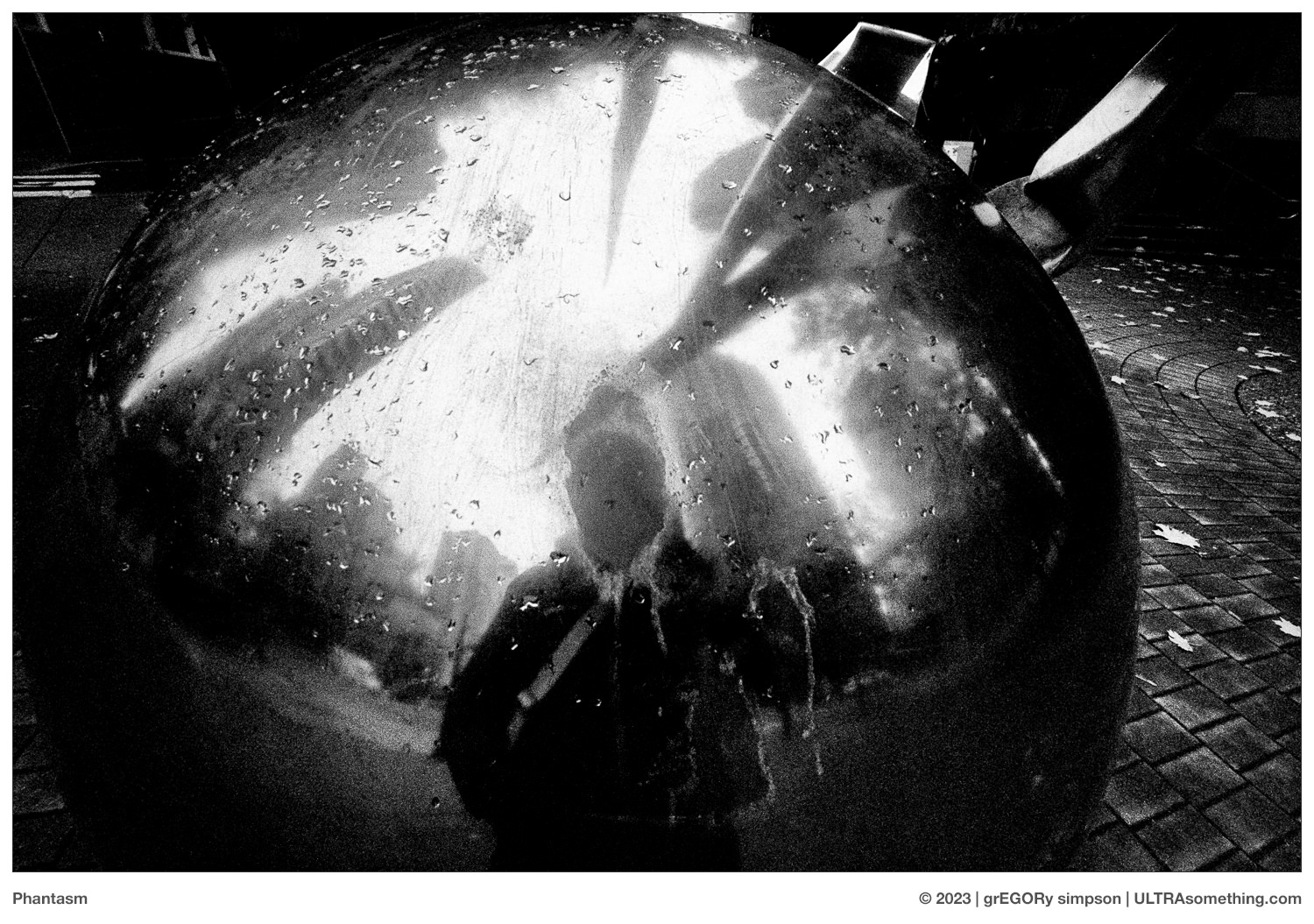
    So with that out of the way, here are the technical details for the nerds and the generally curious: ‘Phantasm‘ was shot on Fomapan 200, using a Leica M6TTL with a Voigtlander 15mm f/4.5 Super Wide Heliar lens, and developed in HC-110 Dilution H. The dead centre placement of the main subject (me) eliminates it from magazine consideration. ‘Amore‘ was shot on Fomapan 100, using a Pentax MZ-S with a Pentax-M 120mm f/2.8 lens, and developed in HC-110 Dilution H. Once again, the dead centre placement of the lucky hug recipient would end up in the magazine’s spine, so it’s being web-published instead. And if you think the motion blur has anything to do with my choice to exclude it from any future magazines, you obviously haven’t bought a magazine (or read this website for very long). ‘Mixed Messages‘ was shot on Fomapan 100, using a Pentax MZ-S with a 43mm f/1.9 Limited lens, and developed in HC-110 Dilution H. It ended up here because of its obvious relation to the article’s subject matter. ‘Philosopher‘ was shot on Ortho Plus 80, using a Hasselblad Xpan with a 45mm f/4 lens, and developed in HC-110 Dilution H. As a panoramic photo, its aspect ratio immediately eliminates it from magazine consideration. ‘Bottleneck’, like ‘Philosopher’ is simply the wrong aspect ratio for magazine publication, but like ‘Phantasm’ was shot on Fomapan 200, using a Leica M6TTL with a Voigtlander 15mm f/4.5 Super Wide Heliar lens, and developed in HC-110 Dilution H.

    REMINDER: If you’ve managed to extract a modicum of enjoyment from the plethora of material contained on this site, please consider making a DONATION to its continuing evolution. As you’ve likely realized, ULTRAsomething is not an aggregator site. Serious time and effort go into developing the original content contained within these virtual walls — even the silly stuff.

    Those who enjoy a tactile engagement with photographs are encouraged to visit the ULTRAsomething STORE, where actual objects are available for purchase.

  • EXORCISM 01

    EXORCISM 01

    For the past fourteen years, ULTRAsomething has maintained a mostly virtual presence — its photos no more tactile than the code that delivers them to your screen. About a dozen years ago, I self-published a photo book through a print-on-demand service. Its print quality screamed “MAGAZINE!” while its sticker price screamed “ART BOOK!” This disconnect lead me to two simultaneous conclusions. One, was that I would never release another book until I had the means for a luxurious printing. Two, was that as long as I could only afford to produce magazine quality publications, magazines were exactly what I would produce.

    Today, twelve years after that first publishing experiment, I still haven’t the means to create the photo book I’d like, but having completed my PhD in procrastination, I’m now publishing the first “brick & mortar” issue of ULTRAsomething magazine.

    I hope to produce several such volumes a year. Because each issue will require that I take a rather extensive number of photos in a rather constrained amount of time, chance will play a crucial role in the results. To ensure even less control over the outcome, all photos will bleed off the page — necessitating that each be brutally and unceremoniously cropped to the unwavering dictates of a page’s physical dimensions. Consequently, every issue will result more from purge than plan; more from exorcism than curation.

    Every photo in “ULTRAsomething | Exorcism 1” was shot this summer, and without any intent or purpose beyond my desire to gather visual vestiges of my daily life. They are merely accidents of where I happened to be, and what camera I happened to have. In this particular issue, everything was shot on film. Future exorcisms might contain a mix of digital content; or they might juxtapose new and old photos; or even have a more cohesive unifying theme. Predictions are futile — this is improvisational publishing.


    The above transcript is the apologia, and is the only text to appear in ULTRAsomething’s premier issue (or “exorcism,” as seems more poetically accurate). It serves to both explain and defend the 60-page publication, and each subsequent exorcism will contain its own apologia.

    My intent is for each issue to contain only photos never before published on the website — though any post announcing new exorcisms (such as this one) will obviously contain a few representational shots. Publishing this is crazy enough — publishing it without at least a modicum of marketing would be a step too crazy. Suffice to say, the vast majority of photos will be revealed in print. So if you want to experience them all in full 8.25” x 11” glory (or 16.5” x 11” glory for landscape-oriented shots), then your best bet is to purchase the magazine.

    And speaking of purchasing magazines, I’ve hacked together a rather pedantic but effective storefront, accessible from the STORE menu at the top of this page. Billing is currently handled through PayPal (though you don’t need a PayPal account). Eventually, I’ll implement a slicker cart — with the word “eventually” chosen precisely for its indeterminate characteristics. For now, please keep in mind that I’m only one guy, and my name isn’t “Amazon.”

    That said, I am like Amazon Prime in one important way: shipping will be free to locations in Canada and the continental USA. Unfortunately, I cannot offer free shipping to customers outside the USA and Canada… well, I could, but I would lose money on every sale. So I would kindly ask all international purchasers to please blame Canada Post, and not me.

    As you might expect, I haven’t slept much these past few months — designing the format; shooting/editing photos; building/tweaking the maquette; and establishing an infrastructure for future exorcisms. And all while continuing to hold down a “real” job.

    Next month, I’ll have more to say about the magazine, the philosophy behind it, and this new, expanded direction for ULTRAsomething. But for now, why not treat yourself to your very own Christmas exorcism?


    © 2022 grEGORy simpson

    ABOUT THE PHOTOS: The photos, shown here, appear in ULTRASOMETHING | EXORCISM 01 , but represent only a small subset of the images contained in the magazine — all of which were shot on film, with each of the following cameras contributing at least one photo to the publication: Black’s Sassy; Contax IIa; Contax G1; Fuji GS645 Pro Wide 60; Konica Autoreflex TC; Konica C35; Konica Hexar AF; Minolta TC-1; Minolta XTsi; Olympus Pen FT; Nikon 28Ti; and Pentax MZ-S. Yes, this is arguably excessive and marginally eccentric. But so is publishing a photo magazine in an Instagram world.

    REMINDER: If you’ve managed to extract a modicum of enjoyment from the plethora of material contained on this site, please consider making a DONATION to its continuing evolution. As you’ve likely realized, ULTRAsomething is not an aggregator site. Serious time and effort go into developing the original content contained within these virtual walls — even the silly stuff.

    Those who enjoy a tactile engagement with photographs are encouraged to visit the ULTRAsomething STORE, where actual objects are available for purchase.

  • Shooty Shoot Shoot

    Shooty Shoot Shoot

    It’s been a year of ULTRAexperimentation. In addition to my recent Folly Trilogy discussing three different “inappropriate” film cameras, I also wrote about another half-frame camera, and penned a couple of lens-based essays — one digging into fisheyes, and the other exploring the benefits of a particularly decrepit 90mm lens from the 1930s. For a site that purports to be more interested in the psychological aspects of photography than hardware, that’s a whole lotta gear talk.

    But with the year rapidly drawing to a close, I can now reveal that those weird gear articles were, in fact, just a carefully considered diversion — meant to buy myself time to engage in this year’s real experiment: to fundamentally alter my very approach to photography.

    For the past couple of decades, I would prowl the streets looking for the perfect photograph. Step-by-step, mile-by-mile, I’d scour every inch of this town hoping to bag the big one. My ratio of “shots taken” to “worn out shoes” was spectacularly low. And yet, in spite of all that walking and all that looking, I’ve yet to take a single photo I’d be proud to represent me on my non-existent Wikipedia page. Which, come to think of it, is probably the reason no one’s bothered to make me a Wikipedia page.

    Facing each new publishing deadline with an empty cache of perfect photos, I’ve been forced to fill these pages with a hodgepodge of miscellany — snapshots I would shoot mostly as “justification” for having bothered to leave the condo. On their own, none seem worthy of anything beyond a participation ribbon. But, as an assemblage, they would often say “something” — even if I was never able to fully comprehend exactly what it was.

    I’ve long believed my own photography’s grandest purpose isn’t to create an image that hangs on the wall, but to create a collection of images that, when bound together, communicate an entire universe of thought and emotion through metaphor and implication. When I do hang an individual photo or two, I suspect it’s due more to convention than consideration. To me, framing a single photograph is like framing a single word from a favourite novel or screenplay — its context is removed or, at best, merely implied through familiarity.

    For example, if I hung the word “Rosebud” over the sofa, it would indeed conjure a world of meaning every time I gazed upon it — but that meaning would come, not from the word, but from the context in which it was used within Citizen Kane. The word, itself, is not “perfect.” It’s the concept that’s perfect, and the single word is merely the proxy for an entire collection of other words and scenes. The same thing happens when I engage with some of my favourite photographs from some of my favourite photographers — an individual image becomes more potent, because I know the context from which it came. Seeing one is a gateway toward remembering them all.

    Does it strike you as “a little crazy” that someone who views photography this way, would then put so much effort into hunting for that one perfect photo? If so, then congratulations — you’ve reached the same conclusion I have, and you didn’t spend 20 years getting there.

    Perusing my oeuvre to date, it’s clear my personal favourites are often the most flawed, least perfect photos imaginable. They came from the monthly “hodgepodge of miscellany,” and not from any grand design. Which lead me to wonder why I’ve been so sparing with my exposures all these years. Since my “best” photos are the ones that best represent a collection, wouldn’t such representational photos become magically “better” if the collection itself became better? And wouldn’t the collection become better if I actually allowed myself the freedom to photograph anything that interested me, rather than self-limiting my exposures so as not to ‘waste time or money’ on shots I knew weren’t “perfect?”

    So my fundamental change is to do exactly what I’ve always done, except to disable my brain’s self-censoring circuit while doing so. Granted, on the surface it doesn’t really seem like change at all. But anyone who’s ever tried to rewire their brain knows how difficult that can be. It’s taken me the better part of a year, but after a lifetime of being the stingiest photographer in recorded history, I’m gradually moving into the vicinity of semi-prolific. Not “guy on vacation with a digital camera” prolific; not “mom instagramming the crap out of her baby” prolific; but “guy who spools a roll of film through a camera every five or six days” prolific.

    The question, now, is “what should I do with all these photos?” Just because I’m transforming into the photographer I want to be, doesn’t mean I’m transforming into one with a place in the modern world.

    One part of me thinks I should just leave them unpublished, languishing on a hard drive until it’s destroyed by solar flares or mechanical failure. There’s something poetically punk rock about that direction. After all, it’s exactly what would happen to these moments had I not photographed them — making my passion a rather apt metaphor for life itself. Another part of me thinks such conceit smacks of bad performance art, and that the photos should absolutely be published — somewhere. Somehow.

    But that’s a struggle for another essay. For now, all I really needed was to just take more photos. And on that front, the year has been a resounding success.


    © 2022 grEGORy simpson

    ABOUT THE PHOTOS: “Lobby 1” was shot on Fomapan 100 at ISO 100 and developed in HC-110 (Dilution H), using a Pentax MZ-S and a Pentax-M 50mm f/1.4 lens. “Lobby 2” was photographed on Fomapan 400 (pushed to ISO 800) and developed in Rodinal 1:50, using a Fuji GS645S Wide 60 camera. “Fetch” was shot with an OM Digital Solutions 40-150 f/4 Pro lens mounted on an Olympus OM-1 digital camera. “Criminal Intent” was another digital shot — this time using the Ricoh GRIII. “Empress Metaverse” and “Loo View” were shot on Delta 3200 (pulled to ISO 1600), inside a Contax G1 fronted with a Zeiss Planar 45mm f/2 lens, and developed in Rodinal 1:50.

    REMINDER: If you’ve managed to extract a modicum of enjoyment from the plethora of material contained on this site, please consider making a DONATION to its continuing evolution. As you’ve likely realized, ULTRAsomething is not an aggregator site. Serious time and effort go into developing the original content contained within these virtual walls — even the silly stuff.

  • The Folly Files III : Blurrography

    The Folly Files III : Blurrography

    What’s great about trilogies, is that you know precisely how many instalments you’ll need to endure… unless we’re talking about George Lucas, who has obviously deemed the dictionary to be a purveyor of fake news.

    Still, just because there are three of something, it doesn’t mean you need to consume them all. Which — Lucas example extended — is exactly what happened with me and the Star Wars “trilogy.” I nodded off during the first film; never saw the second (or third, fourth, fifth, sixth, etc); and have been shunned by my technology coworkers for decades since. So I’d like to thank the small smattering of ULTRAsomething’s larger smattering of readers who’ve soldiered through to this, the final chapter in the Folly Trilogy — a trio of articles discussing “taking photos with cameras that are utterly inconsistent with modern visual tastes or with 21st century photo dissemination techniques.”

    The first camera in this trilogy, the Kodak Stereo camera, qualifies as “folly” because its images, while likely to engage with an audience, are kept from doing so thanks to a 200 year dearth of suitable stereo viewing and distribution methodologies.

    Unlike the Kodak Stereo camera, the second camera — the Pinsta — produces images that can be easily viewed and distributed through traditional means — but it succumbs to “folly” because I, the photographer, can’t be bothered to spend the inordinate amount of time and effort required to produce a single decent photograph — much less a collection.

    The third and final camera in the Folly Trilogy — the Ford MVP — is easy to carry and enjoyable to shoot (unlike the Pinsta); while producing standard 35mm images (unlike either the Kodak or the Pinsta). Unfortunately, the Ford MVP is guilty of looking more like a camera than acting like one. So cheaply made, it makes the build quality of Lomography cameras look like Hasselblads. And its image quality? No reason to change the metaphor, because it also makes the output of a Lomography camera look like a Hasselblad. If you ever wanted to smear a lens with Vaseline to get a dreamy effect, but didn’t have any Vaseline handy, this is the camera to reach for.


    Obviously, Ford Motor Company didn’t make this camera, but they did slap their logo on the box — once offering it as incentive for customers to pony up for a new pony car. It’s from the same dubious lineage as the more widely known Time Magazine and Sports Illustrated cameras, which also served to sweeten the perceived value of parting with one’s cash. Unlike those zine cams, which had faceplates imprinted with the words “Time” or “Sports Illustrated”, the Ford is emblazoned with the letters “MVP”. Why? I have no idea, but I’m using it as a motivational tool. Preferable, too, is Ford’s decision to give it a swanky “chrome” body, which definitely out-hips those boring black magazine variants.

    I’m guessing the camera dates from around the mid-1980’s, which corresponds precisely with my time at Ford Motor Company — though my job developing Ford’s high-end, acoustically-tuned, premium/branded sound systems left me ignorant of the mechanizations of Ford’s marketing “brains.” This little bit of Egor trivia is precisely why my friend — one of the few people aware of my automotive past — leapt at the chance to connect the dots, and gifted me with a Ford MVP that she stumbled upon in a Portland camera shop.

    Belying a body made from Fisher-Price grade plastic, and a rewind crank that falls apart if you turn the camera upside down, the MVP sports a 50mm lens with an actual glass element. It even provides a modicum of exposure control via its pictograph-based aperture dial — its odds of relevancy depending, obviously, on your choice of film speed. Rumour has it the camera’s one and only shutter speed is 1/100s — which I figure is probably correct within an order of magnitude or two.

    The MVP is much heftier than I expected, which gives an impression of quality — though one that’s been debunked by various websites, which reveal the presence of a lead weight placed in the bottom of the camera to produce exactly this illusion. I was tempted to disassemble mine to confirm the weight’s actual chemical compound, but given the build quality of the rewind crank, I opted not to risk removing any screws from any plastic.

    The bottom of the camera proudly states “Made in Taiwan,” though I have yet to uncover its actual manufacturer, or who was responsible for its development. Not that it really matters, since designing butt-simple film cameras isn’t rocket science; much less automotive engineering.

    The better question is “who, in Ford’s marketing department, thought this would make a good promotional item?” Any glee a customer might have felt pulling this from their bag o’ new car swag, would surely dissipate once they drove that new Mustang to the Fotomat™ kiosk and picked up their prints.


    One of the main reasons I shoot half frame cameras (besides the fact I’m ‘cheap’), is their murky fidelity — somewhere between a photograph and a charcoal drawing. It’s a look I love, and one vaguely similar to that from the MVP, in spite of the fact it’s not a half-frame camera. However — not content with just a little smudge — the MVP pushes the murk factor into overdrive. It’s as if you took a half frame image; loaded the film on the developing reel without bothering to use a dark bag; processed it in exhausted chemicals; framed it behind a frosted sheet of plastic; and coated the corners with Canola Oil.

    I’ll admit, given the curious inclusion of a glass lens, I expected a modicum of fidelity. But once I extracted the first reel from the development tank, those expectations got slapped down by the big clammy hand of reality. The images this camera produces are an abomination — and this is exactly why I love it.

    Unfortunately (from a remuneration standpoint) my tastes are “utterly inconsistent with modern visual tastes.” So any camera that delivers such taste (in spades, no less) falls squarely into the trilogy’s definition of folly. Characterful images are contrary to the inclinations of the literally-minded, sharpness-obsessed influencers of today. Most folks want their camera to define the subject, not interpret it. They want to see details, not suggestions. Perhaps, if this was the late 19th century and the dawn of pictorialism, it would be a camera of desire — much like the Kodak Stereo camera would have been a camera of desire in the mid-19th Century. But now? In a time where the vast majority of humans equate idealized, hyper-realism with great photography? The Ford MVP is going to offer the opposite.

    Fortunately, folly will always find a home at ULTRAsomething — because every fool needs a paradise.


    Final Ratings:

    Personal Enjoyment Factor : 7. It would have been an “8,” but I dinged it a point for the mindful vigilance required to keep the camera upright, so the rewind crank remains intact. Viewing its photos is also quite enjoyable if, like me, your tastes reside on the outskirts of sanity. The MVP is like many of my favourite, no-budget, 1970’s drive-in movies — so bad it’s good.

    Convenience : 8. Sure, it could be more convenient if, instead of manually setting the exposure via pictograph, the camera set it automatically. Then again, imprecise exposure is part and parcel of the camera’s gestalt, so any auto-exposure feature would need to include an element of randomness… which, come to think of it, would definitely be a camera I’d buy.

    Long Term Potential : A safe and natural alternative to antipsychotic medications. As someone who has a tendency to occasionally step into a quagmire of banality and literalism and grow woefully depressed because of it, I need only point this camera at the most tiresome and vapid of subjects, look at the prints, and be instantly pulled from my moronic morass.


    © 2022 grEGORy simpson

    ABOUT THE ARTICLE : This is the final instalment in a trilogy of articles exploring cameras that are totally at odds with the expectations and demands of 21st Century life. The first was here, and the second was here. Many of you will be pleased to learn that, were it not for my heartless ability to exclude several worthy contenders (including the Insta360, a sample of which is seen to the right), this “trilogy” could easily have turned into an extended “series.” You’re welcome.

    Regarding that Ford JBL Audio Systems tear sheet: Toward the end of my time at the company, there was actually a brief collision between my audio design duties and Ford’s marketing department. This glaringly patriarchal ad, which I assure you I had no hand in creating, ran in all the major stereo and hifi magazines that year. Alas, though my hand wasn’t in the ad, the same can’t be said for my face, which is on the far left, looking so very… um… I’m lost for an adjective here. I was paid $1 for the shoot, which marked both the beginning and the end of my professional modelling career.

    REMINDER: If you’ve managed to extract a modicum of enjoyment from the plethora of material contained on this site, please consider making a DONATION to its continuing evolution. As you’ve likely realized, ULTRAsomething is not an aggregator site. Serious time and effort go into developing the original content contained within these virtual walls — even the silly stuff.

  • The Folly Files II: Toilography

    The Folly Files II: Toilography

    If patience is a virtue, then Satan’s in the kitchen, whipping up canapés for my impending “Welcome to Hell” party.

    Every couple of days, I venture out — camera in hand — for a quick 8 km walk. On an average day, I’ll push about a dozen frames through a camera — rarely bothering to pause for the 1/60th of a second it takes for the shutter to complete its journey across the film plane. Occasionally, with reservation, I might slow down slightly when I snap a photo. But a full stop? Who has the patience for that? Blurry schmurry. I’ve got things to do.

    Related to my impatience — and the reason why Satan’s also enlisted a crack team of demon sous chefs to prepare some delightful amuse-bouche offerings — is my pathological need to be unencumbered. I don’t want useless crap weighing me down or impeding my freedom of motion. No backpacks; no bulging pockets; no bulk; no weight. One look at the preponderance of compact cameras in my cabinet will confirm this. The heaviest, most ponderous cameras I own are probably the Leica rangefinders.

    So with this is mind, what’s the silliest camera I could possible buy? A large format camera, you say?

    Surely, you don’t think I’m that foolish!


    OK. I’ll admit — overcome by a completely unrealistic notion that I would somehow magically become someone I’m not — I did purchase a large format camera earlier this year. But in my defense, it’s “only” a 4×5 (not an 8×10); has a pinhole (rather than a bulky lens); and is made entirely of plastic — placing its weight squarely in line with other cameras in the cabinet. But if you think these caveats somehow exclude me from the rank of “imbecile” on the Levine and Marks 1928 IQ Classification Scale, we need to dive a little deeper.

    The camera in question is a “Pinsta” — a modern 4×5 pinhole kickstarter camera, designed to capture images on direct positive paper, rather than on a negative. What distinguishes it from other direct-positive pinhole cameras is the way it doubles as a portable darkroom — enabling you to develop the print right inside the camera. I suppose this is what puts the “insta” in “Pinsta” — at least if you’re the sort who measures time in “eons.” The manufacturer also advertises it as a camera “that fits in your pocket.” Seeing as it makes a twin-lens Rollieflex look svelte, I’m assuming the Pinsta folks must also be in the couture business, and that their new PinstaPocket™ baggy burlap ready-to-wear SackPants™ collection has yet to hit the Paris runways.

    So — bearing in mind my Hell-bound tendency toward impatience, and my accompanying pathological insistence on unimpeded mobility — let’s explore, point-by-point, the various conflicts betwixt myself and this camera.


    To begin, it’s a large format camera — designed to take exactly one shot before you need to reload it. And loading a large format camera isn’t as simple as popping in a new 35mm cassette, or unspooling a fresh roll of 120 film. Instead, it requires putting both the camera and direct positive paper into a changing bag; zipping it up; opening the camera; unboxing the paper; removing a sheet from the inner light-blocking plastic bag; fumbling around to feel which side is the emulsion side; inserting it in the camera; putting the paper back in the bag/box; reassembling the camera; unzipping the bag and extracting the camera.

    After that, the camera needs to be mounted on a tripod, positioned and levelled — a further interminably exasperating act, which is exacerbated by the fact that the Pinsta is not a view camera. In fact, there is no viewfinder at all — no ground glass focussing screen; nothing. In order to know what is and is not in the frame, I need to crouch, squat, and contort my body to look through the camera’s little sight line aids — one pair for each of the four corners of the image.

    And if this wasn’t slow enough, consider that the images are not being exposed on film, but on paper — paper that has an ISO of 3. Yes, THREE. Which is pretty drastic, considering I think ISO 100 film is borderline “too slow.” So recording onto a medium that’s 5 stops slower means standing around 32 times longer waiting for it to expose. For those of you thinking, “chill out, dude — 1/2 second isn’t that much longer than 1/60th of a second,” let me remind you that this is a pinhole camera. Which means I’m not shooting at f/8, I’m shooting at f/zillion (give or take — I haven’t bothered to do the math).

    The simple “Sunny 16 rule” isn’t quite as simple when you’re dealing with these sorts of film speeds and aperture openings. So I need to spend a bit of time staring at the scene — peering into the shadows; gazing at the sky; and assessing the overall dynamic range — all in an effort to make a total wild-ass guess as to how long the exposure should be. Usually, on a typical overcast Vancouver day, it’ll take several minutes for enough light particles to march single file through the tiny opening to expose the paper.

    Once I make my wild-ass guess, I enter it into my iPhone’s timer app, open the Pinsta’s shutter, and stand around for the next several minutes — waiting for the paper to record an image, and wondering why I don’t just take a shot with that very same iPhone, and move along.

    Also, as someone who likes to practice the fine art of invisibility whilst taking photos, I can assure you this is not an invisible act — the changing bag on the ground; the tripod’s footprint; all that crouching and squatting and scrutinizing of some big goofy black box — people will notice you. They mill about, looking quizzically at the process, yet they remain oblivious to the fact that an actual photo is being taken — passing in front of the “lens”, or even parking themselves there in an effort to work out what I’m doing and why I’m now just standing around doing nothing but looking bored.

    When the alarm goes off and I close the shutter, a full fifteen minutes will have passed between the time I decided to take a photo and actually took it. Alas, the process doesn’t end there. After all, I can’t take another photo until I’ve developed and removed the film I just shot.

    This is where things get particularly interesting, since I’m now required to extract three large syringes from a giant backpack — one filled with developer; one filled with fixer; and the third filled with water for washing — and inject them, one-after-the-other into the body of the camera.

    Needless to say — in the middle of an urban location with an epidemic of open drug use — anyone juggling syringes full of brown liquid does not exactly garner positive attention. At this stage, I know I need to move quickly before the cops arrive — but it’s hard to be quick when you’re developing a print.

    The contents of the first syringe get injected into the camera and the whole box gets swirled around for a minute or two, making sure fresh developer constantly flows over the print. The syringe protrudes from the camera the whole time — waiting for me to suck the liquid back out of the box and horrify anyone still in the vicinity.

    Next I inject the fixer, which requires about 5 minutes of swirling and swishing before it too gets sucked back into the syringe, followed by another syringe, which injects water, which washes the print for another minute or so.

    At this point, I crack open the camera, whip out a knife (exhibiting yet more anti-social behaviour) and use it to pry the saturated, shiny, dripping wet print from the camera back. I shake off the excess fluid, sandwich the print in a drying frame, seal it in a ziplock bag, and slide the whole thing into one of the backpack’s outer pockets.

    The camera gear gets dried off; the syringes get put away; the tripod gets folded up; the changing bag gets rolled up, and the entire shebang gets stuffed back into my multitude of bags and packs, ready for the next spot.

    And speaking of spots, I can really only photograph a maximum of three locations before the chemicals are exhausted — and, truth be told, that third development is rather woeful. So, unless I plan to haul all this around for the purpose of taking only two photos, I need to also carry an additional jug full of pre-mixed developer; another full of pre-mixed fixer; and a third filled with water. I also need to carry an even larger, empty jug for disposing of the exhausted chemicals.

    So basically, it takes me 30 minutes to take the same photo I could have taken in 1/60th of a second with any other camera.

    Shooting with the Pinsta is not just a ridiculous drain on the amount of time I have left on earth — it’s an equally ridiculous burden on my need for unencumbered mobility. On a normal photo excursion, I carry — in one hand — a single camera with only the lens that adorns it. A tiny, empty bag is slung over my shoulder — just in case Vancouver does its thing and begins to drop rain from the sky. But a Pinsta-based photo excursion means packing a full size backpack, a large shoulder bag, and a tripod — basically the same amount of gear the average college graduate uses to travel the world in their “gap” year.

    Fortunately, I can endure anything — even an assault on both my patience and mobility — should the results prove worth it. Alas, one look at the smattering of photos contained within this article indicates they are not. There are far easier ways to take grungy photos — one of which will be featured in Part Three of this trilogy.

    I have no doubt this would be a dream camera for someone who isn’t me, or isn’t anything like me. A hermit monk perhaps; or maybe someone who breeds pack mules; or, at the very least, someone whose personality aligns, rather than clashes with their romanticism. There are definitely people for whom the Pinsta will unlock their creativity, rather suppress it; who will bond with the workflow, rather than rebel; and who will use it to create works of art that trample everything I’ve done in my 30+ years of hit and run photography. But in my hands it is, without peer, an object of sheer folly. In the words of Dirty Harry, “a man’s got to know his limitations.”


    Final Ratings:

    Personal Enjoyment Factor : On a scale of 1 to 10 (10 being most enjoyable), it rates a negative 3 – ’nuff said.

    Convenience : On a scale of 1 to 10, (10 being most convenient), it rates a negative 8 – also ’nuff said.

    Long Term Potential : Craigslist


    © 2022 grEGORy simpson

    ABOUT THE ARTICLE : This is Part 2 of a three part series exploring the use of cameras totally at odds with the expectations and demands of 21st Century life. Part 1 is here and Part 3 is here.

    ABOUT THE PHOTOS : As with all cameras, the image is inverted on the film — but because I’m shooting to direct positive paper, the usual film-to-paper image reversal does not occur. Sure, since I’m simply photographing the 4×5 prints for publication, I could just flip the images in Photoshop — but that seems contrary to the spirit of this camera, so all images remain reversed — exactly as they appear on the physical prints.

    Also, I should note that the introductory photo — which shows some of the gear required for a basic Pinsta excursion — is missing a few items, such as the aforementioned knife, plus some towels for drying the camera between shots, and a few large ziplock bags for protecting the wet prints — increasing the bulk and the burden beyond what you see here, and what was able to fit on my table. And yes, “The Making of Skeletal” was, indeed, shot with the iPhone while I was standing around, waiting for the Pinsta exposure to finish.

    REMINDER: If you’ve managed to extract a modicum of enjoyment from the plethora of material contained on this site, please consider making a DONATION to its continuing evolution. As you’ve likely realized, ULTRAsomething is not an aggregator site. Serious time and effort go into developing the original content contained within these virtual walls — even the silly stuff.

  • The Folly Files I: Stereography

    The Folly Files I: Stereography

    Cheesy British horror anthologies occupy a soft spot in my heart — along with cheesy Italian horror anthologies; cheesy Japanese horror anthologies; cheesy Korean horror anthologies; and… oh, who am I kidding? My heart is big enough and soft enough to accommodate the entire spectrum of 20th century genre cinema.

    The point, however, is that sometimes an assemblage of short schlocky silliness is just what the doctor ordered — were I lucky enough to have such a doctor. And if this is true for genre cinema, perhaps it’s true for genre blogs — which I guess is what ULTRAsomething is… though I’ve never really been able to classify its precise genre.

    So with this in mind, I decided to craft ULTRAsomething’s next three articles as if they were vignettes in an overarching theme — a theme that, when all three entries were combined, would be about the length of a typical article.

    Well, that didn’t happen. This — the first so-called “vignette” — was supposed to clock in at about one-third the length of a typical essay. Instead, it wound up being twice the length. Fortunately, I’m nothing if not adaptable, so instead of calling this next series of three articles an “anthology,” I’m calling it a “trilogy.” Problem solved.

    Semantics aside, the thematic structure of the trilogy remains the same as the anthology. Each of the next three articles, whatever their length, will revolve around a different camera — and when I say “different,” I mean “utterly inconsistent with modern visual tastes or with 21st century photo dissemination techniques.” Each camera is a folly unto itself, and each will make you (and me) question whether I harbour some hidden desire to burn my web stats to the ground.

    On with the show!


    Our first folly is the Kodak Stereo camera from the mid-1950’s.

    It’s a rather unorthodox looking box of brown bakelite — the sort of thing that invites unsolicited commentary from total strangers. For this reason, toting the camera on a photo walk requires allocating extra time for the inevitable conversations it provokes. I discovered this on my very first outing, when I ducked into the local grocery, and quickly found myself engaged in the following conversation:

    Clerk: “Is that a real camera?”

    Me: “Yes.”

    Clerk: “Does it work?”

    Me: “Yes.”

    Clerk: “It looks so weird.”

    Me: “It’s a stereo camera. That’s why there are two lenses.”

    Clerk: “Oh, so it’s a radio.”

    Me: “No, it’s a camera. By stereo I mean it takes 3D photos.”

    Clerk: “Like in a circle?”

    Me: “No. It takes images that look 3-dimensional, as if they had depth.”

    Clerk: “I’ve never heard of anything like that.”

    Me (in my mind): ‘Of course you haven’t. It predates social media.’

    Curiously, she was only the first of three that week, who asked if it was a “real camera.” I’ll admit, I’m as confused about why someone would ask this, as they are about why I’d sling such a thing over my shoulder.

    Had I more time (or had they enough interest), I could have explained that the camera’s two lenses are separated by a distance equivalent to that which separates our eyes. One press of the shutter captures two simultaneous images on film — distinguished only by the parallax shift inherent with such separation. When these images are combined in some special way, or viewed side-by-side with (or without) the aid of a stereoscope to merge them, the two images form a phantom centre image, which has a pronounced 3D effect.

    Using some surprisingly sharp lenses, the 35mm Kodak shoots 20 pairs of stereo images on a strip of 36 exposure film. Each image is 23 x 24mm in size, and the way each stereo pair is entwined with other stereo pairs on the film makes scanning a bit tedious, but the results (I believe) are worth it.

    I’m sure, to anyone who’s only ever taken a photo with a telephone, 1950-something sounds like an eternity ago. They might even believe this camera dates from the dawn of 3D photography, but they’d be wrong. The fact is, stereo photography is almost as old as photography itself.


    Niépce took his first photo in 1826 — a mere six years before Charles Wheatstone realized you could take two side-by-side photos and gain access to that precious third dimension. But the whole concept really took off in the 1840s, when optical physicist David Brewster slapped a couple of refracting lenses onto a stereographic viewing device, and caught the attention of Queen Victoria. Thanks to the royal thumbs-up, stereographs lit a fire beneath the rapidly evolving caldron of photographic techniques, and within months the London Stereoscopic Company had manufactured hundreds of thousands of stereoscopes plus a million stereographic prints — employing teams of photographers to travel the world to take 3D images.

    Unfortunately, Brewster’s stereograph was not very forgiving of those with either non-aristocratic incomes or less-than-perfect vision, and many people — Oliver Wendell Holmes included — would get headaches from using them. This prompted Holmes to partner with Joesph Bates, and invent an extremely simple, lightweight, handheld device with an adjustable lens-to-photo distance that allowed people with crappy vision and a beer budget to also enjoy 3D photos.

    Stereography remained popular for a couple of decades, until it became a victim of its own success — attracting photographers with both dubious imaging skills and a penchant for rephotographing other photographer’s stereo cards. With declining image quality came declining interest. An economic downturn further dampened the appeal of the stereograph, as did the inevitable backlash that occurs when one generation yields to the next. In this case, it was a hip, new breed of young photographers — engaged in the hip, new school of “pictorialism” — who universally proclaimed stereography “a gimmick,” and declared photography’s true purpose was to give an artist’s impression of a scene, and not a clinical rendering.

    3D fell from favour in the art world, but found new life in the educational market, where ‘clinical renderings’ were considered a good thing. Over time, as movies and television introduced their own third dimension (time) to the photographic image, the educational market began to erode, and stereographic interest shifted to motion pictures, which adopted another ancient viewing method: the “anaglyphic magic lantern.” Unlike the stereo cards favoured since the Victorian era, this technique did not project two separate side-by-side images, but instead coloured one red and the other cyan, and superimposed them into a single frame. In order to see the 3D effect, viewers used special glasses with one red lens and one cyan lens, thus ensuring each eye would see only the correctly coloured image. As ubiquitous in the mid-20th century as stereoscopes were in the mid-19th, I suspect anyone who’s old enough to remember the panic surrounding Y2K is likely to have at least one pair of cardboard red/cyan 3D glasses in the bottom of a forgotten drawer or box.

    As the years progressed, 3D continued to go in and out of fashion — and with each resurgence came and went other viewing methodologies. The simple red/cyan anaglyph glasses yielded to more advanced polarized glasses, which yielded to the active shutter glasses that fuelled the failed 3D TV market in the early part of the 21st century. Lenticular prints and their online equivalent, the “wigglegram”, represent two more attempts to create widespread acceptance of simple 3D photographic stills — each but a blip in the trash heap of trends.


    It’s clear that the one unifying factor in stereography’s 200 year struggle to succeed has been (and continues to be) the absence of a suitable viewing mechanism — something I find rather strange. After all, most of us have two eyes with variable focus capability; and there are two images in front of us — so why do we need a mechanical viewing aid at all? Why not just refocus our eyes to form a phantom stereo image between the two projected halves? We can all position ourselves between a pair of stereo speakers, and without donning some sort of elaborate, rickety contraption, we can hear the instruments spread across a phantom sound stage. Our eyes’ ability to localize objects is no different than our ears’.

    I’ve had a fascination for stereo photography since, as I child, I first peered through a beige Model G View-Master at a handful of God-awful tourism reels. But it was enough to hook me, and I have subsequently engaged with far more (and far more obscure) types of stereo images than I discuss in this cursory introduction. In the 30 years since I decided to take the leap from photography connoisseur to actual photographer, I’ve wanted to get involved with stereography — but the distribution problem has always stopped me.

    Now, however, in my new guise as a photographer who doesn’t give a crap about his legacy, I’ve decided to finally take the plunge.

    In general, I’ve settled on three techniques for displaying stereographic images:

    Method one (and my favourite, by far) is the classic Victorian approach of stereo cards and an Oliver Wendell Holmes style viewer. Alas, not only is it the most internet-hostile of the techniques, it’s even gallery-hostile — since only one person at a time can engage with a stereograph. This approach guarantees I’m the only one who will see the photos in their greatest glory — hence the need to be comfortable with obscurity.

    Method two is the humble red/cyan anaglyph, which can be vaguely satisfying when viewing images online — provided one is willing to rummage around a few drawers and boxes to find that old pair of cardboard glasses. Without such glasses, however, the photos are pure gobbledygook.

    Method three, which I find to be the most satisfying for online viewing, is the crossed-view presentation technique. This method requires absolutely no goofy viewing devices and uses nothing more than our own eyes — just like people listen to stereo with nothing more than their own ears. However, many people do need to practice a bit in order to see the phantom image. And sadly, if I’ve learned anything from my time on earth, it’s that most people would rather buy their way to an instant solution than practice their way to a free and better one.

    I have posted both crossed-vision and anaglyph images with this article. Those of you without benefit of a ratty old pair of glasses, but who still want to see some stereographs, will need to apply the crossed-view technique. For the unfamiliar, it works like this:

    1. Size your browser such that it’s wider than 1200 pixels.
    2. Click one of the cross-view photos to open it full size (1200 pixels wide).
    3. Position your eyes a little bit more than arm’s length from your computer, and focus on the screen.
    4. Slowly begin crossing your eyes until the two images form a centre, phantom image. It works best if you concentrate on aligning only one single element in the frame (preferably in the foreground). Once aligned, the stereo image should seem to almost snap into place and your eyes will lock focus — allowing you to peruse the image in full 3D glory, and without any viewing aid. If you feel your eyes crossing uncomfortably, you’re trying too hard. In general, your eyes only cross about as much as if you were trying to read a book pressed close to your face.

    And if, after practicing, you’re still unable to form the phantom image, don’t sweat it — I’ve got an entirely different folly camera with which to horrify you in the next installment…


    Final Ratings:

    Personal Enjoyment Factor : 8 – this thing is a blast to shoot. Its only downside is it’s rather addictive and causes me to constantly prowl for scenes that would ‘look good in 3D’ even when I’m carrying a regular camera.

    Convenience : 2 – The little aperture slide on top of the camera is a bit fiddly to set, and its through-the-viewfinder bubble level — while both handy and important — triggers 20 bouts of photographic OCD per roll. Scanning is a pain, since pairs are interleaved on the negative, requiring a lot of shuffling back and forth, with every left frame needing its scan exposure documented, so as to set a matching exposure for the right frame. Post processing is also a bit tedious (particularly since I employ three entirely different display techniques), but I’ve mostly automated that now. In general, when you consider the entire process from shooting-to-displaying, this is probably the fussiest camera I’ve used… but it pales compared to next month’s camera…

    Long Term Potential : To taunt me from the camera shelf until I finally take that series of impressionist 3D photos I’m planning — photos that will ultimately become my greatest achievement. But with no ability to display them to a mass audience, I will eventually succumb to a devastating psychological breakdown, and a lifelong dependence on anti-depressants.


    © 2022 grEGORy simpson

    ABOUT THE PHOTOS: Yes, these images are rather pedantic — so much so that I haven’t even bothered to publish them in a proper ULTRAsomething display format. That’s because, first and foremost, I needed to get comfortable with how the Kodak Stereo camera ‘draws’ a scene in 3D, and I had to devise a scanning and display methodology, as well. At this point, I’m now comfortable with the process, so my next goal (as mentioned in the article) is to start using stereography to create impressionist images — ’cause it’s about time someone thumbed their nose at all the pictorialists who ruined 3D photography in the late 19th century.

    REMINDER: If you’ve managed to extract a modicum of enjoyment from the plethora of material contained on this site, please consider making a DONATION to its continuing evolution. As you’ve likely realized, ULTRAsomething is not an aggregator site. Serious time and effort go into developing the original content contained within these virtual walls — even the silly stuff.

  • Legacy

    Legacy

    Some people live for the here and now; and some live for the future. I’ve historically been one of those future dwellers — always planning; always sacrificing today for the promise of a better tomorrow. Funny thing though: the older you get, the less of a future you have. It’s one of those immutable laws of physics that eventually forces many a “futurist” to become a “here and nower.”

    To date, I’ve failed to budge one iota from a tendency to plan several decades in advance — decades that, thanks to those immutable laws, now stretch into the afterlife, and the somewhat nebulous notion of “legacy.”

    As legacies go, mine is a bit ramshackle. There were a couple of synth pop albums in the early 1990’s — neither earned me a dime, though friends did report hearing the music while on-hold for Microsoft Tech Support. So I’m pretty sure I don’t want that as my legacy. Additionally, I’ve had a significant hand in numerous music technology innovations — particularly early in my career. These, however, were all conceived and designed while employed by some company or another, and are thus unrecognizable as a personal legacy. Also, there’s that BC License Plate, which is sort of the photography analog to the Microsoft hold music. Which, pathetically, just leaves this website…

    Legacy-wise, it seems I have less to mark my time on earth than the guy who knocks up his girlfriend at the high school dance.

    But recently — and surprisingly — that iota of mine seems to have shifted ever so slightly, and I’m beginning to think living for the future isn’t really the sophisticated endeavour it’s cracked up to be. Society tends to put us planners on a pedestal, as if careful consideration of one’s future actions is more noble than succumbing to the lure of current delights. But is it? As a lifelong model of such virtue, I’m questioning whether all this planning isn’t just an elaborate ruse — concocted by my subconscious as a way to pretend I’m doing something useful with my life when, in fact, I’m not doing a damn thing. When you live for today, you can assess your situation, and adjust accordingly to maximize each moment. When you live 20 years in the future, there’s no accountability — so you get to be a little lackadaisical on the fine details.

    Besides, when did anyone who’s planning 20 years into the future ever achieve a single one of their objectives? What good is living for a future that never comes? When I was 10 and planning for 30, my world was consumed with designing fashionable jetpacks and garages with retractable roofs to facilitate my hovercraft. As I aged, my planning became more practical, and as little as a decade ago, my scenario for this year involved being retired from my day job, working on ULTRAsomething full time, and making annual pilgrimages to Japan. Unfortunately, these plans seemed to collide with someone else’s plans for a worldwide pandemic, savings-eradicating inflation, and a generational disinterest in both the written word and in any sort of metaphoric and/or ‘social landscape’ photography.

    If I can’t make feasible plans for life in the future, how am I supposed to make them for death? Why worry about legacy when I don’t even have a currency?

    Putting aside my suspicion that legacy planning is merely a mollification of a life lived for naught, there’s another sticky issue: 100 years from now, will there be any humans left to care? That was the timeline for human extinction, suggested by Stephen Hawking at the end of his life — and I’m starting to think he was an optimist. So it’s pretty silly to invest all this time and energy into building a legacy, when there’s only going to be another generation or two. Tops.

    So all these plans I’m making for my work to outlive me? They’re as absurd as designing a house with a hovercraft garage. Wouldn’t the more sensible plan be to simply try to take a photo that pleases me when I look at it? Or write a piece of music that I want to listen to? Or pen an essay I actually want to re-read?

    Besides, no one really gets to choose their own legacy. Show me the reanimated corpse of most anyone famous, and I’ll show you one ticked-off zombie — annoyed to discover all the inaccurate quotes, actions and beliefs that society has wrongfully attributed to them. My intentions in life are misunderstood enough — I can only imagine how they would be interpreted in death.

    What is legacy really? And why do we all want one? At its most basic, it’s really just a desire to be remembered… or at least to have had one’s existence acknowledged. I’ve always balked at the idea that children are a legacy, even though it’s the most surefire way of being mentioned for another generation or two. Some people are so desperate to be remembered, they don’t even care what it is they’re remembered for — just some post-mortem acknowledgement that they once roamed the planet. But what’s the point? I certainly don’t know anything about the people who don’t yet exist, so why care if they know anything about me?

    So I’m making a conscious effort to step away from the “legacy planning” thing. And while there’s still a little of it left, I’ll be diving head first into the “here and now.” Obviously though, before doing anything too rash, I’ll need to consider how future generations might perceive this decision of mine… I wouldn’t want to do anything to tarnish my legacy.


    © 2022 grEGORy simpson

    ABOUT THE PHOTOS: “Optimism Rally” was photographed with a Leica M10 Monochrom, fronted with a 21mm f/3.4 Super-Elmar-M. “Shoddy Matinée” was shot on Fomapan 100, inside a Nikon 28Ti, and developed in HC-110 (H). “Condo Living” was photographed through a 35mm f/3.5 Elmar LTM lens and Leica IIIc, onto Tri-X at ISO 400, and developed in HC-110 (E). “Placeholder” was shot on FP4+ at ISO 125 and developed in HC-110 (H). The camera was the cheapest bit of utter crap I could possibly find. It shall remain ‘nameless,’ since it’s a gift I’ve yet to present to a photographer friend. Hmm… maybe this is indicative of why I have so few friends.

    REMINDER: If you’ve managed to extract a modicum of enjoyment from the plethora of material contained on this site, please consider making a DONATION to its continuing evolution. As you’ve likely realized, ULTRAsomething is not an aggregator site. Serious time and effort go into developing the original content contained within these virtual walls — even the silly stuff.