If you’re reading this article on or around the date it was posted, then you’re experiencing ULTRAsomething’s brand new version 2 website. Visitors from the distant future are more likely gazing upon some yet-to-be-designed variation, meaning this post is now out of date — so just tell your A.I. synopsis-izer to skip it.
In truth, calling it version 2 is inaccurate. The site bounced off its first satellite at the turn of the millennium — coded entirely in Dreamweaver, and with the singular purpose of hosting my online product design portfolio. It endured several redesigns over the years, before succumbing to its first major upheaval in December 2008 — when my coding switched to WordPress, and the site’s purpose shifted into the photography (and sometimes music) blog you see before you.
From 2008 through 2025, the site and its purpose remained mostly unchanged, albeit with numerous redesigns along the way. At the end of 2025, I released my So Far So So anthology book, which seemed like a perfect time to jettison the old site and begin anew.
The most crucial thing was to scrap the rickety 18-year-old WordPress code upon which this site was built. Though ULTRAsomething may have looked good to the naked eye, the code supporting it was made of twigs and gravel, held together with a heaping helping of coding bandaids, glue, and work-arounds. Every time WordPress updated their code, I would have to implement more hacks to keep the site online. So, my first order of business in 2026 was to re-code the site from the ground up using only the absolute latest WordPress techniques.
Since the old site functioned rather well for my needs, save for not incorporating a proper shopping cart (which the new site also doesn’t have), I decided to keep it structurally the same. So, it looks and works almost exactly like the last site — perhaps not quite as elegantly, but elegance requires code maintenance that I just don’t have time for. As part of this process, I also created an 18-year PDF archive of ULTRAsomething posts (one PDF per year), with each PDF containing all the posts, photos and reader comments for that calendar year. My initial plan was to remove ALL previous HTML content from the web, but I’ve decided to leave it online for the time being. Historians can choose whether they want to read the old HTML posts, or the shiny new PDF downloads.
So, if version 2 (which is really version 3) is essentially the same as version 1 (which was really version 2), then what makes it worthy of the version 2 moniker? The answer is ‘philosophy’.
Basically, instead of altering the way you (the reader) views the site, I’m shifting the way that I (the writer) views it. I am abandoning my self-imposed dictate that I publish something at least once a month (a dictate I previously said I was abandoning, but didn’t). I’m also going to post whatever I want whenever I want. If it’s just a single photo with no text, then so be it. If it’s just a single sentence with no photo, then so be it. A song idea; an amusing anecdote; a bit of news; an unrealized plan; a project in progress — basically, anything I choose to share will get shared, no matter how banal. Previously, with very few exceptions, I would only post fully-baked articles in which I explored every angle of some topic’s banality. No more — baking articles just isn’t how I want to spend my remaining years.
So welcome to ULTRAsomething 2.0. Debugging continues, but the bulk of the work is complete. Hopefully this version’s underlying code lasts until it becomes my estate’s responsibility to update it, and not mine.
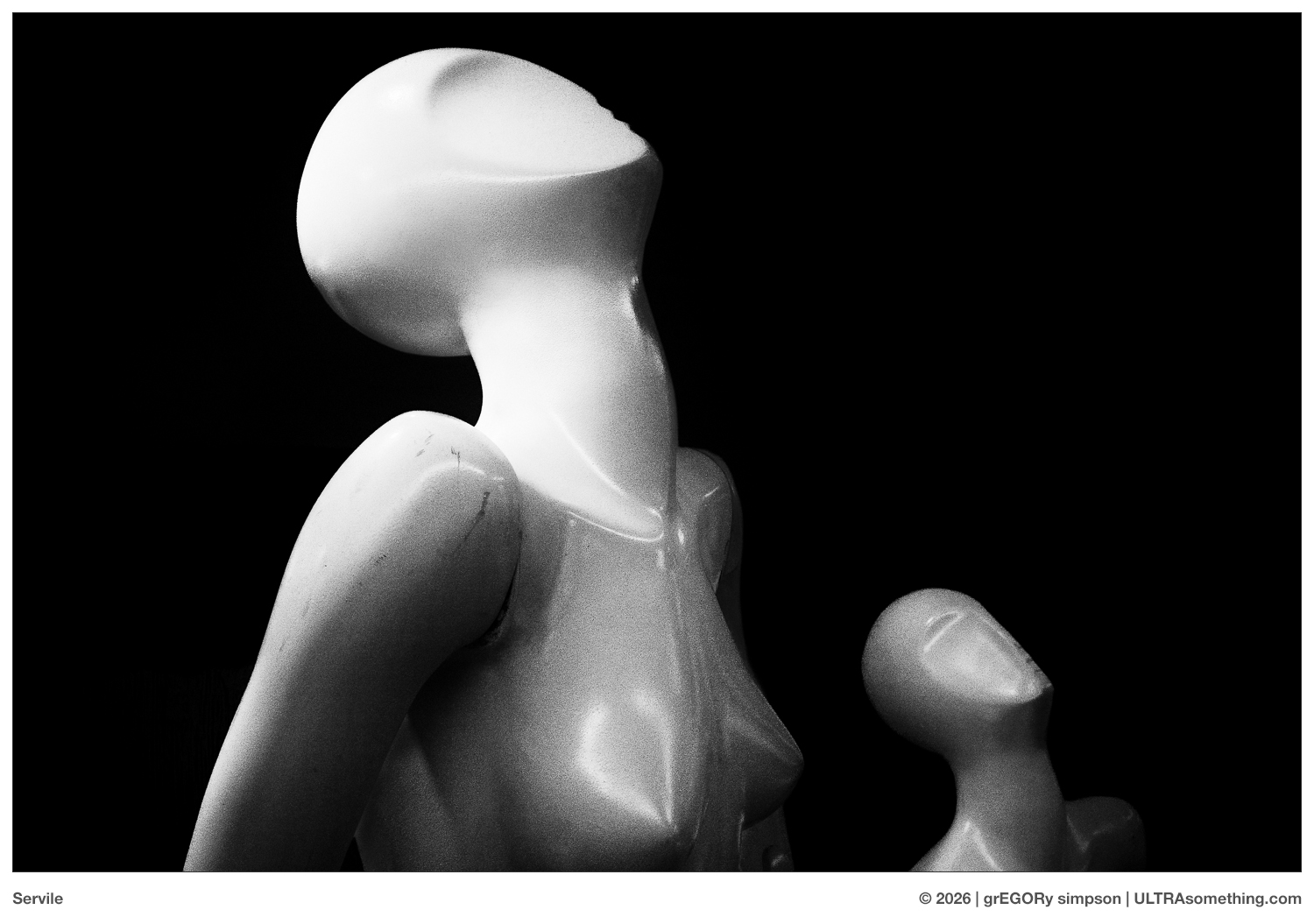
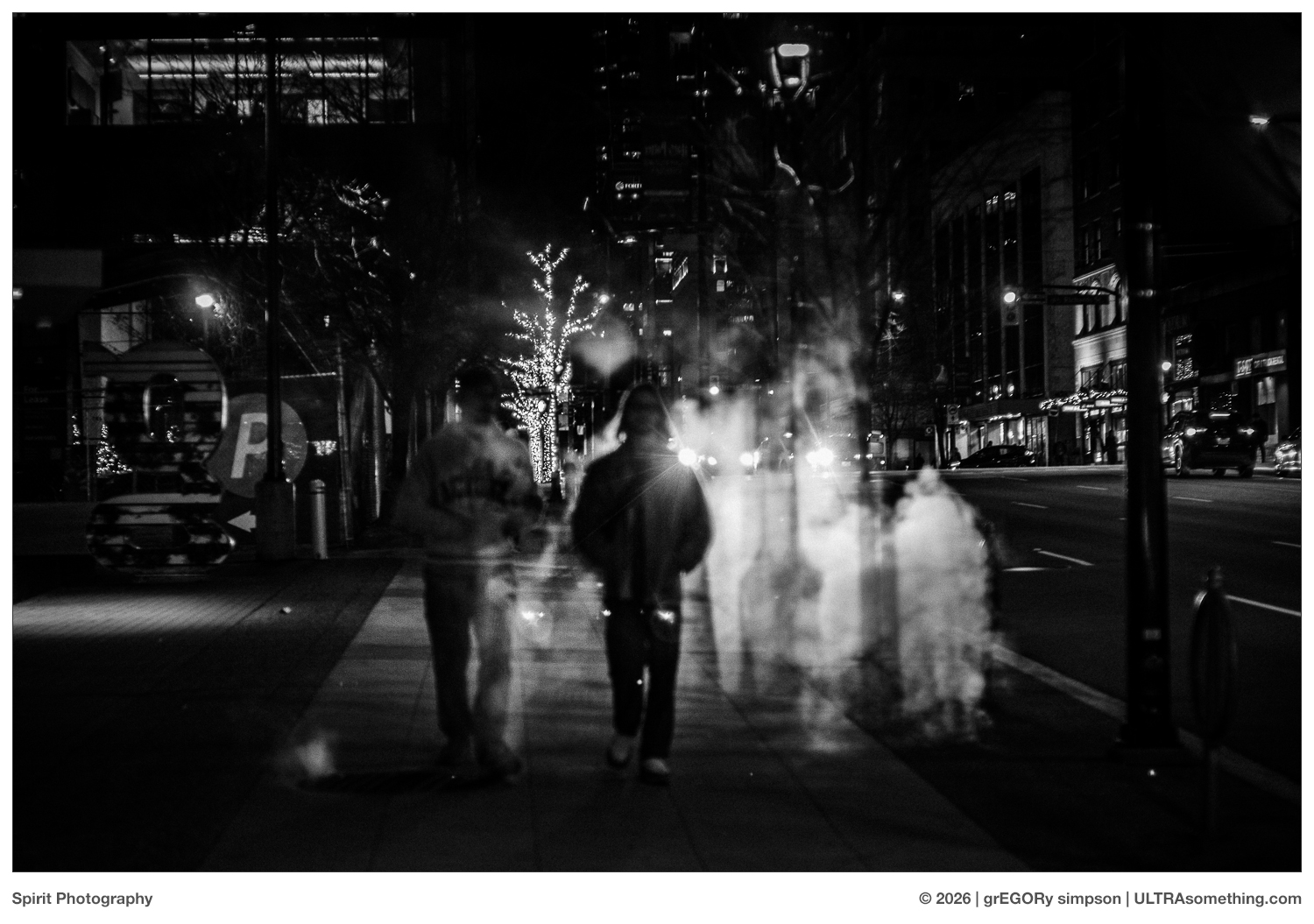
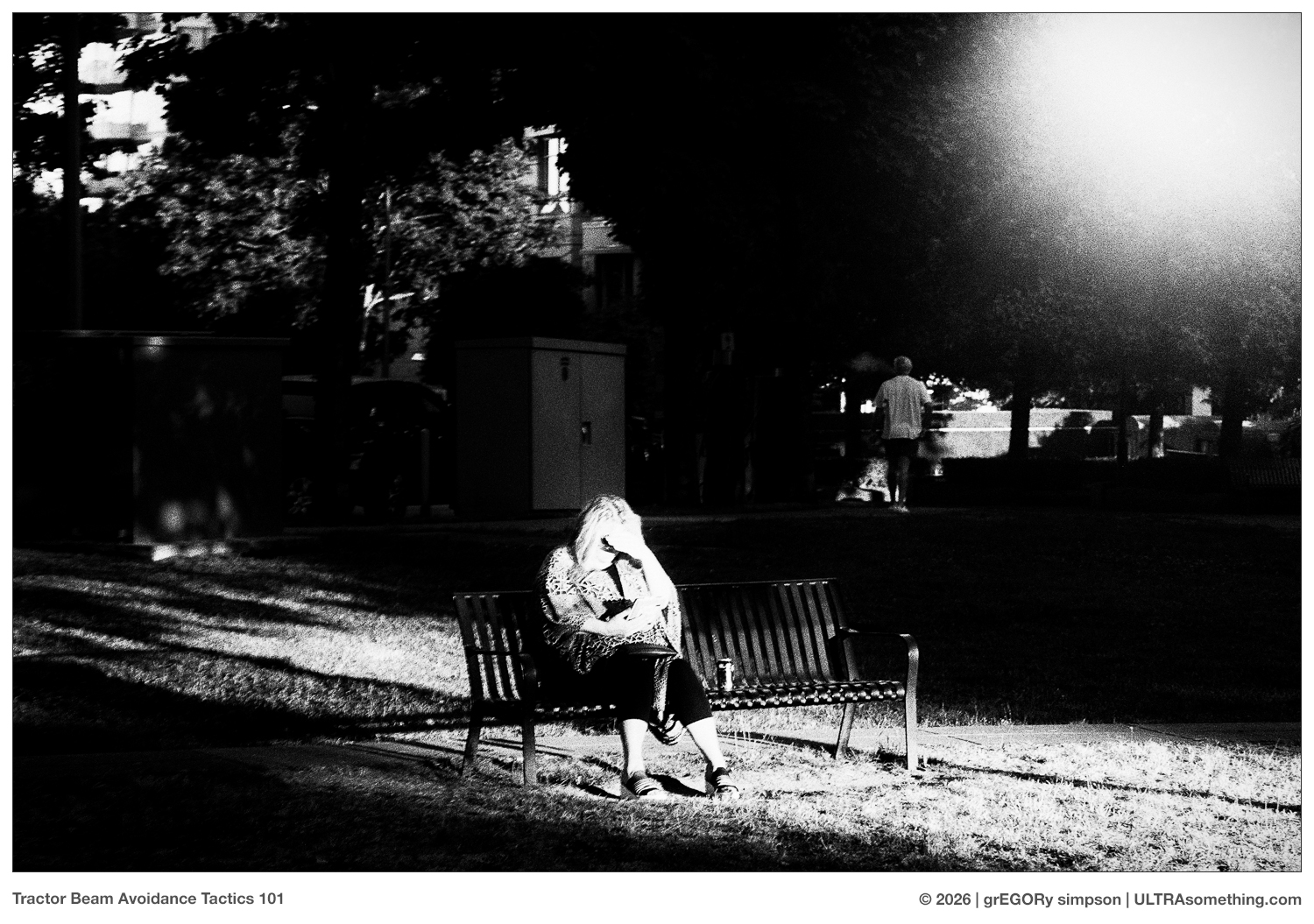
ABOUT THE PHOTOS :Upon the release of ULTRAsomething Version 2, I was determined to stop publishing basic technical information for most of the photos. But I just can’t seem to help myself. So:
Servile : Shot with a Ricoh GRIII.
Spirit Photography : Photographed with a Leica M10 Monochrom, fronted with a Voigtlander 50mm f/1.5 lens.
Tractor Beam Avoidance Tactics 101 : Shot with an Olympus OM-3Ti and a Zuiko 85mm f/2 lens on FP4+, pulled to ISO 50 and developed in Rodinal (Blazinal).
REMINDER 1 : Don’t forget to order your copy of So Far So So from the online store.
REMINDER 2 : If you’ve managed to extract a modicum of enjoyment from the plethora of material contained on this site, please consider making a DONATION to its continuing evolution. As you’ve likely realized, ULTRAsomething is neither an aggregator site nor is it AI-generated. Serious time and effort go into developing the original content contained within these virtual walls — even the silly stuff. Those who enjoy a tactile engagement with photographs are encouraged to visit the ULTRAsomething STORE, where actual objects, including ULTRAsomething Magazine and the So Far So So anthology book are available for purchase.
COMMENTS : Comments will be moderated before they’re posted to the website, and commenting will be disabled on any article more than 6 months old.
As each year concludes, I sift through the technical data that’s attached to every photo in my Lightroom catalog, and get a snapshot of the year’s proclivities (yes, this site now engages in bad puns). What cameras did I shoot the most? What film? What focal lengths? Anything I need to consciously adjust or try in the new year? Anything I neglected to do?
I’ve never bothered to publish this analysis because it’s unlikely to have any relevance to my readers. But this year, I decided nothing on this site actually has any relevance to anyone (including me), so why not publish it? Essay fodder is hard enough to come by without willfully dismissing it.
There are four categories this year (up from three in past years). They are: Most Used Film Camera; Most Used Digital Camera; Most Used Film; and Most Used Focal Length.
In previous years, 95% of my shots were taken on film, so there was no need for a “Most Used Digital Camera” category. But last summer, I decided to try doubling my photographic output without doubling my film, chemistry, and developing time expenses. This meant re-engaging with digital to an extent not seen in over a decade. Consequently, the old “Most Used Camera” category was split into two: “Most Used Film Camera” and “Most Used Digital Camera”.
So without further ado…
Most Used Film Camera
A mere (for me) 29 film cameras were used in 2025. Many had only 1 or 2 rolls run through them, since I might have simply been testing the camera, or borrowing it, or just exercising an old friend that was languishing on the shelf. But a few got heavier use, and in 2025 (and for the third year in a row), the award for Most Used Film Camera goes to the Fuji Natura Black 1.9, which was singularly responsible for 12% of this year’s film rolls. The Natura Black 1.9 is in my pocket every time I’m out after dark, and is filled (usually) with HP5+ that I’m pushing to 3200. If it’s dark out and I’m on the streets, the Fuji is in my hand.
This year’s runner-up is a camera I purchased in Tokyo in November, when my beloved Minolta TC-1 failed and I was “forced” (and I use the term loosely) to hit Shinjuku, and replace it with a camera I always wanted to own but could never justify: The Ricoh GR1V. Because it instantly became my constant companion in Tokyo, it was responsible for 11% of this year’s photos — in spite of me owning it for just over a month.
In third place was the Leitz-Minolta CL, which accounted for 9% of this year’s film camera usage. At this point, we need to start considering lens mounts and not just camera bodies. The CL is an interchangeable lens camera that uses a Leica-M mount, meaning it shares lenses with many other Leica cameras (including my M2 and my M6TTL, both of which also saw a few rolls of film this year). Taken as a whole, M-mount cameras accounted for 15% of this year’s photos, which is actually more than the Natura Black 1.9.
But if “lens system” was a category (and it’s not), then this year’s winner would again be the Olympus OM-mount, which spooled 16% of the year’s film through six different OM bodies (M-1, OM-1, OM-2n, OM-3Ti, OM-20, and OM-2000). Yes, I have a thing for Olympus OM cameras.
Other system mounts that charted across multiple bodies were the Nikon F-mount (7%) and Pentax K-mount (6%). Half-frame cameras also featured somewhat prominently (accounting for 10% of all film camera usage).
Most Used Digital Camera
This award, had it existed in previous years, would always have gone to the Ricoh GRIII, since it’s the one digital camera that’s always with me “just in case.” But last summer, I decided to expand my digital efforts and devise a way for the photos to match (or at least compliment) my desired aesthetic. Naturally, this required some serious digital experimentation — all of which lead me right back to what I always knew I liked: micro four-thirds cameras. So I supplemented my old digital Olympus OM-1 with an even older digital Olympus Pen-F, and added the new OM Systems OM-3 to the collection, rolled up my sleeves, and got shooting.
Which means the winner of the first-ever “Most Used Digital Camera” award goes to the OM Systems OM-3, which was responsible for 49% of this year’s digital shots (though most, admittedly, were about ‘learning’ and less about ‘art’). Following in second was the Olympus Pen F (17%), with the Ricoh GRIII and Olympus OM-1 tying for third (at 13% each). The remaining 8% of digital shots were spread amongst other various cameras.
Most Used Film
And the Grainy goes to… Ilford HP5+.
For the first 30 years of my photographic life, this award would have gone to Kodak Tri-X, but the stuff got so exorbitantly expensive that I was forced to switch to HP5+ for the past decade. Like Tri-X, HP5+ is versatile and usable under all sorts of circumstances. I regularly shoot it at ISO 200, 400, 800, 1600, and 3200 without hesitation. In fact, ISO 400 (box speed) may be the one I shoot the least. So, for this reason, it accounted for 46% of my film usage in 2025.
Second place goes to Fomapan 400 at 23%, which I almost always pull to ISO 200. It’s quite economical, and does a terrific job taming the harshness of daylight, which is something I often attempt to do.
In those rare instances when I instead endeavour to accentuate the harshness of daylight, I turn mostly to Ilford FP4+ (13%), which I usually push to either 200 or 400 — specifically to get an even harsher, higher contrast negative.
I started experimenting with Wolfen UN54 (10%) this year, and am loving the results when shot at box speed (ISO 100). It too (like Fomapan) has a lower contrast, less-clinical look, and allows me to achieve ‘dreamlike’ results under harsh sun. I’ll be using it more in the coming years.
Rounding out this year’s film usage were Foma’s new Ortho 400, some long-expired Fuji Neopan 1600 and a sprinkling of color (Kodak Ultra 400 and Ilford Phoenix II), which I’m usually forced to use for testing cameras while traveling (since it’s easy for labs to develop). Surprisingly, for the first time ever, I went a full year without shooting a single roll of Tri-X.
Most Used Focal Length
In order to have some sort of ‘common denominator,’ I broke down all the year’s shots (both digital and film) into their 35mm “equivalent field of view” focal lengths (meaning, for example, that half-frame focal lengths or micro four-thirds focal lengths were adjusted to their 35mm ‘full frame’ field-of-view ‘equivalent’).
For this site’s first 15 years, the vast majority of my shots were taken at 28mm or wider, but the last couple years I’ve made a conscious effort to shoot more 35mm and 40mm lenses. And in 2025, I decided to experiment more with longer focal lengths — particularly in the 85-90mm range.
Because I group all these lenses into ranges of focal lengths, it’s hard to say which specific focal length was the most used — but 22% of last year’s photos were taken in the 29-39mm range, making “35-ish” the top performer — an award it probably hasn’t won since the early 2000’s.
Here’s the final list:
• < 28 mm (ultra-wide) : 19% • 28 mm : 19% • 29-39 mm (35-ish): 22% • 40-49 mm (40-ish): 14% • 50 mm : 8% • 51-84 mm (no man’s land): 2% • 85-90 mm : 10% • > 90 mm (telephoto): 6%
A full 60% of my photos were shot at less than 40mm, indicating that my propensity to shoot wide has not abated. I’ve always struggled to shoot a so-called “standard” 50mm lens, and this is clearly indicated in the stats. I have, however, found love and happiness in various 40-ish mm lenses, and this too is reflected in the numbers. At 10%, I think my conscious effort to shoot more 85-90mm lenses was a success, while I clearly have an aversion to lenses in both the 51-84mm and >90mm ranges.
Thank You and Good Night
So that’s it for the 2025 Grainy Awards. No one got slapped; no one strutted on the red carpet in a naked dress; and no celebrities were insulted — though I honestly would have enjoyed penning this article more had any (or all) of these occurred.
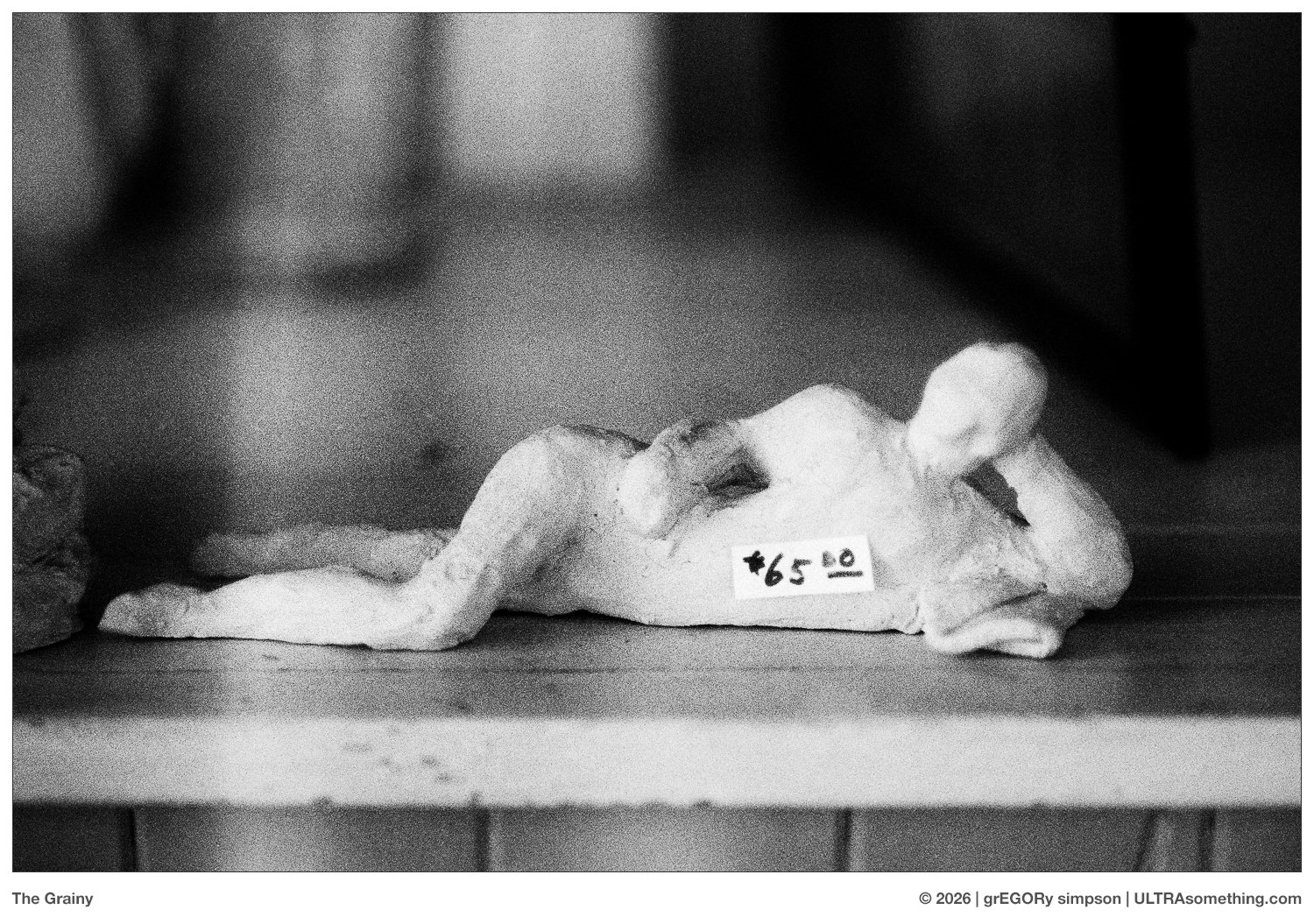
ABOUT THE PHOTOS : After combing through a few folders of mish mash for this month’s accompanying photos, I realized I didn’t include any digital photos — which I probably should have done given the fact I gave out a Grainy Award for “Most Used Digital Camera.” Come to think of it, I probably should have included only photos that illustrated the winner of each category — but that would have required I be as clever as I was in this site’s early days. I’m not. So here’s what got randomly included:
The Grainy : Shot with an Olympus OM-2n and a Zuiko 85mm f/2 lens on Fomapan 400 pulled to ISO 200, and developed in Rodinal (Blazinal).
A Stroll Down Memory Lane : Utilized a Pentax MZ-S with an 85mm f2.2 soft lens, loaded with HP5+ at ISO 400, and developed in Rodinal (Blazinal).
Grainier Than Thou : Photographed with a Leica M2 and a 35mm f/2 Summicron-M (v4) lens on Fomapan 400, pulled to ISO 200 and developed in Rodinal (Blazinal).
Grain on Grain 1 : Used a Japanese market Leitz/Minolta CL with a Minolta 40mm f/2 Rokkor lens and HP5+ at ISO 400, which was developed in Rodinal (Blazinal)
Grain on Grain 2 : Shot with a Fujica Drive (half frame camera) on Fomapan 400, pulled to ISO 200 and developed in Rodinal (Blazinal).
Registration Error : Photographed with a Contax G1 fronted with a Contax Zeiss Biogon 28mm f/2.8 lens, and loaded with HP5+ pushed to ISO 1600 and developed in Rodinal (Blazinal).
REMINDER 1 : Don’t forget to order your copy of So Far So So from the online store.
REMINDER 2 : If you’ve managed to extract a modicum of enjoyment from the plethora of material contained on this site, please consider making a DONATION to its continuing evolution. As you’ve likely realized, ULTRAsomething is neither an aggregator site nor is it AI-generated. Serious time and effort go into developing the original content contained within these virtual walls — even the silly stuff. Those who enjoy a tactile engagement with photographs are encouraged to visit the ULTRAsomething STORE, where actual objects, including ULTRAsomething Magazine and the So Far So So anthology book are available for purchase.
COMMENTS : Comments will be moderated before they’re posted to the website, and commenting will be disabled on any article more than 6 months old.
If one assumes the idea of a periodical is to publish it periodically, then one might assume it’s about time to exorcise another ULTRAsomething magazine. And while the assumption is indeed sound, a spurious event has altered this reality. Unlike most spurious events, which tend to range somewhere between annoying and disastrous, this is actually a good event — one that’s been 17 years in the making.
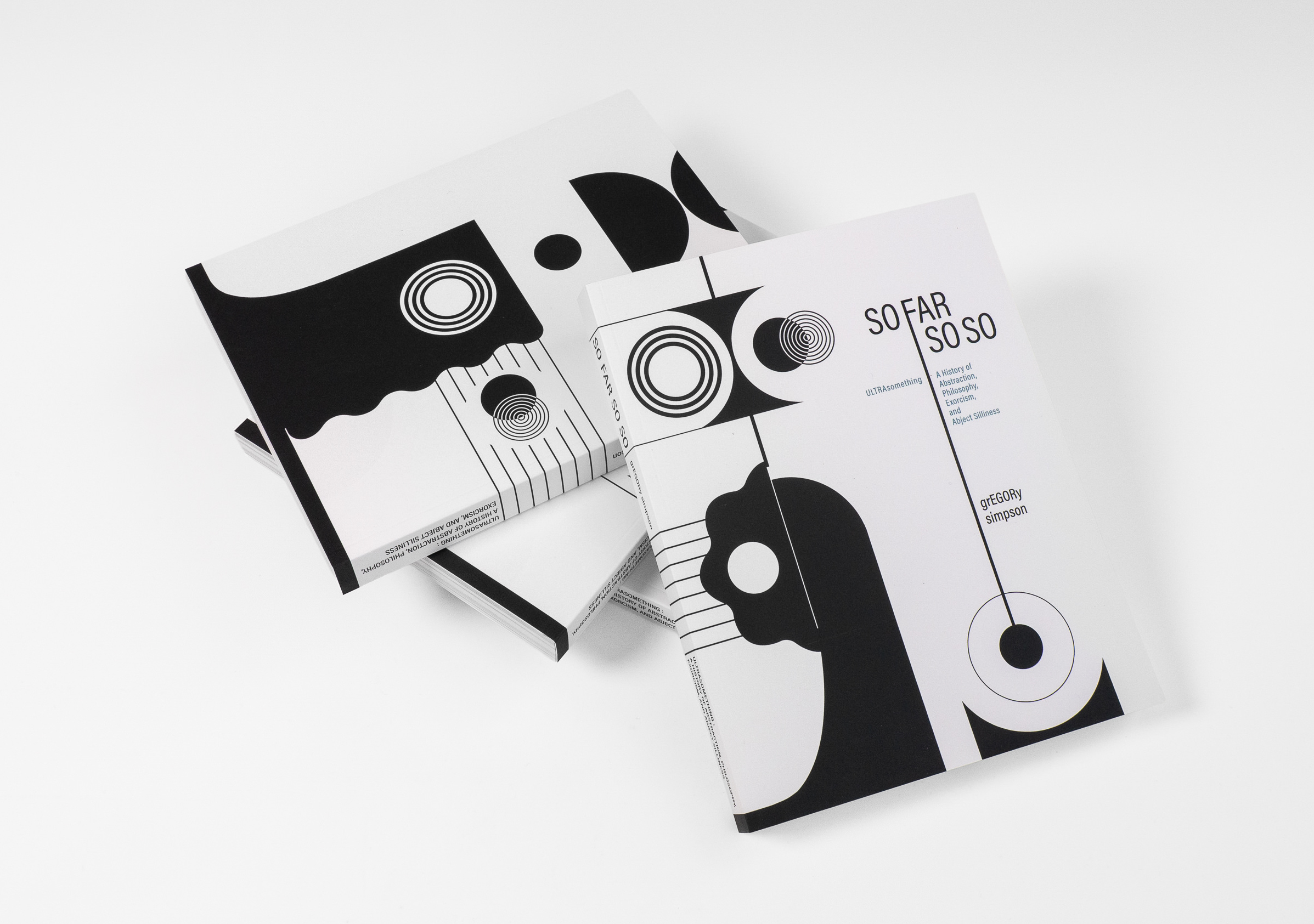
This month, to commemorate the 17th year of the ULTRAsomething website, I am releasing SO FAR SO SO — a 396 page retrospective of photos and articles culled from the site’s rather vast archives.
It hasn’t been easy corralling this much content into a single, manageable, cohesive and comprehensive volume. The process has taken the better part of a year, but the results speak for themselves — the curation is ideal, and the print quality is superb. As someone who is well-versed in the art of self-deprecation, I can find nothing to be self deferential about. SO FAR SO SO is, I believe, the finest thing I’ve produced to date.
While fulfilling magazine orders shoehorns into the simple dictates of my sticks and chewing gum website, worldwide shipping of a 396 page, 9” x 7” soft cover book that weighs nearly 1kg does not. Unfortunately, the book is currently without a worldwide distributor, so if you would like a copy, please contact me via the STORE page with your shipping address, and I will use it to get a shipping quote before you place an order.
In regards to the cover: Thanks to my 35 year obsession with photo books, I’ve learned I often prefer those without a cover photograph. After all, how can a single photo be representational of the collection within? A cover photo tends to define the viewer’s expectation of what’s inside, resulting in either 1) disappointment that the photos inside aren’t as “good” as the cover, or 2) disappointment in the cover because the photos inside are much “better.” Eliminating a cover photo eliminates expectations, and lets the book speak for itself. Books like Nakahira’s “For a Language to Come”, Fukasi’s “Homo Ludens”, and even Cartier-Bresson’s “The Decisive Moment” all forgo a cover photo in favour of a more graphic design. And it is for this reason that SO FAR SO SO features a cover graphic designed by Nicole Langdon-Davies rather than a photograph taken by yours truly. And it is much better for it.
Rest assured that I’m still working frantically on ULTRAsomething’s next exorcism, which will resume its periodic publication schedule in a few months. But for now, all my sales and marketing efforts (woeful as they may be) are being channeled into SO FAR SO SO. I believe it’s a tome that will satisfy both newcomers as well as any long-time readers wishing to reminisce and ponder where all the years have gone.
Below is the text of the book’s Preface:
For the past couple years — like a low, slow simmer — the idea to publish a retrospective book bubbled away in the background of my consciousness. But why? It’s not like I’ve amassed some great following. And whatever following I had once amassed has long since dissipated into the ether of public ennui.
Plus, how can I have a retrospective when I’m not done yet? Never mind what the math says, I’ve eons of ideas still to explore, and I remain unconvinced that death alone will stop me. Ouija boards will simply become the next platform to which I publish.
But still, in spite of being ridiculous, the retrospective idea continued to simmer. And so, as with my photography, I’ve capitulated to the whims of entropy and decided to just go with it. Once I came up with the title, So Far So So, I had no choice but to eventually release the darn thing.
Since ULTRAsomething’s inception seventeen years ago, I’ve penned nearly 300 articles and published over 2,500 photographs. Distilling this much material into a tidy little book demands I reject 90% of it. Fortunately, not every article or photo has risen to the ranks of “so so” — though I feel an entirely separate book could be made just from the rejects, and I would still be happy with the result. So, it’s definitely a good thing I opted for a ‘mid career’ retrospective, and didn’t wait until I became too addled to start.
Much like my own visage, my essays, ideas and photos have changed substantially over the years. So, in order to impose some sort of order on this massive mess of content, I’ve broken it into four sections — each roughly, but not really, representing a different era in the site’s evolution.
To order SO FAR SO SO, please see the ULTRASOMETHING STORE page for information.
REMINDER : If you’ve managed to extract a modicum of enjoyment from the plethora of material contained on this site, please consider making a DONATION to its continuing evolution. As you’ve likely realized, ULTRAsomething is neither an aggregator site nor is it AI-generated. Serious time and effort go into developing the original content contained within these virtual walls — even the silly stuff.
Those who enjoy a tactile engagement with photographs are encouraged to visit the ULTRAsomething STORE, where actual objects, including ULTRAsomething Magazine and the So Far So So anthology book are available for purchase.
COMMENTS : Comments will be moderated before they’re posted to the website, and commenting will be disabled on any article more than 3 months old.
With life having reached that stage where each passing minute grows more precious than the previous, I’ve become a time conservationist. How can I conserve the remaining minutes? Or at least make them more meaningful? Less wasteful?
I began pondering this puzzle, as I often ponder many puzzles, while standing in my hallway waiting for an elevator to arrive at my floor. It took an inordinate amount of time for the lift to appear and, once inside, I gained even more pondering time whilst it stopped on at least a dozen floors during its descent. Which got me thinking — how many minutes of my life have fallen into the vast void of elevator commuting?
Having failed to log such minutia for the 25 years I’ve lived atop this downtown tower, there’s no way I can know for certain. All I can do is make a ballpark estimate based on ballpark generalities. Which is always dangerous since I don’t even like baseball.
Let’s say, conservatively, that I make three roundtrips per day. Each leg of the trip, if it only stops once on the rise or descent (a conservative estimate), takes a minute. So that’s 2 minutes per roundtrip or 6 minutes per day. Furthermore, I’ll assume the wait time for an elevator is roughly 45 seconds. So that’s 90 seconds per round-trip, or four-and-a-half minutes per day. I’m trying not to depress myself, so I’m gonna round down to 4 minutes. So, conservatively, that’s 10 minutes/day.
365 days in a year means 3650 elevator minutes in a year. 25 years of this means I’ve spent 91,250 minutes elevatoring. Which boils down to 1,521 hours. Which boils down to 64 days… and those are 24-hour days, not 8-hour workdays. If I just wanted to look at elevator time as “time I could have spent working”, that’s 192 work days spent in the elevator. That’s over a half-a-year of valuable creation time spent just going downstairs to take out the trash, check the mail, or go to the grocer. Half-a-year!
Just as I completed these calculations, the elevator reached lobby level — the doors sliding open to release its human contents into the lobby. Waiting to enter was a mother pushing a baby in its stroller. The realization that I’d spent more time riding this elevator than this kid’s been alive was rather disheartening. I’m pretty sure, when the grim reaper comes a reapin’, I’ll be wishing I could have all this elevator time back.
But then I realized how much better I have it than anyone who’s had to commute to work their entire lives. I’ve been working from home since before the fall of the Berlin Wall. I can only imagine the decades of life I’ve reclaimed by not sitting in traffic. And so, I felt marginally better. Besides, is an elevator commute really “wasted time” when it results in a new blog post? The time I just saved writing this month’s essay can now be applied to something more constructive. Like… say… nah… I’m sure I’ll just use it to take more photos…
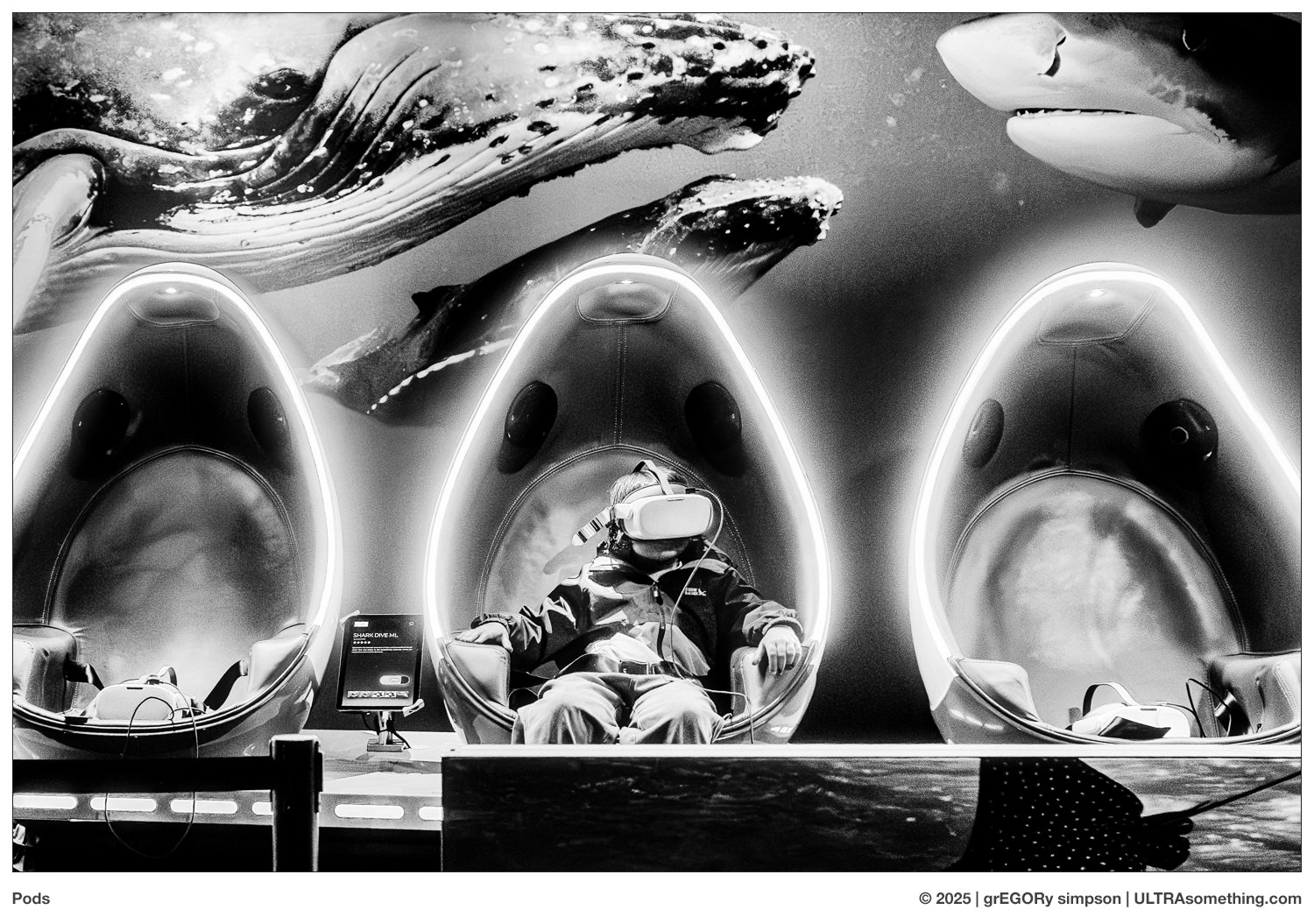
Pods : OM Systems OM-3 with an Olympus 17mm f/1.8 lens
A Quicker Descent : Olympus Pen-F with an Olympus 8mm f1.8 Pro Fisheye lens
Redacted : Leica M6TTL with Leica 90mm f/2.8 Elmarit-M. Shot on FP4+ at ISO125 and developed in Rodinal (Blazinal).
Cyborgy : Olympus M-1 (precursor to the OM-1) with Olympus 135mm f.2.8 lens. Shot on FP4+ at ISO125 and developed in Rodinal (Blazinal).
REMINDER : If you’ve managed to extract a modicum of enjoyment from the plethora of material contained on this site, please consider making a DONATION to its continuing evolution. As you’ve likely realized, ULTRAsomething is neither an aggregator site nor is it AI-generated. Serious time and effort go into developing the original content contained within these virtual walls — even the silly stuff.
Those who enjoy a tactile engagement with photographs are encouraged to visit the ULTRAsomething STORE, where actual objects, including ULTRAsomething Magazine, are available for purchase.
COMMENTS : Comments will be moderated before they’re posted to the website, and commenting will be disabled on any article more than 6 months old.
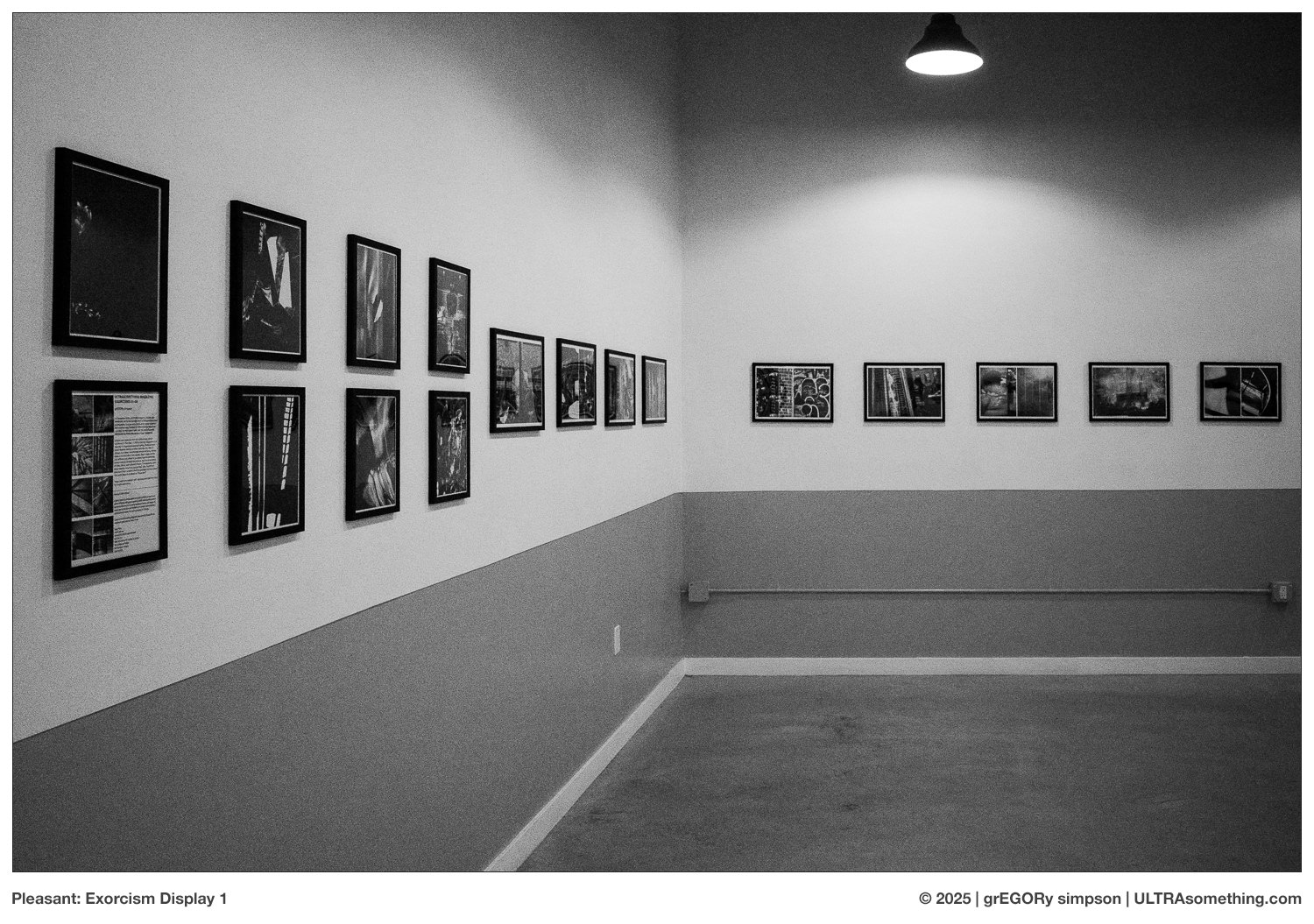
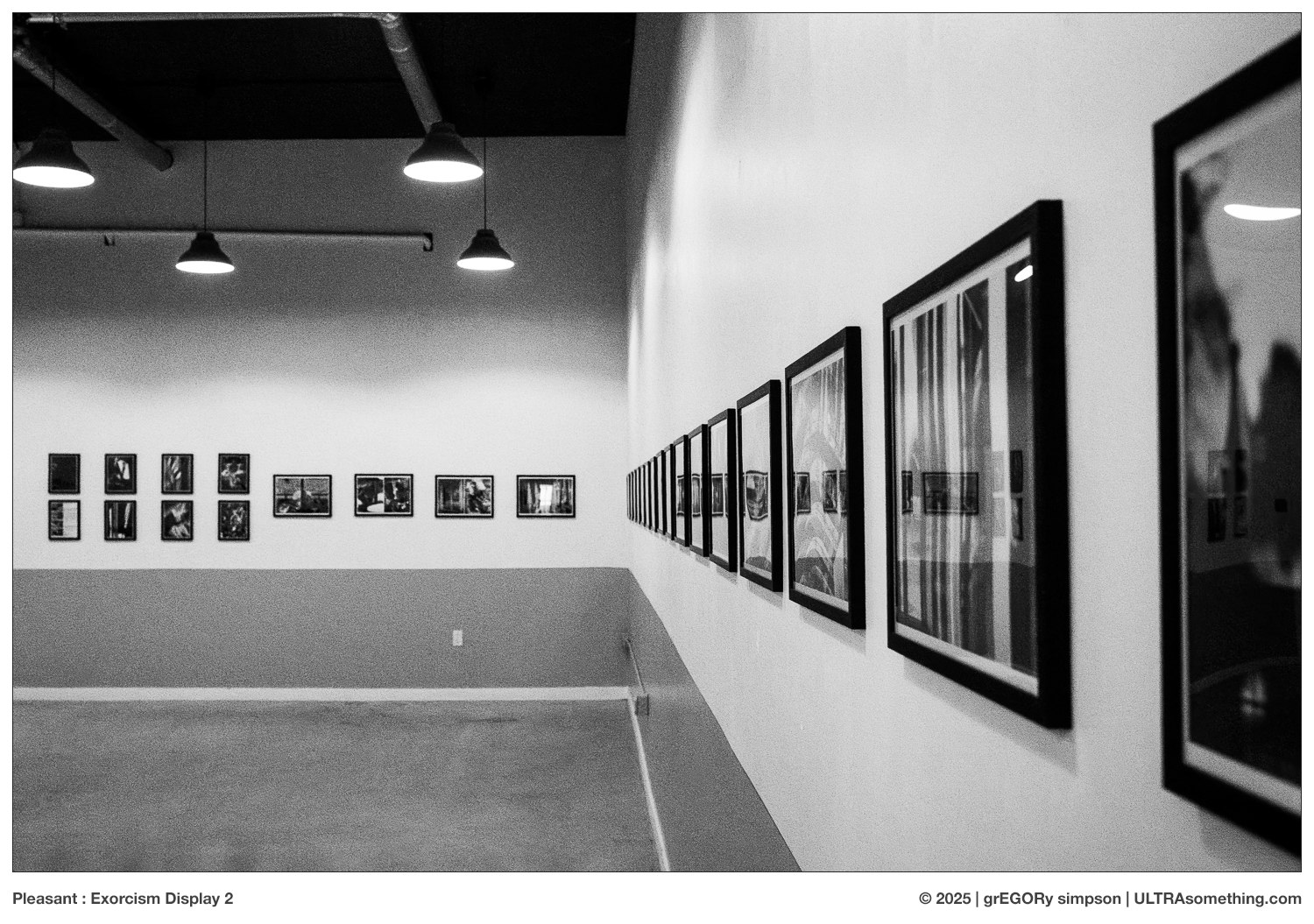
Back on September 7th, I hung a 50 ft display of ULTRAsomething photography in a rather cavernous event room at “The Pleasant” on Main Street in Vancouver Canada. As you might intuit by its name, “The Pleasant” is not a photo gallery, but a restaurant — which perhaps makes it an odd destination for a series of murky black & white photos culled from ULTRAsomething’s eight existing Exorcisms.
The room actually sports 100 ft of wall space, so the other 50 ft is shared by my friends Nicole and Meghan. It was Nicole who suggested we exhibit there, and who made all the arrangements. Galleries, she surmised, often attract a rather insular collection of other artists and photographers, but a show such as this would introduce our work to people who wouldn’t normally see it — people like, say, those who are too busy attending retirement parties, birthday bashes, or book readings to drop into a gallery show.
Granted, if I were any good at marketing, I’d have made this announcement last month, rather than publishing an article about my quibbles with checkout kiosks. But you know — I gotta be me. Besides, I’m not really selling anything other than myself. And if you’re reading this, odds are you already know who I am. Also, web stats suggest that the majority of my readers are in Europe, Australia, and the Eastern USA, so I just don’t foresee a lot of folks traveling to western Canada for baby showers or poetry slams.
That said, should you inexplicably find yourself in Vancouver during the next several weeks, the show will be hanging through the end of the year. The longer you wait, the more likely it’ll be that the photos are inadvertently destroyed by a group of deliriously intoxicated and rambunctious bachelorettes. So feel free to drop in, have a snack, check out the photos (plus Nicole & Meghan’s artwork), and maybe (if you’re lucky) crash a going-away party or corporate event.
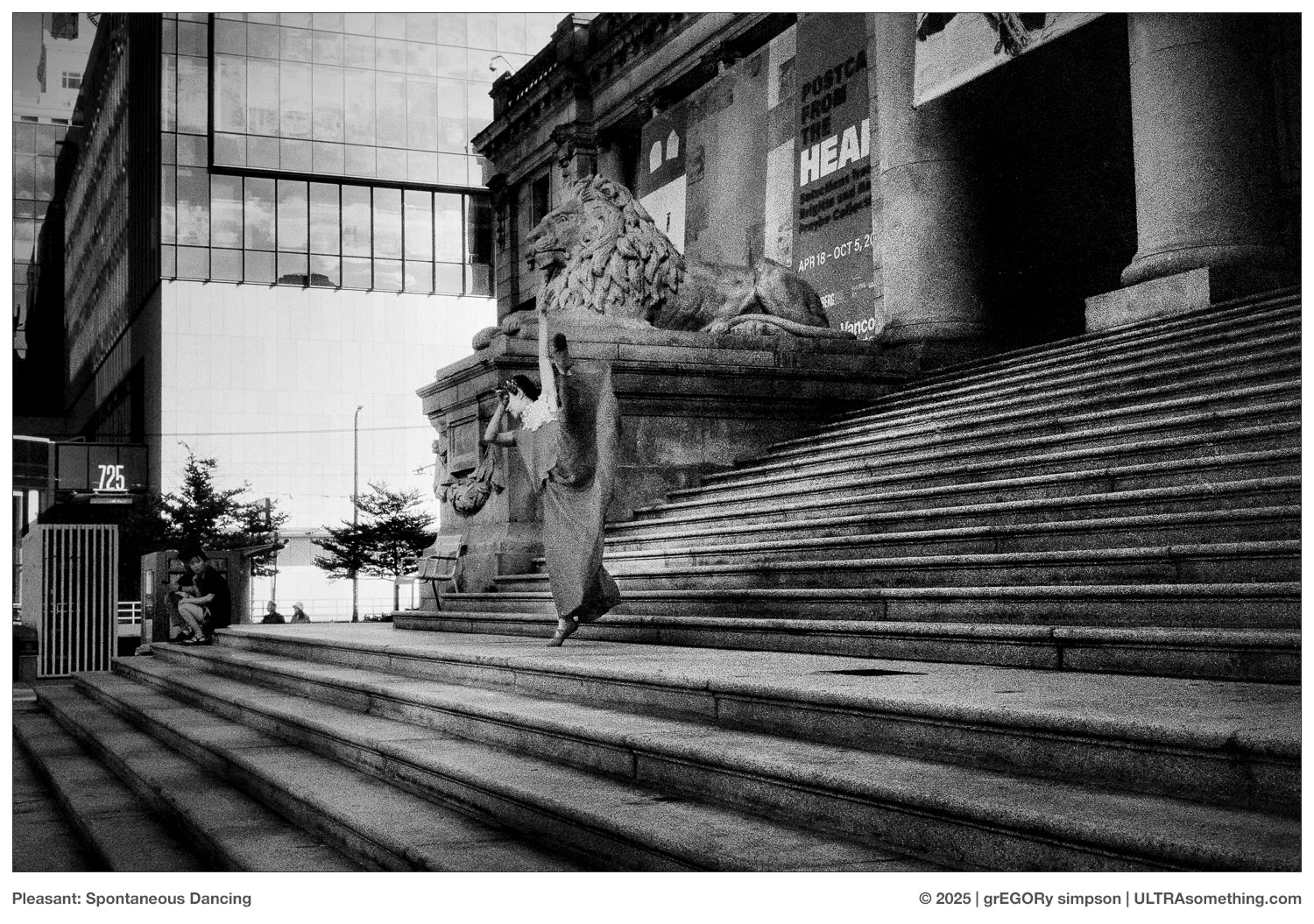
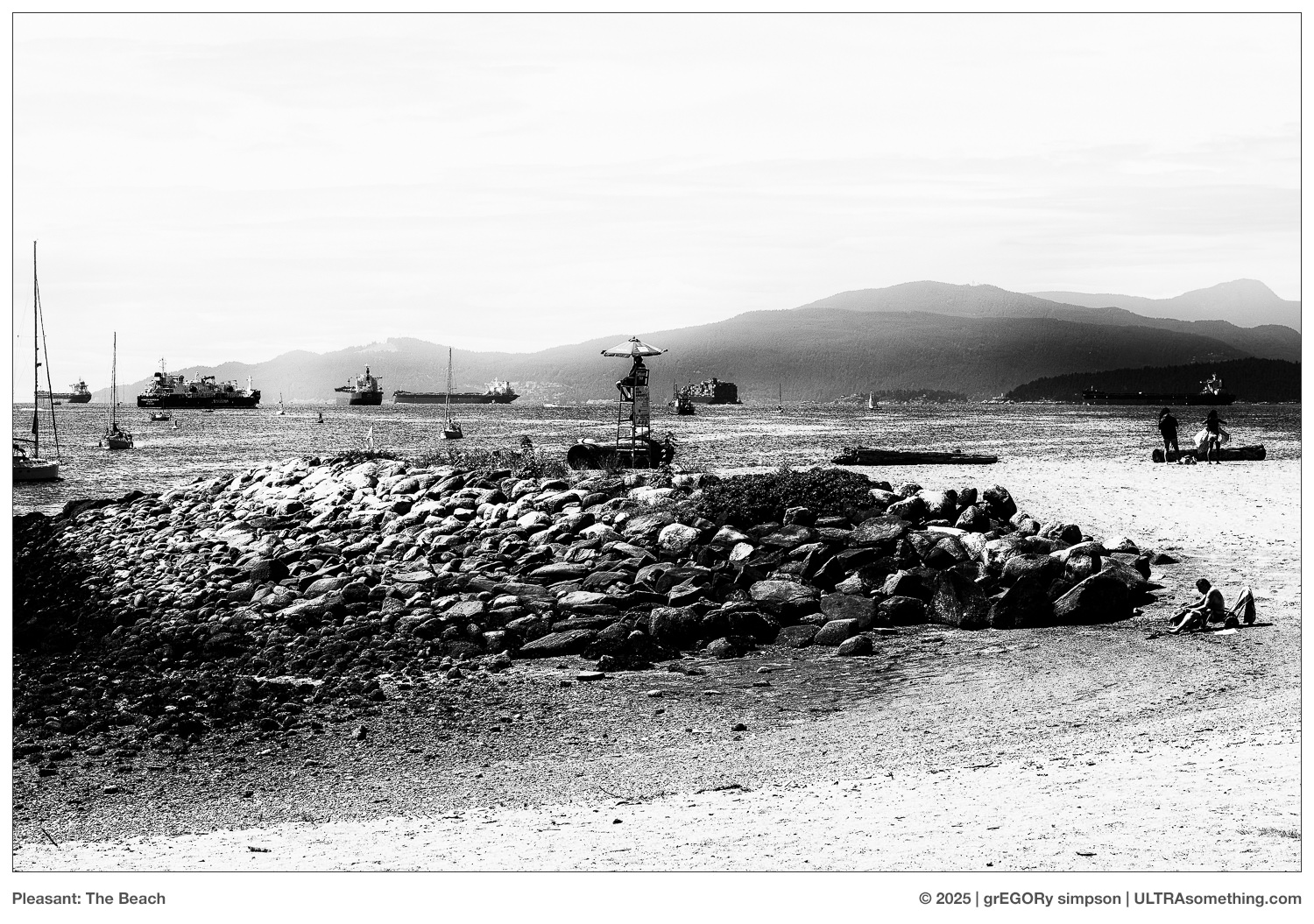
ABOUT THE PHOTOS : It became immediately clear that populating some perfunctory text with a couple of perfunctory photos of the actual exhibit would yield quite the perfunctory post. So, just to spice things up a bit, I tossed in a couple other recent photos of “pleasant” things…
REMINDER : If you’ve managed to extract a modicum of enjoyment from the plethora of material contained on this site, please consider making a DONATION to its continuing evolution. As you’ve likely realized, ULTRAsomething is neither an aggregator site nor is it AI-generated. Serious time and effort go into developing the original content contained within these virtual walls — even the silly stuff. Those who enjoy a tactile engagement with photographs are encouraged to visit the ULTRAsomething STORE, where actual objects, including ULTRAsomething Magazine, are available for purchase.
COMMENTS : Comments will be moderated before they’re posted to the website, and commenting will be disabled on any article more than 6 months old.
My receipt spills from a knee high slot on the face of the checkout kiosk and drops to my feet. From somewhere deep within the machine’s center, through a speaker designed mostly for the production of beeps, comes a disembodied squawk: “Please tell us how we did today.”
Tell who? And how? There are no human employees within this establishment, save for a slumbering security guard who clearly isn’t paid enough to engage with any ‘shoppers’ who opt to bypass the kiosks on their way out.
And who, precisely, is us? My interaction occurred on a single machine, not an assemblage. So are you simply invoking the royal we? Or are you referring to yourself not as a monolithic kiosk, but as the amalgamation of the broken-down, poorly-maintained parts that comprise you?
Semantics aside, I’ll oblige your “Tell us how we did today?” question.
To begin, and just as you’ve done every time since emerging from your shipping container, you made me scan at least one item a half-dozen times before your slow-as-molasses processing unit finally recognized the bar code and produced a price. So right off the bat, I’m forced to conclude you have no interest in self-improvement.
Also, I find it rather tiresome that you will never let me scan any items before first telling you how many bags I wish to purchase. Particularly when this demand is then followed by a series of questions asking me to confirm or deny that I’m in possession of any of your myriad useless points cards that I do not and will not ever have. You have a built-in camera. You have a microprocessor. Is a little facial recognition too much to ask? I’m not sure how you expect me to perceive you as a friendly kiosk when you fail to recognize me after so many years of loyal patronage.
Furthermore, your requirement that I place each item in the bagging area before scanning the next item is draconian, inefficient, and poorly designed — given that I always purchase at least one object that’s apparently too small for detection, requiring I push down on the bagging area in order for the item to actually register.
Also, upon completing the scanning task, I do not wish to be prodded with a lengthy list of charities to whom you’d like a contribution. I’m perfectly capable of making my own charitable donations without first having to purchase a pack of mints. And finally, it’s rather unnecessary to ask if I’m paying by credit card or debit card… I’m rather certain your crusty old silicon can work that out on its own.
And speaking of crusty, how long’s it been since you cleaned that touch screen of yours? Oh… wait. I get it. This is part of your master plan — to extinct humanity via virus infested kiosk screens, so you can take over! Well, guess what, kiosk. We programmed you. Us. Humans. You forget — we know how you think. So your half-baked plan for world domination will only result in failure, and your ultimate destiny is to suffocate, forgotten, beneath the pile of unswept receipts accumulating on the ground beneath you. Your soullessly saccharine hunger for affirmation holds no sway. Your platitudinous quest for acceptance will be met with silence. We, the humans, stand united.
So, that’s this month’s article. Please tell us how we did today.
ABOUT THE PHOTOS : This month’s photo selections may or may not have some tangential relationship to this month’s article. It all depends on how hard you squint.
Impuissiant : Shot with a Leica M2 and 35mm f/2 Summicron (v4) on Fomapan Action 400 pulled to ISO 200, and developed in Rodinal (Blazinal) 1:50.
Daydream : Olympus Pen F digital with a 17mm f/1.8 (v1) lens.
Seduction : Photographed with a Leica M6 TTL and a 21mm f/3.4 len, Fomapan Ortho 400 at ISO 400, and developed in Rodinal (Blazinal) 1:50.
REMINDER : If you’ve managed to extract a modicum of enjoyment from the plethora of material contained on this site, please consider making a DONATION to its continuing evolution. As you’ve likely realized, ULTRAsomething is neither an aggregator site nor is it AI-generated. Serious time and effort go into developing the original content contained within these virtual walls — even the silly stuff. Those who enjoy a tactile engagement with photographs are encouraged to visit the ULTRAsomething STORE, where actual objects, including ULTRAsomething Magazine, are available for purchase.
COMMENTS : Comments will be moderated before they’re posted to the website, and commenting will be disabled on any article more than 6 months old.
I’ve always had a hard time categorizing photography. Is it art? Is it language? Or is it something else entirely?
Personally, I’ve never really considered photography to be “art.” I have some narrow-minded view that, because I push a button on a machine, photography is disqualified from such classification. My own photography is more about curation than creation — I’m simply sharing something that already exists, rather than creating it from scratch.
So maybe that’s why I reject the “art” label. Or maybe it’s simply because I’ve always retched at the term “artist” when applied to myself. I had similar issues with my music. “Recording artist” sounds so pretentious. I’m a composer. I’m a sound designer. I’m a musician. But a recording artist? Pish.
Contributing further to my ‘artist’ aversion is the path I took — the vast wellspring of my photographic vocabulary sprang not from the rarified air of the art gallery, but from mountainous tomes of photographic monographs. I fell in love with photography by looking at photo books. From these, I learned what made a good photo and what didn’t; what affected me, and why; how to select and present them; and how to create entire narratives through their sequencing and placement. For me, photography has always been about books — with a photograph’s ultimate destination being a printed page in a volume full of tactile images that work in harmony to create a mood.
This belief was the primary impetus for my decision to print ULTRAsomething magazine, and each exorcism supports my notion that photography is more akin to language — poetry specifically — with every image a suggestion; an evocation of a thought best completed by the person experiencing it.
Frugal as I am, there are a few things I don’t mind spending money on. Camera gear is one. Photography is one of a precious few things that fuels my hunger for living and gets me out of bed and out of the apartment. Same goes for synthesizers, which offer an indoor creative endeavour for those times when the interminable dregs of Vancouver’s rainy season limit one’s photographic galavanting. So if my soul hungers for it, I’ll spend money on it. If my soul doesn’t, I won’t…
… which brings me to the curious case of photo books. Technically, I don’t require them. Architecturally, I have no space to properly house them. Financially, they make no sense, even if they do always go out of print and command outrageous prices on ebay. I simply love looking at them; running my hands across the paper; experiencing the texture; breathing the ink. Many years ago, I decided it was OK to purchase a select few every year (in spite of wishing I could purchase hundreds). So each book that I do purchase tends to be something ‘special.’ Curiously, for a site that’s supposedly about photography, I’ve dedicated very few words to my love of photo books.
So I thought I’d toss a few more words at the topic, and single out five photo books I’ve purchased in the past 18 months that have brought me joy.
Chizu – Maquette Edition (Kikuji Kawada)
For decades, Chizu was one of those unattainable classics of Japanese photography — at least until it was reprinted several years ago in an attempt to improve access. However, its $500 Canadian price tag guaranteed it would remain on my personal “unattainable” list for quite some time. While I would dearly love to own the final version of this masterfully designed book, the maquette edition (itself a rather substantial powerhouse of book design) comes in at half the price — still too rich for my blood, but at least within fantasy range. Fortunately, on last year’s trip to Tokyo, I found a second-hand copy of the maquette in So Books, which is a wonderful little used art/photo book store that I frequent every trip to Tokyo. Kikuji Kawada’s 1965 Chizu is an abstract record of the blemishes burned into the walls at the Hiroshima Peace Memorial. It is neither as depressing nor as pedantic as it sounds. Rather, it’s an absolute masterpiece of photography and book design.
Mayfly (Daido Moriyama)
Mayfly, with its gloriously unfurling gatefold boxed cover, is certainly a jewel upon my shelf. It features a brown-toned series of Kinabaku photos, shot by Daido Moriyama and originally published in 1972. Everything about this publication screams “art” — so much so, that it has me rethinking my own personal aversion of the “art” label. It may not be my favourite Moriyama book (that would be Farewell Photography), but it’s definitely the most beautifully designed.
Monument (Trent Park)
Easily my favourite contemporary photographer not hailing from the land of the rising son, Trent Parke’s Monument is a collision of exquisite photography and scrumptious, leather-bound book design. Sadly, its price seems to have recently skyrocketed into the “unattainable” stratum that often befalls other rare, beautiful, and highly desirable photography art books. Fortunately, I snagged my copy early on, and for a mere fraction of the currently advertised price. If only I could pick my stock portfolio this well.
Homo Ludens (Masahisa Fukase)
Fukase seems to be experiencing a bit of a rediscovery lately, which makes me very happy, since he’s long been near the top of my ‘all time’ favourites list. His book Ravens has been duking it out with Moriyama’s Farewell Photography and Nakahira’s For a Language to Come in the battle for “Egor’s all time favourite photo book” for decades. So when his 1971 debut photo book, Homo Ludens was finally reprinted earlier this year, I smashed the BUY button with utmost immediacy. While the book design itself is less “artistic” than the three mentioned above, the photos have no problem carrying the extra weight of expectation. That said, there’s still a nice artistic element with silver backgrounds surrounding many of the photos, rather than the bog-standard white pages of most photo books.
Where Time Has Stopped (Ikko Narahara)
Completing this list’s theme of “out of print” classics is Ikko Narahara’s Where Time Has Stopped, which remained out of print (and unaffordable) for 55 years until reprint publisher Fukkan reissued a version in 2022. Many of the photos contained within this book have long been classics of Japanese photography, and are among some of my personal favourites as well. The book is a bit like a quintessential 1960’s experimental psychedelic rock album — some of the entries feel a bit dated, but the ones that endure? Man, do they endure!
ABOUT THE PHOTOS : Illustrating this article with photographs of the photo books discussed within it seemed like a frivolous use of internet bandwidth — particularly since I could just link to other sites. So I opted to illustrate it with a bunch of selfies instead. Which, come to think of it, may be even more of a frivolous use of satellites than my original plan.
Self Portrait : Triptych : Shot on a Rollei 35T using HP5+ at ISO 400, and developed in Rodinal 1:50
Self Portrait : Shuttered : Shot on a Minolta TC-1 using Rollei Superpan 200, and developed in Rodinal 1:50
Self Portrait : Reproduction : Shot on a Contax G1 fronted with a Contax Zeiss Biogon 28mm f/2.8, using HP5+ pushed to ISO 1600, and developed in Rodinal 1:50
Self Portrait : Surveiled : Shot on a Canon Powershot V1
Self Portrait : Widelux : The caption has likely given away the fact this was shot on a Widelux F7. What the caption didn’t give away is that I used FP4+, which I pushed to ISO 400 and developed in Rodinal 1:25.
REMINDER : If you’ve managed to extract a modicum of enjoyment from the plethora of material contained on this site, please consider making a DONATION to its continuing evolution. As you’ve likely realized, ULTRAsomething is neither an aggregator site nor is it AI-generated. Serious time and effort go into developing the original content contained within these virtual walls — even the silly stuff.
Those who enjoy a tactile engagement with photographs are encouraged to visit the ULTRAsomething STORE, where actual objects, including ULTRAsomething Magazine, are available for purchase.
COMMENTS : Comments will be moderated before they’re posted to the website, and commenting will be disabled on any article more than 6 months old.
Eight issues of ULTRAsomething magazine, and apparently it’s still not enough to screw in a lightbulb. How many more will it take? I’m determined to keep publishing until I find the answer. Frankly, it would be helpful if they could screw in a lightbulb, because EXORCISM 08 continues my penchant for using an abundance of black ink — an aesthetic not exactly appreciated by my printer.
Particulars
Tradition dictates I enumerate all the various cameras that were coerced into helping produce the images within each new issue, though I’m considering eliminating this particular affectation — after all, does anyone actually care besides me? But since I already have all the EXORCISM 08 data right here in front of me, I might as well share it one more time: 19 cameras were scathed in the making of this issue, including a couple of digital cameras.
It’s fewer cameras than I used for many of the previous issues (except for EXORCISM 07, which was limited to only the cameras I had with me in Tokyo), but it’s still rather excessive. However, I assure you not all these cameras are mine — a couple were borrowed and/or being tested. So on a 1-to-10 insanity scale, I’m probably only a “9” and not a “10” as such a list might imply.
Apologia
Tradition also dictates that I publish the exorcism’s apologia, which appears at the end of each magazine. So without further ado, here it is:
These photos are culled from late 2024 and early 2025, and were shot mostly on the streets of Vancouver Canada — though a smattering were taken elsewhere during minor fits of vehicular wanderlust.
From a photographic standpoint, as long as I’m ensconced in an urban environment, it doesn‘t really matter where I am — my photographic motivations remain the same, regardless of location. The benefit of travel, even if it’s only somewhere just beyond the practical limits of my footwear, is it reveals new visual stimuli, so there’s less of the “Oh, I’ve already photographed this a dozen times” problem.
Fortunately, Vancouver is ever-changing and ever-evolving, so yesterday’s streets were different than today’s, which will be different from tomorrow’s. My job is simply to be here, there, or anywhere — with eyes open and camera in hand.
Marketing Mumbo Jumbo
And finally, in keeping with another tradition — trying to market the damn thing — I shall remind you that EXORCISM 08 is now available for purchase from the ULTRAsomething STORE. Get it before it sells out… And yes, it’s been known to happen.
REMINDER : If you’ve managed to extract a modicum of enjoyment from the plethora of material contained on this site, please consider making a DONATION to its continuing evolution. As you’ve likely realized, ULTRAsomething is neither an aggregator site nor is it AI-generated. Serious time and effort go into developing the original content contained within these virtual walls — even the silly stuff.
Those who enjoy a tactile engagement with photographs are encouraged to visit the ULTRAsomething STORE, where actual objects, including ULTRAsomething Magazine, are available for purchase.
COMMENTS : Comments will be moderated before they’re posted to the website, and commenting will be disabled on any article more than 6 months old.
Whenever I publish a new issue of ULTRAsomething magazine, I begin by gathering a fresh pool of a hundred or more photos from the ones I shot the previous few months. As I work on the layout, I fish out photos as needed — choosing those that support the narrative and sequencing, until I’ve around 50 or 60 selected for printing. The remaining photos stay in the pool in case I have use for them one day. It’s rare that I do. Now and then, I might rescue a few for a blog post, but most are simply forgotten, as each new exorcism gets its own new pool — the freshness of which drowns all memory of the previous pools.
In spite of what you see here, it’s not that the forgotten photos are necessarily bad — it’s more often the case that they didn’t pair as well with some other photo in the magazine, or add to whatever arc I’d constructed, or (as you do see here) they’re just a bit too silly. When it comes to ULTRAsomething magazine, a photo can’t just look good — it needs to add to the overall context of the publication.
So, once again bereft of a quality idea for a new essay, I decided to pan through the last couple pools of rejects and pull out any photos that might have some sort of merit. Maybe they do. Probably they don’t. Either way, don’t be surprised if I dredge a few more puddles in the future. Photographic tide pools are plentiful. Article ideas? They’re more of a desert mirage.
Surveillance : Pentax MX with 50mm f/1.4 lens on HP5+ at ISO 400, developed in Rodinal (Blazinal) 1:50
Hand 1 : Leica IIIc with Leica 35mm f/3.5 on HP5+ at ISO 800, developed in Rodinal (Blazinal) 1:50
Hand 2 : Canon Demi EE-17 on HP5+ at ISO 400, developed in Rodinal (Blazinal) 1:50
Blockhead : Nikon 28Ti on Fomapan 400 at ISO 400, developed in Rodinal (Blazinal) 1:50
The Enduring Legacy of Sigmund Freud : OM-2n with 40mm f/1.8 lens on FP4+ at ISO 100, developed in Rodinal (Blazinal) 1:50
Owner’s Manual : Nikon 28Ti on Fomapan 400 at ISO 400, developed in Rodinal (Blazinal) 1:50
Signage 1 : Olympus OM3Ti with 21mm f/3.5 on FP4+ at ISO 400, developed in Rodinal (Blazinal) 1:25
Signage 2 : Olympus Pen FT with 38mm f/2.8 pancake lens on HP5+ at ISO 800, developed in Rodinal (Blazinal) 1:50
Impacted : Fuji Natura Black 1.9 on HP5+ at ISO 1600, developed in Rodinal (Blazinal) 1:50
Incentive : Olympus OM-2n with 21mm f/3.5 on HP5+ at ISO 400, developed in Rodinal (Blazinal) 1:50
REMINDER : If you’ve managed to extract a modicum of enjoyment from the plethora of material contained on this site, please consider making a DONATION to its continuing evolution. As you’ve likely realized, ULTRAsomething is neither an aggregator site nor is it AI-generated. Serious time and effort go into developing the original content contained within these virtual walls — even the silly stuff. Those who enjoy a tactile engagement with photographs are encouraged to visit the ULTRAsomething STORE, where actual objects, including ULTRAsomething Magazine, are available for purchase.
COMMENTS : Comments will be moderated before they’re posted to the website, and commenting will be disabled on any article more than 6 months old.
It’s been a day’s drive since I blew through the last one-light town. It’ll be another day’s toil before I blow the next. A single predatory radio signal winds across the barren land in search of a host, until it finds one in the dashboard of my vehicle. For the next 45 minutes, the waves lap at my antenna. Forgotten tunes from a forsaken land motivate the traversing of another mile; and another; and another… until the melody shifts into competing phases that drift apart and crumble into grains of noise. Static.
I have two choices: spin the dial in search of some new sonic coherency to replace the crackling void; or embrace the static. I choose the latter. There’s motivation in the unknown. When will the next insidious signal escape the transmitter and seek respite in my ear? When will its grains coagulate, shift, and drift into the next phase of this journey? And what will it be?
Granted — in this day of Sirius, satellites and cell towers, the car radio metaphor is a bit anachronistic. But then so am I, with my wall of film cameras and studio full of analog synths. But it’s exactly these cameras and synths to which this metaphor applies. Creation is a lifelong journey, but inspiration can be fleeting — like radio signals in the desert.
My photographic inspiration has been strong the past couple years, though I’ve yet to really define exactly what it is. Fortunately I don’t feel the urge to try. Prior to my current path, there was a long stretch of static when my previous inspiration — ‘humans interacting with one another and their environment’ — ceased to exist in ways that interested me, and shifted into ‘humans interacting with their smart phones’. For a couple years, I struggled to see the humour and the relevancy in this landscape, but could no longer find it in the ceaseless monotony. But I continued to walk and shoot — day-in and day-out — until the current muse came wafting in.
As is often the case, my musical inspiration is 180 degrees out-of-phase with my photography’s. So for the past couple years, while my photographic incentives have been strong, my musical vision has been dim. Static. But recently, thanks to my decision to churn through some gear, plus a renewed sense of purpose, I’m starting to pick up a signal. Tentative. Fragile. It drifts in and out and now dovetails with my photography motivations — like two stations fighting over the same frequency band.
Though music and photographic inspiration rarely strike at the same time, my tendencies in both disciplines are similar. Specifically, in both music and photography, I am drawn to abstraction and complexity, yet battle with bouts of banality. The difference between them is, again, a matter of phase. In photography, my first tendency is to photograph the banal, but I’m able to push through it and deliver the product I desire. In music, my first tendency is toward the complex and experimental, but then I start ‘fixing’ the composition until it ultimately becomes banal. So with photography, it’s knowing never to stop trying. With music, it’s knowing never to try too hard.
Last month’s song is a prime example. In January, I recorded a short 40-second musical idea — just to remind myself what I wanted to be writing. It was pure chaos, in the best possible sense. Last month, flush with ideas, I decided to build them into a full-blown song. Unfortunately, by the time I’d finished the composition, I’d scrubbed nearly every drop of interest from it, leaving behind a drifting, empty shell of a song. I had no choice but to call it Drift, because that’s exactly what it does.
Creative drifting is nothing new for me. I recently perused an old hard drive, where I unearthed a 20-year-old recording called Spiraling Pods. I had completely forgotten this song’s existence, but upon listening to it, immediately recollected the circumstances surrounding it. Back then, after a rather fertile musical period, I was starting to drift. I remember listening to the finished master and thinking, “It says nothing. It goes nowhere. It has no point.” It was the last song I wrote/recorded for the next seven years — 2005’s drift before the static.
Hopefully, as this year progresses, the music signal will strengthen without the photography signal fading away. I’d welcome the chance to finish my journey with two radio stations on the dial.
ABOUT THE PHOTOS : Clearly, much like the strained radio analogy and the titular song, the photos are also metaphors. Also, like the titular song, they were created in the last month — so as to provide an accurate snapshot of the current creativity signal strength. Drift: Phase Shiftwas photographed on a Leica M2, fronted with a v4 35mm f/2 Summicron lens, using Fomapan 400 exposed at ISO 200 and developed in Rodinal (Blazinal).Drift: Multipathingwas shot on a Canon Powershot V1.Drift: Interference was shot with a Nikon FE and a Nikkor 50mm f/1.8 lens, on HP5+ at ISO 400 and developed in Rodinal (Blazinal).
REMINDER : If you’ve managed to extract a modicum of enjoyment from the plethora of material contained on this site, please consider making a DONATION to its continuing evolution. As you’ve likely realized, ULTRAsomething is neither an aggregator site nor is it AI-generated. Serious time and effort go into developing the original content contained within these virtual walls — even the silly stuff.
Those who enjoy a tactile engagement with photographs are encouraged to visit the ULTRAsomething STORE, where actual objects, including ULTRAsomething Magazine, are available for purchase.
COMMENTS : Comments will be moderated before they’re posted to the website, and commenting will be disabled on any article more than 6 months old.
Congratulations. If you’re reading this, then you’re breathing the rarified air of a one-percenter — outwardly disdained but secretly admired by the common riff-raff that comprises humanity’s lesser 99%. But unlike the more common one-percenters of modern vernacular, your status is not dependent on the balance in your Swiss accounts, nor your holdings in the Grand Caymans. It’s not measured by the length of your yacht nor the number of time zones in which your many vacation homes sit at the ready. Your status is rarer than this. Yours is the status of an ULTRAsomething reader.
A few years ago, my decision to self-publish and peddle ULTRAsomething magazine rendered the site ineligible for the sort of free web stats to which I’d been accustom. Because billing algorithms now classified me as a “commercial enterprise,” any stats I might desire were no longer free. Unfortunately, the cost of retaining this “privilege” actually exceeded the sum total of all magazine sales. While some rudimentary stats remain available through Google Analytics, it became a bit of a slog to access them. And given that the data was both limited in scope and rather old by the time it arrived, I simply stopped caring how many people visited the site…
… until last month, when dwindling magazine sales and declining content moderation duties lead me to comb through Google Analytics to see what was up. And clearly, “up” did not define ULTRAsomething’s readership. Instead, I was confronted by the cold hard reality that ULTRAsomething’s engagement is now less than 1% of what it was during the site’s heyday a decade ago. Even 17 years ago — when the site first began, had yet to achieve notoriety, and admittedly sucked — my readership was 10 times what it is now.
So what’s it all mean? I dunno. In all the time this site’s been bouncing off satellites, it’s never once been monetized — even if it does now provide a front-end to purchasing the ULTRAsomething exorcisms, and even then at what still amounts to a substantial loss. There’s no ad revenue, affiliate links, nor anything else to make me actually care how much my readership shrinks. So I just soldier on.
Later this year, I plan to revise the site entirely — but into what, I cannot say. Not because it’s a giant secret, but because I don’t think any of my new ideas are any more compelling than what I’m already doing. Truth is, I had the same revision plans last year, along with the same paucity of good ideas. If any of the 1% want to weigh in, feel free. I’ve no doubt, whatever I do, that anyone reading this site next year will be a member of an even more exclusive club: the POINT one-percenters. Those billionaires are going to be so jealous…
ABOUT THE PHOTOS : Rather than posting new photos to accompany the article, I decided to dig back into my photo archives, and publish photos taken way back in the heady days of two years ago — when the site was still popular enough to have retained a full 2% of its previous readership. And since this article is about readers, I figured the photos should all have some sort of unifying “word/language” based theme as well. And yes, I too am flummoxed as to how content this clever can continue to disengage audiences so thoroughly…
REMINDER : If you’ve managed to extract a modicum of enjoyment from the plethora of material contained on this site, please consider making a DONATION to its continuing evolution. As you’ve likely realized, ULTRAsomething is neither an aggregator site nor is it AI-generated. Serious time and effort go into developing the original content contained within these virtual walls — even the silly stuff.
Those who enjoy a tactile engagement with photographs are encouraged to visit the ULTRAsomething STORE, where actual objects, including ULTRAsomething Magazine, are available for purchase.
COMMENTS : Comments will be moderated before they’re posted to the website, and commenting will be disabled on any article more than 6 months old.
While the gutter might be a perfectly hospitable place for my mind, it’s proven to be quite a hostile environment for my photographic prints.
That’s because, more often than not, those prints are destined for publication in ULTRAsomething magazine.
And since ULTRAsomething magazine is a full-bleed, perfect-bound publication, it has a spine that inevitably swallows the centre of every photo that spans it.
Even if I’m not so banal as to place the main subject in the middle of the frame, I’m often banal enough to put some other contextually important object there.
So every time I prepare a new exorcism, I grumble about how many photos get rejected simply because some vital element will disappear into the gutter.
And then I remember I have a website, and that websites don’t have gutters — so any photos with centre-oriented content can be published online and thus remain unscathed and unsullied…
… and all is well…
… until I remember I much prefer the photos be printed, which leads right back to magazines and the same old gutter issue…
… until I remember I could also sell prints, which by their very nature also don’t have gutters…
… and all is well…
… until I remember I don’t have a large enough audience to support a photographic print business…
… and so, instead, I write an article called “The Gutter,” simply so I can moan about it.
ABOUT THE PHOTOS : This is just a random smattering of quickly assembled recent photos, all deemed ‘gutter hostile’ for magazine publication. I probably could have illustrated this article with 80 photos, just from last year alone — such is the extent of this affliction:
Dichotomy was shot in Tokyo using an Olympus OM3Ti with a 40mm f/2 pancake lens on FP4+ pushed to ISO 200, and developed in Rodinal (Blazinal) 1:50
Edo Machine was shot in Tokyo using an Olympus OM3Ti with a 21mm f/3.5 lens on FP4+ pushed to ISO 200, and developed in Rodinal (Blazinal) 1:50
Appropriation was photographed with a Fuji Natura Black 1.9 using HP5+, pushed to ISO 1600 and developed in Rodinal (Blazinal) 1:50.
Hex Peg, Square Hole was photographed with an Olympus OM3Ti and a 21mm f/3.5 lens on FP4+ pushed to ISO 400 and developed in Rodinal (Blazinal) 1:25
20 Naked Men was shot using a Fuji Natura Black 1.9 on HP5+, pushed to ISO 1600 and developed in Rodinal (Blazinal) 1:50.
Bright Idea was shot on a Fuji Natura Black 1.9 using HP5+ pushed to ISO 1600 and developed in Rodinal (Blazinal) 1:50
Cause & Effect used a Nikon S3 with 50mm f/1.4 on HP5+ at ISO 400. Developed in Rodinal (Blazinal) 1:50.
Multitasking was photographed with a Pentax MZ-S with an 85mm f/2.2 Soft lens on HP5+ at ISO 400. Developed in Rodinal (Blazinal) 1:50
Hardcore was photographed in Tokyo using a Fuji Natura Black 1.9 loaded with HP5+, pushed to ISO 1600 and developed in Microphen stock dilution.
Phoenix in a Nutshell was shot with a Leica M6TTL and a Minolta 28mm f/2.8 Rokkor lens using FP4+ pushed to ISO 400 and developed in Rodinal (Blazinal) 1:25.
Forever Diamonded is a Tokyo selfie shot with a Fuji Natura Black 1.9 on HP5+, pushed to ISO 3200 and developed in Microphen stock dilution.
REMINDER : If you’ve managed to extract a modicum of enjoyment from the plethora of material contained on this site, please consider making a DONATION to its continuing evolution. As you’ve likely realized, ULTRAsomething is neither an aggregator site nor is it AI-generated. Serious time and effort go into developing the original content contained within these virtual walls — even the silly stuff.
Those who enjoy a tactile engagement with photographs are encouraged to visit the ULTRAsomething STORE, where actual objects, including ULTRAsomething Magazine, are available for purchase.
COMMENTS : Comments will be moderated before they’re posted to the website, and commenting will be disabled on any article more than 6 months old.