What a year it’s been here at ULTRAsomething World Headquarters. First, I swapped the horse and buggy for one of those new-fangled automobile thingies. Then, in rather rapid succession, I ditched the transistor radio in favor of an iPod; threw out the old ‘rabbit ears’ antenna and replaced it with what the kids call “cable TV;” and fired poor Beatrice, whose adroit stenography skills enabled my dictated mumblings to be transcribed onto the world wide web. At ULTRAsomething, we believe in responding quickly and decisively to all necessary innovations.
So when all those social media types kept saying that ULTRAsomething should have a Facebook page, I was able to point smugly to the fact that I already owned numerous facebooks. I had, in fact, discovered their remarkable restorative powers years ago — how splaying them across one’s face would diminish a room’s ambient light, thus improving one’s napping efficiency and mental prowess.
But here’s the thing: “Facebook” means something completely different to these people! Although ULTRAsomething thrives on the leading edge of technology, we’re not ones to just blindly follow every fad that comes down the highway. We do our research. So I asked these social media people, “What will a Facebook page do for ULTRAsomething?”
“It will let people like you,” came the answer.
“But people already like us,” I responded.
“Yes, but this gives them a demonstrative means to show that they like you.”
“But people already show us they like us by visiting the ULTRAsomething web site.”
“Yes, but the people who like you have friends and associates who don’t know about you, so this is also a way for them to show other people that they like you.”
“Sounds like a pyramid scheme,” I replied.
And, with that, I chalked up another victory against banality. Frankly, I just couldn’t fathom how Facebook could benefit ULTRAsomething or its fans. Sure, every time I wrote a new article, I could notify my ‘fans’ on Facebook. But if someone was really my fan, they were already subscribed to the RSS feed.
Over the years, ULTRAsomething’s purpose has evolved. My original intention was that it be a simple and classic “web log” — a place where I could make small observations, ask for opinions, offer assistance, deliver some news, post a few photos and, in general, have a low-key web interaction with my clients. But as the years went by, ULTRAsomething became a lot less “blog like” and a lot more “thoughtful.” My articles become virtual word tomes full of satirical, tongue-in-cheek commentary on camera gear, photography, and the philosophy behind it all. ULTRAsomething grew far beyond its original scope, and it no longer offered a place to make small observations, ask for opinions, offer assistance or deliver some news. I needed to think of a way to make ULTRAsomething more communal without modifying its current structure. For the benefit of my neural connections, I assumed a restful position on the sofa and commenced pondering — how could I possibly socialize all this media?
I awoke suddenly and with a start. “Facebook!” I exclaimed, slapping myself hard upon the forehead, knocking my old-school facebook to the floor. “I need to fire up the Wang, get on the information superhighway, and research that Zuckerberg guy!”
And thus it has come to pass. ULTRAsomething has a Facebook page. People who actually like ULTRAsomething can now virtually “like” us on Facebook. It will become a sort of clearinghouse for all those little things I wish to share with the ULTRAsomething community, but that don’t warrant a full-blown article. Think of ULTRAsomething’s Facebook site as the equivalent of the “special features” section of a DVD… huh? What’s that? People don’t watch DVD’s anymore? It never ends, does it?
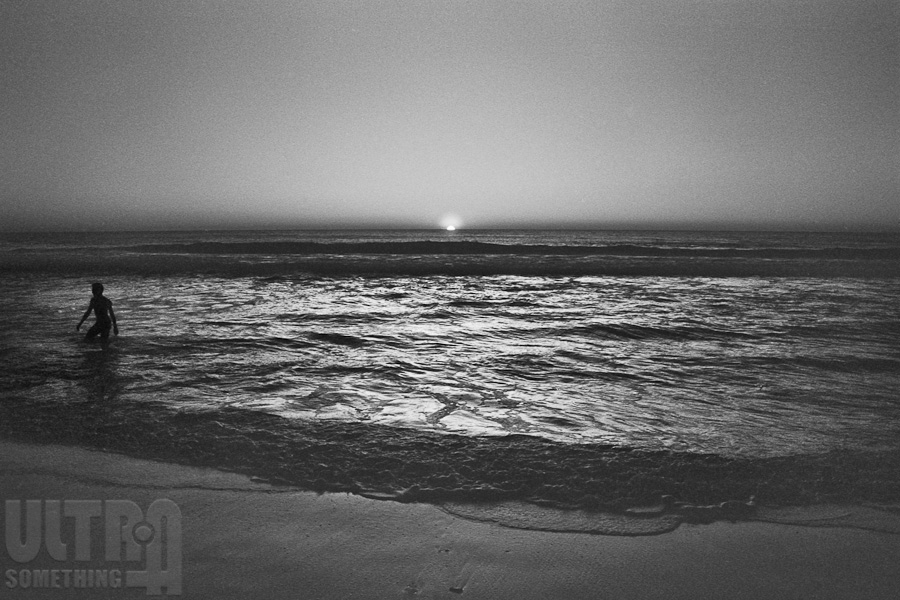
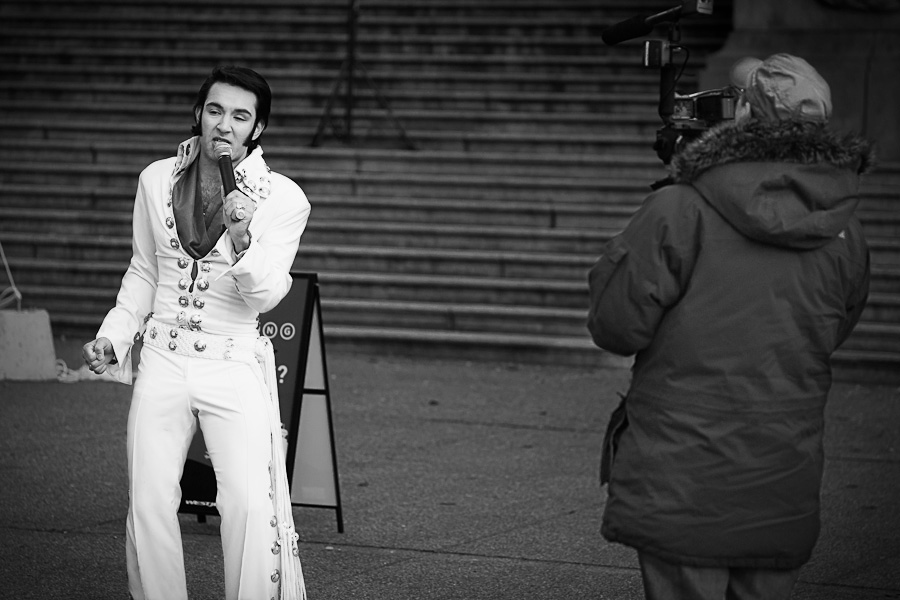
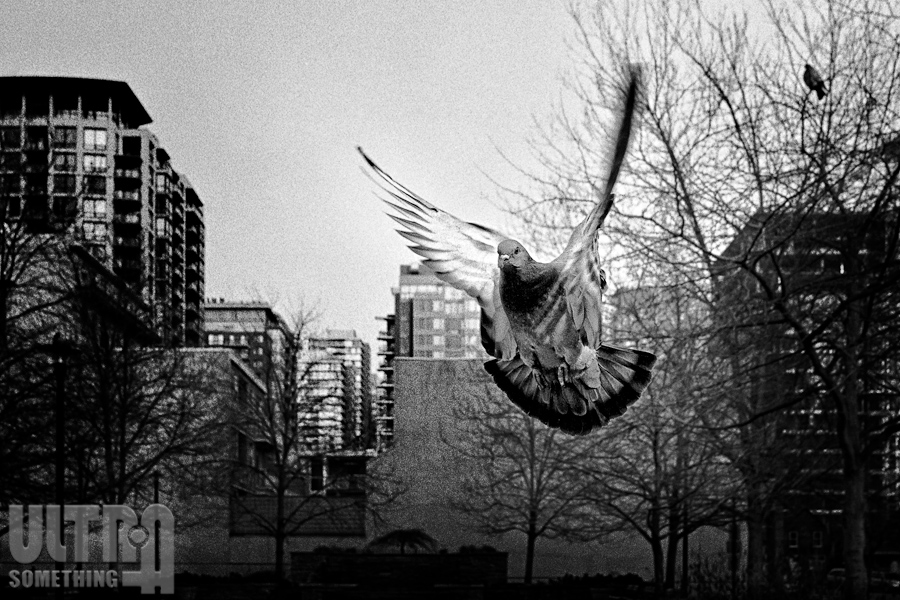
ABOUT THESE PHOTOS: “Facebook,” a self portrait, was shot with a Leica M9 and a 28mm f/2 Summicron lens. “Web Access Portal” was shot with a Leica M9 and a Voigtlander 50mm f/1.1 Nokton lens.
If you find these photos enjoyable or the articles beneficial, please consider making a DONATION to this site’s continuing evolution. As you’ve likely realized, ULTRAsomething is not an aggregator site — serious time and effort go into developing the original content contained within these virtual walls.
Last week I was strolling home along Granville Street, my guard down and my mind wandering, when something tickled my photographic subconsciousness. Experience has taught me to trust the tickle. Things happen fast on the streets. “Shoot first, comprehend later.” That’s my motto. I fired off a shot just as the tickle began to coagulate into an amorphous shape within my conscious mind. As the indefinite form passed on my left, I was faintly aware of only two things: bouffant hair and long false eyelashes. “My comrade!” I thought, happy to have her photo safely stored within the metal and vulcanite walls of my Leica.
Bruce Gilden said there’s something that attracts him to the people he photographs on the streets and for that reason he considers these strangers his friends. I’ve always felt the same way. I photograph people who interest me, attract me, fascinate me, haunt me or somehow stir something within my emotions.
What drew me to the bouffant lady? Why did I consider her a comrade as she passed me on the street? The answer likely rests within the camera I used to photograph her — a 1959 Leica M2. In the year 2011, this woman and I were both anachronisms. Tourists from another era, we both left our homes confident and comfortable with our retro-infused choices. I will never know why she settled on a mid-1960s appearance that belies the dictates of the latest issue of Vogue. But I know exactly why I’m carrying a late-1950s manual mechanical film camera that belies the dictates of the latest issue of Shutterbug, and it’s probably not what you think.
Many people, who don’t know me, see my film camera and believe that I’m a Luddite — fearful of change and resistant to advancement. I’ve been accused of being stuck in the past and lectured on the street by people who thought I was somehow unaware of 21st Century technological advances. But believe me, I didn’t take the passive road to photographic anachronism — I worked at it. Most anachronistic people were fashionable once, in the same way that a broken clock is still correct twice a day. Me? I’ve been a photographic anachronism in every time.
I began to photograph seriously some twenty years ago, right about the same time that Kodak started marketing the very first digital camera — a $20,000, two-piece, 1.3 megapixel behemoth. Although the digital Kodak exceeded my photography budget by 4000 percent, its very existence helped guide my decision to get serious about photography. I had spent the previous decade working with electronic music, and was hard at work transforming music creation from an analog endeavor into a digital one. I knew that photography would eventually follow the same trajectory as music and I was anxious to take that ride. I had recently developed an insatiable appetite for photographs and spent much of my spare time leafing through photography monographs in art book stores, galleries and libraries. By early 1991, my appetite for new images was so voracious that I decided to start taking photographs myself. I figured that, by the time I learned my craft, digital technology would become affordable enough that I could ride the digital train— exactly as I was doing with music.
True to my plan, I learned to shoot with a Canon EOS film SLR. I learned to process my own black & white film. I also bought an enlarger and learned to print in the hot, cramped and awkward confines of my only bathroom. By late 1992, digital cameras were still not any more affordable, so I decided to take a half-step toward digital photography — I purchased a Nikon Coolscan LS-10 scanner and a copy of Photoshop 2.0. Although my electronically processed photos looked great on my computer monitor, there was no way for anyone to actually see them. The Mosaic web browser, which was the first browser popular enough to bring the world wide web into public awareness, was still over a year away. So I would often resort to printing the photos on my laser printer, with obviously limited success. It was 1992, and I was an anachronism — longing for photographic tools that did not yet exist.
Undaunted, I continued my march toward the future. Eventually, I was able to pay exorbitant fees to specialist labs who could print my digital files using ridiculously expensive IRIS inkjet printers. By 1994, the internet was gaining significant traction and Apple released the first affordable digital camera: the 0.3 megapixel QuickTake 100. It was just what I’d been waiting for. A year later I upgraded to a Kodak DC40, with its massive 0.38 megapixel sensor (of which half those pixels were noise), and enough memory to hold a whopping 48 photos (six times the storage capacity of the QuickTake 100)! The more I used the Kodak, the more I resented shooting and scanning film. It just seemed like such an outdated process and, frankly, that Nikon LS-10 scanner gave new meaning to the word “finicky.”
I soon surmised that the future of photography rested with the digital camera, and that the future of publishing was the world wide web. In fact, those two technologies seemed perfectly suited to each other. Digital photos were so laden with chromatic noise that the best way to minimize the effect was to display them at a reduced size — perfect for transmitting over all those 28.8 kB/s modems! I remember attending a photography class in which I presented my portfolio as tiny images on a computer screen. Everyone else had traditional paper portfolios — no one had ever seen or heard of an electronic photo portfolio. My classmates looked bemused. My instructor took one look and stated, unequivocally, that digital photography would never catch on. The limitations of early digital cameras and mid-90s web technology required me to radically alter my photography techniques and simplify my images. By the summer of 1995, I was even more of an anachronism than in 1992.
I soldiered on. By 2000, I deemed digital cameras such as the Canon EOS D30 “good enough” to replace my film cameras, and sold my last remaining film SLR. Of course this was a premature proclamation, but I was so desperate for the future to arrive that I was ready to call it. I was still an anachronism, but at least people now knew I was an anachronism. They knew digital represented the future of photography and I was finally seen as ahead of my time, rather than just a crackpot. Eventually, other photographers would make the same proclamation — some with the introduction of the Canon EOS-1D, some with the D60 and others with the 10D or 20D. The world that I wished, cajoled and willed into existing had finally arrived. And the more I lived in that world, the less I actually liked it.
I was such an early digital adopter that, for me, it had been several years since I had shot film. Time distorts memory and I began to forget about the hassles of developing film, of the unwillingness of my LS-10 to scan when I asked it to, and of the tedious process of spot-healing dirty negatives. Instead, I began to focus on the unforgiving highlights and shadows in my digital photos, of their strangely unnatural tonal characteristics and limited dynamic range, and of their clinical precision and irritating noise patterns.
Mind you, I was not becoming anti-digital. The visual anomalies of digital that I find disagreeable have been around since the technology’s beginnings. The difference was, unlike the previous decade, I had eliminated choice from my photographic toolkit. In the 1990s, as I waited anxiously for digital to reach state of the art, I continued to employ film. I would use it whenever a particular photographic assignment called for something that looked, shall we say, more “organic.” Throughout the 2000s, digital cameras improved by leaps and bounds, yet certain aspects of digital’s appearance still irked me. I still loved all the benefits of digital and I was still thrilled that a fully digital workflow had finally arrived, but I found myself actually missing film. Specifically, I found myself missing the ability to choose between digital and film. Since 1991, I had been so focused on replacing my film cameras, I’d forgotten what got me into photography in the first place. I’d forgotten that all those images I used to go and admire in book stores, galleries and libraries were all shot on film. The images I held in highest regard all had a certain look that was well and truly different than digital.
So a couple years ago, I returned to my hybrid days, meaning I began to supplement my digital images with film. I began, once again, to develop negatives in my kitchen and scan them into Photoshop. The more I shot film, the more I liked it. But unlike the zealous “digital or bust” days of my youth, I’d finally achieved balance. I’d finally come to realize that I could shoot both film and digital, and enjoy the benefits of each. In fact, I wrote about the importance of choice in an ULTRAsomething article, called Click Clique.
Sadly, I fear that my desire for choice is yet another anachronism. In the days of analog, I desired digital. As the popularity of digital grew, I began to desire analog and now, in a world gone almost totally digital, I desire choice. It’s my eye that should dictate the camera I carry, not fashion.
I got to wondering about my bouffant lady. Does she value choice? Does she sometimes party in a slinky, 1970s pleated polyester disco dress? On a sunny day, will she stroll downtown in a brightly colored, broad-shouldered asymmetrical jacket from the mid 1980s? Does she, on occasion, slip on a pair of Lululemon yoga pants and blend seamlessly with a million other women on the streets of Vancouver? I like to think she does all these things. She is, after all, my comrade.
ABOUT THESE PHOTOS: “Bouffant, 2011” and “Camouflaged, 2011” were both shot on Tri-X 400 with a 21mm f/2.8 Elmarit lens, and developed in Ilfotec DD-X — the first with a Leica M2, and the latter with a Leica M6 TTL. “Pedantic Sunset, Carmel 1992” was shot with some sort of Canon EOS SLR (time has erased the details from my memory). “Pedantic Sunset, Grand Canyon mid-90’s” was shot with a digital Kodak DC40.
This article (along with many of its associated comments) first appeared March 14, 2011 in my f/Egor column for the Leica Camera Blog.
If you find these photos enjoyable or the articles beneficial, please consider making a DONATION to this site’s continuing evolution. As you’ve likely realized, ULTRAsomething is not an aggregator site — serious time and effort go into developing the original content contained within these virtual walls.
As recounted in Part 1, I recently purchased a 1967 Leica 135 f/4 Tele-Elmar lens and committed to discussing its merits for The Leica Blog. There’s only one problem — I wield a 135 with about as much skill and finesse as a monkey with a scalpel.
Before I dive into the meat of this article, let’s dispense with the potatoes — the lens itself. The Leica 135 f/4 Tele-Elmar is a fantastic lens and it delivers everything that any sensible person could ever want from a tube full o’ optical elements. The tale of woe that surrounds my use of the Leica 135 owes nothing to either the quality or technical merits of the lens. Rather, it has everything to do with my ability to use it properly.
Intellectually, of course, I know full well how to use a 135mm lens. I know its optical attributes and the type of subjects suited to those attributes. But I also know that my personal photography has less to do with intelligence than with emotion and, as such, this focal length’s personality quirks seem at odds with my own.
For example, I realize that 135mm lenses flatten perspective, which can help disparate objects within a photographic frame share significance. It’s a trait that makes 135s particularly adept at certain types of landscape photography.
But just because the lens is ideally suited to landscape photography doesn’t mean that I am. Though I was once employed as a landscape photographer and enjoy working in that discipline, it’s rarely a subject I choose to photograph for my own personal projects. I seldom make photographic forays specifically for the purpose of shooting landscapes, so this lens will likely see little actual landscape work.
Another obvious attribute of the 135 is that it lets the photographer shoot distant subjects without getting close to them. Perhaps I could adapt this characteristic to my street photography. I spent two weeks wandering the streets with the 135 affixed to my M9 and, as a consequence, missed dozens of excellent 28/35/50mm photo opportunities. The simple fact is, I tend to look for photographs that are only two meters away from me, not 20. Even if I did manage to spot an enticing photo opportunity 20 meters away, the gap ‘twixt camera and subject would fill with dozens of pedestrians, all of whom would obstruct my shot. The only instances in which this lens worked in a street scenario were when pedestrians tended to avoid my subject and, thus, gave me an unobstructed shot.
It was clear I must seek a different path. Perhaps the lens itself could tell me what to shoot. I twirled it around in my hand and marveled at its impeccable construction. It was built like the proverbial tank. Is that the clue I needed? Maybe the copy of the lens I didn’t purchase — the “Vietnam War” copy — was the one to have fulfilled its intended destiny! Maybe this lens was designed specifically for combat — to withstand the rigors of war while providing enough reach to protect the photographer from bullets whizzing through the air. Maybe I just needed to rethink my street approach.
Here in Vancouver, the air is thankfully rather free of whizzing bullets. So, in order to test my theory, I would need to simulate these conditions. The only thing vaguely heinous to traverse Vancouver’s sky is the annual heavy winter rainfall, so this would have to suffice. Obviously precipitation doesn’t provoke mortal fear, but I do have a certain acute phobia about shooting my digital Leica M9 in the rain. Maybe this would be the lens that lets me shoot more in inclement weather. I could hide in protected doorways or under awnings, which would shield the camera from precipitation, while the lens would provide enough reach to photograph those who are forced to battle it.
As fate would have it, the first heavy precipitation occurred on a very cold day and I had only a half charged battery in the M9. Since I didn’t want to risk having the battery deplete while I was out shooting, I coupled the 135 to my winterized camera — a Leica M6TTL with the meter battery removed — and went out into the snow.
It took me only a single afternoon to discover that, for someone who photographs “humans being,” inclement weather results in a dearth of quality photo opportunities. People tend to stay indoors in such conditions. Not only that, but lurking in the shadows just made me feel kind of creepy. I usually make every effort to photograph from the middle of the action, rather than from the outside. My attempt to simulate battle conditions may have uncovered a potential use for the lens, but it’s not a use I’m likely to explore further.
So I continued to look at the lens’ attributes for guidance. I’m aware that long lenses possess a narrow depth of field, which makes them extremely effective at isolating subjects from their background. Current trends in portraiture suggest that the 135 might make a very nice portrait lens, since the general public now equates “portrait” with “person seen against a sea of background blur.” Call me contrary, but I tend to favor environmental portraits, in which the subject is actually juxtaposed with their background. So, once again, another ideal 135mm usage scenario failed to meet my own personal needs.
Trendy portraits are, of course, not the only subject that benefits from shallow depth of field. Flower photographers, for example, would likely enjoy this lens immensely. Alas, I am decidedly disinterested in flower photography, and winter isn’t exactly “flower season” here in Vancouver.
After this, I took the lens on a brief journey into abstract territory — hoping to capitalize on its beautiful out-of-focus renderings. The result of this photographic voyage is a disk full of soft, pillowy images — all purposely taken out-of-focus yet, to the untrained eye, indistinguishable from crappy accidentally out-of-focus images.
Weary, disgruntled and humbled, I removed the lens from my daily carry bag and put it on a shelf with my other specialty gear. Freed of my obsession to make proper use of the lens, I turned my attention toward figuring out what I had learned from the experience. The facile answer is, “Thou shalt not purchase gear for which thou hast no specific application.” But this is something I already learned long ago. And it is, after all, one of my own commandments — so it can’t really be a moral.
Perhaps there’s a deeper meaning. Only twice in recent history have I violated this commandment, and both times it was with a 135mm lens. Is there a connection? Maybe it’s an indication of a mental synapse with an underdeveloped neurotransmitter; a mystical connection between myself and those 135 measly millimeters that ceaselessly seduce me without cause.
Alas, I fear nothing so extraordinary is at work here. Rather, I suspect the moral is simply this: “On occasion, we all make silly choices and take lousy photographs — but only someone two-stops shy of a full exposure would document it on the internet.”
ABOUT THESE PHOTOS: “Squamish, Jigsaw Puzzle Fodder,”“Obstructed View, Howe Sound,”“Show Biz, First Rung,”“Wither and Wane” and “Arm in Arm” were all shot with a Leica M9 and a 135mm f/4 Tele-Elmar. “Homologous” was shot with a Leica M6 TTL and a 135mm f/4 Tele-Elmar on Tri-X at ISO 400, developed in Ilfotec DD-X.
This article (along with many of its associated comments) first appeared Feb 16, 2011 in my f/Egor column for the Leica Camera Blog.
If you find these photos enjoyable or the articles beneficial, please consider making a DONATION to this site’s continuing evolution. As you’ve likely realized, ULTRAsomething is not an aggregator site — serious time and effort go into developing the original content contained within these virtual walls.
This is an article about failure — a post to which my fellow photographers can all point and exclaim, “See! That’s what happens to morons.” Like most stories with a moral, this one begins “once upon a time” (four long months ago) when I finally decided to part ways with my Canon cameras, lenses and other assorted bits of related flotsam and jetsam.
My Canon gear saw very little action these past two years, but the system and I did share a two decade photographic history. So there were a few inevitable twinges of regret — none more painful than parting with my beloved Canon 135 mm f/2 L lens. The Canon 135 was beloved for one basic fact: the images it rendered were consistently stunning. Yet it was always the least-used of my SLR lenses. The reason for this paradox is simple — I just don’t see in 135 mm. Never the less, the technical quality of the 135mm f/2 L images were so beautiful that I carried it everywhere — looking, hoping, longing for something to photograph with it.
But that 135 mm focal length always sat right smack in the middle of my own photographic nowhere. Either it was too long, and I’d shoot the 85 mm instead, or it was too short, and a 200 mm would create just the look I wanted. Year after year, the 135 remained in mint condition because, year after year, it went mostly unused. Over time, I managed to stumble upon two occasional occupations for this lens: concerts and events. Specifically, I found it ideal for shooting backing musicians from the front of the stage, and for stealing candid portraits from across the room at corporate events. That’s it. For me, the Canon 135 was a beautiful pony that knew only two tricks. As such, my love for this lens was more idealistic than realistic.
Only two days after selling the Canon 135mm f/2 L, I chanced upon a pair of old Leica 135 f/4 Tele-Elmar lenses in a local camera shop. Because of my struggles with the 135 focal length, I never had any inclination to use such a lens with my Leica M-mount bodies. But I was still in mourning for the recently departed Canon 135, so I asked the dealer to show me the two lenses. One of them looked as if it had seen significant combat action during the war in Vietnam. The other stood gleaming and unblemished within its original protective tube — resplendent after what I can only assume was a 40 year career as an objet d’art at the Louvre. Either that, or the previous owner, like me, hadn’t a clue what to shoot with a 135.
With the vaguest of interest, I glanced at the price tag on the Vietnam copy. Leapin’ Leica, it was cheap! Classic, heavy metal Leica thunder for one-third the cash I’d just collected for my Canon 135? Granted, it sported a few shards of imbedded shrapnel and had apparently been dropped, more than once, from a helicopter. But it was the least expensive Leica I’d ever laid eyes on. Then, just to satisfy my curiosity, I checked the price of the sparkling, mint condition copy — knowing it would likely be crazy expensive. It was a mere $50 more.
At this point, I can only surmise that I blacked out because the next thing I recall was standing in front of the camera shop, shooting test photos with the 135 mounted on my M9 and checking the image quality on a laptop. Yet, curiously, I had neither the M9 nor the laptop when I first entered the store. In some kind of hypnotically possessed state, I had apparently driven home, grabbed the camera and computer and returned to the shop. My next lucid memory involves pulling cash from my pocket (which was also not there when I first arrived at the store) and handing it over to the dealer. Reminiscent of the way some people compensate for the death of a pet by instantly getting a new one, I had just replaced my Canon 135 f/2 with an immaculate M-mount 1967 Leica 135 f/4.
Crap. Now I had to find something to shoot with it.
Modern wisdom — gleaned from my perusal of various internet photography forums — suggests that the aforementioned pet makes an ideal subject for a photographer starved of inspiration. Alas, I possess no cats, dogs, fish, ferrets, iguanas, puffins or any other critters at which to point the 135. I do, however, live in a glass-walled condo, so my first inclination was to simply shoot willy-nilly into the center of downtown Vancouver.
Although these photos verified that the lens could indeed form an image on a sensor, I certainly don’t have any pressing need for mind-numbingly dull shots from my apartment window. So I went outside … and inexplicably kept shooting buildings.
Why? I don’t know. Probably because I haven’t a clue what to photograph with that 135 mm focal length. Concert and event photos, which had become subject matter for the Canon 135, both require an f/2 aperture, but the Tele-Elmar only opens to f/4. I had violated one of my own core photographic commandments, “Thou shalt not purchase gear for which thou hast no specific application.” So, reminiscent of my Canon days, I began to carry the Leica 135 everywhere I went — looking, hoping, longing for something to photograph with it.
The rangefinder’s natural synergy with wide and standard focal lengths further complicated my struggle. Most Leica M users (myself included) gravitate toward wider lenses. Unless you’re extremely gifted and persnickety about cropping, wide lenses allow plenty of framing leeway — helping photographers, in hurried moments, to successfully place all the intended elements somewhere within the frame. Similarly, wide lenses have extensive depth of field, meaning you can be rather sloppy with your focusing accuracy. And, equally as important, you can use slower shutter speeds without worrying about camera-induced motion blur. Wide lenses forgive a multitude of sins. And I should know, because Dante recently purchased several of my street photos for Hell’s newly remodelled Grand Foyer.
In contrast, the 135 Tele-Elmar is about as pious as a lens can be. It renders a shallow depth of field that demands precise focus. It’s unforgiving of even the slightest camera motion, meaning that coffee addicts (like myself) need to keep their shutters set to “snappy.” And framing? If you’ve ever looked through your M9 and pondered the purpose of that tiny little rectangle centered within your luxuriously spacious 28 mm frame lines — that’s the field of view offered by the 135!
So not only don’t I know what to shoot with this lens but, sinner that I am, I can’t shoot it worth a 3-legged octopus. I have purchased a lens that will do nothing but frustrate me; that will expose and amplify my personal weaknesses and force me to question my abilities as a photographer. Even worse, I’ve committed to discussing this lens on The Leica Blog, insuring that my failure becomes public spectacle.
Anyone who wishes to elevate their self esteem by heaping derision upon a fellow photographer should subscribe to this blog feed. You definitely don’t want to miss Part 2’s graphic examples of photographic carrion.
ABOUT THESE PHOTOS: “Debbie Shair & Ann Wilson of Heart” was shot with a Canon 5D and a 135mm f/2 L lens. “Sliver,” “North View Sunset,” and “Foreboding” were all shot with a Leica M9 and a 135mm f/4 Tele-Elmar lens.
This article (along with many of its associated comments) first appeared Feb 9, 2011 in my f/Egor column for the Leica Camera Blog.
If you find these photos enjoyable or the articles beneficial, please consider making a DONATION to this site’s continuing evolution. As you’ve likely realized, ULTRAsomething is not an aggregator site — serious time and effort go into developing the original content contained within these virtual walls.
Short of taking photographs, few things excite a photographer more than planning their next major camera purchase. Conversely, short of a trip to the dentist, few things excite a photographer less than contemplating a backup camera strategy. After all, money spent on a backup camera is money you won’t have available for that next primary camera body; or that fast prime lens; or that slick new flash; or that dream photo excursion.
Surprisingly (or maybe not), I actually know several working photographers who do the unthinkable — they go on assignment without any backup camera. Their logic, such as it is, seems to be based on the legendary ostrich tactic — if they don’t think about the worst case scenario, then they won’t experience the worst case scenario. But all it takes is a single camera failure to nullify the years of hard work you spent building your reputation. Clients don’t want to hear “Sorry, my camera broke.” They’re not paying for excuses — they’re paying for images. And the day you fail to deliver those images is the day you’ll say “I wish I had thought about a backup strategy.”
But here’s the thing — backup cameras don’t have to be boring. In fact, choosing the right backup camera may actually unlock a world of previously untapped photographic possibilities, while simultaneously helping you avoid the potential pitfalls of the single camera gamble.
So how can you put the “up” into your backup camera? What are some of the possible backup strategies, and what are the pros and cons of each? So glad you asked…
Strategy 1: The Clone
The most literal backup solution is also the most obvious — a second, identical model of your primary camera.
UPSIDE: Simplicity factors heavily into the clone strategy. Owning two identical bodies means you’ll cope with only one learning curve; it means you don’t have to rethink your techniques when switching to the backup camera; and it means any photographs shot with the backup will be indistinguishable from those shot with the primary camera. Identical bodies share accessories, so you don’t have to carry a different type of battery, a different type of quick release bracket, additional lenses, or an additional pocket manual. It also helps the photographer transition easily into a “two body shooter.” If you’re a zoom user, a 24-70mm on body #1 and a 70-200mm on body #2 will pretty much insure you get any shot you need. And, should one body go down, you can keep shooting without missing a beat.
DOWNSIDE: Many working pros choose a camera with a full-frame 35mm sensor as their primary body. Adding a second Nikon D3x, Canon 1Ds, or Leica M9 can be quite cost prohibitive. And if you’re shooting digital medium format, you’re probably still paying off a camera loan. So, chances are, you’re not overly receptive to the idea of going still further into debt. Even if you’re fortunate enough that cost isn’t an issue, there’s still another downside to the clone strategy — flexibility. No one camera system is perfect, no matter how expensive it is. You may have spent a fortune on a Phase One, but adding a second isn’t going to make you any more capable of shooting in low light. Your second D3x isn’t going to be any more “stealthy” than your first, and that second Leica M9 still won’t double as a wildlife camera.
Strategy 2: The Crop-a-Doodle-Do
The second backup strategy is to purchase a smaller “prosumer” version of your primary camera. For example, a full-frame Canon user might choose a cropped sensor Rebel or xxD model to serve as backup. A full-frame Leica M9 shooter might consider an old M8 or Epson R-D1 as a cropped sensor backup.
UPSIDE: As with the cloning strategy, the “crop sensor” solution helps to limit the amount of additional backup gear you need to carry. Since you’ve chosen a cropped version of your primary camera, it will (in most instances) mount all the same lenses as your primary camera. If the backup camera is made by the same manufacturer as your primary camera, there is probably enough similarity between operating systems that you can move from primary to backup without too much discombobulation. In almost every instance, choosing a prosumer camera to backup your pro model will greatly diminish the cost of owning a backup, which means you’re more likely to actually do it. And there’s another advantage over the clone strategy — flexibility. Although a cropped sensor body will take the same lenses as your full-frame primary camera, those lenses will behave “differently” on the backup body. Specifically, the crop body will act as both a free tele-converter and depth-of-field extender for each lens. This gives you options should you wish to employ both bodies on assignment. In some instances, it may even allow you to carry fewer lenses. For example, if you’re a full-frame Canon shooter and you add an old 50D as a backup body, the 50D’s 1.6x crop factor will change the field of view of any lens you mount on it. A 35mm mildly wide lens on your 5DmkII becomes a 56mm mildly telephoto lens on a 50D. Similarly, an 85mm lens on your 5DmkII becomes a 136mm lens on your crop camera. So, with only two lenses in your bag, you have access to four different focal lengths: 35, 50, 85, and 135. In addition, that crop camera will have extended depth-of-field, which allows you to pick-and-choose the camera body based on the shooting scenario.
DOWNSIDE: Obviously, a different body may require different accessories, such as quick release brackets and batteries. So you need to factor in the additional cost (and weight) associated with having duplicate sets of batteries, chargers, and the like. You also need to consider that, should your primary camera die, your widest lens might not be wide enough on a crop body. This may necessitate that you carry an additional extra-wide lens to cover any worst-case scenario.
This is exactly the strategy I employed when I worked as a photographer for BC Parks. I would often drive a couple of hours to a particular location, then spend another couple hours hiking up some mountain. The last thing I wanted was for my camera to fail once I reached my final destination. So I carried a 40D as backup to my 5D — using it as both “backup” and “teleconverter” (to reduce the number of lenses I needed to lug around in my backpack).
Strategy 3: The Pocket Porty
If Vogue, National Geographic, or even the bride’s CEO daddy aren’t footing the photography bill, it may be difficult to justify the added expense of a second system body — regardless of whether it’s a clone or a crop of your primary camera. But a small photography budget does not excuse you from your responsibilities. You still have a client that expects his money’s worth, and you still have a professional reputation to uphold.
One of the most popular solutions to this dilemma is the humble “enthusiast” camera. In general, these enthusiast cameras have built-in, non-interchangeable zoom lenses, and are similar to their pocket-friendly consumer-oriented camera cousins. But, unlike their cousins, the enthusiast models include additional features required by working photographers — features such as manual exposure, a hotshoe (which can be used to trigger external flash), and RAW file support. Canon’s G-series (currently up to the G12) and Panasonic’s LX series (now at LX5) are both very popular and capable examples of enthusiast cameras.
UPSIDE: The Pocket Porty is likely to be both your least expensive backup option and your most portable (though it will necessitate carrying an extra type of battery and charger). Its diminutive dimensions might just entice you to slip it into a pocket and, once there, you’ll probably discover all sorts of scenarios (like candids) that benefit from its non-threatening appearance. Because it uses its own built-in lens, rather than your system lenses, you’re not tied into one particular brand or form factor — it can back up any primary camera you currently own.
DOWNSIDE: Image quality, ergonomics, and responsiveness are the biggest prices you’ll pay for all that portability and frugality. Images from a small sensor simply won’t hold up to those taken with a full-frame or APS-C sized sensor. If your client’s demands don’t extend beyond web publishing, that’s probably OK. But if your images are destined for print, neither you nor your client may be satisfied with the results. Similarly, the hostile combination of tiny buttons and labyrinthian menus make these cameras much harder to control than a larger system camera. And their contrast detect focusing and general lack of a quality viewfinder make it difficult to both frame your shots and time them decisively. Then there’s the matter of your own image — should your system camera fail and your enthusiast compact be forced into action, the client may wonder why he’s paying pro rates for “point and shoot” photography.
Recently, photographers have started to see a new breed of enthusiast cameras that feature larger, APS-C size sensors. These cameras directly address one of the two major complaints about the previous decade’s enthusiast cameras — image quality. Cameras like the Sigma DP series, the Leica X1, and the upcoming Fuji FinePix X100 all use larger sensors, while retaining the “pocketability” requirement of their smaller sensor siblings. All three of these cameras stick to the concept of non-interchangeable lenses but, curiously, dispense with the zoom lenses employed by their forefathers. Instead, each sports a high-quality prime lens — generally in the 35-40mm range. While I’m exactly the sort of photographer who will always choose a prime lens over a zoom, this limitation may ultimately make these large-sensor compacts less appealing for “backup” duty. After all, the idea behind the backup camera is that, in a pinch, it can substitute for your big system camera and bag full of lenses. But without a zoom, your backup becomes limited to photos of a single focal length. What if that 35mm focal length isn’t the length your client needs? While this new breed of enthusiast camera is, indeed, a more exciting photographic tool than the G12/LX5 ilk, the jury (me) is still out on whether it’ll make a suitable backup camera.
Strategy 4: The Geezer
Throughout the entirety of the 20th century, talented photographers created beautiful images on film — photographs with the power to inspire us, touch us, teach us, or delight us. The advent of digital technology does not suddenly negate a photographer’s ability to create beautiful photographs on film. Yet many modern photographers seem to think that film is somehow beneath their talent and vision — as if shooting film will somehow make their photographs less valuable. Hogwash. Many of today’s top digital camera systems have their origins in the days of film — Yesterday’s Mamiya, Pentax, Canon, Hasselblad, Nikon, and Leica lenses will still perform on today’s digital bodies and, conversely, today’s lenses will often still perform on older film-based bodies. Why not back up that expensive full-frame digital body with a top-of-the-line film-based equivalent?
UPSIDE: Although your backup camera is film, it’s still from the same system as your primary digital camera — meaning it shares many of the same lenses and peripheral items. Although modern “wisdom” says “digital is better than film,” it’s really all about how you define “better.” Camera manufactures have spent a decade hammering home the idea that “better” means “sharper images and more resolution” — two characteristics that, not coincidentally, are indicative of what digital does best. But what if “better” means “greater dynamic range, a more natural and pleasing response to both shadow and highlight regions, and better tonality?” These are the merits of film — attributes that have been downplayed by camera marketing departments in the rush to digital. The fact is, neither film nor digital is better — they’re just different. And, as such, having the ability to shoot both can be a real boon to your photography. Here in rainy Vancouver, I’ve found another upside to shooting film — my mechanical film bodies have no electrical components, making them much more conducive to shooting in inclement weather. Another upside to film is that, thanks to the successful marketing campaigns of camera manufacturers, you can purchase some wonderful professional bodies for less than you’d pay for that Pocket Porty enthusiast camera — and with increased handling ability, flexibility in lens choice, greater durability, and drastically improved image quality.
DOWNSIDE: Film has a recurring cost that digital “lacks.” In reality, professional digital cameras are rendered ‘obsolete’ every couple of years, while professional grade film cameras can last decades. So the ongoing cost of film and processing is really more about perception than reality. But the fact is, should your primary camera break and your film camera be forced into action, you will incur additional film/processing costs for the photos you take. Also, a film-based workflow is slower — after 36 photos you need to stop, rewind, and reload. Similarly, film lacks digital’s ‘instant gratification’ factor since it needs to be developed, dried, and scanned before the client can see it. And film also lacks digital’s convenient ability to change ISO at any time — once you load a roll of film, you’re stuck with that ISO for the next 36 shots. Finally, some misguided clients — driven to delusion by years of successful digital camera marketing efforts — now demand that photographers deliver files that exceed a certain number of megapixels. This number often exceeds the file size delivered by all but the most expensive drum scanners, making post-processing even more tedious and expensive.
The choice of whether or not to use film as a backup to digital rests more on the expectations of your client than on any other factor. Today, many commercial clients expect to sit beside the photographer and instantly review each photo, as it’s taken, on a tethered computer monitor. News organizations expect photographers, while still in the field, to wirelessly upload images to a central server for immediate publication. But if a photographer is blessed with less-controlling clients, he (and the client) might both just discover that film’s upsides may actually negate its perceived downsides. In the past year, I have rethought my own backup strategy, and am no longer backing up my Leica M9 with a cropped-sensor M8. Instead, I’ve opted for two backup solutions: film is one (compliments of an M6 TTL and an M2). The other is discussed next…
Strategy 5: The Transformer
These cameras, like their toy- and movie-industry namesake, allow a photographer to transform his entire photography system from one type into another. The current spate of so-called “mirrorless” cameras are a classic example of how you can achieve this magical transformation. Many mirrorless system cameras, like Micro Four Thirds or Sony NEX, are capable of mounting lenses from other camera systems via an adapter and, as such, can function as backup cameras.
UPSIDE: With the right adapter, these cameras can mount all sorts of different lenses from all sorts of different camera systems. This means, in a pinch, that they can be coerced into “backup” camera duty. Their real beauty, however, lies in their transformative properties. Look, for example, at the case of my Panasonic DMC-GH2, which sometimes serves as backup and “second shooter” to my Leica M9. With a Novoflex adapter, my GH2 can mount all my Leica M lenses. The GH2 has a 2x crop factor, meaning a 21mm lens becomes a 42mm lens, a 50 becomes a 100, and so on. Since the M9 is not well-suited for telephoto use, the GH2 opens a world of new possibilities — converting that bag full of M-mount lenses into useful telephotos. In addition, one focuses the GH2 by looking THROUGH the lens (like an SLR), rather than looking through a separate viewfinder (like the M9). This also increases the capability of the M-mount system, since the GH2 transforms the M-system rangefinder lenses into an SLR-type system. With the addition of a GH2 body, those M-mount lenses become video lenses. Live view becomes a reality. The articulating LCD lets you put the camera in all kinds of odd locations, and depth-of-field can be previewed right on the screen.
DOWNSIDE: That same tele-converter function, which makes the GH2 so useful as a “second shooter,” can be somewhat detrimental should my M9 actually fail. While I can carry on shooting with the GH2, I would lose the ability to shoot wide angle. For this reason, carrying the GH2 as “backup” necessitates that I carry an extra lens or two — perhaps something like a Voigtlander 15mm, or one of the wider Micro Four Thirds system lenses. This, of course, adds a bit of weight to the travel kit. Also adding weight to the kit is the additional batteries and charger required by the GH2. Image quality will also suffer should your GH2 be forced into “backup” duty. Its smaller sensor simply can’t deliver the same dynamic range, resolution, or noise characteristics as a full-frame camera. And, since the sensors contained within these cameras have not been optimized for M-mount lenses, images shot with adapted Leica lenses tend to get a bit soft in the corners. Ultimately, the image quality tradeoffs are something you’ll need to weigh against your client’s needs and your own aesthetics.
Conclusion
Many pros consider backup cameras to be a necessary evil but, in reality, they’re a necessary “good.” When you stop thinking of your backup as “only” a backup, and start thinking of it as your “second shooter,” you bring a host of additional possibilities and options to your photography. As I wrote earlier, no single camera is “perfect.” Adding a backup camera can negate many of your primary camera’s imperfections, while doubling as a career-saving insurance policy. Just because your camera hasn’t yet failed doesn’t mean it won’t. Don’t let complacency be your downfall. Don’t feed the ostrich.
ABOUT THESE PHOTOS: “A Curious Pigeon” and “Ménage à Pod” were both shot using a Leica M2 with a Leica 28mm f/2 Summicron lens and Tri-X 400 developed in Ilfotec DD-X. “Alone, Under a Tree” was shot with a Leica M2, 21mm f/2.8 Elmarit pre-ASPH lens, and Tri-X 400 developed in Ilfotec DD-X. “Generation Skip” was shot using a Panasonic DMC-GH2 with a Leica 90mm f/2.8 Elmarit-M lens.
If you find these photos enjoyable or the articles beneficial, please consider making a DONATION to this site’s continuing evolution. As you’ve likely realized, ULTRAsomething is not an aggregator site — serious time and effort go into developing the original content contained within these virtual walls.
Do you remember where you were in the autumn of 2008 when, drunk with greed, all the bankers in the world stripped naked, strapped on barrels lined with our life savings and plummeted over Niagara Falls?
I do. I had just completed a successful stint as the official photographer for BC Parks and was negotiating a long-term contract renewal. Anticipating the contract’s acceptance, I pre-ordered a Canon 5D Mark II camera and was well into researching my 37th backpack purchase — confident that a magic pack existed, which would render weightless all those tripods, ball heads, camera bodies and lenses that I insisted upon schlepping up every mountain.
If all went according to plan, I would soon sign up to travel around British Columbia and photograph its nearly 1,000 provincial parks — many of which were inaccessible except by helicopter and, thus, rarely seen by human eyes.
Alas, everything did not go according to plan. The worldwide cost of rescuing all those drunken naked bankers caused the provincial government to tighten their budget significantly and the photo project I’d been crafting for so long came to an abrupt end.
I could have moaned. I could have whined. I could have drowned my sorrows in a bottomless pint of Guinness and lamented the lost opportunity to become the most important landscape photographer in British Columbia history. Instead, I rejoiced.
Wired to the polygraph, I might admit that the celebration didn’t begin the very minute I learned of my impending unemployment. In fact, it took several months to gain the perspective necessary to begin the revelry. And it took something else, too — a Leica M8.
Don’t misunderstand. Leica did nothing to recoup the lost revenue potential of my BC Parks assignment — quite the opposite actually. Rather, the Leica M8 allowed me to recoup something far more important — my soul.
For twenty years I had put all my photographic energy into satisfying the visual sensibilities of others. No trend escaped me. No technical advance slipped beneath my radar. I lived on the bleeding edge of current and my photos dripped with the blood of the here and now. This, I reckoned, made me the consummate professional. After all, I’m being paid to satisfy someone else’s vision, not my own.
Only now I was no longer receiving any pay. As every out-of-work photographer knows, this means it’s time to rework the portfolio. With no definitive clients in mind, I chose to assemble a fairly generic collection — one that showcased my abilities in a number of different genres. The more I worked on this generic portfolio, the more obvious it became just how generic my photography had become. In my dogged quest to take photographs that satisfied others, I’d neglected to take any photographs that satisfied myself.
Nowhere in my portfolio were there any photographs that I personally admired. So I set out to rectify this and designated that fancy new 5D Mk II “channeler of my inner Winogrand.” But numerous SLR-related ergonomic factors rendered the experiment an abject failure. Next, I thought I could use high-end enthusiast cameras to release my inner Frank, but the cameras could not keep pace with the instantaneous demands I placed upon them.
Inner-Frank and Inner-Winogrand had plenty of company — Erwitt, Friedlander, Moriyama, Koudelka, Smith, Burri, HCB and hundreds more were collectively attempting to find photographic egress through my shutter. But none of my shutters would cooperate.
So I bit the bullet, purchased a Leica M8 and my world and everything in it suddenly became a photo opportunity.
If I passed a girl on the street smoking two cigarettes, the Leica let me photograph her. A dSLR would have been too obvious, and the enthusiast cameras would have been too slow to respond to the shutter click.
If a man stands and quickly checks his watch beneath a towering clock, it’s the Leica that lets me shoot him.
These are shot opportunities that exist all around me — opportunities that I’ve always seen, but could never capture until I turned to the rangefinder. So successful was my transition to the M8, that I gave it an M9 to keep it company. Then, in order to give them both a bit of schoolin’ in the old ways, I added an M6 TTL to watch over them.
And now, for the first time ever, I have a photographic portfolio that I’m proud of — one that, in all likelihood, will secure me far fewer jobs and more than an ounce of scorn — but it doesn’t matter. It doesn’t matter because, regardless of what anyone else says, I’m happy with my photos because they’re true — true to myself, true to my vision, true to my aesthetics, and true to my instinct. In fact, they’re so true to my instinct, that I chose Instinct as the title for my new photography book — the maquette of which is now available here on blurb.com.
So thanks Leica — I may never get a commercial assignment again, but you saved my photographic soul. That and a $4000 winning lottery ticket might just buy me a 50mm Summilux.
ABOUT THESE PHOTOS: The copyrights to “Alice Lake, British Columbia” and “Mt. Seymour, British Columbia” are owned by BC Parks, and were shot by grEGORy simpson using a Canon 5D. “Fresh” was shot with a Leica M8 and a 28mm f/2 Summicron lens. “One of Those Days” was shot with a Leica M9 and a v4 35mm f/2 Summicron lens. “Ob(li)vious” was shot with a Leica M9 and a 28mm f/2 Summicron lens.
This article (along with many of its associated comments) first appeared Jan 12, 2011 in my f/Egor column for the Leica Camera Blog.
If you find these photos enjoyable or the articles beneficial, please consider making a DONATION to this site’s continuing evolution. As you’ve likely realized, ULTRAsomething is not an aggregator site — serious time and effort go into developing the original content contained within these virtual walls.
Assume you’re a photographer (which, since you’re reading this article, is likely a safe assumption). Assume you maintain some sort of photo blog (which, if you’re struggling to compete in today’s net-centric world, had better be a safe assumption). Assume further that you have a, umm, slightly unnatural love for Leica M-System rangefinders (a single, nearly imperceptible nod of the head will suffice for those of you too ashamed to admit this readily). Assume Leica contacts you, compliments your photography blog and asks you to write a tips column for them. You jump on it like a shark at an all-you-can-eat sushi bar. Right?
Assume, too, that you’re more sensible than I am — because I said “no” to Leica.
It’s not that I wasn’t flattered. I was. It’s not that I didn’t want to write for Leica. I did. It’s just that I abhor tips columns. They always launch with the highest of intentions, but soon, after the author exhausts all his grade A material, the column begins a rapid descent into the banal. In the blink of an eye, that once-helpful column starts serving up advice like, “for greater depth of field, use a narrow aperture” or “ten new ways to take adorable cat photos.”
Perhaps I was being too pessimistic. Maybe this wouldn’t happen to me. I needed to be certain. Fresh out of crystal balls, I gazed into the biggest hunk of M-mount glass I own, a Voigtlander 50mm f/1.1 Nokton lens. Too poor to afford the luxuriously prescient view through Leica’s own 50mm f/0.95 Noctilux, I knew the Voigtlander’s limited three-month glimpse into the future would have to suffice.
Staring into the front optical element, I was astonished to see myself wearing a new shirt. Normally, I’m loath to spend money on anything that doesn’t have a direct impact on my ability to take photographs. I did notice a certain unkempt, Howard Hughes-ish quality to my hair — perhaps reflective of my decision to purchase the shirt. Having sated my narcissistic tendencies, I stared deeper into the lens and saw that I was typing out something on the iPad. It was my new tips column for Leica. I focused the Nokton on the iPad’s screen. To my horror, I saw myself blogging about the M9?s snapshot profile feature. In my desperation to fulfill my tips obligation, I had resorted to plundering the owner’s manual for rarely used functions, which I was now extracting and presenting as tips. Beside me sat a Pulitzer Prize — earned just two months previously for my tip outlining how to achieve financial security through photography. It served as a cruel and ironic reminder of how far and how quickly I had fallen.
My suspicions thus confirmed, I contacted Leica and politely declined to be their tipster. Sure, the idea of winning a Pulitzer was tempting, but not at the expense of writing an article about the joys of snapshot mode. “If I’m going to blog for Leica,” I wrote, “I must have complete editorial freedom to write about whatever topic I choose.” And thus, as quickly as the opportunity presented itself, it disappeared…
… Except it didn’t. Leica actually agreed to these terms. Why they did, I do not know. I have a theory that involves Google and some curiously misinterpreted English-to-German web translation. But, whatever the cause, I was on the hook and there was no getting off. I am now committed to writing a column for the Leica Blog.
I have absolutely no idea where this column will lead. I have no notion of what I’ll be writing about and article frequency is a complete unknown. There are, at this time, only two things of which I am absolutely certain: 1) Every article will, in some way, directly or indirectly, tangentially or perpendicularly, relate to Leica, and 2) someone, somewhere is going to get very upset about something I write. So keep reading — it might just be you!
ABOUT THESE PHOTOS: “Canada Hockey Gold Celebration” was shot with a Leica M9 and a Voigtlander 15mm f/4.5 Super Wide Heliar lens. “Canada Day Festivities” was shot with a Leica M9 and a 28mm f/2 Summicron lens. “An Awkward Merging of the Arts” was shot with a Leica M9 and v5 50mm f/2 Summicron Lens. “Busking Pay Dirt” was shot with a Leica M9 and a 90mm f/2.8 Elmarit lens.
This article (along with many of its associated comments) first appeared Jan 5, 2011 in my f/Egor column for the Leica Camera Blog.
If you find these photos enjoyable or the articles beneficial, please consider making a DONATION to this site’s continuing evolution. As you’ve likely realized, ULTRAsomething is not an aggregator site — serious time and effort go into developing the original content contained within these virtual walls.
When is a photograph no longer a photograph? At what point is an image so “pimped out” that it leaves the realm of photography, and enters the province of illustration? If you clone a crumpled beer can from of a landscape shot, is it still a photograph? If you merge multiple shots into a single image, can you call it a photograph? If you heal all the pimples on your model’s face, is it still their photograph?
Where is the soft grey line between photography and illustration, and when do we cross it?
I suspect most people would say that the “line” is crossed once a photographer does something to alter the reality of a scene. But where is the reality line? The moment a photographer chooses to point the lens in one direction and not another, reality is altered. The direction in which a photographer points the camera introduces bias (at best) or outright fabrication (at worst). I shot the following photo, from my book INSTINCT, at Vancouver’s Canada Day celebration on July 1. There were thousands of happy people at that event, but I was a bit bored — so, to amuse myself, I sought and photographed only those people who appeared as bored as I.
On the left, the man’s yawn is real. The woman on the right was indeed, just as it appears, carefully scrutinizing a french fry. And the woman in the center was really and truly staring off into space. The scene, as shown in this photograph, is completely unaltered. Nothing’s been cloned out. Nothing’s been pasted in. No one’ s had any wrinkles removed or blemishes tamed. And yet, the photo is an out-and-out lie. So does that mean it’s not a photograph? After all, I crossed the “line” by altering the reality of a scene — I photographed a joyful event and made it appear boring.
Many of you will probably say, “No, it’s still a photograph because you didn’t alter what was captured within the frame.”
Didn’t I?
I shot this image in RAW format, using a Leica M9 camera. That means I captured millions of bits of data onto a computer chip — data that is completely and utterly unintelligible without some type of computer program to interpolate and apply meaning to it. In the case of this photo, I used a software algorithm within Adobe Lightroom to artificially create an image from the digital data collected by the M9. Lightroom’s proprietary algorithms interpret that data in a way that’s unique to Lightroom. If I used a different RAW converter, like Capture One, DxO or Aperture, then the images they create would each look somewhat different.
I could just have easily taken that same M9 data file and run it through a program like Metasynth. Had I done that, I wouldn’t have an image at all — I’d have a sound. That’s because Metasynth is a program that maps data from image files to various sonic attributes, which it then uses to create audio. So, if I ran this M9 capture through Metasynth, my computer would play a sound, rather than display an image. And that sound would sound nothing like what I heard when I released the shutter on the M9. So is a straight RAW capture really a photograph when, in reality, it’s simply data that any software application can interpret in any way it wants?
Many of you will probably say, “Yes, it’s still a photograph because the people who program photographic RAW conversion algorithms are striving for photographic realism.”
But the image you see above is in black & white, while the RAW data collected by the M9 contains a significant amount of color information. In fact, couldn’t one argue that most humans see color, so black & white images are unrealistic and therefore cross the line between photography and illustration?
If I had shot this same image on black and white negative film, no one would suggest I crossed the line between photography and illustration. Yet many seem to think that a digital black & white image does cross that line — mostly because the sensor itself has captured color data, so removing it from the photo seems fraudulent. But, if you accept the fact that RAW camera data is simply data that can be interpreted in any way, who’s to say that you can’t interpret color data as luminosity? Black and white film photographers do exactly this when they put color filters on their camera lenses. If a black and white film photographer wants a landscape photo to display a darker sky, they might shoot the scene with a yellow filter. The yellow filter decreases the luminosity of blue objects — meaning the black and white film photographer is using color as a luminosity control. Black & white film photographers sometimes take portraits with red filters on their lenses, since this tends to reduce tonal variations in the skin, and makes people “pop” out of the scene a bit better. The only difference between a black and white photo shot on black and white film, and a black and white photo shot on a color digital sensor is when the color filtration takes place. The film photographer makes his color filtration choices before taking the photo. The digital photographer makes his color filtration choices after taking the photo. Why does it matter when the actual color filtration and desaturation process occurs? If the photos yield identical results, why would the black and white film shot be a “photograph” and the black and white digital shot be an “illustration?” To me, this line is so soft and so light grey that it’s actually invisible.
Where are you going? Don’t leave yet. I’m just getting warmed up.
If I dodge and burn a photograph, is it still a photograph? Does it make any difference if I do the dodging and burning under an enlarger or if I do it digitally in Photoshop? Since the earliest days of photography, photographers have selectively lightened and darkened various areas of a photograph to help draw a viewer’s eyes to the most important elements. If the elements themselves are not altered, is there anything inherently wrong with subtly altering the lightness and darkness of an image?
Again, most photographers would probably think this is perfectly acceptable, and that a dodged and burned photograph does not cross the line into illustration. But is there a limit to how much dodging and burning one can do before crossing that line? Look, for example, at some of Sebastiao Salgado’s photographs. Or W. Eugene Smith’s. Or Ansel Adams’. Dodging and burning increases the tonal variation within their images to such a point that they no longer represent how a human eye would perceive the scene. These photographers are masters at “amplifying” tonal differences — they take a slight shadow and burn it into a deep abyss. They take a highlight and dodge it into a luminous halo. Ansel Adams said, “dodging and burning are steps to take care of mistakes that God made in establishing tonal relationships.” Eugene Smith’s later Life Magazine photos would look nothing like the photos that would appear if you or I stuck that same negative under the enlarger. Gene’s images were dodged, burned, and bleached into perfection. Were they still photos? Or were they illustrations?
The line grows softer when you compare these images to today’s digital manipulations. In many ways, images like Ansel Adams’ and Eugene Smith’s were progenitors of the HDR “look.” I put the word “look” in quotes because many of the images people associate with HDR are not, in fact, HDR images — rather they’re simply tone mapped single images with freakishly pumped local contrast and copious quantities of high pass filtering. Although these images are wildly popular, no self-respecting news magazine would ever publish one because they don’t look “realistic,” and we all know that news photos need to be “realistic.” Yet these images aren’t really doing anything that our buddy Gene didn’t do with his dodging and his burning and his chemical compounds. Maybe it’s simply a matter of “taste.” To produce this look in the analog days required great skill and dedication, so it was always applied with purpose. To produce this look with software takes a few seconds, and is usually applied liberally and without consideration. Maybe this is why I find Smith’s and Salgado’s images riveting and inspirational, while I find faux-HDR images repulsive.
Let’s take another step further in our search for the soft grey line. What if the dodging and burning isn’t used to amplify, but to obscure? What happens, for example, if you burn some part of an image to solid black, thus obscuring any detail in that part of the photo? Is it still a photo? Photographers have long used this technique to eliminate clutter from an image — burning (or dodging) insignificant background or foreground areas so as not to distract from the important parts of an image. Look, for example, at the photo I recently posted of Cannon Beach, Oregon:
In the lower left corner of the image is a hillside. The nearest point of that hillside contains a rather unsightly wooden fence — a portion of which was visible in the extreme foreground of this photograph. Because the fence was an insignificant distraction to the scene at hand, I simply burned that part of the image so severely that all details — fence, gravel, and grass — disappeared into shadow. Did I cross the line? Did the photograph become an illustration?
I suspect most photographers would say that I did not cross the line, because this has been an accepted photographic process since the early days of film. I’m not altering the reality of a scene — I’m just darkening it to such a point that no actual reality exists.
But what if, instead of darkening that area, I simply cloned out the fence by painting over it with some of the neighbouring grass and gravel? Would that cross the line?
The majority of photographers would probably think this crossed a line, if not the line. Specifically, most photojournalists would think it crossed the line of journalistic integrity, since the photograph would imply a reality that is, in fact, a lie. But many fine arts or commercial photographers would think it did not cross the line because reality is not the point of this particular picture. The line is thus as soft, grey, and arbitrary as can be.
What if a photographer retouches a single acne blemish on a model? Is the resulting image an illustration or a photo? “Photo!” I hear you shout. What if the photographer retouches 300 acne blemishes on a model? Now is the resulting image an illustration or a photo?
What if a photographer uses a computer algorithm to remove noise from a photo? Has it become an illustration? “No,” say the masses. What if a photographer uses a computer algorithm to add noise to a photo (artificial film grain, for example)? Now has it become an illustration? The chorus no longer replies in a unanimous voice. But why? With both operations, you’re essentially just painting new pixels onto the image. In the case of de-noising you’re painting with computer-generated pixels that have less pixel-to-pixel tonal variance than the ones you’re replacing. In the case of artificial film grain, you’re painting with computer-generated pixels that have more pixel-to-pixel tonal variance than the ones you’re replacing. So why is painting over an image with a “smooth” wash of color considered to be “OK,” while painting over an image with a speckled wash of color is not?
What happens when you take a photo using a lens that exhibits barrel distortion? Is it all right to remove the distortion with software, or have you crossed the line? On one hand, the act of correcting barrel distortion will effectively modify every single pixel in your image — which certainly sounds like “illustration” to me. But on the other hand, such distortion did not actually exist in the scene you photographed — so you’re actually helping to “right” the “wrong” created by your lens. And, if we say it’s not all right to correct lens distortion via software, does that mean we can’t use a camera that corrects optical flaws internally and stores this data as part of the RAW file? If that’s so, then neither my Leica M9 nor my Panasonic GH2 take actual photographs, since both have built-in software to correct for lens aberrations.
And what about software perspective correction? Is that crossing the line? Anyone who’s ever tilted their camera upward to take a picture of a tall building knows this will make parallel lines appear to converge. To avoid this optical phenomenon, photographers have historically employed a mechanism that shifts their lenses vertically or horizontally in relation to the film/sensor. Most large format cameras have this capability, while medium- and small-format photographers can purchase special tilt/shift lenses for this very purpose. I’ve taken many architectural shots with a tilt/shift lens and, in the analog days, it was the only way to avoid converging lines when photographing architectural elements. No one ever suggested that using a shift lens lead to an “illustration” rather than a “photograph” — quite the opposite, since such lenses render a more ‘realistic’ interpretation of the scene. What about today? With software, we have the ability to correct converging lines in programs like Photoshop and Lightroom. Just like the barrel distortion correction algorithms, these software tools alter nearly every pixel in an image — completely transforming it geometrically from the image that was actually shot. Is this crossing the line? We’re simply correcting an optical aberration in software. Is that any different than correcting the same optical aberration in hardware? And, if so, why?
What’s the difference between illustration and photography? Where is the line? Truth is, it seems to shift every year. Originally, it was thought that if a digital modification had no analog parallel, then it crossed the line. For example, people dodged and burned in the old days, so dodging and burning were allowed. People diffused photos under their enlargers, so software-based diffusion was allowed. But this is far too simplistic a division. Our buddy Gene Smith could, with a single drop of white paint, make it appear as if someone’s eyes were looking in a direction they weren’t. Gene certainly lived in the analog days, and his trickery then was not only accepted but revered. Yet, if someone today used Photoshop to do this, the photo would instantly be labelled a fraud.
So where is that line? And how thick is it? And how fuzzy? When is a photograph no longer a photograph?
This blog would be rather pointless if I only posed questions, but didn’t answer them. So here we go: In my opinion, the line isn’t soft. The line isn’t fuzzy. The line isn’t even grey. Everything dealing with photography is a manipulation — some of which I believe enhance a photo’s appeal, and some of which detract from it. Any photo will automatically and irrevocably alter the very thing it purports to show. It is, by design, an abstraction of a moment — an illustration. Therefore, I can confidently say that each of us crosses that line the very instant we touch our cameras.
So grab your camera, and get out there and take some illustrations.
ABOUT THESE PHOTOS: “Post Processing – Street Incarnation,”“Bean,” and “Parallel Lines” were all shot using a Panasonic DMC-GH2 with a Voigtlander 15mm f/4.5 M-mount lens. “Canada Day Festivities,” and “Cannon Beach from Ecola State Park” were both published previously, and were both shot using a Leica M9 with a v4 Leica 35mm f/2 Summicron lens.
If you find these photos enjoyable or the articles beneficial, please consider making a DONATION to this site’s continuing evolution. As you’ve likely realized, ULTRAsomething is not an aggregator site — serious time and effort go into developing the original content contained within these virtual walls.
Instinct is traditionally abstract and intangible. Some people have a natural inclination to trust theirs. Others must cultivate the relationship. Many, instead, opt to borrow it from friends, family or colleagues. But Instinct now comes in a convenient and palpable new physical form — a book.
Instinct is my new photography monograph — a collection of 70 “street” photographs, culled from a two-year, pavement-pounding, photographic examination of humans simply being. Each image is a small part of a greater whole, forming a photographic sequence that suggests numerous compelling stories. The viewer writes the words.
Instinct, in its current form, is a maquette. It’s a prototype in search of a publisher — one who grasps the concept, appreciates the content, and realizes that reproduction quality is a key ingredient in the success of the monograph.
Instinct, the maquette, is self-published via Blurb. Blurb’s CMYK-based, on-demand printing methodology is not optimized to produce strikingly crisp and vibrant black & white images. Instead, it produces slightly murky, grey images with a decided color cast. In spite of these shortcomings, I have decided to allow my readers to purchase their own copies of the Instinct maquette.
Instinct, the intangible abstract, will force you to question why you should purchase a maquette when a commercial publication will deliver higher quality reproductions at a reduced price. I can think of two reasons:
1. Instinct may never get picked up by a commercial publisher. This maquette may be your only chance to own this collection of images presented in this form. In this scenario, Instinct is a pleasure purchase.
2. Instinct may actually entice a commercial publisher. If this happens, I will pull the maquette off the market — instantly transforming any existing maquette into a rare and potentially valuable possession. In this scenario, Instinct is an investment.
Instinct, the maquette, is available for sale RIGHT HERE on blurb.com:
Instinct, yours, is hopefully telling you to go ahead and order it. Check out the following ‘teaser’ ad, if you need a little extra nudge:
ABOUT THESE PHOTOS: The Untitled cover photograph on “Instinct” was shot using a Leica M9 with a v4 35mm f/2 Summicron lens. The video presentation was prepared in Final Cut Pro, and the music was composed and performed specifically for this video by grEGORy simpson, using Ableton Live and numerous software instruments.
If you find these photos enjoyable or the articles beneficial, please consider making a DONATION to this site’s continuing evolution. As you’ve likely realized, ULTRAsomething is not an aggregator site — serious time and effort go into developing the original content contained within these virtual walls.
I’ve never been very good at sightseeing. “Abysmal” is the actual word that springs to mind. When I see a sign pointing toward a tourist destination, my tendency is to turn and head the opposite direction. Traveling to Tokyo, I’ll more likely seek out the seediest back alley in Shinjuku, than visit the Imperial Palace. If you hear I’m in London, don’t look for me at the Tower — I’ll be throwing back a pint in a Soho pub. It’s not that I have anything against tourist sites, scenic vistas, or must-see destinations — it’s just that, for me, tourism is about the people and the culture, and not so much about ‘things.’
Mind you, I’m not impervious to the charms of a spectacular landscape — quite the contrary. In fact, British Columbia’s magnificent scenery weighed heavily in my decision to immigrate to Canada. In the ten years I’ve lived in Vancouver, I haven’t once become the slightest bit blasé about its topography. Not a day passes when I don’t stand at my condo window and gaze in admiration at my view of English Bay, The Strait of Georgia, and the rugged mountains along the North Shore, Sunshine Coast, and Vancouver Island. I am invigorated by natural beauty, and am in awe of pounding surf, snow-capped mountains, and the violent ramifications of earth’s ongoing upheavals.
Given the fact that I love photography, and that I’ve just written an unabashed declaration of love to the beauty of landscapes, you would rationally conclude that I also love landscape photography — after all, if A = B and B = C then, by the transitive property of geometry, A must equal C, right?
Wrong.
The truth of the matter is that landscape photographs bore me silly. I’m not talking about just my landscape photographs — I’m talking about all landscape photographs. This statement is probably even more shocking if you knew that, before the latest economic collapse, I was happily employed by the Ministry of Environment as the photographer for BC Parks — a job that required traveling around British Columbia photographing all this beauty. Frankly, it was the best job I ever had.
So how can such a dichotomy exist? Before all you passionate landscape photographers click this site’s contact link to send me nasty emails, let me attempt an explanation:
In nature, a beautiful landscape is immobile. It may contain some kind of dynamic element — like a waterfall or a shifting pattern of light and shadow — but the overall scene is not going anywhere anytime soon. You are free to stand and admire it for as long as you like. You can hear the wind rustle through the leaves, or the chatter of a stream as it rushes past. You can smell the air — sweet with the fragrance of flowers, or tangy like the salty sea. Your face feels the heat of the sun or the spray of the surf. A beautiful landscape engages all the senses, and reveals itself completely to anyone who chooses to stand and experience it for long enough. A photograph of that same landscape, by contrast, engages only one of the senses. This is why landscape photographers use the highest calibre equipment — in order to engender a sense of awe that’s even vaguely commensurate with the scene itself, they must extract every drop of visible information possible. But, ultimately, a landscape photograph is always less appealing than experiencing a landscape in person.
This is one of the reasons why, in general, I choose to photograph ‘small’ things; ‘simple’ things; ‘people’ things. I’m drawn to the little slices of life that surround us, and the photographers who document them. Unlike a scenic vista, which reaches out, grabs us, and demands our attention, life’s passing parade often goes unnoticed — except by photographers like Frank, Winogrand, Erwitt, Moriyama, and others. When you look at simple ‘street’ photos, you see more in the photo than you saw in real life, not less. My last post, “How to Ignore How-To Guides,” contains a couple of prime photographic examples — On the streets, you might never notice the man who stands beneath a giant clock, yet feels the need to check his watch for the time. You might not see the woman standing in a doorway smoking two cigarettes at once. To me, these tiny flashes of life are every bit as beautiful as a Yosemite landscape, but it’s a beauty that can only be truly absorbed and appreciated through photography.
This is why I say that “landscape photographs bore me.” At best, they might compel me to visit a place and witness the view for myself. Or they might have some sort of technical merit that intrigues me as a photographer. But, in general, landscape photos neither demand nor benefit from repeat viewing. Everything is spelled out. ‘Street’ photography, on the other hand, is open ended — it appears to tell a story but, in reality, it’s the viewer who writes the tale. ‘Street’ shooting invites interpretation. It asks questions. It creates multiple moods and conflicting emotional responses. Landscape photography doesn’t do this.
Which brings me back (hopefully) to the topic at hand: my trouble with vacation photography.
I’m no etymologist, but personal experience would suggest that the word “vacation” derives from two sources — the words “vacate” and “shun.” Vacate means to leave, or to give up a place or position. Shun means to avoid or ignore something. For me, “vacation” means “to ignore my usual photographic inclinations, and to give up taking the kind of pictures I like to take — resorting to generic landscapes and banal ‘I was here’ photos.”
For the last couple weeks, I’ve been on one of those “vacate shuns” — driving up and down the Oregon coast. For my money, the Oregon coast is endowed with the most beautiful scenery in the continental United States. It’s the type of trip where you drive from scenic overlook to scenic overlook — each offering a magnificent view and another chance to heal your wounded spirit. But, as a photographer, it’s also the type of trip that triggers the panic alarm — because, at each destination, I’m compelled to take a photo. And not just any photo — but a landscape photo. Even worse, the scene I photograph at each stop is the exact same scene that’s been photographed a hundred million times by a hundred million travellers before me. What’s the point in this? The panic alarm rings louder.
Prior to leaving Vancouver, I meekly suggested that my wife pack her little Canon point-and-shoot so she could take all the ‘pretty’ pictures. It didn’t matter that image quality would be lousy — one week after returning, no one ever looks at their vacation photos again. My motive, of course, was to give myself the freedom to photograph any of those delicious “slice of life” moments — the type I’d likely miss whilst fiddling with postcard shots.
No dice. The lady’s too smart — she gently reminded me that I was the photographer in the family and, by having me take the photos, she’d be free to feel the sea mist, smell the marine air, and watch the wildlife with her 10x Pentax binoculars. I flashed, briefly but enviously, on Robert Frank — and how, in his travels through America in the 1950’s, he stopped at places like the Grand Canyon, yet never bothered to expose even a single frame at such magnificent sites. Instead, he photographed jukeboxes, flags, and the disconnect between America’s self-image and its actual self. Lucky son of a gun.
In reality, it wouldn’t have mattered if my wife had taken the tourist shots — late October on the Oregon coast is well past the summer tourism season. We had 363 miles of scenic coastline all to ourselves. To help dampen my photographic panic alarm, I chose black & white for all the ‘pretty’ shots — deciding to work with my strengths, rather than against them. I also took the “I was here” shots by surrounding my wife with her environment, rather than having her pose in front of it. Hence (as shown earlier), I’ve shot her waving from the top of the Astoria Column, and exploring tide pools at Devil’s Churn.
Fortunately, my wife’s proclivities tend toward the offbeat, and she is every bit as adept at finding tourism spots as I am at avoiding them — so any vacation we take is bound to lead us to a few curious destinations that are far-removed from the beaten path. On this trip, besides finding a remote covered bridge some 10 miles off the highway, and paying homage to some of the world’s largest hairballs (from a pig’s stomach), she also managed to navigate us to a monk’s cemetery (shown above) and a taxidermy museum that featured, amongst other oddities, an 8-legged calf.
I did try, on occasion, to sneak a few candid shots of other travellers. But, as I mentioned, human beings were few and far between. At Hug Point (the second photo in this post), I saw a family off in the distance — insignificant, yet harmonious with the tranquil sea, paisley-esque sky, sunlit mountains, sea caves, and hidden waterfalls. While walking the sand at Cannon Beach, a few silhouetted figures crossed my path. But they, too, seemed one with their surroundings. On this vacation, incongruity did not exist and irony was nothing more than a word in a dictionary. My usual photo modus operandi was rendered null and void.
And now, just like every traveller since the dawn of photography, I’ve returned home with a bunch of dull photos that I was compelled to take, but will probably never look at again. Yet, inexplicably, like a billion travellers before me, I also feel compelled to bore others with these photos. And so, I present a few of them here. I suppose, if I can’t photograph human nature, I might as well exhibit a bit of it myself.
ABOUT THESE PHOTOS: “Cannon Beach from Ecola State Park,”“Rush Hour at Hug Point” and “Haystack Rock, Cannon Beach” were shot with a Leica M9 digital and a v4 35mm f/2 Summicron lens. “The Obligatory Wave From the Top of the Tower Shot,”“Premature Entry” and “Eight Legs, One Calf” were photographed with a Leica M9 digital and a 28mm f/2 Summicron lens. “Tide Pool Exploration at Devil’s Churn” was shot with a Leica M9 digital and a Voigtländer 15mm f/4.5 Super Wide Heliar lens.
If you find these photos enjoyable or the articles beneficial, please consider making a DONATION to this site’s continuing evolution. As you’ve likely realized, ULTRAsomething is not an aggregator site — serious time and effort go into developing the original content contained within these virtual walls.
I’m cognizant of the irony that drips from this article’s title, and I’m fully aware of the reality that — without typing a single supporting word — I’ve already written myself into a literary corner. As I see it, my chance of securing your attention beyond this opening paragraph relies on one of two basic human instincts: perversion or curiosity. Specifically, those with a perverse desire to see another man flail about in a self-made paradox are sure to read on, while those with an innate curiosity will likely become so intrigued by the following graphic that they’ll forget all about the title’s inherent self-contradiction:
Few photographers, after examining this flowchart, would opt for anything other than Path 2. Not only does it clearly delay death, but it insures joy and self-actualization to all who choose it. Intriguing, isn’t it? Read on…
Innocence
Amongst those of at least modest financial means, a significant percentage have access to a camera. It might be a cell phone. It might be a simple point-and-shoot. It might be an SLR borrowed from a friend, or even a cardboard disposable purchased for an important occasion. The urge to document a special event, person, or place is a natural tendency that touches all mankind — regardless of one’s political, religious, or social beliefs. For most people, photographs are nothing more than a tangible (though important) realization of a pleasant memory. These are photography’s happy innocents — people who have not tried to make photography into something more than it need be.
Inspiration
Fortunately or unfortunately, some of us choose to leave this utopian garden of innocence. The number of paths leading out are numerous, but they all entice with a common temptation — the desire to take “better” photographs. For some, the inspiration to relinquish innocence is awakened by the arrival of a new love — the birth of a baby, or the addition of a kitten or puppy. For others, it’s precipitated by a once-in-a-lifetime vacation to an exotic locale, or the realization that your child is an athletic prodigy. Perhaps it’s a desire to replace the generic art that hangs from your wall with something of your own creation. For many, it might simply be a case of wanderlust — the seduction of better photographic equipment has tempted many from the garden. Whatever the inspiration, each of us — each on our own separate path — finds a few fleeting moments of newfound photographic happiness along the inspiration trail.
Despair
Inevitably, the trail we each chose to follow — the one that inspired us to leave the garden of innocence — ends suddenly in a thicket of thorny shrubberies at the edge of a precipitous cliff. This is the point at which you have completed your journey of photographic inspiration. You stand alone — expensive camera in hand — with no idea what to photograph next. In a rare moment of self-reflection, each photographer realizes that the path that led here, though inspiring, did not deliver him to his ultimate goal — better photos. You may have taken more photos. You may have taken cleaner, crisper, and sharper photos, but deep down you know that they still aren’t much better than those you took in the garden of innocence.
Exploration
It’s here — facing despair at the end of the inspiration trail — that every photographer ceases to become a traveler and becomes, instead, an explorer. The path that brought you here has ended short of the desired destination and, in order to carry on, you must now forge your own trail. Until now, the journey has been self-guided — but it’s here that photographers must explore the teachings of others if they want to progress. Such guidance may come from many sources: books, forums, friends, or even blogs like this one. The source of the guidance is not nearly as important as its content.
If you study the graphic that begins this article, you’ll see that the exploration stage is critical to every photographer’s journey — the proverbial “fork in the road,” if you will. If you’ve ever wandered through the photography section in a major urban bookstore, you’ve seen photographers who are at this stage of the journey. You’ll find them gathered around the “How-To” section — Lowepro bags, holsters, and backpacks dangling from their shoulders as they thumb through the myriad instructional guides spilling from the shelves. If you’re anything like me, this sight triggers two concurrent thoughts: 1) Maybe I should buy stock in Lowepro, and 2) why aren’t any of these people thumbing through REAL photography books?
Watch carefully, and you’ll see photographers reach over, under, and around each other to extract titles from the shelf: “How to Shoot Landscapes,” “How to Shoot Portraits,” “How to Shoot Macros,” “How to Shoot Black & White,” and the ever-popular “How to Shoot Nudes.” Meanwhile, in an adjacent section of the store — unnoticed and unloved — sit hundreds of books with exquisitely realized depictions of those very same landscapes, portraits, macros, and nudes.
For the benefit of those merely skim-reading, I should warn you that I’ve finally reached the nucleus of this article: My supposition that the path to photographic enlightenment is not paved with “How-To” books — it’s paved with photo collections and photographer monographs.
Seeking guidance in “How-To” books does not enable you, the photographer, to forge your own trail. “How-To” books may inspire you. And they may teach you about something, but they don’t teach you about the most important photographic tool in your bag — yourself. If you don’t know yourself and, in particular, your own soul, how can you hope to become a better photographer?
I would suggest that photographers who seek guidance in their local book seller’s “How-To” section take a few steps further down the aisle — to that unpopulated area labelled “Photography Collections” or “Photographer Monographs” — and just start looking. Even better, pay a visit to your local library. They’re often stocked with thousands of expensive, rare, and out of print photography books — just waiting for perusal.
Photography is not difficult. In fact, it’s one of the simplest things a person can do. Taking a good photograph doesn’t require an extensive amount of technical know-how, complex equipment, or handholding — all it takes is the ability to see. A “How-To” book can not teach you how to see — it can only teach you how to create an image that someone else saw. But photography collections and artist monographs can teach you how to see — because they can show you how someone else chose to photograph the very same things that inspire you.
In spite of my advice, many photographers will still search for direction in “How-To” guides and, as the graphic illustrates, they will remain in Path 1’s infinite loop — unsatisfied, joyless, and seeking inspiration from external sources, rather than from the passion within. The good news is, no matter how many times a photographer repeats the “How-To” cycle, each passage through “despair” yields another chance to escape onto Path 2.
Joy
Studying the works of other photographers helps us to unlock our own inner visual sense. The world is full of many things to see — big, small, chaotic, and quiet. Every person who looks out at this world sees it, feels it, and experiences it differently. The problem, for each of us, is to figure out how to craft a photograph that expresses exactly what it is that we see, feel, or experience. When you explore the work of other photographers, you’ll eventually discover photos that convey objects, thoughts, and emotions that match your own experiences. It’s a moment of liberation that’s nothing short of “joyful.”
Any photographer who’s ever escaped from Path 1’s infinite loop of despair has had at least one such epiphanic moment. Henri Cartier-Bresson frequently credited Martin Munkacsi’s photograph of three boys running toward the breaking surf of Lake Tanganyika as his inspiration for becoming a photographer. In turn, Elliot Erwitt has credited Henri Cartier-Bresson’s 1932 photo of Saint-Bernard Wharf for showing him that photography isn’t about artifice, but about simple observation. It doesn’t matter which photographer or photos inspire you. It doesn’t matter if your inspirational photos are completely different from mine or anyone else’s. It matters only that you find them.
Self-Actualization
In his theory on the Hierarchy of Needs, Abraham Maslow placed self-actualization at the pinnacle — the point at which we humans are the most satisfied. For a photographer, the road to self-actualization begins with a trip into the eye of another. When we see how another photographer has wrestled a shared vision into a compelling photo, it unlocks our creativity and opens our own dormant photographic eye.
Because I have unlimited access to myself, I’ll use me as an example. I have always been a fervent people watcher — keenly aware of body language, appearances, emotions, and circumstance. In my younger days, I often enjoyed nothing more than spending a leisurely afternoon at a busy sidewalk cafe, watching the passing throngs engage in the mere act of being. It was an endless source of fascination yet, even though I was a photographer, it never occurred to me that actual photographs could stem from this most curious “hobby.” It was the work of photographers like Elliott Erwitt, Robert Frank, and Garry Winogrand that opened my eyes. They were the ones who showed me that a photograph didn’t have to be “pretty” to be interesting. They were the ones who showed me that there was actual photographic potential in my favorite pastime. Through them, I realized that photography was a way to show the rest of the world what, exactly, I found so fascinating about the seemingly mundane actions of everyday people.
Without discovering the work of these photographers, I might never have achieved the ultimate photographic desire — “better” pictures. In the process, I learned an equally important lesson — that by satisfying myself, it no longer mattered if others believed that my photographs were “better.” All that mattered was that I knew they were, and that I had satisfied the goal that long-ago pulled me from the garden of innocence.
Death
If a photographer is lucky, he won’t die before he discovers that “How-To” books are not the road to self-actualization. If a photographer is very lucky, he’ll have multiple opportunities to engage in Path 2’s own inherent feedback loop. Photographers are only people. And people, by nature, are never totally satisfied. Each of us knows, no matter how much our photographs improve, that we’ll never be fully content. We know there is always a better photo to be taken, and we’re driven to take it. Prior to death, there is no point in a photographer’s journey where he can’t re-evaluate his direction. Our interests are layered, interwoven, and complex. Sometimes you need to peel away one vision before you have the capacity to explore a deeper one.
As transformative as the aforementioned works of Robert Frank or Garry Winogrand were to my own photography, I did not immediately bond with either of them. It was probably a decade between the time I first looked through Robert Frank’s “The Americans,” and the moment it actually clicked. But when it did finally click, it was more like a lightning bolt than a tap on the shoulder.
There’s never a point where a photographer can’t and shouldn’t return to the exploration stage. New life experiences uncover new passions that, in turn, offer new trails for photographers to forge. Exploration is something that we — not just as photographers, but as people — should never stop doing.
Conclusion
I suspect all those who hoped to witness my struggle with this article’s self-inflicted conundrum have long-ago stopped reading, and are now purchasing the latest “How to Shoot HDR” book. In contrast, those of you whom I’ve successfully distracted with a fancy flowchart and some fuzzy logic might, instead, have embraced the article’s irony and are now searching for new photographic mentors in your local library’s Photographer Monograph section. The only loose end is that, by making this supposition, I’ve made it rather difficult to justify writing my own “How-To” book — too bad, ’cause those babies can be a lucrative source of income!
ABOUT THESE PHOTOS: “Ob(li)vious” was shot with a Leica M9 digital and a 28mm f/2 Summicron-M lens. “One of Those Days” was photographed with a Leica M9 digital and a v4 35mm f/2 Summicron-M lens. Surely the technical details surrounding the other two images are of no concern.
If you find these photos enjoyable or the articles beneficial, please consider making a DONATION to this site’s continuing evolution. As you’ve likely realized, ULTRAsomething is not an aggregator site — serious time and effort go into developing the original content contained within these virtual walls.
Michael Ricken from Bochum Germany, I have your camera. I’m ignorant of the circumstances surrounding your decision to dispose of it, and of the amount of time that’s passed since you last cradled it in your palm, but I owe you a note of thanks — two of them actually. First, I thank you for having the good sense to take such wonderful care of this camera. And second, I thank you for having the horrible sense to carve your initials into it. That conflation of seemingly disparate decisions resulted in an immaculate and functionally flawless camera endowed with absolutely no collectible value. And so it was for this reason — in the autumn of 2010 and for about the same price I’d pay for a decent restaurant meal — that I came to possess your old Rollei 35 T.
Unless one’s soul is carved from stone, the Rollei 35 is the sort of camera that will infect both photographers and non-photographers with a powerful case of gear lust. I first saw this marvellous mini in the late 1970’s — before I had even the slightest hint of an interest in photography — and I remember thinking “now that’s the camera I’d have if I had a camera!” In the last 20 years, since some invisible demon cursed me with a terminal case of photographyitis, my Rollei 35 lust has resurfaced on several occasions. But there always seemed to be some sort of impediment standing between me and ownership… until now.
Why Purchase a 35mm Compact Film Camera in the Digital Era?
For the majority of my photographic life, I was the typical two-system camera user. In the film days, I owned a big 35mm SLR, which I would usually employ in the studio or on important assignments. For casual or travel needs, I’d carry the latest trendy 35mm compact. Obviously, the compact camera was far less flexible than the SLR, but I never felt as though image quality was being compromised — just shooting options. After all, a compact 35mm camera uses 35mm film — just like a 35mm SLR — so as long as it was fitted with a high-caliber lens, fidelity was never an issue.
When I moved to digital, I employed the same 20th century ritual — a big dSLR for the “important” stuff, and a compact digital camera for the casual shots. Unfortunately, unlike the film days, shooting with a compact digital resulted in a significant reduction in both image quality and handling. The tiny sensor meant limited dynamic range. It meant high shadow noise. It meant slow focusing. It meant hostile ergonomics. It meant unmanageable shutter lag. It meant I needed to carry the big dSLR a lot more than I ever carried the film SLR.
A couple years ago, I converted to Leica M-series rangefinders. The Leica’s image quality and handling relegated the dSLR to part-time duty as a “long lens” specialist camera, while its portability eliminated my need for a compact “enthusiast” camera. I began to carry the Leica everywhere and, essentially, I became a one-system camera user. Although a near-perfect arrangement, I do occasionally feel a little self-conscious slinging a Leica M9 over my shoulder just to make a milk-run to the neighborhood grocery store. But there’s no way I’m going to miss a photo op just because I don’t have a camera on me. I did try — ever so briefly — to adapt the iPhone as my “just in case” camera. It failed. Miserably. The iPhone ended up filling more needs than I could ever have imagined (it’s even my darkroom timer!), but “portable camera for candid people photography” is not one of them.
Recently, I began to think about getting a camera that I would just leave in the glove compartment of my car. Briefly, I entertained the idea of getting a new digital compact for this purpose. I even tried out a couple of the latest offerings — and was immediately reminded of the image problems, ergonomic deficiencies, and handling woes that these cameras carry with them. None of the offerings were compelling enough to make me comfortable with the idea of leaving the Leica at home. And then, suddenly, it hit me: “Why not a compact film camera? They worked for me in the 1990’s. Why not now?” Seeking solutions in the past was exactly what I’d proposed in my Click Clique article. Perhaps I should follow my own advice?
Earlier this year, I purchased a Leica M6 TTL film camera to supplement my digital images. The experiment was a resounding success, and I’ve been happily shooting a tandem of film and digital for the past 6 months. Developing film and scanning negatives is now a regular part of my photographic routine. If I purchased a 35mm compact film camera, I’d be shooting with a high fidelity “sensor” (35mm film) that’s over 30 times larger than the tiny sensors built in to modern digital compacts. If I purchased a 35mm compact film camera, I’d have real controls and responsive handling — and for far less money than even the most humdrum of digital compacts. In short, if I purchased a 35mm compact film camera, I’d be able to leave the Leica behind on those quick trips to the gas pump, bakery, or lunch spot.
But another thought soon crossed my mind — batteries. You know that flashlight you keep in your car’s glove box? The one whose batteries are always dead when you actually need to use it? I realized the same fate would befall whatever camera I kept in the car — unless it was a fully mechanical camera. A vision of the Rollei 35 popped into my head! Not only is the Rollei a compact 35mm film camera with a stellar lens, but it features a fully mechanical shutter and film advance. I could put this camera in my car, drive it to the Arctic, park it there all winter, and I could return in the spring and the Rollei would be ready to take photos. As I began to research the Rollei, I realized something else about it — my shooting style and its minimalist functions were in perfect alignment. Since switching to rangefinders, I’d become a fully “manual” photographer, and the Rollei 35 is as manual as a man could want.
Which Rollei 35?
Once I realized that the act of satisfying a 35 year old case of gear lust was both a fiscally and fundamentally sound decision, I needed to decide which of the various Rollei 35 models to purchase. On paper, the Rollei 35 S with its 40mm f/2.8 lens is slightly more desirable than the Rollei 35 T, which is 6/10th of a stop slower at f/3.5. But, in reality, it pays to remember that the Rollei 35 is a scale focused camera — there is no way to focus the camera other than guessing (or measuring) the distance between camera and subject, and setting that distance on the lens ring. I’ve become rather adept at scale focusing, so I knew that an f/2.8 lens had the potential to tax my distance guestimating abilities. At f/2.8 and a distance of 1.5m, I’d have a depth of field only about 24cm (9″) deep. Given a few seconds to analyze the situation, I’d likely guess a distance that falls within this margin of error. However, since I tend to take photographs that must be focused, exposed, framed, and shot in the blink of an eye, I knew there would be few instances when I’d choose to use the camera at f/2.8. The slower lens on the 35 T would give me a focusing “slop factor” of about 30cm (12″) for close subjects — a range I’m more likely to hit when focusing by “instinct” rather than careful consideration. Further cementing my decision to choose the “T” over the “S,” was the collectibility of S-model Rolleis — they simply command higher prices than the T’s.
Having firmly decided on a T-model Rollei, I next needed to choose between the older 35 T and the newer 35 TE. One factor that weighed in favor of the TE was the location and type of battery used to power its built-in light meter. The older T-model uses a now-outlawed mercury cell, and encases it within the film chamber — meaning that, should the battery die, I’d have to finish shooting a roll of film before I could open the case and replace the battery. The TE-model uses a non-mercury battery and gives me access from outside the camera — meaning I can replace the battery without removing the film from the camera. At first blush, this might point to a slam-dunk decision to choose the TE over the T — but for every yin, there’s always a yang. And the yang factor working against the TE is the actual location of its light meter. On the 35 T, the light meter is on top of the camera. On the 35 TE, it’s in the viewfinder. Again, those prone to early blushing might surmise this is simply another reason to choose the TE over the T… but it’s not. The Rollei 35 was designed to be configured while the photographer looks down at the camera, rather than through it. The shutter speed, aperture, and focus distance dials are all positioned to be set with the camera held at waist level. Because of this, the top plate location of the light meter on the 35 T is an ergonomic delight. You need only hold the camera at your waist, and you can clearly see the light meter, along with the shutter and aperture settings. This allows the photographer to set exposure faster than with any camera I’ve ever used. In contrast, by placing the meter in the viewfinder, the 35 TE makes the camera much slower to operate — the camera needs to be brought to the eye to check the light, then dropped to the waist to see and set the shutter and aperture selections. My “gut feel” was that the 35 T’s top-plate location would work far better with my “run and gun” style of photography than the viewfinder meter of the TE. There was still the mercury battery issue, but I knew I could substitute a modern 675 zinc-air hearing aid battery to power the meter. The downside of zinc air batteries is their short lifespan. But I also knew I could purchase a C.R.I.S. MR-9 mercury battery adapter, which would let me use modern, long-lasting silver oxide batteries to power the meter.
So the decision was reached. My camera of choice was the Rollei 35 T. All I needed to do now was decide between black and chrome — an easy decision since it mirrors the one I make with the Leicas. Chrome bodies look nice in a display case, but black bodies draw fewer glances and less attention on the streets. I shoot with my cameras, rather than display them. So black it was.
Anyone who’s ever purchased old, discontinued equipment knows that the act of deciding what to purchase only takes you half way toward ownership. You then face the struggle of actually finding the right model on sale at the right price. After a couple months of monitoring Ebay, I found my Rollei 35 T at Trudhild in Germany — priced ridiculously cheap due to the aforementioned carving of the initials “MR” directly below the thumb on the camera’s back. After an uncharacteristically quick handoff between Germany’s postal system and Canada’s, the Rollei 35 T was in my hands.
Using the Rollei 35 T
When I purchased the Rollei, I expected to receive a “serviceable” camera that looked great, delivered quality images, but was somewhat clunky to operate. One need only look at the Rollei photos that begin this article to see a plethora of curious design quirks uncommon to any other camera. But, instead of slowing me down, these quirks all coalesce to form a new photographic paradigm that, in reality, make shooting this camera one of the most joyful photographic experiences ever. The Rollei 35 T is a surreptitious shooter’s delight. It’s easily cupped in the hand, which allows it to snake around heads, shoulders, or other barriers to find the most intimate of shots. The shutter releases with a barely audible click.
Proponents of the tinier digital compacts might argue that their cameras are just as capable, but I would argue not. The photographer pre-focuses the Rollei and doesn’t rely on autofocus to find the subject. Likewise, one manually sets the Rollei’s exposure for a particular scene, meaning it won’t be tricked by the changing reflectivity of objects within that scene. The Rollei will fire off a shot the instant I ask it to, not a half-second later. And the Rollei, when loaded with black & white film, possesses enough dynamic range that I can extract useful data from both the highlights and the shadows.
As cumbersome as the Rollei might appear, it’s the fastest functioning camera I’ve ever worked with. The vertically mounted, low profile shutter and aperture dials are even quicker to set than those on the Leicas, and are infinitely faster than the menu-driven systems of most digital cameras. The collapsible lens is human-powered, rather than battery-powered — meaning you can tug the lens into its extended shooting position far faster than any motor-driven lens system I’ve used. The distance scale on this particular lens is demarcated in both meters and feet, which is an important consideration since some photographers estimate distances in metric units, and others in imperial. The optical viewfinder is brighter and larger than any compact camera I’ve ever used — particularly any digital compact camera. And film loading is absolutely idiot proof.
All these benefits would, of course, be meaningless if the Rollei 35 T took lousy photos, but that’s happily not the case. The Tessar lens is sharp, flare resistant, and has just enough contrast to make a nice, clean, scannable negative. The meter is accurate and matches the recommendations that my bigger, more expensive Sekonic meter suggests.
At the time of this writing, I’ve run only a few rolls of Tri-X through the camera — experimenting with a wealth of different subjects in a number of different lighting and usage scenarios. I have found only one issue: Photos taken with a shutter speed of 1/60s suffered from camera shake. Normally, I would have no trouble handholding 1/60s with a 40mm lens but, on the Rollei, two things work against me: First, the shutter release button is surrounded by a protective wall, necessitating a rather direct finger plunge to engage it. Second, the camera is so small that it’s essentially held in a single hand — making it a bit more difficult to hold as steady as a larger camera. Fortunately, I noticed this problem after the first roll, so I borrowed one of my Leica’s soft release buttons, and threaded it onto the Rollei’s shutter release. Problem solved! I no longer notice any such camera shake at 1/60s.
Astute readers may have already noticed a couple of additional quirks that I have yet to address. One is that the film travels from right-to-left in the Rollei 35, meaning the film advance is under the left thumb rather than the right. Prior to purchasing this camera, I thought this might prove irksome, but I grew accustom to it by the third shot of the first roll and have never given it another thought. The backward film path does, however, dictate that I modify the way I file Rollei negatives and insert them into the scanner, since the shots are upside down compared to those from the Leica M6 TTL.
Another curiosity is the hotshoe on the bottom of the camera. Obviously, if you were to mount a flash here and let it dangle upside-down from the bottom of the camera, your shots would all resemble Boris Karloff publicity photos. So a simple solution to using flash on the Rollei 35 T is to turn the camera upside down when taking a flash photo. Personally, I haven’t mounted a strobe on a camera since the internet was something only university students used. Instead, on those rare occasions when I use flash, I mount a Pocket Wizard on the camera and trigger remote flashes via radio signal. I’m happy to report that the Pocket Wizards work perfectly with the Rollei and that the Plus II Transceiver unit, when dangling from the bottom of the camera, makes a dynamite handle that actually helps steady the little Rollei!
Conclusion
The Rollei 35 T is, perhaps, more “fun” to shoot than any camera I’ve ever used. Nestled in your palm it practically begs you to take more photos, and to stick it in places you might not normally think to stick that upscale Leica or dSLR kit. I’m normally a bit conservative with my exposures when shooting film, but I find myself shooting “digital” quantities with this camera. Rarely have I left the house with the Rollei, and not returned with a fully exposed roll.
The camera’s fit and finish are superb. The rigid metal body instills confidence, and the 40mm f/3.5 Tessar lens delivers everything I ask of it. The Rollei 35 is a camera that gets out of my way, and lets me take the photos that I want to take the way I want to take them. This is all I ever ask for from a camera. Alas, as simple a requirement as this is, it’s one rarely realized by modern camera designers. If I were developing a modern digital compact camera, I would definitely choose to model it on the Rollei 35. In fact, I’d go so far as to say that a Rollei 35 with an APS-C sensor and a flip up rear-panel LCD (so you could frame your shot with the camera still at your waist) would be the most ideal digital compact camera I could ask for. Sadly, such a camera doesn’t exist. But for anyone willing to shoot film, the Rollei 35 is the next best thing.
My only problem now is that I’m so enamoured with the Rollei, that I ‘m reluctant to relegate it to my automobile’s glove compartment. I suspect I may soon be surfing eBay for another Rollei 35 deal. If any of you readers have one with your initials carved into it, you know who to contact.
ABOUT THESE PHOTOS: “Sunset, English Bay”, “Grass Not Greener”, “Marquee Attractions”, “21st Century Pedestrian Crosswalk”, “21st Century Social Gathering”, “An Inaudible Calm”, and “Billboard, Nelson Street” were all shot within a one week period using a Rollei 35 T camera loaded with Tri-X film, rated at ISO 400 and developed in Ilfotec DD-X. The two photographs of the Rollei, itself, were shot with a Leica M9 and a 28mm f/2 Summicron lens.
If you find these photos enjoyable or the articles beneficial, please consider making a DONATION to this site’s continuing evolution. As you’ve likely realized, ULTRAsomething is not an aggregator site — serious time and effort go into developing the original content contained within these virtual walls.