This article’s original working title was “Digital SLRs Make You Stupid.” But after typing only a paragraph or two, I realized dSLRs might well make me stupid, but that doesn’t necessarily mean they make you stupid.
Now don’t get too comfortable wallowing about in smugness — I’m not letting you off the hook that easily. In reality, we (as a collective of photographers) are all a smidgeon muttonheaded, but we each possess our own personal and individual stupidity catalyst. Mine might well be dSLRs. Yours might be mirrorless cameras, lenses, flash units, noise specs, software, video codecs or even fashion.

Generally speaking, it’s photographic gear that dims our wits. Every month, photo equipment suppliers dump fresh buckets full of gear guano into photographer filled trenches. So thick and heavy is this guano, that it impedes our ability to move forward — blinding us to anything not presently deposited upon us. We can’t see the future. We can’t see the past. We can only see the gleam of the new and the shiny. All our favorite websites are flooded with the latest product puffery. All our photo friends are salivating profusely. Everyone’s in a rush to sell their “useless” old camera gear and tender their little plastic cards for a chance to sip from this month’s Holy Grail. The only way for a photographer to avoid the guano is to treat it like the monster under the bed: close your eyes and it simply disappears.
For some time now, I’ve been rather proficient at keeping my eyes shut and the covers over my head. Of course, being predominantly configured from human DNA, I’m not completely immune to new contraptions. But for the last several years, I’ve managed to successfully ignore every manufacturer’s gear guano deluge. Sure, I bought a few cameras — but these were mostly old and inexpensive film cameras from a previous era. With the blankets pulled tightly over my head and my flashlight shining upon books by Koudelka, Frank, Friedlander, Davidson, Moriyama and a thousand others, I was comfortably impervious to the marketers and their ceaseless paraphernalia droppings.
My favorite camera of all time is my 1958 Leica M2. It has no spot metering. Nor does it have center-weighted, matrix or scene metering — in fact it has no exposure metering at all. It has no scene modes, no style modes and no Av, Tv or P modes. It has no autofocus, no focus tracking, and no ability to even select a focus point other than “smack in the middle.” You can’t use it with long lenses. You can’t use it for sports. You can’t use it for macros or tilt/shift photographic effects. It has no depth-of-field preview, no exposure bracketing, no art filters, no image stabilization, no live view, no gyroscopic levelling, no GPS, no wireless tethering, no USB connector, no user-customizable buttons, no histogram, no HDMI output, no clock, no self-timer, no high-speed frame rate, no electronic communication with its lenses, no power button, no white balance setting, no built-in flash, no focus assist light, no face, blink or smile detection, no weather sealing and, most egregiously, no video! In fact, the Leica M2 body gives me access to only one parameter: shutter speed. ISO? That comes from the film. Aperture and focus? That’s for the lens to control. Everything else? That’s up to me and my creativity.

Even my digital purchases have been measured and thoughtful. My shooting style frequently makes use of wide-angle lenses, so my upgrade from a cropped-sensor M8 to a full-frame M9 was a no-brainer — it had a direct impact on my ability to better-practice my craft. And my decision to jettison Micro Four Thirds in favor of the Ricoh GXR could hardly be the result of marketing hysteria. After all, the GXR was already a two-year-old camera when I decided to buy one, and Ricoh doesn’t even bother to sell them in Canada.
Over time, I’ve developed my own photographic vision(s), and I insist that my photo equipment conform to that vision. I do not wish to make my vision conform to the photographic equipment. I’m pig-headed that way — or at least I was until the Pentax K5 digital SLR landed on my camera shelf. I bought it primarily for one purpose: to take photos in the rain. And, if I had treated the K5 like every other camera I own, I would be perfectly happy letting it sit on the shelf, waiting for the next rainy day to fulfill its purpose. But I just couldn’t leave well enough alone. I started digging through the owner’s manual, reading about its multitude of special features — all of which promised to magically transform me into a “better” photographer. Naturally, I started to learn how to use each and every one of these features, even though I had no actual need for the majority of them. “You never know,” I thought, “I might need this feature one day.”
These are the words uttered by every shutterbug who steps onto the slippery slope — the one misstep that snatches the well-meaning photographer from his blanketed, marketing-proof cocoon, and sends him sliding into the gear guano canal with all his other pea-brained photo brethren.
For the last decade, SLRs have been conceived and marketed as “all things to all people.” Because no single do-everything camera can possibly perform every one of its functions better than the competitor’s do-everything camera, people are forever and for always dissatisfied with their current selection, and thus envious of any new product — each of which is sure to have at least one or two features that surpass the capabilities of their gear. The more functions a camera gains, the more room there is to contrast, compare and pit one camera against another. Marketing heaven.

And this is precisely why my purchase of something so ordinary as a year-old, garden variety SLR landed me in the gear guano canal. I don’t recall ever taking a “test shot” with any of my Leicas, yet in the last two months, I’ve taken thousands of inane trial exposures with the K5. I’ve spent countless hours painstakingly configuring its myriad custom settings, while continuously fine-tuning its micro-focussing accuracy to correctly confirm focus with the paleolithic-era K-mount manual lenses that I prefer.
Every time I encountered a feature I didn’t find particularly worthy, I’d get mildly annoyed. For example, the K5’s video capabilities pale in comparison to both my old Panasonic DMC-GH2 and my even older Canon 5DmkII. Never mind that I rarely shoot video, or that neither camera’s superior video functions prevented me from selling them. Suddenly and inexplicably, I decided the K5’s video capabilities weren’t “good enough” for me, and I would likely need a replacement camera. I leapt to this ridiculous conclusion solely because of my awareness that other dSLRs have much better video functionality. Of course, any K5 replacement would still need weather sealing — I wasn’t going to give that up just to get better video quality. So I quickly found myself reading everything I could about the new Canon 1Dx and the Nikon D4 — two weatherproof cameras with much better video capabilities than the K5, and with a pair of sphincter-altering $6000+ price tags hanging off them.

Putting video out of my mind for a little while, I continued to take more “test” photos with the K5. And the more I took, the more that camera’s anti-aliasing filter began to bother me. Neither my M-Mount Ricoh GXR module nor my Leica M9 have an anti-aliasing filter. This means their images have the potential to be much sharper than anything I could ever take with my K5. Forget the fact that I rarely use any camera under such ideal conditions that I’m able to obtain optimal focus — The fact that the K5 would never produce as much resolution as my other cameras led me to conclude that I simply couldn’t live with that quality-squelching anti-aliasing filter.
So it was back to the internet in search of a solution, and because I didn’t want to give up weather-sealing, I soon found myself studying up on the $10,000 Pentax 645D medium format camera. But wisdom prevailed, and I reckoned that, in my heart, I’d never be happy with the 645D knowing that the $23,000 Leica S2 would more sufficiently satisfy my “needs” — a pointless admission since the odds I’ll ever afford either are greater than the odds I’ll be struck by lighting while sitting indoors on a sunny day. Besides, while I’m certain that either camera would give me the sharpness, dynamic range and resolution I need to make very large prints, neither camera shoots video — so I’d be crazy to give up the K5. In spite of the fact I had decided its video wasn’t “good enough,” it’s still better than having a modern SLR with no video at all. Isn’t it?
In the middle of this mania, Nikon announced the new D800e and I thought, “At last! A perfect solution! It’s got great video specs, an option to purchase it without an anti-aliasing filter, and enough pixels to make big prints — and it’s ‘only’ $3000! What all can I sell?” But then I started worrying about clients. Nikon’s going to market this camera to the masses, meaning they’ll sell hundreds of thousands of them. Is any well-healed client going to hire me if they see me shooting with the same camera they use? Perception is reality, after all. Further complicating this mental exercise was my realization that the D800’s weather-sealing is somewhat lacking when compared to my K5. “Maybe,” I thought, “I could do without weather sealing…”
It’s at this point that I became cognizant of being way over my head in gear guano. I bought a K5 for essentially one reason: inclement weather shooting. And now, because it has a million other bells, whistles and buzzers on board, I start comparing its bells to Canon’s; its whistles to Nikon’s; and its buzzers to medium format — effectively rationalizing away the one real reason that I own the camera: weather sealing! Why am I worried what my clients will think if I use a particular camera on an ad shoot? Who cares? Last I checked, I don’t have a single advertising gig on my calendar, nor do I plan to look for one. Will my fine art prints fail to sell because my existing cameras only have enough resolution for a 13″ x 19″ A3+ print? In truth, it’s far more likely they’ll fail to sell because I’ve never actually bothered to delve into the world of fine art photography. Besides, I’m a photographer who primarily documents humanity — who’s going to pay money to hang those shots on the wall? No one. No matter how big I make the prints.
I’m one of the lucky ones — it only took me a couple of months to recognize my descent into the guano, so I still had enough strength of will to extricate myself. I’m now back to using my K5 properly — in the rain and, on occasion, as a nice way to shoot wonderful (and wonderfully inexpensive) Pentax lenses from days gone by. But I’ve re-learned my lesson, and any way you slice it, the fact remains: SLRs make me stupid. In this, I know I’m not unique. But as I mentioned earlier, SLRs aren’t the only gizmos that consume a photographer’s brain matter faster than a bong-toking zombie — any unreasonable gear obsession will do it. And it’s not an obsession that’s unique to cameras, or even to the digital age. Plenty of photographers once whiled away weeks, months and even years in the darkroom, taking “test shots” and experimenting with different films, developers and papers — all in search of the illusive quality of “technical perfection.” But there is no such thing as technical perfection. There is no perfect camera. There is no perfect lens, flash, film or Photoshop plugin. There is only the perfect image — and people have been taking them for well over a hundred years with some amazingly imperfect gear.
Which reminds me: There’s a world full of subjects out there, and I’ve been neglecting my lovely little Leica M2 for far too long now…
©2012 grEGORy simpson
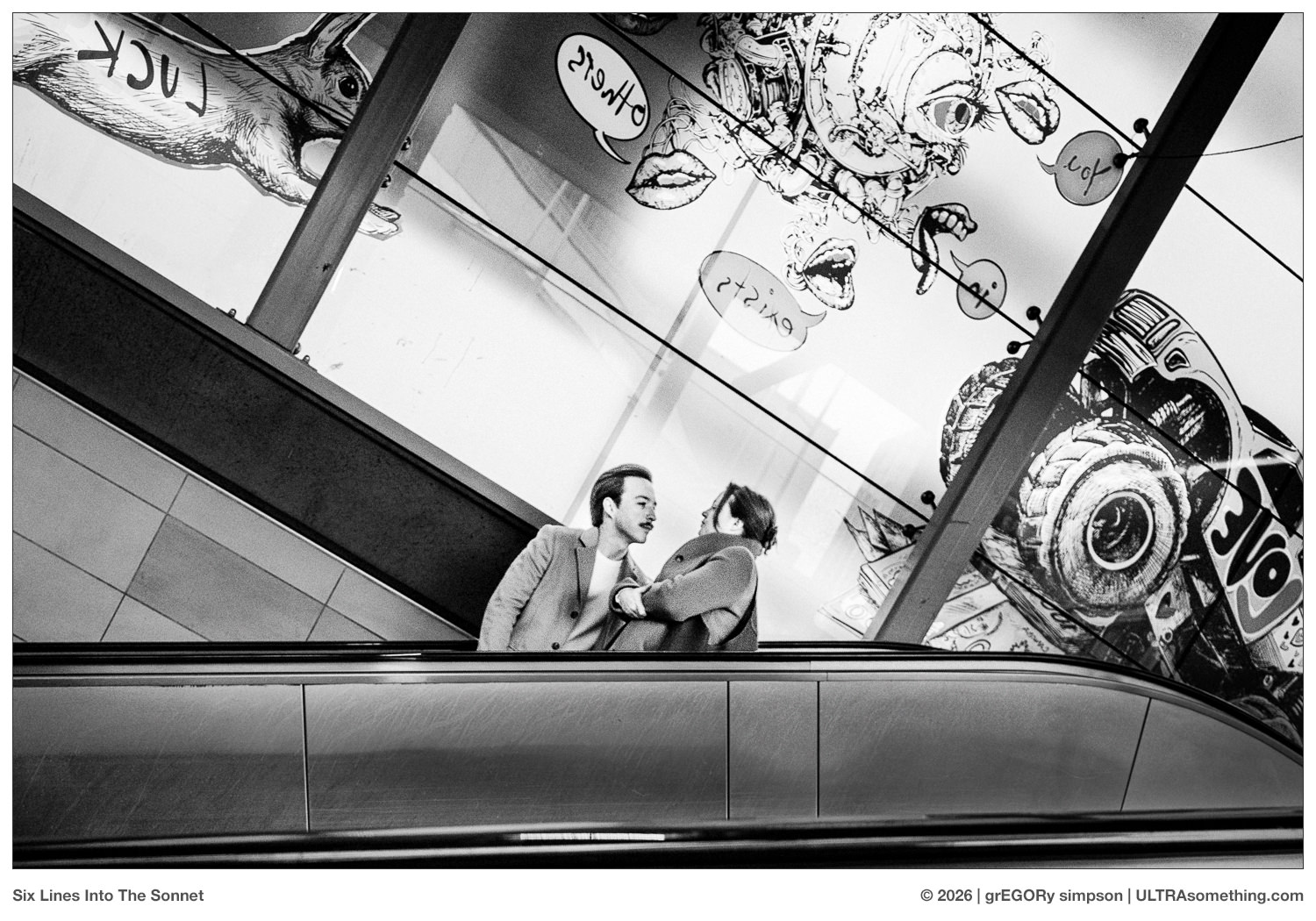
ABOUT THESE PHOTOS: Only one of these photos was shot with my K5 digital SLR. Can you guess which one? In all the others, the camera occupied its rightful place as the medium, not the message — as it should be. “Cup Holder, Vancouver Style” was shot with a Leica M9 and a pre-production 21mm Super-Elmar-M f/3.4 ASPH lens. “Little Ray o’ Sunshine” was shot with a Ricoh GXR using its A12 28mm f/2.5 lens module, which I “guess focussed” using Ricoh’s ‘snap focus’ feature. I was immediately drawn to the little girl’s expression, and included it here since it so accurately mirrored mine as I wrote this post. “Urban Gypsy, Good Fortune” was shot with a Leica M9 and a 28mm f/2 Summicron lens.
If you find these photos enjoyable or the articles beneficial, please consider making a DONATION to this site’s continuing evolution. As you’ve likely realized, ULTRAsomething is not an aggregator site — serious time and effort go into developing the original content contained within these virtual walls.