Blog

  • The Miscreant Photographer

    The Miscreant Photographer

    On February 16th, 2009, the UK began to enforce their ambiguously-worded counter-terrorism laws that, essentially, call into question the motives of all photographers and cast doubt upon their actions. Photographing any police officer, military personnel or intelligence official is an ‘offense’ for which a photographer can now be arrested. The vagueness of the law is nearly as disturbing as the fact it even exists, because it empowers any police officer to detain a photographer and confiscate both equipment and images under the flimsiest veil of legitimacy.

    As I mourned the vilification of my UK brethren, I took solace in the fact that I lived in Canada — a nation fiercely committed to rights, freedoms, and artistic expression… or so I thought.

    On March 20th, Vancouver police shot and killed a man they erroneously identified as a suspect in a recent vehicular break-in. It was an event with nearly 50 witnesses, one of whom captured the shooting using his cell phone. Police confiscated the man’s phone and deleted the four minute video of the shooting. Then, on April 5th, Vancouver police shot a suspected car thief. A news photographer, who happened to live nearby, ran out of his home to photograph the aftermath. Police demanded he turn over his camera. When the photographer refused, they tried to wrestle it away from him — manhandling him, and putting him in a lock-hold in an effort to forcibly confiscate his camera. Eventually, under threat of arrest, the photographer surrendered it to police.

    In spite of police spokespeople who confirm the department supports Canada’s Charter of Rights and Freedoms, the B.C. Civil Liberties Association reports at least four such recent incidents. Fortunately, local public opinion weighs heavily in favor of photographers, and the actions of a few rogue police officers has not vilified the camera toting members of this community.

    Such vilification, apparently, is the duty of Translink — metro Vancouver’s regional transport authority. They recently unveiled a new print campaign featuring an ad in which a man is shown photographing a security camera. The ad encourages people to report this kind of activity to the police. I’ll overlook the obvious irony that Translink, themselves, took a photo of a security camera for their own advertisement, thus self-demonizing the campaign. But what I can’t overlook is TransLink spokesman Ken Hardie’s rationalization for why photographers should be reported. According to Mr. Hardie, “they’re taking pictures of wiring, pipes, electrical panels. Well, I’m sorry, not many people go around doing that.”

    You are correct, Mr. Hardie. Not many people go around doing that. Just photographers, designers, artists, architects and people who find beauty and interest in man-made creations. “Normal” people who turn their cameras around backward, holding them at arm’s length so as to take self-portraits in front of tourist sites, are usually not the sort to photograph architectural details. Nor are terrorists, as Bruce Schneier wrote so eloquently in an article for the UK’s “Guardian” newspaper, last year.

    I take photos of pipes, wires, panels, and all manner of things that Translink would have us believe are illicit offenses. Last week, the following object attracted my attention:

    The way the pipe snaked across the wall, dividing it into dark and light halves, reminded me of the Yin-Yang symbol. There’s even a circular element that conforms to the smaller circles within the Yin-Yang graphic. The fact I even noticed this would probably befuddle Translink, but the reason I photographed it is even more sinister: As a capitalist, I thought it might make a nice CD cover for some band. I even worked on a little ‘mock up.’ So feel free to contact me if you’d like to purchase it.

    Now, honestly, I have no problem with citizens being aware of their surroundings and doing due diligence. I’ve been approached several times while photographing some rather peculiar objects. It matters not to me whether these people are suspicious or merely curious — I’ll treat them with respect and gladly tell them what I’m photographing and why. What concerns me is the way in which this Translink ad casts photographers as likely criminals and encourages others to view us in this way.

    I recently stood in the middle of a parking lot, in front of a large white wall, and took a photo of a small section in which a brick was missing. It’s the sort of thing few people ever notice, much less photograph. But I caught site of a small syringe within the crevice, so I photographed it. Upon returning home, I could see, in the murky shadows, another syringe and what appears to be a knife handle. It’s a rather eerie photograph. But am I the criminal for having taken it?

    So if you ever see me photographing electrical wiring, some pipes, or a blank wall and you’re worried or curious, just ask me about it. I’d be happy to tell you, for example, that I took the following photograph because I thought it would make a nice background on which some company could ‘paint’ an advertisement or slogan.

    In fact, now that I think about it, that’s exactly what I’ll use it for:


    ©2009 grEGORy simpson

    If you find these photos enjoyable or the articles beneficial, please consider making a DONATION to this site’s continuing evolution. As you’ve likely realized, ULTRAsomething is not an aggregator site — serious time and effort go into developing the original content contained within these virtual walls.

  • Shut Up and Shoot

    Shut Up and Shoot

    For a photography blog, these posts certainly skew toward the wordy. Every now and then I need to exercise a little restraint, and simply let the images do the talking. So, in that spirit, I present a few street shots from the last couple of weeks — each of which can tell its own story without my usual reams of imposing prose.

    Didgeridoo and Didgeridon’t

    After my apathetic reaction to the bands that played Vancouver’s Juno Awards festivities, I wandered one block to the west and found a more photogenic and organic form of both musical expression and audience involvement.

    The Polarizing Power of Suggestion

    As I waited for the light to change, I spotted this little melodrama directly across the intersection. From appearances, it looks like the embracing couple has inspired a sense of longing in the gentleman. But the woman—to whom his yearning gaze seems directed—possesses a body posture that’s diametrically the opposite. Then again, maybe none of this is transpiring. But that’s the beauty of street photography — it captures a split second, and the viewer fills in the story.

    The Old Gang

    In 1958, when Link Wray invented heavy metal by poking holes in his guitar amp’s speaker to give his recording of Rumble a grittier sound, this gang probably used it as background music for a few rumbles of their own. Conjecture? Maybe. But I’m still rather certain these guys could take me.


    ©2009 grEGORy simpson

    If you find these photos enjoyable or the articles beneficial, please consider making a DONATION to this site’s continuing evolution. As you’ve likely realized, ULTRAsomething is not an aggregator site — serious time and effort go into developing the original content contained within these virtual walls.

  • The Reel World

    The Reel World

    In spite of appearances, the title of this post is not a misspelling, though it is an anachronism. But I’m getting ahead of myself…

    Vancouver hosted the Juno Awards last weekend. For the edification of the 99.5% of the world’s population that doesn’t live in Canada, the Juno Awards are this country’s annual musical awards event. In celebration, the city cordoned off the only two blocks of Granville Street not currently under-construction, and hosted a four-day jam-fest featuring performances by dozens of dreadfully dull bands from across Canada. Now don’t get all riled up — I’m not singling out the bands that played the Juno festivities, nor am I dismissing the whole Canadian music scene. No, when I dismiss something, I go all the way. And it’s my belief that nearly all modern commercial music, worldwide, borders on the insipid and banal. Competent? Yes. Compelling? No.

    Youngsters are likely to suspect that the distinguishing grey strands sprinkled throughout my hair are the ‘root’ cause of my dismissal, but I have a strong argument to the contrary: I’m not dismissing modern music for being different than the music of my youth — I’m dismissing it for being the same. The bands I saw this weekend have progressed not one inch from the foundations that were built by pioneering rock acts like The Who, The Rolling Stones, and The Yardbirds. They use the same instruments, strike the same affected poses, play the same chords, and sing about the same subjects. What’s with that? What happened to rebellion? What happened to finding your own identity? What happened to culture? The only currently popular music genre that wasn’t popular when I was in High School is Hip Hop — but even that music has its roots in the 1970’s, and continues to play by rules that were firmly established in the early 1980’s.

    Dismayed by the fact that another generation of musicians was failing to make an imprint on culture, and annoyed that I was neither hearing nor seeing anything new, I lost interest in photographing the bands. Instead, I turned my attention and camera to the audience. And that’s when I saw it — the cultural difference between this generation and those that preceded it — the video monitor.

    All around me, people were holding up cell phones, video recorders, and all manner of minuscule point-and-shoot cameras — gazing intently into their little LCDs. Nearly everyone watching a performance was experiencing it on a personal video monitor. If people weren’t watching a video monitor, they weren’t watching the band — almost as if, without benefit of a personal viewing device, the event wasn’t even happening.

    The photo below shows that, not only is the girl watching the band perform on her camera’s video screen but, zoomed-in, we see that she’s even watching another girl watch the band on another video screen.

    After a decade-long diet of reality television, is this what the world has come to? Is reality no longer “real” unless it’s seen on a television screen or computer monitor? Has the “real world” become the “reel world?” Are we seeing a new generation for whom the world’s events don’t actually exist unless they’re on film? Or, more precisely, unless they’re digitized and compressed bits of data recorded to a flash memory device and seen on an LCD video display?

    What a curious way to experience life. But what a delight for me, as it has given significance to that sprinkling of grey in my hair. I finally have a reason to shake my fist and say something profound like, “in my day, we actually watched things happen live, rather than on a video monitor… and it was better that way.”


    ©2009 grEGORy simpson

    If you find these photos enjoyable or the articles beneficial, please consider making a DONATION to this site’s continuing evolution. As you’ve likely realized, ULTRAsomething is not an aggregator site — serious time and effort go into developing the original content contained within these virtual walls.

  • The Positive of Being Negative

    The Positive of Being Negative

    Lately, I’ve been thinking about negatives. This might seem curious since I haven’t shot film in years. In fact, I haven’t even looked at a negative since the time, several years back, when I went on a 3-day scanning binge — a process so painfully tedious that, to this day, I suffer a mild anxiety attack whenever I see a curled up strip of plastic.

    So why am I thinking about negatives? Because I’m thinking of them in the stylistic sense, rather than the traditional. Specifically, I’ve been thinking about creating the opposite of an image — inverting every decision I made in the original capture, and replacing it with its conceptual opposite.

    The notion first came to me as I took a self-portrait in a dilapidated mirror that adorns an abandoned night club. At the time, I wasn’t sure whether I wanted to focus on my face or on the mirror. I chose my face and, after publishing the photo in my Tempted by Texture article, I began to second-guess that decision. The more I looked at the image, the more I thought I’d like to try inverting every decision I made. In other words, not only would I take the focus off my face and put it on the mirror, but I’d also invert the lighting — shooting at night, rather than day. Similarly, since I originally conceived the image in high-contrast black & white, I wanted its ‘negative’ to be a murkier color print. I returned to the mirror on Granville Street and, on a chilly winter’s night, shot the “negative” version of that previous image.

    In photography, as in life, inspiration can come from anywhere — you just have to be receptive enough to recognize it, and thoughtful enough to capitalize on it. This particular idea — to create a stylistic ‘negative’ — has increasingly permeated my consciousness the last several weeks. Now, when I look at a scene, I find myself looking for its conceptual opposite. Sometimes the ‘negative’ concept isn’t compelling, but sometimes it’s more visually interesting than the original composition.

    Case in point: I was walking around a local park with a Lensbaby mounted to my camera body. Lensbabies are ideal for creating selective focus effects and, by their very nature, they force you to think seriously about composition. I was kneeling down to frame a shot that contained three elements: In the foreground was a fountain, which I would render out of focus. In the background was a building, which I would also render out of focus. The focal point of the image, located a couple meters from my lens, was a pot of flowers. As I eyed this shot, it felt too ‘pedestrian’ — even with the Lensbaby effect. So I decided to consider its ‘negative’ image.

    In the original shot concept, both the water and the building would be out-of-focus. So the ‘negative’ image would require that those two elements now be in focus. By the same logic, any greenery — which was the intended focus in the ‘positive’ image — would need to be rendered out-of-focus in the ‘negative.’ It seemed like an impossible set of constraints, but I chose to spend a few minutes scrutinizing my environment for possibilities. Within 30 seconds, I spotted the reflection of a high-rise in a puddle. Using the Lensbaby’s crazy articulation capabilities, I was able to twist it in such a way that the puddle and building were in focus, while the greenery in and around the puddle was not. The result is a compelling image that I would never have thought to compose, had I not been looking for the ‘negative’ of my intended image.

    Rules and limitations force us to find creative solutions. By imposing rules on your photography, you force yourself to think creatively and to carefully consider composition. This is one of the reasons that I rarely shoot with a zoom lens. It’s also why I invent little games for myself, like “finding the negative of the image.” Sometimes the best shots are where you would normally never look.


    ©2009 grEGORy simpson

    If you find these photos enjoyable or the articles beneficial, please consider making a DONATION to this site’s continuing evolution. As you’ve likely realized, ULTRAsomething is not an aggregator site — serious time and effort go into developing the original content contained within these virtual walls.

  • Construction Site

    Construction Site

    The 2010 Winter Olympics are just over 10 months away, and construction projects continue to disfigure and disrupt this beautiful city as if Mothra and Godzilla had chosen to wage a street hockey battle in our little metropolis. But if you think that’s the actual subject of this article, you’re mistaken… and forgiven. I did, after all, become culpable for this deception when I chose to illustrate my words with photographs of downtown construction sites. It’s just that the real topic of this post — website construction — isn’t nearly as photogenic as all the cranes, backhoes, and mounds of rubble scattered about the city.

    But website construction is, indeed, the topic of this article. And unlike Vancouver’s myriad building projects, mine didn’t inconvenience a million people for five years. More importantly, mine is now complete. Among the more mundane additions to the ULTRAsomething photography site are the inclusion of sample images in the gallery link, and the addition of an RSS feed (which appears in the bottom-right footer of each blog page).

    More exciting — at least for those who feel compelled to part with a little pocket change between economic meltdowns — are the new e-commerce features. First, I am now making selected blog photos available for purchase. Customers in any country can purchase blog prints (or digital downloads) from my hosted gallery pages on Smugmug.com.

    Second, I’ve created a new client site for my Canadian customers (ADDENDUM: This feature has been removed since the original publication of this article). This site has a completely different focus than the Smugmug-hosted galleries, and is designed specifically to allow local clients to proof images and buy event photos with Canadian currency. While the hosted gallery is still the best choice for viewing and purchasing public gallery photos, my northern neighbors now have the option of purchasing blog photos with Loonies and Toonies.

    Finally, for those of you who enjoy these blogs and photos but have no need for prints or downloads, I’ve added a donation option.

    Now if the City of Vancouver would just follow my lead and finish their construction projects. I’m dreaming of a day when, once again, I have sidewalks to stroll upon and roads to drive down. That daytime photo above? That’s Granville Street — Vancouver’s entertainment district, and our major north/south artery. Seriously. February 12, 2010 can not come soon enough.


    ©2009 grEGORy simpson

    If you find these photos enjoyable or the articles beneficial, please consider making a DONATION to this site’s continuing evolution. As you’ve likely realized, ULTRAsomething is not an aggregator site — serious time and effort go into developing the original content contained within these virtual walls.

  • The Freedom of Free

    The Freedom of Free

    I’m sure my accountant would argue that there’s nothing good about volunteering for a free photography assignment. And, should one wish to pay for such mundane things as rent and food, she would be right. But for me, both rent and food rank slightly below coffee on my list of life’s essentials. So when my friend Mike, who owns Coo Coo Coffee on Davie Street, mentioned that he needed a few photos to boost his business, I jumped all over it.

    Mike pulls the best espresso in downtown Vancouver and, because of this, he’s been helping feed my daily habit for the last 8 years. After living for over a decade in San Francisco’s North Beach neighborhood, I’d grown rather particular about my coffee. “Snobbish,” actually. So when I first moved to Vancouver, I was forced to get in my car every weekend and make a special trip to Commercial Drive which, like North Beach in San Francisco, is an Italian neighborhood. The coffee on Commercial Drive was great, but my access to it wasn’t. I had a daily habit to feed, not a weekly one. So, for several months, I attempted to supplement those weekend trips with weekday visits to numerous Pacific Northwest coffee chains. But chain coffee is about as satisfying as a tofu burger to a meat lover. Surprisingly, many of the downtown independent cafés demonstrated absolutely no inclination to improve upon the barely potable brown water served up by the famous chains. Discovering Coo Coo saved me from the indignity of the coffee chain, and it saved me from the withdrawal pangs I felt between trips to Commercial Drive. In fact, I don’t even feel the need to travel to Commercial Drive anymore.

    So if Mike’s hurting, then I’m hurting. And, just to make sure no one else gets hurt, I decided not to tell my accountant. After all, what she doesn’t know can’t hurt her, right? Besides, there are some non-remunerative advantages to working for free. For example, your client can’t be even remotely particular about what you shoot. “Shooting for free” means “freedom of choice.” And “freedom of choice” means you get to pull out all those wacky little photo tricks that you never get to use on “real” jobs.

    Mike did have one request: He wanted a shot of his yellow La Marzocco, and he wanted some customers to be in the photo with it. Easier said than done. Since the unit is squeezed into a corner of the shop, there’s really no vantage point from which it can be photographed in its entirety — at least not using any ‘traditional’ means. No problem. Free gig = freedom of choice. So, for the photo shown at the top of this post, I used my widest rectilinear lens, the 17-40 f/4L, and wedged my camera into the corner — its back just inches from the trash, and its lens mere inches from the La Marzocco. This gave me a shot of the machine’s long, sleek lines as well as some context of its placement within the shop. The second half of Mike’s request was that the photo contain customers. But photographing customers to use in an advertisement meant I’d have to secure model releases. No thanks. By the time I’d get someone to consent, my coffee would be cold — and this is, after all, all about the coffee. So, with freedom of choice as my guide, I simply chose to stop down the lens and shoot a 1 second exposure. The long shutter meant that people would become a blur and, thus, unrecognizable. It would also give some movement and life to an otherwise static shot. Working for free gave me carte blanche to solve the problem any way I saw fit. And that’s almost as good for my soul as one of Mike’s Italian cappuccinos.

    The above photos are representative of other shots that “the freedom of free” allowed me to take. The left-most photo came about because Mike mentioned he’d like a close-up of his new lighting fixtures. That request was a bit of a head-scratcher for me since Mike sold coffee, not lighting fixtures. So, while I’m scratching my head, I’m thinking “Mike didn’t say the lighting fixture had to be in focus. So there you go. Getting a photo request that made me scratch my head inspired me to create a photo that would make everyone scratch their heads.

    The photo on the right was externally influenced. I recently started re-watching Twin Peaks on DVD. The night before I took this photo, I viewed the episode in which Jack Nance utters the classic phrase, “there’s a fish in the percolator!” Inspired, I thought to myself, “Wouldn’t it be funny to replicate this statement photographically?” So the next day, I simply stuck my fisheye lens so close to Mike’s La Marzocco that the camera was practically inside it. Work for free and you’re free to amuse yourself in any ridiculous manner you see fit.

    That’s “the freedom of free.” Just don’t be tempted to partake in this delight too often and, whatever you do, please don’t imbibe if your client is willing to actually pay you for a shoot. “Free” may be liberating, but that doesn’t mean you have to be stupid. There are, after all, accountants to feed.


    ©2009 grEGORy simpson

    If you find these photos enjoyable or the articles beneficial, please consider making a DONATION to this site’s continuing evolution. As you’ve likely realized, ULTRAsomething is not an aggregator site — serious time and effort go into developing the original content contained within these virtual walls.

  • Like a Leica (Addendum)

    Like a Leica (Addendum)

    Last month, I penned the 5-part Like a Leica series of articles for this blog. In it, I expressed dissatisfaction with my attempts to coerce both a dSLR and an advanced point-and-shoot camera into street photography duty. Like a million photographers before me, I identified the rangefinder as the ideal tool for the job. Unfortunately, rangefinders are currently out-of-favor and, unless I’m willing to return to my film roots, my only digital choice is the Leica M8.2 — a $6,000 camera body. Add a pair of Summilux lenses and toss on the sales tax, and I’d be staring down the barrel of a $15,000 bill.

    So, once again, I exercised fiscal responsibility and opted for a ‘work around.’ In this case, I decided to try the new ‘micro four thirds’ standard — a standard with exactly one camera to support it: the Panasonic DMC-G1. What lured me to the system was its adaptability; specifically the ability to adapt M-mount lenses to the body. In part 4 and part 5 of the series, I presented my initial assessment of the G1 and identified several issues with the camera — particularly in regards to adapted lenses.

    Since I first published my report, one of those issues has been rectified. Specifically, I identified a problem in which all adapted lenses focused beyond infinity. This caused several problems. First, it meant the scale markings on the lens barrel were inaccurate, which made zone-focusing impossible. Without accurate lens markings, there is no way a street photographer can focus the lens when shooting from the hip. Second, it meant that the lens’ full 90 degrees of focussing rotation could not be used. Rather, only about 15 degrees of rotation existed between the minimum focus distance (.7m) and infinity. This made it nearly impossible to achieve accurate focus.

    So how was the issue rectified? By getting another Novoflex adapter. This sounds easier than it was. For starters, Novoflex is one of the most respected lens adapter manufacturers in the world. Since these adapters are machined on automated equipment, there is no way I could have a rogue ‘bad’ adapter. If my micro four thirds (MFT) adapter was bad, then every Novoflex MFT adapter was bad. But there were no reports on the internet about bad Novoflex MFT adapters. My posts on various forums were met, mostly, with the usual “my adapter works fine” response. My dealer told me he had sold several, and that none of his customers had complained. The same was true with the Novoflex distributor in Canada. Fortunately, on rangefinderforum.com, a fellow named Nemjo, from Hungary, had seen my post and confirmed that he’d experienced the same problem with his Novoflex adapter. This spurred him into calling Novoflex’s German headquarters, and Novoflex admitted that all their MFT adapters had been manufactured to the wrong thickness. Nemjo posted his findings and, suddenly, the internet was awash with photographers complaining about their Novoflex adapters. I find it inconceivable that hundreds of photographers could have used the Novoflex MFT adapter and not noticed this glaring error until it was confirmed by the manufacturer — but this is a blog about photography, not human nature. After an interminable three week wait, I finally received my replacement adapter last Thursday.

    With the new Novoflex MFT adapter, my Voigtländer 35mm f/1.4 Nokton no longer focusses beyond infinity. The distance markings on the lens barrel are seemingly accurate (I haven’t done any scientific testing), and the lens’ full 90 degrees of focus rotation can be employed — meaning I’m able to focus far more accurately through the G1’s electronic viewfinder. I do get a sense that my Nokton now focusses ever-so-slightly short of infinity or, perhaps, just reaches it. It’s certainly impossible to make it focus beyond infinity, even slightly, meaning there’s no tolerance here at all. It remains to be seen if this becomes a problem in different climate conditions.

    With the second generation Novoflex MFT adapter, the G1 has become a much more viable street camera. The shot taken at the top of this article was a classic hip shot — zone-focussed using the lens barrel markings. It was exactly the type of shot that wouldn’t be possible with the previous Novoflex adapter.

    Last night, I decided to ‘torture test’ the G1/Novoflex/Nokton combo. I took it out into the nightlife along Vancouver’s Granville Street, shooting wide-open at f/1.4 with the G1 set to ISO 3200. This shot of a girl, waiting impatiently to enter a night club, was blindly zone-focussed. At f/1.4, the narrow depth-of-field yields no margin for error and, sure enough, the focus is a bit off. But the fact that I manually focussed, blindly, using only the barrel markings and my ‘guesstimate’ of the girls’ distance validates my reason for originally choosing the MFT format — to use rangefinder lenses for blind, zone-focus shooting. Note that the G1’s noise level at ISO 3200 is excessively high, but as I discussed in my Tempted by Texture post, I don’t consider ‘faults’ such as soft focus or noise to necessarily be detrimental to an image — in this shot, they’re what make the image.

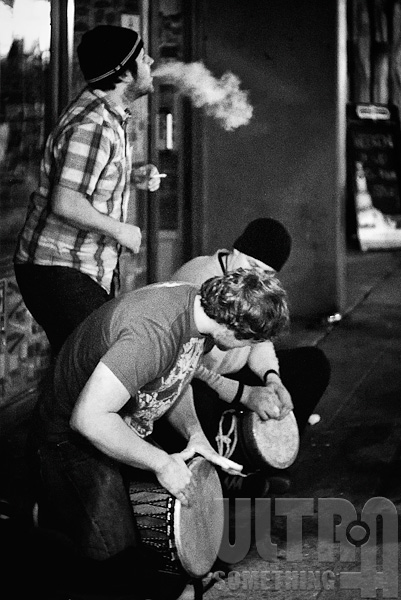
    For the following shot of the late night street musicians, I used the electronic viewfinder. The doorway in which they played was extremely dark and, at f/1.4 and ISO 3200, I could still muster only 1/60s — too slow to freeze their kinetic action, and also a bit too slow to handhold with the 70mm equivalent focal length of the adapted 35mm Nokton. This shot would have been difficult, if not impossible, to capture with a rangefinder. But the G1’s ability to brighten the viewfinder to compensate for low-light conditions allowed me to achieve at least a modicum of focus. Granted, this shot would be a breeze with my 5DmkII, but I didn’t have my 5DmkII with me — I was testing the limits of the G1 under the most extreme conditions possible, and its performance exceeded my expectations.

    As you might expect, the experience of shooting with adapted lenses on a G1 is much improved when you use a properly manufactured adapter. I mentioned several other issues in the original ‘Like a Leica’ series, and they still remain. In particular, there are two matters I’d like to see Panasonic address: First, I’d like to have 1-button access to the zoomed-in MF assist mode. It’s still cumbersome to trigger the 2-button sequence needed to enter this mode and, when using adapted lenses, you need to enter this mode on nearly every shot. Second, I’d like to see a user-selectable minimum shutter speed when using Aperture priority mode. The camera’s default setting of 1/30 is simply too slow for a non-stabilized lens.

    So, after using the G1 for a month now, am I any less inclined to like a Leica? Well, the more I use the G1, the more I see it as a perfect compliment to a rangefinder. It lets you take telephoto shots that would be difficult with a rangefinder, and it lets you focus in conditions much darker than would be possible with a rangefinder. But, in spite of everything the G1 offers, it’s still not a rangefinder and, as such, lacks many necessary attributes inherent in that tried, true, but hopelessly forgotten format. The more I use the G1, the more I yearn for the rangefinder experience. But I now yearn for a rangefinder as an addition to — rather than a replacement for — the G1.

    20 July 2009 Update:  Addicted to gear talk? Wishing for a sequel? Then you’re in luck. In a subsequent series of posts, beginning with “The M8ing Ritual (Part 1),” I discuss adding a Leica M8 to my ‘street’ kit. And in a follow up post, titled “Geeking out with a 50 ‘Cron,” I discuss the performance differences between a DMC-G1 and an M8 when both are fronted with a 1991 Leica 50mm Summicron.


    ©2009 grEGORy simpson

    If you find these photos enjoyable or the articles beneficial, please consider making a DONATION to this site’s continuing evolution. As you’ve likely realized, ULTRAsomething is not an aggregator site — serious time and effort go into developing the original content contained within these virtual walls.

  • Tempted by Texture

    Tempted by Texture

    Prior to 1991, my photographic undertakings were perfunctory at best. I used a camera only for ‘special’ occasions — like birthdays and vacations — and I parsimoniously rationed each exposure to minimize my film and processing costs. I was both blithely ignorant and squeaky cheap.

    That year, I experienced a monumental photographic awakening. I don’t know what caused it, and I can’t point to any one single image or photographer that was responsible. But I suddenly became voracious in my consumption of photographic images. I studied every page of every publication in every photography section of every bookstore in San Francisco. I attended any gallery or museum that tacked photographs to its walls, and I purchased dozens of photography periodicals each month — even the French and German ones. Never mind that I didn’t speak those languages, I was on an insatiable quest. And as my gluttony grew, my ‘food’ supply ran short. In these primitive, pre-internet days, photographs were a finite commodity — and soon, the only way I could see new photos was to take them myself. What a revelation! My world changed in an instant, and suddenly everything in it looked completely different — life, itself, had became a photo opportunity.

    And thus, I was ignorant no more!

    But I was still squeaky cheap. So when the time came to start shooting my own film, I decided to save stacks of cash by processing and printing it myself. This, of course, meant black & white. And the more I shot it, the more I became enamored with its graininess and contrast. I would often purchase the highest ISO film stock I could find, then shoot in the darkest and murkiest places. Shadows began to interest me more than the subjects that cast them. Indefinite, grainy edges became sources of intrigue and mystery. Everything I shot was cold and distant yet, inexplicably, warm and inviting. In short, I had become enamored with texture.

    Texture became one of the biggest creative influences in my life — not just in photography, but in the densely dark music I was writing and producing at the time. In some ways, I didn’t adopt texture, it adopted me. In those early photographic days, I couldn’t afford to shoot, process, or print brightly colored images. I couldn’t afford sharp, vivid lenses. My tools and materials limited my options, and thus expanded my creativity.

    Technology advanced and, as the years progressed, my cameras, lenses, techniques and knowledge all improved dramatically. Eventually, I was able to produce the sort of high-calibre professional images that were beyond my grasp in those early years. And, with my photographic appetite showing no signs of waning, I was more than happy to feed it all the bright, clean, colorful, rich, and radiant images I could muster.

    But recently, something new has entered my ongoing evolution as a photographer, and it’s actually something quite old — texture. I am, once again, beguiled by its imperfection and its incomprehensible shadows. I’m drawn to its secrets and, like a lost love rekindled, this attraction has energized me with a renewed spirit and a feeling of youth to belie my years.

    In my quest to become a more ‘professional’ photographer, I’d forgotten what it meant to be a ‘personal’ photographer. For me, photographic beauty lies in the defects, flaws, cracks, scratches, deficiencies and limitations of the textured image. These are the sort of images I once took for myself. And these are the images I’ve started taking again.

    At the top of this article, is an image I shot in early-February. I had planned to publish a series of Valentine’s Day ‘street’ photos but fell ill, which forced me to scrap the project. I’m publishing the image here as a tangible example of texture’s magical properties. Because love, itself, is timeless, I wanted the image to convey that same sense of timelessness. Shooting at a fairly high ISO speed and with manual focusing, I was able to create the sort of grainy, imperfect image that can’t be identified with any particular era.

    The second image is a self portrait. I shot this today, from the hip, into a filthy and broken mirror outside an abandoned nightclub on Granville Street. The cracks and stains provide both a slightly distorted reality and a different type of texture than the beach photograph.

    While the technology behind photography has always been a quest for perfection, texture is about imperfection. It sets a mood and suggests a feeling. In a medium meant to depict reality, texture provides a way to inject surreality.


    ©2009 grEGORy simpson

    If you find these photos enjoyable or the articles beneficial, please consider making a DONATION to this site’s continuing evolution. As you’ve likely realized, ULTRAsomething is not an aggregator site — serious time and effort go into developing the original content contained within these virtual walls.

  • Termino Morbus

    Termino Morbus

    After a week of malady compounded further by the medicine meant to combat it, I finally felt like venturing out of the condo yesterday. Well, maybe I didn’t exactly feel like it, but I was beginning to suffer from an opportunistic affliction known as termino morbus. Don’t worry, it sounds worse than it actually is. Like all things medical, it’s a latin term that, roughly translated, means “closure sickness.” Its folksier name is “shutter withdrawal” and, as any obsessive photographer knows, it’s an affliction that causes one eye to close and the index finger to flex up-and-down. While this is a perfectly normal occurrence in a healthy photographer, you must remember that healthy photographers always have a camera in hand. After long periods of non-photography (such as those caused by illness) the brain’s auto-mechanical neural network causes one’s muscles to contract spontaneously as if taking a photo, even though no camera is present. Strangers are often amused by this mildly ‘eccentric’ behavior, but it does tend to frighten loved ones — particularly in its advanced stages where patients begin to make audible camera sounds with their lips.

    So, in spite of the fact that my health wasn’t quite where it needed to be, I felt I simply must leave the condo or risk a worsening case of termino morbus. I grabbed my smallest, lightest camera — the Panasonic DMC-LX3 — and, like a newborn fawn (but not nearly as adorable) took my first tentative steps. With an uncertainty reflected in my unsteadiness, I moved slowly over the length of that first city block. But as I gained my confidence, I captured a second block; then another; and another — until I arrived at the Vancouver Library.

    Why the library? Two reasons. One, I had some DVDs to pick up. And two, it’s a beautiful building. Buildings are ideal subjects for eradicating termino morbus because they’re immutable. They don’t run away. They’re not shy. They stand patiently waiting for you to photograph them. They’re “chicken soup” for the shaky, enervated photographer, and the Vancouver Public Library — a modern helical take on a classical coliseum — is a mighty fine bowl of it. After spending a mere five minutes triggering the electronic shutter on my compact LX3 camera, the tremors subsided, my eye opened, and my index finger stopped flexing all by itself. My termino morbus went into remission, and I even have a few useless shots of the Vancouver Library to show for it.

    I was even lucky enough to score a “candid” shot in the library atrium. Granted, it required a minimum of effort on my part, since my subject wasn’t exactly moving — but he did give me an extra injection of termino morbus anti-venom, which will carry me through the remaining days of my existing, primary malady.


    DONATION to this site’s continuing evolution. As you’ve likely realized, ULTRAsomething is not an aggregator site — serious time and effort go into developing the original content contained within these virtual walls.
  • For Dan

    For Dan

    My good friend, Dan Timis, passed away yesterday. I was fortunate enough to have worked with Dan on two separate occasions over the last twenty years — at both Opcode Systems and at Muse Research. Dan was a brilliant digital audio programmer and a very clever fellow. He could see a solution to a problem before many of us even knew that a problem existed. He always had an interesting idea; another angle; or a unique take on a design.

    But as much as I valued Dan as a coworker — and he was the best — I valued him far more as a friend. I’ve never met anyone with a greater enthusiasm for life. His zeal was infectious, and his hunger for knowledge was ravenous. Yet he possessed the endearing qualities of innocence, wonderment and purity that are more commonly associated with a child. Because Dan’s musical tastes were as broad and eclectic as mine, we would discuss subjects like opera and Romanian folk music the way most guys chat about football. Dan was a film and television nut so, when I moved to Canada, he immediately drafted me as a human TiVo — supplying him with a slew of Canadian television comedies he’d been wanting to see. But the thing Dan and I shared the most over the last few years was a love of photography. In fact, the week before his heart attack, I told him I was considering going back to film for street photography. Dan thought I might be losing my sanity, so it was for him that I started writing the Like a Leica series of articles for this blog.

    Dan was the quintessential ‘backyard’ photographer — literally. By that, I mean his favorite subjects were whatever critter happened to wander into his or a friend’s backyard. These photos always had a certain quirky charm that made me smile. With Dan’s passing, I wanted to take my own backyard photo for him. But, since I live in a high rise, I don’t have a backyard. In fact, I don’t have a yard at all. As I looked out my condo window to contemplate how I could possibly take a ‘backyard’ photo for Dan, I saw the sky change in an instant. It burned a dark and vibrant orange for a period just long enough for me to photograph it. I’m not much for either sunset photos or romantic notions, but I like to think that Dan was responsible for this fleetingly intense show in my Vancouver “yard.” So this photo’s for you Dan. The world needs more of what you offered it.


    ©2009 grEGORy simpson

    If you find these photos enjoyable or the articles beneficial, please consider making a DONATION to this site’s continuing evolution. As you’ve likely realized, ULTRAsomething is not an aggregator site — serious time and effort go into developing the original content contained within these virtual walls.

  • Signs and Times

    Signs and Times

    Ten minutes. That’s how long I spent walking around Vancouver’s downtown core this afternoon. But ten minutes and a camera are all you need to capture the signs of the times.

    What times are those? Let’s start with the most trivial one: The Vancouver Canucks hockey team. Here in Canada, the trials and tribulations of the local NHL franchise surpass even “the weather” as the topic most likely to unite strangers who, otherwise, would share only awkward silence. The mood of a Canadian city ebbs and flows with the fortunes of its hockey team, and the Canucks are currently mired in a seven game losing streak — the strain of which is worn on the face of many Vancouver residents.

    The sign? A metaphorical one. A discarded Canucks ticket lies upon the city sidewalk. On it is the face of Canucks centre, Ryan Kesler — as trampled and wretched as the hockey club itself.

    Example of the times, number two? The collapse of the housing industry. For the past decade, every building that didn’t scrape Vancouver’s sky was bulldozed and replaced with one that did. 200-unit condominium towers would sell-out before the developer erected the first construction crane. Prior to the building’s completion, each unit would exchange hands a half-dozen times. Condominiums ceased to become residences, and became currencies of exchange. But like a giant cosmic game of musical chairs, the music stopped. And when it did, those caught holding condominiums could no longer find purchasers. The luckiest developers, who witnessed the market’s collapse before they broke ground, have all turned their construction sites into instant “urban parks.” The unlucky developers, who have projects in-progress, are now facing mounting bills, unsold units, and bankruptcy.

    The sign? A literal one. Specifically, the one in front of the 190-unit H&H building in Yaletown — the trendiest neighborhood in Vancouver. With the developer bankrupt and 44 units still unsold, liquidators continue to slash prices in an attempt to find a realistic market value. This photo contains a “bonus sign” to the far left — a “For Rent” sign. Faced with mortgages they can’t afford, and units that are worth only half of what they paid just 6 months previously, thousands of desperate “ex-investors” are becoming “unemployed landlords.”

    Times example three? Retail’s inevitable collapse. At the base of all those high-rise condominiums are retail outlets. Unlike the units stacked above them, most are still occupied. But for how long?

    The sign? Look through the front door of any retailer. Any one you choose — it doesn’t matter which. What do you see? If you see customers, you’re witnessing a sight more rare than a flute player in a rock band. And, for all I know, that elusive shopper might actually be Ian Anderson.

    Need a fourth glimpse of our times? How about jobs? Or rather, the lack thereof? Thousands are disappearing every day. Many who were lucky enough to survive the first round of layoffs are facing significant salary reductions. Those presently unscathed by either unemployment or reduced wages live in fear of being “next.”

    The Sign? Ketchup becomes a side dish. If times get worse, it may become a meal.


    ©2009 grEGORy simpson

    If you find these photos enjoyable or the articles beneficial, please consider making a DONATION to this site’s continuing evolution. As you’ve likely realized, ULTRAsomething is not an aggregator site — serious time and effort go into developing the original content contained within these virtual walls.

  • Like a Leica (Part 5)

    Like a Leica (Part 5)

    In Part 4, I began to dive into all the nitty-gritty details of the Panasonic G1, particularly in regards to “street” shooting and using adapted M-mount lenses. The following concludes the question and answer exchange between myself and, umm, myself:

    EGOR: So would you give a thumbs-up or thumbs-down to the adapted lens capabilities of the G1?

    EGOR: I guess, based on my experience, I’d give it a marginal thumbs-up. Adapting M-mount lenses definitely accentuates all the worst qualities of a particular lens. Based on my experiences, and after trying several lenses at my camera dealer, I can unequivocally state that the Voigtländer 35mm f/1.4 Nokton provides the worst adapted experience of all. In general, the better your glass, the happier you’ll be with the adapted lens experience. But that’s true of most any product.

    EGOR: Lets zoom out even further, so to speak. Is the G1 a better street camera than your Canon 5DmkII or the Panasonic LX3?

    EGOR: Absolutely. It’s better than the 5D because of weight, portability, and stealthiness. And I can toss an extra lens or two in a pocket, rather than carrying a camera bag. This makes me light on my feet and mobile. I can shoot from the hip (using the flip out screen) and still have about a 20% chance of getting a decently focused image. Granted, that’s not great, but it’s better than the 0% chance I had with the 5D. Obviously, I have a wider selection of lenses available for the 5D and, in nearly every instance when neither discreetness nor portability are key requirements, I’ll use the 5DmkII. To date, it’s the best camera I’ve ever used. But on the street, I’m only going to capture about 1% of the desired shots with a 5D, whereas with the G1, I’m probably capturing about 20%. The same applies to the LX3. With its laborious menu-based control system, its sole reliance on the rear-panel LCD, and its draconian insistence that I deal with unnecessarily imposed camera settings, I was still capturing only about 1% of the desired images. So the G1’s 20% “hit rate” is a huge improvement.

    EGOR: Do you think any camera, other than a rangefinder, will ever give you a 100% hit rate?

    EGOR: No. And there’s no way a rangefinder would either. I figure, at best, I’d never achieve more than an 80% rate using the best of rangefinders, with the best of glass, under the most ideal photographic conditions. That’s just the nature of street photography, and part of what makes it so fun. That said, the G1’s 20% rate is nowhere near my ideal 80% figure. Honestly, if Panasonic would fix the software to allow more accessible MF-assist focusing and faster default shutter speeds in Aperture Priority mode, my hit rate would probably jump to 40%. And, if someone was able to make an adapter that allowed M-mount lenses to operate over their entire focus range and match the distance markings, I don’t see any reason why my “hit rate” with the G1 wouldn’t increase to, say, 60% or more. So, the G1 is a massive improvement over other cameras I’ve tried to use on the street. And, with some simple firmware updates, it could be improved even more. That said, in its current incarnation, the G1 still isn’t enough like a Leica to make me forget I’d like a Leica. But it’s only version 1 of a brand new product format… so I’m keeping my fingers crossed.

    A (Scant) Few Samples

    So you’re probably hoping to see some examples of bright, contrasty G1 test images. How’s that one on the left grab you? What’s that? Not enough contrast? A little soft, you say? That’s not the G1’s doing. This picture is accurately indicative of the weather here in Vancouver for the past couple of weeks. Actually, it’s indicative of the weather on one of the “clearer” days. I’ve never seen anything quite like this. We’ll sometimes get stretches of fog that last for a day or two, but never for two straight weeks! On many occasions, the fog has been so thick that I couldn’t see the street from my condo (I do live in a high rise, but still…). So that dense, soft, soupy stuff that surrounds the boats in this photo isn’t the result of a faulty Voigtländer 35mm f/1.4 Nokton. It’s just good old fashioned fog. While this makes for some nice atmospheric photographs, it also makes it rather difficult to gauge how well a lens performs. Does it flare? Who knows, I haven’t seen the sun. Is it contrasty? Well, it seemed to capture the entire limited dynamic range of this scene. Are the colors rich? Just look at those shades of grey!

    Surprisingly, just a few minutes after I took the photo shown above, the sky actually cleared — ever so briefly and ever so partially — and I was able to capture the photo shown on the left. It’s not gallery material, but at least it gives some indication of the beautiful way in which the 35mm Voigtländer Nokton draws. There’s still a bit a “dreaminess” in this image, but consider these two facts: First, there was almost no actual color visible to the naked eye, yet the Nokton managed to find it and render it. Second, I took this photo almost directly into the sun. The moisture in the air made the sky light up like a prison search light. It was so bright, I had to squint harder than Clint Eastwood sizing up a gunslinger just to even see those boats on the water. I love it when a lens gives you more than your eye sees, and I’m really starting to like that Nokton. I’m not accustom to getting this kind of image quality from a walk-around camera — unless I’m walking around with several pounds of Canon dSLR gear slung over my shoulder.

    While walking around town experimenting with camera, lens, and techniques, I found one curiously common thread running through all the test images — dogs know you’re photographing them. I don’t know how they know this. But they know. People don’t have a clue. But dogs know instinctively. Can they smell a camera lens? Does the imaging sensor emit some kind of high pitched sound? I really can’t say. All I can say is that, no matter how discreet your intent, a dog will know when you’re taking its photo. The image on the left, shot from the hip with the kit lens, is very indicative of the dozens of test images I have that display this phenomena.

    Ultimately, this entire five part article was about street photography. So I’d probably be remiss if I didn’t include a heaping handful of street photos. Well, call me “irresponsible,” because I’m not going to do that. In normal street photography, one chooses their subjects because they convey some wry ironic commentary; or because a single expression tells a story; or because they convey some real emotion that’s captured the photographer’s eye. But I haven’t been doing “normal” street photography this past week, and I haven’t chosen my subjects for any of those reasons. Instead, I chose them simply because they walked in front of my camera. I was working in “simulated” photojournalist mode where, in order to get enough experience with the camera in enough situations, subjects were chosen indiscriminately. Consequently, what I’ve captured this past week are a lot of dull photos of dull people doing dull things. It won’t always be this way. That’s why I’ve started this blog — so I can post these images as they become available. And now that I have a camera that will actually improve my ability to capture street life, it will be the job of future posts to show off the street cred of the G1.

    AMENDMENT: On 22 Feb 2009, I published an addendum to this article.


    ©2009 grEGORy simpson

    If you find these photos enjoyable or the articles beneficial, please consider making a DONATION to this site’s continuing evolution. As you’ve likely realized, ULTRAsomething is not an aggregator site — serious time and effort go into developing the original content contained within these virtual walls.