Blog

  • Like a Leica (Part 4)

    Like a Leica (Part 4)

    Here we are. The fourth, lengthiest, and most technical post in a topic that, originally, I’d intended to be only a few paragraphs in length. But deeming both a dSLR and an advanced point-and-shoot camera “unacceptable street-photography tools” warranted justification, so that subject became a dedicated post (Part 1). Discussing why a rangefinder is the ultimate street camera helped explain why, in the digital age, a street photographer might consider reverting to film-based photography, so Part 2 was born. Finally, I needed to tender the factors influencing my decision to choose a Micro Four Thirds (MFT) camera, so Part 3 became another stand-alone entry. At the end of Part 3, I asked whether a Panasonic DMC-G1 would be enough like a Leica to make me forget how much I’d like a Leica. The short answer is, “No, not quite.”

    But, if you’ve waded through all this minutia for this long, you certainly want more than a flippant, 3-word answer to that question. You want details. You want some hard questions and the hard answers. So, inspired by the recent interest in 1977’s Frost/Nixon interview series, I’ll play the parts of both Frost and Nixon, and get to the bottom of the real meaning behind the answer, “No, not quite.”

    Questions and Answers about the Panasonic DMC-G1 w/Novoflex Leica M-Mount Adapter

    EGOR: The G1 looks a little large. Is it compact enough to use as a street camera?

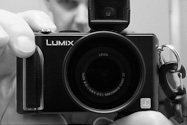
    EGOR: Because the G1 is styled to resemble an SLR, it seems deceptively large when viewed out of context. But, if you look at the photo at left, you can compare the size of the G1 (shown in the middle) to both the larger 5DmkII dSLR and the smaller LX3. In this shot, the G1 doesn’t appear much larger than the LX3, which is a “coat pocket” camera. In actuality, the standard LX3 is somewhat smaller than what’s shown here. This photo shows the camera decked out in its “street” wear, which includes a 24mm external viewfinder and a lens adapter around the lens barrel. Note that I don’t actually adapt anything to the LX3’s lens, I just use it to protect the lens from damage. So, what you see in this shot is an apples-to-apples size comparison: The G1 is outfitted exactly the way I take it onto the street, as are the LX3 and dSLR. Keep in mind that my personal Holy Grail — the rangefinder — isn’t a “coat pocket” camera either. In fact, the G1 and the Leica M8.2 are nearly identical in size, though obviously different in shape. If you add up the total width+height+depth of the M8.2 and compare it to the G1, they’re only 3 mm apart. So, no, I don’t find that the G1 is too large for street use. I think it’s just right — small enough to be discreet, but large enough to actually handle.

    EGOR: What’s it like using an electronic viewfinder, rather than an optical one?

    EGOR: Well, I thought it would be like looking through a video camera, but it’s much more pleasant than that. The G1 has a very high resolution display and a fairly fast refresh rate. In good light, it’s almost as satisfying as the optical viewfinder in a consumer-grade dSLR. For me, using the G1’s electronic viewfinder is a thousand times better than using its rear-panel LCD, since the viewfinder has a diopter adjustment. That means I can actually see the darn thing. The viewfinder does tend to get progressively worse in dim light, though that doesn’t mean it gets darker. Instead, Panasonic applies gain to the viewfinder, so you can still see your subject in a fairly dark environment. This is a good solution, but it’s not without side effects. For one, to get enough light in a darkened environment, the viewfinder frame rate decreases substantially, and it takes on a “strobe-like” appearance. This is fine for static subjects, but makes it difficult to focus on moving objects. That said, I didn’t purchase the G1 to be a low-light camera. I have the 5DmkII for that, and it’s without peer. Since the G1 is for street use and I’m usually taking street photos during daylight hours, the low-light performance of the electronic viewfinder is not an issue for me. What is an issue, however, is the camera’s battery life. Unlike an optical viewfinder, an electronic one takes power — apparently, a lot of power, since I’ve twice drained the G1’s battery in a single day. Also, as a side note, when you attach a faster M-mount lens to the G1, then more light reaches the sensor, meaning the viewfinder’s low light performance improves dramatically.

    EGOR: We’ll get into using M-mount lenses shortly. But before we do, tell us a little about the kit lens. You actually proclaim to like the kit lens that comes with the camera. Seeing as most discerning photographers look at kit lenses with great disdain, aren’t you sacrificing your reputation here?

    EGOR: Most kit lenses deserve to be looked at with disdain, but this 14-45mm version is a different animal, and I wouldn’t balk at using it — even if my reputation were at stake. The lack of any chromatic aberration within the kit lens is amazing. I don’t know whether they’re eliminating the aberrations in software, or if it’s somehow a part of the lens design, but it’s impressive. Of course, no knowledgeable photographer would, in a side-by-side comparison, ever mistake an image taken with the kit lens for one taken with an M-mount. But that said, there’s nothing shameful about the images captured with this lens. I have absolutely no reservations about using it. In fact, if the ambient light level is good and I’m not concerned with creating a shallow depth of field, I’ll use it instead of the adapted M-mount lens. That way, I can use the G1’s auto-focus and capture a greater percentage of in-focus images.

    EGOR: You’re just itching to talk about the adapted lenses, aren’t you? OK, but first (since you mentioned it), tell us a little more about the G1’s contrast-detect auto-focus. Is it really usable?

    EGOR: Not only is it usable, but it’s actually fast enough for street photography! I wouldn’t shoot a sporting event with this camera but, when people are moving about at normal street speeds, the G1’s auto-focus quickly and accurately focuses on my subject without any waffling. This really surprised me, because this is definitely not the case with contrast-detect focusing on a point-and-shoot camera. I think the G1’s sensor size, which is so much larger than a point-and-shoot’s, really helps with the focus speed. I’m less enamored with some of the camera’s gee-whiz auto-focus features. Face detection, for example, is something I thought would be useful for street photography but, in testing it, the software really can’t identify a face unless it’s staring right at the camera. The camera needs to see two eyes, a nose, and a mouth before it says “that’s a face!” I ran some experiments by pointing the camera at myself in the mirror. If I covered one eye with my hand, the G1 would cease to recognize my face as a “face.” The same thing happened if I covered my mouth, or my nose. It also happened when I turned in profile. It’s like the camera is counting holes in your head. If it doesn’t see two eyes, two nostrils and a mouth, it’s not going to call it a “face.”

    EGOR: OK. Let’s get into it now. One of the main reasons you chose the MFT format was its ability to use M-mount lenses. I gather you’ve done this and you’re dying to talk about it.

    EGOR: Yep. I got the Novoflex adapter and a Voigtländer Nokton 35mm f/1.4 M-mount lens. This was a perfect way to hedge my bets on the MFT format. That Voigtländer lens is about 10 times cheaper than the Leica equivalent, but would give me a much different look than the kit lens, and infinitely better images than anything a point-and-shoot could produce. Essentially, it was the “safe” way to give myself an escape route — if the G1 experiment failed, I’d have one less barrier standing between me and either an analog rangefinder or, perhaps, the Holy Grail… a Leica M8.2.

    EGOR: Also, since you’re the eternal optimist, I must assume you’re still hopeful that someone will someday come out with an affordable M-mount digital rangefinder?

    EGOR: That’s right, and it’s the reason I chose the 35mm focal length. On the G1, it functions as a 70mm telephoto, which is quite usable. But on a full-frame rangefinder, it’ll display an actual 35mm focal length, which is my favorite length for street photography. And on an M8.2-type cropped-sensor, it’ll still function as a very practical 47mm “workhorse” lens. I just can’t believe I’m the only guy on earth who wants a digital rangefinder, but who doesn’t have $6000 to drop on one. One of these manufacturers is going to get smart one day and, when they do, that Voigtländer Nokton will segue nicely from the G1 to the rangefinder.

    EGOR: So, how does the Nokton perform?

    EGOR: That’s a question with a hundred different answers. Can you be more specific?

    EGOR: OK. What do you like best about the Nokton?

    EGOR: The image quality is supurb. Under ideal conditions, it draws every bit as nicely as some of my Canon L lenses. You’re not going to get this kind of look from any other small digital camera in existence (except for the M8.2, of course). The fact I get all this out of a lens that’s less than 1/4 the size of its L-equivalent is wonderful news to both my back and shoulders. With this lens on the G1, I don’t necessarily feel like I’m sacrificing image quality for portability. And, from a purely aesthetic standpoint, the G1 is magically transformed from an ugly duckling into a beautiful swan when the Nokton is mounted. It’s just a handsome lens, and it makes the camera body handsome simply through contact.

    EGOR: Since all M-Mount lenses need to be manually focused, is this a difficult process on the G1?

    EGOR: In many ways, it’s not as easy as a rangefinder. But, in other ways, it’s actually easier.

    EGOR: Can you explain?

    EGOR: As I mentioned earlier, the electronic viewfinder is quite useful thanks to its high resolution and rapid refresh rate. But without a split prism to guide you, manual focusing can be somewhat hit-and-miss. Panasonic provides an MF-assist feature, which zooms in on the center of the frame, so you can see to focus on details. This actually enables you to focus quite accurately, but it does present a problem with immediacy. To enable the MF-assist feature, you have to press not one, but two buttons in succession. Complicating matters is the fact that these buttons are so poorly located that you have to lift you right hand off the camera and rotate your wrist in order to press them. This is an ergonomic nightmare. If your photo opportunity is fleeting, then you won’t have enough time to activate the zoomed-in focus screen and you’re forced to manually focus without it. If you’re using a fairly fast aperture with its limited depth of field, then manually focusing without the MF-assist will, more often than not, result in focusing errors. So, for focusing on fast moving or fleeting subjects, the rangefinder is much better. But for focusing on static subjects, the G1 is actually better.

    Of course, my whole purpose for having a G1 is ’street’ photography so, for me, it pales when compared to a rangefinder. What’s really annoying is that Panasonic could definitely fix the problem with a firmware update. There are a lot of unused buttons when the camera’s equipped with an adapted lens. Panasonic should give the customer the ability to assign the MF-assist function to a more ergonomically positioned button, and they should allow that function to be enabled with a single button press, and not a pair of button presses. If Panasonic were to do this, I’d probably double or triple my manual focus success rate on the street.

    AMENDMENT: The following two questions (indented below) discuss a situation in which M-mount lenses, mounted to the Novoflex adapter, focussed well beyond infinity. This caused numerous focusing issues that limited the usefulness of adapted lenses. Subsequent to my publication of this report, Novoflex confirmed a manufacturing error with their entire first batch of M-mount to Micro Four Thirds adapters. I have received my replacement adapter, and have now posted an addendum to this article.

    EGOR: At least the Voigtländer Nokton has those big beautiful focus markings on the barrel, so you can finally realize your dream of being able to zone-focus and shoot from the hip!

    EGOR: I wish that were true. This is one issue in which the adapted lens concept fails miserably on the G1… at least with my 35mm Nokton. The lens focuses substantially beyond infinity. In fact, the lens is pretty much focused at infinity when its distance scale is at 3 meters. If this lens were mounted on an actual rangefinder, it would have about 90 degrees of rotation between its minimum focus distance and infinity. Unfortunately, on the Novoflex adapted G1, the bulk of its focus range is achieved within about 15 degrees of rotation. This creates two detrimental side effects. First, of course, is the fact that the distance markings on the lens are completely useless, which makes zone-focusing for “blind” shooting impossible. Second, since such a large focal distance is covered by only about 15 degrees of rotation, it’s much more difficult to achieve accurate focus. Even the slightest nudge on the focus ring can throw the whole scene out of focus. Think about it. On a real rangefinder, that full 90 degrees of rotation means you have plenty of room to twist the lens into perfect focus. But, when mounted on the G1, everything between 2M and infinity is focused within about a 15 degree turning radius. With wide open apertures, accurate focus is difficult to achieve — even with the zoomed-in MF-assist feature.

    EGOR: Are all adapted lenses like this?

    EGOR: I can’t give a definitive answer, since the 35mm Nokton is the only one I own. But I did go to my local camera store and test this phenomenon with several other M-mount lenses on the G1 body. In general, the longer the focal length, the less severe the problem. Although both a 75mm and a 90mm focused well beyond infinity, the problem wasn’t as extreme as on the 35mm. This meant I could use a greater percentage of the longer lens’ rotational range for focusing. Sadly, their distance markings were still completely inaccurate. I tried a 21mm lens and it was, like the 35mm, considerably off. But since I was able to get more depth-of-field from the 21mm, it was actually easier to focus than the 35mm. All in all, the 35mm was, by far, the hardest lens to focus manually on a G1 body. Mind you, the Voigtländer is the only 35mm I tried. I have no idea if the same would be true for a Leica 35mm.

    EGOR: So you still can’t shoot from the hip?

    EGOR: Well, that’s not entirely true, either. The G1 has an articulated, fold-out LCD screen. With that, I’m able to keep the camera at waist level, then fold out and rotate the LCD. In this way, I can peer down at the camera, like one would do with an old Twin Lens Reflex or Hasselblad except, of course, the image isn’t inverted. Since the camera’s at my waist, rather than eye-level, I can actually see the LCD well enough to select a focus point when I use the kit lens. Manual focusing with the adapted M-mount is tougher, though. Granted, this method isn’t as discreet as hip-level rangefinder photography since everyone can see I’m looking at my camera’s video display, but it’s better than a dSLR or a point-and-shoot — neither of which have any hip-shot shooting ability.

    EGOR: Getting back to adapted lenses, is the G1’s 2x lens-conversion factor a hindrance?

    EGOR: Yes and no. “No” because it gives you telephoto capabilities previously missing from street cameras. “Yes” because it takes away the wide angle capabilities normally associated with street cameras. Because of the way rangefinders are designed, telephoto lenses aren’t really practical. So the ability to use standard lenses in a whole new way is a novel experience. Suddenly, thanks to the G1, your fast M-mount lenses all become “portrait” lenses. Since rangefinders don’t have optically scaling viewfinders, it’s difficult to get a good feel for how a telephoto image will actually look through a rangefinder’s viewer and, because of this, it can also be difficult to focus. The 2x factor of the G1 effectively converts all your rangefinder lenses into telephoto lenses but, unlike a rangefinder, the G1’s electronic viewfinder scales with the focal length. Thanks to the G1, you can shoot, frame, and focus at focal lengths that would be impossible on a rangefinder. But this is also why, at the same time, the 2x factor is a hindrance — you can’t shoot wide with M-mount lenses. Getting true wide-angle capabilities with the G1 means waiting for MFT system lenses to appear — your rangefinder lenses won’t help you here.

    EGOR: Anything else you can comment on regarding the use of M-mount lenses on a MFT body?

    EGOR: Since the 35mm Voigtländer is the only M-mount lens I own, my experiences are rather specific to that lens. Although it’s a newly manufactured lens, it’s based on a very old optical design, which Voigtländer markets as “classic.” In this case, “classic” means “no aspherical lens elements,” which sometimes translates into “spectacularly horrific chromatic aberration.” At wider apertures, this lens/body combination produces a thick blue halo around every highlight it sees. And it’s not the kind of halo that can be easily removed with Adobe Camera Raw or some other software. It’s a dark blue halo, several pixels thick, that completely encircles any highlight. It’s a real shot ruining artifact when it happens, and it happens frequently.

    EGOR: Do you just have a bad lens?

    EGOR: I don’t think so… but I do think it might be a bad lens for adapted use on a G1. I took the lens and body to my dealer, popped off a shot of the fluorescent light fixture in his store, and we both saw the thick blue halo. He then mounted the lens on a Leica M8 and photographed the light fixture — there was no chromatic aberration. That said, I don’t know what aperture setting he used. Perhaps he inadvertently changed the aperture when he mounted it on the Leica? I don’t know. But I do know I didn’t see any chromatic aberration on the Leica. We then proceeded to try several other M-mount lenses on the G1. In general, the longer the lens, the less the aberration. The 40mm Nokton was slightly better than the 35mm, and the 75mm better still. But focal length isn’t the only factor. We tried a 21mm Zeiss lens and it exhibited absolutely no aberration on the G1. Of course, that lens is much more expensive than the Voigtländer and it also has a narrower maximum aperture. So just like the focus range problems I discussed earlier, the 35mm Nokton was, by a wide margin, the worst offender on the G1. Interestingly, my dealer suggested I try a UV filter to see if it would reduce the chromatic aberrations. I normally abhor the use of UV filters but, to my surprise, it actually helped. In fact, the UV filter completely eliminated the aberrations on the longer focal length lenses though, on the 35mm, the benefits were less pronounced. I still have more tests to run with the B+W UV filter before I can determine how useful it is at controlling chromatic aberration on this lens. One problem, though, is that the UV filter sometimes creates very pronounced reflective aberrations. This, of course, is the main reason I’m loathe to use filters. I can foresee a day when I might have to choose which “evil” is less offensive: the chromatic aberration seen under contrasy lighting, or the reflective aberrations seen under those very same conditions. I have a lot more testing to do in this area, so I’ll likely post an update sometime in the future.

    EGOR: Since the G1 expects to see MFT system lenses mounted on the body, does it “freak out” or do anything “weird” when an M-mount lens is on it?

    EGOR: Fortunately, when Panasonic designed this camera, they chose to make it backward compatible with all their older standard Four-Thirds lenses. So, by specification, the camera had to be compatible with adapted lenses — some of which, because of MFT’s contrast-detect focus method, would need to be manually focused. This is the “back door” that allowed these enterprising companies to start developing rangefinder lens adapters for the G1 — the fact that Panasonic was forced to consider the possibility of mounting a non-system lens on the camera meant they designed software that didn’t “freak out” when an unknown lens was mounted. That said, there are still some design choices I’d like to see changed — in particular, I’d really like to see some changes to the way shutter speeds are handled in Aperture Priority mode.

    EGOR: How so?

    EGOR: Panasonic has apparently assumed that any adapted lens will contain image stabilization. As a result, when you use auto ISO and shoot in lower-light situations, the camera will always set the shutter to 1/30th of a second. Obviously, this is far too slow for a non-stabilized adapted M-mount lens. My 35mm acts like a 70mm on the G1, so I’d prefer that the camera choose 1/60 as its minimum default shutter speed, and bump up the ISO to compensate. If I were using a 40 or a 50 then, obviously, I’d rather see the camera set 1/90 as the minimum shutter speed. Unfortunately, the camera doesn’t offer any way for the user to program this minimum value. It simply gives you 1/30. I’d like to see Panasonic implement a feature that would let the photographer define the minimum shutter speed in Aperture Priority mode. Even if Panasonic doesn’t do that, there’s something else they could do to improve the situation — they could offer a “program shift” feature in Aperture Priority mode. That way, when the camera gives you 1/30s at ISO 100, you could simply turn the front dial one click, and the camera would bump the shutter speed to 1/60 and the ISO to 200. Bump it again, and the shutter would go to 1/120 and the ISO to 400. If you activated the feature that lets you change ISO in 1/3 stop increments, then you’ve had even finer control over the shutter/ISO. But, the way it is now, one of two things happens: either the camera sets a shutter speed that’s too slow (resulting in blur), or I miss the shot because I’m trying to manually reset both the shutter speed and the ISO to compensate. Again, a simple firmware update could make this camera much more usable for anyone shooting M-mount lenses. I really hope Panasonic recognizes this market and releases a software update or two that address the specific needs of M-mount lens shooters.

    Eyes getting tired? Take a break and, when you come back, head on over to Part 5 and the exciting conclusion!


    ©2009 grEGORy simpson

    If you find these photos enjoyable or the articles beneficial, please consider making a DONATION to this site’s continuing evolution. As you’ve likely realized, ULTRAsomething is not an aggregator site — serious time and effort go into developing the original content contained within these virtual walls.

  • Like a Leica (Part 3)

    Like a Leica (Part 3)

    So I sit at another crossroads. Behind me (as discussed in Part 1) are the wrecked remains of my previous efforts to reach street-style photography heaven. The dSLR and the point-and-shoot, two sound and satisfying imaging vehicles, were no match for the rugged terrain of street photography. Ahead of me is my goal — fast, efficient street shooting — where the camera becomes an enabler instead of an impediment, and life’s minor moments become a documented part of history. But the road is blocked by the exorbitantly high price of the digital Leica. To my left, as discussed in Part 2, is the road to Retroville. With a 55 year inventory of classic M–mount lenses, numerous mechanical rangefinder bodies and old-school film processing, it’s a land of simple pleasures and simple times — a place where a photo buff can while away his remaining days while the rest of the world passes him by. To my right is… hey… what IS to my right?

    A Detour

    Last September, Panasonic and Olympus announced a new camera format: Micro Four Thirds (MFT). The original Four-Thirds format, which was released a few years ago, never really ignited in the marketplace and for good reason: it offered no compelling advantage to the existing range of dSLR cameras from Canon or Nikon. Four-Thirds lenses were still bazookas, and Four-Thirds SLR bodies were still curvaceous black bricks. In fact, the only thing you really “gained” was something you lost — sensor size. The Four-Thirds sensor is actually smaller than the APS-C proportioned sensor contained in most consumer-level dSLR’s, and both professionals and advanced amateurs were clamoring for cameras with larger, full-frame sensors. So what good is a big, heavy dSLR if it doesn’t have a big, beautiful, light-sucking sensor? Panasonic and Olympus took note of the industry’s collective shrug, and created the Micro Four Thirds (MFT) format.

    Using the same sensor size as the standard Four-Thirds format, the two companies decided to actually capitalize on that compactness, and chose to completely eliminate the mirror from the SLR body — a standard feature in every previous SLR. In fact, without a mirror, it’s not even an SLR anymore. That’s because the “R” in “SLR” means “Reflex.” When you look in the viewfinder of an SLR, there is a mirror that reflects light from the front of the lens into your eye. When you take a picture, that mirror needs to swing up and out of the way (hence, “reflex”), so that light can reach the actual photo sensor. With the evolution of digital photography, point-and-shoot cameras have chosen to tap into the sensor’s actual signal and, instead of showing an optical image, they display a “televised” image on the rear-panel’s LCD. By eliminating the mirror, and the swing radius it needs to mechanically flip out of the way, the MFT format echoes the point-and-shoot methodology, and enables manufacturers to create smaller camera bodies using a larger sensor. And, since the lenses can now mount so much closer to the sensor, MFT lenses will be much smaller than their SLR counterparts. MFT simply capitalizes on the display method employed by point-and-shoot cameras: It reads a digital signal directly off the imaging sensor and sends it to an LCD. In the case of Panasonic’s first MFT camera, they’ve implanted a tiny little LCD in an eye cup, complete with diopter, so the experience will be similar to looking through an SLR’s viewfinder.

    I must admit that I found the format intriguing, and decided to keep an eye on future developments. It was, I surmised, a format of the future, but not a format I would immediately adopt. First, I found the idea of pressing a tiny little TV screen to my eye somewhat ridiculous. Second, I’ve found the speed and accuracy of contrast-detect focusing (as employed by point-and-shoot cameras) to be far inferior to an SLR. Third, there is only one MFT body in existence — the Panasonic G1 — and I found its fake consumer SLR stylings to be rather distasteful. Fourth, since MFT is a new standard, there are actually only TWO lenses currently in the entire MFT lineup. Both are slow. Both are zooms. Both are cheapy little pieces of plastic. So, ultimately, I drove right through the tiny little hamlet of MFT Town, made note of its potential to one day be a viable format, then went straight back to researching home prices in Retroville. And then something interesting happened…

    House on a Hill

    Almost immediately, small, enterprising companies started making lens adapters for the MFT format — adapters that would let you mount all manner of old rangefinder lenses on a G1, including lenses designed for Leica’s M-mount. Whoah! Suddenly, the G1 wasn’t hampered by a dearth of lenses. With just a little ring of metal, you could mount old Leica, Voigtländer, and Zeiss optics on that body. The G1 was lens-starved no more. Instead it was bathing in a sea of optical riches.

    So I suspended my property search in Retroville, jumped in my car and sped back to MFT Town. I decided to actually try out a Panasonic G1, and see just how bad it was to frame photos through an electronic (rather than optical) viewfinder. Score one for Panasonic — it’s not as nice as an optical viewfinder, but it’s infinitely better than I feared. And that contrast-based focusing? It’s not dSLR-fast, but it smokes any point-and-shoot I’ve ever tried to focus with. And the cheap little kit lens that comes with the body? No, it’s not the sort of formidable fast glass that I love to use — but it’s surprisingly contrasty, reasonably sharp, and void of any chromatic aberration whatsoever. Who’d have thought? Right out of the box, the Panasonic G1 is actually a respectable camera — deftly blending some of the imaging benefits of a dSLR with the portability and discreetness of a point-and-shoot.

    In fact, the Panasonic G1 was looking like a mighty fine place to try and hang my street-photography hat. It wasn’t appreciably larger than my hot-rodded LX3, but would operate far faster. Its ugliness — styled to resemble a consumer level, fixed-lens, point-and-shoot, quasi-SLR — meant that it wouldn’t stand out in a crowd. And its diminutive lenses would never draw attention to themselves. But the most important point in the G1’s favor is its adaptability — specifically, the fact I’d be able to purchase an adapter and mount rangefinder lenses. This would give the camera a clear view of Retroville, but still provide me with all the modern conveniences of digital. So I gathered up some old gear, sold it on Craigslist, took the cash to my local dealer, grabbed a crowbar, turned right at the crossroads, and headed headlong into the process of trying to force the Panasonic G1 to be the street camera I always wanted, but never had.

    So the question is, can the Panasonic DMC-G1 be enough like a Leica to satisfy my needs? Can it make me forget that I’d like a Leica? The answer will be posted in Part 4.


    ©2009 grEGORy simpson

    If you find these photos enjoyable or the articles beneficial, please consider making a DONATION to this site’s continuing evolution. As you’ve likely realized, ULTRAsomething is not an aggregator site — serious time and effort go into developing the original content contained within these virtual walls.

  • Like a Leica (Part 2)

    Like a Leica (Part 2)

    In Part 1 of this article, I discussed why my Canon digital SLR system, so integral to so many of my photo endeavors, failed miserably as a street camera. With its excessive bulk to weigh me down, its bazooka-like lenses to frighten my subjects, and its missing (or microscopic) depth-of-field markings to negate the possibility of “blind” manual focusing, I was forced to seek an alternate solution. I then recounted my efforts to force the innocent little Panasonic LX to live up to its lens lineage and body styling. Regrettably, while the diminutive LX can go places the Canon could never dream of (like a coat pocket), street photography was no more its forte than the mighty dSLR’s.

    So now, four years after first trying to force the dSLR into street duty, and two years after trying to force the LX series to do the same, I’m wielding the crowbar once again. What camera should I next try to force into performing a function for which it was never designed?

    The Law of Supply and Demand

    Those who wonder why I don’t simply use the right tool for the job have obviously not read Part 1. The reason is simple. The right tool is a rangefinder and, at this point in time, there is only one digital rangefinder on the market — the $6000 Leica M8.2. A camera that, when combined with a couple of Leica Summilux lenses, demands $15,000 from one’s wallet. This is why Leicas are owned by more doctors, dentists, and actors than by actual photographers. It’s an obscene amount of money for a camera that has fewer features than most modern, consumer-level point-and-shoots. Most people, including many actual photographers, can’t even comprehend why Leica is still in business. These people want their cameras laden with all manner of bells and whistles. But the majority of these ringing, dinging camera doodads place themselves squarely between the photographer and his subject, second guessing his every decision and, in general, serve no function other than to protect the photographer from himself. The Leica does none of this. It simply does what you tell it. If you tell it to do something wrong, you’ll have a lousy photo.

    In other words, you actually need to understand photography to use a Leica. But most people don’t want to learn to take a picture, they want their camera to do it for them. The result is an upside-down marketplace: For a couple hundred dollars, you can buy a camera with more high-tech features than you’ll ever use. But a camera that does nothing except what you tell it to do costs $6,000! Those who remember their basic economics will recognized this as The Law of Supply and Demand. The vast majority of consumers want a camera that does their thinking for them. The scant few of us that don’t want that are left unserved by the market—except for Leica, who can charge a surgeon’s ransom for an astonishingly basic camera.

    But it’s the utter simplicity of the Leica that makes it ideal for street photography. Nothing gets between you and your picture. The camera doesn’t try to second guess you. It doesn’t fight you. The photographer is in charge. He tells the camera what to do and it obliges without complaint or judgement. This is why I’d like a Leica. But, since so few others share this need, the Law of Supply and Demand forces me to continue my quest for something that’s like a Leica… or at least something that will allow me to capture more street shots than either the dSLR or the point-and-shoot “solutions” I’ve been attempting these last few years.

    The Faux Rangefinder Follies

    The Panasonic LX3, which I discussed in Part 1, isn’t the only camera to take its design cues from rangefinder cameras. There are many so-called “enthusiast” cameras styled after the rangefinders of yore. Like the Panasonic LX series, they’re essentially point-and-shoot cameras that up the ante on their dime-a-dozen siblings by giving the user a bit more manual control, a RAW file format, and some improved optics. A perusal of the latest offerings from Canon, Sigma, and Ricoh all revealed the same thing: while these manufacturers all offer a camera that appeals to those who like the styling of a rangefinder, none of their products are actually anything remotely like a rangefinder. In form, yes. In function, no. Like the LX3, they’re still glorified point-and-shoots playing dress-up—and I’ve been down that road already. I don’t need a replacement for the LX3. I need a street camera. So my search continues.

    Taking a Drive to Retroville

    I have, throughout this series of articles, identified the rangefinder as the perfect street camera. While I’ve been using that term synonymously with “Leica,” there are, in fact, several companies that manufacture rangefinder cameras — it’s just that Leica is the only one currently making a digital rangefinder. Zeiss, for example, makes the Zeiss Ikon — a beautiful and thoroughly modern film rangefinder. It’s pricey, but it’s substantially cheaper than a Leica. Voigtländer’s Bessa range is the “Honda Civic” of the rangefinder world: they might lack the fit and finish of a Lincoln, but they’re a heck of a lot better than commuting 100 miles/day by bicycle. Leica, too, continues to make film cameras—all of which are more reasonably priced than the M8.2 digital body.

    So if I’m seeking the perfect street camera, and the perfect street camera is a rangefinder, why not go back to film? A Bessa R3A and a couple of inexpensive Voigtländer Nokton lenses might not give me images with quite the same “pop” as a Leica, but they’ll still exceed anything I take with a point-and-shoot. And the best part is, I’ll have the right tool for the job. It’s tempting…

    … So tempting, in fact, that I started to research local film labs. I checked into who’s making new film stock, and what stocks have disappeared since I last shot film. I researched transparency scanners, and even toyed around with shooting B&W film exclusively, so I could again process my own film without requiring the services of a lab. A quick cost analysis revealed that, even with the cost of film and processing, plus the need for a slide scanner, the Voigtländer rangefinder system made good, solid financial sense.

    But something kept nagging at me. I kept wondering if, by going back to film, I wouldn’t simply remove one impediment (the camera) and replace it with another (the processing). Like most of us photographers who’ve reached a certain age, I learned my craft on film. I processed my own B&W images, and I printed them in a darkroom. I really disliked developing film, but I disliked paying for film development even more. My least favorite part of the entire process was printing — the chemicals actually made me ill.

    In the 1980’s, I’d been at the forefront of the music technology revolution. I’d helped design many of the tools and techniques that ushered in the demise of analog recording and dedicated hardware—replacing them with digital recording and computer software. Back in 1991, I knew the same fate would eventually befall analog photography, and I gleefully abandoned my enlarger for a scanner and a copy of Photoshop v2.0. For many years in the 1990’s, I shot film, scanned it, and processed it digitally. I couldn’t wait for the day when I no longer needed to shoot film. I began purchasing digital cameras when, at best, they captured 640×480 pixel images, of which half those pixels were noise. And I started using those grainy, awful, first generation digital cameras in place of my far superior film cameras. The future couldn’t come soon enough for me.

    So here I am, in 2009, thinking that the only way I can “move forward” is to “go back” to 1991. Yes, I’m aware of the irony. I’ve taken a drive to Retroville, and I’ve priced the housing market. Will I move here? All will be answered when I publish Part 3.


    ©2009 grEGORy simpson

    If you find these photos enjoyable or the articles beneficial, please consider making a DONATION to this site’s continuing evolution. As you’ve likely realized, ULTRAsomething is not an aggregator site — serious time and effort go into developing the original content contained within these virtual walls.

  • Like a Leica (Part 1)

    Like a Leica (Part 1)

    When I shoot a portrait, I instinctively grab my Canon dSLR, twist on a tube of luxuriously fast L-glass and capture some subtle aspect of my subject’s personality. I’ll photograph landscapes by refitting the same camera body with a different lens, one that’s wickedly sharp and wide. Architecture? Lock on a tilt-shift lens, and I’m a master of perspective. Macros? Products? Concert photography? The same system for all — Canon dSLR and a finely chiseled hunk of appropriate L-class glass. In all these disciplines, photographing all these subjects, it’s as if the camera doesn’t exist. It’s weightless. It’s an extension of my arm, of my eye, and of the synapses firing in my mind. In these moments, it’s not a camera, it’s me.

    So why, when I take to the streets, does this extension of my very self suddenly feel like an anvil on my shoulder? Why do its formerly liberating myriad of modes and knobs and buttons become impediments? Because street photography is like nothing else. It demands that the camera go unnoticed. But a dSLR sits as discreetly against one’s body as a feather boa tie with a business suit. Street photography freezes moments. And, though a dSLR also freezes moments, they’re often a half-second later than the one desired. Have you ever tried shooting from the hip with a dSLR? If its lens even has depth-of-field markings, you’d need a microscope to read them. This makes zone focusing impossible. It also means that, until opthamologists figure out a way to put an eye on my hip, street photography with a dSLR is about as practical as using a chainsaw to cut your lawn.

    All those other photo disciplines—the portraits; the architecture and landscapes; the macros, products, and concerts—they require specialized camera lenses. But street photography requires something different. It requires a specialized camera body. It requires a rangefinder. And more specifically, if you want to shoot digital, it requires a Leica.

    I’d Like a Leica

    And thus we arrive at the first of the double entendres in this article’s poetic title. I would like a Leica. Actually, that’s a considerable understatement. Truth is, I would love a Leica… but that proclamation doesn’t rhyme. At times, I’ve even felt like I need a Leica but, since that assertion effectively paints me as a pathetically obsessed photo nerd with misplaced priorities, I’ll retract it.

    I’m sure many readers will bristle at my notion that a dSLR isn’t a good street camera, and some may point to stunning examples that will prove me wrong. I’ll save you the trouble. I’ve seen many outstanding and enviable street photos taken with dSLR’s. I’ve even taken a couple myself. But, for me, carrying a dSLR means missing 99% of the shots I want to take. I lose the immediacy, the speed, and the stealthiness that a rangefinder would give me. But, yes, it’s possible to get good street photos with any camera: dSLR, point-and-shoot, or even medium format. Speaking of medium format, on a recent visit to Seattle I actually witnessed two separate occasions of people using Hasselblad H-system cameras for street photography. The fact that I spotted them both, a block away and in the teeming hordes at Pike Place Market, would suggest that it’s a format even more conspicuous than the dSLR. I’m certain there are some high-quality images in those Hasselblad’s… but I’m equally certain that the photographers missed far more photos than they captured.

    So if I’m obsessed with being a more efficient street photographer and I’ve identified the impediments and their solutions, why don’t I have a Leica? I’ll give you 15,000 reasons—all of which are worth exactly $1. Yes, that’s what it costs for one Leica M8.2 body and two choice Summilux lenses. As much as I tell myself I need a Leica, the reality is I need to eat.

    So, if a dSLR is the wrong tool for the job and the right tool would result in starvation, I had to ask myself, “is there any tool that would be an acceptable compromise?”

    What’s Like a Leica?

    And here we arrive at the second of the double entendres inherent in this article’s title. What alternative will be most like a Leica? What photographic tool can I use to drastically improve my street photography without triggering personal financial ruin? The street photography bug has bitten and, like Lyme disease, it’ll infect you for life. So how best to live with it? My ability to miss hundreds of fleeting moments with the Canon gear has sent me looking for alternatives. With “bulk” and “speed” being detriments of the dSLR and “cost” being a detriment of a Leica, my first inclination was to try using some sort of advanced point-and-shoot camera for street photography. To this end, I’ve been using the Panasonic LX series for a couple of years.

    These cameras are superb. Borrowing both an optical design and body lines from classic Leica rangefinder cameras, the LX series is light weight and, in spite of the tiny sensor, captures remarkably usable images. It offers full manual exposure control, manual focus, and shoots in RAW format. To the casual observer, it appears no different than any of a million other point-and-shoot cameras on the street, which means I’m less likely to draw attention to myself. That’s a real bonus. So too is the fact that the entire camera costs less than a single inexpensive L-class lens.

    Slam dunk solution, right? Not so fast. Let’s dissect it a little bit.

    For starters, I’m a middle aged man not a teenager anymore. This means wonky eyesight. The kind of eyesight that makes you fumble for reading glasses and curse the morons who print important product information using a ridiculously tiny font. It’s also the kind of eyesight that makes it impossible to frame a photo with one of those ubiquitous rear-panel LCD’s. The second you thrust your camera out from your body like a father changing a newbon’s diaper, you’ve blown your cover and any chance you might have had at covert photography. Just click the photo on the left and count how many people are staring down the barrel of my lens. Ignoring the fact that everyone within eyeshot has identified me as an idiot taking a photo, there’s still the problem that, even at arm’s length, I can’t see the LCD well enough to select an autofocus point—another fact that’s evident in this photo. My solution to the LCD problem was simple: equip the camera with a 24mm optical viewfinder.

    The viewfinder instantly solved a few nagging problems. With it, I could quickly lift the camera to my eye, compose a shot, and release the shutter — and no one’s the wiser. Of course, since the viewfinder is optical, it always displays a 24mm field of view regardless of the lens’ actual zoom level. That’s a problem, but it shouldn’t be insurmountable. I reckoned that, with a little practice, I’d be able to reasonably estimate the field of view at a couple different focal lengths. While that’s certainly possible, the unfortunate fact is that neither camera nor lens gives any visual feedback as to what, exactly, its current focal length is. Push the zoom button briefly, and you have no idea whether your lens has zoomed to 28mm, or 35mm, or 50mm. Without knowing the focal length of your lens, you have no idea how to compose the shot in the optical viewfinder. So I simply kept the camera anchored at 24mm and pretended it was a prime lens, rather than a zoom. Compromise? You bet. But even with these limitations, the viewfinder soon found itself permanently attached to the LX3, and I could happily and stealthily frame 24mm shots to my heart’s content. Everthing was great… if only I could focus.

    You see, unlike a rangefinder, there’s no split prism nor any other means to manually focus through the viewfinder. Also, because the viewfinder isn’t coupled to the body, there are no focus confirmation lights displayed within it. This means that even auto-focus becomes risky. Of course, I knew all this when I started down this path. But, since anything short of the Leica (and the 15,000 reasons why I couldn’t own that system) meant “compromise,” I was prepared to deal with it. When the LX3 is set to manual focus mode, you can press a helpful little button that will quickly auto focus on the center point. My assumption was that, looking through the optical viewfinder, I would always have a reasonable idea where its “center” was, and would therefore be able to auto-focus even without visible feedback. It was a good theory, but it failed in practice. First, without visible confirmation of focus, I had no way of knowing whether or not the camera had actually even achieved focus. So I had to turn on the audible focus confirmation beep, which is loud enough to alert everyone in my vicinity that I’m about to take a photo. Not good — I might as well be an idiot holding a camera at arm’s length. Second, my brain’s “ballpark” idea of the viewfinder’s center point is not nearly as accurate as the camera’s. Often, when I thought I was focusing on something in the center of the frame, the camera was actually focusing on something else entirely — specifically, it was focusing on what was actually in the center of the frame, not what I thought was in the center. The result? Hundreds of surreptitiously captured, but hopelessly misfocused images.

    But I’m not one to give up easily, so I approached the focus problem from another angle. Since a 24mm lens possesses extensive depth of field, I’d simply pre-focus to the hyperfocal distance then, for most subjects, I wouldn’t even need to re-focus. I’d just point and shoot… literally. Sadly, Panasonic trampled this concept by implementing a “feature” in which the camera always “wakes up” at infinity focus. To actually set the hyperfocal distance, I’d have to fiddle with buttons, modes, menus, and that infernal rear-panel LCD. Then, if I went more than five minutes without taking a photo, the camera would go to sleep and my carefully set focus distance would disappear like a fleeting dream.

    So, after two years of trying to force the Panasonic LX into street camera clothing, the end result was essentially the same. 99% of the moments I saw still passed me by—unphotographed, undocumented, and forgotten. The reasons surrounding the missed opportunities are different, but they’re misses all the same. This will absolutely not do. The Panasonic LX series is a marvelous coat-pocket camera, second to none. I love this little thing and have taken some great images with it, but it’s no more a “street” camera than my big bad Canon system. So, is a Leica in my future? One glance at the recent financial crises and its devastation upon my bank account provides an easy answer—not a chance.

    But there are many more avenues to explore in my quest to achieve a Leica-like experience with a pauper’s wages. And, in part 2 of this article, I’ll tell you where I’m thinking of going next.


    ©2009 grEGORy simpson

    If you find these photos enjoyable or the articles beneficial, please consider making a DONATION to this site’s continuing evolution. As you’ve likely realized, ULTRAsomething is not an aggregator site — serious time and effort go into developing the original content contained within these virtual walls.

  • Canon EF 17-40mm f/4L USM

    Canon EF 17-40mm f/4L USM

    Rating: 9 out of 10

    Exceptional images are definitely not the exception with this lightweight, affordable, L–class ultra-wide zoom.

    I must admit that, when I first purchased this lens, I expected it to see limited use. I had only occasional need for an ultra-wide so, exercising great fiscal responsibility, I chose this model over Canon’s 1-stop faster, 3-times pricier 16-35mm f/2.8L. Since I would mostly use the lens for the occasional landscape or architecture shot—two disciplines requiring good depth-of-field—I wasn’t too concerned about the f/4 aperture. I would, in most cases, be using it at f/8- f/11 and, as I already mentioned, it wasn’t like I was going to use this lens all that much, anyway…

    Yeah, right. In 2008, I took more photos with the lens I “wasn’t going to use much” than with all my other lenses combined.

    What I didn’t know, when I purchased this glass, was that the bulk of my 2008 photographic income would come from landscape and architecture work — two areas that, until 6 months ago, were only hobbies for me. Instantly, this lens rose from “novelty” to “bread and butter” status, and not once did I ever think, “I wish I had purchased the 16-35.”  In fact, it was quite the opposite — spending a summer climbing mountains and hiking many rugged and steep trails made me appreciate every ounce I didn’t have in my backpack, and the 17-40 is one of the lightest lenses in my kit. Stopped down and mounted on a tripod, this lens is both an architecture and landscape-capturing machine. Handheld at f/4, it’s still surprisingly terrific, though a little softer in the corners than I would like. On the new breed of 21+ megapixel bodies, cropping away unwanted width (or softness) actually becomes a feasible alternative to swapping lenses. Never before has “thriftiness” actually worked out so well for me.

    Sample Images

    The following are just a few photos shot with this lens:


    ©2009 grEGORy simpson

    If you find these photos enjoyable or the articles beneficial, please consider making a DONATION to this site’s continuing evolution. As you’ve likely realized, ULTRAsomething is not an aggregator site — serious time and effort go into developing the original content contained within these virtual walls.

  • White Christmas

    White Christmas

    After spending so much time coding the new photo site, I finally deemed it “good enough,” and was ready to venture outside for a long walk around town. I’d suck in a little of that fresh Vancouver air and, if something struck my fancy, I might even take a photo or two. Normally, long walks are an essential part of my work day because, in my estimation, I solve about 90% of my most complicated problems while pounding pavement. It’s one of my many little idiosyncrasies that makes it essential that I work at home. Whenever I’m given a complex design task by an employer, the first thing I do is take off out the front door. Walking is how I accomplish my best design work. And there’s the rub — admittedly, it doesn’t reflect too well on me if, when presented with a big problem to solve, I’m seen immediately leaving the office for a couple of hours. Water cooler politics would, of course, dictate that I make a beeline for my desk and sit there shuffling papers with furrowed brow until the task is accomplished. But, for me, the desk is just about the last place where I’m going to be productive… at least when dealing with issues related to design or creativity.

    So these last few weeks have been an anomaly because I actually have been stuck at my desk. It’s not that web design isn’t creative. It’s just that, for every 5 minutes I spend designing the site, I have to spend the next 3 days getting cozy with Google — researching all the code, tools, and techniques required to actually implement the thing. I design while walking. I solve problems while walking. But research requires being chained to my desk.

    Choices Market

    After three weeks of research, I was more than ready to walk. Last time I was out, I was kicking through a shin-deep sea of beautiful red maple leaves. Now I’m kicking through shin-deep snow. Funny how much can change in a few short weeks. Vancouver has recently seen about a foot-and-a-half of snow, and more is falling as I write this. The air is fresh and crisp. The dogs are happy. The trees are enrobed in a shroud of white where, just last month, they were warm in their brightly saturated red, orange, and yellow jackets.

    When I captured the image at the top of this page, I was walking south across the Granville Street Bridge, nearly blinded by the bright winter sun, which hung low above the horizon. As I approached a park on the south shore of False Creek, the trees began to filter the harsh winter sun, making it look as if the snow itself was luminescent. In the distance was a couple walking a dog—muzzle burried in the snow. Regrettably, I needed a long lens, but had the 17-40 wide-angle mounted on my camera. The moment would pass if I switched lenses, so I took the shot with the 17-40; later cropping away at least three-fourths of the captured scene to get the composition I wanted. Those 21 megapixel images can really help save a shot like this.

    The extra-blustery winter scene, shown above, was captured with my little Panasonic LX3 on my way to buy ice cream (I kid you not) at Choices Market on Christmas Eve.

    snowmobiles

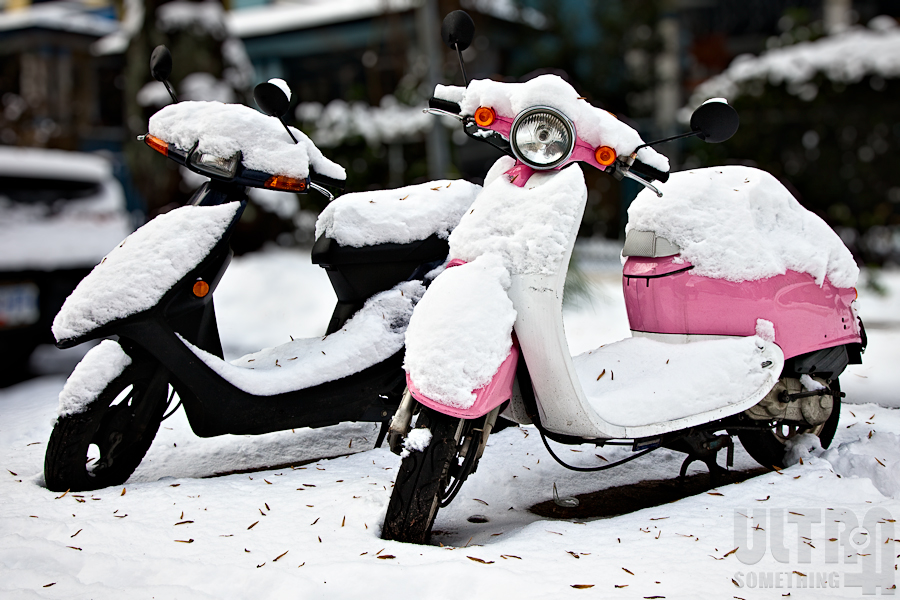
    The “his and hers” scooters, above, caught my eye because the snowmobile was invented in Canada. Of course, despite all appearances to the contrary, neither of these are representative examples.

    The snowlady, below, fascinated me not just because she was so well realized, but because she’s so indicative of the city in which I live. She’s standing in a downtown public park. I walked by her in the morning then, again, in the afternoon — yet no one had stolen her purse, her earrings, her beads, her fur color — nothing!

    snowlady


    ©2008 grEGORy simpson

    If you find these photos enjoyable or the articles beneficial, please consider making a DONATION to this site’s continuing evolution. As you’ve likely realized, ULTRAsomething is not an aggregator site — serious time and effort go into developing the original content contained within these virtual walls.
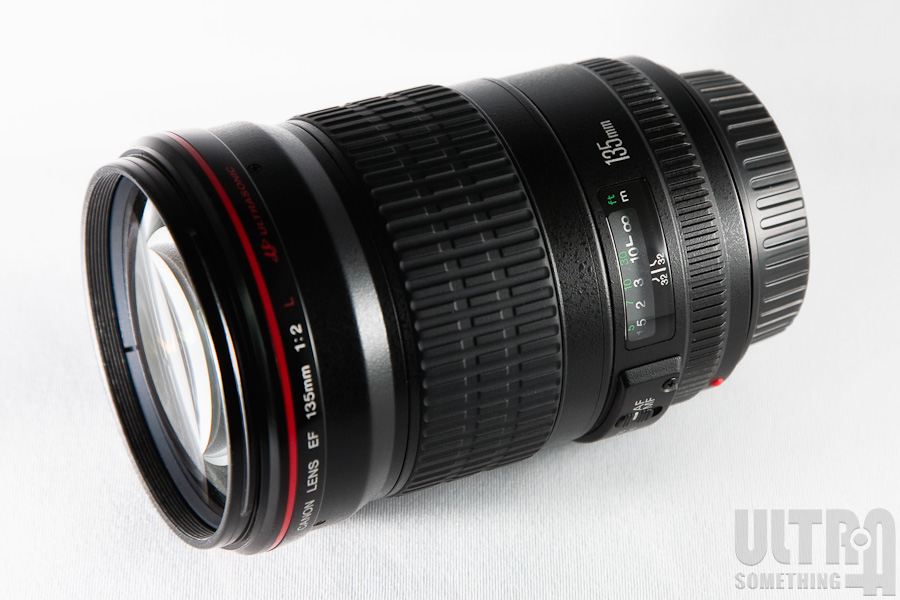
  • Canon EF 135mm f/2L USM

    Canon EF 135mm f/2L USM

    Rating: 10 out of 10

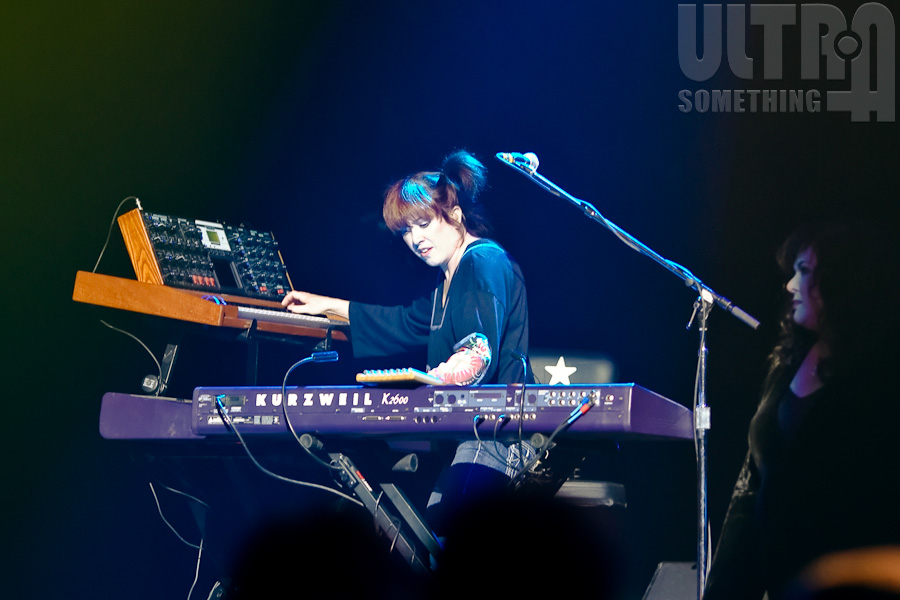
    Physics? Try magic. This lens is, quite simply, the best glass I’ve ever had the pleasure to use. Adjectives like “stellar,” “remarkable,” and “extraordinary” don’t do it justice. It’s that good. It’s just a shame this quintessential Canon glass occupies such an awkward focal length because it possesses the preternatural ability to absorb light where there is none. Wide open, it’ll render a sharp, almost 3–dimensional look to any subject in its field of vision.

    Its uncanny capacity to paint contrasty, saturated images in the dark makes it an ideal concert lens and, if you’ve got enough room to take a few steps backward, it’ll deliver portraits gorgeous enough to hang in the National Gallery. This lens might just be supernatural.

    Sample Images:


    ©2008 grEGORy simpson

    If you find these photos enjoyable or the articles beneficial, please consider making a DONATION to this site’s continuing evolution. As you’ve likely realized, ULTRAsomething is not an aggregator site — serious time and effort go into developing the original content contained within these virtual walls.

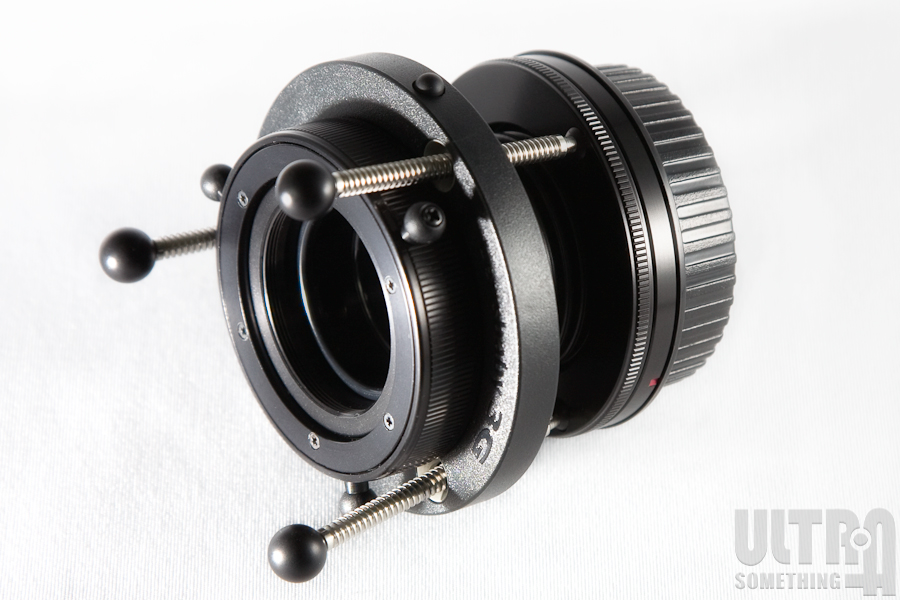
  • Lensbaby 3G

    Lensbaby 3G

    Rating: 7 out of 10

    Optically, this 50mm is even more “suspect” than the Canon EF 50mm f/1.8 II — but it’s so much more fun. Mounted on a miniature bellows, the 3G is focused by manually pushing or pulling the lens toward or away from the camera body. If you do this asymmetrically, you’ll create some bizarre selective focus effects. Want to change the aperture? Just insert some magnetic washers!

    Although a bit awkward for handheld use, the 3G’s ergonomics improve drastically when the camera is mounted on a tripod. The optional “close up” adapters let you apply its glorious fuzziness to the macro domain. Totally useless for photojournalist work and, like the fisheye, a bit wearisome if used too often, the Lensbaby 3G succeeds by putting a little fun back into photography.

    Sample Images:


    ©2008 grEGORy simpson

    If you find these photos enjoyable or the articles beneficial, please consider making a DONATION to this site’s continuing evolution. As you’ve likely realized, ULTRAsomething is not an aggregator site — serious time and effort go into developing the original content contained within these virtual walls.

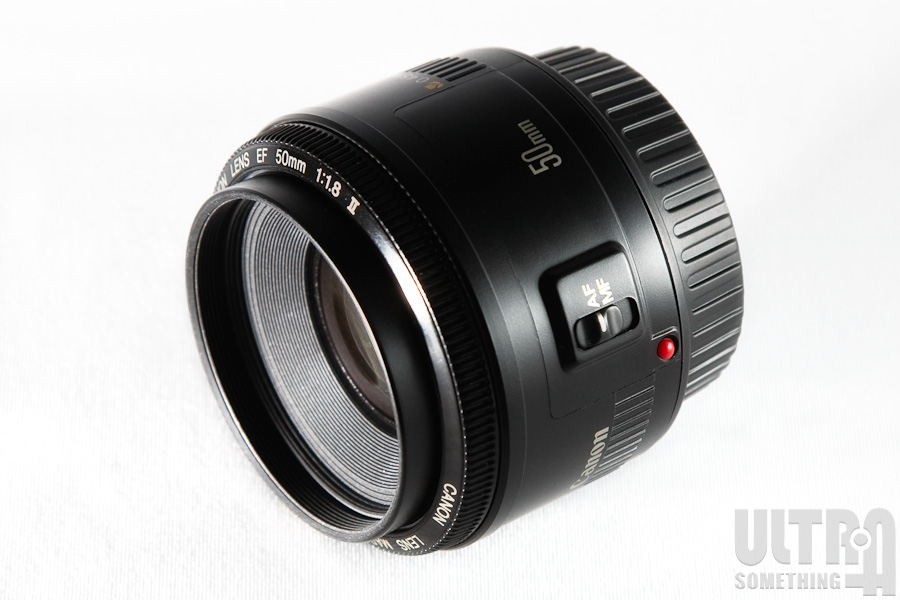
  • Canon EF 50mm f/1.8 II

    Canon EF 50mm f/1.8 II

    Rating: 7 out of 10

    Cheaper than a tank of gas, this little plastic prime seems to be in every Canon shooter’s kit. Although better than it should be, the lens is easily out-resolved by today’s crop of dSLR camera bodies.

    Unless I simply can’t bear to carry a couple more ounces in my bag, I will always opt for either the 35mm f/1.4L or the 85mm f/1.8 — either of which will deliver far superior results. That’s not to say the lens doesn’t have its uses. Lately, I’ve been reverse–mounting it, thereby pressing it into service as a poor-man’s macro.

    Sample Images:


    ©2008 grEGORy simpson

    If you find these photos enjoyable or the articles beneficial, please consider making a DONATION to this site’s continuing evolution. As you’ve likely realized, ULTRAsomething is not an aggregator site — serious time and effort go into developing the original content contained within these virtual walls.

  • Canon EF 35mm f/1.4L USM

    Canon EF 35mm f/1.4L USM

    Rating: 9 out of 10

    Never has a lens taken so long to grow on me. Purchased as a fast, wide-angle to compliment my 135 f/2L, three things immediately impacted my enjoyment:

    First, the focus varied erratically between soft and very soft. Second, unlike the 135, this lens does not excel at its maximum aperture. And third, I discovered that I didn’t really “see” in 35mm — my eye tended to gravitate toward 24mm and 50mm focal lengths.

    Fortunately, all three of these impediments to lens nirvana were easily removed. The softness problem was alleviated with a trip to Canon’s service center, where they repaired and calibrated the lens. To alleviate the “softness” at f/1.4, I simply pretend this is an f/2 lens, only resorting to a wider aperture when the softness is preferable to higher ISO noise. And finally, to eliminate the third problem, I practiced the art of patience and perseverance and, at long last, I’ve grown to love the focal length.

    The 35L is now one of my three most-used lenses, delivering great environmental portraits, group shots, landscapes and low-light interiors.

    Sample Images:


    ©2008 grEGORy simpson

    If you find these photos enjoyable or the articles beneficial, please consider making a DONATION to this site’s continuing evolution. As you’ve likely realized, ULTRAsomething is not an aggregator site — serious time and effort go into developing the original content contained within these virtual walls.
  • Canon TS-E 24mm f/3.5L

    Canon TS-E 24mm f/3.5L

    Canon TS-E 24mm f/3.5L

    Rating: 9 out of 10

    Believe it or not, this is not the oddest looking lens in my collection (a distinction currently held by the Lensbaby 3G). Like a fisheye or macro, this highly underrated gem is a specialty lens. However, unlike those lenses, owner satisfaction requires patience, knowledge and skill.

    The tilt and shift functions make this lens ideally suited to landscape and architectural photography, where the shifting mechanism keeps parallel lines from converging and the tilting mechanism provides extensive control over depth-of-field.

    Best used at f/8 on a tripod (though I’m fond of handholding it), this manually-focused mechanical wonder delivers vibrant, geometrically accurate photos that far exceed the quality obtained by software-based perspective solutions.
    Sample Images:


    ©2008 grEGORy simpson

    If you find these photos enjoyable or the articles beneficial, please consider making a DONATION to this site’s continuing evolution. As you’ve likely realized, ULTRAsomething is not an aggregator site — serious time and effort go into developing the original content contained within these virtual walls.

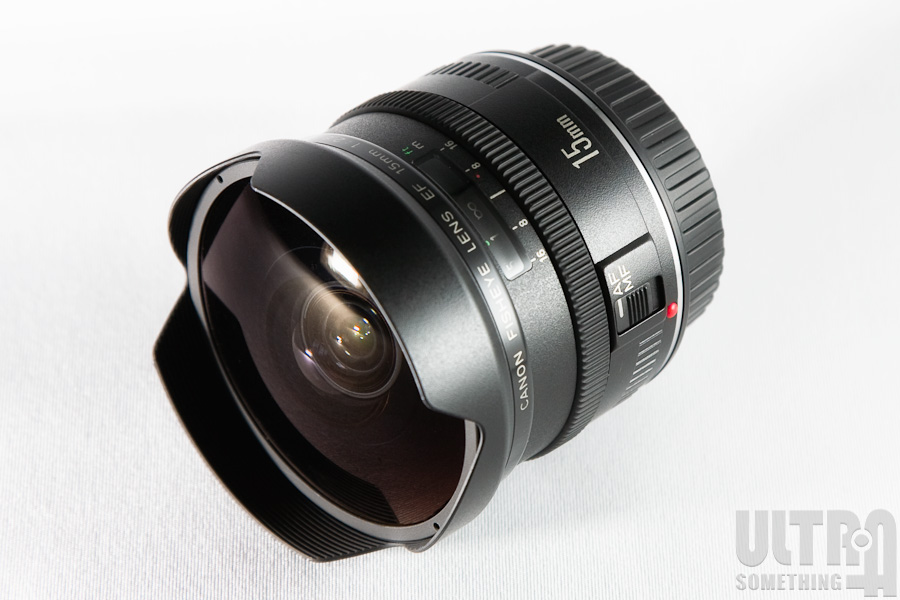
  • Canon EF 15mm f/2.8 Fisheye

    Canon EF 15mm f/2.8 Fisheye

    Rating: 9 out of 10

    Although I could be happy mounting this lens on my camera and using it exclusively for an entire week, such merriment would be “self indulgent.” For the majority of people, the fisheye effect (like its namesake), begins to smell funny rather quickly. Consequently, I use it somewhat sparingly — though I still press it into “non standard” service (such as portraits) whenever possible. Also, with a little post-processing, it’ll de-fish nicely into an ultra-wide angle alternative. This is one sharp tube of glass.

    Its only fault (and it’s minor) is the “friction fit” lens cap that, more often than not, detaches itself from the hood, leaving the bulbous front element exposed. Though it’s still perfectly unmarred, I live with a certain modicum of fear whenever I take this lens into the field.
    Sample Images:


    ©2008 grEGORy simpson

    If you find these photos enjoyable or the articles beneficial, please consider making a DONATION to this site’s continuing evolution. As you’ve likely realized, ULTRAsomething is not an aggregator site — serious time and effort go into developing the original content contained within these virtual walls.