
Several years ago, while forced into chit-chat duty at some evening event, I wandered into conversation with a young graduate student. It’s my tendency, during such obligations, to keep only one brain cell engaged and idling in neutral — so I don’t recall exactly how or why the topic turned to high school. But I do recall her grousing about the difficulty of writing so many research papers.

“They didn’t teach you everything you needed to know, so you had to spend extra time googling the topic!” she exclaimed exasperatedly.
This struck me as a curiously nonsensical complaint that warranted further exploration, so I stepped on the gas and shifted my single solitary brain cell into first gear.
“I dunno,” I answered, “isn’t doing research one of the main components of learning? Plus, having it all online is far better than driving to the library and searching through stacks of encyclopedias, like when I was in high school.”
She cocked her head, furrowed her brow, and gazed off into the distance — as if trying to make sense of what I had just said.
“Oh,” she replied, relaxing her expression with a sudden glint of recognition, “I’ve heard of those. They were called CD-ROMS, right?”

“No, this was before CD-ROMS,” I said.
Her countenance transformed once again — the blankness of her gaze informing my need to elaborate.
“CD-ROMS,” I added, “only existed for a few short years in the 1990’s. They weren’t around when I was in high school.”
“I don’t understand.”
“They were actual books,” I said. “Every year, encyclopedia companies would publish a three foot high stack of books, which contained information about thousands of subjects, all arranged alphabetically.”
Her jaw dropped and her eyes bugged out like an old Looney Tunes cartoon. “Noooooo waaaay,” she exclaimed. “You had to use books?!”

I flashed back to my own similar moment of disbelief — around age 7 — when my grandparents casually mentioned listening to plays on the radio. “Noooooo waaaay,” I exclaimed. “You didn’t have television?” Recalling how this revelation filled me with questions about humanity’s existence within such a void, I offered the woman a few elucidating tidbits.
“Yup,” I answered. “And since encyclopedias were really expensive, libraries rarely replaced them — which meant you were often looking up information that might be 10 years old.”
Watching her recoil in horror, I quickly doubled down. “So before there was a web to surf, I’d sometimes surf the encyclopedias for fun. I’d just grab a book off the shelf — Maybe the “G” book today, or maybe the “T” book, and randomly read all about whatever subjects began with that book’s letter.”

“Wow,” she said, shaking her head. “That’s terrible. I can’t even imagine what that must have been like.”
At that point, another gentlemen sauntered into the conversation, telling the woman, “That’s right, my parents told me about those days.” And as they began to discuss how lame people were in the past, I shifted my single brain cell back into neutral — slinking off to the corner in an effort to avoid any additional chit-chat.
I have since identified this evening as the very moment when I first stepped into the tar pit. Other instances have followed, such as the time an incredulous techno musician, upon finding out I designed, developed, tested and documented electronic music synthesizers for a living, exclaimed, “How can you know anything about synthesizers? You’re old!”

But there is probably nothing that makes me feel more like a dinosaur than watching the changing nature of music and photography. Unlike many of my Mesozoic brethren, I do not believe either medium is ‘dead.’ On the contrary, they’ve never been more alive. The difference is in what people choose to communicate, and the channels with which they communicate it.
Any kid with an iPhone and a few free sound loops can assemble a collage of beats and publish a new dance tune — and they do. Tap another app on that same iPhone, and an entire team of Silicon Valley A.I. engineers spring into action — applying every algorithm necessary to compute an image that will match all the most popular attributes of similar images. Photography, like music, has become democratized and disposable. Neither are particularly vital anymore, but both are ubiquitous. They are a part of the fabric and currency of everyday life. That’s not death; that’s full adoption.

The problem is that democratization leaves little room for creativity. When everyone’s music employs the same rhythms and sounds, and when everyone photographs the same subjects while hoping for the same results, the opportunities for anyone wishing to express themselves outside accepted parameters become more limited. Of the dozens of musical genres I enjoy, exactly zero have a dedicated channel on Apple Music. The photography I like is never seen on Instagram, but rather in those same dusty, antiquated, paper tomes that once held every high school student’s collected knowledge.
And so, little by little, month by month, I sink deeper into the tar pit — still consumed by a desire to pen an opera for those who only want to dance, and driven by the need to mount an exhibition of murky, black & white, metaphorical photos to an audience only accepting of the sharp, colourful, and literate.

One part of me is comforted by a dream that some future generation might one day unearth my bones and — appreciating them for their love of hard bop trumpet licks and crunchy silver halide crystals — choose to display them in a museum. Another part of me recognizes that museums will likely no longer exist — having themselves become dinosaurs.
But tar is like quicksand — the more you struggle, the deeper you sink. And so I’ve learned to simply accept the inevitable — that there is no future in becoming a dinosaur, and yet we are all destined to become one. In my case, I’ll just get there a few years earlier than the grad student.
©2020 grEGORy simpson
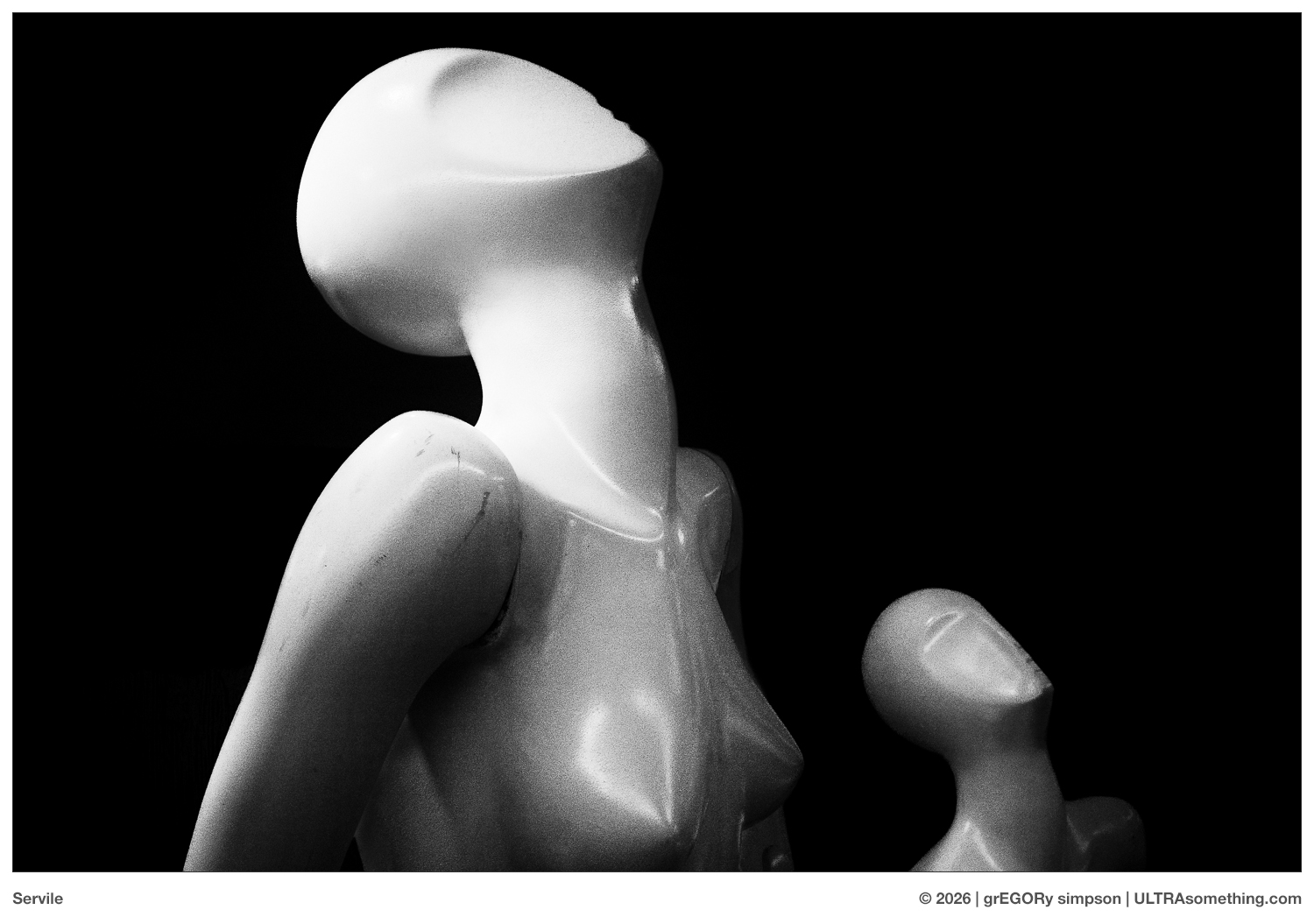
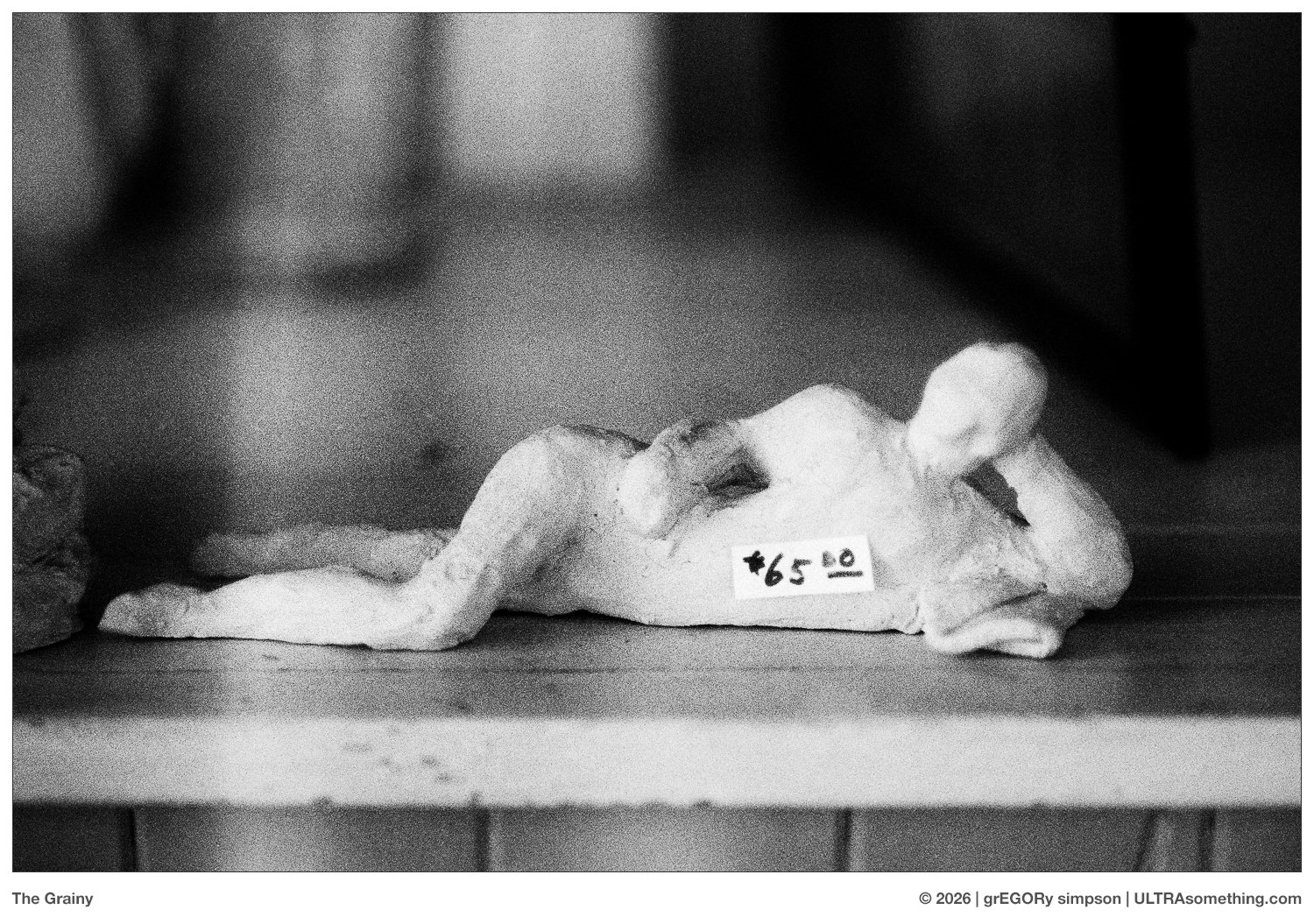
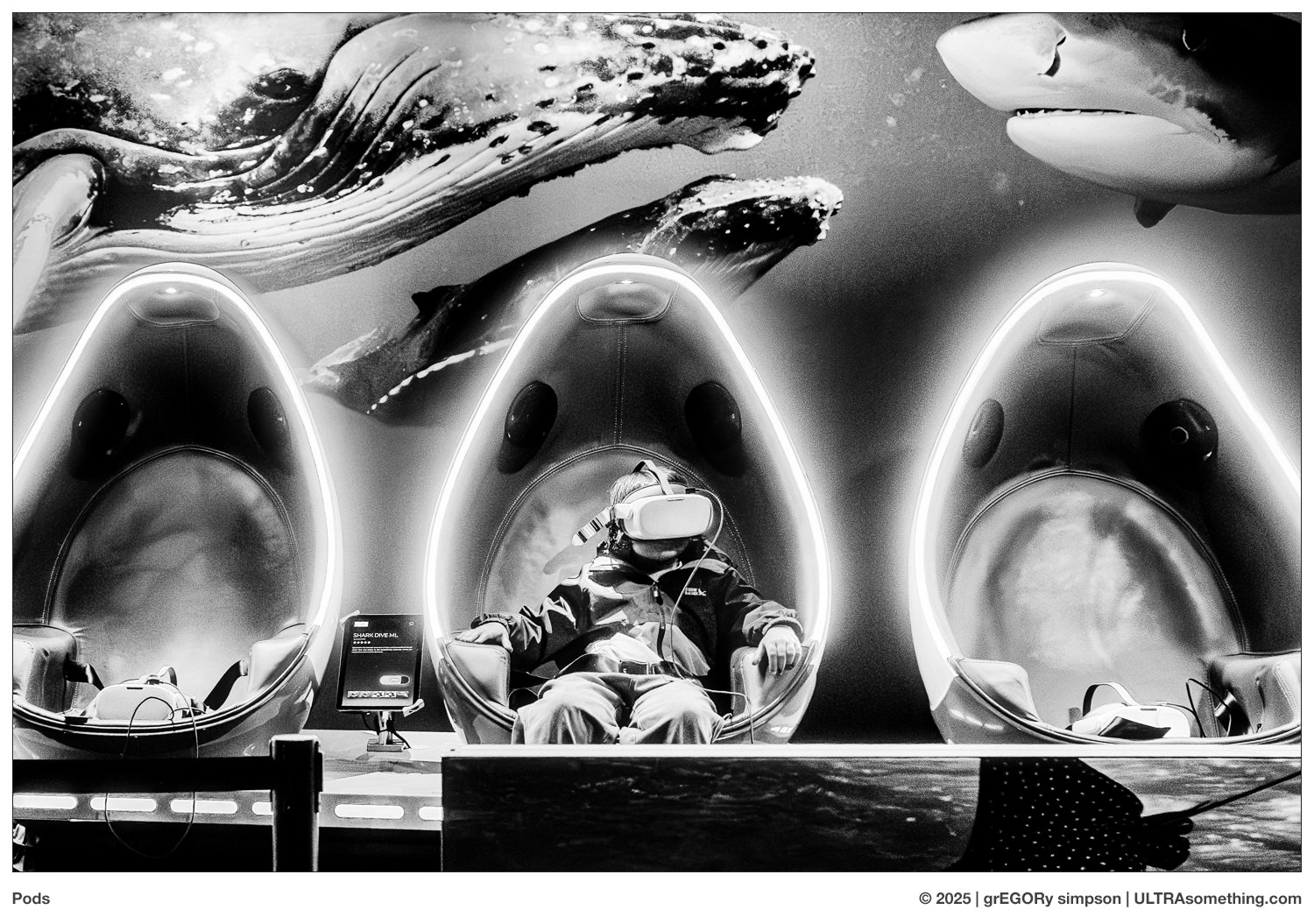
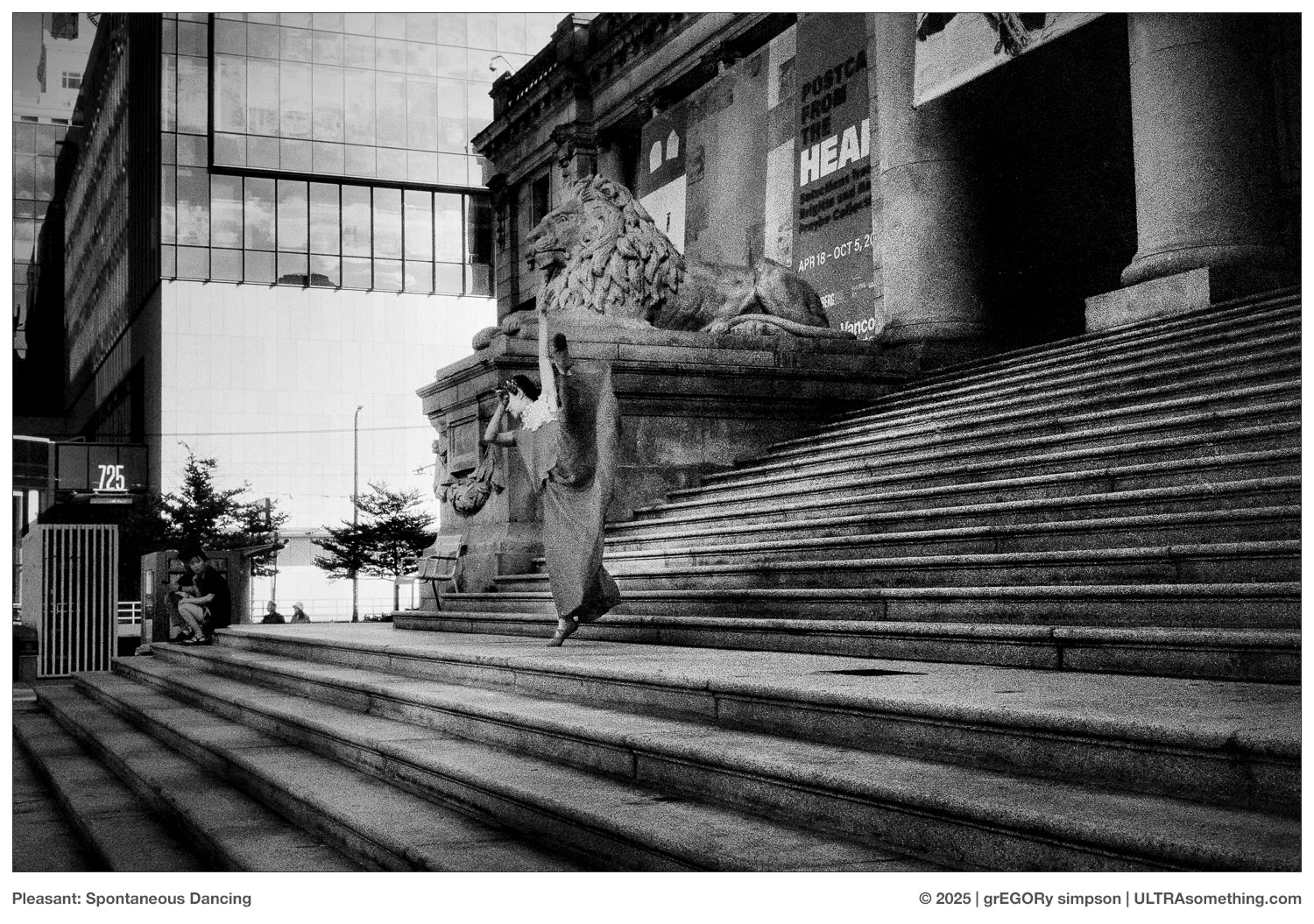
ABOUT THE PHOTOS: Speaking of dinosaurs (and murky black & white), this month’s compliment of photos springs forth from my latest roll of Tri-X — exposed at ISO 200, and spooled through a Ricoh Auto-Half, which is a half-frame film camera from the 1960’s that I enjoy using perhaps a little too much.
REMINDER: If you’ve managed to extract a modicum of enjoyment from the plethora of material contained on this site, please consider making a DONATION to its continuing evolution. As you’ve likely realized, ULTRAsomething is not an aggregator site. Serious time and effort go into developing the original content contained within these virtual walls — even the silly stuff.